日本機械学会 2013 年度年次大会 [2013.9.8-11]
CopyrightⒸ2013 一般社団法人 日本機械学会
[No.13-1] 日本機械学会 2013 年度年次大会講演論文集 〔2013.9.8-11,岡山〕
G011051
仮想領域法および有限要素法による
フライス加工時における工作物表面温度分布シミュレーション
倉橋 貴彦
*1,井伊 優生
*2,杉山 元次郎
*3,井山 徹郎
*4Numerical Simulation of Surface Temperature Distribution in Milling Machine Processing
Based on Fictitious Domain and Finite Element Methods
Takahiko KURAHASHI
*1, Masaki II
*2, Motojirou SUGIYAMA
*3and Tetsuro IYAMA
*4*1 Takahiko Kurahashi, Nagaoka National Courage of Technology, 888 Nishikatakai, Nagaoka, Niigata 940-8532, Japan
*2 Masaki Ii, Nagaoka National Courage of Technology, 888 Nishikatakai, Nagaoka, Niigata 940-8532, Japan
*3 Genjiro SUGIYAMA, Nagaoka National Courage of Technology, 888 Nishikatakai, Nagaoka, Niigata 940-8532, Japan
*4 Tetsuro IYAMA, Nagaoka National Courage of Technology, 888 Nishikatakai, Nagaoka, Niigata 940-8532, Japan
In this study, analysis of surface temperature distribution in milling is carried out based on fictitious domain and finite element methods. Applicability of this method to problem of rotation and movement of milling is investigated.
Consequently, result that computational result is good agreement with observation data could be obtained.
Key Words : Fictitious Domain Method, Finite Element Method, Milling Machine Processing
1. は じ め に
領域を分けて解析を行う方法として,仮想領域法がある(1),(2).この方法は解析を行う全体領域以外に副領域を 設けて,副領域を全体領域に重ねて解析を行う手法である(図1, 2).主に流体中のおける粒子の移動を対象とした 研究が行われており,実験結果等とも良く一致するとの報告もある.そこで本研究では,工具先端からの発熱に より切削対象の材料の温度分布を適切に予測するためのツールとして,仮想領域法を用いた有限要素法による非 定常熱伝導解析プログラムの構築を行う.また,解析結果とエンドミル加工時における切削対象材料の表面温度 の測定結果の比較を行い解析結果の妥当性について検証を行う.
Fig. 1 Image diagram of overlapped mesh Fig. 2 Image diagram of overlapped mesh (Magnified figure)
*1 正員,長岡工業高等専門学校 機械工学科(〒940-8532 新潟県長岡市西片貝町888番地)
E-mail: [email protected]
日本機械学会 2013 年度年次大会 [2013.9.8-11]
CopyrightⒸ2013 一般社団法人 日本機械学会
[No.13-1] 日本機械学会 2013 年度年次大会講演論文集 〔2013.9.8-11,岡山〕
2. Fictitious Domain 法による定式化
Fictitious Domain法における計算領域および境界の定義を図3に示す.Ωは全体領域,ωは副領域,Γdは第1
種境界,Γnは第2種境界を示す.本研究では,2次元平面領域を対象とする.
Fig. 3 Definition of computational domain and boundaries 総和規約により表示した熱伝導方程式を式(1)に示す.
, 0
ii
(1)
φは温度,κは熱拡散率を示す.式(1)に示す熱伝導方程式に対して完全陰解法を適用すると,式(2)の様になる.
n n ii
n t
1 ,1 (2)
ここに,初期条件および境界条件を式(3)の様に定義する.
2, 1
0
ˆ , ˆ ,
on
c n h b on
in g in
t
i
i
(3)
niは外向きの単位法線ベクトル,hは熱伝達率,ρは密度,cは比熱,φ∞は雰囲気温度を示す.副領域ωにおける 温度φに対する制約条件を考慮して,式(2)を解くためにラグランジュの未定乗数法を適用する.また,有限要素 法を適用し,式(4),(5)に示す重み付き残差方程式を誘導する.ここに,λはラグランジュの未定乗数を示し,wφ, wλは温度φとラグランジュの未定乗数λに対する重み関数を示す.
d t w d w d w d
w
e e
e e
n n
n ii
n
, 1 1
1 (4)
1
0
w gde
n (5)
式(4)にグリーンの定理を適用し,熱流束の項をnステップ目の値とすると,式(6)の様になる.
d t w d w d w d t w nd
w
e e
e e
e
i n i i n
n n
i i n
, , 1
1 , ,
1
(6)
温度φと重み関数wφの補間に対して三角形一次の形状関数を適用し,ラグランジュの未定乗数λと重み関数wλ の補間に対してはディラックのδ関数を適用する.結果として,式(7),(8)に示す有限要素方程式が得られる.
M
n1t
Hxx
Hyy n1
BT
n1
M
n tTn in (7)
B
n1
G in (8)3. 数値解析例
加工対象の材料をアルミニウムとし,アルミニウムの板材とエンドミル(図 4)を上平面から見た場合の有限 要素メッシュを図5のように用意する.矩形領域を領域Ωとし,図5の左側に示す領域はエンドミルの断面形状 を表したメッシュであり,副領域ωとする.計算条件を表1に示す.解析においては,エンドミルの領域(Foreground mesh)は背景領域内(Background mesh)に含めた位置から解析をスタートさせることとし,背景領域内の左端にエン ドミルを位置した時間を解析のスタート時刻とする.
Table 1 Computational conditions
Total number of nodes in Ω 10,201 Time steps 40,000
Total number of elements in Ω 20,000 Initial temperature in Ω, deg. 21.975
Total number of nodes in ω 933 Thermal diffusivity κ, mm2/sec. 83.6
Total number of elements in ω 1,768 Rotation speed of endmill, rpm 1,750
Time increment, sec. 0.001 Movement speed of plate, mm/s 2.0
本検討では,矩形領域の周辺境界は熱伝達境界とし,雰囲気温度φ∞は21.975℃,熱伝達率hは4W/m℃,アル ミニウムの密度ρと比熱cは2,700kg/m3, 899J/(kg・℃)とする.また,図6に示すように,切削している点のみに 温度を与える条件とするため,図6中に示す角度θが-90°≦θ<90°の範囲の際に温度gを切削先端の点において与 え,それ以外の場合はgの条件を与えないものとする.
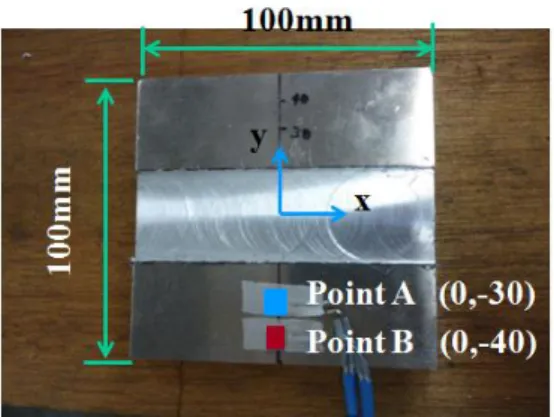
上記の解析条件のもと,図7に示すPoint A, Bにおける計測温度と解析結果の比較を図8,9に示す.この解析結
果はgを38.2℃と与えた場合の結果である.図8,9において,点は計測温度,実線は解析結果を示している.結
果より,計測温度と解析結果はおおむね一致していることが確認できる.また,全体領域内における温度を図10,11 に示す.図10は解析開始10秒後,図11は解析開始20秒後の結果を示す.結果よりエンドミルの温度が背景領 域に伝わり,良好に温度分布が得られていることを確認できる.
連絡者1名のみ記入
(a) Horizontal cross section (b) Vertical cross section Fig. 4 Shape of endmill
Heat transfer boundary
Rotational direction
Heat source points
Endmill movement direction
Fig. 5 Finite element mesh
θ=90° 45° 0° -45° -90°
θ
:Temperature “g” is not given.
:Temperature “g” is given.
Temperature “g” is given during cut of material,
i.e., temperature “g” is given in -90°< θ ≦90°.
Fig. 6 Image diagram of how to give temperature g in ω Fig. 7 Observation points
Fig. 8 Time history of temperature at Point A Fig. 9 Time history of temperature at Point B
Fig. 10 Temperature distribution at T=10sec. Fig. 11 Temperature distribution at T=20sec.
4. お わ り に
本研究では,エンドミル加工時における材料表面温度を予測するため,仮想領域法および有限要素法に基づく 非定常熱伝導解析を行った.全体領域Ωの離散化には三角形一次要素によるガラーキン法,副領域ωの離散化に はディラックのデルタ関数に基づく方法を適用した.また,エンドミル加工時における材料表面温度の計測を行 い,シミュレーション結果との比較を行った.結果として,計測温度と解析結果は概ね一致し,適切なシミュレ ーションが行えていると考えられる.今後は,エンドミルの温度予測等に本手法を適用していきたいと考えてい る.
謝 辞
本研究を行うにあたりユニオンツール株式会社「科学技術研究費助成金制度」の援助を受けた.ここに謝意を 表す.
文 献
(1) R. Glowinski, T.W. Pan, T.I. Hesla, D.D. Joseph, and J. Periaux, A Fictitious Domain Method with Distributed Lagrange Multipliers for the Numerical Simulation of Particulate Flow, Contemporary Mathematics, Vol.218, (1998), pp.121-137.
(2) R. Glowinski and Q. He, A Least-Squares/Fictitious Domain Method for Linear Elliptic Problems with Robin Boundary Conditions, Commun. Comput. Phys., Vol.9, No.3, (2011), 587-606.