Acta med. nagasaki. 5 : 136-141
Reactive Hyperemia in Coronary Blood Flow 1
Fumio TAKENAKA, Shigeaki SADAMATSU, Hiroshi IRIE
Tamotsu ODA, & Makoto MAEKAWA*2
Department of Pharmacology, Nagasaki University School of Medicine,
Nagasaki, Japan
Received for publication December 19, 1960
The reactive hyperemia induced by a temporary occlusion of coronary circulation was investigated in an isolated cat's heart perfused with blood supplied by a donor. The magnitude of hyperemia was quantitatively proportional to the ischemic periods ranging from 6 to 90 seconds. The pretreatment with atropine as well as dinitrophenol did not affect the reactive hyperemia. Diphenhydramine HCl in a dose reducing the effect of 1.0,µg of histamine decreased the magnitude of hyperemia. After pretreatment with cocaine and procaine the reactive hyperemia was inhibited . Serum potassium level of the coronary outflow collected after the occlusion was significantly increased. These findings suggest that the metabolites involved in the reactive hyperemia may not be acetylcholine, but histamine and potassium which probably produce the dilatation of coronary vessels through an axon reflex.
It has been demonstrated by KATZ and LINDNER 8), HASHIMOTO 6) and KOBAYASHI 9) that myocardial ischemia due to a temporary occlusion of the blood supply resulted in a dilatation of coronary blood vessels.
This reactive hyperemia seems to be of significance in the local control of coronary blood flow. Vasodilator substances involved in the reactive hyperemia may be metabolites accumulated during the ischemia3).
Although a release of histamine4 , adenosine4) , or acetylcholine" has been postulated, direct determination of these substances has not yet been reported.
In our previous experiments") it was noticed that the rate of coronary blood flow showed an unusually high level immediately after the isolated heart was perfused.
This primary increase in coronary blood flow seems to be induced by accumulated substances during isolation and connecting the heart with the perfusing apparatus.
The present study is concerned with quantitative observation of the reative hyperemia, the effect of some drugs upon it, and the significance of chemical factors involved.
*" A part of this work was presented at the 23rd annual meeting of the Japanese Circulation Society in April. 1959.
*2岳 中 典 男 ・貞 松 繁 明 ・入 江 浩 ・小 田 保 ・前 川 誠
METHODS
The isolated heart of the cat was perfused with whole blood supplied by a normal donor animal anesthetized with sodium pentobarbital and heparinized. Coronary blood inflow was measured by means of a rolling circular manometer system. The details of the procedure was the same as described previously"). Blood flow was interrupted temporarily by clamping the rubber tube connecting the aorta of the isolated heart and the carotid artery of the donor. Any increase of blood flow encountered upon release of the clamping was interpreted as reactive hyperemia.
The following drugs were injected into the rubber tube close to the aortic cannula of the isolated heart : diphenhydramine HCl, atropine sulfate, cocaine HC1, procaine HC1 and 2,4-dinitrophenol.
Potassium in blood serum was precipitated as K2 NaCo (NO2 )° and Co was determined colorimetrically according to the method reported by BULTASOVA and KONOPASEK2) . This method is based on the formation of a purple complex of Co with ethylenediaminetetraacetic acid as described by PRIBIL and MALIK'')
RESULTS
Correlation of reactive hyperemia to the duration of occlusion
A 6-seconds to 2-minutes period of interruption of coronary blood flow was followed by an augmentation of the flow upon release of the clam- ping. The increase of coronary blood flow is shown by a hatched area in Fig. 1. The degree of hyperemia was almost proportional to the duration of the occlusion. The rate and amplitude of heart contractions were not appreciably altered during the ischemic period tested.
Fcc. 1. Increases in coronary blood flow due to occlusion. Hatched area, reactive hyperemia. A, clamp; B, relase. Heart contraction were recorded by tambour
(Hl) and lever system (H2) BP, perfusion pressure; CBF, coronary blood
flow; T, time (6sec).
Effect of atropine
Fig. 2 shows an influence of atropine on the reactive hyperemia induced by a 1-minute period of occlusion. The dose of atropine emp- loyed was enough to block the effect of 0.01 mg of acetylcholine on coronary blood flow as well as heart contractions. The magnitude of the reactive hyperemia after pretreatment with 1.5 mg of atropine was essentially the same as the control value.
FIG. 2. Effect of atropine on reactive hyperemia. Records as in Fig. 1.
Diphenhydramine HC1
Preliminary experiments were carried out to investigate the antago- nistic action of diphenhydramine against the effect of histamine on coro- nary blood flow. It was found that 6.5 mg of diphenhydramine diminished the vasodilator action of 0. 1 to 1.0tig of histamine, but did not reduce the effect of 10 fig of the drug.
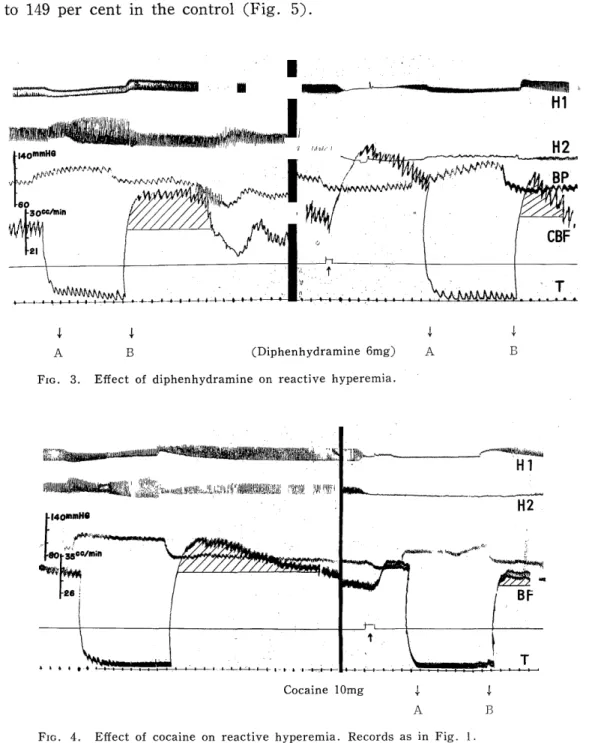
Since diphenhydramine produced a marked increase in coronary blood flow, the reactive hyperemia was examined after the flow had returned to the control level. The reactive hyperemia observed after pretreatment with 6.5 mg of diphenhydramine was 21 per cent, which was signifi- cantly lower than 32 per cent in the control. A typical experiment is presented in Fig. 3.
Cocaine HC1 and Procaine HC1
Cocaine produced an increase in coronary blood flow and inhibition of heart. contractions with the dose of 10 mg injected intra-coronarily.
The occlusion of coronary flow was started while the flow was showing a still higher level than the control. The reactive hyperemia after the administration of 10 mg of cocaine was found to be 48 per cent. This
value is significantly smaller than 65 per cent in the control. (Fig. 4).
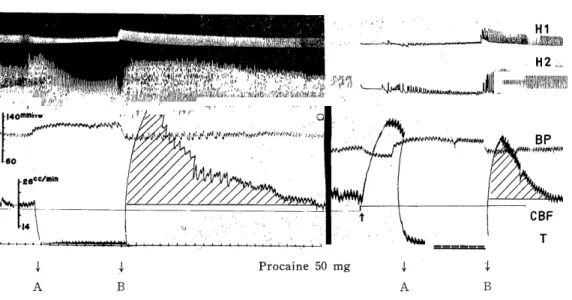
The influence of 10 mg of procaine on the reactive hyperemia was similar to that of cocaine. The reactive hyperemia after pretreatment with procaine was 77 per cent, the reduction being significant compared
to 149 per cent in the control (Fig. 5).
(Diphenhydramine 6mg)
FIG. 3. Effect of diphenhydramine on reactive hyperemia.
Cocaine 10mg
FIG. 4. Effect of cocaine on reactive hyperemia. Records as in Fig. 1.
2,4-Dinityophenol
Five mg of dinitrophenol injected intracoronarily markedly increased the coronary blood flow accompanied by inhibition of heart contractions.
The reactive hyperemia observed after pretreatment with 5 mg of dinitrophenol was 32 per cent. This value is essentially equal to 33 per
cent in the control.
Procaine 50 mg
FIG. 5. Effect of procaine on reactive hyperemia. Records as in Fig. 1.
Potassium concentration in coronary outflow
Serum potassium concentration was determined in the blood collected immediately after the clamp was released. The average value of serum potassium in the perfusing blood was 14.2 mg per cent in four experi- ments. After a one-minute occulsion, this was increased to 15.5 mg per cent. The difference was found to be significant at P<0.05.
DISCUSSION
KATZ and LINDNER") have demonstrated a good quantitative correlation of the reactive hyperemia to the duration of ischemic periods. They used an lsoiated heart with fibrillating ventricle perfused with defibrinated blood. The results obtained in the present experiments using the isolated cat heart perfused with normal donor blood, are in agreement with the findings described by KATZ and LINDNER. g,
Since the pretreatment with atropine did not affect the reactive hyperemia, it is unlikely that acetylcholine was' responsible for produc- ing this reaction. HILTOI\" has observed that atropine neither aboli- shed nor reduced the post-contraction hyperemia in the skeletal muscle.
Neverthless, he believed that the result does not preclude the partici- pation of cholinergic fibers.
In our experiments, the reactive hyperemia was partially reduced by diphenhydramine with doses capable of inhibiting the vasodilator effect of 0.1 to 1.0t'g of histamine. This fact seems to suggest the possible involvement of histamine in the reactive hyperemia in coronary blood flow. FOLKOW, HAEGER and KAHLSON4> have observed the reactive hyperemia in the hind limbs in cats. They concluded that the magnitude
of reactive hyperemia was not reduced by antihistaminic drugs which completely annul the vasodilator effect of the minimal doses of histamine.
The difference in the effects of antihistaminic drugs on the reactive hyperemia may be due to the different experimental conditions and materials.
It has been demonstrated that adenosine triphosphate (ATP) produced a profound vasodilatation in the hind limbs4Ias well as in the coronary vascular beds. l3) ATP may be suspected as a vasodilator substance responsible for the reactive hyperemia, since ATP is a natural metabolite in the tissue.
The reactive hyperemia, however, was normally demonstrated after the pretreatment with dinitrophenol which is known to inhibit the formation of energy-rich phosphate compounds.' As the present experiments are not complete enough to rule out the role of ATP, further studies will be necessary to clarify the significance of this metabolite.
It is evident that a deficiency of muscle oxygen supply results in hyperemia in skeletal muscle as well as myocardium. As suggested by KATZ et al. 14) , it remains unknown whether oxygen tension per se direc- tly modifies the tone of vascular smooth muscle through direct action or stimulation of local end-organ. It is also possible that oxygen deficiency may release substances capable of producing vasodilatation. The release of potassium ions which possesses a coronary vasodilator property may play a role in producing the reactive hyperemia.
With respect to the mode of action of vasodilator substances, our results seem to support the view that they act through an axon reflex-' because of the fact that cocaine and procaine reduce the reactive hyperemia.
REFERENCES
1) BRODY, T.M.: Pharmacol, Rev. 7: 335 (1955).
2) BULTASOVA, H. AND KONOPASEK, E.: Chem.. Abst. 49: 12575 (1955).
3) FOLKOW, B.: Physiol., Rev. 35: 629 (1955).
4) FOLKGW, B. HAEGER. H. AND KAHLSON, G.: Acta physiol. Scand. 15: 264 (1948) 5) GREEN, H.D. AND KEPCHAR, J.H.: Physiol. Rev. 39: 617 (1959).
6) HASHIMOTO, K.: Jap. Circulation J. 21: 290 (1957).
7) HILTON, S.M.: J. Physiol. 120: 230 (1953); 123 289 (1954).
8) KATZ, A.M., KATZ, L.N. AND WILLIAMS, F.L.: Am. J. Physiol. 180: 393 (1955).
9) KATZ. L.N. AND LINDNER, E.: Am. J. Physiol. 126: 283 (1936).
10) KOBAYASHI, T.: Transactions of the 15th General Assembly of the Japanese Medical Congress, p. 516 (1959).
11) NAKAZAWA, Y., TAKENAKA, F. AND UENO, A.: Tap. J. Rharmacol. 7: 75 (1958).
12) PRIBIL, R. AND MALIK. J.: Chem. Absi. 49: 7441 (1955).
13) SADAMATSU, S.: Nagasaki Med. J. 35: 1721 (1960) (Japanese).
14) WEGRIA, R.:. Pharmacol, Rev. 3: 197 (1951).