Fukushima Medical University
福島県立医科大学 学術機関リポジトリ
This document is downloaded at: 2021-11-08T00:26:05Z
Title Serotonin syndrome caused by minimum doses of SSRIS in a patient with spinal cord injury
Author(s) Satoh, Koichiro; Takano, Shizuko; Onogi, Takashi; Ohtsuki, Koji; Kobayashi, Toshio
Citation Fukushima Journal of Medical Science. 52(1): 29-33
Issue Date 2006-06
URL http://ir.fmu.ac.jp/dspace/handle/123456789/183
Rights © 2006 The Fukushima Society of Medical Science
DOI
Text Version publisher
Fukushima J. Med. Sci., Vol. 52, No.1, 2006
[Case Report]
SEROTONIN SYNDROME CAUSED BY MINIMUM DOSES OF SSRIS IN A PATIENT WITH SPINAL CORD INJURY
KOICHIRO SATOHI), SHIZUKO TAKAN0
2 ),TAKASHI ONOGP>, KOJI OHTSUKP) and TOSHIO KOBA YASHP)
1)
Institute of Physical Medicine and Rehabilitation, Fukushima Medical University School of Medicine, Fukushima, 960-0201, Japan
2)
Department of Phannacology, Fukushima Medical University School of Medicine, Fukushima, 960-1295, Japan
(Received March 7, 2006, accepted April 17, 2006)
Abstract: There have been only a few reports of serotonin syndrome developing after mono-therapy with a selective serotonin reuptake inhibitor (SSRI). We report a case of serotonin syndrome caused by long-term therapy with ftuvoxamine prior to treatment with paroxetine. An 18-year-old man with spinal cord injury (SCI) at thoracic level 2-3 presented with onset of serotonin syndrome after taking ftuvox- amine (50 mg per day) for 8 weeks prior to treatment with paroxetine (10 mg per day) for 6 days. He had confusion, agitation, severe headache, tachycardia (124 beats/minute), hypertension (165/118 mmHg), high fever (39TC), and myoclonus.
All of the symptoms disappeared within 24 hours after discontinuation of administra- tion of paroxetine. This is an interesting case of serotonin syndrome that developed after minimum doses of single therapy with an SSRI in a patient with SCI.
Key words: Fluvoxamine, Paroxetine, Serotonin syndrome, Spinal cord injury
INTRODUCTION
Many patients with spinal cord injury (SCI) experience depressive feelings because they cannot accept their illness and they feel hopeless for their future.
1)Selective serotonin reuptake inhibitors (SSRIs), new antidepressant agents, are recommended for treatment of depression because they have fewer side effects than those of tricyclic antidepressants (TCAs). However, different combinations of drugs that can affect the serotonergic system, such as TCAs, SSRIs and monoamine oxidase (MAO) inhibitors, induce severe toxicity referred to as "serotonin syn-
~i1iiJb-~~, ji1lj!fMt.:r-, Jj\!f*f3f:, *tJ.I!lllItl~, ,N'*flJ!13
Correspondence to: Koichiro Satoh, Institute of Physical Medicine and Rehabilitation, Fukushima City 960-0201, Japan.
E-mail: [email protected]
29
30 K. SATOH et at.
drome".2) In Japan, two SSRIs, fluvoxamine and paroxetine, have been commer- cially available since 2000. The usual doses of fluvoxamine and paroxetine used in Japan are 50-150 and 10-40 mg/day, respectively. To our knowledge, there are only two reports
3•4)of serotonin syndrome induced by mono-therapy with SSRIs_ Our patient had damage to the spinal cord at thoracic 2 and 3 (T2-3) levels caused by a motor vehicle accident and his depression was treated with fluvoxamine at the usual dose (50 mg per day) for 8 weeks. Six days after switching to paroxetine, he had an abrupt onset of serotonin syndrome. We discuss briefly why such low doses of SSRIs induced serotonin syndrome in our patient with SCI.
CASE REPORT
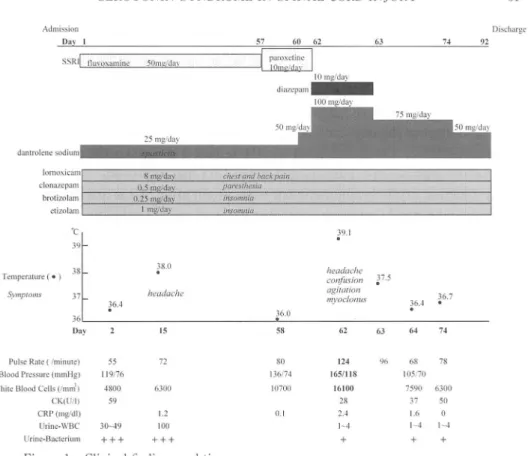
An 18-year-old Japanese man who had no previous medical history was involved in a motor vehicle accident. There were four young men in the car. He was not the driver. He was diagnosed as having a complete fracture dislocation at the T2-3 level with immediate and complete paraplegia. Thirteen weeks after the accident, he was admitted to our hospital. Depressive symptoms such as depressive mood and insomnia were observed. His statements to us included "I was the only one injured in the accident.", "Now I am a physically handicapped person.", and "I could not prevent the accident." We diagnosed him as depressive mood, he was treated with fluvoxamine at a dose of 50 mg per day. He was also given dantrolen to depress spasticity, a non-steroidal anti-inflammatory drug Oornoxicam) to con- trol back pain, an anti-epileptic (clonazepam) to relieve paresthesia of bilateral legs, and sleeping medication (brotizolam and etizolam) for insomnia, as shown in Figure 1.
He started rehabilitation consisting of physical therapy and massage therapy.
He was given trigger-point injections twice a week for treatment of pain with
stiffness around the bilateral shoulder girdles. His gait improved after ambulation
exercise. However, spasticity in his legs and chest oppression increased with
recovery of muscle power. Almost every night, he was anxious about his future and
became angry at the slightest provocation. At night on the 49th day, he tried to
commit suicide. In addition, he had sudden attacks of somatic symptoms such as
shaking, sensation of smothering, chest pain and paresthesia of his back. From
these symptoms, we diagnosed him as panic disorder.
5 )On the 57th day, fluvox-
amine was replaced with paroxetine (10 mg/day), which has been shown to be
effective for treating panic disorder.
6 )On the 60th day, the spasticity and chest
oppression were very severe. In the evening 6 days after the start of paroxetine
treatment, he had fever (39.1°C), elevation in blood pressure (165/118 mmHg) and
tachycardia (124 beats/minute), and blood chemistry findings were serious, as shown
in Figure 1. Serum electrolyte values were as follows: sodium 142.5 mEq/l, potas-
sium 4.13 mEq/l, chloride 105.7 mEq/1. Specific mental and physical changes
observed were confusion, agitation, disorientation, and myoclonus. Ten mg of
SEROTON IN SYNDROME IN SPINAL CORD INJURY 31
Admission Day I
Discharge
SSRI lluvoxamin"C 50ml!fdflY
25 I
damrolenc
lomo.\icam 8 mwda\ chest and hack paill clonazepam 0.5 mwdav pareslhi:!/j"ia
brotizolam 0.25 rng/dav insomnia
~tizo\am I mgldu)' insolllnia
·C 39
.
39.138 38.0
headache
Temperature (. )
.
COIl/liS ion ]7.5
Symptoms 37 headache agirariol1
36.7
l6.4 myoclonus 36A
36.0
.
36
D:l~r 15 58 62 63 64 7~
Pulse Rate (!minute) 55 72 80 124 96 68 78
Blood Pressure (mmHg) 119176 136174 1651118 105170
White Blood Cdls (lmnf) 4800 6300 10700 16100 7590 6300
CK(U/I) 59 28 37 50
CRP (mg/ul) 1.2 0.1 2.4 1.6 0
Urinc-WBC 30-49 100 1-4 1-4 I-~
UrilH.'-Bactcrium