• 検索結果がありません。

The CuRRenT STaTuS of CaRe ManageR wiTh CaRe woRkeR CeRTifiCaTion, and TheiR LeaRning needS

N/A
N/A
Protected

Academic year: 2021

シェア "The CuRRenT STaTuS of CaRe ManageR wiTh CaRe woRkeR CeRTifiCaTion, and TheiR LeaRning needS"

Copied!
6
0
0

読み込み中.... (全文を見る)

全文

(1)

Abstract

The professional experience of care managers with care worker certification and the learning programs for these care managers after the enforcement of the Long-Term Care insurance program in Japan were investigated. a survey was conducted of 42 certified care workers employed as in-home long-term care support providers in niigata Prefecture. This study focused on what kind of learning should be provided to care managers to improve their theory and skills under changing circumstances.

Seventeen out of 42 (40.5%) of the in-home long-term care support providers surveyed used to work as a care staff member at care facilities.

Their responses to the survey questions revealed that they have a strong need for specific learning, such as “total care theory for a demented patient”

(78.6%), “better caretaking skill” (61.9%), and also “medical knowledge” (54.8%).

in the future, a learning program must be established to provide care managers engaged in in-home long-term care support with the expertise they need to strengthen their theory and skills.

This learning program needs to be based on the workers' professional experience as certified care workers.

Introduction

Care managers are a newly designated profession in Japan that was created concurrent with the enactment of Long-term Care insurance

in 1997. These care managers are qualified to oversee and provide perspective on necessary support for persons receiving long-term care, and to make a care plan that fosters collaboration among health, medical and social welfare services.

The care managers make a care plan for in- home long-term care support providers, facility care services, and multifunctional long-term care in small and large group homes, and also coordinate appropriate care services based on the patient's needs (The Committee of Textbook for the Long-Term Care Support Specialist internship, 2008).

Care managers are registered in prefectures after passing a care manager examination and completing a learning program. Candidates must possess appropriate health, medical or social welfare qualifications and must also have five years of work experience in relevant fields.

The most successful candidates for this position among the variety of specialists from health, medical or social welfare fields are nurses from health and medical services, and certified care workers from social welfare services. in 2009, certified care workers accounted for about 65% of the total number of successful candidates (The Ministry of health, Labor and welfare, 2009).

Many certified care workers became qualified care managers and work as in-home long-care

The Current Status of Care Manager with Care Worker Certification, and their Learning needs

fumi okada

Key words : certified care workers, care manager with care worker certification, lifelong professional learning,

niigata university of health and welfare department of Social welfare

1938 Shimami kita-ku niigata 950-3198

[email protected]

(2)

support providers. They are experienced workers who provide total care according to each patient's mental and physical condition. however, they face new challenges, primarily creating a network of community and societal resources that can help support independence in the daily life of care receivers.

The purpose of this study is to understand the current status of, and problems faced by, care managers with care worker certification by focusing on their professional experience and participation in a learning program organized by associations of certified care workers. The discussion below is based on the responses from certified care workers employed as in-home long- term care support providers, which we extracted from a questionnaire survey on members of the Association of Certified Care Workers in Niigata (okada, 2011).

To our knowledge, this is the first study on this topic, as no previous articles were found by Citation information national institute of informatics (Cinii) or other searches.

Subjects and Methods

The survey was conducted on 1,544 members of the Association of Certified Care Workers in niigata, which sent anonymous self-administered questionnaires to their members and received responses by mail from the august 17

th

to September 15

th

, 2009.

The survey consisted of 22 questions, which have been detailed previously (okada, 2011). for the present study, however, only items relating to care managers were extracted, and are discussed in detail here. These questions consisted of the following: (1) the respondent’s present workplace, (2) any learning program attended in the past, and (3) a learning program the respondent feels a need for.

after permission was granted by the ethics Committee of niigata university of health and welfare, a request letter was enclosed with the

questionnaire. This letter clearly stated the purpose of the study, and explained that the personal information provided by respondents would be strictly protected to prevent identification of individuals.

Results and Discussion

1. Ratio and attributes of respondents

Three-hundred and eighty-nine of 1,544 members responded to the questionnaire. The majority were females: 338 females (86.9%) and 51 males (13.1%). The average age was 39.9 years ± 12.21 (S.d.) in males and 46.2 years ± 11.12 (S.d.) in females. one-hundred and eighty- three respondents (47.0%) were qualified care managers, 23.1% of which were employed as designated in-home long-term care support providers, 21.3% in intensive care homes for the elderly, 9.8% in long-term care health facilities, and 3.8% in group homes for dementia patients, all facilities which are required to employ a care manager. Some respondents are employed in visiting care (8.7%) or outpatient care (6.0%), where care managers are not obligatory. The great majority of care managers employed as designated in-home long-term care support providers are females: 92.8% and 7.1% males.

2. Workplaces where the respondents were employed at the time the Long-Term Care Insurance program was introduced

Table 1 shows where the respondents were working when Long-Term Care insurance program started. Seventeen out of 42 workers (40.5%) were employed by care facilities, and their other workplaces are as follows: designated in-home long-term care support providers (14.3%), visiting care workers (14.3%), day-care facilities (9.5%), and other workplaces (19.0%).

This result clearly demonstrated that most of the

respondents were employed in the total- care field

at the time the long-term insurance program

began.

(3)

The most remarkable finding is that although the majority were employed as care staff members in facilities, different skills are required to provide consultation as a care manager, as this job requires collaboration with the community and the coordination of various care services. in addition to their experience providing support to individuals, the workers need to improve their knowledge and skills to provide consultation to persons requiring in-home care or support

services.

3. Learning program attended by certified care workers working for designated in-home long-term care support providers

Table 2 shows the learning programs that certified care workers employed as designated in- home long-term care support providers took in the past, which were organized by the association of Certified Care Workers in Niigata. The result

Table 1 Occupation of 42 certified care workers working as care managers at the time long-term care insurance program was introduced

occupation no. of workers (%)

Care staff employed by care facilities 17 (40.5)

in-home care manager 6 (14.3)

Visiting care worker 6 (14.3)

Staff employed by day-care facilities 4 (9.5)

welfare counselor 1 (2.4)

other 8 (19.0)

Total 42 (100)

Table 2 Learning courses that certified care workers employed as designated in-home long- term care support providers previously participated in (multiple answers)

Course no. of workers

who attended (%)

Practical course 25 (59.5 )

Total care for a demented patient 20 (47.6 )

Care staff ethics 19 (45.2 )

first-step program 10 (23.8 )

Care management 14 (33.3 )

Seminar by prominent figure 12 (28.6 )

Risk management 10 (23.8 )

Medical practice for care staff 8 (19.0 )

Recreation in nursing care 5 (11.9 )

Recording method 6 (14.3 )

fundamental knowledge about Long-Term Care insurance 14 (33.3 )

Leadership learning for providing 3 (7.1 )

Total 42

(4)

shows that more than half of the workers participated in “practical courses,” while 47.6%

attended to learn skills to provide “total care for a demented patient,” and 45.2% attended to learn

“ethics as a care staff person”

4. Learning programs requested by certified care workers

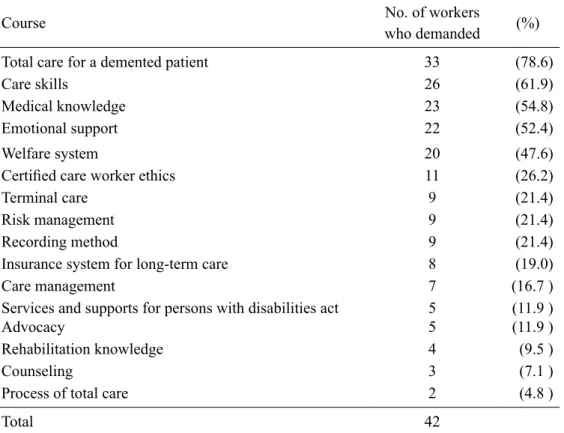
The learning programs which certified care workers would like to participate in are introduced in Table 3. The great majority of members want to learn skills to provide “total care for a demented patient,” and more than half of the members would like to learn “caregiver skills” as well as “medical knowledge” and “how to support care receivers and their families emotionally.”

Public awareness of dementia has been changing, and total care for these patients are

considered one of the most difficult types of in- home long-term care. The Ministry of health, Labor and welfare found that care managers would like to develop their skills for providing total care for patients with dementia (The Ministry of health, Labor and welfare 2009).

appropriate “caregiver skills” and “medical knowledge” are necessary not only for certified care workers who provide practical support to patients, but also for the care managers who coordinate the care services. it is important to improve their fundamental knowledge and skills so that they can provide skilled services to persons with wide-ranging needs.

This study had some limitations which may have affected our interpretation of the research results presented in the discussion above. first, an insufficient number of people were surveyed: 389 out of 1,544 members (25.2%) returned the

Table 3 Learning courses requested by certified care workers employed as designated in- home long-term care support providers (multiple answers)

Course no. of workers

who demanded (%)

Total care for a demented patient 33 (78.6)

Care skills 26 (61.9)

Medical knowledge 23 (54.8)

emotional support 22 (52.4)

welfare system 20 (47.6)

Certified care worker ethics 11 (26.2)

Terminal care 9 (21.4)

Risk management 9 (21.4)

Recording method 9 (21.4)

insurance system for long-term care 8 (19.0)

Care management 7 (16.7 )

Services and supports for persons with disabilities act 5 (11.9 )

advocacy 5 (11.9 )

Rehabilitation knowledge 4 (9.5 )

Counseling 3 (7.1 )

Process of total care 2 (4.8 )

Total 42

(5)

questionnaire, and of this number, we discussed the results provided by 42 care managers.

Therefore, the discussion of their situation may be incomplete. Second, the information provided may be less reliable than information obtained by individual interview or other methods, because the questionnaire was an anonymous self- administered questionnaire sent by mail.

The ratio we obtained of care managers to certified care workers was similar to that obtained by The Japan Association of Certified Care Workers (The Japan Association of Certified Care workers, 2007): 47.0% in our results and 44.9%

in their report, “Report on the working condition and professional awareness of Certified Care workers.” according to the “Report of the 12

th

Care manager examination” by the Ministry of Health, Labor and Welfare, 169,182 certified care workers have passed the examination so far, which accounts for 34.2% of all such workers.

This number is much higher than that of other professionals. These data and our results suggest that it is necessary to provide specialized support to care managers who are qualified certified care workers.

it has been 12 years since the Long-Term Care insurance program began, and since then, 507,581 care managers have been registered. of these care managers, 34.2% are certified care workers. This ratio has been increasing and obtaining certification is considered to be an important career path. Certified care workers provide superior individualized total care (The Japan Association of Certified Care Workers, 2008), which is required to be a care manager. however, it is also essential for these care managers to have a broad perspective, coordination skills, and management skills in order to coordinate care services so that adequate support is provided to care receivers and their families. it is important to have a new learning program for these workers so that they can develop an understanding of

“family,” “community” and “societal resources.”

Conclusions

There are many more certified care workers than other professionals who become care managers, and the number is still increasing.

Therefore, it can be said that their quality determines the quality of the entire in-home long- term care support system.

in this study, we focused on what kind of learning should be provided to care managers to improve their skills. Their multiple answers revealed that they are strongly interested in specific learning to provide “total care for a demented patient” (78.6%), improve their

“caregiver skills” (61.9%), and also increase their

“medical knowledge” (54.8%). however, it is obvious that to be a care manager, learning in other skills besides these is needed. in fact a more important challenge is to strengthen their expertise by giving them more understanding of

“family,” “community” and “societal resources.”

The current learning system offers “learning for capability of leader” and “management ability for chief care manager”, snd are available for all care managers to develop their skills. however, it would like to suggest that the Japan association of Certified Care Workers establish a new life- long program to educate care managers and to also create a continuous support system.

References

okada, f. (2011) The Role and Challenges of Professional organizations in Care work Specialist Learning in niigata. niigata Journal of health and welfare. in press. in Japanese.

The Textbook Committee for the Care manager internship: (2008) Textbook for the Care manager internship, Tokyo. foundation of Social development for Senior Citizens. in Japanese.

The Japan Association of Certified Care Workers

(1997), Manual for assessment for

independence support and making a care

(6)

plan from the perspective of the seven life fields. Tokyo. Chuohoki Publishing. in Japanese.

The Japan Association of Certified Care Workers (2009), Report on the 8th working condition and professional awareness of Certified Care workers, Tokyo, The Japan association of Certified Care Workers. In Japanese.

The Ministry of health, Labor and welfare (2008): Report of the research on medical care for a demented person and the urgent project to improve the life quality of their live. in Japanese.

http://www.mhlw.go.jp/houdou/2008/07/dl/

h0710-1a.pdf (accessed on december 29, 2010).

The Ministry of health, Labor and welfare (2009): Report of the 12

th

Care manager examination. Ministry of health, Labor and welfare, from http://www.mhlw.go.jp/topics/

kaigo/hoken/jukensha/12-2.html (accessed

on december 29, 2010).

Table 1  Occupation of 42 certified care workers working as care managers  at the time long-term care insurance program was introduced
Table 3  Learning  courses  requested  by  certified  care  workers  employed  as  designated  in- in-home long-term care support providers (multiple answers)

参照

関連したドキュメント

The reasons associated with feelings of burden were the following 14 items: “Breastfeeding requires care about what mothers can eat and drink”, “Breastfeeding alone does not

5) The Japanese Respiratory Society Guidelines for the management of respiratory tract infection. The Japanese Respiratory Society.. A prediction rule to identify low- risk

This research was an observational cohort study under routine healthcare; it did not specify what inter- ventions, such as medication or patient guidance, were to be used during

This study was performed to examine attitudes toward evacuation(wish to stay at home, access evacuation sites)among elderly community residents that were able to choose

Nursing care is the basis of human relationship, is supported by how to face patients and to philosophize about care as a

For the assessment of the care burden we used the Japanese Version of the Zarit Caregiver Burden Interview (J- ZBI) and compared it with the caregiver’s age, relationship, care term

It seems that the word “personality” includes both the universality of care and each care worker ’s originality with certain balance, and also shows there are unique relations

International Association for Trauma Surgery and Intensive Care (IATSIC) World Congress on Disaster Medicine and Emergency Medicine (WADEM). International symposium on intensive