Japan Advanced Institute of Science and Technology
JAIST Repository
https://dspace.jaist.ac.jp/Title Analysis of the Local Field near Au Nanowires by Optical Second Harmonic Spectroscopy
Author(s) Mizutani, Goro; Sugawara, Akira; Sano, Haruyuki Citation
Issue Date 2006-03
Type Conference Paper
Text version author
URL http://hdl.handle.net/10119/4743
Rights
Analysis of the Local Field near Au Nanowires by Optical Second Harmonic Spectroscopy, Goro Mizutani / Akira Sugawara / Haruyuki Sano, Frontiers of Basic Science Towards New Physics Earth and Space Science Mathematics, Ed. Hideaki Takabe / Nguyen Hoang Luong / Yoshichika Onuki (Osaka University Press, Osaka, 2006/3) p. 163-164.本著作物は大阪大学出版会の許可のもとに掲載す るものです。
Description
Analysis of the Local Field near Au Nanowires by Optical Second Harmonic Spectroscopy, Goro Mizutani / Akira Sugawara / Haruyuki Sano, Frontiers of Basic Science Towards New Physics Earth and Space Science Mathematics, Ed. Hideaki Takabe / Nguyen Hoang Luong / Yoshichika Onuki (Osaka University Press, Osaka, 2006/3) p. 163-164.
Analysis of the Local Field near Au Nanowires
by Optical Second Harmonic Spectroscopy
Goro Mizutani, Akira Sugawara, and Haruyuki Sano
School of Materials Science, Japan Advanced Institute of Science and Technology, 1-1 Asahidai, Nomi-shi,Ishikawa 923-1292, Japan
We have measured optical second harmonic (SH) intensity from Au nanowire arrays as a function of the photon energy. We have found that the SH response is weak when the electric field and the nanowire axes are perpendicular to each other, due to the canceling of the incident field by the depolarization field created by the dielectric response of the nanowires. This cancellation of the incident field is found to be weak when the incident photon energy exceeds 1.6eV due to the less ideal metallic response of Au.
1. Introduction
Metallic nanowires are one of the most important new materials developed by the nano-technologies in recent years. They have a potential to show anisotropic optical nonlinearity in the red wavelength region. In order to search systematically the usefulness of the nanowire materials, the guideline by the information on the basic mechanism of their optical nonlinearity is necessary.
In our previous reports [1,2], we measured SH intensity from Au nanowire array/ NaCl(110) systems as a function of the azimuthal angle and the fundamental photon energy. We have found a large anisotropy around the surface normal in the SH intensity. The nonlinear response was stronger when the incident electric field and the nanowire axes were parallel than when they were perpendicular to each other.
By analyzing the SH intensity spectra for the s-in/p-out polarization combination, we have attributed this anisotropic nonlinearity to the anisotropic depolarization field induced in the Au nanowires. In this contribution we try to explain the SH intensity spectra for p-in/p-out polarization combination taking the effect of depolarization field into account.
2. Experiment
The Au polycrystalline nanowires were prepared by shadow deposition in UHV [3]. The faceted NaCl(110) substrate was prepared by first etching by water, annealing at 200oC for 8h and then etching thermally at 450oC for 30 min. Au was deposited at room temperature from an effusion cell aligned by 65o from the template normal. The
Au nanowires were sandwiched by 10-nm-thick SiO layers. The light source for excitation was an optical parametric generator/amplifier system driven by a frequency-tripled mode-locked Nd:YAG laser. In order to calibrate the SH intensity, α-SiO2(0001) was used as a reference
sample.
3. Results and Discussion
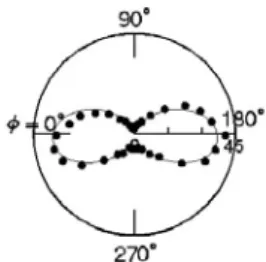
Figure 1 shows the polar plot of the SH intensity from the Au nanowire array on the NaCl(110) template with the wire thickness of 60nm as a function of the sample rotation angle φ around its surface normal for the p-in/p-out polarization combination. We see that the SH intensity is stronger when the incident plane is parallel to the nanowire axes (φ=0o
,180o), and weaker when the incident plane is perpendicular to the nanowire axes (φ=90 o
, 270o). According to our previous report, there is a large cancellation of the incident field in the nanowires when the field is perpendicular to the nanowire axes at φ= 90 o
and 270o [1,2].
Fig. 1 SH intensity from Au nanowires as a function of the sample rotation angle φ for p-in/p-out polarization combination. When φ=0o
, the incident plane is parallel to the nanowire axes. The photon energy of the excitation field is hω=1.17eV.
Fig. 2 (a) SH intensity spectra from the Au nanowires for p-in/p-out polarization combination. φ is defined in the same way as in Fig. 1. (b) The calculated local field factor.
Fig. 2(a) shows the spectra of the SH intensity from the Au nanowire array as a function of the photon energy for p-in/p-out polarization combination at the azimuthal angles φ=0o
and 270o. In order to discuss the physical meaning of the SH intensity curve at φ=270o
in Fig. 2(a), we have calculated the local field factor of the nanowires used in our previous paper [2]
L⊥ =[
ε
0N⊥
ε
m + (1− N⊥)ε
0]2 (1),
for the electric field perpendicular to the nanowire axes. In eq. (1) N⊥ is the depolarization factor
and is set equal to 0.5 [2].
ε
0 andε
m are the dielectric functions of the host (SiO) and the guest (Au) materials, respectively. The calculated Fresnel factor,| L
⊥2
(
ω
)L
⊥(2
ω
) |
2is shown in Fig. 2(b). The Fresnel factor increases above the fundamental photon energy 1.5 eV. This is because the absolute value of the dielectric function
of gold
ε
m(ω
) in the denominator of eq. (1) becomes smaller when the photon energy increases. These local field factors are defined for the field inside the nanowires, but due to the continuity of the electric displacement, they are also proportional to the local field outside the nanowires.The calculated curve in Fig. 2(b) has a frequency dependence quite similar to that found in Fig. 2(a) for φ=270o
. This result indicates that the effect of the depolarization field dominates the SH intensity spectrum for the incident electric field perpendicular to the nanowire axes for p-in/p-out polarization combination, as was already found in the SHG for s-in/p-out polarization combiation in our previous work [1,2].
On the other hand, the calculation of the local field factors for φ=0o
for p-in/p-out polarization combination is not easy because the fundamental and the SH electric fields have components both parallel and perpendicular to the nanowire axes. However, no remarkable structure other than the one found in Fig. 2(b) is expected because the linear dielectric function has a monotonic variation in this energy region. Nevertheless, in Fig. 2(a) we find that the SH intensity curve for φ=0o
has a peak at 2hω~3.25eV. We suggest that this peak might involve an electronic resonance at the Au/SiO interface or at nanostructures created in the nanowires.
Acknowledgments
This work was supported in part by a Grant-in-Aid for Scientific Research from the Ministry of Education, Science, Sports and Culture. One of the authors (G. M.) gratefully acknowledges the financial assistance from the Ogasawara Foundation for the Promotion of Science and Engineering.
References
[1]T. Kitahara, A. Sugawara, H. Sano, and G. Mizutani, Appl. Surf. Sci. 219, 271 (2003).
[2]T. Kitahara, A. Sugawara, H. Sano, and G. Mizutani, J. Appl. Phys. 95, 5002 (2004).
[3]A. Sugawara, G. G. Hembree, M. R. Scheinfein, J. Appl. Phys. 82, 5662 (1997).