A Systemic Functional Perspective
Gilder Davila
11Lecturer, Ritsumeikan Asia Pacific University (APU), Beppu City, Oita, Japan. Email: [email protected]
Abstract
For tertiary level students, organising and writing texts requires a considerable amount of time. To minimize this issue, they need to be taught how to organise a text as a whole. In Systemic Functional Linguistics, the notion of periodicity can help teachers explain to students how to organise their texts successfully. As Martin and Rose (2007) state, “periodicity is concerned with information flow: the way in which meanings are packaged to make it easier for us to take them in” (p. 188). The pedagogical purpose of this study is to propose the integration of the notion of periodicity when teaching writing to EFL learners at the tertiary level to improve the coherence and cohesion of their academic essays. Using central ideas from systemic functional linguistics, this study shows how coherence and cohesion were developed in two academic essays by analysing their hierarchical structures. Essay A followed a traditional composition style method and Essay B followed a suggested method using ideas from the notion of periodicity. The results showed that the hierarchical structure of Essay B was more consistent and organised than Essay A. The paper concludes with the introduction of an outline that aims to improve the quality of EFL learners’ essays in terms of their coherence and cohesion.
Key terms: Systemic Functional Linguistics (SFL), periodicity, hyperTheme, hyperNew, Theme,
Rheme, and New.
1. Introduction
The way in which students construe meaning has been an important aspect of academic writing for many years. During the mid-sixties, there was an increasing awareness of ESL students’ needs with regard to producing extended written discourse. Kaplan (1966) suggested that ESL writers “employ a rhetoric and a sequence of thought which violate the expectations of the native reader” (p. 4). For this reason, it is necessary to provide the student with a form within which he may operate (Kaplan, 1966, p. 20). A cursory look at ESL composition texts indicates that, for the most part, writing assignments are made for the sole purpose of testing the mastery of specific grammatical structures and that few involve invention techniques or prewriting strategies (Zamel, 1982, p. 196). In addition, this concern towards the instruction of writing promoted the idea that ESL students need logical construction and arrangement of discourse forms. Paragraphs became the primary interest, and attention was given to their elements (topic sentences, supporting sentences, concluding sentences, and transitions) (Silva, 1994, p. 14). This assumption may be one of the reasons why
Gilder Davila
1in many writing textbooks for university-level EFL students, the focus seems to be on presenting elements of essay structure (thesis statement, topic sentences, controlling ideas, conclusion sentences) and its development (introduction, body, and conclusion) as the pattern most appropriate (Silva, 1994, p. 14). While these elements are relevant to academic writing, the organisation of words to convey meaning are also important. Learning how to choose meaning and communicating it correctly might represent a challenge for those EFL learners coming from a background that focuses on essay structure and its development.
Systemic Functional Linguistics (hereafter SFL) provides a suitable approach to helping learners construct meaning. It explains the function of language in social situations, which can help teachers and learners understand how meaning is put together to realise language and achieve the goal of effective communication. In SFL, there are three particular metafunctions that explain the functions of language: (i) to enact our social relationships (interpersonal), (ii) to represent our experience (ideational), and (iii) to organize our enactments and representations as meaningful text (textual). In this paper, the textual metafunction will be explored in order to explain the notion of periodicity in English writing.
According to Halliday and Mathiessen (2014), “textual meanings tend to be realized by the order in which things occur, and especially by the placing of boundaries” (p. 328). The textual meaning of the clause is expressed by what is put first (the Theme); by what is phonologically prominent (and tends to be put last – the New [Rheme]), signalled by information focus); and by conjunctions and relatives which if present must occur in the initial position. Thus, it forms a wave-like pattern of periodicity that is organised by peaks of prominence and boundary markers. The notion of periodicity is also used to model how information is structured at the discourse level by looking at patterns of thematic structuring; i.e., waves of Theme and New (Rheme) across longer spans of text and examining their textual function. In other words, periodicity is about information flow, giving readers some idea about what to expect, fulfilling those expectations, and then reviewing them (Martin & Rose, 2007, p. 188).
With the above in mind, this paper examines the pattern of organisation in two English academic essays from the SFL perspective of periodicity. The essays come from an upper-intermediate English class at an international university in Japan where Japanese students learn English as a foreign language. The instructional method employed by the instructor during the lessons for Essay A was mainly related to traditional styles of composition, where attention is paid to the structure of the essay (see Appendix 1). For essay B, the instructor integrated ideas from the notion of periodicity into the materials used to teach writing and used terms already known by the students (see Appendix 2). Since teaching the notion of periodicity involves the use of a particular metalanguage commonly unknown by teachers and learners, the instructor created an activity and an outline that help learners create hierarchies of text within a text. In addition, students were taught how to work with meaning in the construction of a text.
The Hierarchical Structure of Academic English Essays: A Systemic Functional Perspective
41 40
2. Literature review
In the literature, the word wave has been used to describe information flow in discourse. According to Pike (1982), “in a written piece meaning flows together like ripples on the tide, merging into one another in the form of a hierarchy of little waves and big waves” (p. 12-13). Writers package information into big waves and these informational waves are suggestive of what comes later in the text. Under the notion of periodicity, these expectations are met by further thematic or informational development in the text, giving the effect of larger waves followed by small waves of information. Additionally in English texts, expectations are flagged forward and then consolidated by summarizing them back. This particular pattern of foreshadowing and reiteration in writing is useful for EFL writers who want to improve their academic writing skills. At the clause level, the idea of flagging is realised by the Theme element. The Theme is the element that serves as the point of departure of the message; it is that which locates and orients the clause within its context. The remainder of the message is called the Rheme. As with the Theme, the Rheme typically contains another kind of prominence. This prominence is called News. As a message structure, therefore, a clause consists of a Theme accompanied by a New (Rheme); and the structure is expressed by the order – whatever is chosen as the Theme is put first (Halliday and Mathiessen, 2014, p. 89). Below, there is an example of how Theme and Rheme are identified in SFL. The boundary between Theme and Rheme is shown by +:
(Theme) When people + (Rheme) want to get rid of their pets, they + take them to animal shelters. Once pets + are abandoned by their owners, there are + two possible outcomes. <sic>
Therefore, when studying periodicity, the analysis of Theme and New in the clause is essential to the understanding how meaning is flagged and summarised at a discourse level, that is, at a level beyond individual clauses. In the introduction of periodicity, Martin and Rose (2007) stated that discourse has a beat, and without this rhythm, it would be very hard to understand what the writer is trying to communicate (p. 189). This beat is construed in the Theme and New of the clause; by looking at Theme, we can see how expectations are construed and presented, and by looking at New, we can see how those expectations are fulfilled, forming a wave-like information flow.
In a traditional composition class, the idea of flagging might be represented by the use of controlling ideas. However, the notion of periodicity allows us to establish a hierarchy of waves that goes beyond the explanation of controlling ideas. In other words, by using ideas from periodicity, students will be able to work not only with structural units (grammar) but also semantic ones (discourse). They will be able to see the role of textual meaning when writing an essay.
2.1 EFL students issues with writing
According to the literature, teachers often experience difficulties explaining to students how they should order the information in their sentences (Fries, 1996, p. 69). EFL students consider
vocabulary their most serious handicap, words are the smallest physical meaningful units of the message and they play an important role in writing (Yorio, 1971, p. 107). Another recurring problem in the production of text by EFL students is how choices of meaning are, in most cases, affected by the previous language. Thus, a great deal of the problems found in the creation of controlling ideas for a text come from choices of meaning. To minimize this issue, teachers should spend more time explaining the role of meaning in the construction of waves in a text. While this might require the use of a complex metalanguage for the students, there are different ways to introduce the notion of periodicity using students' current knowledge of writing. These ideas are introduced in a later section of this paper.
2.2 Higher level Theme and New (HyperTheme and HyperNew)
HyperTheme represents a higher layer of information in discourse. It refers to a statement, in most cases the first sentence found at the beginning of a text. It works as the point of departure of what is to come in a text (Martin & Rose, 2007). As mentioned previously, in a clause the Theme works as the point of departure and it is commonly represented by an unmarked theme (subject) and in some cases by a marked Theme. The idea of hyperTheme represents a larger scale patterning in discourse which is structurally and semantically more elaborate than the Theme. Here is an example from Martin and Rose (2007, p. 193) of how hyperTheme works:
After about three years with the special forces, our hell began.
He became very quiet. Withdrawn. Sometimes he would just press his face into his hands and shake uncontrollably, I realized he was drinking too much. Instead of resting at night, he would wander from window to window. He tried to hide his wild consuming fear, but I saw it. In the early hours of the morning between two and half-past-two, I jolt awake from his rushed breathing. Rolls this way, that side of the bed. He’s pale. Ice cold in a sweltering night – sopping wet with sweat. Eyes bewildered, but dull like the dead. And the shakes. Table 1
Informational structure of the hyperTheme
Table 1 shows the role of Theme and New in the construction of the hyperTheme. According to Martin and Rose (2007), in the first clause the thematic element our hell functions as a kind of preview for the events which follow as the writer spells out what that hell is. From a linguistic perspective, this topic sentence is treated as a kind of higher level Theme: a hyperTheme (p. 194). In other words, the hyperTheme serves as a point of orientation for what is to come. It foreshadows the information readers are about to take in. What makes this particular clause different is that it
Marked Theme Subject / Theme New
After about three years with the
special forces our hell began
The Hierarchical Structure of Academic English Essays: A Systemic Functional Perspective APU Journal of Language Research Vol.3, 2017
functions as a hyperTheme; i.e., it exerts control over the information that might be expected to follow.
At the end of a phase in discourse, there is a new layer of information that good writers commonly use to remind readers of where they have been during the reading. This new layer of information is referred as the hyperNew. HyperThemes tell us where we are going in a phase; hyperNews tell us where we have been (Martin & Rose, 2007). Although the frequency of hyperThemes is considerably higher than hyperNews, the latter helps the reader to understand the relevance of the phase of discourse previously unfolded. Here is an example of hyperNews from Martin and Rose (2007):
The Second World War further encouraged the restructuring of the Australian economy towards a manufacturing basis.
Between 1937 and 1945 the value of industrial production almost doubled. This increase was faster than otherwise would have occurred. The momentum was maintained in the post-war years and by 1954-5 the value of manufacturing output was three times that of 1944-5.
The enlargement of Australia’s steel-making capacity, and of chemicals, rubber, metal goods and motor vehicles all owed something to the demands of war.
The war had acted as something of a hot-house for technological progress and economic change.
In the example above, the hyperTheme is underlined and the phrases that paraphrase it are in italics. According to Martin and Rose (2007), the body paragraph paraphrases the hyperTheme. Phrases such as this increase, the momentum, and other phrases in the paragraph are paraphrasing the hyperTheme. However, the hyperNew is never an exact paraphrase of the hyperTheme, nor is it simply a summary of the wave's trough (Martin & Rose, 2007, p. 196). The hyperNew takes the reader to a new point in the text that could only be understood if the reader has gone through the hyperThemes. In other words, to understand the purpose of the bold text in the example above, the reader must go through and understand the information given in the body paragraph.
In many written texts, waves of Theme and New extend beyond clauses and paragraphs to much larger phases of discourse. This higher level Theme is referred as the macroTheme (Martin & Rose, 2007, p.197). The macroTheme predicts what is to come, while the hyperTheme choices refer back to what has been predicted and refer forward to what is to come in each paragraph. Waves of New also have a higher level, which is referred as the macroNew. Martin and Rose (2007) stated that one of the possible functions of the macroNew is to show a higher level New that distils hyperNews (p. 195).
Thus far, we have seen that in discourse, clauses are organised into waves of Theme and a New, and that some of these clauses serve as discourse level hyperTheme and hyperNew, which are suggestive of the informational meanings which are to follow in the text. At the same
}
HyperNewtime, the hyperThemes are frequently foreshadowed by a higher level Theme which is called the macroTheme. In addition, each phase of discourse contains a clause complex that functions as a New, which explains to readers where they have been and prepares them for encountering new information in the text. The clauses that exert this function are called the hyperNews. Finally, in the last phase of discourse a macroNew functions as an expansion or development of the point of the text. Figure 1 summarises the different layers of information found in discourse.
Martin and Rose's (2007) layers of information are not meant to be a fixed structure in the construction of discourse. Instead, they are pursuing an understanding of how periodicity (information flow) takes place in this particular type of text (academic English essay). Therefore, teaching EFL learners about the hierarchical structure of discourse (Figure 1) might help them to improve the organisation and development of texts since it considers language from both a structural and a semantic view. Teaching this particular metalanguage at early stages of English acquisition might cause confusion among learners due to the high level of abstraction employed in the meaning choices. Thus, this paper aims to suggest teaching hierarchical structures to students using metalanguage that students know from previous language learning experiences. It is believed that the integration of ideas from SFL might make the teaching of writing more effective among EFL learners.
In the following section, the hierarchical structure of two academic English essays from upper-intermediate EFL learners at an international university are analysed by considering the informational structure employed by the writers. This hierarchical structure uses ideas from Martin and Rose (2007) regarding layers of Themes and News in discourse (Figure 1). For the purpose of this paper, different sections from the two essays are presented to describe and understand how EFL learners at an international university employ periodicity. Firstly, a thematic development will be presented to see how textual meaning was construed at the clause level. Next, the analysis will focus on the hierarchical structure of some parts of the essay by looking at possible instances of hyperTheme, hyperNew, macroTheme, and macroNew at a discourse level.
Method of Development Point (genre focus) (field focus) macroThemen
hyperTheme
predict Theme ... New accumulate hyperNew
macroNewn
Figure 1. Layers of Themes and News in discourse (Martin & Rose, 2007).
The Hierarchical Structure of Academic English Essays: A Systemic Functional Perspective APU Journal of Language Research Vol.3, 2017
3. Hierarchical structure in academic essays
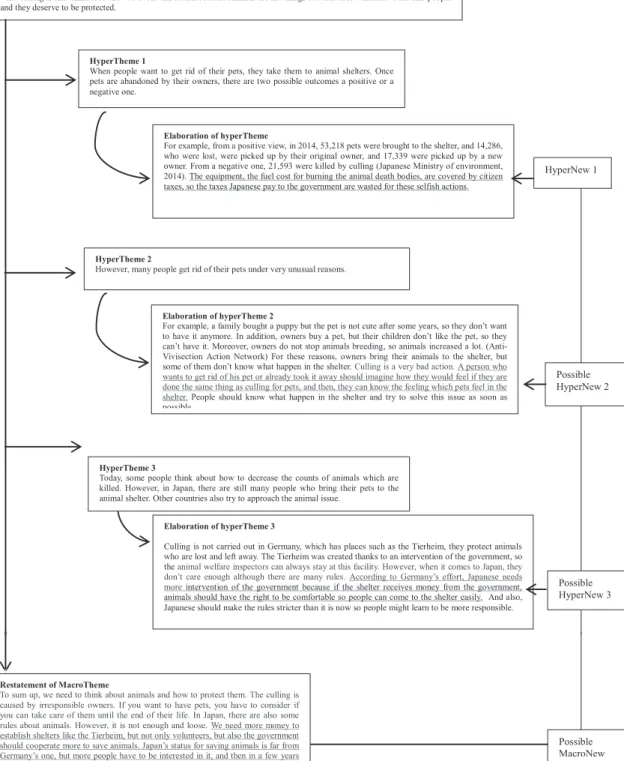
The main purpose of a periodicity analysis is to model how information flows in discourse (Martin & Rose, 2007, p. 188). Therefore, it helps both writers and readers to understand how information is packaged in the creation and subsequent transmission of text. One way to understand how EFL students organise information is by looking at the hierarchical structure of the text. In this paper, the periodicity analysis starts by examining the role of macroTheme, hyperThemes, hyperNews, and macroNew from two essays. Due to the considerable amount of information in each essay, certain phases have been selected to illustrate the analysis of the hierarchical structure of the text. By using a similar model as the one introduced in Christie and Dreyfus (2007), Figure 2 shows the pattern of Theme, New, macroTheme, hyperTheme, macroNew and hyperNew in Essay A.
Figure 2. MacroTheme, HyperTheme, MacroNew, HyperNew (Essay A). (Model adapted from Coffin, 2006).
3.1 Essay A
Essay A foreshadows the information to be presented in the essay by using relevant meaning in the first paragraph with choices of
Macro-Theme
Do you know many people get rid of their pets to avoid this responsibility? Do you know how many pets are killed every year? In Japan, culling, the act of killing pets such as dogs or cats is decreasing in recent years. However, it is still happening;
today, many people have pets that make them happy because they have a new family member, but there are some problems behind this. "One of the hottest questions in the study of animal behavior is, “Do animals have emotions?” And the simple and correct answer is, “Of course they do.”" Marc Bekoff, a professor in the Department of Ecology and Evolutionary Biology, says that. According to him, animals also have emotions, like human beings. They feel anger and sadness when they are left away, but some people do not understand it because pets are no more than things for them. More people should know about what culling is and think about how to avoid this action because animals are not things but creatures which have life like people and they deserve to be protected.
Elaboration of hyperTheme
For example, from a positive view, in 2014, 53,218 pets were brought to the shelter, and 14,286, who were lost, were picked up by their original owner, and 17,339 were picked up by a new owner. From a negative one, 21,593 were killed by culling (Japanese Ministry of environment, 2014). The equipment, the fuel cost for burning the animal death bodies, are covered by citizen taxes, so the taxes Japanese pay to the government are wasted for these selfish actions.
HyperTheme 1
When people want to get rid of their pets, they take them to animal shelters. Once pets are abandoned by their owners, there are two possible outcomes a positive or a negative one.
HyperTheme 2
However, many people get rid of their pets under very unusual reasons.
Elaboration of hyperTheme 2
For example, a family bought a puppy but the pet is not cute after some years, so they don’t want to have it anymore. In addition, owners buy a pet, but their children don’t like the pet, so they can’t have it. Moreover, owners do not stop animals breeding, so animals increased a lot. (Anti-Vivisection Action Network) For these reasons, owners bring their animals to the shelter, but some of them don’t know what happen in the shelter. Culling is a very bad action. A person who wants to get rid of his pet or already took it away should imagine how they would feel if they are done the same thing as culling for pets, and then, they can know the feeling which pets feel in the
shelter. People should know what happen in the shelter and try to solve this issue as soon as
possible.
Possible HyperNew 2 HyperNew 1
Elaboration of hyperTheme 3
Culling is not carried out in Germany, which has places such as the Tierheim, they protect animals who are lost and left away. The Tierheim was created thanks to an intervention of the government, so
the animal welfare inspectors can always stay at this facility. However, when it comes to Japan, they
don’t care enough although there are many rules. According to Germany’s effort, Japanese needs
more intervention of the government because if the shelter receives money from the government,
animals should have the right to be comfortable so people can come to the shelter easily. And also, Japanese should make the rules stricter than it is now so people might learn to be more responsible.
HyperTheme 3
Today, some people think about how to decrease the counts of animals which are killed. However, in Japan, there are still many people who bring their pets to the animal shelter. Other countries also try to approach the animal issue.
Possible MacroNew
Restatement of MacroTheme
To sum up, we need to think about animals and how to protect them. The culling is caused by irresponsible owners. If you want to have pets, you have to consider if you can take care of them until the end of their life. In Japan, there are also some rules about animals. However, it is not enough and loose. We need more money to establish shelters like the Tierheim, but not only volunteers, but also the government should cooperate more to save animals. Japan’s status for saving animals is far from Germany’s one, but more people have to be interested in it, and then in a few years later that all animals will be saved their life and protected them.
Possible HyperNew 3
Figure 2. MacroTheme, HyperTheme, MacroNew, HyperNew (Essay A). (Model adapted from Coffin, 2006).
3.1 Essay A
Essay A foreshadows the information to be presented in the essay by using relevant meaning in the first paragraph with choices of
Macro-Theme
Do you know many people get rid of their pets to avoid this responsibility? Do you know how many pets are killed every year? In Japan, culling, the act of killing pets such as dogs or cats is decreasing in recent years. However, it is still happening;
today, many people have pets that make them happy because they have a new family member, but there are some problems behind this. "One of the hottest questions in the study of animal behavior is, “Do animals have emotions?” And the simple and correct answer is, “Of course they do.”" Marc Bekoff, a professor in the Department of Ecology and Evolutionary Biology, says that. According to him, animals also have emotions, like human beings. They feel anger and sadness when they are left away, but some people do not understand it because pets are no more than things for them. More people should know about what culling is and think about how to avoid this action because animals are not things but creatures which have life like people and they deserve to be protected.
Elaboration of hyperTheme
For example, from a positive view, in 2014, 53,218 pets were brought to the shelter, and 14,286, who were lost, were picked up by their original owner, and 17,339 were picked up by a new owner. From a negative one, 21,593 were killed by culling (Japanese Ministry of environment, 2014). The equipment, the fuel cost for burning the animal death bodies, are covered by citizen taxes, so the taxes Japanese pay to the government are wasted for these selfish actions.
HyperTheme 1
When people want to get rid of their pets, they take them to animal shelters. Once pets are abandoned by their owners, there are two possible outcomes a positive or a negative one.
HyperTheme 2
However, many people get rid of their pets under very unusual reasons.
Elaboration of hyperTheme 2
For example, a family bought a puppy but the pet is not cute after some years, so they don’t want to have it anymore. In addition, owners buy a pet, but their children don’t like the pet, so they can’t have it. Moreover, owners do not stop animals breeding, so animals increased a lot. (Anti-Vivisection Action Network) For these reasons, owners bring their animals to the shelter, but some of them don’t know what happen in the shelter. Culling is a very bad action. A person who wants to get rid of his pet or already took it away should imagine how they would feel if they are done the same thing as culling for pets, and then, they can know the feeling which pets feel in the
shelter. People should know what happen in the shelter and try to solve this issue as soon as
possible.
Possible HyperNew 2 HyperNew 1
Elaboration of hyperTheme 3
Culling is not carried out in Germany, which has places such as the Tierheim, they protect animals who are lost and left away. The Tierheim was created thanks to an intervention of the government, so
the animal welfare inspectors can always stay at this facility. However, when it comes to Japan, they
don’t care enough although there are many rules. According to Germany’s effort, Japanese needs
more intervention of the government because if the shelter receives money from the government,
animals should have the right to be comfortable so people can come to the shelter easily. And also, Japanese should make the rules stricter than it is now so people might learn to be more responsible.
HyperTheme 3
Today, some people think about how to decrease the counts of animals which are killed. However, in Japan, there are still many people who bring their pets to the animal shelter. Other countries also try to approach the animal issue.
Possible MacroNew
Restatement of MacroTheme
To sum up, we need to think about animals and how to protect them. The culling is caused by irresponsible owners. If you want to have pets, you have to consider if you can take care of them until the end of their life. In Japan, there are also some rules about animals. However, it is not enough and loose. We need more money to establish shelters like the Tierheim, but not only volunteers, but also the government should cooperate more to save animals. Japan’s status for saving animals is far from Germany’s one, but more people have to be interested in it, and then in a few years later that all animals will be saved their life and protected them.
Possible HyperNew 3 The Hierarchical Structure of Academic English Essays: A Systemic Functional Perspective APU Journal of Language Research Vol.3, 2017
3.1 Essay A
Essay A foreshadows the information to be presented in the essay by using relevant meaning in the first paragraph with choices of meaning such as get rid of, pets are killed and culling. While these choices seem to be relevant for the entire text, the subsequent clauses, in the first phase, take the reader in a different direction. One example is the introduction of a third interrogative sentence Do
animals have emotions? This question is expanded by adding a citation related to the topic of the
question, which gives the impression of a change in the main topic from “killing dogs and cats” to a discussion of animals’ emotions. In other words, there is lack of coherence and cohesion in this section of the text.
HyperTheme 1 seems to focus the reader's attention on the topic of getting rid of pets. An example of this technique is realised in the first hyperTheme by using the word abandon, which is close in meaning to the word introduced in the macroTheme get rid of. The New information unit from the hyperTheme is then elaborated on this phase of the discourse, which allows the writer to expand on the information flagged in the macroTheme. At the end of this phase, the writer introduces New information that neither support the hyperTheme nor the macroTheme. This New information The equipment, the fuel cost for burning the animal death bodies…<sic> could be considered as a possible instance of hyperNew 1. As explained in the literature section, hyperNews are used to make the readers aware of where they have been. Their functions can be either to provide a paraphrase of the hyperTheme or to introduce a new point in the text. In this particular case, hyperNew 1 seems to be introducing a new point in the text that might be mentioned or developed in a subsequent phase of the discourse. However, after reading the entire text there are no instances that contain an expansion of this hyperNew, which means that it dies out after this phase.
The second phase of this essay starts with the presence of hyperTheme 2 ‘However, many
people get rid of their pets under very unusual reasons’ this hyperTheme is directly connected
to the macroTheme. The writer then elaborates on the hyperTheme and introduces New information. One of the problems found in this particular phase is the introduction of more than one hyperTheme. These others hyperThemes found throughout the text are not connected to the macroTheme, which means that the reader is taken to a different and disconnected new point in the text. Having many hyperThemes in one phase can make the whole text difficult to read due to the inclusion of many ideas that are not properly elaborated on the text. The text ends with a conclusion and the introduction of what seems to be a macroNew. However, the purpose of the macroNew as explained in the literature section could not be found in Essay A. The integration of ideas from the notion of periodicity could avoid this problem since it helps writers to keep control over the content of the text and the way it is presented.
The information flow in Essay A from the view of macroTheme and hyperTheme seems satisfactory to a certain extent in terms of the meaning-connection established by the writer. However, while the presence of hyperThemes can be identified in each phase of discourse, the connection among the hyperNews and the macroNew should be more clearly delineated. It could
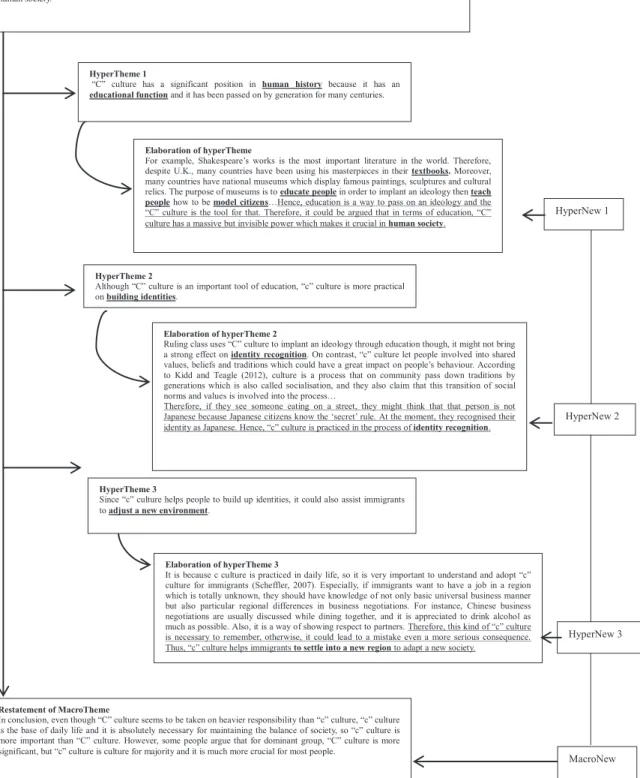
be assumed, to a certain extent, that the use of a traditional composition outline, which normally focuses on the thesis statement, controlling ideas, and topic sentences, might be a possible reason for the paucity of the macroNews and the hyperNews. It is believed that integrating ideas from the notion of periodicity can help students build a more substantial knowledge in terms of writing skills. “Successful writing demands a good relation of the whole discourse rather than the ability to compose grammatically correct sentences in isolation” (Piriyasilpa, 2009, p. 4). Figure 3 shows the structure and hierarchies of Essay B using Christie and Dreyfus's (2007) model.
The Hierarchical Structure of Academic English Essays: A Systemic Functional Perspective APU Journal of Language Research Vol.3, 2017
Figure 3. MacroTheme, HyperTheme, MacroNew, HyperNew (Essay B). (Model adapted from Coffin, 2006). How important is “C” culture and “c” culture in human society? It is generally agreed that both “C” culture and “c” culture
are really important elements for culture. However, some people may think that one of them is more significant than the other. Nonetheless, what do “C” culture and “c” culture stand for? “C” culture is known as ‘high culture’ which stands for art, history, architecture, music and so on. On the other hand, “c” culture is recognised as mass culture which related to people's daily life, such as values, traditions and beliefs (Bennett, 1998). This essay will examine how important “C” culture and “c” culture are in human society in terms of education, identity recognition and migration adjustment, then discusses which one is more crucial in human society.
Elaboration of hyperTheme
For example, Shakespeare’s works is the most important literature in the world. Therefore, despite U.K., many countries have been using his masterpieces in their textbooks. Moreover,
many countries have national museums which display famous paintings, sculptures and cultural relics. The purpose of museums is to educate people in order to implant an ideology then teach
people how to be model citizens…Hence, education is a way to pass on an ideology and the
“C” culture is the tool for that. Therefore, it could be argued that in terms of education, “C” culture has a massive but invisible power which makes it crucial in human society.
HyperTheme 1
“C” culture has a significant position in human history because it has an
educational function and it has been passed on by generation for many centuries.
HyperTheme 2
Although “C” culture is an important tool of education, “c” culture is more practical on building identities.
Elaboration of hyperTheme 2
Ruling class uses “C” culture to implant an ideology through education though, it might not bring a strong effect on identity recognition. On contrast, “c” culture let people involved into shared values, beliefs and traditions which could have a great impact on people’s behaviour. According to Kidd and Teagle (2012), culture is a process that on community pass down traditions by generations which is also called socialisation, and they also claim that this transition of social norms and values is involved into the process…
Therefore, if they see someone eating on a street, they might think that that person is not Japanese because Japanese citizens know the ‘secret’ rule. At the moment, they recognised their
identity as Japanese. Hence, “c” culture is practiced in the process of identity recognition. HyperNew 2 HyperNew 1
Elaboration of hyperTheme 3
It is because c culture is practiced in daily life, so it is very important to understand and adopt “c” culture for immigrants (Scheffler, 2007). Especially, if immigrants want to have a job in a region which is totally unknown, they should have knowledge of not only basic universal business manner but also particular regional differences in business negotiations. For instance, Chinese business negotiations are usually discussed while dining together, and it is appreciated to drink alcohol as much as possible. Also, it is a way of showing respect to partners. Therefore, this kind of “c” culture is necessary to remember, otherwise, it could lead to a mistake even a more serious consequence. Thus, “c” culture helps immigrants to settle into a new region to adapt a new society.
HyperTheme 3
Since “c” culture helps people to build up identities, it could also assist immigrants to adjust a new environment.
MacroNew
Restatement of MacroTheme
In conclusion, even though “C” culture seems to be taken on heavier responsibility than “c” culture, “c” culture is the base of daily life and it is absolutely necessary for maintaining the balance of society, so “c” culture is more important than “C” culture. However, some people argue that for dominant group, “C” culture is more significant, but “c” culture is culture for majority and it is much more crucial for most people.
3.2 Essay B
As in Essay A, the macroTheme is introduced in an interrogative sentence how important is “C”
culture and “c” culture in human society? However, the New information from this sentence
remains constant in the text, and it is also expanded on every phase of the text by making use of words that connect to the central question posed in the macroTheme. Essay B establishes the main topic in the macroTheme and then introduces each hyperTheme at the end of the first phase (e.g.
human society in terms of education, identity recognition and migration adjustment).
The first hyperTheme contains meaning that is flagged forward in the text (underlined text). These relevant meanings have been highlighted and bolded as shown in Figure 3. The writer then elaborates the hyperTheme by making use of synonyms and related words to the content in the hyperTheme; thus, keeping the reader connected to the text. This procedure is repeated in a similar way with hyperTheme 2 and 3. In other words, Essay B shows cohesion between the hyperTheme and the macroTheme. The macroNew of Essay B summarizes each layer of the text and introduces New information in the form of reflection.
The hierarchical structure of Essay B is more consistent than Essay A as was shown after the identification of the different layers that compose the text; i.e., macroTheme, hyperTheme, hyperNew, and macroNew. Essay B made use of a set of outlines that includes ideas from the notion of periodicity without particularly using the metalanguage introduced by Martin and Rose (2007). On the contrary, Essay A made use of a traditional composition outline that included terms already known by most EFL learners, such as the thesis statement, controlling ideas, topic sentence, and others. While the purpose of this paper is not to discredit the role of traditional composition teaching, the intention is to show that the integration of ideas from the notion of periodicity could lead EFL learners to the production of better texts in English.
4. Suggested Pedagogical Interventions
The previous discussion centred on how students organise information in a text. In particular, two essays were analysed to show how patterns of meaning are construed by EFL learners at an international university when writing academic English essays. Essay A followed a traditional writing composition style (see Appendix 1) while Essay B followed a set of outlines that uses the notion of periodicity (see Appendix 2). After presenting, discussing, and analysing instances of written language, problems regarding the proper construction of macroTheme, hyperTheme, hyperNew, and macroNew were found in Essay A. Learners following the style used in Essay A seem to have an acceptable control on the construction of a clause. However, more instruction regarding the hierarchical structure introduced here might help learners to establish a better control over the text.
For this reason, it is believed that pedagogical interventions should take place in the classroom, and in particular using the notion of periodicity when teaching writing skills. The instruction of periodicity to EFL learners implies the design, creation, and careful organisation of the hierarchical structure of language in academic English writing. One way to start the
The Hierarchical Structure of Academic English Essays: A Systemic Functional Perspective APU Journal of Language Research Vol.3, 2017
introduction of this notion is by presenting EFL learners the metalanguage used in periodicity. Understanding this particular metalanguage may require learners to have a certain level of English that goes beyond intermediate level. Another reason for this suggestion is that due to the typological language differences between English and Japanese and the differences in composition and style, teaching periodicity at early stages of English acquisition might promote confusion among learners. Therefore, integrating ideas from the notion of periodicity while still using terms already known by EFL learners, such as traditional composition terms, might be an effective start into the introduction of functional grammar. In doing so, EFL learners will learn about periodicity and its metalanguage in well-defined and logically constructed stages.
One possible suggestion to start the organisation of classroom activities and material for teaching periodicity is by looking at some of the guidelines (see Appendix 3) proposed by Piriyasilpa (2009) in the paper Periodicity and Its Use in Language Teaching. An adapted version of the guidelines is presented here.
According to Piriyasilpa (2009), the teacher may organise the classroom activity in three stages:
First stage: whole class teaching Second stage: group writing Third stage: individual writing
The first stage implies the teaching of the central idea behind the concept of periodicity in functional grammar. This includes the introduction of text structure through the discussion of functional metalanguage, namely macroTheme, hyperTheme, macroNew, hyperNew, Theme and Rheme, and Given and New. According to Piriyasilpa (2009), the language instructor can encourage the class to analyse the text by asking questions using the metalanguage (p. 9). To achieve this, the present paper claims that the notion of periodicity can be introduced by making use of learners’ current language knowledge. In other words, students do not need to be introduced to the metalanguage at once, but instead the teacher can introduce the notion of periodicity by using terms already known by the students. This particular strategy will serve as a preparation for a subsequent introduction of the proper metalanguage. This can be done by following stages similar to those presented by Piriyasilpa (2009). In this paper, four stages are suggested to introduce the notion of periodicity at the tertiary level.
4.1 Stage 1 (Guidance)
By using examples from other essays, the teacher encourages the class to find examples of hyperTheme and its connection with the whole text (macroTheme). This activity can be carried out without making use of the metalanguage employed in the notion of periodicity. Conducting a group activity is an example of how the teacher can lead the writing class towards a successful use of the outline employed in Essay B.
After introducing one example of the target text to the students, the teacher might make use of follow-up questions to introduce the organisation of the text (Table 2). One of the aims of the stage is to pay attention to how cohesion and coherence are developed.
Table 2
Follow-up questions for stage 1
4.2 Stage 2 (Scaffolding)
The second stage serves as a scaffolding activity for learners to reinforce the concepts involved in the notion of periodicity. In order to achieve this goal, a group writing activity is suggested to build confidence among the students. This activity can take place during the class or by making use of an online forum where students can share their answers and opinions. According to Piriyasilpa (2009), learners will have a chance to brainstorm ideas and put into practice the new knowledge acquired. In this case, a similar activity is proposed to achieve a similar goal without making use of the proper metalanguage. By working in groups, learners are able to focus on different parts of the text organisation and its development. In addition, this activity promotes interaction and cooperation among learners.
Is there a sentence expressing the purpose of the whole text? (MacroTheme) In which part of the text is this sentence?
What is the informational structure of that sentence? (Theme and Rheme) What nouns were used in that sentence? Make a list.
What is the meaning of each noun?
What similar words can you use to replace each noun? (Working with synonyms) How many discussion points are in the text? (HyperTheme)
Is the vocabulary used in each discussion point connected to the sentence expressing the purpose of the text? If so, what words express this connection? (HyperTheme)
Is there a sentence expressing a summary of the whole text? (MacroNew) In which part of the text is this sentence?
What is the informational structure of that sentence? (Theme and Rheme)
What nouns were used in the last phase (paragraph)? What other nouns in the text are similar to the ones found in the last phase?
The Hierarchical Structure of Academic English Essays: A Systemic Functional Perspective APU Journal of Language Research Vol.3, 2017
Table 3
Stage 2: Scaffolding
4.3 Stage 3 (Outline)
For stage 3, students are given the proposed outline (see Appendix 2) and a writing prompt. Using the techniques employed in stages 1 and 2, the teacher assist the students in the preparation of an outline that considers not only essay development structure but coherence and cohesion structure as well. If the whole class is working with one topic then the activity can be conducted in groups of three or four as in stage 2. If the class is assigned with different topics then stage 2 activity will serve as a review practice before moving into stage 4.
The left side of the outline uses terms from traditional composition to guide learners towards the creation of the structure of the essay. The right side of the outline (outlining Coherence and Cohesion) focuses on how to construe meaning. By making use of the same parts of the structure outline, learners are requested to work on the coherence and cohesion of the essay. This particular outline encourages learners to work on vocabulary (meaning). In addition, it helps them to understand the role of meaning across the entire essay.
4.4 Stage 4 (Essay)
The fourth stage is the creation of a text by the learner. In this stage, learners will put into practice the ideas learnt from the previous three stages and write an essay by employing the proposed outline and the techniques introduced in the previous stages. In order to achieve the goal of the fourth stage, the teacher should encourage learners to fill out the proposed outline before and after the production of the text. Thus, learners will have more control and understanding of their texts.
Make groups of three or more and work on the solution of the following task.
Student A: Find the statement in the first phase of discourse that considers the goal of the text. (MacroTheme). Then analyse its informational structure. What words were used in the Theme and Rheme? What is the meaning of each word? Find synonyms in the text for each of those words. Student B: Find the statement that exerts control over each paragraph. What words were used in the Theme and the Rheme? What transition words were used in each phase of discourse? What is the meaning and purpose of each transition word? Explain. (HyperTheme)
Student C: Find a statement that summarises the whole text. What words were used in the Theme and Rheme? Can you find these words (or similar ones) in other places of the text? If so, where are they? What is the meaning of each word? (MacroNew)
Student D: What is the purpose of the text? What kind of audience is this text for? What is your opinion about the text? Will you use the same information to support your ideas? Explain.
As mentioned before, periodicity is a tool that helps writers to see how text is organised. However, it is important to keep in mind that there are different types of essays and as a result different organisations. In EFL lessons, learners are exposed to a variety of texts that correspond to different academic topics. Since the main target is to make EFL learners produce successful essays, teachers should introduce periodicity by looking at the informational structure found in academic essays. Once EFL learners understand and recognise how to use the hierarchies of language introduced here, the class can expand on and introduce other types of English text. This is the reason why adding another stage to the outline ‘type of text’ might be necessary to guide EFL learners towards an understanding of language and its different functions in society and culture. The purpose of this optional stage is to show the learners that the organisation of a text is not always the same, and that the outline presented here changes in accordance to the target text type.
5. Conclusion
The purpose of this paper was to present and introduce the benefits of the notion of periodicity when teaching writing to EFL learners at the tertiary level. The notion of periodicity was employed to explain why hierarchies in text should be considered when teaching writing to EFL learners. Two academic English essays written by upper-intermediate EFL learners at an international university in Japan were selected and analysed to provide information regarding the informational structure employed in each essay. One essay followed ideas from traditional composition (Essay A) and the second essay followed an adapted outline that uses the notion of periodicity. While Essay A met most of the criteria demanded for that particular task, the results show that the text lacked of coherence and cohesion. A second essay (Essay B), from the same level, was written following an outline set that contains ideas from periodicity. The results showed a more organised and consistent text that successfully met the ideas exposed within the notion of periodicity.
After the analysis of the two essays, the author concluded that pedagogical interventions should take place in the classroom to improve EFL learners’ current writing skills. This paper suggests teaching the notion periodicity and SFL metalanguage by stages; i.e., by creating scaffolding strategies that will make the access to this functional grammar aspect more effective. One possible start to the organisation of classroom activities and material for teaching periodicity is by making use of EFL learners previous and current knowledge of writing composition. Teachers can find ways to integrate ideas from SFL by expanding and elaborating more on the concepts and techniques used in traditional composition, namely, thesis statement, controlling ideas, topic sentence, and conclusion sentence. Once learners reach a higher level of English language (upper-intermediate or advanced) the teacher can introduce SFL metalanguage to expose learners to different texts and their informational structures.
The Hierarchical Structure of Academic English Essays: A Systemic Functional Perspective APU Journal of Language Research Vol.3, 2017
References
Christie, F., & Dreyfus, S. (2007). Letting the secret out: Successful writing in secondary English.
Australian Journal of Language and Literacy, 30(3), 235-247.
Coffin, C. (2006). Historical Discourse. London and NY: Continuum.
Fries, P. (1996). Theme and New in written English. The Journal of TESOL France. Volume 2, number 5, pages 69-85.
Halliday, M.A.K. & Mathiessen, C. (2014). Halliday’s Introduction to Functional Grammar.
Routledge London and NY: Arnold. 4th edition.
Kaplan, R. (1966). Cultural thought patterns in intercultural education. Language learning. Volume16, pages 1-20.
Martin, J.R. & Rose, D. (2007). Working with Discourse: meaning beyond the clause. London: Continuum. 2nd edition Continuum.
Pike, K. L. (1982). Linguistic Concepts: An Introduction to Tagmemics. Lincoln: University of Nebraska Press.
Piriyasilpa, Y. (2009). Periodicity and Its use in Language Teaching. Teaching English as a Second
or Foreign Language. Volume 12, number 4, March 2009. 1-20.
Silva, T. (1994). Second language composition instruction: developments, issues, and directions in ESL. Second Language Writing. Research insights for the classroom. Pages 11-21
Yorio, C.A. (1971). Some sources of reading problems for foreign-language learners. Language
Learning. Volume 21, number 1, pages 108-115.
Zamel, V. (1982). Writing: The process of discovering meaning. TESOL Quarterly. Volume 16, number 2, pages 195-209.
Appendix 1 Essay Instructions
Students must write a four-paragraph essay in which they present and discuss the results of their research related to one social issue in another country. This should be a research essay, which means that its purpose is to help the reader to understand a situation clearly by providing relevant information, evidence and examples from reliable sources. Students may also discuss examples and give their own opinions, but evidence needs to be provided wherever possible.
Important Points
Essay length: 850 to 1000 words
Minimum number of English sources required: 3
It is necessary to include a clear thesis statement in the introduction that summarises the main message of your essay in one sentence. It is very important that every part of the essay is connected to this thesis statement.
The essay must contain all of the following parts:
1. Introduction paragraph: including a hook, overview, thesis statement
2. Background paragraph: topic sentences, history of the issue (with in-text references)
3. Solution paragraph: how the issue is being solved (with in-text references)
4. Conclusion paragraph: summary of essay (connection to thesis statement) 5. References (full APA style)
Formatting
Student and essay information: full name, class, word count (excluding the bibliography) and essay due date at the top right of the first page only
Title: top centre of the first page, 14-point Times New Roman bold All other text: 12-point Times New Roman
Spacing: double-spaced Margins: normal
Page numbers: bottom right Word count: bold, end of paper, left Outline due date: ________________ Final due date: __________________
Grade weight: essay outline: 5% (of total course grade) final essay: 10% (of total course grade)
>BEFORE YOU SUBMIT YOUR ESSAY, READ THROUGH THIS PAGE AGAIN<
The Hierarchical Structure of Academic English Essays: A Systemic Functional Perspective APU Journal of Language Research Vol.3, 2017
Appendix 2
Outlining Structur
e
Title: Thesis statement:
Body paragraph
Discussion point 1: (argument, evidence, support): Discussion point 2: (argument, evidence, support): Discussion point 3: (argument, evidence, support): Summary: Conclusion:
Outlining Coher
ence and Cohesion (meaning)
Title (key terms): Introduction (key terms/synonyms): Introduction (cohesive devices): Introduction (reference/author
, year):
Body paragraph
Appendix 3
Stages for teaching periodicity in the language classroom (Piriyasilpa, 2009, p. 11) Stage 1: Whole Class Teaching
Stage 2: Group writing
Stage 3: Outlining
1. What do you think the purpose of this text is?
2. Does the writer set up a hyperTheme of the whole text? If so, what is it? (HypeTheme: Level A) 3. How many arguments are made in this text?
4. What are the hyperThemes of these arguments? (HyperThemes: Level B)
5. How is each argument construed at the clause level? Identify the structure of Theme and Rheme within each argument.
6. Does the writer make a point after the discussion of each argument? (HyperNew: Level B) 7. Does the writer make a point of the whole text? (HyperNew: Level A)
1. Consider the goal of discourse and set up a hyperTheme of the whole text (HyperTheme: Level A) 2. Outline the arguments to be made and set up a hyperTheme of each argument (HyperTheme: Level B) 3. List all supporting details of each argument and use relevant vocabulary or pronouns in Themes to construct a cohesive discussion under each argument
4. Make points of the argument where necessary by setting up a hyperNew of each argument (HyperNew: Level B-optional)
5. Make a point of the whole text by
1. Consider the goal of the discourse and set up a hyper Theme of the whole text HyperTheme Level A: 2. Outline the arguments to be made and set up a hyper Theme of each argument
HyperTheme 3 Level B: Prostitution causes problems to the society.
3. List all supporting details of each argument and use relevant vocabulary or pronouns in Themes to construct a cohesive discussion under each argument
4. Make point of the whole text (optional) by setting up a hyperNew of the whole text
The Hierarchical Structure of Academic English Essays: A Systemic Functional Perspective APU Journal of Language Research Vol.3, 2017