ISSN 0915 7654
第 30 号
2 0 1 9
武庫川女子大学
言語文化研究所年報
第三十号
二○一九
MUKOGAWA WOMEN’S UNIVERSITY
ANNUAL REPORT
OF
RESEARCH INSTITUTE FOR LINGUISTIC
CULTURAL STUDIES
Vol.30
MARCH 2020
Contents
Ⅰ.The Article:Perspectives on the Entangled History of New Education Movement: Elizabeth Hughes, Tetsu Yasui and Harriet Finlay-Johnson
Yoko YAMASAKI Ⅱ.The Autumn Seminar 2019:
1.The Opening Address Akira TAMAI 2. Words Fashionable in the Present-Day World :
Exaggeration, Shortening, Non-Affirmation, Superficial Honorific Language, Non-Independency Hideo SATAKE Ⅲ.The Autumn Forum 2019:
Tsudurikata-Kyoiku and Linguistic Culture :
The Link Project of the Inter-University Research and Education between Mukogawa Women s University and Kobe University − Linguistic Education and Linguistic Culture − How to Compose Sentences − Part Ⅰ. The Opening Address: The 2nd Forum Akira TAMAI
Part Ⅱ. Reports of Panelists:
Lecture Ⅰ. The Importance and Tutoring Method of Composition Education Hideo SATAKE Lecture Ⅱ. Linguistic Education and School Drama Yoko YAMASAKI Comment Ⅰ. AKU Yu and Composition Education
Takanobu WATANABE Comment Ⅱ. The Importance and Problem of Self-Expression-by-Language Education Ayako KAWAJI Comment Ⅲ. University Students s Real Opinion about Japanese
Composition Chiaki KISHIMOTO Part Ⅲ . The Closing Address Akira TAMAI
武 庫 川 女 子 大 学
言 語 文 化 研 究 所 年 報
第 30 号
目 次
Ⅰ.論文
1.Perspectives on the Entangled History of New Education
Movement:
Elizabeth Hughes, Tetsu Yasui and Harriet Finlay-Johnson
Yoko Yamasaki 1
Ⅱ.言語文化研究所 秋季言語文化セミナー(2019年度)
1.秋季言語文化セミナーを開催するにあたって
玉井 暲 37
2.此比巷ニハヤル 物
―誇張 短縮 非断定 安直敬語 非自主性―
佐竹 秀雄 39
Ⅲ.言語文化研究所 秋季言語文化研究所フォーラム(2019年度)
― 言語文化研究所と神戸大学との大学間教育研究連携プロジェク
ト「綴り方教育と言語文化」―
1.「言語文化と言語教育―ことばを綴るとは?」
第2回フォーラムの開催にあたって
玉井 暲 51
2.フォーラムについての報告
講演:1)作文教育の意義と指導法
佐竹 秀雄 53
2)言語教育と学校劇
山﨑 洋子 61
コメンテイター1阿久悠と綴り方教育
渡邊 隆信 91
2自己を言語で表現する教育の意義と課題 川地亜弥子 93
3「作文」に対する大学生の本音 岸本 千秋 97
D12286-72002235_目次.indd 1 2021/02/22 9:37:503.第2回フォーラムを終えるにあたって
玉井 暲 101
Ⅳ.言語文化研究所シンポジウム(特別学期公開講座との共同企画)
―学院創立80周年記念シンポジウム―
テーマ:「ネーミングの言語文化」
1.シンポジウムの開催にあたって
玉井 暲 105
2.第1部 講演
英語圏児童文学から読み解く「名前」
福本由紀子 107
第2部 シンポジウム(討論)
問題提起:1.文学・芸術・学術の世界において
1)文学作品における登場人物のネーミング 玉井 暲 111
2) 名前の正しさ―言語と思考及び世界との関係について
再び考える―
冨永 英夫 123
3)教育(学)におけるネーミング―教育問題と訳語選択―
山 洋子 125
問題提起:2.生活と社会との関わりにおいて
4)子供の命名に働く意識
佐竹 秀雄 127
5) アンパンマンのネーミング―子どもの視覚に訴えるイ
メージと名前の関わり―
設樂 馨 129
6)ニックネームの付け方・付けられ方 岸本 千秋 133
V.言語文化研究所 春季言語文化セミナー(2019年度)
1.司会
岸本 千秋
2.講演 「ラフカディオ・ハーンと浦島伝説」 玉井 暲
(2020年3月25日〔水〕開催予定。新型コロナ・ウイルスの感染拡大のため延期)Ⅵ.言語文化研究所活動の概要 2019−2020
147
Ⅶ.編集後記
154
D12286-72002235_目次.indd 2 2021/02/22 9:37:50Ⅰ.論文
-1-
Perspectives on the Entangled History of New
Education movement:
Elizabeth Hughes, Tetsu Yasui and Harriet
Finlay-Johnson
Yoko Yamasaki
Introduction
From the early twentieth century a ‘New Education’ or ‘Progressive Education’ movement in Britain engaged in transnational communications, conferences and publications in Europe. Ideas and experiments in Britain and elsewhere influenced reform of schooling in Japan (Yamasaki, 2010).
Recent historical research in Japan has explored the reception of Western new education (Hashimoto, 2018), but men’s contributions continue to overshadow those of women in published research. Historiography has tended to foreground male actors, but this paper contributes to correcting the balance by focusing on three pioneering women educators and transnational conduits, Elizabeth Hughes (1851-1925) in UK; Tetsu Yasui (1870-1945)1 in
Japan; Harriet Finlay-Johnson (1871-1956) in UK. An overview of these three agents identifies three core ideas of progressive education: development of personality, respect for individuality, emphasis on self-spontaneous/self-activity in education. These ideas developed in transnational exchanges. For an alternative historiography (Yamasaki & Kuno, 2017, 7) I focus on each individual’s involvement in educational administration and pedagogical ideals to understand how their identity was constructed through transnational and national networks in their careers. Unraveling their growth of identity and
1 She often expressed her given name Tetsu as Tetsuko.
-2-
self as females in transnational exchanges, their manner of negotiation and resistance against tradition, engaging with intellectual networks of feminists and progressive educators, I consider how the descriptive possibility of an alternative entangled historiography of New Education.2
Transnational activities and exchanges towards progressive education
I focus on transnational activities and exchanges between Britain and Japan by three agents to explore new channels or alternative perspectives. Elizabeth Hughes (1851-1925)
Elizabeth Hughes was a Welsh scholar, teacher, and pioneer of teacher training for women and women’s education in Britain. She had little education as a child, but later attended a independent school in Cheltenham, eventually becoming a teacher at Cheltenham Ladies' College, under the mentorship of Dorothea Beale (1831-1906). After that she became the first woman in the university to take first-class honours and was appointed principal of the Cambridge Training College (CTC) for Women in1884 (Figure 1 and 2). Hughes and her senior colleague Oscar Browning
(1837-1923), principal of CTC for Men, were persuasive advocates of the importance of training for teachers. (Hirsch, 2004, xii) Her aim, when trained teachers were required following the Elementary Education Act of 1870, was to create an elite corps of teachers, and to send these professionally trained women teachers into secondary girls’ schools. (Hirsch,
2 Recently the naming of New Education in the historiography has been questioned. For example, see Karsten Kenklies, Book review: Educational progressivism, cultural encounters and reform in Japan, edited by Yoko Yamasaki and Hiroyuki Kuno, History of Education Journal of the His-tory of Education Society, Online published Jan. 2020, 1-4, Routledge, https://www.tandfonline. com/action/showCitFormats?doi=10.1080/0046760X.2020.1718778, accessed 15 Jan. 2020.
-3-
Perspectives on the entangled history of New Education movement:Elizabeth Hughes, Tetsu Yasui and Harriet Finlay-Johnson
210) In 1899 she left Cambridge for health reasons, that is, having “Shattered nerves through overwork” as she had repeatedly complained about overwork to the council of CTC (Hirsch, 188) an announcement that shocked the council.
Figure 1:Elizabeth Hughes in1884 Source:Unknown
Figure 2: Cambridge Training College for Women new building 1895 Source: https://www.hughes.cam.ac.uk/
about-us/history-of-hughes-hall/, accessed 10 May 2020
Hughes was sent to Japan by the UK Government, visiting over 75 schools from August 1901 to November 1902, and lecturing to teachers about radical new teaching methods in many institutes in Japan (Ōno, 1989), though her real mission and her report to the UK government was poorly documented. For Japanese educators her lectures and essays inspired them in terms of methodology and ethos. Her lectures to educators covered a wide range of
-4-
pedagogy from kindergarten to women’s education, J. F. Herbart to G. Stanley Hall, and from gymnastics for women to drawing and teaching of English.
In Hughes’s lecture at the Kindergarten attached to Tokyo Women’s Higher Normal School on 5th October 1901, an audience of about 230 (Froebel
Society, 1901f) (Figure 3)3, she insisted on educational aim for children in
kindergarten as follows:
We educate children for reasons of their human nature, children need to develop their own individuality (Kojinsei), and in this way, children might grow as mature adults who become the most influential people in the world. (Hughes, 1901, 59)
Figure 3: “Development and care of children’s individuality in the kindergarten” translated by Tetsu Yasui Source: Fujin to Kodomo (Women and Children), vol. 1,
no.11, Froebel Society in Japan,1901, 57.
3 This lecture was given at the 22nd general meeting of Froebel society. See Yoko Yamasaki and Peter Cunningham, Transcultural collaboration for personal development in early childhood ed-ucation:Tetsu Yasui and Elizabeth Hughes, Gengo bunka kenkyuusyo nenpo (Mukogawa Women’s University annual report of Research Institute for Linguistic Cultural Studies), vol. 29, 2019, 1-16.
-5-
Perspectives on the entangled history of New Education movement:Elizabeth Hughes, Tetsu Yasui and Harriet Finlay-Johnson
The idea of children needing ‘to develop their own individuality’, was insisted on by Hughes, while the word of individuality (Kosei) was introduced into Japan (Udono, 2014, 68) in 1887, making a strong impressions on Japanese educators.
Most Hughes’ lectures and talks were published in Japanese, especially three significant books for understanding her educational ideas: a serial lecture Kyojuhokogi (The Art of Teaching), 19024 ; ‘Home of England’ as the
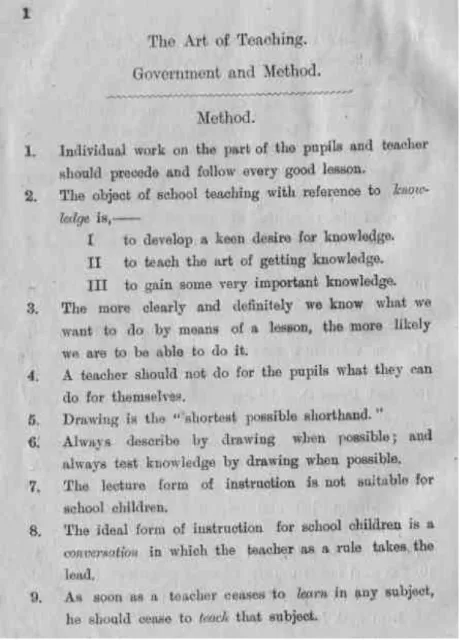
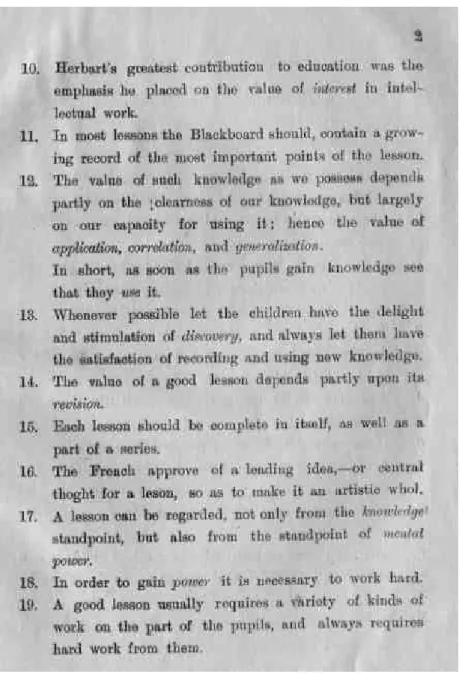
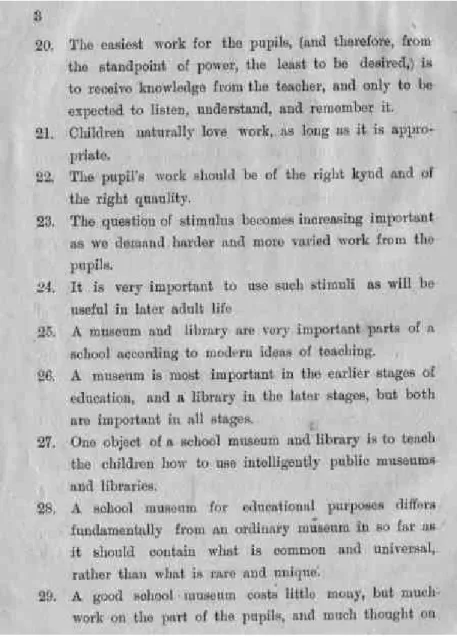
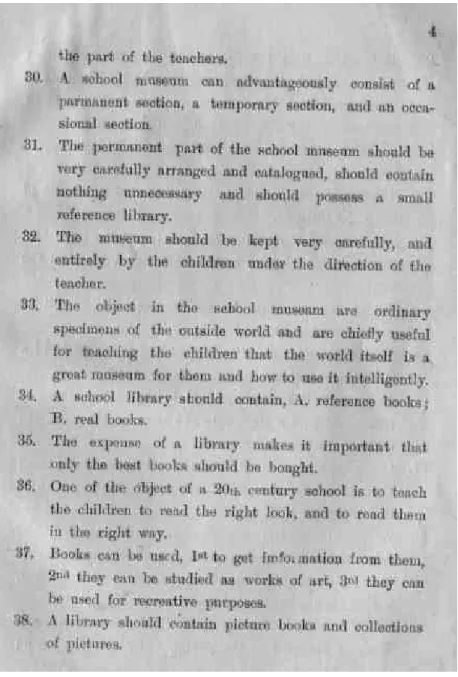
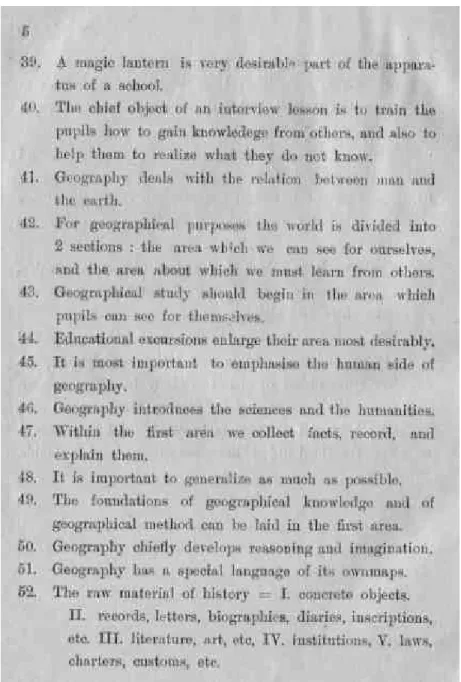
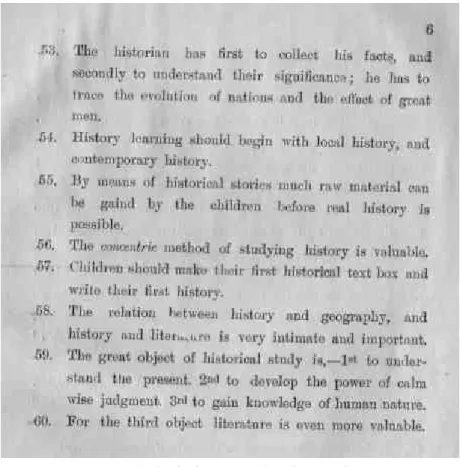
first chapter in Katei no Mohan (Exemplification of Home), 1902 (Figure 10); and Eikoku Fuzoku (English Life), 1902 (Figure 11). In the translation by Prof Honda Masujiro there is Appendix in The Art of Teaching, sixty cardinal points given to students at the outset of lectures (Figure 4-9), with a preface by the Principal Kanō Jigorō (1860-1938) entitled Miss Hughes’ Lectures on Pedagogy, Tokyo Higher Normal School for Men. Preface to the first article states: ‘Miss Hughes’ lectures are interesting and sharp in intelligence with the mixture of her own studies and own experiences of teaching; her critique of our education is worth listening to and quite useful.’ (Hughes, E. P., 1902a, 1-4)
Japanese educators were inspired by her progressive ideas and ethos, which resonated with imperialistic ideology in Britain (Ikeda, 2014).
4 This lecture was constructed by sixteen times with two hours for trainees who became teachers in April, at Tokyo Higher Normal School for Men in January and February in 1902.
-6-
Figure 4:Cardinal points 1-9, in the appendix. Source:Hughes, E. P., 1902a, 1.
-7-
Perspectives on the entangled history of New Education movement:Elizabeth Hughes, Tetsu Yasui and Harriet Finlay-Johnson
Figure 5:Cardinal points 10-19, in the appendix. Source:Hughes, E. P., 1902a, 2.
-8-
Figure 6:Cardinal points 20-29, in the appendix. Source:Hughes, E. P., 1902a, 3.
-9-
Perspectives on the entangled history of New Education movement:Elizabeth Hughes, Tetsu Yasui and Harriet Finlay-Johnson
Figure 7:Cardinal points 30-38, in the appendix. Source:Hughes, E. P., 1902a, 4.
-10-
Figure 8:Cardinal points 39-52, in the appendix. Source:Hughes, E. P., 1902a, 5.
-11-
Perspectives on the entangled history of New Education movement:Elizabeth Hughes, Tetsu Yasui and Harriet Finlay-Johnson
Figure 9:Cardinal points 53-60, in the appendix. Source:Hughes, E. P., 1902a, 6.
-12-
Figure 10:Cover of Exemplification of Home.
Source:Hughes, E. P., 1902b. Figure11:Cover of English LifeSource:Hughes, E. P., 1902c.
According to her observations of Japanese patriarchy, women in Japan were dominated by men, and domestic ideology maintained strong powers restricting individuality of woman in general. ‘Education for women is necessary for better homes and the development of society and the nation’. (Hirsch, 201) Yet through ‘Homes of England’ or English Life her account of the wife as ‘a queen of the home’ in middle-class Britain (Hughes, 1902b, 24-25), another possibility, the concept of ‘good wife, wise mother’ in Japan, was created.
After returning to the UK, her contributions are such that she was awarded MBE in the Order of the British Empire, for her services in British Red Cross Society, another significant social network during the First World War.5 She
5 In the collection in the Imperial War Museum (IWM) in London, a charity, four photographs of Miss Elizabeth P Hughes, Member of the Order of the British Empire (MBE), British Red Cross Society, WWC D8-6-32, were saved. https://www.iwm.org.uk/collections/item/ob-ject/205380562, accessed 09 May 2020.
-13-
Perspectives on the entangled history of New Education movement:Elizabeth Hughes, Tetsu Yasui and Harriet Finlay-Johnson
became the sole woman on a committee that drafted a charter for the University of Wales, and in 1920 she received an honorary degree from that university. When the New Education movement became an international organisation, and the concept of self-government became a focus of its leading journal, the New Era of the New Education Fellowship in April 1921 (New Era, 1921)6, Hughes published her opinion on ‘Self- Government in
schools’ alongside sixteen other influential educators including Norman MacMunn (1877-1925), Alice Woods (1849-1941) and J. H. Badley (1865-1967) (Figure 12). She mentioned that the problems or difficulties of ‘many teachers [who] still fear to introduce self-government’ can easily be removed if a few general principles are accepted, and she proposed such principles to develop citizenship.7 This proposal was clearly her expectation for the future.
6 She summarised the meaning of self-government and its application in schools: ‘The word “Self-Government” is unfortunately used in two different senses-1st the pupil governing himself at any rate for a short period and within certain boundaries: 2nd the pupil taking a share in the government of the community...Madame Montessori has developed wonderfully the first kind of self-government for young children, and her classes show us vividly that children work under these conditions with great enthusiasm and vigour. This kind of self-government develops initia-tive, love of work, capacity for hard work, a moral power which can only grow rapidly in a state of freedom, a great widening of interests, etc.’,
7 Her main opinions are: (1) Self- government should not be introduced suddenly... (2) In some schools self-government does not mean the making of laws, etc., but doing a good many tasks which take up much time, are often a grave anxiety and cause of worry to the pupils, and which otherwise would have to be done by the teachers... (3) It is obviously an advantage to copy as far as possible the customs of our national citizenship, e.g., to vote by ballot, to choose representatives, etc... (4) It is essential that if the pupils make a mistake, e.g. choose bad repre-sentatives, or make foolish laws that they should not be allowed to alter them for a given period so as to realise their mistake vividly by sad experience. (5) It is well to demonstrate to the pu-pils the special advantages of the school community, e.g. their great freedom, they can make any laws; they know one another and their conditions at first hand
-14-
Figure 12:Contents of The New Era
Source:New Education Fellowship, April 1921.
Hughes’ identification with her belief in the human-being as citizen had flexibility and strength, and through involvement in the New Education Fellowship she connected her hope to make a democratic society.8
Tetsu Yasui (1870-1945)
Tetsu Yasui entered the male-centered education system as a woman teacher (Figure 13) and administrator for a women’s university while receiving advice from Hughes and Ume Tsuda (1864-1929).
8 IWM London Our Collections Miss Elizabeth Hughes, https://www.iwm.org.uk/collections/item/ object/205380562, accessed 10 May 2020.
-15-
Perspectives on the entangled history of New Education movement:Elizabeth Hughes, Tetsu Yasui and Harriet Finlay-Johnson
Figure 13:Tetsu Yasui of Tokyo Women's Normal School days Source: Junko Takamizawa, Gonin no sensei tachi (Five women's
teachers), Nihon Kirisutokyo dan shupanbu (Publishing Department of Christian group in Japan) , 1960, no page. See also Aoyama, N. 1949, 21.
In October 1897 Yasui studied Pedagogy and the History of Education at Cambridge Training College for Women (f.1885) in England under its first principal, E. P. Hughes (Figure 14). Living independently as a woman, Yasui sent a comparative view to her friend on 2nd March 1900:
In Japan women are always dominated by men, which is tradition... It is no shame for me to be a single woman... It is the ultimate honor to live with God's will... Japanese women are always regarded like babies by men, and how men consider women in Japan is at a low level, a very worrying situation, I recognise. (Aoyama, 1949, 88-89)
This was her determination just before returning home, on how she would live in Japan, and offers a critical viewpoint on the gender bias as it existed in Japanese society, while she had never been interested in women’s movements such as the suffragettes in Britain and Seito (Japanese Blue
-16- stocking group, f.1911) in Japan.
Visiting the Universal Exposition in Paris, and impressed by meeting there with Inazo Mitobe (1862-1933), she returned to Japan in July 1900. She was eventually baptized as a Unitarian by Danjo Evina (1856-1937)10 on the
Christian feast of the Nativity, 25th December 1900. Following her enjoyable
work with Hughes, who stayed in Japan 1901-1902, her outstanding competency was fully demonstrated. But then she was ordered by the Japanese government to go to Siam (present-day Thailand), in order to set up the Empress Girls’ School in Bangkok (Figure 15) and to teach female students from January 1904 to March 1907, in the meantime she was becoming infected with malaria.
9 This phot was included in a letter from Yasui on 12 August 1898, Nao Aoyama, Yasui Tetsu Den (Autobiography: Tetus Yasui), 1949, 58.
10 He was baptized by Leroy Lansing Janes (1838-1909) of Kumamoto Yo Gakko (Kumamoto for-eign school in Kumamoto Prefecture), first co-education school in Japan.
Figure 14:Article on relation Hughes and Yasui
Source:The Hughes magazine, Issue 21, December 2014.9
https://issuu.com/hugheshall/docs/hughes-magazine-issue-21_bb79a2d772ad54/26, accessed 10 May 2020
-17-
Perspectives on the entangled history of New Education movement:Elizabeth Hughes, Tetsu Yasui and Harriet Finlay-Johnson
Figure 15:With her Colleagues in Siam (present-day Thailand) Source: Aoyama, N., ibid., 106.
Completing that mission for the Japanese government, she transferred to Wales, at Hughes’ suggestion, to study ethics and T.H. Green’s philosophy with J.S. Mackenzie (1860-1935) at Cardiff University(Figure 16), at her own cost, September 1907 to June 1908.
Figure 16: Professor J. S. Mackenzie and his wife Millicent Hughes Mackenzie (1863-1942).
Source: Millicent Hughes Mackenzie (ed), John Stuart Mackenzie, Williams & Norgate, 1936.
-18-
Returning to Japan once more she was involved in a difficult situation for a Christian: as lecturer at Gakushuin 1908-1909; she helped Umeko Tsuda of Jyoshi Eigakujyuku (Tsuda College) part-time; lectured at Tokyo Women’s Higher Normal School in 1910 and promoted as professor in 1912. She at last chose to settle, as she became a college supervisor at Tokyo Woman Christian College in 1918 under president Nitobe, taking the role of president from December 1923 to December 1940 ( Figure 17, 18 and 19). Yasui who expected education for woman did not deny that the ‘the good wife, wise mother’ concept, cultivated in the modernisation of Japan, as in an article entitled “Home Education versus Education for Women” in 1916 she stated that:
[The] conventional idea in Japan that educated women lose their motherhood is wrong...Women who have trained their intelligences and have wide interests and developed abilities of their judgement might make a good wife. (Yasui, 1916, 11-14)
She did not deny the role of mothers at home as a great responsibility to nurture children, and stated ‘The needs of the higher education for women arise from the need to qualify mothers.’ This statement therefore was set not only against the national consciousness of women as mothers in Japan, but also represented progress on the ideology of ‘Good Wife, Wise Mother’, which expressed her nationalism.
Yasui faced the hard work of ‘being responsible for the life of each student’ (Aoyama, 1949, 226: Karasawa, 1979, 177) based on the respect of students’ individuality. Her identity with educational conviction and belief might be made in her own transnational network and knowledge. Moreover, her shock is to be noted as a key to understanding her identity, when policemen arrived at her university to arrest students who believed in Marxism and joined the
-19-
Perspectives on the entangled history of New Education movement:Elizabeth Hughes, Tetsu Yasui and Harriet Finlay-Johnson
socialist movement. She advocated that they should speak about their beliefs and ideas, and should seek a legal judgment. (Aoyama, 1949, 169: Karasawa, 1979,179) President Yasui thus aroused criticism from the media, but avoided the students’ withdrawal by putting pressure on their opponents.
Figure 17:Main building of Tokyo Woman University
Source: https://www.twcu.ac.jp/univ/about/introduction/spirit/index.html, accessed 10 May 2020.
Figure 18:Opening ceremony of Tokyo Woman University, April 1918 Source: https://www.twcu.ac.jp/univ/about/spirit-and-history/archives/,
accessed 10 May 2020.
-20-
Figure 19:Graduating ceremony of Tokyo Woman University
Source: https://www.twcu.ac.jp/univ/about/spirit-and-history/, accessed 10 May 2020. See also Nao Aoyama, 1949, 241.
Harriet Finlay-Johnson (1871-1956) 11
Qualified as a teacher through private study of Froebelian principles and practice, rather than through college training, at the age of 26 in 1897, Harriet Finlay-Johnson took charge of a small village school in Sompting, Sussex, as head-teacher, with her sister as the sole assistant teacher of infants. Finlay-Johnson reflected a growing Froebelian trend, but applied kindergarten methods equally to her fifty junior pupils across the age range 8 to 14. Much of their curriculum focused on nature study pursued in an alternative space beyond the bounds of the classroom, cultivating school gardens and exploring the local environment. Out of classroom activities became an established feature of the curriculum: rambles in the surrounding country and on the local seashore, bee-keeping, gardening, and cooking. (Cunningham, 2018, 23-24) In 1902 she was prized as one of twelve
excellent teachers by the local School Board.
11 The school building in Sompting is now a community centre which is named the Harriet John-son Centre. On the side of the building is a blue plaque to Harriet Finlay JohnJohn-son. https:// en.wikipedia.org/wiki/Harriet_Finlay-Johnson, accessed 01 Aug. 2019.
-21-
Perspectives on the entangled history of New Education movement:Elizabeth Hughes, Tetsu Yasui and Harriet Finlay-Johnson
Chief Inspector Edmond Holmes (1850-1936)12(Figure 20), ‘as a key
figure in the New Education which became labelled the ‘Progressive Movement’’’ (Bowmaker, 2002, 92), visited Sompting school on 26th
November 1907 and observed her dramatic method, then re-visited two weeks later on the 11th, and again 12th with his friend with B. Hawker
(1868-1952) (Bowmaker, 2002, 89-90). He was the most senior official responsible for the quality of the nation’s schools, and subsequently credited Finlay-Johnson with transforming his view of education (Figure 21). (Cunningham, 2018, 23)
Figure 20:Edmond Holmes
Source: The Beginning of New Ideals and Edmond Holmes, https://newidealsineducation.blogspot.com/2018/09/ the-beginning-of-new-ideals-and-edmond.html, accessed 10 May 2020
12 Edmond Holmes became Chief Inspector of Elementary Schools in 1905. Holmes had a lifelong interest in Buddhism and pantheism, and his religious ideas permeate What Is and What Might Be. Nonetheless the book was an important contribution to the debate about the nature and purpose of education. In their 1980 book Inside the Primary Classroom (The ORACLE Report) Galton, Simon and Croll describe it as 'the first striking manifesto of the "progressives" in its to-tal condemnation of the arid drill methods of the contemporary elementary school'.
-22-
Figure 21:Harriet Finlay-Johnson Source:Bowmaker, 2002, no page.
The relations between history and geography, and history and literature are very intimate and important. Historical stories acted out to gain knowledge of human nature (Figure 22).
Figure 22: School libraries, real books, reading for information and for recreation.
Source:Bowmaker, 2002, viii.
-23-
Perspectives on the entangled history of New Education movement:Elizabeth Hughes, Tetsu Yasui and Harriet Finlay-Johnson
In August 1909 (Bowmaker, 2002, 106), Finlay-Johnson got married to her former pupil George Weller (?1888-1952) who was 17 years younger than her, and she bravely fought the inevitable local gossip (Figure 23). Marrying a former younger pupil was undoubtedly scandalous at that time, and no doubt a great shock to the whole village. Finlay-Johnson resigned on 24th of
March 1910 (Bowmaker, 2002, 115), just as previously another woman had resigned from the school on marriage, a common expectation.
Figure 23:Wedding with her former pupil Mr George Weller Source:
https://search.yahoo.co.jp/image/search?rkf=2&ei=UTF-8&gdr=1&p=Harriet+Finlay-Johnson#mode%3Ddetail% 26index%3D0%26st%3D0, accessed 1 Aug. 2019.
Holmes in his 1911 book, What Is and What Might Be: A Study of Education in General and Elementary Education in particular 13, drew national
13 In 1910 Holmes wrote a confidential memorandum in which he criticised school inspectors who had previously been elementary school teachers, and who were understandably angered when it was made public. Secretary to the Board of Education Robert Morant was forced to demand Holmes’ resignation, following which Holmes visited Rome to research Maria Montessori’s Casa dei Bambini (1906-1911).
-24-
and international attention to the work of a rural elementary school head-teacher, a young woman, with the pseudonym ‘Egeria’. Holmes described how, in her school:
... every child is, as a rule, actively employed. And bearing in mind that “unimpeded energy” is a recognized source of happiness... there is a close connection between the activity of the children and the brightness of their faces. (Holmes, 1911, 155)
Finlay-Johnson, persuaded by Holmes, published The Dramatic Method of Teaching in 1911 and described her progressive method in a few introductory words.
I taught my school children by the Dramatic Method... I feel sure that all educationists worthy of the name will agree that at the present day, more than ever before, only the very best will be good enough for the education of our children. (Finlay-Johnson, 1911, 15)
Holmes’s book is more philosophical and hers more pragmatic, offering between them not only a graphic account of progressive practice in many aspects, but also a most original and influential case study of drama as pedagogy. ‘Her explanations of activity and experience, exploration and discovery, creativity, individual and collaborative expression in the children’s work, and a new role for teachers, reflect the broad scope of new vehicles of learning that were being discovered and developed in the early twentieth century.’ (Cunningham, 2018, 23) Yet teaching through children’s drama tended to traditional literature such as Shakespearean plays, and the wall decoration and visual displays in the class room impressed middle-class tastes in the late Victorian and Edwardian era, though her teaching method was
-25-
Perspectives on the entangled history of New Education movement:Elizabeth Hughes, Tetsu Yasui and Harriet Finlay-Johnson
certainly radical.
Finlay-Johnson’s dramatic method of teaching, with its quality confirmed by HMI, was introduced into Japan by the translation of Holmes’ book in 1913,14 and later in 1923 by different translators. Seishi Shimoda,15 a
transnational conduit of progressive thought and practice, as an art teacher from 1921 at the independent Tokyo progressive school, Seijo Gakuen, translated her book into Japanese in 1923,16 in a single month, aided in
scribing and copying by two women Umeko Hiragaki and Kaneyo Kobayashi, who later became teachers at Ikebukuro Children’s Village School, Tokyo. Arata Osada (1887-1961), a scholar in Hiroshima,17 emphasised in its preface
that ‘Education has to correspond to life....’ (Osada, 1923, no page), and ‘In Europe and America the integrated method with drama and education has been heavily differentiated and developed, not simply drama set pieces performed by children for a public audience at a school’s Arts Festival.’ (ibid) He surprised his readers with Finlay-Johnson’s use of dramatic methods not only for history and literature but also nature study, geography and arithmetic, and he encouraged dramatization in education.
In addition, Finlay-Johnson’s essay ‘Drama in Education’ was published in
14 Translator Gentaro Matsumoto (1859-1925), professor of Gakusyuin, received a letter from Holmes, in which he expressed his belief in Buddhism.
15 Shimoda also derived inspiration from A.S. Neill (1883-1973), whose writings he translated into Japanese. He visited Finlay-Johnson in 1928 but the precise date is not clear, and Akira Okada (1923-2009) in Tamagawa University, Tokyo, informed Mary Bowmaker, biographer of Finlay
Johnson, that a Japanese translation was made as Gekika seru kakuka kyojyuho in 1923. 16 In Japan led by Kuniyoshi Obara (1887-1977), children’s drama was initiated at a conference
of National Elementary Teachers’ Association in Hiroshima, 1918. In Tokyo 2,000 elementary teachers observed the first public school drama performance at Seijo, and children’s drama in school soon became very popular among elementary schools all over Japan. See Cunningham P. and Yamasaki, Y. (2018) 20.
17 Osada, A. and Sawayanagi M., took an interest in progressive women teachers. They travelled abroad to observe school systems in the world for one year, visiting Giuslia Civita Franceschi (1870-1957) in Italy and Margaret McMillan (1860-1931) in London. See Osada, A. and
Sa-wayanagi M. (1923).
-26-
New Era, January 1923 and was introduced to Japanese educators in greater detail by translation in the monthly progressive magazine, Kyoiku no seikisha (Century of Education) in 1924. (Kyoiku no Seikisha, 1924)
Perspectives on the entangled history of New Education: possibilities for an alternative historiography?
The first point requiring emphasis is the possibility of presenting an alternative historiography for these three agents, using the concept of ‘translation’ as a lens. Hughes and Yasui related to each other as teacher and student, across an age difference of approximately twenty years, and entered into the male-centred education systems in their respective national societies, based on a gendered division of labor, supported by a few humanitarian educators of the opposite sex. Hughes’ legacy to ‘new education’ was that she not only opened the door of secondary education to women, but also conveyed the importance of responding to and encouraging the individuality of children. Her ideas were also aligned with those of progressive men like Cecil Reddie (1858-1932) and J. H. Badley in the New Education movement. Yasui’s ideals for education for women were gathered through her educational tourism. A key concept related with Yasui’s thought is ‘Personalismus’, based on Christianity which was formed by practical life with Hughes and Philosophy and Ethics in British Idealism. Yet Yasui’s impact on women’s education was only for the middle class, where we have to recognize some limitation, from the perspective of modern expectations regarding gender. Nevertheless, she was one of the pioneers for improving the status of women, who suffered discrimination in her time. Ideas of liberty for women and mothers in the middle class opened the road for those who were to gain the right to a higher education later. In addition women had a way of interrogating their own interests and motivation, and addressed a broad intellectual knowledge with freedom and emancipation.
-27-
Perspectives on the entangled history of New Education movement:Elizabeth Hughes, Tetsu Yasui and Harriet Finlay-Johnson
Finlay-Johnson’s progressive method represented new pedagogy supported by male inspectors including Holmes, and her Japanese translator. Many of her ideas, although she encountered typical gender problems, she would in time be taken up by what became known as the progressives and her work came to influence the curriculum in schools all over the UK and the USA, and Japan, remaining relevant to this day. The ideas of Hughes and Finlay-Johnson, nevertheless lacked any critique of a gendered and classed society. From a modern perspective, a weak point in their progressivism appears to be a lack of teaching about awareness of women’s rights or a critical stance to traditional gender bias in acceptance of women’s primarily domestic role as wives and mothers. That problem may be seen as rooted in the lives of Hughes and Yasui as unmarried women with experience of childbirth, and Finlay-Johnson as women with inexperience of childbirth.
What we are concerned here is two ways we should put intentionally. Three agents engaged in a social and transnational network, established some personal ideals for education, fighting various forms of discrimination for native Welsh and Japanese, Christians and members of their own sex. They confronted gossip about their personal lives, whilst weaving a thread of new or progressive education within the imperial contexts that pertained in Britain and Japan, indicating the prospect of alternative histories. What I introduce in this article is a simple approach from Japan. We could describe a more nuanced and variegated historiography of New Education movement based on women’s activities, embedded in plurality channels, at the beginning of twentieth century in Britain and Japan, if we trace the intricate tapestry by following the many warps and wefts within their activities and administrations. Doing this we might clarify its history observed through a two-way lens, to identify any impact on Hughes’ or Finlay-Johnson’s ideas and pedagogical principles, following their relationship with the Japanese.
-28- Appendix:
The lives and careers of Elizabeth Hughes, Tetsu Yasui and Harriet Finlay-Johnson: an overview
The table outlines their main activities as a linear progression in the context of various routes.
Elizabeth Hughes (1851-1925) Tetsu Yasui (1870-1945) Harriet Finlay-Johnson (1871-1956) 1850 1851 ・ born to a Christian nonconformist (Methodist) family
in Wales, her father a medical officer of health and chairman of the school board, a prominent civic activist. 1860 1870 1877-1881 ・ taught at Cheltenham Ladies' College. 1870 1876
・ born to a Shinto and Buddhist family,the warrior class, Tokyo. ・ enrolled into
elementary school in Tokyo.
1871 ・ born in Hampstead, London. Her father, master of builder. 1880 1881-1884 1884 1884 1885 1885, Oct. ・ studied at Newnham College, Cambridge, the first year in which women were admitted to university examinations. Hughes studied at first Moral Sciences (to 1884) and then History (1884-5). ・ a first in the moral
science Tripos. ・ won a prize for her
essay ‘The higher education of girls in Wales’ ・ a second in history ・ appointed first principal of Cam-bridge Training College for Women (CTCW). 1881 1882 1884 ・ transferred to the preparatory school of Tokyo Women’s Nor-mal School (TWNS) ・ transferred Women’s Higher middle school (THWNS), abolition of TWNS. ・ entered Tokyo Women’s Normal School D12286-72002235_Ⅰ-Yoko Yamasaki.indd 28 2021/02/22 9:21:44
-29-
Perspectives on the entangled history of New Education movement:Elizabeth Hughes, Tetsu Yasui and Harriet Finlay-Johnson
1890 1898
1899
・ Secretary of the Association for Promoting the Educa-tion of Girls in Wales.
・ resigned as principal of the CTCW, pleading ill health
1890 1892 1894 1896, Dec. 1897, Oct. ・ Associate teacher at Women’s Higher Normal School after graduation THNS. ・ Teacher at Iwate Normal School. ・ Teacher at Women’s Higher Normal School. ・ Order to abroad
study for three years in Britain.
・ Study at Cambridge Training College for Women under Hughes. 1892 1897 ・ passed Certificate Examination (second division), qualified teacher after working for eight years at St Mary's C of E School, Willesden. ・ appointed to headmistress at the village school, Sompting, Sussex. Her sister Emily was appointed to work in the infant depart-ment as an assistant teacher. 1900 1900-1901 1901, Aug.-Nov. 1902 1902, Apr. 1902 ・ visited Massachusetts and Chicago to study the probation system. ・visited Japan. ・ appointed as Professor of Japan Women University (pioneer of Women’s University in Japan). ・ formed the Barry
Twentieth Century Club for lifelong education. 1900, Apr. 1900, Sep 1900, Dec 1901-02 1904, Jan -1907, Mar 1907, Sep.- 1908, Jun. 1908-09
・ meeting with Inazo Nitobe in Paris. ・returned to Japan. ・baptized a Christian. ・ attendant and translation for Hughes. ・ Deputy head at Women’s Higher School in Bangkok. ・ study at Cardiff University under J. S. Mackenzie. ・ Lecturer at Gakushu-in, Tokyo. 1902 1907 1909, Aug.
・ prize for excellent teacher.
・ E.G. Holmes, HMI, visited Finlay- John-son’s village school. ・married.
1910 1918 ・ MBE of the Order of the British Empire for her lectures in Red Cross Hospital in Barry. 1910 1912 1918 ・ Lecturer at Tokyo Women’s Higher Normal School. ・ Professor at the University above. ・ Lecturer and a college supervisor at Tokyo Woman Chris-tian College (TWCC). 1910, Mar 1911 1911 ・resigned. ・ Holmes introduced Finlay-Johnson’s dramatic method of teaching in his book, What Is and What Might Be. ・ published Dramatic
Method of Teaching.
-30-
1920 1920 1921
1925
・ received an honorary degree from the University of Wales. ・ published an article ‘Self-government in school’ on the New Era. ・death. 1923 ・President at TWCC 1923, Jan. ・ published an article ‘Drama in Education’ on the New Era.
1930
1940 1949 ・ CTCW renamed Hughes Hall in her honour. 1940 1945 ・retired from TWCC ・death. 1950 1956 ・death. References:
Aoyama, N., (1949), Yasui Tetsu Den (Story of Tetsu Yasui), Tokyo: Iwanami shoten. [In Japanese]
Bowmaker, Mary (2002), A Little School on the Downs, West Sussex: Woodfield.
Cunningham, P. and Yamasaki, Y. (2018), “Space and Time in the Creative Curriculum: Drama and education in two island nations in the early twentieth century”, Espacio, Tiempo y Educación, 5(2): 11-33.
Finlay-Johnson, H. (1911), The Dramatic Method of Teaching, James Nisbet & Co., Limited.
Finlay-Johnson, H.("Egeria") (1923), “Drama in Education”, New Education Fellowship, The New Era, January, vol.4, no.13, 131-134.
Froebel society Japan (1901), Kaiho (Society News), Fujin to Kodomo (Women and children), vol.1, no. 11, Nov. 1901, appendix 1. [In
Japanese]
Galton, Maurice J.& Simon, Brian & Croll (1980), Paul, Inside the Primary Classroom (The ORACLE Report), London: Routledge & K. Paul. Tsujimoto, M. and Yamasaki, Y. (eds.) (2017), History of Education in Japan
(1600-2000), London: Routledge.
Hashimoto, Miho (ed.) (2018), Taisho Shinkyoiku no Juyoshi (The history of
-31-
Perspectives on the entangled history of New Education movement:Elizabeth Hughes, Tetsu Yasui and Harriet Finlay-Johnson
reception of New Education in Taisho era, Japan), Tokyo: Toshin do. [In Japanese]
Hirsche, P. and McBeth, M. (2004), Teacher Training at Cambridge, London: Woburn press.
Holmes, E. G., (1911), What Is and What Might Be: A Study of Education in General and Elementary Education in particular, London: Constable & Co. Ltd.
Hughes, E. P., Yasui T. (trans.) (1901), “Yochien ni okeru Yoji Kojinsei no Hatsutatsu oyobi Hogo” (Development and care of Individuality of child in the kindergarten), Fujin to Kodomo, vol. 1, no. 11, Nov. 57-63. [In Japanese] We can download from Ochanomizu University Web Library-Institutional Repository, https://teapot.lib.ocha.ac.jp/?action=pages_view_ main&active_action=repository_view_main_item_detail&item_ id=33103&item_no=1&page_id=64&block_id=115, accessed 04 April 2019.
Hughes, E. P., (1902a), Honda, M. and Tanahashi, G. (trans.), Kyojuhokogi (The Art of Teaching), Tokyo: Sankaido shoten. [In Japanese]
Hughes, E. P., (1902b), Honda, M. (trans.), “Home of England”, in Katei no Mohan (Exemplification of Home), Tokyo: Ikuseikai. [In Japanese] Hughes, E. P., (1902c), Ogata, R. (trans.), Eikoku Fuzoku (English Life),
Tokyo: Chishin kan. [In Japanese]
Ikeda, K. (2014), “British Cultural Influence and Japan: Elizabeth Phillips Hughes's Visit for Educational Research in 1901-1902”, The International Journal of the History of Sport, 31(15):1925-1938.
Karasawa, T., (1979), Jyoshi Gakusei no Rekishi (The history of women students in Japan), Mokuji sha. [In Japanese]
New Education Fellowship (1921), “Self-Government in Schools”, The New Era, April ,vol. 1, no. 6, 159-181.
Osada, A., Jo (Introduction), Johnson, H. F. Shimoda, S. (trans.) (1923)
-32-
Gekika seru kakuka kyojyuho (The Dramatic method of Teaching), Nihon Kyoiku Gakkai. [In Japanese]
Ōno Nobutane(1989), “E. P. Hughes in Japan (1901-1902)”, Gakushuin University Faculty of Letters, Research Annual Report, 36, 323-346. [In Japanese]
Udono, A., (2014), “Kosei gainen ni tsuite no ichikosatsu” (A study about the concept of Individuality in Japan], Bunkyo Gakuin Daigaku kyosyoku katei centre, Bunkyo Gakuin Daigaku kyosyoku kenkyuronsyu, vol. 5, 65-73. [In Japanese]
Yasui, T. (1916), “Katei kyoiku tai jyosei kyoiku” (Education at home versus education for women), Fujin shu ho (Weekly Magazine for Women) vol. 2, no.7, 11-14. [In Japanese]
Yamasaki, Y. and Kuno, H. (eds.) (2017), Educational Progressivism, Cultural Encounters and Reform in Japan, London: Routledge.
Yamasaki, Y. (2016), "Tetsu Yasui and Transcultural Influences in Educational Reforms for Women", Nishinomiya: Mukogawa Women’s University, Annual Report of Research Institute for Linguistic Cultural Studies, 26, 101-121.
Yamasaki, Y. (2015), "Developing citizenship: lessons from British progressives, Dramatic Method of Teaching by H. Finlay-Johnson(1912)", Nishinomiya: Mukogawa Women’s University, Research Bulletin of Education, vol. 10, 17-23.
Yamasaki, Y. (2013), "Continuing the conversation: British and Japanese progressivism", History of Education,London: Routledge Taylor & Francis, 42(3): 335-349.
Yamasaki, Y. (2010), "The impact of Western progressive educational ideas in Japan: 1868-1940, History of Education,London: Routledge Taylor & Francis, 39(5): 575-588.
-33-
Perspectives on the entangled history of New Education movement:Elizabeth Hughes, Tetsu Yasui and Harriet Finlay-Johnson
Note: This paper is based on my handouts for symposium of the 2019 World Education Research Association (WERA), Focal Meeting, entitled Gender and Transnational Perspectives in the History of Education, ID: 352, 5th-8th August 2019 in Tokyo. Presenters are as follows:
Speakers: Setsuko Kagawa (Nishikyushu University, Japan), Joyce Goodman (Winchester University, UK) Yuko Takahashi (Tsuda University, Japan), Sayaka Nakagomi (Rikkyo University, Japan) and Yoko Yamasaki.
Chair: Makoto Iwashita (Aoyama University, Japan). Discussant: Takayuki Sato (Waseda University, Japan).
Acknowledgment: This work was supported by Japan Society for the Promotion of Science (JSPS), Grant-in-Aid for Scientific Research (KAKENHI) (C), 17K04594 and 17K04550.
Ⅱ.言語文化研究所 秋季言語
文化セミナー(2019年度)
−37−
秋季言語文化セミナーを開催するにあたって
(2019年11月30日〔土〕開催)
玉 井 暲(言語文化研究所所長)
言語文化セミナーは、日本内外の著名な研究者を招いて、言語文化につい てのご高説を拝聴するのを恒例にしている。 今年度は、秋季セミナーにおいて、武庫川女子大学言語文化研究所の前所 長でいらっしゃった佐竹秀雄先生(武庫川女子大学名誉教授)にお願いをし て、現代日本語における最近の言葉使いの特徴についてお話を伺った。先生 は、近年流行しているさまざまな日本語を取りあげ、伝統的な用法からすれ ば、場合によっては逸脱していると見なさざるを得ないさまざまな表現につ いて、そうした表現の生まれた文化的・社会的背景を視野に入れつつ、丁寧 に考察をされた。その姿勢は、それらの用法を、一方的に批判したりはせず、 いわば正誤の両面から寛容に包み込んで分析を加え、望ましい用法への啓蒙 を交えながら、そうした如何かなと思われる新しい言語現象の生まれている メカニズムをわかりやすく解説していただいた。 D12286-72002235_Ⅱ-01玉井暲.indd 37 2021/02/19 10:35:08−39−
此比巷ニハヤル物
―誇張 短縮 非断定 安直敬語 非自主性―
佐 竹 秀 雄
1.はじめに タイトルは、14世紀前半における、当時の世相を風刺した文書『二条河 原の落書』の冒頭部分をもじったものである。サブタイトルは本セミナーの 主張にかかわるもので、もとの文書が七五調であるのに合わせている。 本セミナーで扱うものは、世相を強く反映することばである。近ごろの日 本語には、旧来の日本語とは異なる、新しい現象がいくつか見られる。それ らは、どういう特徴をもち、なぜ生じるのか。あるいは、そこにどのような 意味があるのか。旧来にはなかった語感による表現法の傾向を分析し、それ らのメリットとデメリットについて考えることが目的である。 以下、近年流行していると位置づけられる言語現象を取り上げ、共通する 性格ごとに整理して述べる。 2.誇張表現と漢語好き (1)発覚・号泣・快挙 単語の問題から始めよう。第1は「発覚」である。スポーツ紙の見出しで、 芸能人の話題を取り上げたものに、次のような表現がよく見られる。 ① 「○○と××、熱愛発覚」「◇◇に恋人発覚」 「発覚」の本来の意味は「隠していた悪事・陰謀などが明るみに出ること」 で、「○○さんにガン発覚」などが普通の使い方である。つまり、「発覚」の 対象は、「悪事・陰謀」などよくないことであり、本来なら「熱愛」「恋人」 は「発覚」の対象になり得ない。 それにもかかわらず、「発覚」が使われる理由は、芸能界において「熱愛」 「恋人」はよくないことだということであろう。一般の人にとっては、恋愛 D12286-72002235_Ⅱ-02佐竹秀雄.indd 39 2021/02/03 16:15:48−40− は決して悪いことではないが、芸能人にとってはファンに見放される可能性 があり、好ましくないことだとも言える。よって、恋愛は隠すべきことがら であり、それが露見したときに「発覚」となるのであろう。 このような理屈で使われ始めたと思われるが、近年は、それだけでなく、 もはや理屈抜きに定型化した表現であるかのように使われている。 第2は「号泣」である。インターネットの世界では、次のような例が見つ かった。 ② 「なんだか涙が出てくる」号泣ソング集 ③ 「久しぶりにしゃっくりみたいな泣き方をしてしまった」と号泣した ことを告白した。 「号泣」は、本来「大声をあげて泣く」という意味であるが、近年、「声を あげないで泣く」場合や、単に「泣く」だけの意味に使われる。 文化庁の「国語に関する世論調査」(2010年度)によれば、「号泣」の意 味を問うアンケートに対して、次のような結果が示されている。 「大声をあげて泣く」という意味……34.1% 「激しく泣く」という意味………48.3% 本来の意味でない方が多く支持されている。こうした事実を反映してか、 「三省堂国語辞典」第7版(2014)には、語釈に第1義として本来の意味を 示した後、第2の意味として「[ 俗 ] 大いになみだを流すこと。」と掲載さ れている。しかし、現実には「大いに泣く」どころか、上の②のような、単 に涙を流す場合や、さらには、涙をぽろっとこぼす程度に対しても「号泣」 が使われている例が見られる。やはり誇張表現と言わざるを得ない。 第3は「快挙」である。地方新聞では、次のような記事があった。 ④ 見出し:〇〇さん、ソフトテニスで快挙 本 文: 「第1回アジアジュニアソフトテニス選手権大会」で、〇〇 〇〇さんが12歳以下のシングルス男子の部で優勝しました。 ⑤ 本 文: 「第11回フラワーデザインコンテストクイーンズカップ 2019」の学生部門に出場し、花歴0年で第3位を獲得する という快挙を成し遂げた。 D12286-72002235_Ⅱ-02佐竹秀雄.indd 40 2021/02/03 16:15:48
−41− 此比巷ニハヤル物 ⑥ 見出し:ダイオウグソクムシ脱皮確認 全部脱げたら…世界初快挙 本 文: これまではいずれも体の後半部のみの脱皮だっただけに、〇 〇〇〇学芸員(49)は「前半部も完全に脱皮して、世界初 の快挙を達成してほしい」と期待を寄せる。 「快挙」は、辞書では「胸のすくような(真似のできないような)すばら しい行為」などとされる。④では、本文では単なる優勝とされることを、見 出しでは「快挙」と表現されている。⑤では、始めて間もないという条件は あるものの、3位でも「快挙」とされる。⑥は、ダイオウグソクムシという 甲殻類生物が脱皮することが快挙の対象である。これも「発覚」「号泣」と 同様、誇張したシーンで使われている。 (2)購入・挿入・投入・供す・食す 次に、使われる単語が、以前と違って異なる語に変化したものを取り上げ る。インターネットで検索すると、次のような例が見つかった。 ⑦ 馬券(勝馬投票券)は何歳から購入できるのですか? ⑧ 上腕式血圧計(腕を挿入するタイプ) ⑨ 味に関してはシンプルでしたがやはりニンニクを投入することで良さ が出るのかも ⑦の場合、以前なら「買えるのですか」と表現していたところである。「買 う」が「購入」に変化した。「自宅用の土地」でも「100円程度の菓子」で も「買う」よりも「購入する」が使われる。 ⑧は「入れる」から「挿入」への変化である。電車で乗り越し精算をしよ うとすると、精算機にカードを「挿入してください」と言われたりする。「入 れてください」ではない。⑨も「入れる」ではなく「投入する」が好まれる。 「買う」から「購入する」、「入れる」から「挿入する」「投入する」への変 化は、いずれも和語から漢語への変化である。和語が日常語で多く使われる のに対して、漢語は書きことばで多く使われる傾向がある。つまりは改まっ た性格をもっている。それだけに、話しことばで漢語が使われると、大層な 印象を与えるのである。 D12286-72002235_Ⅱ-02佐竹秀雄.indd 41 2021/02/03 16:15:49
−42− 以下は、食にかかわるテレビ番組での例である。 ⑩ 妻の手作りの料理が、日曜日の食卓に供せられる。 ⑪ 茶こしなどで粉砂糖を振りかけて供します。 ⑫ わたし、食さなくても、おいしさがわかります。 ⑬ 毎日、一食はラーメンを食することにしています。 「供する」「食する」を使った例である。単に「出す」「食べる」という日 常でよく使う語でもいい場面である。ここでも、やはり和語から漢語への変 化が認められる。 以上、「購入・挿入・投入・供す・食す」が好まれて使われている事実は、 和語を漢語で言い換える傾向の存在であり、それは、大層な物言いを好む傾 向だとも言える。要するに、漢語による誇張表現の増加という流行である。 3.責任回避の曖昧好み (1)「…(の)かなと思います」 ここでは文末表現を取り上げる。次は、テレビでのコメントである。 ① いのちということを、活動の中で大事にしていることかなと思います。 ② 少子化というのは、なかなか厳しいのかなと思っております。 発言の最後に「…かなと思います」「…のかなと思います」という言い方 をする人が増えている。コメンテーターに限らず、政治家、官僚から一般庶 民まで、地位や立場に関係なくよく使われている。 「(の)かな」の部分を抜いた「…と思います」と比べれば明らかなように、 「(の)かな」によって、発言のトーンが弱くなる。主張も柔らかいものにな る。その発言が、自分の主張をすべき場面であれば、決して好ましいことで はないはず。しかし、他方、その意見が相手と異なる主張であれば、和らげ る効果によって、鋭い意見対立を招かないですむことにもなる。 この問題について、小野正樹(2006)では、次のように述べている。 他の意見を排除しないことを表し、話題に関係のある人や組織、他の意 見に配慮を示す。強い意思をやわらかな印象で伝えたり、自分自身の評 価を控えめにしたりする機能がある D12286-72002235_Ⅱ-02佐竹秀雄.indd 42 2021/02/03 16:15:49
−43− 此比巷ニハヤル物 また、鈴木智美(2015)では、次のように述べられている。 聞き手と思考内容を共有せず、あくまでも個人的な見解であることを示 しつつコメントするというのは、主張を曖昧にしつつ、自己防衛を行お うとする発言の姿勢である。 これらの指摘にもあるように、「…(の)かなと思います」という表現法は、 主張を曖昧にするものであるが、そこには、周りに配慮する、柔らかな指摘 にとどめるという効果を持つとともに、それによって相手から反論をされな いようにできるという利点がある。だから、好まれて使われるのだ。 表明した意見が、一般人による芸能ゴシップや天気予測のような無責任な ものであれば、何も問題はない。しかし、例えば、政治家や行政官が国民の 暮らしにかかわる意見の表明に使ってもらっては困る。もっとも、「…(の) かなと思います」を使って責任逃れをしている可能性も十分考えられるが。 (2)「…かもしれません」 「…(の)かなと思います」と類似のものに、「…かもしれません」がある。 次は、テレビの報道番組でのMCの発言である。 ③ このようなスタイルの店が、今後増えていくかもしれません。 ④ 日本の歴史を塗り替えるかもしれない。そんなニュースでした。 現実の状況を報道しておいて、最後のまとめに「かもしれません」を付け るのである。報道の姿勢としてこれでいいのだろうか。「かもしれない」を 付ければ、何も言っていないことと等しくなってしまう。断定を避けている。 非常に無責任な発言ということになろう。 それにもかかわらず、好んで使用されるのはなぜか。それは、断定を回避 することで、だれにも文句を付けられないというメリットが生まれるからで ある。近年、ネット社会では、特定の人物の発言が簡単に攻撃を受ける事態 が生じる。いわばクレーム社会が進化しているのであり、そのような社会で 身を守るのに、「…かもしれません」はとても便利な武器になるのである。 D12286-72002235_Ⅱ-02佐竹秀雄.indd 43 2021/02/03 16:15:49
−44− 4.敬語・敬意表現に関する意識 (1)「…してもらっていいですか」 最後は、敬語の問題を扱う。その第1は、依頼の表現「…してもらってい いですか」である。 ① 私の代わりに行ってもらっていいですか。 ② 恐れ入りますが、お名前を聞かせてもらってよろしいでしょうか。 どちらも、現実には丁寧に依頼をしている場面である。しかし、敬語とい う点で見ると、①では、「いいですか」の丁寧語「です」が使われているだ けで、尊敬語も謙譲語も使われていない。②についても、同様に、丁寧語「ま す」「お」「です」しか使われていない。このように考えると、敬語形式とし ては敬意の高い表現とはとても言えないものである。 ところが、現実には、この「…してもらっていいですか」の依頼表現は、 非常によく使われている。しかも、使っている人は、敬意の高い表現だと思 い込んでいるようなのである。 その理由の一つは「もらう」にあると思われる。「もらう」は相手から恩 恵を受ける意味を示す。恩恵の授受関係は上下関係と同じように認識されや すい。恩恵を与える側が上位者で、受ける側が下位者と認識されるのである。 例えば、「先日は結構なものをいただきました」と述べるとき、モノの授受 を通して、相手と自分の間に一時的な上下関係を認識するような感覚が生じ る。その感覚は、敬語を使用するときの意識に通じる。つまり、「もらう」 を使うことが、敬語を使うような錯覚を生んでいると考えられる。 もう一つの理由は、「よいか」という相手に許諾を求める表現にもある。 許しを相手に求める場面だから、許しを与える側が上位者、許しを求める側 が下位者の立場となる。したがって、「よいか」と許しを求める表現そのも のが、相手を上位者として立てる、敬語に通じる意識があると考えられる。 要するに、本来、敬意を示さない表現形に、今や敬意が存在すると人々が 思い始めたということである。 この問題については、NHK 放送文化研究所の調査(2007年)がある。「… していただいてよろしいですか」という言い方に対して、違和感をもつ人は D12286-72002235_Ⅱ-02佐竹秀雄.indd 44 2021/02/03 16:15:49
−45− 此比巷ニハヤル物 平均39% であり、高齢者ほど違和感が高くなるという傾向が報告されている。 やはり、若い人を中心に増えてきていて、これからも増える表現ということ であろう。 (2)「…してくださる」か「…していただく」か 同じく NHK 放送文化研究所の調査(2011年)に、「∼てください」と「∼ ていただき」のどちらを使うかというものがある。結果は、「∼いただき」 を使う(「∼くださり」は使わない)回答が、やや多くなっている。また、 全体的な流れとしては、「∼いただき」のほうが優勢になりつつあるという。 なぜ「…していただく」のほうが優勢なのだろうか。「…していただく」 は「…してもらう」の敬語形式で、「…してくださる」は「…してくれる」 の敬語形式であり、どちらの表現も恩恵の授受関係を示すものである。した がって、どちらも同じはずなのに、「…していただく」の方が好まれる。こ こで、一つ考えられるのは、前述の「…してもらっていいですか」との関係 である。「…してもらっていいですか」を好んで使うことが、その敬語形式 の「…していただく」を好むことに通じるということである。 「…してくれる」「…してくださる」は、「…する」という動作をする相手 の立場に視点を置いた表現である。それに対して、「…してもらう」「…して いただく」は、自分の視点からの表現である。例えば、「(相手が)来る」と いう動作に対して、相手の視点に立てば「来てくれる」「来てくださる」、自 分の視点に立てば「来てもらう」「来ていただく」である。このことから、 近年、人々は敬意を表現する際に、自分の視点からとらえようとする傾向が あると言うことができる。 「…してくださる」は、相手を高める尊敬語であり、相手に直接的に敬意 を示す。他方、「…していただく」は、自分を低めることで間接的に相手を 高めるものである。理想を言えば、両者が使い分けられてもいいはずである。 しかし、「…していただく」がより好まれているわけで、要するに、使い分 けの精神がなくなっていることの表れととらえることもできる。 D12286-72002235_Ⅱ-02佐竹秀雄.indd 45 2021/02/03 16:15:49
−46− (3)「…させていただく」を取り巻く正誤意識 敬語に関する近年の流行の一つに「…させていただく」の過度な使用があ る。形式として間違っているわけではないが、その使用場面として適切でな いものがしばしば認められる。 文化審議会国語分科会が示している「敬語の指針」によれば、「…させて いただく」の使用条件として、「許可を受けている」と「恩恵を受ける事実 や気持ちがある」の2つを挙げている。例えば、選挙演説で「今回、立候補 させていただきました○○です」と言う場合で考えてみよう。立候補者は、 立候補できたことに満足感を覚えるなど、なんらかの恩恵の気持ちをもって いると考えられる。つまり、2条件の後者はクリアしている。しかし、前者 の許可についてはどうか。そもそも、立候補は国民の権利であって、だれか の許可を受けるものではないはずである。許可を受ける必要がないシーンで 「…させていただく」が使われる違和感が、「…させていただく」問題の中核 にあると考えられる。 ここで、ネットの情報サイトで、「…させていただく」の正誤に関してど のように扱われているかを調べてみた。具体的な場面としては、司会などに 紹介されて挨拶する場面での「ご挨拶させていただきます」についての言及 を比較する。 ① 敬語のプロを自称する YT 氏 指名を受けたときの「はなはだ僭越ながら、ご挨拶をさせていただきます」 について、「指名」も「許可」と考えられるから正しい。 ② 英語表現の意味と使い方を説明するサイト「英語部」 「本日は私がご挨拶をさせていただきます」で、依頼を受けたことは、許 可を受けたということになるので正しい。 ③ ライター講座を開設しているサイト「pro writers」 「挨拶させていただく」は場合によって使い分ける必要がある。相手が許 可していない場合は使えない。例えば、「僭越ながら、挨拶させていただき ます」などは誤り。 ④ リクルートグループが提供する就職ポータルサイト「リクナビ」 D12286-72002235_Ⅱ-02佐竹秀雄.indd 46 2021/02/03 16:15:49