Introduction
The aging rate in Japan is 28.1% as of 2019, and it is expected to continue to increase 1. When compared with the aging rate in other high-income countries, Japanʼs rate peaked in 2005 and is expected to continue to maintain this high level in the future 2,3. With the progressively aging population in Japan, the government proclaimed that the medical system would be switching from the conventional “Hospital-based end-of life” care to “completely community-based” medical care 4. Consequently, the length of hospital stay is decreasing year by year, whereas the number of older people receiving in-home medical long-term care is increasing. The Japanese
government has enhanced a comprehensive networking system between medical-health care provision and long-term care provision for older people within residential areas since 2012. This ensures that older people with both medical and nursing care needs are supported in their local area of residence 5. An integration policy of high-quality medical-health care provision systems including advanced acute and community-based integrated care systems have been introduced to guarantee medical-health care and long-term care for older people within residential areas in each region prefecture. Medical-health and long-term care systems have been reformed into an integrated community care system to secure the provision of in-home end-of-life care, so that care can be received in
MS#AMN 07262
Factors associated with overall satisfaction level of older people regarding
medical-health and long-term care service within residential areas
Seiichi Yokoo 1,2, Sumihisa Honda 1, Ryoichiro Iwanaga 2, Goro Tanaka 2
1 Department of Public Health Nursing, Nagasaki University Graduate School of Biomedical Sciences, Japan
2 Department of Psychiatric Rehabilitation Science, Unit of Rehabilitation Sciences, Nagasaki University Graduate School of Biomedical Sciences, Japan
Purpose: This study examined the factors related to the overall satisfaction level of older people treated at home, regarding medical and welfare services in their area of residence.
Method: The survey targeted older people who reported using the services at a day rehabilitation center in Nagasaki Prefecture. The survey investigated the individuals’ backgrounds of, including their age, sex, period of long-term care insurance use, living environment, details and anxiety. It also indicated, through a self-rate system, the extent of information sharing among medical personnel and long-term care workers. The Japanese version of the Client Satisfaction Questionnaire 8-item version (CSQ-8J) was used to measure their level of satisfaction with medical and long-term care services.
Results: Data from 205 people were analyzed, which included 73 men (35.6%) and 132 women (64.4%). The mean age was 81.2 ± 7.6(mean±standard deviation) years, the mean period of long-term care insurance was 38.1 ± 38.2 months, and the mean CSQ-8J score was 24.8 ± 5.7 points. The results of the multiple regression analysis (backward stepwise method) showed that only the item “information on illness and treatment is shared among medical personnel and long-term care workers” was significantly associated with the CSQ-8J score (p = 0.007). The results suggest the need to determine the details of the information regarding illness and treatment that should be shared among concerned parties.
ACTA MEDICA NAGASAKIENSIA 64: 45−51, 2020 Key words: satisfaction, older people, medical and long-term care service
Address correspondence: Seiichi Yokoo, Department of Public Health Nursing, Nagasaki University Graduate School of Biomedical Sci-ences, 1-7-1 Sakamoto, Nagasaki 852-8520, Japan
Tel and Fax: +81-95-819-7982, E-mail: [email protected] Received June 17, 2020; Accepted August 31, 2020
familiar residential surroundings.
An assessment of the care for older peoples has highlighted the importance of caregiver's understanding 6 regarding of factors that affect the perception of quality of care from the perspective of older people. It is crucial to clarify the recog-nition of and satisfaction with medical welfare services by older people themselves to improve and develop the quality of medical-health and long-term care services for this group who are treated at home in Japan.
Previous studies have evaluated the level of satisfaction regarding quality of based on individual characteristics of the care receivers Age-based verification indicates that older people are highly satisfied with the outpatient care they receive 7. Moreover, older patients, especially older people aged 75 to 84 years, are more satisfied with inpatient care than other age groups 8. Similarly, most of the previous studies that have addressed care satisfaction by age have demonstrated that older people showed higher satisfaction than younger people in general. In terms of gender differences, 139 literature review reports have shown that gender does not affect overall satisfaction 9. An interracial study found that White peopleʼs satisfaction scores were greater for Hispanic or Latino patients and less for Asian people, while there was no significant difference for Black or African American people10. Based on participantsʼ educational background, it was found that individuals with a high level of education are less satisfied with the services they receive in outpatient studies11. A study of patients enrolled in hospital databases also found that support for decision-making processes, as well as patient consent, was associated with overall patient satisfaction12. A study on the degree of satisfaction for older people in one region found that the group that underwent an intervention in health education tended to be more satisfied with the health management program than the group that did not
receive the intervention13.
There are many studies that have focused on the degree of satisfaction with one particular type of welfare service14-17 or medical service18, 19 provided at home. Studies have also examined the overall level of satisfaction with medical-health and long-term care services, including reports on studies that evaluated the level of satisfaction of older people who received medical-health and long-term care services using simple tabulation20 and qualitative studies21. However, research remains limited in terms of a comprehensive evaluation of medical and welfare services provided in older peopleʼs areas of residence. Therefore, the present study evaluated the factors related to the overall level of satisfaction with the medical and welfare services provided in residential areas for older people who are treated at home.
Materials and Methods 1) Operational definitions
“Long-Term Care Insurance System”: Japan is facing the challenges of aging and nuclearization of families. Some people are forced to give up their careers to take care of their aged relatives. The long-term care insurance system, established in 2000, aims to achieve a long-term care solution that is supported by society as a whole22. If you become bedridden, demented, acquire a condition that requires constant care (condition of need for long-term care), or if you need support for your daily life such as housework and dressing, a preventive care service is particularly effective (condition of need for support)23. This system allows you to receive nursing care services if you are in a state. Conditions regarding the need for long-term care is divided into 7 levels24(Table 1).
Table 1. Condition of need for long-term care is divided into 7 levels Long-term care level
Persons requires support 1 Certification for long-term care is in condition to be admitted that standard time is equivalent to under 32 minutes or this more than 25 minutes Persons requires support 2
Persons requires long-term care 1 Certification for long-term care is in condition to be admitted that standard time is equivalent to under 50 minutes or this more than 32 minutes Persons requires long-term care 2 Certification for long-term care is in condition to be admitted that standard
time is equivalent to under 70 minutes or this more than 50 minutes Persons requires long-term care 3 Certification for long-term care is in condition to be admitted that standard
time is equivalent to under 90 minutes or this more than 70 minutes Persons requires long-term care 4 Certification for long-term care is in condition to be admitted that standard
time is equivalent to under 110 minutes or this more than 90 minutes Persons requires long-term care 5 Certification for long-term care is in condition to be admitted that standard
time is equivalent to more than 110 minutes
The estimate is calculated using the refrence time for long-term care certification in five fields (i.e., direct assistance, with daily life, indirect assistance with daily life, BPSD-related actions, functional training-related actions, and medical-related actions). The care level is judged from 1: Requires Support to 5: Requires Care based on the sum of that time and additional fees for dementia.
2) Survey period
The survey was conducted from April 2013 to March 2014. 3) Study participants
We surveyed older peoples who used day rehabilitation center in Nagasaki Prefecture (four facilities: two facilities in Nagasaki City, one in Nishisonogi District, and one in Isahaya City).
4) Survey tool
(1) Individual characteristics: Questionnaire included the respondentʼs sex, age, period of use of long-term care insurance service (period of use of the care insurance system service mainly for older peoples aged 65 years and above enforced in 2000: period of use of public social insurance services), certification for long-term care (certified to be in a condition requiring long-term care according to the physical and mental conditions stipulated in the long-term care insurance system. Certification is classified into seven categories equated to Requires Support 1 or 2 through to Requires long-term care 1 to 5), whether the person lives with other family members, receipt of public funding, living environment, anxiety about social changes, anxiety about oneʼs own health, and anxiety about a spouseʼs health, and the following items: “Information on my own illness and treatment is shared among medical personnel and long-term care workers,” “Information on my own illness and treatment is shared among long-term care workers,” “Information on my own medical care intentions is shared among medical personnel and long-term care workers,” and “Information on my own medical care intentions is shared among long-term care workers.”
(2) Satisfaction Scale: The Japanese Client Satisfaction Questionnaire 8-item version (CSQ-8J).The CSQ-8J is the Japanese version of the eight-item version of the Client Satisfaction Questionnaire developed by Attkisson25, the reliability and validity of which was verified by Tatemori26. Each item consists of a four-point Likert scale ranging from 1 (not good), 2 (somewhat good), 3 (good), and 4 (very
good). The total CSQ-8J score was calculated by adding the
scores for each item. The total CSQ-8J score takes an integer value between 8 and 32 points, the higher the score, the higher the level of satisfaction23. The CSQ is available in several version : the original 31-item version, and 8-item versions. The 8-item version used in this study is relatively easy to use and highly reliable27.
5) Survey method
Prior approval was obtained from the managers of the four-day rehabilitation center in Nagasaki Prefecture regarding
survey cooperation.
The researchers directly visited the day rehabilitation center that had consented to participate in the study. They explained the purpose, method, and ethical considerations of the study both verbally and in writing, and then obtained written consent from the managers. The researchers also explained the purpose, method, and ethical considerations of the research to the respondents both verbally and in writing. Consent to participate in the study was assumed once the survey form was placed in the collection box. We excluded individuals diagnosed with dementia by their attending physician, or those for whom cooperation in the survey was deemed to be difficult by the person in charge of the facility owing to the individualʼs poor physical or mental state at the time of the survey. The survey was a self-administered anonymous questionnaire, except in the case where the participants asked the researcher to write the answers on the survey form on their behalf. 6) Statistical methods
The mean CSQ-8J scores were analyzed using a t-test for each of the above individual characteristics. Multiple regression analysis (backward stepwise method) was performed using the CSQ-8J score as the dependent variable regarding the individual characteristics mentioned under the ʻsurvey toolsʼ section (sex, age, period of use of long-term care insurance service, etc.).
Long-term care certification was divided into “support required” (“support required 1 and 2”) and “long-term care required” (long-term care required “1-5”), and then set as binarized data. Age and the long-term care insurance service usage period, as continuous quantities, were analyzed as the following categories. Age was divided (≥75 years, <65 years), whereas long-term care insurance usage periods were divided by the median value (≥26 months, <26 months). J SPSS 25.0 for Windows was used for statistical analyses; the statistical significance level was set as < 5%.
7) Ethical considerations
This study was approved by the Nagasaki University Graduate School of Biomedical Sciences Ethics Review Board (approval number: 150514412).
Results
Requested survey cooperation was sent to 230 people.Data from 205 of the 220 respondents were included in the analysis set; questionnaires with incomplete responses were excluded (valid response rate, 93.2%).
1) Basic characteristics of the participants (Table 2)
Of the 205 participants, 73 were men (35.6%) and 132 were women (64.4%). The mean age was 81.2 ± 7.6 (mean± standard deviation). The mean long-term care insurance usage period was 38.1 ± 38.2 months. The mean CSQ-8J score was 24.8 ± 5.7 points, and Cronbachʼs α coefficient was 0.877. Regarding the question on the receipt of public funds, 106 participants (51.7%) responded “Yes,” whereas 99 participants (48.3%) responded “No.” Of the four items of information sharing, “I think so” (67.3-71.0%) was the most
common response. Of the three items of anxiety, the most common response was “anxious” (33.2-59.5%).
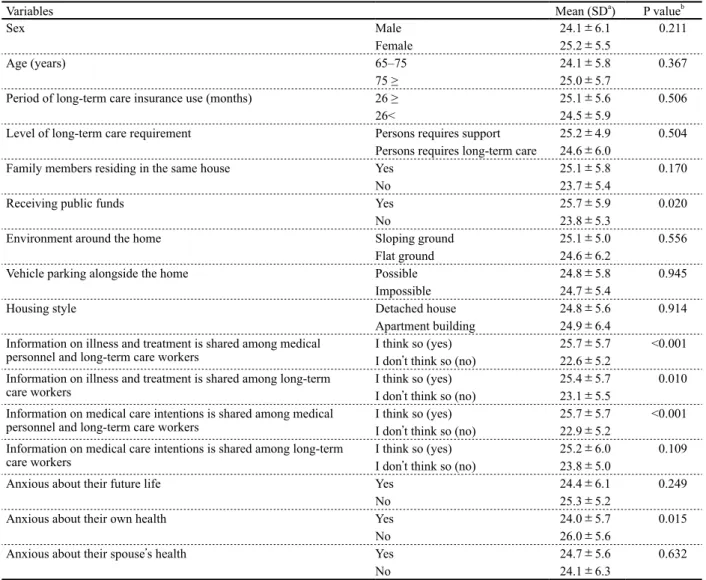
2) Differences in mean CSQ-8J scores based on individual characteristics (Table 3)
Items that showed a significant difference in the mean CSQ-8J scores were as follows. Receipt of public funds had a significantly higher number of “Yes” than “No” responses (p = 0.020). The item “Information on illness and treatment is shared among medical personnel and long-team care workers” Table 2. Characteristics of the participants
Variables n %
Sex Male 73 35.6
Female 132 64.4
Age (years) a 65–75 41 20.0
75 ≥ 164 80.0
Period of long-term care insurance use (months) b 26 ≥ 101 49.3
26< 100 48.8
Level of satisfaction with medical long-term care service (CSQ-8J) c 24 ≥ 119 58.0
24< 86 42.0
Level of long-term care requirement Persons requires support 1 19 9.3
Persons requires support 2 36 17.6
Persons requires long-term care 1 81 39.5 Persons requires long-term care 2 47 22.9
Persons requires long-term care 3 15 7.3
Persons requires long-term care 4 5 2.4
Persons requires long-term care 5 2 0.1
Family members residing in the same house Yes 163 79.5
No 42 20.5
Receiving public funds Yes 106 51.7
No 99 48.3
Environment around the home Sloping ground 93 45.4
Flat ground 112 54.6
Vehicle parking alongside the home Possible 158 77.1
Impossible 47 22.9
Housing style Detached house 169 82.4
Apartment building 36 17.6
Information on illness and treatment is shared among medical
personnel and long-term care workers I think so (yes)I donʼt think so (no) 14560 70.729.3 Information on illness and treatment is shared among long-term
care workers I think so (yes)I donʼt think so (no) 14956 72.727.3
Information on medical care intentions is shared among medical
personnel and long-term care workers I think so (yes)I donʼt think so (no) 13867 67.332.7 Information on medical care intentions is shared among long-term
care workers I think so (yes)I donʼt think so (no) 14560 70.729.3
Anxious about their future life Yes 112 54.6
No 93 45.4
Anxious about their own health Yes 122 59.5
No 83 40.5
Anxious about their spouseʼs health Yes 68 33.2
No 31 15.1
No spouse 106 51.7
a Age: mean ± standard deviation, minimum–maximum, median: 81.2 ± 7.6, 65–97, 83
b Period of long-term care insurance use: mean ± standard deviation, minimum–maximum, median: 38.1 ± 38.2, 1–194, 26 c CSQ-8J: mean ± standard deviation, minimum–maximum, median: 24.8 ± 5.7, 11–41, 24
had a significantly higher number of “I think so” than “I donʼt think so” responses (p < 0.001). The item “Information on illness and treatment is shared among long-team care workers” had a significantly higher number of “I think so” than “I donʼt think so” responses (p = 0.010). “Information on medical care intentions is shared among medical personnel and long-team care workers” had a significantly higher number of “I think so” than “I donʼt think so” responses (p = 0.001). “Anxious about own health” had a significantly higher number of “No”
than “Yes” responses (p = 0.015).
3) Factors related to the CSQ-8J score (Table 4)
Table 4 shows the results of the multiple regression analysis (backward stepwise method). The only item significantly associated with the CSQ-8J score was “Information on illness and treatment is shared among medical personnel and long-team care workers” (p = 0.007).
Table 3. Differences in CSQ-8J means values based on characteristics of the participants
Variables Mean (SDa) P valueb
Sex Male 24.1±6.1 0.211
Female 25.2±5.5
Age (years) 65–75 24.1±5.8 0.367
75 ≥ 25.0±5.7
Period of long-term care insurance use (months) 26 ≥ 25.1±5.6 0.506
26< 24.5±5.9
Level of long-term care requirement Persons requires support 25.2±4.9 0.504
Persons requires long-term care 24.6±6.0
Family members residing in the same house Yes 25.1±5.8 0.170
No 23.7±5.4
Receiving public funds Yes 25.7±5.9 0.020
No 23.8±5.3
Environment around the home Sloping ground 25.1±5.0 0.556
Flat ground 24.6±6.2
Vehicle parking alongside the home Possible 24.8±5.8 0.945
Impossible 24.7±5.4
Housing style Detached house 24.8±5.6 0.914
Apartment building 24.9±6.4
Information on illness and treatment is shared among medical
personnel and long-term care workers I think so (yes)I donʼt think so (no) 25.7±5.722.6±5.2 <0.001 Information on illness and treatment is shared among long-term
care workers I think so (yes)I donʼt think so (no) 25.4±5.723.1±5.5 0.010
Information on medical care intentions is shared among medical
personnel and long-term care workers I think so (yes)I donʼt think so (no) 25.7±5.722.9±5.2 <0.001 Information on medical care intentions is shared among long-term
care workers I think so (yes)I donʼt think so (no) 25.2±6.023.8±5.0 0.109
Anxious about their future life Yes 24.4±6.1 0.249
No 25.3±5.2
Anxious about their own health Yes 24.0±5.7 0.015
No 26.0±5.6
Anxious about their spouseʼs health Yes 24.7±5.6 0.632
No 24.1±6.3
a standard deviation b t-test
Table 4. Multiple linear regression between characteristics of the participants and CSQ-8J
Variables βa SEb P valuec
Information on illness and treatment is shared among medical personnel and long-term care workers R2 3.58 0.074 1.31 0.007 a regression coefficient. b standard error
Discussion
1) Mean CSQ-8J score
The mean CSQ-8J score for older people receiving home care in this study was 24.8 ± 5.7 (mean± standard deviation). We compared the average CSQ-8J score in this study with the CSQ-8J average score of previous studies that were verified using CSQ-8J in older people.The CSQ-8J score after breast reduction of older people was found to be approximately 30.3 points28. The mean CSQ-8J score in a randomized clinical trial on nutritional counseling in hospitalized older people was 28.1 ± 3.6 points29, whereas that in a randomized trial on nursing case management of frail older people was 25.0 ± 5.2 points30. Although it is not possible to make a simple comparison based only on the common point that the study participants were older people, the results of this study had low values compared those of previous studies. Studies have shown that satisfaction is low when the clientʼs health condition is poor31, 32. Our participants were visiting outpatient facilities from their own homes for rehabilitation regarding their physical and mental health during recovery. Also, in this study, “Yes” in the “Anxious about their own health” item was 122 (59.5%), which was a subject with many concerns about health. In previous studies28-30, the participants had completed surgery, management, and counseling to improve their health. The low value of the results in our study may be due to the health condition of the participants. It is inferred that the health level of the subjects in this study was higher than that of the previous studies28-30, and it is possible that the difference in health level affected the difference in the average score of CSQ-8J.
2) Factors related to overall satisfaction with medical and welfare services within residential areas
Our results showed that the item “Information on illness and treatment is shared among medical personnel and long-term care workers” is a factor associated with overall satisfaction. In a previous study, Kajonius5 showed shared that information is significantly associated with the level of satisfaction in care, indicating the need for information exchange not only with the older people but also with all personnel involved in the care of older people .The results of our study also showed the need for information sharing, which is consistent with previous studies.
Hirasawa33 clarified that one of the factors that influence satisfaction with care managers is an “understanding of the personʼs illness.” The present study found similar results to Hirasawaʼs34 study in terms of the level of satisfaction with the comprehensive services available in the individualʼs area
of residence, although the studies differed somewhat, as Hirasawaʼs investigated the degree of satisfaction with a single professional in the individualʼs area of residence. Japanese nurses have been educated as medical staff and recognized as medical staff. On the other hand, long-term care workers are recognized as non-medical workers because they have not been educated as medical workers.The welfare sector in Japan employs welfare workers with different educational backgrounds, including care workers with national qualifications and qualified home helpers who have completed training courses run by local governments and the private sector. Long-term care workers with different backgrounds may have a different “understanding of illness,” which may have affected the degree of sharing regarding “information on illness and treatment.”. The Ministry of Health, Labour and Welfare (Japan) stipulates the information that should be shared between medical and nursing care personnel34 as follows: “Status of the patient/user and changes in their physical condition, medication status,” “Information on patient/user illness, medications used, etc.,” “Details of explanations on medical conditions provided to patients and their families and how the explanations were provided,” and “Expected changes in physical condition and coping methods, medical institutions that respond to sudden changes, and preferred medical treatment in case of sudden changes.” Sharing this information may improve the overall level of older peopleʼs satisfaction with medical and welfare services. In the term care insurance service, medical personnel and long-term care workers regularly meet. In this meeting, we think that it is necessary to further share the “information on illness and treatment” of older people.
In the future, by instilling the necessity of “sharing infor-mation on illness and treatment” among medical personnel and long-term care workers, cooperation between medical care and long-term care will be promoted, and the quality of elderly care in each region of Japan will be improved. This survey was conducted within a single prefecture and was limited to older people using the services at a day rehabilitation center. As such, it is necessary to expand the survey area and increase the sample size in future studies. Conclusions
The mean CSQ-8J score for the older peoples receiving home care in this study was 24.8 ± 5.7. Whether or not information on illness and treatment is shared among medical personnel and long-team care workers was a factor associated with the level of satisfaction. Older peoples who thought that
References
1) Ministry of Health, Labour and Welfare. http://www8.cao.go.jp/kourei/ whitepaper/w-2016/zenbun/1s1s_1.pdf Accessed:MAY25,2020 2) UNITED NATIONS. World Population Prospects 2017. https://esa.
un.orq/unpd/wpp/Data-Query/Accessed: MAY25,2020
3) Cabinet Office: International Trend of Aging.https://www8.cao.go.jp/ kourei/whitepaper/w-2018/html/zenbun/s1_1_2.html Accessed: MAY25, 2020
4) Prime Minister of Japan and his Cabinet: National Assembly Report on Social Security Reform. http://www.kantei.go.jp/jp/singi/kokuminkaigi/ pdf/houkokusyo.pdf,Accessed: MAY25,2020
5) Muranaka M. Meaning and Logic of Regional Inclusive Care Journal of
Japan Home Care Association 17(2):5-10,2014
6) Kajonius PJ, Kazemi A. Structure and process quality as predictors of satisfaction with elderly care. Health and Social Care in the Community 24(6):699-707,2015
7) Rahmqvist M, Bara AC. Patient characteristics and quality dimensions related to patient satisfaction. Int J Qual Health 22(2):86-92,2010 8) Rahmqvist. Patient satisfaction in relation to age, health status and other
background factors: a model for comparisons of care units. Int Qual
Health Care 13:385-390,2001
9) Crow R, Gage H, Hampson S, Hart J, Kinber A, Storey L, Thomas H. The measurement of satisfaction with healthcare; implications for practice from a systematic review of the literature. Health Technol
Assess 6(32):1-224,2002
10) Jordan VW, Nicholas R, Mtthew K, Attkisson CC. Evaluating cultural competency and patient satisfaction in an urban dermatology clinic.
Dermatology Online Journal 23(6):18,2017.
11) Bautista RE, Glen ET, Shetty NK. Factors associated with satisfaction with care among patients with epilepsy. Epilepsy Bebave 11:518-524,2007
12) Kjeken I, Dagfinrud H, Mowinckel P et al. Rheumatology care: involvement in medical decisions, received information, satisfaction with care, and unmet health care needs in patients with rheumatoid arthritis and ankylosing spondylitis. Artbritis Rbeum 55:394-401,2006 13) Chao J, Xie W, Yang Y, Liu H, Jiang L, Liu P. The effect of integrated
health management model on the satisfaction among Chinese elderly.
Arch Gerontol Geriatr 57(1):27-31,2013
14) Kim EY, Yeom HE. Influence of home care services on caregivers' burden and satisfaction.Journal of Clinical Nursing 25:1683-1692, 2016
15) Ayalon L, Green O. Live-In Versus Live-Out Home Care in Israel: Satisfaction With Services and Caregivers' Outcomes. The Gerontologist 55(4):628-642,2015
16) Tashiro K, Sugisawa H.Factors related to overall satisfaction towards nursing care of the elderly and their families. Journal of Japan Home
Care Association (11)2: 30-38,2008
17) Grant LA, Rockwood T, Stennes L.Client satisfaction with telehealth services in home health care agencies. Journal of Telemedicine and
Telcare, 21(2):88-92,2015
18) Carter AJE, Arab M, Harrison M, Goldstein J, Stewart B et al. Paramedics providing palliative care at home: A mixed-methods exploration of patient and family satisfaction and paramedic comfort and confidence.
Journal of the Canadian Association of Emergency Physicians
11:1-10,2019
19) Kasai Y, Yotsuya M. Comparison of the Satisfaction of Users of Visiting Nurses Station vs Nurses' Home Service. Journal of the Home Care
Association (12)1:53-61,2008
20) Wakamatsu H, Imanaka Y, Maesawa S. Evaluation of Home Care by Users: Focusing on User Satisfaction. Public Health Research (45)2: 150-158,1996
21) Sakuma S, Sasaki T, Kudou A. Satisfaction Status of Home Care Recipients through the use of Nursing Care Insurance Service. Journal
of Japan Home Care Association (9)2:83-92,2005
22) Ministry of Health, Labour, and Welfare. https://www.mhlw.go.jp/content/ 12300000/000614772.pdf Accessed: JULY27,2020.
23) Ministry of Health, Labour, and Welfare. https://www.mhlw.go.jp/topics/ kaigo/nintei/gaiyo1.html Accessed: JULY27,2020.
24) Ministry of Health, Labour, and Welfare. https://www.mhlw.go.jp/stf/ seisakunitsuite/bunya/hukushi_kaigo/kaigo_koureisha/nintei/gaiyo2. html Accessed: JULY27,2020.
25) Larsen DL, Attkisson CC, Hargreaves WA, Nguyen TD. Assessment of client/patient satisfaction: development of a general scale. Eval Program
Plann 12(3):197-207,1979
26) Tachimori H, Ito H. Review of the reliability and validity of the Japanese Version of Client Satisfaction Questionnaire 8 Item Version.Psychiatry (41)7:711-717,1999
27) Bowling A.Measuring Disease :A review of disease-specific quality of life measurement scales. Open University Press, Buckingham, Philadelphia: 115-117,1995
28) Braig D, Eisenhardt SU, Stark GB, Penna V. Impact of increasing age on breast reduction surgery: A single center analysis. J Plast Reconstr
Aesthet Surg 69(4):482-6,2015
29) Casals C, García-Agua-Soler N, Vázquez-Sánchez MÁ, Requena-Toro MV, Padilla-Romero L, Casals-Sánchez JL. Randomized clinical trial of nutritional counseling for malnourished hospital patients. Revista Clinica
Espanola 215(6):308-14,2015
30) Gagnon AJ, Schein C, McVey L, Bergman H. Randomized controlled trial of nurse case management of frail older people. J Am GeriatSoc 47(9):1118-1124,1999
31) Hall JA., Milburn MA, Epstein AE. A causal model of health status and satisfaction with medical care.Medical Care 31:84-94,1993
32) Marshall GN, Hays RD, Mazel R. Health status and satisfaction with health care: Results from the Medical Outcomes Study. Journal of
Consulting and Clinical Psychology 64(2):380-390,1996
33) Hirasawa Yasuko. Analysis of Factors Affecting Satisfaction With the Care Manager for Long-Term Care Insurance Service Users. Care
Welfare Studies (16)2: 209-215,2009
34) Ministry of Health, Labour, and Welfare. http://www.mhlw.go.jp/file/ 05-Shingikai-12301000-Roukenkyoku-Soumuka/tebiki_3.pdf Accessed: MAY 25,2020.
the information had been shared had a high level of satisfaction.
Acknowledgements
This study is part of a study funded by the Japan Society for the Promotion of Science Grant-in-Aid for Scientific Research (Basic Research C: Project No. 15K11792). There was no conflict of interest between the principal investigator and the study collaborators in this study.
We would like to express our heartfelt gratitude to all the older peoples who cooperated in this study, all the staff of the outpatient rehabilitation centers, and the late Professor Hideyuki Nakane for his extensive guidance.