Survey of Dictionary Use among Japanese High School Students Learning English as a Foreign Language
Osamu MATSUMOTO
Introduction
Many researchers advocate that if used effectively, dictionaries can serve as a source of important information about language or as an instrument for self- study (e.g. , Chan, 2005, 2014; Walz, 1990). In spite of the values of the dictionary in learning a foreign/second language (L2), L2 dictionary user studies were scarce and given little attention for a long time. However, the first European Association for Lexicography (EURALEX) congress held in Exeter and the following first issue of International Journal of Lexicography launched in the 1980s formed a turning point in the field of pedagogical lexicography, and an increasing number of L2 dictionary user studies has been conducted since then (e.g., Atkins & Varantola, 1997; Scholfield, 1999; Tono, 1988). For example, Béjoint (1981) explored reference skills and habits among French university students of English who used monolingual English dictionaries. He found that dictionary use varied in relation to the age and L2 proficiency level of the user. Among recent studies, Nesi and Haill (2002) investigated the dictionary using habits of 89 international students studying at a British university, over a period of three years. They reported that students had difficulty in selecting appropriate entries and determining correct meanings, which possibly resulted in serious errors of interpretation, and that many of the students were not aware of their errors. These studies revealed the lack of skills of L2 dictionary users and complexity of dictionary consultation processes.
However, L2 dictionary research has still not been mainstream in L2 study (Folse, 2004), and yet to date there has been limited information available on L2
learners’dictionary use, especially with respect to the participants targeted in research. Those involved in dictionary user surveys are most likely to be learners at tertiary educational settings such as colleges or universities, and it is often the case that their L2 proficiency levels are high or upper intermediate (e.g., Chan, 2005, 2011; Nesi & Haill, 2002). Less is known about secondary school students, who are more likely to have lower level L2 proficiencies and to resort to the dictionary because of their limited sizes of vocabulary.
The present study investigates the dictionary use of 69 Japanese high school students learning English, who are among those users given less attention in the past studies, by employing a questionnaire designed to elicit as much information as possible for understanding of their dictionary use.
Research questions
1.What kinds of dictionaries do Japanese high school students own and use?
2. What kinds of behaviors do Japanese high school students take before and during dictionary use?
3.What do Japanese high school students think of dictionary and dictionary use?
Questionnaire
The study employed a questionnaire carefully designed to obtain various kinds of information relevant to the students’dictionary use in English learning.
The questionnaire, partly based on Chan’s (2005), consisted of three sections.
The first section offered five questions, designed to collect factual information about dictionaries owned and used, locations dictionaries were used at, and purposes dictionaries were used for. The second section aimed to explore the students’behaviors and strategies in dictionary use, and for this aim, five questions were developed. The last section offered three questions that required the students to provide more subjective answers: the students’views on the usefulness and helpfulness of the dictionary and their self-evaluation as a dictionary user. The second and third sections focused on one type of bilingual dictionary: English-Japanese dictionary in order to collect information
concerning L2 learners’dictionary use as precisely as possible. The questionnaire included thirteen items in total, which were closed questions in the form of 6-point Likert scale, or multiple choice questions, either with one answer or with check-all-that-apply. All items in the questionnaire were written in the students’ native language, Japanese, in order for them not to misinterpret the questions due to their L2 proficiency. In addition to the questionnaire, optional follow-up interviews were carried out with some students so as to explore further information on particular items. All the questions are listed in Appendix, which are originally in Japanese.
Participants
The participants involved were 69 Japanese first-year high school students learning English as a foreign language, all of whom were from 15 to 16 years of age. They had learned English as a required subject for over three years. Their proficiency levels of English were generally low, judging from their performances on the regular examinations administrated by their language teacher.
Results Section 1 Formats of dictionary owned and used
Firstly, the study investigated the formats of dictionaries owned and used most frequently. The questions mainly concerned two dictionary formats:
printed or electronic. However, some variations of the electronic dictionary were added, resulting in six options in total. The first question allowed selection of multiple options while the second question required selection of a single option.
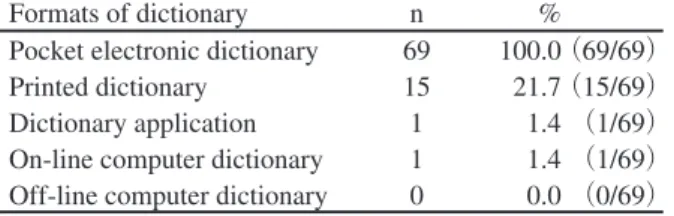
Table 1. Formats of Dictionary Owned (multiple option selection)
Table 2. Formats of Dictionary Used Most Frequently
All the students claimed to own pocket electronic dictionaries while 21.7 % had printed ones as well. Two students owned other kinds of electronic dictionaries in addition to their pocket electronic ones. Further investigation of their answer sheets showed that no one owned more than two different formats of dictionary.
As in Table 2, almost all students claimed that they used a pocket electronic dictionary most frequently. Two students chose different dictionaries: on-line computer dictionary and dictionary application. It is noteworthy that the three dictionaries students most frequently used were all electronic ones.
Types of dictionary used
Types of dictionary concern the language used in the entries and associated explanations. One monolingual dictionary (English-English) and two bilingual dictionaries (English-Japanese and Japanese-English) were provided as options to be chosen. Selection of multiple options was allowed for the types of dictionary used while selection of a single option was required for the types of dictionary used most frequently.
Formats of dictionary n %
Pocket electronic dictionary 69 100.0(69/69)
Printed dictionary 15 21.7(15/69)
Dictionary application 1 1.4(1/69)
On-line computer dictionary 1 1.4(1/69)
Off-line computer dictionary 0 0.0(0/69)
Formats of dictionary n %
Pocket electronic dictionary 67 97.1 On-line computer dictionary 1 1.4
Dictionary application 1 1.4
On-line computer dictionary 0 0.0 Off-line computer dictionary 0 0.0
Table 3. Types of Dictionary Used (multiple option selection)
Table 4. Types of Dictionary Used Most Frequently
All the students used English-Japanese dictionaries while 14.5% also used Japanese-English ones. None of the students used monolingual dictionaries.
It was further found that all used English-Japanese dictionaries most frequently.
Locations of dictionary use
To collect information on the locations where the students used a dictionary, six locations were predefined. For unexpected answers, an ‘other places’ option with blank brackets followed, requiring the students to enter a free-form answer.
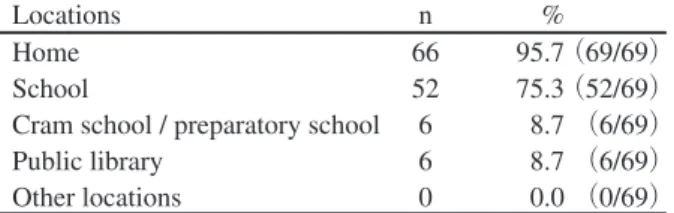
Table 5. Locations of Dictionaries Used (multiple option selection)
Most students used a dictionary at home (95.7%), followed by at school (75.3%). These two figures clearly show that most students used a dictionary both at home and at school.
Purposes for dictionary use
In the final item of Section 1, the purposes of the students’ dictionary use were surveyed. Twelve activities were predefined as options, with an additional
Locations n %
Home 66 95.7(69/69)
School 52 75.3(52/69)
Cram school / preparatory school 6 8.7(6/69)
Public library 6 8.7(6/69)
Other locations 0 0.0(0/69)
Types of dictionary n %
English-Japanese dictionary 69 100.0(69/69)
Japanese-English dictionary 10 14.5(10/69)
Monolingual dictionary 0 0.0(0/69)
Types of dictionary n %
English-Japanese dictionary 69 100.0 Japanese-English dictionary 0 0.0
Monolingual dictionary 0 0.0
free answer option for other purposes. The results are summarized in Table 6.
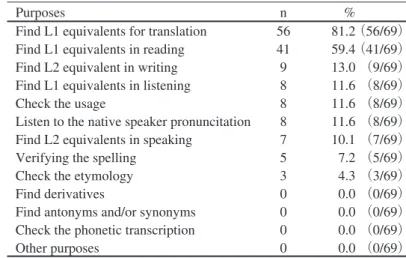
Table 6. Purposes of Dictionary Use (multiple option selection)
The main purpose of dictionary use was finding L1 equivalents for translation (81.2%), followed by finding L1 equivalents for reading comprehension (59.4%). On the other hand, finding L2 equivalents for either writing or speaking was much less frequent (respectively, 13.0% and 10.1%).
The remaining purposes, such as verifying spelling and checking etymology, were even rarer. However, it is worth mentioning that 11.6% reported that they used a dictionary for listening to the native speaker’s pronunciation of the word, which is a function that only electronic dictionaries can offer.
Section 2
The primary purpose of Section 2 was to collect various information related to the students’dictionary use, as accurately and precisely as possible. To achieve this, the questionnaire items in Section 2 focused on the English- Japanese bilingual dictionary. Note that the term ‘dictionary’ in Section 2 refers to ‘English-Japanese dictionary’ for the sake of convenience.
Purposes n %
Find L1 equivalents for translation 56 81.2(56/69)
Find L1 equivalents in reading 41 59.4(41/69)
Find L2 equivalent in writing 9 13.0(9/69)
Find L1 equivalents in listening 8 11.6(8/69)
Check the usage 8 11.6(8/69)
Listen to the native speaker pronuncitation 8 11.6(8/69)
Find L2 equivalents in speaking 7 10.1(7/69)
Verifying the spelling 5 7.2(5/69)
Check the etymology 3 4.3(3/69)
Find derivatives 0 0.0(0/69)
Find antonyms and/or synonyms 0 0.0(0/69)
Check the phonetic transcription 0 0.0(0/69)
Other purposes 0 0.0(0/69)
Frequency of dictionary use
Two questionnaire items were formed to survey the frequency of dictionary use: to what extent the students resort to a dictionary when they read a textbook used in class, and how often they use a dictionary in a typical week. In both questions, a 6-point Likert scale was used. As for the frequency of dictionary use in a week, in order to avoid the ambiguity of the options, additional explanations were presented. The results are shown in Tables 7 and 8.
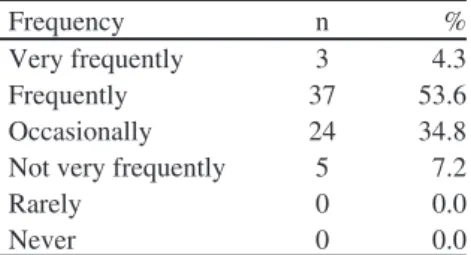
Table 7. Frequency of Dictionary in Reading
Table 8. Frequency of Dictionary Use in a Week
Table 7 shows that most students resorted to a dictionary while reading, with 53.6% choosing ‘frequently’ and 4.3% choosing ‘very frequently’. Only 7.2%
chose a negative answer, ‘not very frequently’. As for the frequency of dictionary use in a week, as shown in Table 8, responses were roughly split among three major options: ‘almost every day’, ‘about a half of the week at least’, and ‘two or three days at most’. There was no one who claimed to never use a dictionary. In sum, two scales of frequency of dictionary use show that most of the students appear to be familiar with consulting a dictionary for reading.
Frequency n %
Very frequently 3 4.3
Frequently 37 53.6
Occasionally 24 34.8
Not very frequently 5 7.2
Rarely 0 0.0
Never 0 0.0
Frequency n %
Every day 1 1.4
Almost every day 12 17.4
Occasionally, about a half of the week 29 42.0 Not very frequently, two or three days at most 23 33.3
Rarely, one day at most 4 5.8
Never 0 0.0
Information referred to
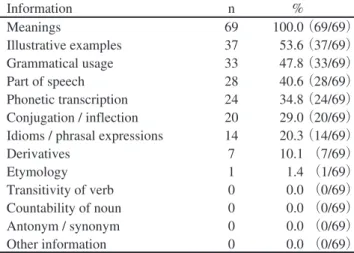
The categories of information in the English-Japanese dictionaries the students referred to were investigated. For this item, twelve options and a free answer option were provided, and the students were allowed to choose multiple answers.
Table 9. Information Referred to in the Dictionary (multiple option selection)
As seen in Table 9, all the students chose the ‘meanings’ of words. The further investigation of their questionnaire sheets revealed that among them around a quarter (n = 16) only chose the meanings, in other words, they referred to only the meanings in the dictionary. The meanings were then followed by two kinds of information that approximately half of the students claimed to refer to: illustrative examples and grammatical usage (53.6% and 47.8%, respectively). It was also found that the students showed little or even no interest in semantic information such as derivatives, antonyms, and synonyms.
Behaviors before dictionary use
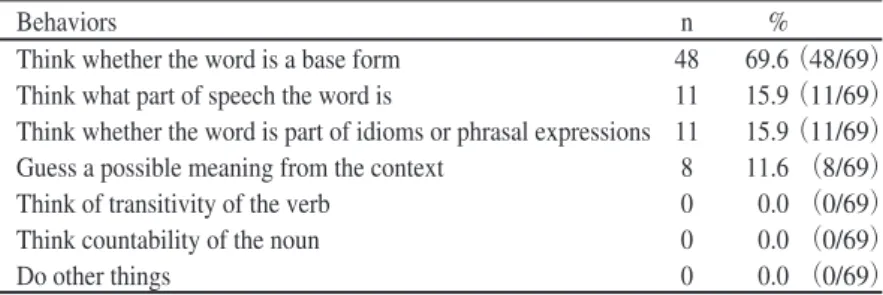
In order to explore the students’ behaviors before looking up a word in the dictionary, six options were first predefined, and then for other behaviors one more option, ‘do other things’ followed by a blank bracket to write down an answer specifically, was added. Multiple option selection was allowed for this item.
Information n %
Meanings 69 100.0(69/69)
Illustrative examples 37 53.6(37/69)
Grammatical usage 33 47.8(33/69)
Part of speech 28 40.6(28/69)
Phonetic transcription 24 34.8(24/69)
Conjugation / inflection 20 29.0(20/69)
Idioms / phrasal expressions 14 20.3(14/69)
Derivatives 7 10.1(7/69)
Etymology 1 1.4(1/69)
Transitivity of verb 0 0.0(0/69)
Countability of noun 0 0.0(0/69)
Antonym / synonym 0 0.0(0/69)
Other information 0 0.0(0/69)
Table 10. Behaviors before Dictionary Use (multiple option selection)
As seen in Table 10, the vast majority of the students chose ‘Think whether the word is a base form’ while other options were much less popular. It is worth mentioning that there were two respondents who chose no options. In the follow-up interviews, they claimed that they did not choose any options because they directly consulted a dictionary when they came across an unfamiliar word.
Types of problem in dictionary use
The students were asked to convey what types of problem they faced when consulting a dictionary. For this item, six options were predefined and a free answer option was provided. They were allowed to select multiple options if necessary. For those who felt that they had no problems, the option of ‘I have no problem’ was included. The results are listed in Table 11.
Table 11. Types of Problem in Dictionary Use (multiple option selection)
The problem the students most frequently encountered was that they did not know which meaning they should choose from the entry (71.0%). This was
Behaviors n %
Think whether the word is a base form 48 69.6(48/69)
Think what part of speech the word is 11 15.9(11/69)
Think whether the word is part of idioms or phrasal expressions 11 15.9(11/69)
Guess a possible meaning from the context 8 11.6(8/69)
Think of transitivity of the verb 0 0.0(0/69)
Think countability of the noun 0 0.0(0/69)
Do other things 0 0.0(0/69)
Problems n %
I don’t know which meaninng I should choose. 49 71.0(49/69)
I have little idea of part of speech. 30 43.5(30/69)
I have little idea of phonetic symbols. 27 39.1(27/69)
I have little idea of transitivity of verb. 18 26.1(18/69)
I sometimes cannot find a word in a dictionary. 15 21.7(15/69)
I have no problem. 2 2.9(2/69)
Other problems 0 0.0(0/69)
followed by the problem that they had little idea of the part of speech, which nearly half of the students selected (43.5%). There were two students who claimed to have no problem and none who chose the free-form answer ‘other problems’.
Section 3
Section 3 was designed to survey the students’ views on the usefulness of the English-Japanese dictionary, and evaluation as a dictionary user. For the two items, a 6-point Likert scale was used. Note that ‘dictionary’ refers to the English-Japanese bilingual dictionary in Section 3, as previously mentioned.
Usefulness of the dictionary
The students were required to evaluate usefulness of the dictionary while reading English texts. The results are presented in Table 12.
Table 12. Usefulness of the Dictionary
It is apparent that all students under study admitted usefulness of the dictionary, though to differing degrees. There was no one who indicated negative attitudes toward usefulness of the dictionary by selecting either “not very useful”, “hardly useful”, or “never useful”.
Self-evaluation as a dictionary user
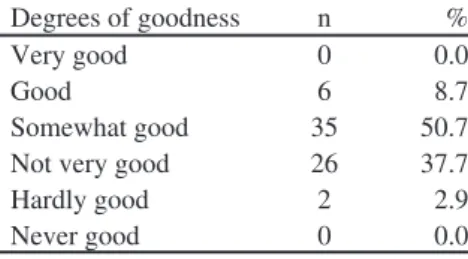
Finally, the students were asked to evaluate themselves as dictionary user in terms of good use of the dictionary. Note that ‘good use’ is associated with the extent of success in meaning determination when consulting a dictionary. Table 13 shows that the numbers are concentrated in the middle; most students regarded themselves as either “somewhat good” users (50.7%) or “not very good” users (37.7%). However, totaling the numbers of “somewhat good” and
Degrees of usefulness n %
Very useful 21 30.4
Useful 35 50.7
Somewhat useful 13 18.8
Not very useful 0 0.0
Hardly useful 0 0.0
Never useful 0 0.0
“good” (n = 41) indicates that there are relatively more students who had positive views of themselves as dictionary users than those who didn’t (59.4%
vs. 40.6%).
Table 13. Self-evaluation as a Dictionary User
Discussion
The purpose of the present study was to create a clear picture of the dictionary users who have received little attention in previous dictionary user surveys: Japanese high school students with low L2 proficiency level, even though they are expected to more frequently use a dictionary while reading because of their limited vocabulary knowledge than advanced L2 learners do.
For the present study, the questionnaire was designed to elicit as various information as possible. As a result, many findings emerged, some of which have rarely been reported in the past studies.
Firstly, with respect to dictionary ownership, it was found that all the students under study had pocket electronic dictionaries while about a third of the students owned other formats of dictionary. Conventional printed dictionaries were unpopular to the great extent. The results are consistent with Bower and McMillan’s (2006) study, in which they reported as many as 96% of Japanese college students involved in their study owned electronic pocket dictionaries.
There are several possible reasons for the popularity of pocket electronic dictionaries in contrast to printed ones. One of the possible reasons is its portability. Pocket electronic dictionaries are literally ‘pocketable’ and much lighter than heavy, bulky conventional printed ones. Considering that the majority of the students, most of whom owned only one format of dictionary, claimed to use a dictionary both at home and at school, this advantage appears
Degrees of goodness n %
Very good 0 0.0
Good 6 8.7
Somewhat good 35 50.7
Not very good 26 37.7
Hardly good 2 2.9
Never good 0 0.0
to be the most important reason for the popularity of pocket electronic dictionaries. In addition, pocket electronic dictionaries offer several functions which printed dictionaries do not. They can store and retrieve words previously looked up, and contain multiple references such as bilingual dictionaries, monolingual dictionaries, or thesauri with cross-reference functions.
Furthermore, recent electronic dictionaries have audio functions which can help users check the pronunciation of words. This function is very helpful because users are not required to have knowledge of phonetic transcription, which many of the students under study claimed that they had little or no knowledge of. The results of the study confirmed that some students actually used this function occasionally.
The present study provided evidence that the English-Japanese bilingual dictionary was exclusively used in students’ learning of L2. This is understandable because most frequent activities with a dictionary were found to be reading comprehension and translation, both of which require finding Japanese equivalents to unfamiliar English words. Students’ heavy reliance on bilingual dictionaries was reported by other studies (e.g., Tomaszczyk, 1979;
Baxter, 1980). However, their frequent dictionary use does not necessarily guarantee their appropriate use of the dictionary, as Fan (2000) stated. The results of the questionnaire revealed that many students face various types of troubles in dictionary consultation, though to differing degrees. Approximately a quarter of the students reported they had little idea of the part of speech or transitivity of the verb, the knowledge of which is clearly required for determining the meaning of a word in context. In regard to behaviors before looking up a word in the dictionary, most students remarked that they did not think about the part of speech of the word. Adding to the fact found in the interviews with two students, who claimed that they directly consulted a dictionary, it is obvious that many students under study were not skillful enough to determine the appropriate meaning of a word in context. As for information categories, less than half of the students referred to the part of speech and usage, and no one paid attention to the transitivity of verb. In addition, they showed little interest in derivatives and etymologies, and disregarded the countability of
noun. These behaviors clearly indicate that many students make only limited use of bilingual dictionaries, which supports Nesi’s (1999) claim that 98% of her participants who entered English higher education did not have sufficient dictionary skills. In sum, the results disclosed that the students under study lacked essential strategies for proper dictionary consultation.
Lastly, in Section 3, one of the findings is that most students had positive attitudes toward the usefulness of an English-Japanese dictionary and that more than half of them evaluated themselves either as ‘good’ or ‘somewhat good’
dictionary users. This is unreasonable because, as already mentioned, they make only limited use of information of dictionaries. Many students are unlikely to own essential knowledge in meaning determination such as the part of speech and transitivity of verb. This suggests that students may overestimate themselves as dictionary users or underestimate the complex process of dictionary consultation.
Conclusion
The purpose of the present study is to survey dictionary use among Japanese high school students with low L2 proficiency. Most language teachers in Japan possibly have some ideas concerning their students’ dictionaries, dictionary consultation skills and behaviors through observing them in class. However, this intuition cannot be convincing without supporting evidences. The questionnaire used in the study was designed to elicit as various kinds of information as possible in terms of students’ dictionary use. As a result, many findings emerged, some of which the past studies have never shed light on. There are, however, some limitations in the study. Firstly, the sample size of the study is obviously not large. In order to support the findings strongly, there should be more participants involved in future studies. Secondly, as Hartmann (2001) claimed, evidence collected by the indirect questionnaire and interview technique needs to be supplemented by direct observation or objective performance tests. In spite of these methodological limitations, the present study would make some contribution to raising awareness of language teachers and lexicographers with respect to dictionary use of Japanese high school
students with low L2 proficiency, a group who has been relatively ignored in dictionary user research.
References
Atkins, B., & Varantola, K. (1997). Monitoring dictionary use. International Journal of Lexicography, 10(1), 1-45.
Baxter, J. (1980). The dictionary and vocabulary behavior: A single word or a handful? TESOL Quarterly, 14(3), 326-336.
Béjoint, H. (1981). The foreign student’s use of monolingual English dictionaries: A study of language needs and reference skills. Applied Linguistics, 2(3), 207-222.
Bower, J., & McMillan, B. (2006, November). Learner’s use and views of electronic dictionaries. Paper presented at the JALT Conference, Kitakyushu, Japan.
Chan, A.Y.W. (2005). Tactics employed and problems encountered by the university English majors in Hong Kong in using a dictionary. Applied Language Learning, 15, 1-27.
Chan, A.Y.W. (2011). Cantonese ESL learners’ use of grammatical information in a monolingual dictionary for determining the correct use of a target word. International Journal of Lexicography, 25(1), 68-94.
Chan, A.Y.W. (2014). How can ESL students make the best use of learners’
dictionaries? English Today, 30(3), 33-37.
Fan, M. (2000). The dictionary look-up behavior of Hong Kong students: A large scale study. Educational Journal, 28(1), 123-138.
Folse, K. (2004). Vocabulary myths: Applying second language research to classroom teaching. Michigan: University of Michigan.
Hartmann, R.R.K. (2001). Teaching and researching lexicography. Edinburgh:
Pearson Education.
Nesi, H. (1999). A user’s guide to electronic dictionaries for language learners.
International Journal of Lexicography, 12(1), 55-66.
Nesi, H., & Haill, R (2002). A study of dictionary by international students as a British university. International Journal of Lexicography, 15(4), 277-305.
Scholfield, P. (1999). Dictionary use in reception. International Journal of
Appendix Questionnair Section 1
Q1 Which format(s) of dictionary do you own ?
Q2 Which format of dictionary do you use most frequently ? Q3 Which types(s) of dictionary do you use ?
Q4 Which type of dictionary do you use most frequently ? Q5 Where do you use your dictionary ?
Q6 For what purpose(s) do you use your dictionary ?
Section 2
Q7 To what extent do you use the dictionary when reading a text used in class ? Q8 How often do you use the dictionary in a typical week ?
Q9 Which infomation do you refer to when you look up a word in the dictionary ?
Q10 What do you usually do before you look up a word in the dictionary ? Q11 Which problem(s) do you have when you use the dictionary ?
Section 3
Q12 To what extent do you think the information in the dictionary is useful ? Q13 Generally speaking, how good do you think your dictionary use is ?
Lexicography, 12(1), 13-34.
Tomaszczyk, J. (1979). Dictionaries: Users and uses. Glottodidactica, 12, 103- 119.
Tono, Y. (1988). Assessment of the EFL learner’s dictionary using skills.
JACET Bulletin, 19, 103-126.
Walz, J. (1990). The dictionary as a secondary source in language learning. The French Review, 64(1), 79-94.