* Department of Molecular Chemistry and Biochemistry, Faculty of Science and Engineering, Doshisha University, Kyoto 610-0321, Japan, Telephone: +81-774-65-6690, Fax: +81-774-65-6849, E-mail: [email protected]
**The Graduate School of Natural Science and Technology (Science), Okayama University, Okayama 700-8530, Japan
***Daiichi Kigenso Kagaku Kogyo Co., Ltd., Hirabayashi-minami Suminoe-ku, Osaka 559-0025, Japan
Fabrication of Dense ZrO
2-Al
2O
3Composite Ceramics by Pulsed Electric-Current Pressure Sintering of Neutralization Co-Precipitated Powders
Ken HIROTA*, Kenta YAMAMOTO*, Koki SASAI*, Masaki KATO*, Hideki TAGUCHI**
Hideo KIMURA***, Masayuki TAKAI***, Masao TERADA***
(Received February 27, 2017)
ZrO2-based composite ceramics containing 25 mol% Al2O3 and 1.125 mol% Y2O3, i.e., with a composition of 75mol%ZrO2(1.5mol%Y2O3)-25mol%Al2O3, were fabricated using pulsed electric-current pressure sintering (PECPS) of solid solution powders prepared by the neutralization co-precipitation method. They were sintered at 1573 to 1623 K (1300~1350°C) for 6.0×10² s (10 min) under 50 MPa in Ar. Thus-obtained ceramics consisted of 130~150 nm grains, composed of -Al2O3 and tetragonal-ZrO2 with a small amount of monoclinic-ZrO2. Dense ceramics with high relative densities ≥99.5% revealed high mechanical properties: bending strength (b)higher than 1.3 GPa and simultaneous fracture toughness (KIC) higher than 15.5 MPa·m1/2, which value was evaluated by the indentation fracture toughness (IF) test. X-ray diffraction (XRD) analysis, scanning electron microscope (SEM) and transmission electron microscope (TEM) with energy dispersive X-ray spectrometry (EDS) observations on the as-prepared and calcined powders, and the microstructures of ceramics demonstrated the homogeneous grain distribution of t-ZrO2 and -Al2O3, with the former grains being surrounded by the latter which had segregated from the calcined cubic ZrO2 solid solution containing both Al2O3 andY2O3.
.H\ZRUGV:zirconia, alumina, mechanical properties, co-precipitation, pulsed electric-current pressure sintering
,QWURGXFWLRQ
Following the discovery of the stress-induced transformation ZrO2-toughening mechanism from tetragonal to monoclinic phases by Garvie 1),
partially stabilized zirconia (PSZ) with a small amount of Y2O3 addition has been a major research focus, and many studies have been performed on the fabrication of dense PSZs with other added stabilizer 2-6).
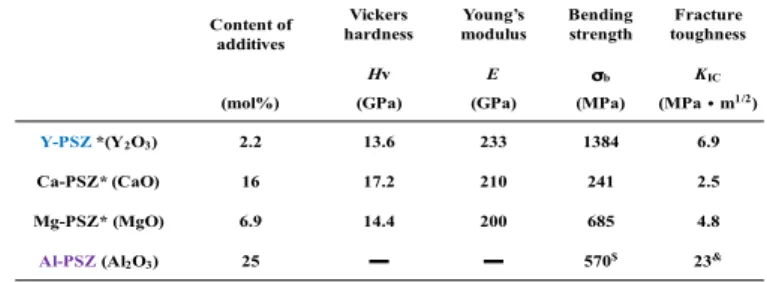
Table 1. Mechanical properties of representative partially stabilized zirconia.
Content of additives
Vickers
hardness Young’s
modulus Bending
strength Fracture toughness
Hv E b KIC
(mol%) (GPa) (GPa) (MPa) (MPa・m1/2)
Y-PSZ*(Y2O3) 2.2 13.6 233 1384 6.9
Ca-PSZ* (CaO) 16 17.2 210 241 2.5
Mg-PSZ* (MgO) 6.9 14.4 200 685 4.8
Al-PSZ(Al2O3) 25 ━ ━ 570$ 23&
*: Partially stabilized zirconia.
$: determined using an 8mm-length span.
&:determined by the indentation fracture (IF) method [13] with Niihara’s equation [14].
* Department of Molecular Chemistry and Biochemistry, Faculty of Science and Engineering, Doshisha University, Kyoto 610-0321, Japan, Telephone: +81-774-65-6690, Fax: +81-774-65-6849, E-mail: [email protected]
**The Graduate School of Natural Science and Technology (Science), Okayama University, Okayama 700-8530, Japan
***Daiichi Kigenso Kagaku Kogyo Co., Ltd., Hirabayashi-minami Suminoe-ku, Osaka 559-0025, Japan
Fabrication of Dense ZrO
2-Al
2O
3Composite Ceramics by Pulsed Electric-Current Pressure Sintering of Neutralization Co-Precipitated Powders
Ken HIROTA*, Kenta YAMAMOTO*, Koki SASAI*, Masaki KATO*, Hideki TAGUHI**
Hideo KIMURA***, Masayuki TAKAI***, Masao TERADA***
(Received February 27, 2017)
ZrO2-based composite ceramics containing 25 mol% Al2O3 and 1.125 mol% Y2O3, i.e., with a composition of 75mol%ZrO2(1.5mol%Y2O3)-25mol%Al2O3, were fabricated using pulsed electric-current pressure sintering (PECPS) of solid solution powders prepared by the neutralization co-precipitation method. They were sintered at 1573 to 1623 K (1300~1350°C) for 6.0×10² s (10 min) under 50 MPa in Ar. Thus-obtained ceramics consisted of 130~150 nm grains, composed of α-Al2O3 and tetragonal-ZrO2 with a small amount of monoclinic-ZrO2. Dense ceramics with high relative densities ≥99.5% revealed high mechanical properties: bending strength (σb)higher than 1.3 GPa and simultaneous fracture toughness (KIC) higher than 15.5 MPa·m1/2, which value was evaluated by the indentation fracture toughness (IF) test. X-ray diffraction (XRD) analysis, scanning electron microscope (SEM) and transmission electron microscope (TEM) with energy dispersive X-ray spectrometry (EDS) observations on the as-prepared and calcined powders, and the microstructures of ceramics demonstrated the homogeneous grain distribution of t-ZrO2 and α-Al2O3, with the former grains being surrounded by the latter which had segregated from the calcined cubic ZrO2 solid solution containing both Al2O3 andY2O3.
Key words:zirconia, alumina, mechanical properties, co-precipitation, pulsed electric-current pressure sintering
1. Introduction
Following the discovery of the stress-induced transformation ZrO2-toughening mechanism from tetragonal to monoclinic phases by Garvie 1),
partially stabilized zirconia (PSZ) with a small amount of Y2O3 addition has been a major research focus, and many studies have been performed on the fabrication of dense PSZs with other added stabilizer 2-6).
Table 1. Mechanical properties of representative partially stabilized zirconia.
Content of additives
Vickers
hardness Young’s
modulus Bending
strength Fracture toughness
Hv E σb KIC
(mol%) (GPa) (GPa) (MPa) (MPam1/2)
Y-PSZ*(Y2O3) 2.2 13.6 233 1384 6.9
Ca-PSZ* (CaO) 16 17.2 210 241 2.5
Mg-PSZ* (MgO) 6.9 14.4 200 685 4.8
Al-PSZ(Al2O3) 25 570$ 23&
*: Partially stabilized zirconia.
$: determined using an 8mm-length span.
&:determined by the indentation fracture (IF) method [13] with Niihara’s equation [14].
Table 1 shows the mechanical properties of the representative PSZs, some of which are commercially available now. In addition, ZrO2(Y2O3)-based and ZrO2(Y2O3)-Al2O3 composite ceramics fabricated using hot pressing (HP) and hot isostatic pressing (HIP) have been developed 7-10).
On the other hand, little attention has been paid to the solid solution (ss) in the ZrO2-Al2O3 system, because it had been believed that the ZrO2-Al2O3 system did not form the (ss) even at high temperatures. However, since the report by Alper 11) on the formation of ZrO2(ss) containing 7 mol% Al2O3, sol-gel derived ZrO2(ss) powders have been prepared and 75mol%ZrO2
-25mol%Al2O3(ss) powders were hot isostatic press (HIP) sintered at 1373 K (1100°C) under 196 MPa for 3.6×10⁴ s (1 h) 12). Evaluation of their mechanical properties revealed a fracture toughness (KIC) of 23 MPa·m1/2 which was estimated by the indentation fracture toughness (IF) method 13) with a Niihara’s equation 14), (afterwards, the value of KIC estimated using this IF method is described in the present study without any comment), however, the bending strength (b) remained as low as 570 MPa. Since this investigation, there has been no report on the fabrication of dense monolithic or composite ceramics that showed a high strength b ≥1 GPa and a high fracture toughness KIC ≥20 MPa·m1/2 at the same time. If bulk ceramics with both a high strengthand high fracture toughness simultaneously could be developed, this would do away with the concept of ceramics as “brittle” and promote their application in a wide range of fields.
In 2012, it was shown that 75mol%
ZrO2(1.2~1.5mol%Y2O3)-25mol%Al2O3 composite ceramics fabricated using pulsed-electric current pressure sintering (PECPS) 15,16) of the sol-gel derived cubic ZrO2(ss) powders containing both Al2O3 and Y2O3
revealed high KIC ≥ 20.0 MPa·m1/2, and at the same time, high b ≥ 1.0 GPa 17,18).
On the other hand, as the sol-gel powder preparation is very expensive due to the high costs of the
starting materials and its complex process, this method is not suitable for the mass-production requirements of the ceramics industry. Therefore, there is much requirement of a low-cost method for producing homogeneous fine-particle powders.
Accordingly, the neutralization co-precipitation method 19), using an aqueous solution, has been considered as a low-cost process for the preparation of (ss) powders corresponding to ZrO2(Y2O3)-Al2O3. Here, we should note that the sol-gel method can produce fine powders with the homogeneous chemical composition and particle shape, and sharp particle size distribution20). In the present study, the following subjects are considered: (1) the optimum content of stabilizer Y2O3
for ZrO2 to attain a high tetragonal ZrO2 (t-ZrO2) ratio in order to utilize the transformation toughening mechanism, (2) the improvement of both the chemical homogeneity of intra-particles and the particle size distribution, and (3) the optimum process conditions, especially the sintering temperature, and (4) by following the guiding principle for fabricating high-strength ZrO2 ceramics to achieve a small grain size ≤1.0 µm, a high relative density ≥99.5% and high t-ZrO2 ratios. As a result, we fabricated ZrO2(Y2O3)-Al2O3 composite ceramics exhibiting high
b and KIC simultaneously from the neutralization co- precipitated powder for the first time. This paper deals with their mechanical properties in relation with the microstructures depending on the Y2O3 content and chemical homogeneity of intra-particles calcined powders.
([SHULPHQWDO3URFHGXUH 2.1 Fabrication of ZrO2 (Y2O3) - Al2O3 ceramics
Solid solution powders with compositions of 75mol%ZrO2(x·mol%Y2O3)–25mol%Al2O3 (x=0.5, 1.0, 1.5, 2.0), i.e., ZrO2 : Y2O3 : Al2O3 = 74.625 ~ 73.50 : 0.375 ~ 1.50 : 25.0 mol% 17,18), were prepared by the neutralization co-precipitation method 19) using high quality reagents (≥99.9% pure) of ZrOCl2·8H2O, YCl3,
and AlCl3 as the starting materials and aqueous NH3
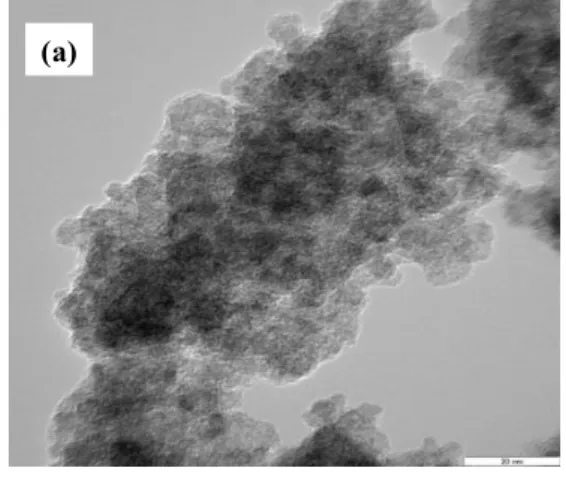
solution as a pH adjuster, all of these are commercially available. The TEM photograph and X-ray diffraction (XRD) pattern of the as-prepared powders (precursor) shown in Fig. 1(a) and (b), respectively, revealed that they are fine amorphous powders.
Then, they were heat-treated (calcined) in two ways, as will be mentioned in a later section: by i) simple one-step calcination at 1173 K (900°C) for 3.6×10³ s (1 h) or ii) a more complex two-step calcination, i.e., the combination of a long low-temperature heating at 973 K (700°C) for 3.24×10⁴ s (9 h) and a short high-temperature heating at 1173 K (900°C) for 3.6×10³ s (1 h) in air. Both calcined powders were milled using an alumina-mortar and pestle for 1.8×10³ s (30 min) in ethanol. After drying at 353 K
(80°C) for 4.32×10⁴ s (12 h) in a reduced pressure, a small amount of diluted poly-vinyl-alcohol (PVA) solution (a concentration of 3~5%) was added to the milled powders. Then, they were compacted into circular disks with the outer diameter (OD) about 15 mm and the thickness about 5.0 mm (15-5.0h mm) under a uniaxial pressure of 70 MPa followed by cold isostatic pressing (CIP) at 245 MPa for 1.8×10² s (3 min). The powder compacts with a relative density (Dg-bulk/Dg-x) of about 46~47%, where Dg-bulkis the green bulk density (2.4~2.5 Mg·m-3) of powder compact and Dg-x its theoretical density (5.3603 Mg·m-3) 21) were sintered with a pulsed electric-current pressure sintering (PECPS) apparatus (SPS-5104A; SPS SYNTEX Inc., Tokyo, Japan) with a heating rate of 1.667 K·s-1 (100 K·min-1: on-off interval=12:2), at 1573 to 1623 K (1300~1350°C) for 6.0×10² s (10 min) under 50 MPa using a carbon mold (40-16-30h mm) and plungers (15.9-40h mm) in Ar.
2.2 Evaluation of samples Microstructures
A differential thermal and thermal gravimetry analyses (DT-TG 60H; Shimadzu, Kyoto, Japan) of the precursors were conducted in air with a heating rate of 0.1667 K·s-1 (10 K·min-1). Crystalline phases were identified by XRD analysis (CuK radiation, Rint 2000;
Rigaku, Osaka, Japan). The volume fraction of the monoclinic ZrO2 (m-ZrO2) phase was determined from the peak intensity ratio of the sum of the monoclinic (111) and (11-1) diffraction peaks to the tetragonal (111) 22). The bulk densities (Dobs) of sintered ceramics after polishing with a diamond paste (nominal size 1~3 µm) were evaluated by the Archimedes method. In order to determine the theoretical densities (Dx) of ceramics the lattice parameters of the t-ZrO2 and m-ZrO2 phases were estimated using Rietveld analysis 23). From the t/m-ZrO2 volume ratios, the chemical composition, and the values of Dx(t-ZrO2(x·mol%Y2O3)), Dx(m-ZrO2
(x·mol%Y2O3)), and Dx(-Al2O3)=3.987 (JCPDS:
#10-0173) Mg·m-3, the Dx values of sintered ceramics Fig. 1. (a) TEM photograph and (b) XRD pattern of
ZrO2(1.5mol%Y2O3)-25mol%Al2O3 powder as-prepared by the neutralization co-precipitation method.
<P
s>: 0.5 nm
(a)
Intensity (a.u.)
80 70 60 50 40 30
20 2 (degree)
(b)
and AlCl3 as the starting materials and aqueous NH3 solution as a pH adjuster, all of these are commercially available. The TEM photograph and X-ray diffraction (XRD) pattern of the as-prepared powders (precursor) shown in Fig. 1(a) and (b), respectively, revealed that they are fine amorphous powders.
Then, they were heat-treated (calcined) in two ways, as will be mentioned in a later section: by i) simple one-step calcination at 1173 K (900°C) for 3.6×10³ s (1 h) or ii) a more complex two-step calcination, i.e., the combination of a long low-temperature heating at 973 K (700°C) for 3.24×10⁴ s (9 h) and a short high-temperature heating at 1173 K (900°C) for 3.6×10³ s (1 h) in air. Both calcined powders were milled using an alumina-mortar and pestle for 1.8×10³ s (30 min) in ethanol. After drying at 353 K
(80°C) for 4.32×10⁴ s (12 h) in a reduced pressure, a small amount of diluted poly-vinyl-alcohol (PVA) solution (a concentration of 3~5%) was added to the milled powders. Then, they were compacted into circular disks with the outer diameter (OD) about 15 mm and the thickness about 5.0 mm (15φ-5.0h mm) under a uniaxial pressure of 70 MPa followed by cold isostatic pressing (CIP) at 245 MPa for 1.8×10² s (3 min). The powder compacts with a relative density (Dg-bulk/Dg-x) of about 46~47%, where Dg-bulkis the green bulk density (2.4~2.5 Mg·m-3) of powder compact and Dg-x its theoretical density (5.3603 Mg·m-3) 21) were sintered with a pulsed electric-current pressure sintering (PECPS) apparatus (SPS-5104A; SPS SYNTEX Inc., Tokyo, Japan) with a heating rate of 1.667 K·s-1 (100 K·min-1: on-off interval=12:2), at 1573 to 1623 K (1300~1350°C) for 6.0×10² s (10 min) under 50 MPa using a carbon mold (φ40-φ16-30h mm) and plungers (φ15.9-40h mm) in Ar.
2.2 Evaluation of samples Microstructures
A differential thermal and thermal gravimetry analyses (DT-TG 60H; Shimadzu, Kyoto, Japan) of the precursors were conducted in air with a heating rate of 0.1667 K·s-1 (10 K·min-1). Crystalline phases were identified by XRD analysis (CuKα radiation, Rint 2000;
Rigaku, Osaka, Japan). The volume fraction of the monoclinic ZrO2 (m-ZrO2) phase was determined from the peak intensity ratio of the sum of the monoclinic (111) and (11-1) diffraction peaks to the tetragonal (111)
22). The bulk densities (Dobs) of sintered ceramics after polishing with a diamond paste (nominal size φ1~3 µm) were evaluated by the Archimedes method. In order to determine the theoretical densities (Dx) of ceramics the lattice parameters of the t-ZrO2 and m-ZrO2 phases were estimated using Rietveld analysis 23).From the t/m-ZrO2
volume ratios, the chemical composition, and the values of Dx(t-ZrO2(x·mol%Y2O3)), Dx(m-ZrO2 (x·mol%Y2O3)), and Dx(α-Al2O3)=3.987 (JCPDS: #10-0173) Mg·m-3, the Dx values of sintered ceramics were calculated.
Fig. 1. (a) TEM photograph and (b) XRD pattern of ZrO2(1.5mol%Y2O3)-25mol%Al2O3 powder as-prepared by the neutralization co-precipitation method.
<P
s>: 0.5 nm
(a)
Intensity (a.u.)
80 70 60 50 40 30
20 2θ (degree)
(b)
were calculated. Hereafter, tetragonal ZrO2 containing 0.5 mol% Y2O3, i.e., t-ZrO2(0.5mol%Y2O3), and 75 mol% ZrO2(1.5mol%Y2O3)-25mol%Al2O3 are abbreviated as t-ZrO2(0.5Y) and [1.5Y], respectively.
Microstructural observations on the as-prepared and calcined powders, and the fractured or polished surfaces of ceramics were conducted using a field emission-type transmission electron microscope (FE-TEM) (JEM-2100F; JEOL, Ltd., Tokyo, Japan) and a scanning electron microscope (FE-SEM) (JSM-7001FD; JEOL, Ltd.) equipped with an energy dispersive X-ray spectrometry (EDS) (JED-2300/T and JED-2300/F, respectively; JEOL, Ltd.). Before TEM observation, the specimens were processed to make them thinner using a focused ion beam (FIB) (FB-2200;
Hitachi High-Tech Fielding Co., Ltd., Tokyo, Japan).
The grain sizes were determined by an intercept method 24).
2.3 Mechanical properties
After the crystalline-phase identification, test bars (~3×3.5×11 mm3) for mechanical- property measurements were cut from the as-sintered ceramics with a diamond cutting-blade, and then their four sides were polished to mirror surfaces with a diamond paste (nominal particle size 1~3 µm). Three-point bending strength (b) was evaluated with a cross-head speed of 8.33×10⁻³ mm·s-1 (0.5 mm·min-1) and an 8 mm-length span length using WC jigs. As this length was not so enough long to evaluate b, however, because of the small samples about 13~14 mm in diameter, their best
b values were re-measured using a long span as 30 mm for the validity check in accordance with Japanese Industrial Standard (JIS) R 1601. Vickers hardness (Hv) was measured using a Micro Vickers Hardness Tester (HMV; Shimadzu) with a duration time of 15 s and an applied load of 19.6 N. As to the measurement of KIC, IF method with a Niihara's equation 14) (KIC[Palmqvist crack 25]))=0.012(E/Hv)2/5·(HvP/L)1/2, here E is Young's modulus, P load and l the average length from the indent
corner to the edge of each crack, i.e., Palmqvist crack length). In addition the relationship between E and HV
i.e., E nearly equal to 20·Hv [26] was adopted to draw a relative comparison in KIC values among the samples.
From the optical microscopic observation their indents with a “c/a” ratio < 2.5 was confirmed, proving the availability of KIC [Palmqvist crack], here, c is the radius of the surface crack, a the half diagonal. Thus KIC was evaluated using a Vickers Hardness Tester (VMT-7;
Matsuzawa Co., Ltd., Tokyo, Japan) with an applied load of 196 N and a duration time of 15 s. The KIC
values will be discussed in the next “Results and discussion”.
5HVXOWVDQG'LVFXVVLRQ
3.1 Characterization of powders and microstructures of ceramics
All DTA curves of the as-prepared powders showed an endothermic peak around 1093 K (820°C) irrespective of the Y2O3 content. From XRD analysis the crystalline phases of samples heated bellow and above this peak were amorphous and c-ZrO2 phase, respectively, i.e., this endothermic peak corresponds to the crystallization temperature (Tx). In order to improve both the chemical inhomogeneity of intra-particles and their particle size distribution, these powders were calcined at 973 K (700°C) for 3.24×10⁴ s (9 h), since it was considered that a long heating at the temperature bellow Tx would enhance the ionic movements or diffusion in each particle due to the amorphous state. In addition, it has been cleared from our previous experiments that crystallized powders yielded ceramics with higher density and mechanical properties than those from the amorphous powders.
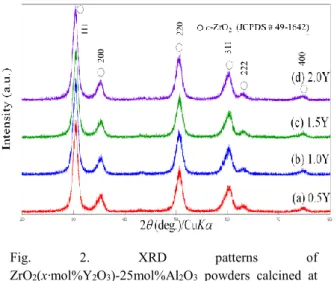
Figure 2 shows the XRD patterns measured on the [0.5Y] ~ [2.0Y] powders after the calcination performed by the two-step heating; strong XRD peaks belong to c-ZrO2 phase were observed and neither Al2O3 nor Y2O3
phases were detected, suggesting that c-ZrO2(ss) containing both Al2O3 and Y2O3 were crystallized from
the amorphous powders. Then, the powder morphology was observed; TEM photographs of the [1.5Y] powders calcined under various conditions are shown in Fig. 3 (a)~(c); (a) calcined at 973 K for 3.24×10⁴ s (700°C/9 h), (b) one-step, and (c) two-step calcinations. Their particle size (Ps) increased from around 6.5 (Fig. 3 (a)) to 9.5 (Fig. 3 (c)) nm with increasing heating temperature. Here, the effects of calcination conditions on the microstructure of ceramics were investigated.
Figure 4 shows SEM photographs of the polished surfaces for [1.5Y]ceramics fabricated at 1623 K using the calcined powders; from (a) one-step at 1173 K (900°C) for 3.6×10³ s (1 h) and (b) two-step calcinations of 973 K (700°C) for 3.24×10⁴ s (9 h) + 1173 K (900°C) for 3.6×10³ s (1 h). In the left SEM photograph, large
and coarse black particles of -Al2O3 can be seen, while in the right photograph, fine and homogeneously dispersed -Al2O3 are observed. Their mechanical properties were also evaluated; the left ceramics revealed a fracture toughness KIC of 9.39 MPa·m1/2, while the right showed a KIC of 14.1~15.3 MPa·m1/2 and a bending strength b of 1360~1390 MPa. By comparing these microstructure and mechanical properties, the two-step calcination was found to be suitable for the fabrication of ZrO2(Y2O3)-Al2O3 ceramics with high KIC
and b than one-step heating. Therefore, we adopted the calcined powders under this combined heat treatment protocol in the subsequent experiments.
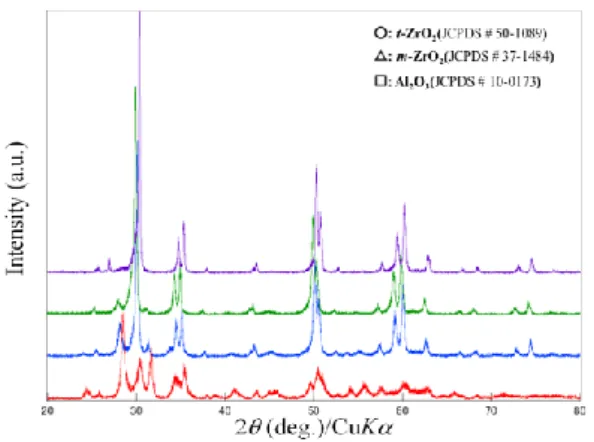
Figure 5 shows the XRD patterns of ZrO2(x·mol%Y2O3)-25mol%Al2O3 ceramics sintered at 1573K/6.0×103s/60MPa (1300°C/10min/60MPa) with x
= (a) 0.5, (b) 1.0, (c) 1.5, and (d) 2.0, revealing clearly the presence of -Al2O3 phase. In addition, by increasing the Y2O3 content, the monoclinic (JCPDS:
#37-1484) vs. tetragonal ZrO2 (JCPDS: #50-1089) ratio was much reduced. These results indicate that the c-ZrO2(ss) decomposed into -Al2O3 and ZrO2 with Y2O3 during PECPS, and that a small amount of Y2O3
could suppress the transformation from t-ZrO2 to m-ZrO2.
Fig. 2. XRD patterns of ZrO2(x·mol%Y2O3)-25mol%Al2O3 powders calcined at 973 K for 3.24×10⁴ s (700°C/9 h) followed by heating at 1173 K for 3.6×10³ s (900°C/1 h) in air.
Fig. 3. TEM photographs of ZrO2(1.5Y)-25mo%Al2O3
powders calcined at various conditions: (a) 973K/3.24×104s (700°C/9 h), (b) 1173K/3.6×103s (900°C/1 h) and (c) 973 K/3.24×104s (700°C/9 h) + 1173 K/3.6×103 s (900°C/1 h) in air.
Fig. 4. SEM photographs of the polished surfaces for ZrO2(1.5Y)-25mol%Al2O3 ceramics sintered at 1598~1623 K (1325~1350°C) using (a) a simple 1173 K for 3.6×10³ s (900°C/1 h) and (b) a “two-step” 973 K for 3.24×10⁴ s (700°C/9 h) and 1173 K for 3.6×10³ s (900°C/1 h) calcined powders, respectively.
Until now, there has been no report treating the theoretical density (Dx) of t-ZrO2(0.5Y), t-ZrO2(1.0Y), and t-ZrO2(1.5Y), except for the study of lattice parameters of t-ZrO2 and c-ZrO2 phases which contained 2.0~6.6 mol% Y2O3 by Ingel et al 27). They reported a measurement value of D(t-ZrO2(2.0Y))
=6.0880 Mg·m-3 and a calculation value of D(t-ZrO2(2.0Y))=6.1067 Mg·m-3 based on their lattice parameters.
From the lattice parameters of the t-ZrO2 phase with the Y2O3 content 0.5 to 2.0 mol% estimated to be a=0.35999~0.36014 and c=0.52255~0.51814 nm, and those of m-ZrO2 a=0.53232~0.51267, b=0.51927~
0.51731, c=0.51591~0.53691 nm, and = 98.87~98.92°
by Rietveld analysis 23), the theoretical values of Dx(t-ZrO2(0.5Y))=6.0381, Dx(t-ZrO2(1.0Y))=6.0736, Dx(t-ZrO2(1.5Y))=6.0698, Dx(t-ZrO2(2.0Y))=6.0666 and Dx(m-ZrO2(0.5Y))=5.7580, Dx(m- ZrO2 (1.0Y))=5.7923, Dx(m-ZrO2(1.5Y))=5.7738 and Dx(m-ZrO2(2.0Y))
=5.7964 Mg·m-3 were obtained. Comparing the present Dx(t-ZrO2(2.0Y)) =6.0666 with the values reported by Ingel et al. (6.0880~6.1067) Mg·m-3, the former is slightly smaller; this could be explained in term of a small amount of oxygen deficiencies in the present ceramics induced during PECPS in a reduced oxygen pressure.
Using the t/m-ZrO2 volume ratios, and the values of Dx(t-ZrO2(x·mol%Y2O3)), Dx(m-ZrO2(x·mol%Y2O3)),
and Dx(-Al2O3)=3.987 Mg·m-3, the Dx values of all of the ceramics sintered at 1598 K (1325°C) were calculated: Dx([0.5Y])=5.219, Dx([1.0Y])=5.238, Dx
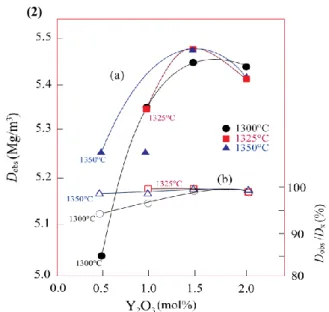
([1.5Y])=5.344, and Dx([2.0Y])=5.363 Mg·m-3. Here, as the [0.5Y] ceramics sintered at 1598 K (1325°C) had many cracks and were broken during cutting and polishing, their t/m-ZrO2 ratio was assumed to be about 5/95vol% from the pieces of broken ceramics, as will be shown in the following section. The bulk densities, except for the [0.5Y], were Dobs([1.0Y])=5.34, Dobs([1.5Y])=5.48 and Dobs([2.0Y])=5.41 Mg·m-3. These values are a little higher than the theoretical values. This might be due to some errors originating from the Rietveld analysis and t-/m-ZrO2 ratios determined with the method by Garvie and Nicholson 22).
Then, their microstructures were observed. Figure 6 shows FE-SEM photographs for the fracture surfaces of [1.5Y] ceramics sintered at: (a) 1573 K (1300°C), (b) 1598 K (1325°C) and (c) 1623 K (1350°C) for 6.0×10² s (10 min) under 50 MPa. The average grain sizes (Gs) determined using the intercept method [24] are also shown in these figures. From left to right, as the sintering temperature was raised, FE-SEM photographs taken as the secondary electron images demonstrate that the grains grew gradually from 130 to 150 nm in the dense homogeneous matrix. The effect of Y2O3 content on the microstructure was also investigated. Figure 7 shows SEM photographs for the fracture surfaces of the ZrO2(x·mol%Y2O3)-25 mol%Al2O3 ceramics sintered at 1598 K (1325°C) with x = (a) 0.5, (b) 1.0, and (c) 2.0.
These Figs. 6 and 7 display dense homogeneous microstructures with hardly any pores; proving the relative density (Dobs/Dx) must be more than 99.5%, as will be shown in Fig. 9. The values of Gs indicate that the Y2O3 addition also suppresses the grain growth. For example, the Gs of [0.5Y] ceramics was 440 nm, and then decreased to 220 [1.0Y], 140 nm [1.5Y] and 135 nm [2.0Y]. Thus, with increasing Y2O3 content, the t-ZrO2 volume ratio increased and Gs reduced.
Fig. 5. XRD patterns of ZrO2(x·mol%Y2O3)-25mol%Al2O3
ceramics sintered at 1578K/ 6.0×10²s/60MPa (1300°C/10min/60MPa); x= (a) 0.5, (b)1.0, (c) 1.5, and (d) 2.0.
Fig. 6. SEM photographs for the fracture surfaces of ZrO2(1.5Y)-25mol%Al2O3 ceramics sintered at: (a) 1573 K (1300°C), (b) 1598 K (1325°C), and (c) 1623 K (1350°C) for 6.0×10² s under 50 MPa. Average grain sizes are also shown at the bottom of each photograph.
Fig. 7. SEM photographs for the fracture surfaces of the 1598 K (1325°C)-sintered ZrO2(x·mol%Y2O3)-25mol% Al2O3 ceramics; x= (a) 0.5, (b) 1.0, and (c) 2.0. Average grain sizes are also shown at the bottom of each photograph.
Figure 8 shows (1) the volume ratio (vol%) of t-ZrO2 in ZrO2 phase and (2) (a) the bulk (Dobs) and (b) relative (Dobs/Dx) densities as a function of Y2O3 content.
This figure (1) reveals that the addition of more than 1.0 mol% Y2O3 increases the t-ZrO2 vol% rapidly, and furthermore, as shown in (2), the addition of 1.5 mol%
Y2O3 yielded the highest densities irrespective of the sintering temperature. It is very interesting that as little as 1.0 or 1.5 mol% Y2O3 was sufficient to stabilize t-ZrO2 phase with high density. Conventional sintering methods, such as pressure less sintering, HP, or HIPping, require a slightly higher Y2O3 content i.e., 2.0 or 3.0 mol% to attain the high t-ZrO2 ratios and the high densities 2-10). These differences between PECPS and conventional sintering might come from the high heating rate, i.e., 1.67×10⁻¹ K·s-1 (100 K·min-1) and 8.33×10⁻² ~ 1.67×10⁻¹ K·s-1 (5 ~ 10 K·min-1) and short soaking time, 6.0×10² s (10 min) and 7.22~21.6×10³ s (2~6 h), respectively. This rapid increasing temperature rate of PECPS could improve the sinter ability of powders by introducing a high electro-magnetic field effect. This effect has already been reported in studies employing the microwave or millimeter-wave sintering methods 28,29). Furthermore, the short soaking time would suppress the grain growth during sintering.
3.2 Mechanical properties of ceramics
The mechanical properties, such as a three-point bending strength (b), fracture toughness (KIC), and Vickers hardness (Hv), as a function of Y2O3 content are displayed in Fig. 9. Here, the values of b and KIC, as already mentioned in the section of 2. Experimental procedure, Evaluation of samples, Mechanical properties, are evaluated using an 8mm-span and the IF method, respectively, to consider only the dependence of mechanical properties on the Y2O3 content and sintering temperature. It can be easily recognized that the addition of 1.5 mol% Y2O3 yielded the overall best data: b
≥1350 MPa, KIC ≥15.5 MPa·m1/2, and Hv ≥15.5 GPa in [1.5Y] ceramics sintered at 1598 K (1325°C). When we determined the KIC values using the Vickers IF method, we measured the average diagonal half length a =76.3 µm, average crack half length c =94.3 µm, therefore, c/a=1.23 < 2.5, and Palmqvist crack length l =18.0 µm around the indent. To investigate the validity or effectivity of these best data, we fabricated large [1.5Y]
ceramics (about 55 mm in diameter and 6.5 mm in thickness) from the same powder and process; their microstructural properties were bulk densities of 2.4 and
Fig. 8. (1) t-ZrO2 volume ratio (vol%), (2) (a) bulk Dobs
and (b) relative Dobs/Dx densities, (2)
5.46 Mg·m-3 powder and sintered compacts, respectively, relative density of ceramics more than 99.9%, t/m-ZrO2
ratio of 88.7/11.3 vol%). Thus fabricated ceramics revealed a b of 1420 MPa determined using a 30mm-span, a KIC of 14.8 MPa·m1/2, and a Hv of 13.9 GPa 30). From these values, the discrepancy between the small and large samples is not so high, or in other words, almost the same.
The KIC values determined by the IF method has been investigated and compared with internationaly standardized fracture toughness test reported by Quinn et al 31). They used the Standard Reference Material SRM2100 and showed the difference in KIC values among various IF technique (Niihara 14), Miyoshi 32), and Anstis 33)) as a function of indentation load; up to indentation load of 100 N, Niihara’s eq. tends to give higher KIC values than those of SRM2100, however, Miyoshi’s eq. seems to fortuitously match in once case, on the other hand, Anstis’s eq. sometimes gives lower than those. However, when the indentation load increase to 196 N, their diremption also increase. Based on their data 31), as Niihara’s KIC values are about 34% higher than those of SRM2100, Niihara’s KIC values in the present best data (14.8 for the large to 15.5 for the small
samples) should be reduced to 11.0 to 11.6 MPa·m1/2. Next, to investigate the origin of the high
mechanical properties, the microstructures of the [1.5Y]
Fig. 9. (a) Three point bending strength b, (b) fracture toughness KIC, and (c) Vickers hardness Hv of ZrO2(x·mol%Y2O3)-25mol%Al2O3 ceramics sintered at various temperatures as a function of Y2O3 content x.
(a)
(b )
(c)
ceramics sintered at 1598 K (1325°C) were observed more precisely. Figure 10 shows: (a) a normal TEM bright field image; and (b) to (e) the elemental mappings for (b) Al, (c) O, (d) Zr and (e) Y on the same region.
Comparison of these photographs reveals that the grey grains of ZrO2 containing Y2O3 are surrounded homogeneously by white fine -Al2O3 particles segregated from the cubic ZrO2 (ss) as mentioned before.
This homogeneous distribution of -Al2O3 might be responsible for the high mechanical properties.
To our knowledge the present study is the first report which describes the realization of both high b ≥ 1 GPa and high KIC ≥ 11.0 MPa·m1/2 in the same ceramics.
This can be explained by two mechanisms: i) the high b was achieved by a high relative density ≥ 99.9% with fine grain sizes around 140 nm, and ii) the high KIC
occurred through the t- to m-ZrO2 transformation toughening, which was induced by both a 25 mol%
Al2O3 addition and a small amount of Y2O3 stabilizer.
We should also note that a high KIC was attained by the homogeneous Al2O3 precipitates tightly surrounding the t-ZrO2 grains; the former Al2O3 particles were decomposed from the c-ZrO2(ss) powders prepared by the neutralization co-precipitation method. These are rather astonishing phenomena, because until now high Fig. 10. TEM photographs of the microstructure for ZrO2(1.5Y)-25mol%Al2O3 ceramics. (a) Bright field image and (b)~(e), elemental mapping of the same region: (b) Al, (c) O, (d) Zr and (e) Y.
(a)
(b)
(c)
(d)
(e)
b and high KIC have not been attained simultaneously in the same sample; i.e., they have always shown a trade-off relation. Therefore, these data are the first breakthrough ever in the history of engineering ceramics.
&RQFOXVLRQV
By utilizing both the c-ZrO2(ss) powders corresponding to ZrO2(1.5mol%Y2O3)-25mol%Al2O3
composition prepared by the neutralization co-precipitation method and the pulsed electric-current pressure sintering (PECPS), we fabricated dense ZrO2-based composite ceramics consisting of fine t-ZrO2 grains less than 150 nm surrounded by homogeneously dispersed -Al2O3 fine particles. These ceramics showed a high bending strength ≥1350 MPa and a high fracture toughness ≥15.5 MPa·m1/2 (or ≥11.0 MPa·m1/2 ) simultaneously, which has not been reported previously. This finding constitutes a new breakthrough in terms of a “trade-off relation” between b and KIC of engineering ceramics, which has previously been considered an intractable problem such as brittleness of ceramics due to the ionic or covalent bonding.
This work was supported by a grant to Research Centre for Advanced Science and Technology at Doshisha University and also financially supported by the Program for the Strategic Research Foundation at Private Universities, 2013-2017, the Ministry of Education, Culture, Sports, Science and Technology, Japan (project no. S1311036). The authors thank Ms. M.
Toda and Ms. J. Morita of the Doshisha University Research Centre for Interfacial Phenomena for making the FE-SEM and FE-TEM observations of the samples.
5HIHUHQFHV
1) R.C. Garvie, R.H.J. Hannink, R.T. Pascoe, “Ceramic Steel?”, Nature, 258 [5537], 703-704 (1975).
2) F.F. Lange, “Transformation Toughening-Part 3
Experimental Observations in the ZrO2-Y2O3 System”, J. Mater. Sci., 17, 240-246 (1982).
3) F.F. Lange, “Transformation Toughening-Part 4 Fabrication, Fracture Toughness and Strength of Al2O3- ZrO2 Composites”, J. Mater. Sci., 17, 247-254 (1982).
4) T.K. Gupta, F.F. Lange, J.H. Bechtold, “Effect of Stress-Induced Phase Transformation on the Properties of Polycrystalline Zirconia Containing Metastable Tetragonal Phase”, J. Mater. Sci., 13, 1464-1470 (1978).
5) N. Claussen, “Stress Induced Transformation of Tetragonal ZrO2 Particles in Ceramic Matrices”, J. Am.
Ceram. Soc., 61, 85-86 (1978).
6) R. Ruhle, N. Clausen, A.H. Heuer, Microstructural Studies of Y2O3-Containning Tetragonal ZrO2
Polycrystal (Y-TZP), in N. Claussen, M. Ruhle, A.
Heuer (eds.), Science and Technology of Zirconia II, Advances in Ceramics, 12, (American Ceramic Society, Columbus, Ohio, 1984), pp.352-370.
7) K. Tsukuma, K. Ueda, K. Matsushita, M. Shimada,
“High-Temperature Strength of
Y2O3-Partially-Sabilized ZrO2/Al2O3 Composites”, J.
Am. Ceram. Soc., 68, C-56- C-58 (1985).
8) T. Tsukuma, K. Ueda, M. Shimada, “Strength and Fracture Toughness of Isostatically Hot-Pressed Composites of Al2O3 and Y2O3-Partially-Stabilised ZrO2”, J. Am. Ceram. Soc., 68, C-4-C-5 (1985).
9) S. Hori, M. Yoshimura, S. Somiya,
“Strength-Toughness Relations in Sintered and Isostatically Hot-Pressed ZrO2-Toughened Al2O3”, J.
Am. Ceram. Soc., 69, 169-172 (1986).
10) T. Masaki, “Mechanical properties of toughened ZrO2-Y2O3 ceramics”, J. Am. Ceram. Soc., 69, 638-640 (1986).
11) A.M. Alper, Inter-Relationship of Phase Equilibria, Microstructure, and Properties in Fusion-Cast Ceramics, in G.H. Stewart(ed.), Science of Ceramics, 3, (Academic Press, London, U.K., 1967), Fig. 2, p. 339.
12) S. Inamura, M. Miyamoto, Y. Imaida, M. Takagawa, K.
Hirota, O. Yamaguchi, “High Fracture Toughness of ZrO2 Solid-Solution Ceramics with Nanometre Grain Size in the System ZrO2−Al2O3”, J. Mater. Sci. Let., 12, 1368-1370 (1993).
13) A.G. Evans, E.A. Charles, “Fracture Toughness Determination by Indentation”, J. Am. Ceram. Soc., 59, 371-372 (1976).
14) K. Niihara, “A Fracture Mechanics Analysis of Indentation-Induced Palmqvist Cracks in Ceramics”, J.
Mater. Sci. Lett., 2, 221-223 (1983).
15) M. Tokita, “Trend in Advanced SPS Spark Plasma System and Technology”, J. Soc. Powder Tech. Jpn., 30, 790–804 (1993).
16) R. Orru, R. Licheri, A. M. Locci, A. Cinotti, G Cao,
“Consolidation/Synthesis of Materials by Electric Current Activated/Assisted Sintering”, Mater. Sci. Eng., R. 63, 127-287 (2009).
17) K. Hirota, K. Shibaya, H. Matsuda, M. Kato, H.
Taguchi, “Fabrication of Novel ZrO2(Y2O3)-Al2O3
Ceramics Having High Strength and Toughness Utilizing Pulsed-Electric Current Pressure Sintering (PECPS)”, Advances in Applied Ceramics: Structural, Functional and Bioceramics, 113, 73-79 (2013).
18) K. Hirota, K. Shibaya, H. Matsuda, M. Kato, H.
Taguchi, “Fabrication of Novel ZrO2(Y2O3)-Al2O3
Ceramics Having High Strength and Toughness by Pulsed Electric-Current Pressure Sintering (PECPS) of Sol-Gel Derived Solid Solution Powders”, The American Ceramic Society’s Ceramic Transactions:
Processing and Properties of Advanced Ceramics and Composites, VI 249, 3-13 (2014).
19) T. Tsukigata, K. Tsukuma, “Zirconia Powder-Raw Material for the Fabrication of High Strength and High Toughness Zirconia Ceramics”, Ceramics, 17, 816-822 (1982).
20) Y. Ozaki, Ultrafine Zirconia Powder, in S. Somiya, M.
Yoshimura (eds.) , Zirconia Ceramics, 1, (Uchida Rokakuho, Tokyo, 2000), pp.31-44.
21) R.C. Garvie, P.S. Nicholson, “Phase Analysis in Zirconia Systems”, J. Am. Ceram. Soc., 55, 303-305 (1972).
22) Rietveld program ‘RIETAN’, http://fujioizumi.verse.jp/
23) M.I. Mendelson, “Average Grain Size in Polycrystalline Ceramics”, J. Am. Ceram. Soc., 52, 443–446 (1969).
24) S. Palmqvist, “Method att Bestamma Segheten hos Spread Materials”, Sarkskilt Hardmetaller, Jernkortorets Ann., 141, 300-7 (1957).
25) Y. Matsuno, H. Wakai, S. Sakaguchi, Evaluation Technology Corpus of Mechanical Properties of Fine-Ceramics, (Realize publisher, Tokyo, 1984), p.182.
26) K. Hirota, K. Yamamoto, K. Sasai, M. Kato, H. Taguchi, H. Kimura, M. Takai, M. Terada, “Al2O3-Compositional Dependence of Mechanical Properties of ZrO2 Based Ceramics Fabricated from ZrO2(Y2O3)-Al2O3 Solid Solution Powders”, J. Jpn. Soc. Powder Powder Metall., 60[10], 428-435(2013).
27) R.P. Ingel, D. Lewis III, “Lattice Parameters and
Density for Y2O3-Stabilized ZrO2”, J. Am. Ceram. Soc., 69, 325-332 (1986).
28) H.D. Kimrey, J.O. Kiggans, M.A. Janney, R.L. Beatty,
“Microwave Sintering of Zirconia-Toughened Alumina Composites”, Mater. Res. Soc. Symp. Proc., 189, 243-254 (1991).
29) M.A. Janney, H.D. Kimrey, “Microwave Sintering of Alumina at 28 GHz”, Ceramic Powder Science, II, 919-924, Am. Ceram. Soc., (1988).
30) H. Kimura, K. Hirota, “Study on Mass-Production of Ceramics with High Strength and High Toughness Using ZrO2-Al2O3 Solid Solution Powder”, Final Report (on Release), AS2511267M, Japan Science and Technology Agency (JST), (2014).
31) G.D. Quinn and R.C. Bradt, “On the Vickers Indentation Fracture Toughness Test”, J. Am. Ceram.
Soc., 90 [3] , 673-680 (2007).
32) T. Miyoshi, “A Study on Evaluation of KIC for Structural Ceramics”, Trans. Jap. Soc. Mech. Eng. Ser.
A., 51A, 2489-97 (1985).
33) G.R. Anstis, P. Chantikul, B.R. Lawn, D.B. Marshal, “A Critical Evaluation of Indentation Techniques for Measuring Fracture Toughness: I, Direct Crack Measurements”, J. Am. Ceram. Soc., 64 [9], 533-8 (1981).