Report of Japanese scientific observer activities
for southern bluefin tuna fishery in 2017
日本のミナミマグロ漁業での科学オブザーバの
2017 年の活動報告
Tomoyuki I
TOH, Yuichi Tsuda, Yukiko Inoue, Yasuko Semba, and Kazuhiro Oshima
伊藤智幸・津田裕一・井上裕紀子・仙波靖子・大島和浩National Research Institute of Far Seas Fisheries, Japan Fisheries Research and Education Agency
水産研究教育機構 国際水産資源研究所
要約
本文書ではミナミマグロを対象とした日本延縄船に対する科学オブザーバ計画について、2017 年調 査の暫定的結果を報告する。主要なCCSBT 統計海区(4-9 海区)において 12 隻に科学オブザーバーを 配乗した。調査カバー率は、隻数で13.6%、使用釣鈎数で 12.6%、ミナミマグロ漁獲尾数で 12.6%であ り、オブザーバが実際に観察した時間を考慮すると使用鈎数で10.6%であった。オブザーバが記録した ミナミマグロの体長と、RTMP で漁業者から報告された漁獲体長とは概ね一致した。オブザーバは乗 船中にミナミマグロからの耳石 251 個体分、筋肉 392 個体分を含む各種の生物標本を採取した。オブ ザーバはミナミマグロ3 個体分の CCSBT 通常標識を回収した。Summary
This document summarizes preliminary results of Japanese scientific observer program for southern bluefin tuna (SBT) in 2017. Scientific observers were dispatched in 12 vessels that operated in the main CCSBT statistical areas (area 4-9). Observer coverages were 13.6% in the number of vessels, 12.6% in the number of hooks used, and 12.6% in the number of SBT caught. When taking into account of the actual observation time during hauling, the coverage in the number of hooks observed were estimated as 10.6%. The length frequency distributions of SBT reported by the observers and those reported from all vessels in RTMP were generally consistent to each other. Observers collected various biological samples including otolith from 251 SBT and muscle tissue from 392 SBT. Observers retrieved CCSBT conventional tags from 3 SBT individuals.
1. 科学オブザーバ活動の概要 Overview of the scientific observer program
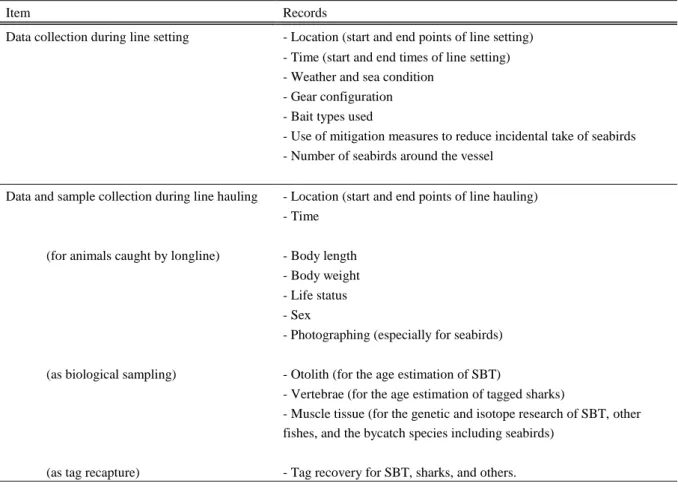
みなみまぐろ漁場における日本の科学オブザーバ調査は、1992 年からほぼ同一の調査方法で実施し てきた。オブザーバはTable 1 に示すように、ミナミマグロおよび生態関連種の生物調査や、気象・漁 具・海鳥混獲回避手段の利用状況等に関する情報を収集する。調査項目には優先順位が付けられてお り、時間が限られているときには重要な項目だけを調査する。調査項目の優先順位は年により異なる 場合がある。オブザーバは、各大洋でミナミマグロを主要な漁獲対象として操業する遠洋延縄漁船か らランダムに選定された漁船に派遣される。2006 年以降のミナミマグロ漁業は、漁期規制の撤廃、燃 費の高騰、およびIQ 制の導入により、各船の操業計画が流動的となっている(CCSBT-ESC/1208/34)。 ミナミマグロ漁獲枠を持つ船に一定期間オブザーバを派遣しても、その船の年間を通した操業戦略上 の都合により、オブザーバの乗船中にミナミマグロ漁場での操業を行わない場合がある。 オブザーバの派遣人数は、当初は10~18 名/年であったが、予算上の制約により 2007 年以降のオブ ザーバ派遣人数は7 名/年程度に留まってきた。これを改善するため、2010 年以降はインドネシア人調 査員を加えてオブザーバを増員した。なお、2014 年まではインドネシア人オブザーバには耳石や胃内 容物などの生物サンプルの採集を指示していなかったが、インドネシア人オブザーバの配乗比率の増 加と調査能力の向上に伴い、2015 年より一部のインドネシア人オブザーバにサンプル採取を指示して いる。Japanese scientific observer program of longline fishery for the southern bluefin tuna (SBT) has been performed systematically in a consistent method since 1992. In this program, scientific observers collect biological data and samples from SBT and ecologically related species during the hauling operations. They also collect information about the fishing operations (e.g., fishing configuration, weather and sea conditions, mitigation measures used to reduce incidental take of seabirds). Table 1 summarizes the research items of the observers. When they are busy and have little time to complete all the research items (because of the severe sea, weather, and/or fishing conditions), observers reduce their research activities in accordance with the established priorities. This priority levels differ depending on the fishing year. Scientific observers were sent to the vessels which were chosen at random from all of authorized Japanese commercial longline vessels targeting SBT in each ocean. Since 2006, annual operational patterns and schedule of Japanese vessels targeting SBT have been possibly affected by introduction of the individual quota (IQ) system, abolishing of the seasonal area closure, and drastic/temporal increase of fuel price (CCSBT-ESC/1208/34). Thus, there are difficulties to deploy the observers for a specific period toward the SBT fishing trips in a timely manner; some vessels with SBT quota do not operate in SBT fishing grounds during the period that observers are on-board because of their fishing strategy.
Japan had regularly deployed 10-18 observers per year in the early period of the program, although the program was forced to reduce the number of observers by budgetary restrictions. In 2007-2009, only seven observers were deployed to the vessel operated in the SBT fishing grounds per year. Since 2010, the number of observers has increased with the employment of Indonesian researchers. Collection of biological samples (otolith and muscle) had not been included in the direction to Indonesian researchers by 2014, however it has
been ordered to a part of selected Indonesian researchers since 2015, along with increasing the ratio of trips with Indonesian researchers and improvement of their research skill.
2. 科学オブザーバの訓練 Observer Training
オブザーバは派遣される前に講習会にて訓練を受ける。2017 年には 4 回の講習会を開催し、オブザ ーバ候補者に対し、調査方法、記録方法、および安全確保について講習を行った。講習では実物の魚を 用いて調査方法や生物サンプルの採取方法の実習も行なった。オブザーバは、調査航海終了後に、乗船 中の調査活動について報告をした。
Before cruises, scientific observer candidates have to take a training seminar. The training seminars for SBT fishery were held 4 times in 2017. In the training seminars, the candidates brushed up their knowledge and skills on research methods, recording procedures and safety. It also included practical training using the actual tuna to measure the fish size and to collect the biological samples. After returning from the cruises, observers reported their research activities in the debriefing.
3. 科学オブザーバのデザインとカバー率 Design and coverage
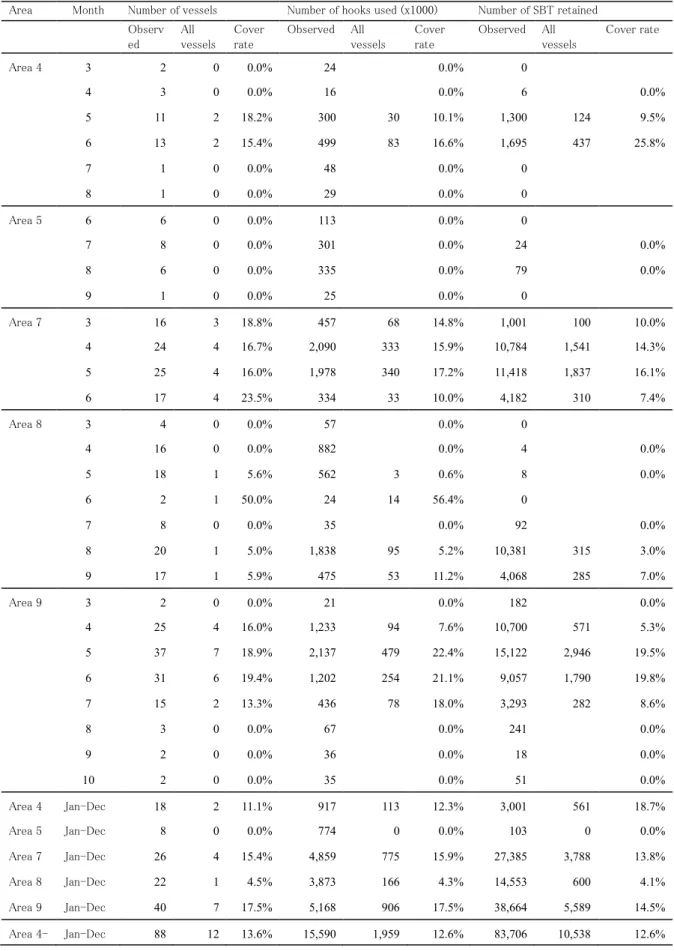
2017 年に主要な CCSBT 統計海区(海区 4-9)で操業を行った漁船に 12 名のオブザーバを配乗した。 全員が過去にミナミマグロまたはマグロ類を対象とした延縄操業船での科学オブザーバ活動の実績を 有していた。ミナミマグロを対象とした操業を観察したオブザーバの雇用日数(日本出国から帰国ま で)は合計1237 日、対象調査船における乗船日数は合計 785 日であった。 海域ごと、月ごとの隻数・努力量(釣鈎数)・SBT の漁獲尾数について、全体に占めるカバー率を計 算した。比較には、CCSBT へ提出したデータ(隻数、努力量、および漁獲尾数)を用いた。2017 年の 4 海区から 9 海区でのカバー率は、隻数で 13.6%、使用釣鈎数で 12.6%、ミナミマグロ漁獲尾数で 12.6% であった(Table 2)。 オブザーバは、食事の休憩や天候等の要因により操業を観察しない場合がある。2017 年にオブザー バが実際に観察した鈎数の割合は総使用鈎数の84.7%であった。したがって、オブザーバが実際に観察 した延縄努力量に基づくカバー率は、12.6%×84.7%=10.6%と計算された。
Scientific observers were dispatched in 12 vessels that operated in the main CCSBT statistical areas (area 4 -9). All observers had experiences of scientific observer activities for SBT or other tunas. The total number of days employed was 1237 while the total number of days on-boarded was 785.
We calculated observer coverage between January and December in area 4-9 (calendar year). The data reported from the fishermen (the denominator for coverage calculation) were based on the RTMP and/or the logbook which were submitted in the CCSBT data exchange. Observer coverages were 13.6% in the number of vessels, 12.6% in the number of hooks used, and 12.6% in the number of SBT caught (Table 2).
Scientific observers did not observe whole of the hauling operations because of rest for meal, rough weather condition, and other reasons. The observers actually monitored 84.7% of all hauling time in 2017. Thus, the
coverage of effort which was actually observed by the observers was calculated as 10.6% (12.6% x 0.847).
4. 収集データ Observer data collected
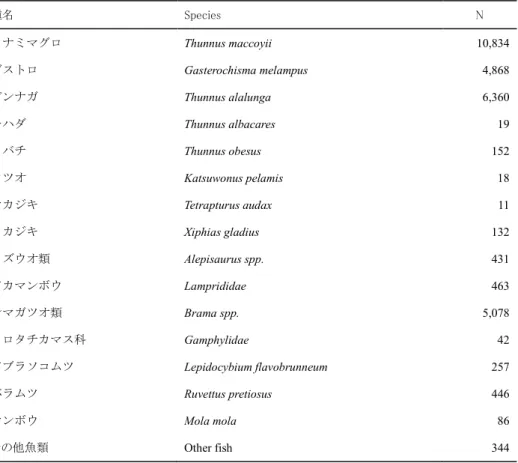
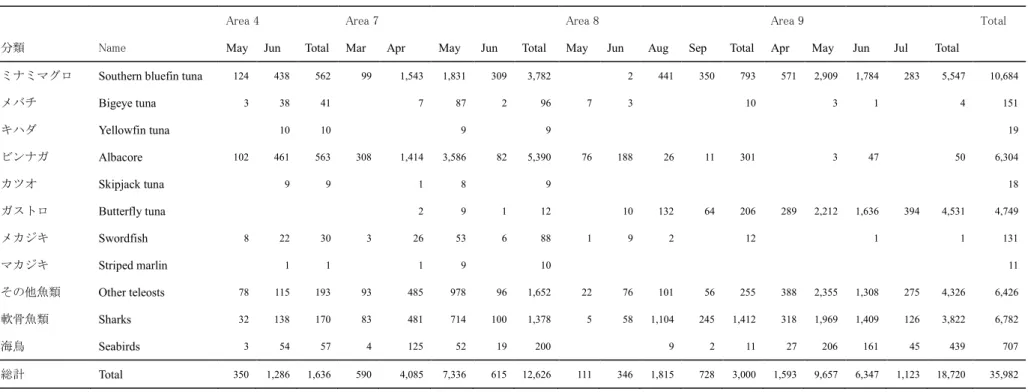
4~9 海区において、オブザーバが記録した硬骨魚類、サメ類、海鳥類、その他のリストを Table3~ 5 に示す。オブザーバによる生物の種査定の一部については、後日、オブザーバが撮影した写真に基づ いて国際水産資源研究所の専門家が確認している。オブザーバが体長を測定した種別個体数を海域・月 別にTable 6 に示す。合計 35,983 個体の生物の体長を測定し、このうちミナミマグロは 10,684 個体で あった。オブザーバは乗船中に耳石、筋肉などの生物標本を収集し、性別を判定した(Table 7)。ミナ ミマグロについては耳石を251 個体、筋肉を 392 個体から採取した。 観察されたミナミマグロの体長組成を海域ごとにFig.1 に示す。RTMP による日本延縄船全船による ミナミマグロ全漁獲個体数の体長組成と比較した。オブザーバが観察した体長分布と、全操業船から 報告された体長分布とは類似していた。詳細にみると 4 海区と 8 海区で違いが見られ、オブザーバー が乗船した場合の方がわずかに大型であった。
Table 3-5 summarize the number of animals observed, by teleosts, sharks, and seabird and others. Some of them were identified its more detailed taxonomic classification later in the laboratory by specialists in the National Research Institute of Far Seas Fisheries based on photographs which scientific observers took on-board. Table 6 summarizes the number of individuals of which body length were measured by the observers by area and month. A total of 35,983 individuals were length measured, including 10,684 SBT. Biological samples collected, as well as sex identified, were summarized by species, area and month in Table 7. Otoliths were collected from 251 SBT and muscle tissue were collected from 392 SBT.
Fig. 1 shows length frequency of SBT from observers comparing to those from RTMP by area. The length frequency distributions of the observer data and RTMP data were generally similar to each other. In detail, there were differences in the length frequencies in Area 4 and Area 8, in which size of observed were slightly larger.
5. 標識魚の再捕 Tag return monitoring
調査を通じて回収したCCSBT 通常標識(通常標識)は、3 隻から 3 個体分(4 本)であった。
Scientific observers collected 4 conventional tags of CCSBT from 3 recaptured SBT on 3 vessels.
6. 科学オブザーバ事業の問題点 Problem experienced
日本の延縄漁船はコスト削減のために洋上補給し、ほとんど寄港しないため、一部のオブザーバは 対象調査船への配乗時に補給船を利用した洋上転船を行った。しかし、洋上転船には天候次第で大き な危険を伴う等の問題点が指摘されている。
Japanese commercial longline vessels rarely come into ports because of cost-cutting; thus, some observers were forced to transfer from supply vessels to fishing vessels on high seas. Transfer on high seas is risky, and magnitude of risk is depending on the weather conditions.
Reference
Itoh, T. 2012 Change in operation pattern of Japanese SBT longliners in 2011 resulting from the introduction of the individual quota system in 2006. CCSBT-ESC/1208/34
Table 1. Research items of observers in Japanese SBT longline observer program.
Item Records
Data collection during line setting - Location (start and end points of line setting) - Time (start and end times of line setting) - Weather and sea condition
- Gear configuration - Bait types used
- Use of mitigation measures to reduce incidental take of seabirds - Number of seabirds around the vessel
Data and sample collection during line hauling - Location (start and end points of line hauling) - Time
(for animals caught by longline) - Body length - Body weight - Life status - Sex
- Photographing (especially for seabirds)
(as biological sampling) - Otolith (for the age estimation of SBT)
- Vertebrae (for the age estimation of tagged sharks)
- Muscle tissue (for the genetic and isotope research of SBT, other fishes, and the bycatch species including seabirds)
Table 2. Observer coverage in Japanese SBT longline observer program in 2017.
Area Month Number of vessels Number of hooks used (x1000) Number of SBT retained
Observ ed All vessels Cover rate Observed All vessels Cover rate Observed All vessels Cover rate Area 4 3 2 0 0.0% 24 0.0% 0 4 3 0 0.0% 16 0.0% 6 0.0% 5 11 2 18.2% 300 30 10.1% 1,300 124 9.5% 6 13 2 15.4% 499 83 16.6% 1,695 437 25.8% 7 1 0 0.0% 48 0.0% 0 8 1 0 0.0% 29 0.0% 0 Area 5 6 6 0 0.0% 113 0.0% 0 7 8 0 0.0% 301 0.0% 24 0.0% 8 6 0 0.0% 335 0.0% 79 0.0% 9 1 0 0.0% 25 0.0% 0 Area 7 3 16 3 18.8% 457 68 14.8% 1,001 100 10.0% 4 24 4 16.7% 2,090 333 15.9% 10,784 1,541 14.3% 5 25 4 16.0% 1,978 340 17.2% 11,418 1,837 16.1% 6 17 4 23.5% 334 33 10.0% 4,182 310 7.4% Area 8 3 4 0 0.0% 57 0.0% 0 4 16 0 0.0% 882 0.0% 4 0.0% 5 18 1 5.6% 562 3 0.6% 8 0.0% 6 2 1 50.0% 24 14 56.4% 0 7 8 0 0.0% 35 0.0% 92 0.0% 8 20 1 5.0% 1,838 95 5.2% 10,381 315 3.0% 9 17 1 5.9% 475 53 11.2% 4,068 285 7.0% Area 9 3 2 0 0.0% 21 0.0% 182 0.0% 4 25 4 16.0% 1,233 94 7.6% 10,700 571 5.3% 5 37 7 18.9% 2,137 479 22.4% 15,122 2,946 19.5% 6 31 6 19.4% 1,202 254 21.1% 9,057 1,790 19.8% 7 15 2 13.3% 436 78 18.0% 3,293 282 8.6% 8 3 0 0.0% 67 0.0% 241 0.0% 9 2 0 0.0% 36 0.0% 18 0.0% 10 2 0 0.0% 35 0.0% 51 0.0% Area 4 Jan-Dec 18 2 11.1% 917 113 12.3% 3,001 561 18.7% Area 5 Jan-Dec 8 0 0.0% 774 0 0.0% 103 0 0.0% Area 7 Jan-Dec 26 4 15.4% 4,859 775 15.9% 27,385 3,788 13.8% Area 8 Jan-Dec 22 1 4.5% 3,873 166 4.3% 14,553 600 4.1% Area 9 Jan-Dec 40 7 17.5% 5,168 906 17.5% 38,664 5,589 14.5% Area 4-9 Jan-Dec 88 12 13.6% 15,590 1,959 12.6% 83,706 10,538 12.6%
Table 3. Number of teleost fish recorded by the Japanese SBT longline observer program in 2017 in CCSBT statistical area 4-9. 種名 Species N ミナミマグロ Thunnus maccoyii 10,834 ガストロ Gasterochisma melampus 4,868 ビンナガ Thunnus alalunga 6,360 キハダ Thunnus albacares 19 メバチ Thunnus obesus 152 カツオ Katsuwonus pelamis 18 マカジキ Tetrapturus audax 11 メカジキ Xiphias gladius 132 ミズウオ類 Alepisaurus spp. 431 アカマンボウ Lamprididae 463 シマガツオ類 Brama spp. 5,078 クロタチカマス科 Gamphylidae 42 アブラソコムツ Lepidocybium flavobrunneum 257 バラムツ Ruvettus pretiosus 446 マンボウ Mola mola 86 その他魚類 Other fish 344
Table 4. Number of sharks recorded by the Japanese SBT longline observer program in 2017 in CCSBT statistical area 4-9. 種名 Species N ヨシキリザメ Prionace glauca 5,312 アオザメ Isurus oxyrinchus 127 ニシネズミザメ Lamna nasus 1,128 その他 Other elasmobranches 846
Table 5. Number of seabirds and the other animals recorded by the Japanese SBT longline observer program in 2017 in CCSBT statistical area 4-9.
種名 Species N
大型アホウドリ類 Large albatrosses 22
暗色アホウドリ類 Dark coloured albatrosses 1
その他のアホウドリ類 Other albatrosses 182 種不明アホウドリ類 Unidentified albatrosses 138 その他の海鳥 Other petrels 329 ミズナギドリ類 Other seabirds 51 種不明海鳥類 Large albatrosses 6 ウミガメ類 Turtles 1
Table 6. Number of individuals its length measured under the Japanese SBT longline observer program.
Area 4 Area 7 Area 8 Area 9 Total
分類 Name May Jun Total Mar Apr May Jun Total May Jun Aug Sep Total Apr May Jun Jul Total
ミナミマグロ Southern bluefin tuna 124 438 562 99 1,543 1,831 309 3,782 2 441 350 793 571 2,909 1,784 283 5,547 10,684
メバチ Bigeye tuna 3 38 41 7 87 2 96 7 3 10 3 1 4 151 キハダ Yellowfin tuna 10 10 9 9 19 ビンナガ Albacore 102 461 563 308 1,414 3,586 82 5,390 76 188 26 11 301 3 47 50 6,304 カツオ Skipjack tuna 9 9 1 8 9 18 ガストロ Butterfly tuna 2 9 1 12 10 132 64 206 289 2,212 1,636 394 4,531 4,749 メカジキ Swordfish 8 22 30 3 26 53 6 88 1 9 2 12 1 1 131 マカジキ Striped marlin 1 1 1 9 10 11 その他魚類 Other teleosts 78 115 193 93 485 978 96 1,652 22 76 101 56 255 388 2,355 1,308 275 4,326 6,426 軟骨魚類 Sharks 32 138 170 83 481 714 100 1,378 5 58 1,104 245 1,412 318 1,969 1,409 126 3,822 6,782 海鳥 Seabirds 3 54 57 4 125 52 19 200 9 2 11 27 206 161 45 439 707 総計 Total 350 1,286 1,636 590 4,085 7,336 615 12,626 111 346 1,815 728 3,000 1,593 9,657 6,347 1,123 18,720 35,982
Table 7. Number of individuals its biological samples collected and sex identified in the Japanese SBT longline observer program in 2017.
種名 Species Otolith Muscle Sex
ミナミマグロ Southern bluefin tuna 251 392 9,998
メバチ Bigeye tuna 30 38 150 キハダ Yellowfin tuna 4 6 19 ビンナガ Albacore 140 144 カツオ Skipjack tuna 1 ガストロ Butterfly tuna 73 4,545 メカジキ Swordfish 17 112 マカジキ Striped marlin 2 11 その他魚類 Other teleosts 125 926 サメ類 Elasmobranches 1 6,722 海鳥 Seabirds 42
Fig. 1. Length frequency distribution of SBT by area in the Japanese SBT longline observer program in 2017.