Journal of the Operations Research Society of Japan
Vol. 26, No. 3, September 1983
SOME BOUNDS ON APPROXIMATION ALGORITHMS FOR
n/m/I/LMAYe
AND
n/2/F/LMAx
SCHEDULING PROBLEMS
T eruo Masuda
University of Osa/qJ Prefecture
Toshio Nishida
Osaka University
Hiroaki Ishii Osaka University
(Received August 2, 1982; Final May 30, 1983)
Abstract In this paper, we analyze approximation algorithms for two types of scheduling problems. The first is the n jobs scheduling problem with due dates on m identical machines to minimize the maximum lateness. For this problem n/m/I/Lmax, we propose two approximation algorithms and derive their worst case bounds. The second is the 2 x n flow shop scheduling problem with due dates to minimize the maximum lateness. For this problem n/2/F/Lmax' we first give a solvable case in the sense that the optimal schedule can be easily found. Then we again propose an approximation algorithm for general n/2/F/Lmax and derive its worst case bound.
1.
Introduction
We consider two scheduling problems whose objective is to minimize maxi-mum lateness. The first is a following parallel machine scheduling problem;
(i) a set of
n
independent jobsJ=(J1,JZ,···,J
n
)
is to be processed on a set of m identic'al machines M= (Ml ,MZ' ••• ,Mm)' (ii) each job J
i
has a processing timet
.~O and due date d .;!O, (iii) preemption is not allowed and (iv) the'Z-
'Z-objective is to minimize the maximum lateness.
The second is the following two-machine flow shop scheduling problem; (i) a set of n independent jobs
J=(Jl,JZ,···,J
n) is to be processed on two machines A and B, (ii) each jobJ.
has two processing times a. and b.~Ocorre-'Z- 'Z-
'Z-sponding to A and B respectively, and a due date d.~O, (iii) the processing
'Z-order of each job J
i is first on A and next on B, and (iv) the objective is to minimize the maximum lateness.
Some Bounds for n/m/I/Lmax and n/2/F/Lmax 213
Further i t is assumed in both problems that no machine can simultaneously process two or more jobs and no job can be processed simultaneously on more than one machine. Hereafter, according to Lenstra et al. [6], these problems are compactly denoted by n/m/I/L and n/2/F/L ,respectively.
max max
For the maximum lateness problem 011 a single machine, Jackson [2] has
obtained an exact algorithm which finds an optimum schedule in a polynomial 2
time of problem size. Furthermore, Lawler [5] has obtained
o(n )
exact algo-rithm for the related problem with arbitrary nondecreasing cost function and general precedence constraints where n is the number of jobs. While, both problems in this paper are known to be lW-complete ( Lenstra. et a1. [6] ). That is, they are among notoriously intractable problems and so there do not and perhaps will not exist any po1ynomia11y bounded exact algorithms for them. For these reasons, practioners are willing to accept good feasible solution. Indeed, for NP-comp1ete problems, many approximation algorithms and their bouds for the worst cases are derived. With respect to scheduling problems with due dates, however, very few worst case bounds have been obtained. (See Graham et a1. [1] for details.) Kise et a1. [4] have developed effective approximation algorithms and showed their worst case bounds for the maximum lateness problem on a single machine.In general, to evaluate the effectiveness of approximation algorithm, various measures such as the absolute deviation
w-w'
(IT) and the relative devi-ation(w-w'(IT»/w
has been customarily llsed so far, wherew
denotes the value of optimal schedule andw'(IT)
the value of approximate schedule generated by the approximation algorithm IT. As pointe"d out by Kise et a1. [4], how€ver, above measures exhibit a shortcoming that they give different values between two equivalent problems, where equivalence means that one is obtained by applying a simple transformation to the other, and the optimal and the approx-imate schedule are the same in both problems. This pathology urges us to employ the following modified relative deviationw-w' (11)
W+d
maxproposed by Kise et al.
[4]
as the effec:tive measure of approximation algo-rithmIT,
where d=
max{d.1 i=l,2, •••
,n}.max
7.-In the sequel, first we propose two approximation algorithms for n/m/I/ L and derive their worst case bounds. Next for n/2/F/L ,we give the
max max
solvable case in the sense that the optlma1 schedule can be easily found. Then we propose an approximation algorithm for general n/2/F/L and again derive
max its worst case bound.
214 T. Masuda, H. Ishii and T. Nishida
2. Approximation Algorithms for n/m/I/Lmax and Their Bounds
In this chapter, we consider the scheduling problem n/m/I/L . This max
problem is characterized by the processing time vector
T=(tl,···,t
n
)
and the due date vectorD=(d
l
,d
2
,···,d
n
).
Here without any loss of generality, we assume that dl~···~d n(=d
).
Our first approximation algorithmEDD (Earliest
max
Due Date)
is a list scheduling and the second algorithmLPT (Longest Prooessing
Time)
is its refinement. Alist soheduling
produces a schedule of jobs based on a list as follows: When one of machines becomes available, first unexe-cuted job on the list is assigned to be processed on it.For the maximum completion time scheduling problem with n independent jobs and
m
identical machines, (n/m/I/C according to Lenstra et al. [6] andmax
the objective is only different from n/m/I/L ), Graham [1] obtained following max
results.
Theorem
(Graham[1]).
For n/m/I/C , letw'
be the maximum completion maxtime of any list scheduling and
w*
that of optimal scheduling. Then~
<2-.l
w* -
mholds. Further for the list such that the jobs are ordered in nondecreasing order of processing times,
w'
4 -1w*
~3'-
3m holds.For the job set
J,
the maximum lateness of schedule constructed by some algorithm IT (approximation or exact) is defined byL(J;IT)=
max{C.(IT)-d.},
l~i~n t. t.where
C.(IT)
is the completion time of jobJ.
in a schedule constructed byt. t.
algorithm IT. Especially, hereafter,
L(J;EDD), L(J;LPT)
andL(J;IT*)
are used to denote their maximum latenesses byEDD, LPT
and a certain optimum algorithm IT* respectively.Now we propose the approximation algorithm
EDD.
Algorithm EDD:
Assign jobs on machines in an orderJ
l
,J
2
,···,J
n
•
In order to analyze the worst case bound of this algorithm
EDD,
following lemma is needed.Lemma 2.1.
For any m and certain number K, J=(Jl,···,Jn) is the min-imal job set among ones for which modified relative deviation of
EDD
exceedsK, Le.,
Some Bounds for n/m/I/Lmax and n/2/F/Lmax
L(JjEDD)-L(J;II*)
L(J'II*)+d
, n> K
holds. Then
J
determines the maximum :Lateness of EDD, L(J;1!:DD).n
215
Proof:
We prove this lemma by contradiction. determines the maximum lateness of algorithm EDD.We assume that job
J
i
, i<n,
Let J'=(Jl,···,Ji ) be the subset of
J
obtained by eliminating j ohsJ
i+1 ' •••,J
n' ClearlyL(J;EDD)=L(J';EDD) ,
and
L(J;II*)~L(J'
;II*)
d
=
max d.~ maxd.=d.
n l~j~n J l~j~i J ~hold. These imply
L(J;EDD)-L(J;II*) K< ~ L(J;II*)+d n L(J' ;EDD)-D(J'
;II*)
L(J' ;II*)+d. ~That is, we have a smaller job set
J'.
This contradicts the minimality of job setJ.
EDD.
Thus job
I
n determines the maximum lateness of algorithm EDD.
0
Fully utilizing Lemma 2.1, we can derive a worst case bound of algorithm
Theorem 2.1.
For any job setJ.
L(J;EDD)-L(J;II*) < 1L(J;II*)+d
n -1-
m
holds. Moreover this bound is best possible.
Proof:
Since the first half of our proof will be a proof by contradic-tion, it is necessary to develop relationship only for the smallest n for which the theorem may be violated. Thus we assume that J defines a minimal job set for which the theorem does not hold.Now by Lemma 2.1, job J determines the maximum lateness of algorithm
n
EDD, 1.
e.,
(2.1) L (J ;EDD) = C (EDD) - d ,
n n
where C (EDD) n is the completion time of job . J n in a schedule constructed by algorithm EDD. Since algorithm EDD is the list scheduling, Graham's theorem shows
216
(2.2)
C (EDD)
n
T. Masuda, H. Ishii and T. Nishida
~ 2- 1 m,
where n* is a certain exact algorithm minimizing maximum completion time and C(n*) is its maximum completion time.
(2.2) , holds
(2.3)
C
(EDD)~(2
-1..
)C(n*)n
m
from (2.2). Substituting: (2.2)' into (2.1), L(J;EDD)
~
(2 - ; )c(TI*) - d n results. (2.4) Hence (2.5) While we have L(J;rr*) 2: C(rr*) - d • n (2.3) and (2.4) imply 1 - -L(J;EDD) - L(J;I1*) ~ (2 - rn)C(rr*) - d n - (C(II*) - dn) =(1 -l..)C(n*). mSince
d
max n=d,
(2.4) and (2.5) together show 1-L(J;EDD) -L(J;rr*)
~
(l-rn)C(rr*) =l-l..L(J;rr*)
+d
max C(n*) m.This contradicts our assumption. Thus we have the desired worst case bound. To see that this bound is best possible, consider three cases depending on m (mod4). (This example is almost the same as the example of Graham's theorem. )
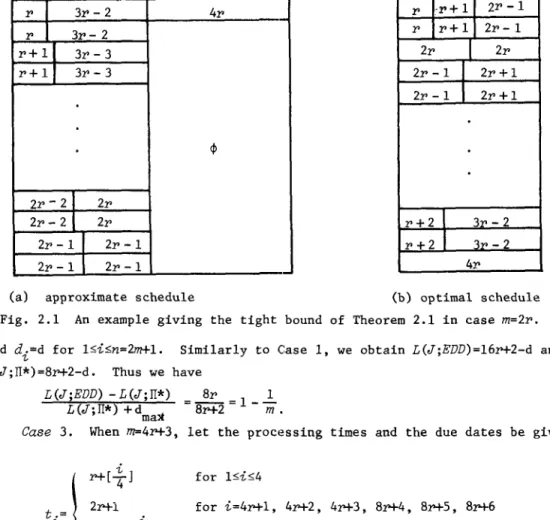
Case 1. When m=2p, let the processing times and due dates be given by
t =t ={p+(i-l)
2i-l 2i 4p - (i
+
1)for l~i~p, for p+l~i~2p and t
4P+l=4p, and di=d(=const.) for 1~i~n=2m+l. Since all the due dates are equal, we may assume that the i-th job assigned by algorithm EDD, 1~i~2m+l, is job J
i
.
Then we obtain the schedule shown in Fig.2.la. Since the optimal schedule by some exact algorithm rr* becomes as shown in Fig.2.lb, and L(J;I1*) is 2m-d, we haveL(JiEDD) - L(Ji l1*) -1 1 _ 1 1 L(Jil1*)+d -
-z;--
-rn.max
Case 2. When m=4P+l, let the processing times and the due dates be given
by 2P+2l4'J -1 i for 1~i~4p 4p for i=4p+l t.= i-I 'Z- 8r-2lTl
+
1 for 4p+2~i~8p+l 4p for i=8P+2 8p+2 for i=8P+3Some Bounds for n/m/I/Lmax and n/2/F/Lmax 217 d d l '
I
31' - 2 41' l ' 1:1'+1I
21' - 1 1'J1'+l 1 21' - 1 21'I
21' 1'J 31' - 2 1'+1 31' - 3 1'+1 31' - 3 21' - 1 21' + 1 21' - 1 21' + 1 <P 21' - 2I
21' 21' - 2I
21' 1'+2 31' - 2 21' - 1 21' - 1 l' +2 31' - 2 21' - 1 21' - 1 41'(a) approximate schedule (b) optimal schedule
Fig. 2.1 An example giving the tight bound of Theorem 2.1 in case
m=21'.
andd.=d
for1$i$n=2m+l.
Similarly to Case 1, we obtainL(J;EDD)=16r+2-d
and
'Z-L(J;IT*)=8r+2-d.
Thus we haveL(J;EDD) -L(J;IT*)
=~=1-1.L(J;II*)
+d.. maA 8r+2m.
Case 3. When m=4r+3, let the processing times and the due dates be given
by r+[i..] 4 for
1:$i$4
t.=
2r+1 fori=4r+1,
4r+2, 4r+3, 8r+4, 8r+5, 8r+6 'Z-i
4r+4$i$8r>+3
4r+2-[4] for 4r+3 fori=8r+7,
and
d.=d
for1$i$n=2m+l.
Again similarly to Case 1 and Case 2, we have
'Z-L(J;EDD)=8r+5-d
andL(J;II*)=4r+3-d.
Hence we proveL(J;EDD) -L(J;II*)
_4r+2 -1 1L(J;IT*)
+d
-
4r+3 - -m.
maxThis completes the proof of Theorem 2.1. D
Above worst case examples show that when the number of distinct due dates is small, this algorithm
EDD
is not so effective. In such a case, the maximum lateness may be greatly influenced on the maximum completion time rather than the due date. Now we propose another algorithmLFT
which is more effective in such a situation. The algorithmLFT
is a hybrid algorithm which consists ofLFT
rule andEDD
rule.218 T. Masuda, R Ishii and T. Nishida
Algorithm LPT :
Step 1.
Assign the jobs to each machine according to the list such that the jobs are ordered in nondecreasing order of the proc-essing times.(LPT rule part)
Step 2.
On each machine, reorder the assigned jobs according to nonde-creasing order the due dates.(EDD rule part)
Next Theorem 2.2 gives a worst case bound of algorithm LPT. But probably algorithm
LPT
has a better worst case bound than that of Theorem 2.2 in most cases.Theorem 2.2.
Let L(J;LPT) and L(J;H*) be the maximum lateness of sched-ule constructed by the algorithm LPT and some exact algorithm TI* for the job set J respectively. Thenmtmin p -L(J;LPT) - L(J;TI*) L(J;TI*) +d n smin I I m(dn -dl )
"3-3m-
P holds, where t .=
min t. and P=L~ It ..m1n lsisn ~ ~= ~
Proof:
LetTI*
be any exact algorithm minimizing the maximum completion time for job set J and C(ll*) the maximum completion time ofll*.
(2.6)
It is clear that
L(J;TI*) ~ C(ll*) - d n
holds. Also we have
(2.7) L(J;LPT)
s C(LPT) - d
l ,where C(LPT) is the maximum completion time of schedule constructed by algo-rithm LPT. From
(2.6)
and(2.7),
we have(2.8)
Since (2.9) L(J;LPT) - L(J;TI*) < C(LPT) - C(rr*) L(J;TI*) +dn -c(ii*)
C (LPT)<..i _
.2:....
C(TI*) - 3
3md -d
+.2!...2
C(rr*)by Graham's theorem and C(H*)~/m, it holds that
(2.10) L(J;LPT) -L(J;TI*) <1..-.2:....+!!..(d - d ) . L(J;TI*) +d - 3 3m P n 1
n
Further, let L(J;LPT)=Ck-d
k, where Ck is the completion time of job Jk in the
schedule obtained by algorithm LPT. It is clear that
Some Bounds for n/m/"ILmax and n/2/F/Lmax
Since Ck$C(LPT), (2.9) and (2.11) imply that
L(J;LPT)-L(J;II*)$Ck-dk-(t. -dk)$C(LPT)-t. mJ.u mJ.n 4 1 -$ ("3-3iii)C(IIf<) - t min, From (2.6), we obtain 4 1
-L(J;LPT) - L(J;II*) <
("3 -
3iii)C(rr'f<) - tmin =.i_....!... _
tmin L(J;II*)+d
max - C(n*) 3 3m C(n*)4 1 tmin
<
-- 3 3m P . Thus we prove Theorem 2.2.
0
3. n/2/F/L
max
Problem
219
In this section, we consider the n/2/F/L scheduling problem. A set of max
n independent jobs J=(J
1,···,Jn) is to be processed on two machines A and B. Each job J. has the processing times a. and
b.
on machines A and B respectively~ ~ ~
and the due date d
i • Again we assume that d1$d2$···$dn• Each job Ji is to be processed on machine A and next on machine B after the processing on machine A. The objective is again to the maximum 1a.teness.
3.1. Solvable case for n/2/F/L
max
General n/2/F/L scheduling problem is NP-complete. Hence we first max
consider the solvable case in the sense that an optimal schedule can be easily found. We assume that for l$i,j$n,
(C)
d.$d~min(a.,b.) $min(a.,b.).~ J ~ J J ~
EDD rule:
EDD rule schedules jobs according to nonincreasing due dates, i.e., in the order Jl ,J2,···,Jn•
Theorem 3.1.
If(C)
holds, EDD rule constructs an optimal schedule for n/2/F/L .max
Proof:
The completion time of job .J~. scheduled by EDD rule, C., is given" ~,
as follows;
\ C.= max
{L~ la'+L~
b.}=max{C.I'L~
1a .}+b ..~ l$u$i J= J J=u J t·- J= J ~ (See iohnson [3].) Then the lateness of job J
i
, L
i
,
becomes as follows; L. = C. - d. = max {C. l'L~
la.} + b. - d ..~ ~ ~ ~- J= J ~ ~
i+1
220 T. Masuda, H. Ishii and T. Nishida
i
i+l
= max{max(C. 1,I· la.)+b.,<;-. la'}+b·+l-d·+l
'!-- J= J '!- I.. J= J '!-
'!-= max{C. 1 +b .•
<;-~
la. +b.,<;-~+lla.}
+b '+1 - d '+1'!-- 1- I.. J= J '!- I..J= J '/..
'!-Let Li' and L
i+l' be the lateness of i-th and (i+l)st jobs in the schedule
obtained by interchanging jobs J
i
and Ji
+
l , (In the resulting schedule, i-th job is job Ji+l and (i+l)st job is job Ji .) That is, Li' is the lateness ofjob Ji+l in the resulting schedule and Li+l' that of job Ji . Thus we have <;-i-l
L.' =max{C. 1'1..' la.+a.}+b. l-d·+l ,
'!- 1-- J= J '!- 1-+
'!-' { <;-i-l \i+l }
L'+l =max '!- C. '!--l+b. 1'1..' '!-+ J= la.+a·+l+b·+l,l..· J '!- '!- J= la. J +b. -d., '!-
'!-First we show that
max(Li ,Li +l ) 5: max(Li' ,Li+l').
Since d.5:d·+l and min(a.,b. l)Smin(a. l,b.), we have L.$L·+l ' and L.'5:L. I'
'!- '/.. '!- '!-+ '!-+ '!- '!- '!- '!- '!-+
That is, we shall prove L
i+l5:Li+l',
Case (i) ai5:bi+l
Note that inequalities a.sa'+l and a.5:b., also hold in this case.
'!- '/.. '!-
'!-Subease (i-a) Li+l =Ci _l +bi +bi+l -di+l
From di5:di+l , we have
Li+l = Ci _l +bi +bi+l - di+l 5: Ci _l +bi +bi +l - di 5: Li +l ' ,
(i-b) Li+l =
l~=laj
+bi +bi+l -di +1Since di5:di+l and aisai+l , we prove
\i \i-l L '!-'+1 = 1..' J = la. J + b . 1-+ b '!-'+1 - d. '/..+ 1 5: 1..' la. + J = J a. '!-+ 1 + b. '!-
+
b -1+1 - d. 5: L. 1'· v '!- '!-+ (i-c) By di 5:di +l \i+l \i-lLi+l = Lj=laj +b i+l - di +l 5, I..j=la j +ai +l +b i +bi+l - di 5:Li +l' •
Hence if ~i5:bi+l' then we have Li +1SLi +l '
Case (ii) bi+1<ai
Note that bi+l5:ai+l and bi+lsbi also hold in this case. We can prove
Li+l <Li+l' by the similar manner to Case (i).
Therefore if min(ai,bi+l)smin(ai+l,bi) and disdi+l , then max(Li ,Li+1)S
Some Bounds for n/m/IILmax and n/2/F/Lmax
Let
Ck '
andLk'
be the completion time and lateness of job Jk
in the schedule obtained by interchanging jobs Ji
and Ji
+
l
.
Fork<i,
it is clear thatCk'=Ck
andLk'=Lk .
221
Since for
k>i+l, Ck'?,C
k
holds by virtue of Johnson's rule, we have.L
k
'?Thus since (C) holds among all jobs and the relation (C) is transitive, we prove the theorem by repeating pairw:tse interchanging of adjacent jobs. D
Since this problem is NP-complete, i t seems Hkel:y that an efficient algorithm does not and will not exist for this problem. Hence enumerative type methods such as branch-and-bound ones may be the only available ones for obtaining optimal solution.
One may suspect that we can decrease the number of enumerations by ap-plying Theorem 3.1 to a number of job pairs for some of which the relation (C)
holds. The following example shows the case that the conjecture fails.
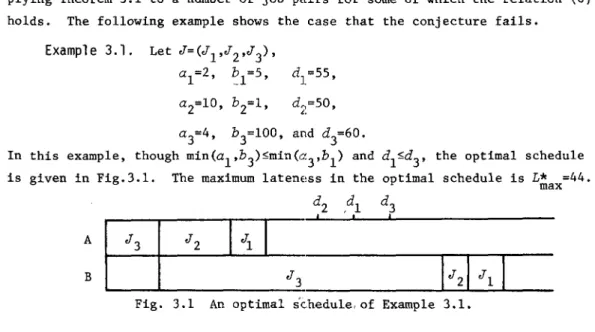
Example 3.1.
Let J=(Jl ,J2,J 3) ,al =2, ~1=5, d1=55,
a
3
=4,
b3=lOO, and
d
3
=60.
In this example, though min(al,b3)~min(c~3,bl) and dl~d3' the optimal schedule is given in Fig.3.l. The maximum lateness in the optimal schedule is
L* =44.
max
Fig. 3.1 An optimal s'c.hedule, of Example 3.1.
3.2. Bound on approximation algorithm for n/2/F/L
max
In subsection 3.1, we showed the solvable case n/2/F/L max • Unfortunate-ly general one is NP-complete. Therefore in this section, we give an approxi-mation algorithm and show how it behaves on the worst case. We call the algo-rithm for the problem n/2/F/L based on
EDD
rule algorithmFEDD,
whichas-max
signs the jobs according to
EDD
rule. We first prove Lemma 3.1 giving the bound of the maximum completion time when a set of jobs is scheduled by algo-rithmFEDD.
222 T. Masutia, H. Ishii and T. Nishida
by algorithm
FEDD
andC~
that of schedule constructed by Johnson's ru1et .
See Johnson I3J.) Then we haveC'
C* 75, 2.
Proof:
It is clear thatC*~max(\~ 1a.,\~
£.1-== 1- £'1-== lb.).1-Also it follows that
C' 75,
L~==l
(ai +bi ) 75,2max(L~==lai'L~==lbi)
75, 2C*.Thus we prove
C'
?*75, 2. D
By using this lemma, we obtain the bound on algorithm
FEDD.
Theorem 3.2.
Let L' and L* be the maximum lateness of schedulecon-max max
structed by applying algorithm
FEDD
and any optimal algorithm for the problem n/2/F/L respectively. Then we havemax
L' max -L* max L* +d
max n
Further this bound is asymptotically best possible.
Proof:
Similarly to n/m/I/L , we may consider only the case L' ==C'-dmax max n'
where C' is the same as defined in Lemma 3.1. Let L' ==C'-d. It is clear that Thus L' -L* max max 75, L* +d max n max n C'-d-(C*-d) ,
n
n
Cc*
==7'!* -
1 •Since C'/C*75,2 by Lemma 3.1, we prove
ble.
L' -L*
max max
L* +d
max n
The following example shows that this bound is asymptotically best
possi-Let al==O, bl==K, d
1=e(>O), a2=K, b2=s, and d2=O, where K is arbitrary
pos-itive constant number. For this instance, the approximate and the optimal
f
Note that the optimal schedule of n/2/F/C ,which is in turn to seek amax
schedule minimizing the maximum completion time on 2-machine flow shop, is obtained by applying Johnson's rule.
Some Bounds for n/m/ljLmax and n/2/F/Lmax
schedule are given in Fig.3.2 (a) and (b) respectively. 2K+e:-e:=2K and L* max "'K+e:-O"'K+e:. Therefore we prove
L' -L* max max A B L* +d max n d 2 dl
I
I J 2 K-e: ='K"+'2€
_ 1 (e:-+CI) d 2 d1 J 2 J 2 J1 JlThen we have
L'
maxJ2
I
(a) approximate schedule (b) optimal schedule Tig. 3.2 An asymptotically tight example
This example completes the proof of the theorem.
0
Acknowledgement
223
We are thankful to the anonymous re,ferees for their helpful comments and suggestions.
References
[1] Graham, R. L., Lawler, E. L., Lenstra, J. K. and Rinnooy Kan, A. H. G.: Optimization and Approximation in Deterministic Sequencing and Schedul-ing: A Survey. Annals of Discrete Mathematics, Vo1.5 (1979), 287-326. [2] Jackson, J. R.: Scheduling a Production Line to Minimize Maximum
Tardi-ness. Research Report 43, Management Science Research ~oject, University of California, Los Angels, 1955.
[3] Johnson, S. M.: Optimal Two- and Three-Stage Production Schedules with Setup Times Included. Naval Researuh Logistics Quarterly, Vol.1, No.1 ( 1954), 61-68.
[4] Kise, H., Ibaraki, T. and Mine, H.: Performance Analysis of Six Approx-imation Algorithms for the One-Machine Maximum Lateness Scheduling Prob-lem with Ready Times. Journal of the Operations Research Society of Japan,
Vol.22, No.3 (1979), 205-224.
[5] Lawler, E. L.: Optimal Sequencing of a Single Machine Subject to Prece-dence Constraints. Management Science, Vol.19, No.5 (1973), 544-546.
224 T. Masuda, H. Ishii and T. Nishida
[6J
Lenstra, J. K., Rinnooy Kan, A.H. G.
and Brucker, P.: Complexity of Machine Scheduling Problems.AnnaZs of Discrete Mathematics,
Vol.l (1977), 343-362.Teruo MASUDA: Department of Mathematics, College of Integrated Arts and Sciences, University of Osaka Prefecture, Sakai, Osaka, 591, Japan.