《論 説》
MassPol
i
ti
csandPol
i
ti
calParty
System i
nWesternEurope
― Rethi
nki
ngWesternPol
i
ti
csf
rom Rokkan’
sModel―
MasaoFuruta
Content Preface
Ⅰ ExpansionofSuffrageinNation-Building Ⅱ From SocialCleavagetoPartySystem Ⅲ PartySystem andVoterAlignment
Ⅳ SocioeconomicChangeandThreeStagesModel Ⅴ Summary
Conclusion
Pref
ace
Since the state-formation in the 17th century, West European governmentshave made every effortto adaptthe ‘dissents’in the territoryastheirownpeopletotheirpoliticalsystem.Intheprocessof the nation-building,the election is one ofthe important political institutionsintermsofthefunctionofnotonlyselectingrepresentatives ofindividualresidents,butalsoformingthem ascitizensandintegrating them intothenation.
Itshouldhavebeendecidedthewayofnation-buildingandnational integrationduringtheeraofthemassdemocracyfrom thelate19th century;theactiveparticipation oftheruled peoplein thepolitical
system,theestablishment,expansionandequalizationofcivilandpolitical rightsandobligations,andtherecognitionofoppositionrightsdealing withmattersrelatingtoelections,suchasconcentrationofsupportand mobilizationandformationofpoliticalpartiesorganizedforitsexpression. Theprocesscanberewordedastheestablishmentofliberalism and democracy.Theelectoralsystem stipulatestherelationshipbetweenthe stateandthepeoplenotonlythenbutalsoinlatertimes.Electionshave theaspectofexpressingthediverseopinionsofthepeoplebasedonsocial cleavage, while the “unapproved members of society” can be incorporatedasamemberofthenation.
Astheuniversal,equalandsecretelectoralsystem hastakenroot,the politicalsystem thatcontrolsthewholenationhassomeconfusion,but overcomingitwillincreasethestabilityofthepoliticalsystem.Bythe early1920s,WesternEuropeancountrieshadexpandedtheirpolitical citizenship(e.g.votingrights)toallmanhood.“Therewasanimportant difference in the character ofelectoralcompetition in 15 Western European countries. The confrontation over representatives was gradually”nationalized“throughthedevelopmentofmassmembership parties,theinterestin theelectionswere...fundamentally different” [Rokkan,1970:70].
Certainly,although thereisvariation in each country from top to bottom,withtheexpansionoftherighttoelectionfrom privil egedtonon-privileged,itispossibletoperform thecomparativeanalysisoftheforms ofeach country according to the criteria ofthe historicalpolitical developmentmodelpresentedbyS.Rokkan.Therefore,intheessay,(1) themeaningoftherightsrepresentedinthenationformation,(2)Iwould like to explain using the Rokkan modelofmacro viewpoint the
circumstancesleadingtothegeneralelectionwiththe“threshold”model, and(3)whichparty(system)expressesthepoliticalsituationofthepeople concerned.
Iwouldliketorestructurethedevelopmentofthemassdemocracyand politicalpartysystem whichhaveexpandedpoliticalrightsinwestern countries,andinterpretationofpresentcontenporarysignificanceinthis paperthroughRokkan’stheory.
Ⅰ Expansi
onofSuf
f
ragei
nNati
on-
Bui
l
di
ng
1.MacroPerspective:ConceptualMapofEurope
Theeast-westaxisoftheconceptualmapofEurope(seeFigure1)identifies theconditionsofnationalconstruction,andthesouth-northaxisidentifies the conditions ofnationalformation.The premise ofthis map is interpretedasanimportantfirststeptowardsthedemarcationofthe territoryafterthereligiousreform[RokkanandUrwin,1983:64-74] .Theeast-westaxisisaneconomiccriterionthatdefinesstate-formationandthe middlezoneseparatingtheeastandwestisthecity-stateEuropewitha tradebelt.Thestate-formationwasrelativelydelayedinorneartrade belts,andwasinitiatedearlierinwestcoastalareasofthedistancefrom tradebeltsandinlandareasintheeast.However,thereisconsiderable differenceinwhetherthenationalform islocatedinthewestortheeast. State-formation is based on economic resources from the highly developedmoneyeconomyinthewestandfrom theagricultureeconomy intheeast,andshowstheasymmetriccharacterofthecontentsinthe state-formation.
Thesouth-northaxisexplainstheconditionsofnation-buildingfrom the culturalaspect.AftertheReformation,Protestantism intheNorthern
F ig ur e 1: A “C O N C E PT IO N A L M A P” O F 16 T H -1 8T H C E N T R Y W E ST E R N E U R O PE (te rr ito ri es re co gn iz ed as so ve re ig n, 16 48 -1 78 9, in ita lic s) So ur ce :R ok ka n, 19 73 :8 2
EuropeanRegionbrokeawayfrom thehyperboli ccontroloftheRoman-CatholicChurch,anditwasedified,andsocializationintomassintegration fornationallanguagestandardizationtonationalculture.Itbecamean institutionandwasincorporatedintosecularpower.Asaresult,Nordic countries completed construction ofthe nation and nation building relativelyeasily,andculturallyintegratedthenationbeforetheageof massdemocracy.Ontheotherhand,theCatholicChurch,whichwasa successoroftheformerRomanEmpireinthesouthernregionandwasa spiritualunity,maintaineditstransdisciplinarycharacterandrepeated longconflictwiththestate.
Giventhestyleofmassmobilizationinthesouth-northdimension,in ProtestantEurope(especiallyBritain,theNetherlands,andScandinavian countries),religious,languageandotherculturalmovementstookthe massmobilizationsfrom thebottom ofthenon-privilegedgroup.Itwas mobilizedanditsleaderwasalsoselectedfrom farmers,urbanresidents and industrialworkers.In Catholicpartsin southern Europe,mass mobilizationwasoftenfrom thetopofexistingchurchesandsecularized privilegednetworks.
From theConceptualMap,theinitialsituationofeachnationcanbe organizedasfollows.
(1)Switzerland and Union ofUtrecht(Netherlands)areformed asa multilateral,federalizedfederalstateinGermanybecausetheurban networkinthetradebeltinahighdensityareaisdelayedinthe constructionofaunifiedsystem.And,likeItaly,theregionthathas undergonelongdivisionsuntilnationalunitywasbuiltasanati on-statequitelate.
(2)Onthewesternsideofthetradebelt,acentralizedstate(e.g.Spain, France,England,Denmark,and Portugal)wasestablishedthatsucceededin politicalintegrationwiththestrongurbaneconomy.
(3)Ontheeasternsideofthetradebelt,acentralstate(e.g.Austria,Prussia, and Sweden)wasestablished wherecitieswereweak and astrong primaryeconomysucceededinpoliticalintegration.
(4)Locatedaroundeithereastorwest,thereweresurroundingareas (e.g.Finland)thatseparatedfrom thegreaterpoliticalsystem inlater years,andareas(e.g.Brittany,Bavaria,Lorraine,andCatalonia)integratedinto thedominantcenter.
At the time ofthe 16th and 18th centuries,full-fledged state constructionwasunderway,whichwouldconditionthemodernnati on-state.Ifthisexternalboundaryconstructioniscompletedwithoutany problems,thepeoplelivingtherehadanopportunitytosmoothlydevelop theircivil,politicalandsocialrightsandobligations.
2.ProcesstoMassDemocracy
Instateformationandnation-building,thetimingandform affectthe transitiontopopulardemocracyintheareasystem intheprocessof externalboundaryconstruction.Inotherwords,thecontrolofexternal exchangewasalsorelatedtothecircuitof“voice”(e.g.justificationof freedom ofexpression)thatfunctionsinthedomain.Itcouldcausethe populationto“exit”from thesystem.Inordertobringtheinhabitants thatareintheregionalboundariesandwithintheboundariesintothe system,their“circuitprotests”,theinternalcircuitofmeanswasopened totheoppositionandthemarginalizedresidents,andsotheboundaries
keepingtheresidentsinthearea,theexecutionofthe“protest”wouldto the “nationalization”ofthe concerned residents.Differences in the distinctivenessofeachnationemergeinconnectionwithitsinstallation. In other words,depending on how the nation-builders tackled the followingfourfactors,itmakesadifferenceinvariousresults.
Thefourfactorsarewhether(1)the“representative(class-of-identi ty-congressionalassembly)circuit”wasmaintained in the criticalperiod of regionalconsolidationfrom 1600to1800,(2)speedoftherightstovote expandedafter1789,(3)“levelsofviolence”thatoccurintakingpolitics into“protests”,and(4)organizingmobilizationof“protests”from below duringthetransitiontopopularpolitics[Rokkan,1974:52].
Theearly‘nationalization’ofProtestantism inNorthernEuropeallowed themobilizationof‘from belowprotests’.Firstofall,earlydevelopmentof “literacy”activelymobilizedthelowerstratatopopularpolitics,andthe factthatthechurch hasbeen incorporated intoapartofthestate apparatus reduces the number of disputes,which the controlled population resided in centraland southern Europe,voluntary mass mobilizationwasdelayedduetounderdevelopedmasseducation,which inturnkeptmobilizationof“from above”.
The development ofdemocracy in Europe in generalmust be consideredbothfrom theinstitutionalside(politicalright=therighttovote)and from thesourceofsocialdifferentiation and mobilization(party system) [Rokkan,1980].
InWesternEurope,aftertheFrenchRevolution,politicalrightswas institutionalizedthesamerightstothepeopleintheareaandcompleteit inthe20thcentury.Theylegallyembodytherighttovoteandtheright toholdofficialpositions,andguaranteethepoliticalstatusof“peoplewho
cannotfreely expresstheiropinion.”Politicalrightsincludeordinary, equalanddirectconstituencies,aswellassecretballots,whichisalsothe processofintegratingthepeopleandtheirrepresentatives.Itincludes secret voting and is also a process of consolidating national representatives.
Secretvotingisasystem thatallowsindividualstoexercisetheirown choices,eithertemporarilyorawayfrom theenvironmentinwhichthey arebound,invoting,ifelectionisregardedasapureindividual’schoice.It can besaid thattheelection system isaproductoftheprocessof achieving“nationalization”intheform ofuniform formalequalitytoall citizensthroughthe“onepersononevote”system[Bendix,1971].
Theequalconstituencyprocessof“onepersonandonevote”basically followsthefollowingfiveconsecutivestages[Rokkan,1968:148].
Inthefirststageofaseriesofpre-revolutionsinthefirsthalfofthe 19thcenturystartingwiththeFrenchRevolution,itwascharacterizedas aconditionofpoliticalcitizenship,withtheapprovalofmembershipin professionalpositions(noblemen,monks,merchants,artisanalprofessionalgroups,free farmers).
Inthesecondphase,duetoboththeAmericanandFrenchrevolutions, thetimewouldcomewhenelectionrightsincrease.However,therewere strictrestrictionson entering the politicalarena underthe regime censitaire.
Intheearlymassmobilizationinthethirdstage,theelectoralrights wasgreatlyexpanded,butformalinequalitiesintermsofitsinfluence,it took various measures and sustained such as multiple votes and inequalityelectionsystem forrepresentatives,etc.
Inthefourthstage,thesocialandeconomiccriteriaforeligibilityfor manhoodwereabolished,andthemanhood’scommonvotingrighthas been generalized.Although the inequalities of one vote in the constituencywereeliminated,thereisagap(ofonevote)worthnotingin termsofthevalueofonevoteintheelectoraldistricts.
Inthefifthstage,therighttovoteforwomanhood,mi norsandshort-term residentsisapproved,and thevalueofonevoter’svotewere homogenized.
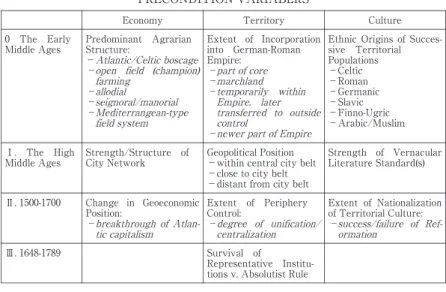
Thefirstandthesecondstagesarethehistoricalstagesthataim atthe establishmentofliberalism,andthethird,thefourth,andthefifthcanbe understoodasthestageoftherealizationofdemocracy.Ofcourse,the stepsuptoequalvotinghavenotbeenuniform amongcountries.We confirm the expansion of political citizenship. Considering the componentsofthepoliticaldevelopmentmodelinTable1,theexpansion anddevelopmentofdemocratizationineachcountryisthegeopolitical position(I:Territory),thentherangeofperipheralcontrol(II:Territory),or religion depending on the outcome ofthe reform (II:Culture),the representativesystem ofthetribalconference(identity-basedparliament)since theMiddleAgeswillsurviveordisappear(III:Territory),andthefinal universalsuffragehasbeenuniversalized(IV:Rights).Therearedifferences insocialandculturalconditionstogradualorrapidprogressofthefive variables(Figure2).Table4illustratesthevariationofeachcountryinthe orderofthegeneralelections,giventhecombinationofthevariablesin Figure2.Wecanrealizeonemessagefrom here.
Culture
Territory
Economy
EthnicOrigi
nsofSucces-sive Territorial
Populations
-Celtic
-Roman
-Germanic
-Slavic
-Finno-Ugric
-Arabic/Muslim
Extent of Incorporation
into German-Roman
Empire:
-partofcore -marchland -temporarily within
Empire, later transferred to outside control
-newerpartofEmpire
Predominant Agrarian
Structure:
-Atlantic/Celticboscage -open field (champion)
farming -allodial
-seignoral/manorial -Mediterrangean-type
fieldsystem 0 The Early MiddleAges Strength of Vernacular LiteratureStandard(s) GeopoliticalPosition
-withincentralcitybelt
-closetocitybelt
-distantfrom citybelt
Strength/Structure of
CityNetwork
Ⅰ. The High
MiddleAges
ExtentofNationalization
ofTerritorialCulture:
-success/failure ofRef-ormation
Extent of Periphery
Control:
-degree ofunification/ centralization Change in Geoeconomic Position: -breakthroughofAtl an-ticcapitalism Ⅱ.1500-1700 Survival of
Representative Insti
tu-tionsv.AbsolutistRule
Ⅲ.1648-1789
Table1:Theprimaryelementsofthemodel PRECONDITIONVARIABLRS
Culture
Territorial
Economy
ExtentofPeriphery-
Cen-terStrain:
Ethnic-linguistic mobilization
Pressures for
Centralization/Unification
v. Movements of
Liberation/Secession
CharacterofRural-Urban
ResourceCombinations:
Commercial or military
combinations with rural
resources v.rural-urban
conflict
Ⅳ. Intensified
Nation-Building
Character of
Church-StateRelations:
strains, conflicts, alliances Pressures for Imperial Expansionv.Movements forDetente,Peace
Rapidity,Localization of
IndustrialGrowth
Ⅴ.Urbanization,
Industrialization,
Secularizarion
INTERVENINGPROCESSVARIABLES:INTERACTIONOFNATIONAL WITHINDUSTRIALREVOLUTION1789-1920s
Partyalternatives
System:alternatives
Rights:extension
Sequencing ofSteps in
Formation ofSystem of
PartyAlternatives
Frequency/Intensity of
CrisesofTransiti
on:ex-tentofviolentdisruptions
Sequencing
ofStepsTo-ward Universalization of
PoliticalRights
Ⅵ.The
Struc-turing ofAl
ter-natives
Class/Culture Conditi
on-ingofPartyChoice
Class/Culture Conditi
on-ing of Attitudes to
System:
acceptancev.rejection
Class/Culture Conditi
on-ing ofLevels/Types of Participation Ⅶ. Consequent Mass Al terna-tives EXPLICANDA:VARIATIONSINPOLITICAL RESPONSESTRUCTURES1848-1950s Source,Rokkan,1981:74-75
Ingeneral,countriesthathadsustainedthecenter-buildingofthestate foralongtimetendtograduallyandgraduallyexpandthesuffrage(see Figure3)inthefourstages[HagvetandRokkan,1980:140141].
(1)Incountrieswherealliancesofvariouspowerstoachievenati on-buildingwereearlysuccessful,rapiddemocratizationstrategiesare unnecessary(England,Sweden).
(2)Althoughthetwonationsachievedindependence,iftherehadbeen stillathreatofseparation,itbroughtaboutasharpincreaseinvoting power.Inaddition,rapiddemocratizationisadoptedevenwhenitis necessary toachievenationalintegration,againstdecentralization (particularism)basedonstrongsocialcleavage(SwitzerlandaftertheSeparation AllianceWarin1846,Norwayinthe1890s,Finlandin1906).
(3)Suddentransitionfrom absolutism torepresentationalruletrended
ThefirstPhase Ⅰ:Territory Geopolitical Positon ThesecondPhase Ⅱ: Territory Extent of PeripheryControl ThefourthPhase Ⅳ: Territory Timing of Unification v of Liberati on/Secess-ion ThethirdPhase Ⅲ: Territory Survival of Representative ThesecondPhase Ⅱ:Culture success/failure of Reformation EXPLICANDA: Formation of Alternatives Ⅵ:Rights The result of order of each phasetowardsthe
universalsuffrage
Figure2:Theprocessleadingtothegeneralelectionright
→ →
tomaximize(atleastmanhood)therighttovote(France,Denmark,Prussia/ Germany).
(4)Countries characterized by strong anti-religious reforms must experiencelongcontinuousstepstowardsfullmanhood’ssuffrage. In countries where the Catholic Church were influential,the democratization processand massmobilization slow down(Austria, Spain,Italy,andBelgium).
3.ThresholdofLegitimacyandIncorporation
Resulttingpartysystem
Levelofeachthreshold
①Legiti-②Incorpo-③Represen-④Majority
mation ration tation power
Autocraticoroligarchicregimes,Verfemungofall
parties:protestsandgrievanceseitherchanneled
throughthefieldadministrationorthroughestate
representation.
a.①H ②H ③H ④H
Embryonic internal party system: cliques of
representatives, clubs ofnotables.Examples:
Britainbefore1832,Swedenduringthequarrels
between“Hats”and“Caps”.
b.①M ②H ③H ④H
Internalparty systems generating rudimentary
outside supportthrough registration association
butsafeguardsintroducedorganizations:predomi
-nantinWesternEuropeduringperiodbetweenthe
absolutism andtheintroductionofparliamentary
ruleundermanhoodsuffrage.
c.①M ②M ③H ④H orM
Initialphase in developmentofexternalparty
system:lower-classmovementsfreetodevelop,but
suffrage stilllimited and/or unequal.Example:
Swedenbefore1909.
d.①L ②M ③H ④H
Samebutwithparliamentaryrule:Belgium before
1899;Norway,1884-1900.
e.①L ②M ③H ④H
Isolationoflower-classorreligiousminorityparties
from the nationalsystem:restrictive measures
againstpoliticalorganizations butfullmanhood
suffrage.Examples:theWilhelmineReichduring
Sozialistengesetze,1878-1890;France during the
Second Empireand early decadesoftheThird
Republic.
f.①M ②L ③H ④H
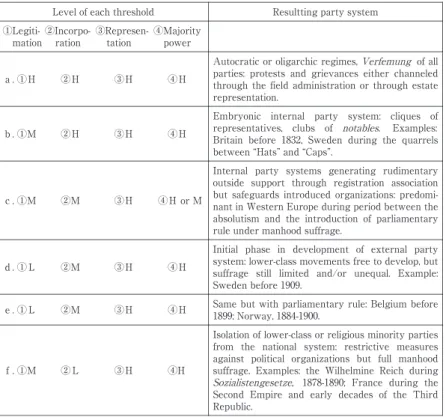
Mass democracy in Western European countries has developed throughfourstagesinresponsetothe“challengefrom below”.Theyare: (1)establishmentoftherighttoestablish amobilization agency,(2) institutionalizationofthemobilizationmarketthroughtheexpansionof therightstovote,(3)acceptanceforthe“movementfrom below”tothe parliamentary representative,(4)actualinfluenceof“movementfrom below”toexecutiveTheseexpansionofpoliticalcitizenshipexpansions, dependingonhow theyaredealtwith,alsohavethe“threatofviolence”. Thenew politicalmovementhastogotothecoreofthepoliticalsystem bygoingthroughthesefour“thresholds”atthesestages(seeTable2)[Rokkan, 1970:79ff].
(1)“Thresholdoflegitimacy”iswhethersuppressedtheprotestasa conspiracyor,toacertainextent,approvedasarightofcriticism or
Competitive party system under universaland
equalmanhoodsuffragebutwithhighpayoffsfor
alliancesandwithaclearseparationoflegislative
andexecutivepowers.Thebestexamplewouldbe
theUnitedStatesifitwerenotfortherestrictions
andthelowdefactoenfranchisementofNegroes
intheSouth.FranceundertheFifthRepublicmay
beabetterexample.
g.①L ②L ③H ④H
Same but with parliamentary rule.Examples:
FranceunderlaterdecadesoftheThirdRepublic
andmostoftheFourth;GreatBritainsince1918.
h.①L ②L ③H ④M
Samebutwithmedium thresholdPR(Propotional
Representation):littleneedforalliancestoacieve
representationbutsafeguardsintroducedagainst
fragmentationthroughexplicitorimplicitelectoral
minima.Examples:theNetherlands,andSwi
tzer-landsince1918-20.
i.①L ②L ③M ④M
SamebutwithmaximalPR andfewerrestraints
againstmajoritypower:thefragmented,centrif
u-galparliamentand the plebiscitarian presi
den-dencyoftheWeimarRepublic.
j.①L ②L ③L ④L
Note:H:High,M:Medium,L:Low
opposition(e.g.rightofassembly,expression,publication).Inthehi storyofstate-formationandnation-building,from whatpointintimedideffective approvaloftherightsofpetition,criticism anddemonstrationrights existforthesystem?From whichtimewasitjudgedthattherewas formal protection of the right of assembly, expression and presentation?
(2)“Thresholdofincorporation”iswhethertheprotesterwasequalto thatofthedominantintermsofpoliticalrights.How longdidittake for the supporters ofthe growing opposition movementto be recognized aslegitimateparticipantsin theselection ofthesame delegateasthevestedinterests?
(3)“Thresholdofrepresentation”iswhetheranew movementgains representationanditisinstitutionallyguaranted.How highisthe initial“threshold”forthenew movementagainsttherepresentative? Andwhenandinwhatwayswasthe‘threshold’loweredtomakeit easierforthelegislaturetogetaseat?
(4)“Thresholdofexecutivepower”(iswhether)Whethertheopponent ornotisincorporatedintomajoritycontrol,orthepartyorparty coalitionoftheopponentcangainpowerbythevictoryoftheelection. How did the government exempted from pressure from the legislature?Andhow longdidittakefortheparliamentaryforcesto directly influencethegovernment’spolicy decisions?Whetherthe minorpartytakestheform ofaproportionalruleapproachingthe administration,or whether it is through the Cabinet system responsibleforthemajorityofthelegislature.
change,wecanobservemanyvariationsintheorderofthechanges.The progressthatdevelopsfrom four“highthreshold”tofour“lowthreshold” isconsideredinthedemocraticscene.Inotherwords,thatisfreedom of expression,assemblyandassociation,andapprovalofexpansionofthe righttovote.Duringthisdevelopmentprocess,manyvariationsinfluence eachsubsequentstage.So,evenwithsomeoptions,thereexistsnosingle, definitivemodelthatcanexplainthewhole.However,itispossibleto arrangeasfollows.
The“thresholds”in (1)and (2)controlthedevelopmentofpopular politics,andtheeliminationofthebarriertoelectoralpowerpromotesthe expansionofpotentialpoliticalmarketsandthepoliticalparticipationof citizens.Atthistime,theconditionsofeachcountrydifferdependingon the timing ofdetermining the decline ofthe firsttwo “thresholds”. Western countries can be grouped into a British modelwith a representativetraditionandaFrenchmodelwithanabsolutisttradition. TheBritishmodelhasnotregainedinequalitybutslow andgradual generalelections,butremains for a long time formalapprovalof inequality(e.g.Sweden,Netherlands,Belgium,Luxembourg,Ireland,andFinland).The Frenchmodelhasanearly,suddenuniversalizationandequalizationof politicalcitizenship,buttheresurgenceofunequalelectionsandtheuse ofthereferendum(e.g.Switzerland,Denmark,Norway,andPrussia/GermanEmpire). Naturally,thevariationofpoliticalgamesineachcountryisexpanded(see Figure2)[Rokkan,1970:86-87].
Countriesthathavesuccessfullypassedthefivestagesofequalityare England,Belgium,andSweden.Thesecountriesareincontrasttothe rapidlychangingcaseofFrance[Rokkan,1961].InEngland,theprocess from the1832electorallaw reform totheabolitionofmultiplevotesin
1948tookover100years.InSweden,statusrepresentationwasabolished in1866,butextremeinequalitiesaffectingelectionsremaineduntil1921.
Belgium movedfrom statusrepresentationtopropertyqualificationas soonasitbecameindependentin1831andendedthemulti-votephase from 1893to1917,resultingintheelectionofallmanhoodovertheageof 25.(However,onemorevoteshadbeenapprovedbyproperty,background,andhouseholder until1919).
IntheNetherlands,hemovedfrom astutasrepresentationsystem toa propertyqualificationsystem in1848,butdidnotexperiencemultiple votingbeforechoosingamen’ssuffrageduringWorldWarI.Finlandhad inheritedthefour-statusSwedishsystem until1906,andthenwenton from thefirststagetothefifthstageofgrantinguniversalsuffrageto menandwomen.
France,incontrast,endedthefirsttofourthstagesinfouryears.The January1789Actwasanindirectelectoralsystem centeredonnobles, monks,andtiersétat,butinthe1791Constitution,ataxingstandardwas establishedtoallow acertainnumberofcitizenstoparticipateinthe election.TheConstitutionof1793movedstraighttothestageofthe manhood suffrage,and sudden democratization appeared in a short periodoftime,butforthenextfew decadesitswungbetweenrestricted andordinaryequalelections.Thatis,intheperiodfrom 1815to1848,the classicalproperty qualification system restricted the suffrage,and democratizationwasrapidlyreproducedbythe1848revolution.
Withatraditionofabsolutists,Denmark,afterashortperiodofstatus representationin1831,reachedthemanhoodsuffragewhichexpandedin 1849,but,likeFrance,itisduringthedisputeoverGermanybetween oligarchelitesandurbanradicalism /peasantunionthatprogressedto
manhood’srighthastakentheform ofadivisionofelectoralsystem, whichisamixtureofthetraditionofstatussystem,propertyqualification system andgeneralelectionsystem.Prussiagainedtherighttovoteafter the1848Revolution,butthethree-classsystem (Dreiklassenercht,1850-1918) protectedtheinterestsoflandownersandbureaucrats.Incontrasttothe third-classelectionlaw,Reich’sempireimplementedequalsuffrageforall manhood.
TheAustrianEmpireandIcelanddidnotfallintothetwopatternsof theBritishmodelandtheFrenchmodel.InAustria,fourstatuselectoral systemswereadoptedfrom 1861torepresentcorporatistinterests,butin 1897thefifthstatuswasaddedfornon-statuscitizens,butin1907itwas unifiedintoanationalrepresentativesystem of“onemanandonevote”. Iceland wasnotcompletely democratized aftertherebuilding ofthe AlsingCouncil,butgraduallyprogressedondemocratizationwiththe liberationfrom Denmark.
4.ThresholdsoftheRepresentativeandExective
Whenthefirsttwoof“legitimates”(oflegitimacyandincorporation)areremoved andtherighttopoliticalparticipationisextendedtomanhood,aparty appears to protestagainstthe numericalinequity ofthe majority representationsystem next.Thisdevelopmentcanbeunderstoodasa politicalprocessthataddsdemocracytoliberalism.Thedebateshifts from theunfairelectoralsystem tothe“threshold”ofarepresentative whodemandstheproportionalrepresentation(PR).
Proportionalrepresentationisintroducedaspartofthestrategyof nation-buildingandintegration,asminoritiessuchaslanguages,religions andethnicitiestendtodestroythesystem from distrustintheelectoral
system inmultipolarsocietiesineachsystem.Therefore,proportional representationwillcreateanew principleofcoexistencewithdifferent elementsbyguaranteeing“protectionofminorityrights”inmultipolar society,andwillcreatenew pressurefrom thebottom,andatthesame timeselffrom above.Itappearedasamovetosavestatuses.Itseems thatitiseasierforself-defensethatitwouldbeeasierforapoliticalparty thathasbeeninapropertyqualificationsystem tolowerthe“threshold” ofarepresentativethantomergewitharulingparty.
Organizing the“threshold”oftherepresentativein relation tothe proportionalrepresentationsystem,thepressurefor(1)theproportional representationsystem islikelytobeestablishedinamultipolarsociety, and(2)introducingtheproportionalrepresentationsystem alongwiththe expansionofthevotingright,groupsthatbecomedisadvantagedfounda meansofsurvival,and(3)theactuallyintroducedstatesaresmalland easytocommunicateamongtheelite,relyingoninternationalpolitical stability,andcanonlybedoneinresourcelesslittleandso,Theresistance to the introduction ofthe proportionalrepresentation system was persistentinthefourpoliticalregimes(e.g.Britain,France,andGermanempire).
From theabove,theproportionalrepresentationsystem willstabilize the system from the viewpoint ofnation-building,and when the proportionalrepresentationsystem isintroducedinthemassmobilization phase,thestructureselectedbythepoliticalpartywillbestabilized,and Itworkedto“freeze”therelationship(IV:PoliticalPartiesinTable2)ofthe electorateandthepoliticalparty.Thatis,“thepartysystem ofthe1960s willstillreflectthesocialclearagestructureofthe1920s,withsome importantexceptions.”Thiswasadefiningfeatureofthecompetitive politicsfoundinWesternEuropeancountries,evenintheeraofhigh
massconsumptionaftertheSecondWorldWar[Mair,1983].Eventhen, partyselectionandpartyorganizationhavebeenolderthanthemajority oftheelectorate,andthepoliticalpartycurrentlyactiveforcitizensofthe WestEuropeanispartofthepoliticallandscapebeforethevotershadthe righttovoteascitizens[LipsetandRokkan,1967:50].
Variationinthegapbetweensocio-economicchangeprocessesand politicaldevelopmentprocessesmustconsidertheroleofpoliticalparties in administrativedecision-making[Rokkan,1970:91-92].Itrelatestothe fourththreshold,“thethreshold”ofMojoritypower.How manyvotes doesapartyneedinanelectionandwhatseatsdoesapartyneedina parliamenttobegiventheopportunityforpoliticalpartiestohavean effectiveimpactonthecentraldecision-makingbodiesoftheregime?The administrativethresholdisrelatedtotheinstitutionalizationofcontrol from parliament to the government.Western European countries introducedrulesofgovernmentcontrolbyparliamentinthe19thcentury exceptGermanyandAustria.
Theprocessofloweringthisthresholdisdividedintotwomodels.One istheBritishmodel(e.g.Belgium,theNetherlands,and Norway),inwhichthe parliamentarymajoritywasresponsibleforthecabinetsystem beforethe expansionoftherighttovote.InBritain,aresponsiblecabinetsystem wasestablished during theWalpoleerain thefirsthalfofthe18th century,Belgium wasestablishedin1831,intheNetherlandsin1848,and inNorwayin1898.Ontheotherhand,theotheristhatthemanhood’s suffragerightwasintroducedbeforethesystem ofresponsibilitywas institutionalized,and the gap between the system of responsible government and the suffrage system was large.It could not be establisheduntil1901intheNetherland.Austria,alsoGermany,didnot
becomepossibleuntilthedefeatin1918.
Thedeclineoftheexectivethresholdwillallow accesstothecabinetif onepartyorcoalitionformsamajoritywithintheparliament,sothe possibilityofminorityparticipationintheadministrationisassumed;(1)in termsofthemajorityseatinparliament,theissueforthecoalitionforthe minoritypartyandthelargestparty,(2)“bargainingability”ofsimilarity andclosenessofpolicy,and(3)severeconditionsofpressurefrom the internationalenvironment.Andtheconclusivemeaningof“thethreshold” ofexectiveis“toexplain thevariation in voting behavioramong all countries”.
Insomecountries,electionspresentconditionsthatallow therulerto choosefrom multipleoptions.However,inothercountries,theelection representsasocialcleavagethatis“loyalitytoasegmentedsociety,”and byelectingrepresentativesoftherightsofeachsegmentedthecultureof itsowncommunity.Wecanguaranteetheinterestsofthecommunity.It clarifiesthestructureof“issurestobeclarifiedVI:ElectionOptions”in Table2.Atthesametime,thisshouldberelatedtodensityin“VI: Progressinformingapartyselectionsystem”.Inotherwords,intheway ofthepartysystem inWesternEuropeancountriesaftertheFirstWorld War,wecanseethecharacteristicsofthepoliticsofeachcountry.
Oncetherelationshipbetweenthelowingofeach“threshold”andthe process ofdemocratization(election)is sorted out,the new political movementwillcommunicateitsviewstothepeopleinanelectionbeyond the “threshold”oflegitimacy and organize,To secure the rightto participate,togaintherighttoinfluencethechoiceofrepresentation equalto established system supporters beyond the two transfer “threshold”, not only to collect votes over the “threshold” of
representativeandifaminoritygetsseatinParliamentinthesameway ofelectionasexistingpoliticalparties,anditisexplainedthepatternthe highandlow offourth“thethreshold”inTable2(patternsfrom atofare historicalcases,gtoj)untilthepresentcase[LipestandRokkan,1967:26-29].
Whataretheconditionsunderwhichpoliticalopponentsfrom these “threshold”organizepoliticalparties?(1)Thearrangementofpolitical partieswithin thepoliticalsystem appearsbeforethedeclineofthe “threshold”ofrepresentatives.(2)“Thethreshold”oftherepresentative posesseverechallengestothenew politicalorganizationatthestageof masspolitics.Inaddition,(3)themovementtolowerthe“threshold”ofthe delegateshasalsobecomeapolicytoprolongthelifeofthesplitpolitical partieswhocannotjointlydefendamongthepoliticalpartiesanew with theemergingmassmovement[cf.Carstairs,1980].
5.Summingup
We lastly confirm the transition pattern to state-formation,nati on-building,and massdemocracy in the sense oforganizing from the historicalviewpointofnationalization(nationalization)[Rokkan,1975].
(1)Inareasfarfrom thetradebelt(England,Sweden,Norway,andIceland), democratization isgradual,so there remainsalmostno violence. Theseareasdidnothaveproblemswiththecontrolof‘exit’choices, maintaining arepresentativesystem,and standardizing theirown law,religionandlanguage.Theexpasionoftherightstovotehas progressedsteadily.
(2)Intheareawithinthetradebelt(Netherlands,Switzerland,and,Belgium), progressedrelativelysmoothly.However,itdevelopedmultipol arco-existenceforthestrengthofurbannetworks,blockedcentralized
nationaldevices,andcompletedtheconsociationaldemocracy. (3)Itwasdifficulttotransitthemassdemocracy,and sometimes
accompaniedbyviolence,astheareasattheendsofthetradebelts (France,Denmark,Prussia/Germany,Austria,andSpain)havestrongcenters.In Prussia,Austria,andSpaininparticular,duetothelackoflegitimacy withintheboundariestotheterritorialcenters,therefore,itwasnot possibletomaintaintheregimewithoutrestrictingthevarious“exit” choices.
(4)Iftheterritoryhadtogothroughtheprocessofcenterformation, peopleformationanddemocratizationinashorttime(ItalyandFinland),it waspronetovariousproblems.
ThedevelopmentofmasspoliticscenteredonelectionsinWestern Europecountries,asmentionedintheconceptualmap,startsfrom the geopoliticalandgeoculturalpositionofthecountry,andisdefinedbythe wayofstate-formationandnation-building.
AsWesternEuropeanhistoryshowsfrom the19thcenturytothe20th century,electionsreflectthediverseinterestsofeachcommunitylayer basedonsocialcleavages,sotherehasexistedaninherentpossibilityofa crisisthatdividesthenation-state.Orithasanimportantmeaninginthe processof“nationalintegration”tomakeeachresidentrecognize“unity asanation”.Wecanunderstandthediversityofthedevelopmentofthe WesternEuropeannation-statesthroughtheexaminationofthehistory ofelectoralsystems in each country,or the formation ofpopular democracythatiscloselyrelatedtoelectionsintheform ofaparty system.ItshouldalsobenotedthatthebasicstructureoftheWestern European party systems was defined before the start of mass
mobilizationduetotheexpansionofelectoralpoweranddemocratization.
II From Soci
alCl
eavagetoPartySystem
1.TheoryofSocialCleavage
Cleavageisaconceptforidentifyingongoingconflictsinacertainsociety. Eveninthecaseofconflict,therearecaseswheretheconflictthatdivides peopleiseasily rooted in trade,negotiations,and an uncompromised socialstructure,butthereshouldbealsoconfrontationsonthesurfaceof eachpoliticalparty.Thestudyofwhattypeofdivisionexactlydeserves tobenamedacleavage,especiallyasocialcleavage,hasbeendescribedin itsownconceptbyeachresearcher,withverylittlediscussionsofar [BartoliniandMair,1990:213-215].
Thesocialcleavageisaconceptthatplacesthesourceofthepolitical divisionofsocialstructureaboutthedifferencebetweenclasses,status, beliefs,values,groups,andorganizationswithinacapitalistsociety.And theemergenceofsocialcleavagesandtheactualimpactofitwillevoke theroleoforganizationalandinstitutionalfactors.
Rokkan explainsthe politicalconflictthathasemerged from the transformationofsocialstructurewiththeconceptofsocialcleavage, alongwiththeNationalandIndustrialRevolutionsinthe18thand20th centuries.Healsodecidestodistinguishpeopleonlywhendifferencesand conflicts between one socialgroup and another confirm a clear perception,andareinstitutionalizedinapoliticalsystem.Wemustargue thatitbecomesastandard[ManzaandBrooke,1999:31-32].
Twoapproachesareneededtoelucidatethesocialcleavage[Bartoliniand Mair,1990:ch.9].Ontheonehand,thereisanapproachthatbringsimpact oninstitutionsandbehavior,andontheotherhand,thereisanapproach
thatchangessocialstructure.Thesocialcleavageisdefinedaswhetherit remainsatthesurfaceofpoliticalconfrontationorevenclosetosocial structures.
Thenwehavetothinkofthreelevels.Thefirstlevelisthe“experience” elementrootedinsocialstructure.Thesecondlevelisthe“normative” elementintheconflictingsenseofsocialgroups.Thethirdlevelisan “institutional”elementexpressed through individualinteractionsand organizations.
S.Bartoliniand P.Mairexplain thatthetypeofpoliticaldivision presentatonlyoneofthethreelevelsshouldnotbeconsideredasocial cleavage.Forexample,divisionsthatarerootedinsocialstructuresbased onclassinequalityarethecriteriabywhichpeoplejudgetheirpolitical position.A politicaldivisionisdefinedasasocialcleavagebecausethe individualorgroupdecidesthestandardofthecleavageasitsownnorm and then institutionalizesthrough the politicalparty(or party system) appropriatelycharacterizedfrom thesocialcleavage,whenitcomesto being,andmostpoliticalconfrontationseitherwiththemere“political quarrels”orshort-livedconflicts.
Itisexpectedtobeinequalitiesrootedinasocialstructurepertaining toasocialgroup,andtheirnormativesignificancehavelittleimpacton thealignmentofvotingbehaviorwithoutanopportunitytoexpressthat elementwithin thepoliticalsystem.Politicaldivisionsdonotpersist unlessthere existsan elementrelated to socialstructure.and are socioeconomic inequalities associated with conflict between groups, whichpoliticalconflicttendstobeshort-lived.
Wemustconsidersocialcleavagesfrom thethreeconditionsofsocial structure,collectiveunity,andpoliticalconfrontation.
Thefirstconditionhastobebasedonacertainsocialstructure.Social structuresusuallychangeslowly,butsocialcleavagestendtopersist onceestablished.Thedivisionbasedonsocialstructureestablishesa groupofpeoplewithsharedinterestsandstatuses.
Forexample,iftheproportionofworkingclassesisreduced,theimpact basedonclasscleavagemaydiminish.Onthecontrary,thedeclinecan bring aboutchangeswithin theclassin termsofchanging political formation.Forthesocialcleavagewithstrongpoliticalimpact,religion, class,race,ethnicity,language,etc.canbeassumed.
Thesecondconditionisthatthererecognizesconflictbetweengroups. Itmustberecognizedthattherearetwoormoredifferentgroupsover collectiveidentificationandonegroupmemberisinoppositiontothe other.Collectiveidentificationisanessentialconditionforestablishinga socialcleavage.Therefore,the conflicts thatarise from temporary dissatisfaction among people are unlikely to be considered in the organizationalandinstitutionalcontext.
Thethirdconditionisthatconfrontationwilloccur.TheSocialcleavage hastobemadeclearerbetweengroupsasawaytomobilizecertainparts ofthepopulationforpoliticalactivity.Thisisnottemporary,butisal ong-term politicalconflict[ManzaandBrooks,1999:33-35].
Rokkan did notconsiderpoliticalpartiesas“outgrowth”ofsocial powers,butregarded politicalpartiesasarepresentativeagency in transitioningfrom asocialcleavagetoaconcretepoliticalconfrontation.
First,the role ofpoliticalparties is to consolidate and express conflictinginterestswiththeestablishmentofmanhood”ssuffrage,to create organized networks,and to translate intergroup disputesby devisingelectoralstrategies.So,everycleavagealwaysdoesnottranslate
itselfintoapoliticalparty[LipsetandRokkan,1967:26].
Second,asaclashofinterests,ittendstoexplainsocialcleavages,but profitsshould be understood asmore deeply rooted than economic advantagesand societalprivileges.When elementssuch ascultural confrontationandideologicaldivisionarestrong,theyaretakenup,for example,intheform ofclasscleavageorexpressedin“state-church conflict”.Theimportantthinghereishow tocontrolthenormsofthe community.Saiddifferently,itmustbeviewedasanissueofvalues. Otherwise,itwillalsounderminetheexplanationofpoliticalphenomena based on socialcleavages.The socialcleavage of“land-industry”of England in 19th century mustbeinterpreted as“twovalue-oriented clashes”relatedtothelegitimacyofstatus.Politicalpartiesrepresent “involvementinvalueinpolitics”[LipsetandRokkan,1967:5,15,18,and19].
TheconfrontationbetweengroupsinWesternEuropeanmasspolitics andtheideologicalconfrontationthataccompanyitare“theconceptof moralrightsandtheinterpretationofhistoryandhumandestiny”[Lipset andRokkan,1967:11],anditdoesnotaccountforincertainsituationsgroup’s profitandloss.Thefollowingthreephenomenaareintertwinedinthe conceptofsocialcleavage[KnutsenandScarbough,1995:493-494].
First,asocialcleavageisarelativelysustainablesocialdivisionthat givesrisetoagroupthat“integrates”objectivelyaccordingtotheclass, religion,economicandculturalinterestsetc.inwhichisrootedinthe structure.Second,somesocialcleavagesarerelated tosomevalues commontogroupmembers.Groupmembersunderstandthe“common life”.Third,certainsocialcleavagesareinstitutionalizedinsomeforms.It adoptstheform ofchurches,tradeunions,andotherassociations,butis ultimatelylefttopoliticalparties.A politicalpartycanberegardedasa
productthathasshiftedmeresocialdivisionintoasocialcleavageby givingconsistentpoliticalexpressionstocertainsocialgroupsandtheir members.
Thesupportofapoliticalpartyisexpressedintheform ofvotesfrom therelativelystablerelationshipwithasocialgroup,andfrom thevoters thesharedvalueorientation.Therefore,politicsbasedonsocialcleavages cannotbeachievedwithoutadoptingtheform ofpoliticalparties.
Thenotionofasocialcleavageismoreexclusivethanthenotionof politicaldivision,andhasamorerigidmeaningthansocialdivision.So socialcleavagesaremorethanjustsocialconflicts,andatthesametime constituteaparticularform ofpoliticaldivision.Iftheterm socialcleavage isusedinallsortsofsocialandpoliticaldivisions,theconceptwillloseits analyticalability.
Inshort,itisthesocialcleavagethatformsthepoliticalandsocialview ofhumanbeings.Itisthesub-culturethatsurroundstheindividual.The lowercultureis“agroupofattitudes,values,beliefs,behaviors,andhabits sharedwithaspecialgrouporsocialclassinsociety,andhasadecisive influenceon theindividual.And ithastobedistinguished from the characteristicsofthewholesociety.”Socialcleavagesareacultureof referencegroupsforindividuals.Socialstructureisacollectionofvarious “impermeable”groups,andculturalaggregatesofdifferenttypesand contents.Inthatrespect,socialcleavagesmaketheinsideofthesocial structurethatformsthepoliticalactivityclear.
Thatiswhycitizenstrytoliveinaclosedpluralsocietyinamultipolar societybecausetheyfeelmoreattachedtotheircommunitysocietythan thepeople’sposition(nationalpoliticalculture).Socialcleavagesthatdivide societieslikeclass,religion,language,ethnicity,race,generation,and
gender,inaway,characterizethecharacterofsocialstructure.Wehave multiplesocialgroupsthatsupportaspecificparty,eachformingaparty, andeachpartyhasbeenembodiedintheform ofapartysystem.
However,thesocialstructurethatcausesthepoliticalpartysystem differsinappearanceinthehistoryofindividualnation-stateformation. Thewayinwhichsocialstructuresbasedonsocialcleavagesaffectthe partysystem canbesummarizedasfollows.
(1)Socialcleavagescreatepartyorganizationsthatrepresentsocial groups.Ittakesahistoricalstack.
(2)Certainpoliticalpartiesreceivesupportfrom certainvoters. (3)Eachpartycompetesfortheacquisitionofvoterswhileappealing
forapartofthesociety.
(4)Policies arising from socialcleavages themselves clarify the differencesbetweentheparties[cf.Rose,1987].
Therefore,we can understand the currentpoliticalsituation ofa countrybyobservingthepartysystem.
2.ImportanceofInterveningAgents
Thedivisionbyclassisusuallytransferredtothepoliticalscene,butnot necessarily in every country.Sometimesreligiousdivisions,even if turnedintopolitics,cannotbeconcludedinrealitythatallcaseswillbeof thesameshape.Andthatisnotalwaysthesamestrength.Forexample, eventhoughgenderconflictisanimportantdivisionineverysociety,itis notreflectedinthepoliticsofeverycountry.
pointsoutthattheconsequencesofitsform dependontheeffortsofthe peoplewhoaretryingtoexpressinpolitics(translators)andthosewho actuallyactwithconviction(persuaders).Putanotherway,whetherornot immobilizing theinnumerabledivisionsin thesociety intocleavages meansthattheprimaryagentcanfunctioneffectivelyanditsinterests canbecommunicatedtopoliticalparties(orotherformsofpoliticalorganizations) [Sartori,1990:169].Forexample,takingtheclassasthecriterionofcleavage, wecansayasfollows.
A politicalpartyisnotan“objective”socio-economicconditionbuta “subjective”socio-economicself-perception.However,ifapoliticalparty derivesonlyfrom socio-economicconditions,thisismoreimportantthan thesocio-economicconditionsoftheclass,astheindependentmotivation andintentionofachievingitspoliticalpurpose.Thatisitsownsocial recognition.Atthattime,thereshouldremaintheexpectationofdemand andsupplytopoliticalpartiesin(partof)society.Forexample,itisthelabor organization(usuallyatradeunion)thatmediatesbetweentheclasscleavage andthesocialistparty,andasaresult,thesocialistpartyrepresentsthe workers’interestsin theelection.Thedivision-cleavage-organization/ group-partyschemeappearsinthepoliticalphenomenonofelections.
Similarconsiderationsapplytootherdivisions,suchasthechurchand itsumbrellaorganizations.ThisissometimesexpressedintheCatholic action.These institutions and organizations evolve in a process of mobilizingsupportersinareligioussense,quicklygainingmomentum eveniftheyarethedominatingparty,andarereligiouslymoreorganized thantheoriginalfounder’sintentions.Theycanmakeclearerdivisions moreclearly.S.N.Kalvasdoesnotautomaticallyreflectthesenseof valuesimmediatelyaftertheidentityandconflictwithwhichreligious
partiesalreadyexist,andconversely,“thereligioustiesareextinguished bymodernization”.Itisconcludedthatthetransitionfrom acleavagetoa partyisastrugglebetweenvariousgroupsandorganizationsinfaceof somepressureunderthesevereconstraintsofsocietyatanygiventime. Asaresult,itcanberewordedalsoasthemanifestationofthewillingness topenetrateself-perceptioninsociety.
Inshort,asshowninTable3,thetransitiontopoliticizationofthe cleavagesthatarisefrom thecriticalsocialcircumstancesatthattimeis atleastaninterveningagentthatactivelyassertspoliticalpowersin societyandfunctionofinterestarticulationandaggregation.Itisessential thatanargentcanperform thefunctionsofthem.Thisfunctionjustifies acting on behalfofthe people in the sub-society.However,when polarizationissignificant,thecostofconsolidatingandfunctioningthem forcitizensisrather“exprensive”[AlmondandPowell,1996:124].
Interveningagentsplayaveryimportantroleinmediatingbetween cleavagesandpoliticalparties[Kitschelt,1992;Doorenspleet,2005:2-8].Itsrole cannotbeexplainedorjudgedonlybythe“objective”situationofsocial structure.Inotherwords,the“objective”roleplayedbythe“subjective” executorwhotriestoputacertainsocialsituationintoapoliticalissue andtheinterveningagentplayanimportantroleinthesocietyand politics.
Table3:FlowofFunctionsofInterestAggregationandArticulation Aggregationfunction → Articulationfunction division → cleavage → subculture → agent → party → policy (e.g.class,religion)(social,cultural,andeconomicorientation) (votingbehavior)
Ifthereisnothingtodividesociety,judgingfrom thestandpointof cleavage,theabsenceofitmeansnoneedforpoliticalpartiesorpolitics. However,such asituation isunlikely.Then wehavetothink about divisionsinsociety.Andifthedivisionchangesaccordingtotheage,the oldcleavagelineshoulddisappearandanew onelineappear.Inthis sense,politicalchangeshouldbeexplainedinresponsetochangesin socialcircumstances[Sartori,1990].However,sincetraditionalcleavagesare firmly embedded in each society as a means ofnetworking and communication,itshould beconsidered thatthey can withstand the changesofthetimes[Steiner,1974:cf.ch.IV].
The“alignment”ofpoliticalpartiesdescribesthesupportofvoters basedonsocialcleavagesinsociety.Forexample,aftertheSecondWorld War,itissaidthatBritain’spoliticalpartysystem wasorganizedbasedon theclasscleavages.TheworkingclasshassupportedtheLabourParty, andthemiddleclasshassupportedtheConservativeParty.InFrance, thenationaldifferencesbetweenCatholicsandanti-clericalistswerea factorinthesupportanddisapprovalofpartiesfrom boththeleftand right.Inothercountries,politicalformationisusuallybasedonsocial cleavages such as socio-economic class,urban and rural,language, religion,region,andethnicity.Needlesstosay,allsocialcleavagesare actuallyreflected,notadoptingtheform ofpoliticalparties.
Theactiontobecomeapoliticalpartysupportbasedonthesocial cleavagethatdividesthesocialstructureisarrangedfrom theconditions ofthehistoryofanation.Thiswillexplainthediversityamongthepeople (=multiplesubcultures).Inthatrespect,evenifthesocialconditionsleadingto politicalaction disappear,they willlastfora long time.The new generationissocializedintovaluesthatcombinewithitssocialcleavages
(“imprinting”).Thatmeansthattherelationshipbetweenthevotersand party options is “freezing ofparty alternatives.” New values are considered topenetratetheyoungergeneration by interrupting the currentgenerationandthenextgenerationinthepoliticalreorganization thatcross-cuttingmaintainstheconventionalvalues.Assoonasmultiple socialcleavagescrosseachother,theyform politicalpartiesbasedonthe interests ofeach field.In such a situation,inter-party competition becomesmore common in the politicalstyle ofmultiparty systems differentfrom theUK-USmodel.From thesocialcl eavagetothesub-culture,thesubcultureandthecultureofeachsocialgroupoccupyone partofthesociety,anditbecomesafixed(frozen)supporttoaspecific partyasapoliticalexpressionafterthat[RokkanandCampbell,1960].
3.SocialStructureofPartyChoice
A Socialchangeprocesscauseschangeintherelationshipbetweenthe politicalparticipationofcitizensandthedeclineinthevotingratein relationtotheconstitutionoftheelectorateandthesocialpositionand electionbehavior.From bothpointsofview,votersdecidethechoiceof party.Itisstatedthat,oncechangesinfactorshavebrokendownthe causalrelationshipbetweensocialstructureandpolitics,thatis,social positionandpartychoice,citizenswillnotbeloyaltoaparticularparty. So,hastheideologythatreflectsthetraditionalcleavagebecomeless importantasafactorindeterminingvoters’politicalattitudeandparty choice[Thomasson,2005:7-9]?
Itisanimportantelementinthemodeltoexplainthatcitizensact instrumentallyonthebasisoftheirpurposebyevaluatingpoliticalissues andpoliticalpartiesandcandidatesrelatedtogovernmentperformance
[CarminesandHuckfeldt,1996].
Theeffectsofsocialchangeon citizensaredepicted in Figure3 explaning thevariablesin thecausality scheme.Itisheld thatthe hypothesisofmovingfrom lefttorightinFigure3.Thishypothesiscan sparethevariationinpartyselection.Itisincommonwithothermodels consistingoflong-term factorsasthebasis.Atthesametime,themodel thatemphasizesinstrumentalintentionstopolitics(e.g.valuechangetheory) shouldbesuccessfulovertime.
However,variousapproaches(e.g.politicaladvertising,mediacoverage,etc.)miss thetruepositionofanindividual.So,asabasicwayofthinking,Ifurther considerthevariousvariablesontherightthatisinfluencedbythe factorsontheleftinFigure3.Sotospeak,thisschemeisasetofvoting behaviorvariablesthataddvaluechangetotheRokkan’stheoryofsocial cleavage.
IthasbeenunderstoodthattheexplanationbyLipsetandRokkanhas lostitseffectivenessintheWesternEuropeanpartysystem.Thisisnot anargumentthathasjustbegun.A debateovertheimportanceofclass
Figure3:ConceptualFrameworkforVotingChoices
dependentvariable:
votingbehavior
→
short-term factor
→
long-term factor
→
independent
variable: social
structure,cleavage
partychoice
how tocatchthei
s-sue judgment
based on
performance and
expectations politi
-calleader’srating
formation ofvalue,
party identification
ideological ori
enta-tion
for the individual
residence, and af
-filiation ofreligious
organization social
class
↑
↑ ↑
↑
politicalandinstitutionalcontext
(sustainabilityandchange)
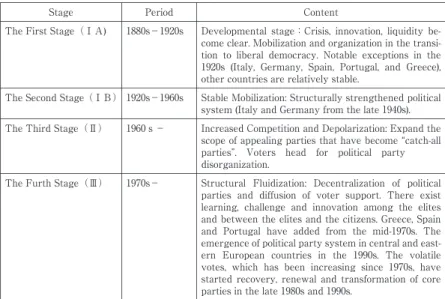
cleavage forpoliticsbegan in the early 1950s.O.Kirchheimerhas explained,undertheprevailing secularization and mass-consumpti on-orientedsituationinthe1960s,theclasscleavage(lines)hasbecomefluid anddiluted,andthemselveswerenolongercritical[Kirchheimer,1966].Itis statedthatmassmembershippartiesandChristianpartiesbasedon previousclassesaredestinedtobecomecatch-allparties.
Thetraditionalcleavages,especiallyclassandreligion,areregardedas lessimportantforvoter’schoiceofpartiesinthelatetwentiethcentury.It istheargumentthatisbasedonsecularization[Dalton,1984;Franklin,1992].It isexplainedthatthereexistsevidencethattheimpactofsocialcleavage declinesinadoublesense[KaaseandKlingemann,1994].
(1)Thenumberintegratedinthecleavagedecreasesduetosocial changeduetothechangeincompositioneffect.Forexample,the numberofCatholicswhoattendchurchesregularlydecreases. (2)Therelationshipbetweenaffiliationofaspecificpartofsocietyanda
partypreferencedeclines.Forexample,Catholicswhodonotattend churchhavenotvotedforCatholicpartiesorChristiandemocratic parties.
However,canwesimplymakethe“conclusionthattheimportanceof thesocialcleavagestructurediminishes”forelectionpoliticssoeasily? Theclaim statesthatitdoesnotconsidertheimportanceofcleavage development towards politicaloutcomes.However,we ignore the importanceofpoliticsandinstitutionsthatpoliticizesocialcleavages[De Gaat,2001].Long-term changeinvoters’behaviorisbecauseitisconsidered tobetheproductoflong-term,gradualandsecularsocialchangeinthe
politicalenvironment[Curtice,2002:164].
Ⅲ PartySystem andVoterAl
i
gnment
1.PartyFormation
Massdemocracyhasdevelopedasourceofpoliticalmobilization(partyand partysystem).Anoverview ofWesternEuropeanpoliticalhistoryshows thatthere existvarious types ofarrangementofbehavior atthe individuallevelfrom thestructureofsocialcleavages,throughtheparty system consistingofparties.Thatis,itshouldbenotedthatinwhatform, inwhichordereachsocialcleavagebecomesapoliticalissue,inanyway, the social cleavage in any combination can adopt the form of confrontationbetweenpoliticalpartiesandthepubliccanbeinvolved.Is itprovidedthebasisforformingapartysystem?Rokkandescribedfive modelsofsocialcleavages[Rokkan,1980b:121].
Center
(4)Owner-Worker (2)State-Church
Economy Culture FunctionalDimention
(3)Land-Industry (1)Center-Periphery Periphery
TerritorialDimention Source:Rokkan,1980b:12
Therehavebeenfour“criticalperiods”inWesternEuropesincethe 16thcentury,andthemeasuresadoptedtherecreateasocialcleavage andtheformationofasocialgroupbasedonwhichthecoreofthe politicalpartieswasformed.Thefirsttwosocialcleavagesaredirect productsoftheReformationandtheNationalRevolution;(1)itwasa conflictbetweenthecentralizednationallanguage,cultureandethnicity, language,andculture(Center-Periphery),(2)itwasaneducationaldispute betweenthestateandthecollectiveprivilegeofthechurch(Statevs.Church).
ThelattertwoarecausedbytheIndustrialRevolution,(3)itwasa conflictbetweenlandinterestandindustrial/enterpriseclass(theprimary industry:ruralvs.thesecondary industry:cities),(4)itwasastrugglebetween owner/employer and laborers/workers(capitalist class vs.working class). Furthermore,(5)itwasasplitbetween workerswhohaveacquired politicalcitizenship before and after the First World War either recognized thatthey weremembersofthenation orprioritizethe internationalposition as a working class.They splitdepending on whetheritisinvolvedinsolidarity(Socialism vs.Communism).
A socialcleavageof“center-periphery”existsineverycountrywith
Table4:CriticalJunctureandCleavage
Issues
Cleavage
CriticalJuncture
Nationalvs.supranationalrel
o-gion
Nationallanguagevs.Latin
Secularvs.religiouscontrolof
masseducation
Tariff levels for agricultural
products;controlvs.freedom
forindustrialenterprise
Nationalintegrati
onvs.Interna-tionalrevolutionarymovement
(1)Center-Periphery
(2)State-Church
(3)Land-Industry
(4)Owner-Worker
(5)Socialist-Communist
Reformation-
Counter-Revolution:16th-17thcenturies
NationalRevolution:1789 and
afterIndustrialRevolution:19th
century
The Russian Revolution:1917
andafter
oneexception(Sweden,theNetherlands,andDenmark).However,when transitioningtoapoliticalpartyinasocialcleavage,the“state-church” hasbeenextremelyimportant.
Thesocialcleavagesin “center-periphery”and “state-church”have affected the socialcleavages that had risen from the Industrial Revolution.For example,in middle Europe the Catholic political movementcrossedthecleavagesofurbanandruraleconomicinterests, sothatincountrieswhereCatholicpartiesexist,agrarianpartiesarein principleabsent.InProtestantcountries,thereexistsagrarianpartythat consolidatespeasants’interests.Also,IndustrialDevelopmentresultedin expandingthelabormarketandpushingmassmembershippartiesto whichtheworkingclassbelongstothepoliticalarena.
Needlesstosay,thereremaineddifferencesamongcountriesinterms ofintegrationintothepoliticalsystem,anddependingonthepolitical characterofeachworkingclass,proletarianinternationalistcommunist partiesandsocialdemocracythathasacceptedthestate.Itsplitsinto politicalparties,andtwotypesofsocialistpoliticalpartiesareformed, whichcompetethroughtheFirstWorldWarandtheRussianRevolution. ThecasewasthecrashoftheGermansocialistcampaftertheFirst World War.Differencesatthehistoricalstageofeach country have addedvariationtothepoliticalpartyorpartysystem.
However,thefirstthreesocialcleavagesformedthefoundationofthe modernpartysystem andformedthedifferencesbetweenthoseineach country.Sothedecisivecontrastinthesystem appearedbeforethe working class party entered the politicalarena.The fourth social cleavagecoloredtheframework,andthefifthsocialcleavageaccented themodernpartysystem.Needlesstosay,itgoeswithoutsayingthatthe
entry ofsocialistpartieshad amajorimpacton theparty system. Therefore,“the party systems ofthe 1960s reflect,with few but significantexceptions,thecleavagestructuresofthe1920’s”[Lipsetand Rokkan,1967:50].
Ifthecompetition between citizenson anationalscalebecomesa disputeoverasystem andis“frozen”withaspecificgroupintheform of asocialcleavagetoindividuals,thatisasocialcleavage— politicalparty hasahistoricaltrajectory.Itisconsidered tobeacreated “political package”;(1)ethnicityandthedivisionofthevotereflectedbylanguage, (2)churchmembers,theinfluenceofchurchactivities,(3)thespreadof urbanizationandthecharacterofprimaryindustry,(4)classvoting,and (5)thedivisionofworkersafterthefirstandthesecondWorldWars. Theycauseddifferencesandvariationsinthepresenceandstrengthof politicalpartiesarisingoutofsocialcleavagesineverycountry.The differencehasbeen expressed in thepoliticalparty system ofeach country.We can understand the politicaltrajectory ofnation by observingthearrangementofpoliticalpartiesinthatnation[Rokkan,1970: 139].
WeconsidertheconditionsforthesettingofaChristiandemocratic partyfrom thecomponentsofthemodelinTable1[RokkanandSvåsand,1978: 56-57].Whatarethepreconditionsforthepresenceorabsenceofastable Christian democraticparty within thepoliticalsystem?Thevarious variablesforitsexistenceareI:Culture(success/failureofReformationasaresult oftheReformation),IV:Economy(resourcescombinationofruralandurban,characterof rural-urbanresourcecombination),andIV:Territory(geopoliticalposition),V:Culture (church-staterelations).IntheCatholicEurope,thepresenceorabsenceofa Christiandemocraticpartyisrelatedtothegeopoliticalpositionandto
theworkofvariablessuchasthealliancebetweenthestateandthe church.So,while Christian democratic partiestraditionally existin Austria,Germany,Italy,Switzerland,Belgium andtheNetherlands,but areabsentinFrance,SpainandIreland.
On the otherhand,in the ProtestantEurope,nonconformistsor dissentersand orthodox rallied intodissidentpartiesbecauseofthe alliancebetweenthechurchandthestate.Inthesecases,theirpolitical argumentswereexpressedinliberalism(e.g.England,Denmark,andSweden), nationalism(e.g.Finland),agricultureandperiphies(e.g.Ireland).Thus,one socialcleavagemayform oneparty,buttheremaybecaseswhereitis absorbedbyanothersocialcleavage.
Wemusttakeintoaccounttwoperspectiveswhenitcomesfrom the socialcleavagetothewayofpoliticalpartyformation.Thefirstisthe partyorganizationanditsmembersandsize.Second,whenandhow a socialgroupexertsparticipatoryaffiliationandwhathappensifasocial group may become politically active withoutforming its affiliation [Stinchocombe,1975:583].Wehavetoconsidertheindividualcircumstances from thehistoricalcircumstancesinallperspectives.
Mass membership parties developed in Europe during the 19th centuryinresponsetotheexpansionofthesuffrage.Thepioneersofthe mass party were seen in the politicalmovement ofthe national movementandtheRomanCatholicChurch,butthesocialistpartyin Europehasdevelopedonthebasisofthepopular.Thesocialistparty succeeded in mobilizing the supportofthe working class,thereby becomingaprominentelectoralpower,andthispartymodelwaslater adoptedbythe“bourgeois”party.This“contagionfrom theleft”isnot necessarilytrue.InBritain,boththeConservativePartyandtheLiberal
PartybecamemassmembershippartiesbeforethebirthoftheLabour Party.
Massmembershippartiesareanefficientmeansofguaranteeinghigh andstablelevelsofelectoralsupport,andmoregenerally,thepolitical mobilizationofaparticularsocialgroup.Historically,andparticularlyfor socialistparties,ahighdegreeof“socialencapsulation”callsfortheunion ofpartiesand members,and formembersoftheparty acollective identityintermsoftheobviousbenefitswasimportantinexpressing.
Somemasspartieshavesucceededin“membershipdensity,”whichcan hiderealisticweaknessesin an broad appealtotheelectorate.The membership has diminished gradually, weakening strong party identification.
InWesternEuropeanelectoralpoliticsforseveraldecadesafterthe SecondWorldWar,itissaidthattwovotingbehaviorpatternscanbe understood[Knutsen and Scarbrough, 1995: 492].The first is a pattern characterizedbythestablemainpoliticalpartiesinthe1950sand1960s, and therelationship between votersstrongly supporting them.“The strengthofmostpartieshaschangedlittlefrom oneelectiontoanother, from oneeratoanother,orfrom onegenerationoflife.”Thisshowsthe “frozenthesis”explainedbyRokkan.
However,thesecondpatternhasbeguntoappearinthe1970s.Itissaid thatbythe1980s,“new politics”haschangedmanyWesternEuropean politics.Insteadofthesustainabilityandstabilityofthefirstpattern,the volatility,thedealigmment,theunconventionalpoliticalbehavior,andthe de-freezedpartysystem.Itistheunfreezingthemeforthelatterpattern. Statedinadifferentfashion,thatpointtothepatternthatoldorder changed.
2.PartySystems
Socialcleavagesarenotallpoliticalissuesineachcountry,anditdoesnot necessarilymeanthataparticularpoliticalpartyisestablishedineach country,anditdoesnotalwaysshifttoaconfrontationbetweenpolitical parties.Certainsocialcleavageindeedcreatesconflictbetweenpolitical partiesinsomecountries,butinothersnot.However,itshouldbenoted thatthesplitofworkingclass(Socialism vs.Communism)canbeobserved commonlyineachcountry.
Wewillconsidertwocasesin which thepoliticalpartiesand the politicalpartysystem wereestablishedfrom acertainsocialcleavage, basedonwhichtheallianceformationofeachpowerwasarranged[Rokkan, 1980b:121].
Consideringthesocialcleavageofcenter-peripheryinSpainandItaly asanexample,thissocialcleavageexistsinbothcases,butinItalythere isnopartythatdefendstheperiphery,butitexistsinSpain.Thereason isseeninthedifferencebetweentheterritorialstructureandthecity network.InSpain,therehasbeentwoeconomicallypowerfulperipheries (Basque,andCatalonia)andapoliticalcenter(Madrid).However,inItaly, sincethecenterofstateformationandthecenterofeconomywerein agreement,thepoliticalpartiesrepresentingtheperipherieshavebeen lacking.
Thesocialcleavageoftheprimaryindustry-secondaryindustry(rural -urban)wasapoliticalissueinnorthernEurope,butnotintheBritain.In bothcases,theReformationintegratedtheChurchintostate-building elites.Theyactedinconcertwithurbanandruralinterestsinthecaseof Britain,butinthecaseofnorthernEurope(especiallyDenmarkandNorway), state-builderswere based on allianceswith urban bourgeoisie.The
reasonisthedifferencebetweenthetwocasesofliberalmobilization. WhereasinBritaintheliberalpartiesweretheresultofanalliance betweenCelticfringesandnonconformists’industryandurbanclasses,in northernEuropetheliberalpartiessupportthecoreofthestate.Itwasa productofthealliancewithfarmerswhoopposedthebuildingofsociety. Itcannotalwaysbeargued thatsocialcleavagesimmediately cause politicalproblemsinthisway,andcausepoliticalpartyformationand politicalconflict[cf.Urwin,1980].
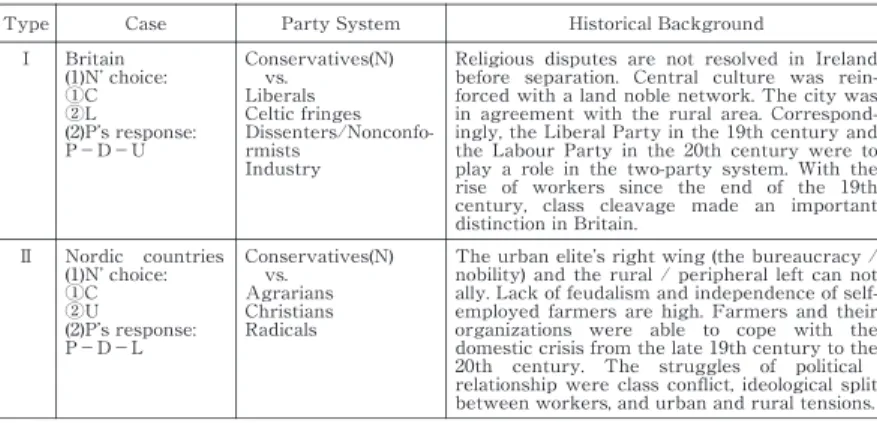
To understand the differencesbetween Western European party systems,wemustpayattentiontothealliance,neutrality,andconflict thatthepre-mass-mobilizedstateandnation-buildingeliteshavechosen inthefirstthree“criticalperiods”.Dependingontheirchoice,Western European Party System’seighttypesin Table 5 have typified the complexanddiversealliancechoiceofsevenactors.Actorsare:(1)the core ofnation-building thatgoverns the state bureaucracy (N),(2) churches(C),(3)theRomanCatholicchurches(R),(4)non-statechurches (D),(5)landownerwhoruledtheprimaryindustry(L),(6)urbancommerce andindustry(U),and(7)resistancemovementfrom periphery(P).
Table5:EightTypesofWesternEuropeanPartySystem
HistoricalBackground PartySystem
Case Type
ReligiousdisputesarenotresolvedinIreland before separation.Centralculture was rei n-forcedwithalandnoblenetwork.Thecitywas inagreementwitht heruralarea.Correspond-ingly,theLiberalPartyinthe19thcenturyand theLabourPartyinthe20thcenturywereto playaroleinthetwo-partysystem.Withthe rise ofworkers since the end ofthe 19th century,class cleavage made an important distinctioninBritain. Conservatives(N) vs. Liberals Celticfringes Dissenters/Nonconf o-rmists Industry Britain (1)N’choice: ①C ②L (2)P’sresponse: P-D-U Ⅰ
Theurbanelite’srightwing(thebureaucracy/ nobility)andtherural/peripheralleftcannot ally.Lackoffeudalism andindependenceofself -employedfarmersarehigh.Farmersandtheir organizations were able to cope with the domesticcrisisfrom thelate19thcenturytothe 20th century. The struggles of political relationshipwereclassconflict,ideologicalsplit betweenworkers,andurbanandruraltensions. Conservatives(N) vs. Agrarians Christians Radicals Nordic countries (1)N’choice: ①C ②U (2)P’sresponse: P-D-L Ⅱ
TheWesternEuropeanpartysystem classifiedfrom thesealliances andrivalsfallsunderanyoftheeighttypemodelsfrom TableI,typesIto VIII.Dependingonthecircumstancesofeachcountry,asocialcleavage
Regionaltensionsby multi-centricstates(e.g. Bavarianseparatism)havemadeitdifficultto unite nationalscales.Western liberalism and easternconservatism wereatodds.Protestant -ism and Catholicism werealsorelated tothe policyofnationalunity(GreatGermanism vs. SmallGermanism),andithasbecomeapparent thatsocialcleavageshadacomplicatedeffect sincethelate19thcentury.
Conservatives(N) vs.
Liberals
Catholics(Zentrum) Bavarians Prussia-German Empire (1)N’choice: ①C ②L (2)P’sresponse: P1-S-U-P2-R Ⅲ
This case is a mixed type ofnorthwestern Europe(I-III)andsouthernandcentralEurope (IV-VIII).In theformation ofpoliticalparties, liberalists,Protestants,andCatholics,whowere responsiblefortheformationofthesupporters, respectively formed aparty.SimilarSwit zer-landdidnotshowanyreligiousconflictatall. Liberals(N)
vs. Calvins Agarians Catholics Netherlands
(1)N’choice: ①C ②U (2)P’sresponse: P1-D-L P2-R-L Ⅳ
Multilingual,multiculturaland multiethnicgo back totheReconquistamovement.A single politicalculture isabsent.The heterogeneity among the people and the strength ofthe independenceoftheregionmadeitdifficultto form the people.Conflicts between secular power and the church have been added to ethnic and culturalissues.Basque’s strong religiousloyaltyisatoddswiththeanti-clerical centralgovernment,and Catalan separatism suppressesclasscleavage.
Liberals(N) vs. CatalanLiga Carlists Spain (1)N’choice: ①S ②L (2)P’sresponse: P1-U P2-R Ⅴ
Thecity ofanticlericalsecularpowersruled Catholics.The central-peripheralconflicthas been long lasting.With the supportofthe Christian TradeUnion in 1944,itformed the People’s Republican (Mouvement R’epublican Populaire:MRP)butdidnotbecomeapopular Christian party.Afterall,the alliance corre-spondingtothesecularnation-buildingelitewas notbased(butestablishedinItaly).Therewasa cross-cuttingpressureofliberals,Catholicsand socialistswithregionalcharacteristics. Liberals/Radicals(N)
vs. Conservatives Catholics Christians France (Italy in similar) (1)N’choice: ①S ②U (2)P’sresponse: P-R-L Ⅵ
Thereexistedaconflictbetweenthecapitaland thegrowingarea.Wealsoconsideredaconflict betweenculturallyandeconomicallydeveloped areas and underdeveloped areas.The party system hasrevolved around ethnic,religious andclassgaps.Beforefascistsseizedpower,the Socialist party and the opposing Bourgeois formedthe“Läger”ontheissueofclassand religion.The tradition is inherited after the SecondWorldWar.Ithasamultipolarsocial character,butconvergestoeithertheleftor rightwing. Christians(N) vs. Liberals Pan-Germans Industry Austria (1)N’choice: ①R ②L (2)P’sresponse: P-S-U Ⅶ
Theoppositioncoalitionwasdismantleddueto schoolproblemsuntilthe early stage ofthe nation formation.Themobilization processof economy,cultureandsocietywaspolarizedto French and Dutch speaking areas. The cleavagesoverlap each other.Thiscaseisin contrasttoSwitzerland,whichhassucceededin integratingethnicallyandculturally. Christians/Liberals
(N) vs. Flemishseparatists Belgium (1)N’choice: ①R ②U (2)P’sresponse: P-L Ⅷ Source:LipsetandRokkan,1967:36-41.
had created a party,and the alliances and conflicts shown the characteristicsofeachcountry’spartysystem intheabovemodels.
We divide Western Europe into two.The characteristics ofthe southernandcentralparts(III,V,VI,andVIIinTable5)areasfollows:(1) anti-Reform strengthened the position of the church,(2) radical secularization movementand Catholic tradition polarize,(3)cultural integration wasstarted,ifthebourgeoisiewhoopposed theancient regimedidnotstandhosttothechurchand(4)thechurcheshaveto reconfirm theirplaceinthenewlycreatedpoliticalorder.
Next,thenorthernandwesternparts(I,II,IV,andVIIIinTable5)are politicallystableasofthe16thcentury,anditissodifferentinthe southernandcentralpartsthatthestructureofsocialcleavageswhich wouldberevealedafterthat.Itsfeatureis;(1)StateChurchwasnotin conflictwith the Nation-Building elites,and (2)the “left”movement againstreadyreligiousestablishedforceshadalliedwithdissentersand urbancommerceandindustry.
Itisimportantthatthebasicstructureofthepoliticalpartysystem was determinedbeforethedemocratizationofelectoralexpansionandthe startofmassmobilization.Inaddition,ithasjoinedthepartysystem until then,intheform ofaclassconflictbetweenthebourgeoisieandworking classdue to the developmentofcapitalism,and the socialistparty representingthelatter.So,oncethefivesocialcleavagesadoptedthe formation ofapoliticalparty,thepoliticalparty system hasbecome “frozen”,and even if individualsocialcleavages disappeared,the establishedpoliticalpartiessurvivethereafter[LipsetandRokkan,1967: 36-38].Thisisthe“freezingthesis”.
pattern ofalliancesand confrontationsofthelowerclassesofthose countriesbeforeindustrialworkersenteredthepoliticalarena.Therefore, theallianceandconfrontationalpatternswiththeupperclassofsociety callfor:(1)callingformeasurestoensurelastingthe“campofrightwing”, andfrom that,(2)forcesthatwillnotbewiththepartnersofalliance chosenbytheworkingclassappearingthereafter,decidedtocondition thestrategy in therelationship ofitselfand others.Thecentralized allianceoftheupperclasswas,sotospeak,bureaucrats,landlords, aristocrats,churches,andsoon,so-calledformer“nation-buildingelites” undertheancienregime.Such‘ins’groupshadtoselectoutofthealliance partners,conditioned on socialenvironment,interestsand ideologies. Thatplacedthe“outs”thatdidnotbecomealliancepartnersattheother sideofthesocialcleavageline[Stinchocomb,1975:577-578].
Thefirstchoiceofallianceandconfrontationwasthegovernment’s religiousorientation.Thechoicewasdeterminedbytheoutcomeofthe Reformation in Europe.TheelitesputtheProtestantChurch under control(in theform ofastatechurch)in England and Scandinavian countries.Nonconformists,Priests,and seculariststurned toward the oppositionsoftheconflictingcamps.
Reformation had been divided in twocountries,such astheLow CountriesoftheNorthSea,Germany,andSwitzerland,intothepatriotic ProtestantmajorityandthestrongCatholicminoritywhoopposeit.The Nation-Building elites,like Germany and the Netherlands,chose an alliance with the patriotic Protestant Church.The Roman-Catholic ChurchwasnotruledbytheNation-Buildingelites,sotheelitehadallied withtheRoman-CatholicChurchorchoseasecular,competitiveattitude insouthernEuropeandinFrance.