2010年度冬の
LA
シンポジウム [22]圧縮文字列上での
$q$-gram
頻度の高速な計算方法
後藤
啓介
*坂内 英夫
\dagger稲永俊介
\ddagger竹田
正幸
\S2011
年
2
月
2
日
Abstract
We present
a
simple and efficient algorithm for cal-culating q-gram frequencieson
strings represented in compressed form, namely,as a
straight line pro-gram (SLP). Givenan SLP of size$n$that representsstring$T$, thealgorithm computes the frequencies of
all q-grams in $T$ in $O(qn)$ time and space. In the
extreme case, $n$
can
beas
small as $O(\log|T|)$, andthus the algorithm is exponentially faster than any algorithm working on the uncompressed represen-tation, when $q$ is considered constant.
Computa-tional experiments show that our algorithm and a
variation of it is practical for small $q$, and actually
runs
fasteron
various real-word string data, com-paredto algorithms that workon
theuncompressed representation. We also discuss applications in data mining and classification of string data, for whichour
algorithmcan
be useful.1
Introduction
Many forms of data such
as
texts, biological se-quences (DNA/proteins), MIDIsequences, etc.can
be represented as a sequence of characters, or strings, anddeveloping methods for efficiently pro-cessing string data isone
of the most importantareas
of research in computer science. A major problem is the sheer size of the data, and efficient algorithms for processing huge amounts of dataare
in high demand. To cope with this problem, algo-rithms that work directly on compressed represen-tationof strings have gained attention especially for the string pattern matching problem [1], and there has been growing interest in what problemscan be$*$ 九州大学大学院システム情報科学府 \dagger 九州大学大学院システム情報科学研究院 $\ddagger$ 第2著者に同じ \S 第2著者に同じ
efficiently solved in this kind ofsetting [12]. In
this paper,
we
attemptto
explorea
more
ad-vanced fieldof application in this setting: data min-ing and classification of string data given in com-pressed form. Methods for discovering useful pat-terns hidden in strings as well as methods for au-tomatic and accurate classificationofthe datainto various groups, is animportant topic in the field of data mining and machine learning with many ap-plications. As afirst step toward compressed string mining,we
consider q-grams on strings. A q-gram is simply a string of length $q$. q-grams aresim-plebut important features of stringdata, and have been used widely in many fields such
as
natural language processing, and bioinformatics.We consider text strings represented
as
stmight line programs (SLPs) [6]. An SLP isa
context free grammar inthe Chomsky normal form thatderives asingle string. SLPsare awidely acceptedabstract model of various text compression schemes, since texts compressed by any grammar-based compres-sion algorithms (e.g. [15, 10])can
be represented as SLPs, and those compressed by the LZ-family (e.g. [16, 17]) can be quickly transformed to SLPs. Also recently,self-indexes
basedon
SLPs have ap-peared [3], and SLP is a promising representation ofa
given string, not onlyfor reducing the storage size ofthe data, but for conducting various opera-tions on it.In this paper,
we
givean
algorithm that com-putes all q-gram frequencies ofa
given text rep-resented as an SLP of size $n$, in $O(qn)$ time andspace. This generalizes and greatly improves
on
the$O(|\Sigma|^{2}n^{2})$-time $O(n^{2})$-space algorithms presented
in [4], and later improved to $O(|\Sigma|^{2}n\log n)$-time
$O(n\log|T|)$-space in [3], for finding the most
fre-quent substring oflength 2 of a given compressed text. Applying the previous algorithms to q-grams respectively require$O(|\Sigma|^{q}qn^{2})$ and$O(|\Sigma|^{q}qn\log n)$
time, since they essentially enumerate
and
countthe
occurrences
of all substrings oflength
$q$.Our
algorithm has profound applications in the field of string mining and classification. For example, it leads to
an
$O(q(n_{1}+n_{2}))$ time algorithm for com-puting the q-gram spectrum kernel [11] between SLP compressed texts of size $n_{1}$ and $n_{2}$. It alsoleads to
an
$O(qn)$ time algorithm for finding theoptimalq-gram (oremerging q-gram) that
discrim-inates
between two sets ofSLP compressedstrings, when $n$ isthe total size of the SLPs.1.1
Related
Work
Several
algorithmsfor
finding characteristicse-quences from compressed texts have been
pro-posed, e.g., finding the longestcommon
substringof.
two strings [14], finding all palindromes [14], find-ing most frequent substrings [4], and finding the longest repeating substring [4]. However,
none
of $|$themhave reported resultsof computational exper-iments. This impliesthat this paper is thefirst to show the practical usefulnessof
a
compressed text mining algorithm.$1$
1
2
Preliminaries
$)$
Let $\Sigma$ be
a
finite alphabet. An element of $\Sigma^{*}$ is$i$
called
a
string. For any integer $q>0$ ,an
element $||$of $\Sigma^{q}$ iscalled
an
q-gram. The length ofastring$T$$\}$
is denoted by $|T|$. The empty string$\epsilon$ is
a
string of $($length $0$, namely, $|\epsilon|=0$. For a string $T=XYZ$,
$i$
$X,$ $Y$and $Z$
are
calleda
prefix, substring, andsuffix
of$\mathcal{I}^{1}$, respectively. The i-th character of
a
string$\ulcorner l^{1}$a isdenotedby$T[i]$ for $1\leq i\leq|T|$,andthesubstring $l|$
of
a
string$T$ that begins at position $i$ and ends atposition$j$ isdenotedby $T[i : j]$ for $1\leq i\leq j\leq|’l^{1}|$.
For convenience, let $T[i : j]=\epsilon$ if$j<i$. $]$
For a string $T$ and $q\geq 0$, let pre$(T, q)$ and $($
$suf(T, q)$ represent respectively, the length-q pre- $i$
fix and suffix of $T$. That is, pre$(’l^{\urcorner},$$q)=?^{1}[1$ :
$|$
$\min(q, |T^{\urcorner}|)]$ and $suf(T^{1}, q)= \prime 1^{\tau}[\max(1, |?^{1}|-q+1):$ $l$
$|’I’|]$. $\{$
For any strings$T$and $P$, let $Occ(T, P)$ be the set $($
of
occurrences
of$P$ in$\prime 1^{7}$, i.e., $Occ(T, P)=\{k>0|$ a$T[k : k+|P|-1]=P\}$ . The number of elements $f$
$|Occ(’l^{7},$$P)|$ is called the
occurrence
frequency of$P$in $T$
.
$l$2.1
Straight
Line Programs
$\chi_{7}$
–
$\sim$
$\chi_{6}$ $\chi_{5}$ ’ 一 $\sim$ / $\backslash$ $\chi_{4}$ $X_{5}$ $\chi_{3}$ $\chi_{4}$$/\backslash$ $”\backslash$ $/\backslash$ $/\backslash$
$\chi_{1}$ $\chi_{3}$ $\chi_{3}$ $\chi_{4}$ $x_{1}\chi_{2}Xl$ $\chi_{3}$
$::’$ : $X_{1}^{/}\grave{X}_{2}x_{1}^{/}\grave{x}_{2}x_{1}^{/}\grave{x}_{3}$ : : : $X_{1}^{/}\grave{X}_{2}$ $”’:’$ ’ $:””’$ ’ $:..;”:’$ ’ $:::j:$ ’ $’:.::,.$ : $::j:$ : $\acute{X_{1}}\grave{X}_{2};.’:$ : $’;.::$ : $::””$ : $:::’:$: $|$ $\dot{:j:}’:’$
a
a
$b$a
$b$a
ababa
a
$b$12345678910111213
Figure 1: The derivation treeof SLP $\mathcal{T}=\{X_{i}\}_{i=1}^{7}$
with $X_{1}=a,$ $X_{2}=b,$ $X_{3}=X_{1}X_{2},$ $X_{4}=X_{1}X_{3}$,
$X_{5}=X_{3}X_{4},$ $X_{6}=X_{4}X_{5}$, and $X_{7}=X_{6}X_{5}$,
repre-senting string $\prime l^{1}=val(X_{7})=$ aababaababaab.
A stmight line progmm $(SLP)\mathcal{T}$ is
a
sequenceof assignments $X_{1}=expr_{1},$ $X_{2}=expr_{2},$ $\ldots,$$X_{n}=$
$expr_{n}$, where each $X_{i}$ is a variable and each $expr_{i}$
is an expression, where $expr_{i}=a(a\in\Sigma)$,
or
$expr_{i}=X_{\ell}X_{r}(\ell, r<i)$. Let $val(X_{i})$ representthe string derived from $X_{i}$
.
When it is notconfus-ing, we identify
a
variable $X_{i}$ with $val(X_{i})$. Then,$|X_{i}|$ denotes thelengthof the string$X_{i}$ derives. An
SLP$\mathcal{T}$ representsthestring$\prime l^{1}=val(X_{n})$. The size
of the program $\mathcal{T}$ is the number
$n$ of assignments
in $\mathcal{T}$. (See Fig. 1)
The substring intervals of $T$ that each
vari-able derives
can
be defined recursivelyas
follows: $itv(X_{n})=\{[1 : |T|]\}$, and $itv(X_{i})=\{[u+|X_{\ell}| : v]|$$X_{k}=X_{\ell}X_{i},$$[u;v]\in itv(X_{k})\}\cup\{[u;u+|X_{i}|-1]|$
$X_{k}=X_{i}X_{r},$ $[u : v]\in itv(X_{k})\}$ for $i<n$
.
Forexam-ple, $itv(X_{5})=\{[4:8], [9:13]\}$ in Fig. 1. Consid-ering the transitive reduction ofset inclusion, the intervals $\bigcup_{i=1}^{n}itv(X_{i})$ naturally form
a
binary tree(thederivation tree). Let $vOcc(X_{i})=|itv(X_{i})|$
de-note the number of times a variable $X_{i}$
occurs
inthe derivation of T. $vOcc(X_{i})$ for all 1 $\leq i\leq n$
can
be computed in $O(n)$ time bya
simpleiter-ation
on
the variables, since $vOcc(X_{n})=1$ andor $i<n,$
$vOcc(X_{i})= \sum\{vOcc(X_{k})$ $|X_{k}=$ $X_{\ell}X_{i} \}+\sum\{vOcc(X_{k})|X_{k}=X_{i}X_{r}\}$. (See Al-gorithm 1)$\overline{Algorithml:}$
Calculating$vOcc(X_{i})$ for all $1\leq$ $i\leq n$.Input:
$\overline{SLP\mathcal{T}=\{X_{i}\}_{i=1}^{n}}$representing string
$rl^{1}$.
Output: $vOcc(X_{i})$ for alll $\leq i\leq n$
1 $vOcc[X_{n}]arrow 1$;
2 for $iarrow 1$ to $n-1$ do $vOcc[X_{i}]arrow 0$;
3 for $iarrow n$ to 2 do
$654$
$\lfloor if\lfloor X_{i}=X_{\ell}X_{r}thenvOcc[X_{\ell}]arrow vOcc[X_{l}]+vOcc[X_{i}];vOcc[X_{r}]arrow vOcc[X_{r}]+vOcc[X_{i}]$
;
Algorithm 2:
Anaive
algorithm for computing$\frac{q-gramfrequencies}{Input:stringT,integerq\geq 1}$
Output: $(P, Occ(T, P)|)$ for all $P\in\Sigma^{q}$ where
$Occ(’l^{\gamma},$$P)\neq\emptyset$.
1 $Sarrow\emptyset_{)}\cdot//$ associative
array
2 for $iarrow$ lto $|’l^{7}|-q+$ldo
$543$ $\lfloor e1seS[qgmm]arrow 1;S[qgram]arrow S[qgram]+1;ifqgram\in keys(S)thenqgramarrow T[i.\cdot i+q-1]$
;
6
return
$S$2.2
Suffix
Arrays and
LCP Arrays
We will makeuse
of thesuffix
arrayand $lcp$ array.It is well known that the suffixarray forany string oflength $|T|$
can
be constructed in $O(|’l^{1}|)$ time [5,8, 9] assuming
an
integeralphabet. Given the text and suffix array,the lcparraycan
also be calculated in $O(|?^{1}|)$ time [7].Definition 1 (Suffix Arrays) The suffix
ar-ray
[13] SAof
any string $\prime 1^{1}$ isan
armyof
length$|T|$ such that $SA[i]=j$, where $?^{1}[j:|T|]$ is the i-th
lexicographically smallest
suffix of
$T$.Definition 2 (LCP Arrays) The lcp array
of
any string $T$ is an arrayof
length $|T|$ such that$LCP[i]$ is the length
of
the longestcommon
prefixof
$T[SA[i-1] : |T|]$ and$T[SA[i] : |T|]$
for
$2\leq i\leq|T|$,and $LCP[1]=0$.
3
Algorithm
3.1
Computing
q-gram
Frequencies
on
Uncompressed
Strings
We first describe two very simple algorithms for computing the q-gram frequencies of a given
un-compressed string $7^{\gamma}$.3.1.1 A Na’ive Algorithm
A very simple and naive algorithm for computing the
q-gram
frequencies isgiven inAlgorithm 2. The algorithm constructs an associative array, where keys consist ofq-grams, and the values correspond to theoccurrence
frequencies of the q-grams. The .Algorithm 3:
A
$1A$lineartime algorithm forcom-puting q-gram frequencies. Input: string$T$, integer $q\geq 1$
Output: $(i, |Occ(T, P)|)$ forall $P\in\Sigma^{q}$ and
some
position $i\in Occ(T, P)$. 1 $SAarrow SUFFIXARRAY(T)$;2 $LCParrow LCPARRAY$($T,$SA);
3 count $arrow 1$;
4 for $iarrow 2$ to $|’l^{1}|+1$ do
$98675$
$\lfloor ifi\leq|T|andSA[i]\leq|l^{1}|-q+1ifi=|’1^{\gamma}|+1orLCP[i],<qthen\lfloor countarrow count+1;\lfloor_{countarrow 0;}^{ifcount>0thenReport}(SA[i-1],count),\cdot$
then
time complexity depends
on
the implementation of the associative array, but requires at least $O(q|T|)$time since eachq-gramis considered explicitly, and the associative arrayis accessed $O(|T|)$ times.
3.1.2 $O(|T|)$ Time Algorithm
It is straightforward to compute the q-gram fre-quencies of string $1^{7}$ using suffix
array
$SA$ and lcparray $LCP$. For each 1 $\leq i\leq|T|$, the suffix
$SA[i]$ representsan
occurrence
of q-gram $T[SA[i]$ :$SA[i]+q-1]$
, if the suffix is long enough, i.e. SA$[i]\leq|1^{\urcorner}|-q+1$. Thekey is that since the suffixesare
lexicographically sorted, intervalson
the suffix array where the values in the lcparrayare
atleast representoccurrences
of the same q-gram. The procedure is shown in Algorithm 3. The algorithmruns
in $O(|’1^{\gamma}|)$ time, since theconstruction
of $SA$and $LCP$
can
be done in $O(|T|)$. Therest
isa
sim-ple $O(|’l’|)$ loop. A technicality is that
we
encodethe output for
a
q-gramas one
of the positions in the text where theq-gram
occurs, rather than the q-gram itself. This is because thereare
a
total of $O(|T|)$q-grams,
and outputting themas
length-q strings would requireat least $O(q|’l^{1}|)$ time.$X_{i}$
Lemma 1 Given a stnng $T$, the
q-gram
frequen-cies
of
$T$can
be computed in $O(|T|)$ timefor
any$q>0$
, assumingan
integer alphabet $\Sigma\subseteq$$\{1, \ldots, |?^{1}|\}$.
3.2
Computing
q-gram
Frequencies
on SLP
]We
now
describe thecore
idea ofour
algorithms, $|$and then go on to explain two variationswhich uti-lize variantsofthe two algorithmspresented in the
$($
previous subsection. For $q=1$ , the l-gram fre- 11 quenciesare simplythe frequencies of the alphabet 1 and the output is $(a, \sum\{vOcc(X_{i})|X_{i}=a\})$ for
a
each$a\in\Sigma$, which takes only $O(n)$ time. For$q\geq 2$,
$s$
we
makeuse
of Lemma 2 below. Theideaissimilar $i$to the$mk$ Lemma [2] but
more
specifically
tailored
for
our
needs.$1$
Lemma 2 Let $\mathcal{T}=\{X_{i}\}_{i=1}^{n}$ be
an
$SLP$ that repre- $r$sents stringT. For
an
interval$[u : v](1\leq u<v\leq$ $1$$|’l^{\urcorner}|)$, there exists exactly
one
variable $X_{i}=X_{l}X_{r}$$|$
such that
for
some
$[u’ : v’]\in itv(X_{i})$, thefollowing $|$ $l$holds: $[u:v]\subseteq[u’ : v’],$ $u\in[u’ : u’+|X_{\ell}|-1]\in$
$itv(X_{\ell})$ and$v\in[u’+|X_{\ell}| : v’]\in itv(X_{r})$
.
$l$.
From Lemma 2, we have that each
occurrence
of
a q-gram
$(q\geq 2)$ represented bysome
length-$!$
$q$ interval of 1‘, corresponds to a single variable :
$X_{i}=X_{\ell}X_{r}$, and is split in two by intervals
cor-responding to $X_{l}$ and $X_{r}$
.
On the other hand,$11$
consider all length $q$ intervals that correspond to
a given variable. Then, counting the frequencies of the q-grams they represent, and summing them
$|$
up for all variables would give the frequencies of all q-grams of$T$.
$\Gamma$
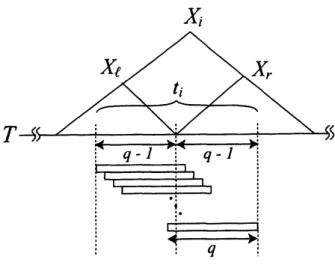
For variable $X_{i}=X_{\ell}X_{r}$, let $t_{i}=suf(X_{l},$$q-$ $1)pre(X_{r}, q-1)$. Then, all
q-grams
represented bylength $q$ intervals that correspond to $X_{i}$
are
thosein $t_{i}$. (Fig. 2). If
we
obtain q-gram frequenciesof$t_{i}$, and then multiply the frequencies of each
q-gram by$vOcc(X_{i})$,
we
obtain thefrequencies ofthe $a$$:”’$ ’ $\mapsto^{!_{.}.::,\prime.}$ $:’$ ’ $\overline{q:\prime}$
Figure 2: Length-q intervalscorresponding to vari-able $X_{i}=X_{\ell}X_{r}$.
$q$
-grams
thatoccur
in all intervals derived by $X_{i}$.It remains to
sum
up the q-gram frequencies of $t_{i}$or all $1\leq i\leq n$. Thus, we
can
regard the problemas
obtainingthe weightedq-gram
frequencies inthe set of strings $\{t_{1}, \ldots, t_{n}\}$, where eachq-gram
in $t_{i}$is weighted by $vOcc(X_{i})$.
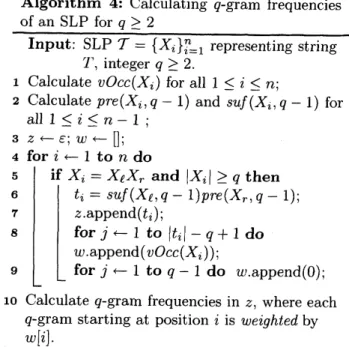
The procedure is shown in
Algorithm 4. A
sin-gle string $z$ isconstructedby concatenating$t_{i}$ suchthat $q\leq|t_{i}|\leq 2(q-1)$, and theweightsof
q-grams
starting at each position in $z$ is held in array $w$.On line 9, $0$’s instead of $vOcc(X_{i})$
are
appendedto $w$ for the last $q-1$ values corresponding to $t_{i}$
.
This is to avoid counting unwanted
q-grams
thatare
generated by the concatenation of $t_{i}$ to $z$on
line 7, which
are
not substringsofeach $t_{i}$. Line10
can be calculated by a slight modification of Al-gorithm 2
or 3.
For Algorithm 2, line 4 should be modifiedto increment $S[qgmm]$ by$w[i]$ ratherthan 1, and line 5 should read: else if $w[i]>0$ then$S[qgmm]arrow w[i];$. For Algorithm 3, the increment
on
line 9 should simply use $w[SA[i]]$.Theorem 1 Given
an
$SLP\mathcal{T}=\{X_{i}\}_{i=1}^{n}$of
size $n$representing
a
string $T$, the q-gram frequenciesof
7“
can
be computed in $O(qn)$ timefor
any $q>0$,assuming
an
integer alphabet $\Sigma\subseteq\{1, \ldots, n\}$.Note that the time complexity for using the weighted version of Algorithm 2 for line 10 of Al-gorithm 4 would be at least $O(q^{2}n)$
.
Algorithm 4: Calculating q-gram frequencies
$\frac{ofanSLPforq\geq 2}{Input:SLP\mathcal{T}=\{X_{i}\}_{i=1}^{n}representingstring}$ 7“, integer $q\geq 2$.
1 Calculate $vOcc(X_{i})$ for all $1\leq i\leq n$;
2 Calculate pre$(X_{i}, q-1)$ and $suf(X_{i}, q-1)$ for
alll $\leq i\leq n-1$ ;
3 $zarrow\epsilon;warrow[]$;
4 for $iarrow$ lto $n$ do
$98675$
$\{\begin{array}{l}if X_{i}=X_{\ell}X_{r} and |X_{i}|\geq q then\lfloor wappend(vOcc(X_{i}));forjarrow 1toq-1dowappend(0);fo.rjarrow 1to|t_{i}|q+1dot_{i}.=suf(X_{\ell},q-1)pre(X_{r}.’q-l);zappend(t_{i});\end{array}$
$10$ Calculate q-gram frequencies in $z$, where each
q-gram startingat position $i$ is weighted by
$w[i]$.
4
Experiments
used
a
linear time greedy algorithm based onRE-PAIR
[10] which recursively replaces the most fre-quent2-grams
occurring in the string, until the string is converted toa
single variable.$0$ 05
$|z|/^{t}$textlength
$t5$ 2
Figure 3: Time ratios: $NMP/SMP$ and NSA$/SSA$
plotted against ratio: (length of $z$ in
Algo-rithm $4$)$/$($length$ of uncompressed text).
To evaluate the effectiveness of our algorithms, Fi. 3 shows the time ratio where is varied
we
implemented 4 algorithms (NMP, NSA, SMP, $g$. $s$ows
$e$me ra
o,were
$q1S$ varlefromom 22 toto 10: NMP SMP10: $NMP/SMP$ andand NSA SSA$NSA/$ , plotted
SSA) to solve the simple problem of calculating against ratio: (length of
$z$ in
Algorithm
$4$)$/(length$the most frequent q-gram. NMP (Algorithm 2) of uncompressed text). As expected, the SLP
ver-and NSA (Algorithm 3) work
on
the uncompressed sionsare
basically faster thantheir naive counter-text. SMP (Algorithm 4 $+$
weighted version of parts, when $|z|/$(text length) is less than 1, since
Algorithm 2) and SSA (Algorithm 4 $+$ weighted the SLP
versions run the weighted versions of the version ofAlgorithm 3) work
on
SLPs. The algo- $nai\cdot ve$ algorithmson
a text oflength $|z|$.rithms
were
implementedusingthe$C++$language.Weused std: :map from theStandard Template
Li-$tionbrary_{1}(STL)$ for the
associative
array implementa-5
Conclusion
The running time is measured in seconds,
start-ing from after reading the uncompressed text into Weshowed that foran SLP$\mathcal{T}$of size
$n$representing
memory for NMP and NSA, and after reading the string $T,$ $q$-gram frequency problems
on
$T$can
betext represented
as
an
SLPinto
memory
for SMP reduced to weighted$q$-gram frequencyproblemson
and SSA. Each computation is repeated at least 3 a stringoflength$O(qn)$,which
can
bemuchshorter times, and theaverage
is taken. than $T$. This ideacan
further be applied to obtainWe applied the algorithms
on
texts XML, DNA, faster algorithms formany
interesting problems. ENGLISH, and PROTEINS, with sizes $50MB$, This paperis a new
additionin the line of workIOOMB, and $200MB$, obtained from the Pizza
&
aimed for efficient string processingon compressedChili
Corpus2.
To obtain SLPs for this data, we texts. The mainconceptual contribution of the pa-per in thissense
is that it takes the first steps in$\overline{1}$
We also used std;:hashmapbut.
omit the results due showing the potential of these approaches forde-to lack of$s$pace. Choosing the hashing function to use is
difficult, andwenotethatitsperformancewasunstable and veloping efficient and pmctical algorithms for very sometimes very bad tvhen varying$q$. large scale data, to problems in the field of string
Acknowledgments
This work
was
supported byKAKENHI 22680014.
References
[1] Amihood
Amir
and Gary Benson. Efficient two-dimensional compressed matching. In Data Compression Conference, pages279-288, 1992.[2] Moses Charikar, Eric Lehman, Ding Liu, Rina Panigrahy, Manoj Prabhakaran,
Amit
Sahai,and
abhishelat.
Thesmallest grammar
prob-lem. IEEE $\prime 1^{\tau}mnsactions$
on
Information
The-ory, 51(7)$:2554-2576$, 2005.
[3] Francisco Claude and Gonzalo Navarro. Self-indexed grammar-based compression. Funda-menta Infomaticae, ’10 appear.
[4] Shunsuke Inenaga and Hideo Bannai. Find-ing characteristic substring from compressed texts. Intemational Joumal
of
Foundationsof
Computer Science, accepted for publication. [5] Juha K\"arkk\"ainen and Peter Sanders. Simple
linear work suffix
array construction. In
Proc. ICALP’03, volume 2719 of Lecture Notes in Computer Science,pages 943-955.
Springer-Verlag, 2003.[6] M. Karpinski, W. Rytter, and A. Shinohara. An efficient pattern-matching algorithm for stringswith shortdescriptions. Nordic Joumal
of
Computing, 4: 172-186,1997.
[7] Toru Kasai, Gunho Lee, Hiroki Arimura,
Set-suo
Arikawa, and Kunsoo Park. Linear-time Longest-Common-Prefix Computation in Suf-fix Arrays and Its Applications. In Proc.of
CPM’Ol, volume 2089 of LNCS,pages
181-192. Springer-Verlag, 2001.[8] Dong Kyue Kim, JeongSeop Sim, HeejinPark,
and Kunsoo Park. Linear-time
construction
of suffix arrays. In Proc. Combinatorial Pat-tem Matching, volume 2676 of Lecture Notes in ComputerScience,pages
186-199, 2003. [9] Pang Ko and Srinivas Aluru. Space efficientlinear time construction of suffix arrays. In
Proc.
Combinatori
$al$Pattem Matching,
vol-ume
2676
of Lecture Notes in Computer Sci-ence,pages
200-210,2003.
[10] N. J. Larsson and A. Moffat. Oflline dictionary-based compression. In Proc. Data Compression
Conference
1999,pages
296-305.
IEEE Computer Society,1999.
[11] Christina Leslie, Eleazar Eskin, and William Stafford Noble. The spectrum kernel: A string kernel for SVM protein classification. In
Pacific
Symposiumon
Biocomputing,volume
7,pages
566-575,2002.
[12] Yury Lifshits. Processing compressed texts:A
tractability border. In Proc.Combinatorial
Pattem Matching,pages
228-240,2007.
[13] U. Manber and G. Myers. Suffix arrays: Anew
method for on-linestringsearches. SIAM J. Computing, $22(5):935-948$,1993.
[14] Wataru Matsubara, Shunsuke Inenaga, Akira
Ishino, Ayumi Shinohara, Tomoyuki
Naka-mura, and Kazuo Hashimoto. Efficient algo-rithms to compute compressed longest
com-mon
substrings and compressed palindromes.Theoretical
Computer Science, $410(8-10):900-$$913$,
2009.
[15] C. G. Nevill-Manning, I. H. Witten, and D. L. Maulsby. Compression byinduction of hierar-chical grammars. In Data Compression
Con-ference
1994, pages244-253.
IEEE Computer Society,1994.
[16] J. Ziv and A. Lempel. A universal algorithm forsequential data compression. IEEE Trans-actions
on
Infomation
Theory, $ITarrow 23(3):337-$$349$, 1977.
[17] J. Ziv and A. Lempel. Compression of in-dividual