Japanese Fifth and Sixth Grade Students’ Vocabulary Knowledge
and
its Relationship with the Awareness of Letter-Sound Correspondence
Waka KoshibaAbstract
The purpose of this study is to investigate the effects of instruction of the letter-sound correspondence when Japanese elementary school students learn new vocabulary in their English Activities lessons. Ninety-eight fifth and sixth grade students from a public elementary school were assigned to receive vocabulary instruction in three lessons. Forty-seven of these students were instructed in vocabulary with a brief explanation of the letter-sound correspondence, and 51 of them were instructed without any such explanation of the letter-sound correspondence. The effects were measured with three kinds of vocabulary tests: a test to measure the ability to understand phonological information, a test to measure the ability to say words orally, and a test to measure the ability to recognize the orthographic information and identify the meaning in Japanese. The results of this study show that students can better understand what orthographic information stands for when they have a brief explanation of letter-sound correspondence than when they do not. The findings also indicate that students’ ability to understand written words are more closely related to their ability to understand phonological information and their ability to say words orally when they have a brief explanation of letter-sound correspondence. The results indicate that instruction with letter-sound correspondence was effective when Japanese elementary school students learned new vocabulary. This study can provide insight into the debate on whether at least an initial portion of English literacy instruction should be introduced in elementary schools in Japan.
1. Introduction
Compulsory foreign language classes in Japanese elementary school started as an area of study (Ryoiki) in April 2011. “Foreign Language Activities", which is the official name of this new area of study, consists of 35 lessons per year and is offered as a compulsory course for fifth and sixth grade students in elementary school. According to the Ministry of Education, Culture, Sports, Science, and Technology (hereafter MEXT), the purpose of introducing Foreign Language Activities in elementary school is:
…to form the foundation of pupils’ communication abilities through foreign languages while developing the understanding of languages and cultures through various experiences, fostering a positive attitude toward communication, and familiarizing pupils with the sounds and basic expressions of foreign languages. (MEXT, 2008, p. 7)
However, elementary school students had already been given occasional foreign language instruction since 2002 during the “Period of Integrated Studies”(Sogo tekina gakushu no jikan), which was established in 1998 for third grade students and above. MEXT indicated that as of 2004, 92% of elementary schools had already started some form of foreign language activities (MEXT, 2005). The same report (MEXT, 2005) also says that English was the language that was being taught. Hence, the classes taught to fulfill the requirement for Foreign Language Activities are commonly referred to as English Activities (Eigo Katsudo).
Many studies have explored what elementary school students have learned or have been exposed to through English Activities. Yoshida (2010) summarizes that, “some kind of positive outcomes in skill aspect as well as the motivational aspect toward English through English Activities are cultivated among students” [sic] (p. 108).
One such positive result of English Activities is acquisition of some knowledge of English vocabulary. Previous studies show the size and the features of vocabulary knowledge that elementary school students have learned and/or have been exposed to (Otagaki, 2007; Chujo, Nishigaki, Yoshimura, & Nishioka,2007; Saji & Saeki, 2012). Other studies focused on the vocabulary knowledge that elementary school students had gained. They investigated elementary school students’ vocabulary knowledge from three aspects: phonological information, orthographic information and semantic information (Nakamura, 2006, 2012; Nakamura, Suematsu, & Hayashida, 2008; Yoshimura, 2008; Saeki & Saji, 2010; Saji & Saeki, 2012; Kasahara, Machida, Osada, Takanashi, & Yoshizawa, 2012).
Vocabulary knowledge has many aspects (Nation, 2001; Schmitt, 2000; Read, 2000). Many vocabulary researchers point out the importance of orthographic knowledge and its relationships with the other aspects of vocabulary knowledge. Ehri and Prakash, Rekha, Nigam, and Karanth (in Scholes, 1993) review the relationship between orthography and phonological knowledge. Orthographic knowledge influences word recognition of L2 learners (Weber & Cutler, 2004; Escudero, Hayes-Harb, & Mitterer, 2008). Allen-Tamai investigated in her series of studies (2006, 2008, 2009, 2011) the relationship between phonological awareness and knowledge of the English alphabet/word knowledge that Japanese young EFL learners have. Ehri and Rosenthal (2007) state that the spelling of words is connected to leaners’ pronunciation and meaning in memory.
Knowledge of letter-sound correspondence, especially in English, is essential in reading and spelling. In order to read a word, it is necessary to recognize the letters in the word and associate each letter with its sound. In order to spell, it is necessary to know the letters that represent the sounds. Knowledge of the letter-sound correspondence allows phonological information to be linked to the mental lexicon that has been already stored (Barron, 1986; Share, 1995; Ziegler & Goswami, 2005). If Japanese elementary school students knew the basic rules of the letter-sound correspondence, it would be easier for them to access their lexicon and hold words in their memory by connecting the phonological information to its orthographic information than if they have little or no letter-sound correspondence knowledge.
The purpose of this paper is to investigate elementary school students’ phonological and orthographic knowledge when they are instructed in vocabulary with a brief explanation of letter-sound correspondence. This study also investigates how the awareness of letter-sound correspondence affects the retention of phonological and/or semantic information of newly learned vocabulary. Studying vocabulary knowledge of elementary school students from these three aspects will help us understand how and in what order their vocabulary knowledge tends to be gained.
2. Literature Review
2.1 Vocabulary Knowledge and Letter-Sound Correspondence 2.1.1 Vocabulary Knowledge
Vocabulary is one of the essential and fundamental components of communication (Meara, 1980; Harley, 1996; Read, 2000; Schmitt, 2000; Nation, 2001; Laufer & Goldstein, 2004; Zimmerman, 2005). It is essential in using a foreign language, as it is impossible to communicate without words. Wilkins (1972) stated, “…without grammar very little can be conveyed, without vocabulary nothing can be conveyed” (p. 110). Knowing vocabulary requires learning the form, the meaning, and the usage of each new word (Nation, 2001). Nation states that knowledge of vocabulary can be divided into three further aspects: 1) the form of a word including the spoken form (phonological information), the written form (orthographic information) and the word parts; 2) the meaning of a word containing the form and the meanings, the concepts and the referents, and the associations; 3) the usages of a word including grammatical functions, collocation, and constraints on use. Each aspect holds receptive and productive knowledge. That is to say, knowing one word means involving 18 aspects of the word(Nation, 2001).
Such knowledge is gradually acquired, and the connection between the form and its meaning strengthens the retrieval of vocabulary knowledge (Nation, 2001). As Nation (2001) states, the form of a word consists of its phonological information (the spoken form) and orthographic information (the written form). In order to connect the phonological information to the orthographic information, knowledge of the correspondence between letters and sounds is required.
2.1.2 Letter-Sound Correspondence
symbols directly represent the meaning and have no or comparatively few cues to their pronunciation. Other writing systems represent the sounds of speech. The letters of syllabic systems such as the Japanese Kana (one of the Japanese syllabaries) correspond with spoken syllables, whereas those of alphabetical systems correspond with their phonemes (Kadota, 2002). Hence, the means of converting the phonological code to pronunciation differs in every language.
Learning to read and spell in English, which uses an alphabetical system, requires learners to understand letter-sound, or phoneme-grapheme correspondence. Knowledge of individual letter-sound correspondence is an important component of reading ability (Ehri & Rosenthal, 2007; Castles, Coltheart, Wilson, Valpied, & Wedgwood, 2009). Ehri (in Scholes, 1993) also reported that learning to read and spell produced some important changes in the learner’s knowledge about speech. Schmitt (2000) stresses the importance of the form of a word. It includes the visual-orthographic information and phonological information. In regard to this, Schmitt wrote:
There is some evidence to suggest that lower-ability young L1 readers use primarily a visual-orthographic route to lexical access when reading, but a phonological route to generate spelling, whereas better readers use both routes in reading and spelling (Barron, 1980). The phonological route is useful for phonologically regular word, whereas the visual route is useful for the exceptions. Better readers can use the appropriate approach as needed. (p. 49)
Schmitt (2000) also states that the beginnings of words are highly salient both orthographically and phonologically when this information is utilized during the recognition.
Ehri’s study (1992) reported that her research participants formed connections between letters in words and sounds in the pronunciations of the words when they learned sight words. Sight words are common words that readers should recognize on sight, and few of them sound as they are spelled, making it difficult for readers to sound them out using the knowledge of phonics. Ehri argues for the involvement of the memory of the spelling in the process of forming connections between pronunciations and meanings. Ehri and Rosenthal (2007) found that the second graders and the fifth graders in their study learned the pronunciations and meanings of new words better when they were exposed to the spellings of the words than when they only practiced speaking the words. They suggest that, “When students are exposed to the spellings of new vocabulary words, grapho-phonemic connections are activated” (Ehri & Rosenthal, 2007, p. 404); in other words, the knowledge of letter-sound correspondence is utilized. The knowledge of the letter-sound system connects graphemes in written words to phonemes in spoken words (Ehri & Rosenthal, 2007). In order to understand the letter-sound correspondence, phonemic awareness is necessary because the awareness of the phonemic segments in spoken words enables people to learn their correspondence with letters and graphemes. Byrne and Fielding-Barnsley (1991) stated that knowledge of letter-sound correspondence, together with phonemic awareness, is sufficient to acquire the alphabetic principle (i.e., the realization that letters represent speech sounds).
In summary, knowledge of letter-sound correspondence plays an important role in storing vocabulary knowledge. As Nation (2001) claims, form, consisting of phonological information and orthographic information, together with the meaning of words, enhance the retrieval of vocabulary knowledge. The author wonders if the
knowledge of letter-sound correspondence can also function as a connector for Japanese elementary school students when they learn vocabulary.
2.1.3 Teaching Literacy Skills in Elementary School
According to MEXT (2001), English lessons given in elementary school should be focused on spoken English, not written English. Activities related to literacy development have not been included since English education was first introduced in elementary school in 2002 (Allen-Tamai, 2008). Some positive and negative reactions to literacy education in English Activities were discussed in the light of cooperation between elementary schools and junior high schools (Noro, 2004). Noro (in Matsukawa & Oshita, 2007) argues that MEXT is reluctant to teach reading and writing in elementary school because reading and writing skills are among the frequently discussed reasons why students fail in studying English in junior high school (Noro, 2004; Benesse, 2009).
Although MEXT’s reluctance to introduce reading and writing instruction is understandable, elementary school students learn Romaji [the Roman alphabet used to describe language based on how it is pronounced] in their curriculum in addition to English classes around the third or the fourth grade. They also see many written English words in their everyday life. It can be safely said that they already have orthographic information of English vocabulary to some extent. Nakamura (2012) and Benesse (2011) report that elementary school students are highly interested in learning how to write in English. According to Benesse (2011), the seventh grade students listed writing and reading ability as one of the abilities that they had wanted to gain before entering junior high school.
2.2 Previous Studies on Japanese Elementary School Students’ Vocabulary Knowledge 2.2.1 Effect of English Activities in Elementary School
During the last ten years since English Activities first started in elementary school in 2002, many studies have revealed what elementary school students have learned through English Activities. Some studies have provided a picture of elementary school students’ overall English proficiency (Butler & Takeuchi, 2005–2006, 2006; Katsuyama, Nishigaki, & Wang, 2008; Yukawa, Takanashi, & Koyama, 2009). These research studies focused on students’ listening and/or speaking abilities and found that they had developed those abilities through English Activities. Another study concluded that English Activities in elementary school have developed students’ positive attitude toward English and English learning(Matsukawa & Oshita, 2007; Benesse, 2011).
Chujo, Nishigaki, and Miyazaki (2009) made a vocabulary list from Eigo Noto [the textbook distributed by MEXT for use in the compulsory classes]. They examined the number of words that elementary school students would encounter during two years through Eigo Noto. They suggest that the list provides useful information for a smooth transition between elementary school and junior high school.
There are also several research studies that report on elementary school students’ vocabulary knowledge (Nakamura, 2006, 2012; Nakamura et al., 2008; Yoshimura, 2008; Saeki & Saji, 2010; Saji & Saeki, 2012; Kasahara et al., 2012). They investigated elementary school students’ vocabulary knowledge regarding
phonological recognition, orthographic recognition, and oral presentation abilities.
2.2.2 Size and Characteristics of Vocabulary
English Activities in Japanese elementary school provide an opportunity to learn everyday vocabulary (Yoshimura, 2006; Chujo et al., 2007; Otagaki, 2007). English Activities in elementary school use words from daily life, such as human relationships, animals, and foods (for details, see Shogakko eigo katsudo jissen no tebiki [Practical handbook for elementary school English Activities], MEXT, [2001]). Yoshimura (2006) examined five major English textbooks and found that the vocabularies that were introduced in elementary school differed from textbook to textbook and that most of the words were nouns. She also pointed out that few functional words were seen in the textbooks.
Chujo et al. (2009) made a “Vocabulary list of the fifth and sixth grade English Note” from Eigo Noto and Eigo Noto Shidoshiryo [the instruction materials] (MEXT, 2008). The list showed many proper nouns and abbreviations such as CD, TV, and PE. It also included some exclamations and foreign words such as “uh,” “wow,” “Chogori” [the word for traditional Korean clothes] and “Kendama” [a traditional Japanese toy]. They report the possibility that students could encounter 386 words, including proper nouns, during two years, and a half of them appear in the three major English textbooks that are used in junior high school. They proposed that the list would help to promote a smooth transition from elementary school to junior high school by juxtaposing it with the vocabulary used in junior high school English textbooks.
Saji and Saeki (2012) investigated Japanese sixth grade students’ word comprehension and its familiarity by using the Word Familiarity Database (Amano, 2008). They found that more than 90% of the words in Eigo
Noto were used as loan words described in Katakana [one of the three forms of Japanese writing] and that about
50% of them seemed to be familiar to elementary school students.
In summary, several studies have investigated Japanese elementary school students’ vocabulary knowledge. However, it is difficult to identify which vocabulary words have been learned as a result of English Activities in elementary school.
2.2.3 Phonology, Orthography and Meaning
Schmitt (2000) states that the knowledge of the spoken form of a word is closely related to the knowledge of its written form, and phonological awareness is necessary for reading and using the alphabet. As was previously mentioned, Nation (2001) states that vocabulary knowledge has 18 aspects altogether. Among these 18 aspects, the phonological information, orthographic information, and the meaning are especially relevant to elementary school students’ vocabulary knowledge.
According to Nakamura et al. (2008), one of Nakamura’s studies (2003) notes that a word possesses its own phonological information, orthographic information and meaning. Nakamura proposes that co-activation of all these three aspects is one good vocabulary acquisition techniques as shown in Figure 1.
Figure 1. Diagram of Terms of Vocabulary Acquisition
Note. From Nakamura et al. (2008, p. 63)
1. phonological information → semantic information: to recognize what the phonological representations stand for
2. semantic information →phonological information: to pronounce words’ semantic content which are shown by some means (e.g., objects, pictures, photos)
3. orthographic information→semantic information: to recognize what orthographic information stands for
4. semantic information→orthographic information: to spell out words semantic content which are shown by some means (e.g., objects, pictures, photos)
5. orthographic information→phonological information: to pronounce written words
6. phonological information → orthographic information: to spell out what phonological representations stand for
Nakamura et al. (2008) investigated elementary school students’ vocabulary knowledge regarding the knowledge of (1)–(6) in Figure 1. One hundred and ninety-nine elementary school students ranging from fourth to sixth grade participated in their study. The participants had been taking an English class once a week since they were in the first grade. They had a questionnaire with30 target words. The 30 target words were written both in English and in Japanese. The students were asked whether they thought they could say or write the words in English when the words were shown in Japanese (shown as (2) and (4) in Figure 1), and they were also asked whether they thought they could understand the meanings or read the words when the words were shown in English (shown as (3) and (5) in Figure 1). The students were asked whether they thought they knew the meaning or spelling for the English word that was pronounced (shown as (1) and (6) in Figure 1). The research results showed that the students’ ability was the highest in recognizing what the phonological representation stands for (shown as (1) in Figure 1). The ability to say words orally (shown as (2) in Figure 1) followed. The ability to understand what the orthographic information stands for and to pronounce written words (shown as (3) and (5) in Figure 1) gradually improved. There is not much difference between the progression of these abilities. Nakamura et al. reported that the students in their study demonstrated poor ability to spell out semantic information (shown as (4) in Figure 1) and to spell out phonological information in English (shown as (6) in Figure 1). They concluded that the elementary school students gained vocabulary knowledge in the order as follows: (1)→(2)→ [(3)→(5) or (5)→(3)]→[(4)→(6) or (6)→(4)]. That is, elementary school students learned to recognize what
orthographic information semantic information phonological information (1) (3) (4) (5) (6) (2)
phonological representation stood for before they learned to say words orally, understanding what orthography stood for and pronouncing written words before spelling out semantic information and spelling out what phonological representation stands for. According to Nakamura et al. (2008), the older the students were, the higher the abilities of (3) and (5) were. They also point out that the results of regression analysis show that orthographic information may contribute to oral presentation ability rather than phonological recognition ability. It is debatable, however, whether the students’ self reported answers are reliable or not, since their study was based on a questionnaire in place of an actual test.
Nakamura (2012) replicated Nakamura et al.’s study using 50 words from Eigo Noto. Four hundred and thirty-five fourth to sixth grade students participated in his study. The result was consistent with that of Nakamura et al. (2008). However, there is no report on how orthographic information affected phonological recognition and oral presentation ability.
There are also several studies that investigated elementary school students’ orthographic knowledge. For example, Saji and Saeki (2012) investigated Japanese sixth grade students’ word comprehension. The target words were chosen from Eigo Noto. Their study reported that elementary school students gained vocabulary knowledge in the order of: (1)→(2)→(5)→(4) as shown in Figure 1. Elementary school students learned to recognize what phonological representation stood for before they learned to say words orally, pronouncing written words before spelling out words. However, they did not investigate the abilities of (3) and (6) as shown in Figure 1. In the test, the participants listened to a word said twice by an Assistant Language Teacher and then they had to select the correct picture from some choices. [Assistant Language Teachers or ALTs are fluent English speaker assistants, mostly native speakers but sometimes non-native speakers of English, who teach English with Japanese teachers.] In multiple-choice tests, there is a possibility of participants scoring correctly with no knowledge of any of the choices (Webb, 2008).
Yoshimura (2008) studied elementary school students’ vocabulary knowledge. Her study was implemented at a school in a Kyoiku Kozo Kaikaku Tokku [a special deregulation zone in which the usual educational restrictions are relaxed]. One hundred and twenty-one first to sixth grade students participated in her study. Among the participants, the third grade students and above had reading and writing education at school. Her study revealed that the ability to understand what phonological representation stood for and to spell out what phonological information represented (shown as (1) and (6) in Figure 1) was greater than the ability to say words orally and to spell out semantic information (shown as (2) and (4) in Figure 1). Her result is in contrast to that of Nakamura et al.’s experiment (2008) and that of Saji and Saeki’s study (2012). This may be due to the fact that the participants in Yoshimura’s study had reading and writing instruction in their English class. In addition, the target words employed for the test seemed to be easy ones, such as PTA, JR, and Japan. Her study concludes that it is difficult for elementary school students to recognize the orthographic representation of words when the students have little phonological representation for those words. Yoshimura’s study, however, employed a set of different target words for each of three aspects of vocabulary knowledge. Additionally, multiple-choice tests were used. To compare in her investigation the three aspects of vocabulary knowledge more easily, the same target words could
have been used.
A recent study of elementary school students’ vocabulary knowledge in Kasahara et al. (2012) shows that students’ ability to recognize what phonological representation stands for (show as (1) in Figure 1) is higher than their ability to understand what orthographic information stands for (shown as (3) in Figure 1) or to spell out what phonological information represents (shown as (6) in Figure 1). They studied 153 participants’ vocabulary knowledge of the words, which appeared in Eigo Noto. The results of their study are consistent with those of Nakamura et al.’s study and those of Saji and Saeki’s study. However, their study also employed multiple-choice tests that had four choices for the answers. That means that there is a 25% possibility that the participants will get the right answer. Additionally, 76% of the fifth grade students and 66% of the sixth grade students among their participants studied English outside of school. Their study did not investigate the abilities of (2) (4) (5) shown in Figure 1.
In summary, Japanese elementary school students seem to be learning to understand spoken English and to say some words orally through English Activities. They can also recognize familiar words in the written form if some choices are shown. It is difficult for them to spell words.
3. Method
3.1 Purpose of this Study and Research Questions
Elementary school students have learned to recognize phonological information and to vocalize basic words. They also have some orthographic knowledge in the sense that they see some English written words in their everyday lives, they learn Romaji in school, and they see many picture cards with letters on them in English Activities. Orthographic information could help learners retain the corresponding words and vocalize those words as several previous studies revealed. However, MEXT has a careful stance against teaching full-fledged writing and reading instruction in elementary school. If orthographic knowledge helps Japanese elementary school students retain newly learned words, reading instruction with a brief explanation of letter-sound correspondence should be introduced in English Activities in elementary school. To learn reading, some basic knowledge of letter-sound correspondence in English can be helpful. It may play a crucial role as a part of the larger goal of English Activities in elementary school to familiarize pupils with the sounds and basic expressions of foreign languages.
Hence, this study aims to investigate whether some basic knowledge of letter-sound correspondence in English would help elementary school students learn unknown vocabulary or not. Furthermore, knowing how this orthographic knowledge is related to the abilities to produce words orally and to recognize phonological representation will give us some suggestions pertaining to the issue of teaching reading and writing skills in elementary school. Thus, the present study addresses the following two research questions:
RQ1: Does vocabulary instruction with a brief reference to English letter-sound correspondence help elementary school students recognize written word?
RQ2: Is the ability to recognize written words related to the ability to recognize words auditorily and the ability to say words orally?
3.2 Participants
Initially, the participants consisted of 73 fifth grade students and 71 sixth grade students aged 11–12 years from S. public elementary school in Kyoto City. The fifth and the sixth grade students had had ten English Activities classes each during their third and fourth grade years. The sixth grade students had 35 English Activities in their fifth grade year. Most of the English Activity classes were given by Japanese teachers of English, and a few classes were given by Assistant Language Teachers. There had been little instruction in reading or writing in their English Activities. The participants consisted of four groups: two experimental groups, i.e., one fifth grade group and one sixth grade group (the groups with treatment 1, Exper. G. hereafter) and two control groups, i.e., one fifth grade group and one sixth grade group (the groups with treatment 2, Contr. G. hereafter). According to the four homeroom teachers, there was no difference between Exper. G. and Contr. G. regarding general cognitive abilities or attitudes toward learning.
Thirty-eight students had had experience studying English outside of school, and eight students failed to attend at least one of all the treatment lessons. The data of these students were excluded from the analyses. In the end, the number of the participants for analysis was 47 (23 males and 24 females) in Exper. G. and 51 (23 males and 28 females) in Contr. G. (See Table 1).
There were four instructors, including the author, to implement this experiment. Table 1
Number of Participants
Male Female Total
Exper. G.
(Treatment 1) 23 24 47
Contr. G.
(Treatment 2) 23 28 51
Note. Exper. G. (Treatment 1): Experimental group
with letter-sound instruction
Contr. G. (Treatment 2): Control group without letter-sound instruction
3.3 Data
3.3.1 Target Words Used in this Study
As the purpose of this study is to investigate whether vocabulary instruction with a brief explanation of the letter-sound correspondence would help students learn vocabulary, the target words should be unfamiliar to the
students. In addition, the current study needs words that simple phonics rules can be applied to at least in the first letter of each word, so that the vocabulary instruction with a brief letter-sound correspondence can be simple. Hence, the following ten words were employed: “actress,” “blossom,” “cactus,” “crossing,” “demon,” “dust,” “enemy,” “plant,” “pond,” and “trash.” These ten target words did not exceed eight letters in length. Since these words were not put in context, it may be a psychological burden for the students to practice and remember only these unfamiliar words. Thus, ten other words, which are familiar words to the students, were added in the practice as well as the test sessions: “apple,” “banana,” “cat,” “dog,” “egg,” “elephant,” “fish,” “horse,” “pencil,” and “strawberry.”
Prior to the experiment, a diagnostic test was implemented in order to examine the participants’ knowledge of the target words. This test was the same as the Test 1 that consisted of the 20 above-mentioned words. The researcher pronounced each word twice, and then the participants were asked to write the meaning in Japanese or check “I don’t know.” The scores of the ten distractors are not included in the analysis. Table 2 presents the performancein the diagnostic test. There were no significant differences between the two groups (Mann-Whitney U = 1166.00, p = .761, r = .03).
Table 2
Score of Diagnostic Test
n M SD
Exper. G. 47 .32 .66
Contr. G. 51 .29 .50
Note. Mann-Whitney, p = .761 Maximum score = 10 points
3.3.2 Picture Cards with Letters
Two kinds of picture cards with the corresponding words written underneath were used in the experiment. To introduce the 20 words in total, a big card for each word was used in the whole-class session. A set of small cards with the same words per group was used for Karuta [a Japanese card game] played in the group work session. The words “enemy” and “dust” were shown in Japanese Kanji and Hiragana since it did not seem to be easy to show their meaning through corresponding pictures (see Appendix A for the actual cards).
3.3.3 Test 1: Listening Test
Test 1 (Listening test) was implemented to investigate the participants’ phonological knowledge of the target words (see Appendix B). This test was the same as the diagnostic test that the participants had before the experiment. The scores of the ten distractors are not included in the analysis. The total time for this test was five minutes.
3.3.4 Test 2: Speaking Test
Test 2 (Speaking test) was carried out to investigate the ability to say an object in English shown in a picture. Because the speaking test needs to be done individually, it takes a lot of time. To save time and diminish the burden on the students, this speaking test used the ten target words and only five words from the distractors. The scores of the five familiar words from the distractors are not included in the analysis. The participants in each class were divided into four groups and had this test individually with one of the instructors. A sheet of paper with the 15 pictures on it was shown to each student (see Appendix C). The instructor pointed to one of the pictures and asked the participant what it was and (s)he replied in English. The order of the test items was not the same as that of the listening test, and the instructor changed the order of the item for each student. The entire process was recorded and checked by the researcher afterwards.
3.3.5 Test 3: Understanding Written Words Recognition Test
Test 3 (Understanding written words recognition test) was employed in order to investigate the participants’ orthographic knowledge of the target words. The participants were given a sheet of paper on which the ten target words were written in English and were asked to write the meaning of each word in Japanese (see Appendix D).
3.3.6 The Order of the Tests
Each student was asked to take three tests. The tests were given in the order of Test 3, Test 2, and Test 1. Test 1 was the last test given to all students. These three tests went from the hardest to the easiest.
3.3.7 Questionnaire
After the participants were administered Test 3, they completed a questionnaire on their experience of studying English outside school. They were asked whether they had learned English outside school and whether they had learned English reading and writing/or only reading. This questionnaire was shown on the sheet of Test 3 (see Appendix D).
3.4 Procedure
Three instructors collaborated to conduct the experiment under the researcher’s supervision. The experiment was conducted at S. elementary school in Kyoto City every Thursday from June 28 to July 12 in 2012. The lesson plans and the instructional materials were distributed, and the implementation was modeled by the researcher (Table 3). All three lessons for each group were carried out during the regular class hours (45 minutes) in their classroom.
Table 3
Lesson Schedule
Day 1 Day 2 Day 3
Exper. G. 5th graders 6th graders Diagnostic test Treatment 1 Karuta game
Review of the words with Treatment 1
Karuta game with an extra
rule. Test 3 Test 2 Test 1 Contr. G. 5th graders 6th graders Diagnostic test Treatment 2 Karuta game
Review of the words with Treatment 2
Karuta game with an extra
rule.
Test 3 Test 2 Test 1
In the first lesson, the participants had the listening diagnostic test that was the same as Test 1 in order to make sure that they had encountered none of the target words prior to the experiment. Then the participants in Exper. G. were taught the ten target words and the ten distractors with an explanation of letter-sound correspondence of the English language (Treatment 1). After they practiced saying each word twice with a brief explanation of the letter-sound correspondence and had a quick review, they were divided into four groups with one of the instructors each to play a Karuta game. During the Karuta game, the instructor of each group presented the sound of the letters of each word. Before they played the game, the instructor in each group told the participants in English, “Look at this card. Listen to me carefully and repeat after me: /k/, /k/, /æ/, /æ/, /k/, /k/, /t/, /t/, /ə/, /ə/ /s/, /s/, ‘cactus.’ ” The participants repeated every sound and word after the instructor. Then the instructor said, “Now, let’s play a Karuta game. Listen: /k/, /k/, /æ/, /æ/, /k/, /k/, /t/, /t/, /ə/, /ə/ /s/, /s/, ‘cactus.’You can take the card the moment you understand.” Hence, the participants in Exper. G. said each word at least five times with a brief explanation of the letter-sound correspondence. The participants in the Contr. G. were taught the ten target words and ten distractors with the same way but without any explanation of the letter-sound correspondence (Treatment 2). After they practiced saying each word twice and had a quick review, they were divided into four groups with one of the instructors each to play a Karuta game. During the Karuta game, the instructor of each group said the words out and had the participants repeat after him/her. “Look at this card: ‘Cactus.’ ” The participants repeated the word after the instructor. Then the instructor said, “Now, let’s play a Karuta game. Listen: ‘Cactus.’ You can take the card the moment you understand.” There was no explanation of the letter-sound correspondence. Hence, the participants in Contr. G. said each word at least five times.
In the second lesson, both groups had a review of the target words with each treatment. Then they had a
Karuta game. In the second lesson, the Karuta game needed another rule. In addition to the previous rule, the
instructor said the words in Japanese. The students said them in English and took the correct card. By doing this, the participants showed that they recognized the meaning of each word. In the second lesson, the participants said each word twice with each treatment. In total, the participants in Exper. G. said each word at least five times with its letter-sound correspondence, while the participants in Contr. G. said each word at least five times without its letter-sound correspondence.
In the third lesson, the participants had Test 3 (five minutes), then Test 2 (18 minutes), and lastly Test 1 (five minutes). After Test 3, they had a questionnaire on their experience of English learning. The orders of the target words that were asked in each test were not the same. A test to investigate the ability to pronounce written words (shown as (5) in Figure 1) was not employed, since Nakamura et al. (2008) and Nakamura (2012) conclude that there is little difference in progress between the ability to understand what the orthographic information stands for and the ability to pronounce written words (shown as (3) and (5) in Figure 1). Note that any tests investigating the ability to spell out semantic information and to spell out what phonological information represents (shown as (4) and (6) in Figure 1) are not employed because these are not practically feasible. 1
3.5 Analysis
In scoring the 10 target words in Tests 1–3, one point was awarded for each correct answer. Thus, the maximum for each test was 10 points. In order to answer RQ 1, the results of Test 3 were compared between the two groups. To answer RQ 2, the researcher reviewed the audio recordings of the participants’ performances in Test 2. The researcher assessed all of the data three times with four days each between any pair of neighboring assessments. The intra-rater reliability of the Test 2 results was found to be sufficiently high (Crombach’s alpha =.98). Then a statistical analysis was conducted to measure Spearman’s rank correlation coefficients among the results of Tests 1–3 in each group.
4. Results
4.1 Results of RQ 1
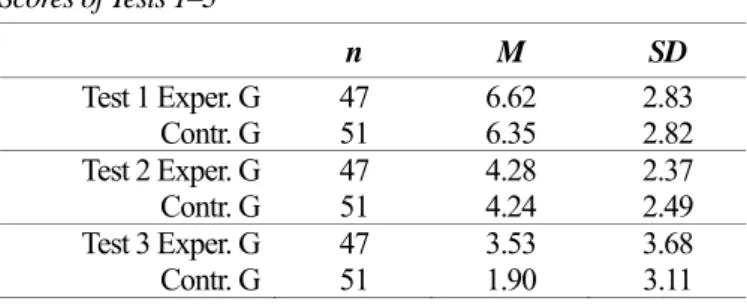
Table 4 shows the descriptive statistics of all of the tests taken by both groups. In order to compare the performances of the groups, first, the normality of the data was checked.
Table 4 Scores of Tests 1–3 n M SD Test 1 Exper. G Contr. G 47 51 6.62 6.35 2.83 2.82 Test 2 Exper. G Contr. G 47 51 4.28 4.24 2.37 2.49 Test 3 Exper. G Contr. G 47 51 3.53 1.90 3.68 3.11
Note. Maximum score = 10 points for each test
As can be seen in Table 5, the result of the Shapiro-Wilk test shows that the normal distributions cannot be assumed in this data except in Test 2 (Experi. G. = .00, Contr. G. = .01 in Test 1, Experi. G. = .10, Contr. G. = .12 in Test 2, Experi. G. = .00, Contr. G. = .00 in Test 3). The Mann-Whitney U Test was chosen for analysis. The results of Test 1, Test 2 and Test 3 are presented in Table 6. As Table 6 shows, the results of the analyses revealed
that there is a statistically significant difference in the results of Test 3 between the two groups (U = 1134.50, p = .65, r = .05 in Test 1; U = 1193.00, p = .97, r = .00 in Test 2; U = 883.00, p = .02, r = .24 in Test 3). The details of the participants’ performances on Tests 1, 2, and 3 are displayed in Figures 2, 3, and 4. Hence, in answer to research question 1, it can be concluded that the knowledge of letter-sound correspondence helps the students understand the orthographically presented words.
Table 5
Test of Normality of Shapiro-Wilk
n Df Statistic p Test 1 Exper. G. Contr. G. 47 51 47 51 .91 .94 .00 .01 Test 2 Exper. G. Contr. G. 47 51 47 51 .96 .96 .10 .12 Test 3 Exper. G. Contr. G. 47 51 47 51 .83 .66 .00 .00
Note. Alpha level = .05
Table 6
Scores of Tests 1–3 and the Results of the Man-Whitney U Test
n M SD Mann-Whitney (U) (p) Effect size (r) Test 1 Exper. G Contr. G 47 51 6.62 6.35 2.83 2.82 1134.50 .65 .05 Test 2 Exper. G Contr. G 47 51 4.28 4.24 2.37 2.49 1193.00 .97 .00 Test 3 Exper. G Contr. G 47 51 3.53 1.90 3.68 3.11 883.00 .02 .24
Note. Maximum score = 10 points for each test, alpha level = .05
The mean score of Test 3 is rather low compared to those of Test 1 and Test 2. There is no statistically significant difference in the results of Test 1 and Test 2 between the two groups. As can be seen in Figure 2 and Figure 4, the mean scores for the word “plant” and “trash” in Test 1 and Test 3 are rather low (0.51 in Exper. G., 0.51 in Contr. G. for “plant,” 0.47 in Exper. G., 0.37 in Contr. G. for “trash” in Test 1, 0.23 in Exper. G., 0.12 in Contr.G. for “plant,” 0.23 in Exper. G., and 0.08 in Contr. G. for “trash” in Test 3). In addition, Figure 3 shows that the mean scores for the words “actress” and “crossing” are rather low in Test 2 (0.28 in Exper. G., 0.27 in Contr. G. for “actress,” 0.19 in Exper. G., 0.24 in Contr. G. for “plant,” 0.19 in Exper. G., 0.10 in Contr. G. for “trash,” 0.19 in Exper. G., and 0.22 in Contr. G. for “crossing” [Table 7]).
0 0.1 0.2 0.3 0.4 0.5 0.6 0.7 0.8 0.91 Exper. G. Contr. G. Figure 2. Mean Score of Each Item in Test
Figure 3. Mean Score of Each Item in Test 2
Figure 4. Mean Score of Each Item in Test 3 0 0.1 0.2 0.3 0.4 0.5 0.6 0.7 0.8 0.91 Exper. G. Contr. G. 0 0.1 0.2 0.3 0.4 0.5 0.6 0.7 0.8 0.91 Exper. G Contr. G
Table 7
Mean Scores of the Items That Were Scored Very Poorly in Each Test
Test 1 Test 2 Test 3
plant trash actress plant trash crossing plant trash
Experi. G. 0.51 0.47 0.28 0.19 0.19 0.19 0.23 0.23
Contr. G. 0.51 0.37 0.27 0.24 010 0.22 0.12 0.08
Note. 1 point for each word
4.2 Results of RQ 2
In order to answer research question 2, namely, if the ability to recognize what the written words stand for is related to the ability to recognize the spoken words and/or the ability to say the words orally, Spearman’s rank Correlation Coefficient was conducted. As is presented in Table 8, there are significant correlations between Test 3 and Test 1, and Test 3 and Test 2 in the two groups. As can be seen, the correlations between Test 3 and Test 1, and Test 3 and Test 2 in Exper. G are higher than those in Contr. G. Conspicuously, the correlation between the results of Test 3 and Test 2 in Exper. G. is higher than that of Contr. G. The students who had high scores on Test 3 had high scores on Test 2. The correlations between Test 1 and Test 2 are relatively high in both groups. There is no doubt that the correlation between Test 1 and Test 2 is high, since Test 2 is the reverse of Test 1.
Table 8
Correlations Among the Three Tests
Exper. G. Contr. G. ρa p ρa p Test 3-Test 1 .76 .00 .68 .00 Test 3-Test 2 .84 .00 .50 .00 Test 1-Test 2 .81 .00 .75 .00
Note. a Spearman rank correlation coefficient, alpha level = .05
5. Discussion
The aim of this study was to investigate if the knowledge of letter-sound correspondence facilitates the students’ ability to understand orthographic information and identify the meaning of a written word when learning new vocabulary. The results of the current study indicate that the students learn to recognize written words better when they have a brief explanation of the letter-sound correspondence than when they do not have it. This study also aimed to examine if the ability to recognize written words is related to the ability to understand phonological information and to say words orally. The findings indicate that although the results show strong associations in
both the experimental and control groups between the ability to recognize what written words represent and the ability to recognize what phonological information represents, and between the ability to recognize what written words represent and the ability to say words orally, the correlations are higher when the students know the letter-sound correspondence.
5.1 Effects of the Knowledge of Letter-Sound Correspondence
The results of this study show that the students’ learning to recognize what the orthographic information represents is different between the two groups, indicating that the knowledge of letter-sound correspondence affects their recognition of written words. When the students know the letter-sound correspondence, they can connect the orthographic information to the phonological information that they already have had. Then they can recall the phonological information and use it as a clue to recall the representation of the orthographic information. As a result, the correlation between Test 1 and Test 2 in the experimental group might be higher than that of the control group even though there is no significant difference between the mean scores of each test in the two groups.
There are two possible reasons why the knowledge of letter-sound correspondence enhances the students’ ability to understand what the orthographic information represents. First, the students used the phonological information in order to access the semantic information by decoding its orthographic information (Barron, 1986; Kadota, 2002). The students can find clues for a word by pronouncing the written word (Ehri, 2005; Ehri and Rosenthal, 2007). The students’ performances were recorded as they tried to recall the pronunciations of the words on Test 2. Some students said, “I know—it begins with /k/ /k/.” These observations support the idea that the knowledge of letter-sound correspondence helps the students retain and recall words from their memory. As Ehri (2005) notes, “…the alphabetic system provides a mnemonic that helps students secure new vocabulary words in memory, both their pronunciations and their meanings” (p. 178).
The findings of this study indicate that although there were only three lessons, the instruction of letter-sound correspondence went smoothly without causing any bewilderment among the students, and the effectiveness of the letter-sound correspondence instruction was confirmed on the recognition of the written words. The experimenter hypothesized that if the students knew the letter-sound correspondences for the newly learned words, they would perform better on Test 1 (i.e., for recognizing what the phonological representations stand for) and Test 2 (i.e., for saying the words orally) as well. It turned out that the results of the current study might show such effects, but the results also showed that there was no negative effect either on learning new vocabulary due to the knowledge of the letter-sound correspondence.
A brief explanation of letter-sound correspondence can be given as a part of phonics instruction. Phonics is a method of teaching how to read by showing the relationship between the letters and their own sounds. According to Moats (2006), 84% of English words can be spelled on the basis of phoneme-grapheme correspondence. The results of this study show that, consistent with the findings of Nishikawa (2009), it is possible for elementary school students to decode English words when they have even little knowledge of the
letter-sound correspondence.
A second possible explanation for the students’ better performance on the task of recognizing written words is that the orthographic information was made salient when introducing new vocabulary. Although there is separate literature on the role of spelling in learning new vocabulary (Hatae, 2004; Ehri and Rosenthal, 2007), the findings of the current study indicate that focusing on spelling with letter-sound correspondence facilitates the students’ recognition of written English words. The results of this study indicate that showing the spelling of words with a brief explanation of the letter-sound correspondence enhances the students’ ability to recognize the orthographic representation.
The findings of this study also demonstrate that the students in both groups learned to recognize the representation of phonological information before they learned to say words orally; they learned to say words orally before they learned to understand what the orthographic information represented. This order is in agreement with the results of Nakamura et al.’s study (2008), Nakamura’s study (2012) and Kasahara et al.’s study (2012).
5.2 Implications for Introducing Reading Instruction in Elementary School
The present study has three implications for teaching English in Japanese elementary schools.
First, a small amount of instruction of letter-sound correspondence should be introduced, considering its effectiveness in regard to the learners’ retention of the words. Many studies claim that phonics instruction should be introduced in English Activities in elementary school. On the other hand, some researchers hold a negative stance toward phonics instruction, claiming that the English spelling system is phonetically irregular and that it is not easy for Japanese elementary school teachers to teach phonics. Although the present author admits the difficulty of carrying out those instructions in practice for Japanese elementary school teachers, it is still worth considering introducing reading instruction in elementary school. For this reason, it is desirable to provide some relevant guidance about the methods as in-service training.
Secondly, MEXT is reluctant to introduce reading and writing instruction in elementary school due to studies which have shown Japanese junior high school students had negative attitudes toward reading and writing in English. However, elementary school students can understand some orthographic information even with simple letter-sound correspondence instruction. They can recognize what the orthographic information stands for, using the knowledge of letter-sound correspondence as clues. As a consequence, the students gained well-balanced vocabulary knowledge. Even a brief explanation of the letter-sound correspondence provides an advantage to the elementary school students.
Thirdly, as was mentioned earlier, elementary school students learn Romaji in the third or fourth grade. It is obvious that the phonetic representation of Romaji is different from that of English. This may cause English acquisition with a strong accent unless the students know the letter-sound correspondence in English. Noro (2007) quoted a student’s example from Chikudo (1996): “I learned Romaji in elementary school and when I saw the word ‘Mike’ /maik/ in the English textbook used in junior high school, I thought the word should be pronounced Mike /mike/ in Japanese Romaji. I hated that difference between Romaji pronunciation and English
pronunciation.” It seems to be difficult for the students who have knowledge of Romaji to read some English words unless the knowledge of letter-sound correspondence is taught.
The participants in the experimental group of this study seemed to readily accept the letter-sound correspondence instruction. They seemed to be pleased to pronounce each sound or a letter. They quickly learned the simple rules of phonics and tried to use that knowledge to recall the meaning of the words when they saw the English written words on Test 3.
5.3 Limitations and Suggestions for Further Research
The author is fully aware that there is a clear need for additional research to address the following limitations. First, because the number of the participants is rather small, it is not easy to draw generalizations. Second, the number of target words is relatively small. Learning ten new words in three lessons does not seem to be difficult for fifth and sixth grade students. The students in fifth and sixth grades can memorize those ten words by rote in three lessons, and it may be difficult to find out how the knowledge of letter-sound correspondence affects their ability to recognize the words auditorily and their ability to say words orally. Third, the result may have changed if the experiment continued for a longer span of time.
6. Conclusion
The present study explored Japanese elementary school students’ phonological and orthographic knowledge when they are instructed in new vocabulary with a brief explanation of the letter-sound correspondence. The study also investigated the effect of the knowledge of letter-sound correspondence on phonological and/or semantic information of newly learned vocabulary.
The most important finding from this study is that even a small amount of knowledge of letter-sound correspondence helps elementary school students recognize written words. The findings indicate that elementary school students use the knowledge of letter-sound correspondence as clues in order to pronounce written English words and understand what they stand for.
During this study, the author observed the students having fun in learning new vocabulary by producing their letter-sound correspondences. Considering that the students in fifth and sixth grades already have knowledge of Romaji, it was expected that they would have read the written English words with Romaji pronunciation. However, when the students came to know the letter-sound correspondence, they enjoyed reading written English words one after another on their own. The idea that reading and writing instruction is difficult for elementary school students is somehow a naive and perhaps questionable assumption.
Recently, MEXT announced a list of government projects with their budget for 2013. MEXT presented a budget of 25,000,000 yen for “Shoraitekina gaikokugo kyoiku no arikata ni kansuru chosa kenkyuu jigyo” [A government project regarding what foreign language education should be like in the future] for the forthcoming year. According to MEXT, English could be offered at the lower grade levels in elementary school. When this plan is implemented, upper grade students will have had English classes for more than 35 hours in total when they
finish their fifth grade curriculum. In that case, literacy instruction, and especially reading instruction, will become possible. If so, the author fully hopes that this study will become one of the methods to be considered.
Note
1 The school and the present author discussed and judged that it was not necessary to give an extra “make-up” lesson on letter-sound correspondence to the control group after the data collection because a short treatment out of context would not fit in with the natural flow in class.
References
Allen-Tamai, M. (2006). Shogakusei no arufabetto chishiki ni tsuite [Alphabetical knowledge among Japanese young learners of English]. ARCLE REVIEW, 1, 72–81.
Allen-Tamai, M. (2008). Koritsushogakko ni okeru kokateki na rideingu shido ni tsuite (1) [An effective reading curriculum for public elementary schools: Teaching the alphabet]. Chiba Daigaku Kyoikugakubu Kenkyu
Kiyo, 56, 15–23.
Allen-Tamai, M. (2008). Shogakusei no arufabetto chishiki no hattatsu to onin ninshiki noryoku no kanrensei ni
tsuite [The relationship between alphabetical knowledge and phonological awareness among elementary
school children]. ARCLE REVIEW, 2, 112–123.
Allen-Tamai, M. (2009). Jido eigo kyoiku ni okeru ritarashii kyoiku: Onin ninshiki noryoku wo chushin ni mita
arufabetto chishiki to tango chishiki no hattatsu [Early literacy development of English: Phonological
awareness and its relationship with alphabetical knowledge and word knowledge]. ARCLE REVIEW, 4, 90– 102.
Allen-Tamai, M. (2011). Shogakko eigo no kyoikuho: Riron to jissen [Teaching English in elementary school: theory and practice]. Tokyo: Taishukan.
Amano, N. (2008). Kihongo deta besu: Gogibetsu tango shinmitsudo [Word familiarity database]. Tokyo: Gakushu Kenkyusha.
Barron, R. (1986). Word recognition in early reading: A review of the direct and indirect access hypotheses.
Cognition, 24, 93–119.
Benesse. (2009). Dai 1 kai chugakko eigo ni kansuru kihon chosa seito chosa [Survey results of eighth-grade students on English and English learning in junior high schools]. Tokyo: Benesse.
Benesse. (2011). Sho-chugakko no eigokyoiku ni kansuru chosa [Survey results of on seventh graders and their mothers on English language teaching in elementary and junior high school]. Tokyo: Benesse.
Butler, G. Y., & Takeuchi, A. (2005-2006). Evaluation of English activities at Japanese elementary schools: An examination based on the Junior STEP Bronze Test. JASTEC Bulletin, 25, 1–15.
Butler, G. Y., & Takeuchi, A. (2006). Instruction and communication abilities: An examination based on the Junior STEP Silver Test. STEP Bulletin, 18, 248–263.
children. Journal of Educational Psychology, 83,(4), 451–455.
Castles, A., Coltheart, M., Wilson, K., Valpied, J., & Wedgwood, J. (2009). The genesis of reading ability: What helps children learn letter-sound correspondences? Journal of Experimental Child Psychology, 104, 68–88. Chujo, K., Nishigaki, C., Yoshimura, T. & Nishioka, N. (2007). Sho, chu, ko, ikkangata eigogoi shirabasu
kaihatsu no tameno kisokenkyu [Towards compiling a national syllabus for Japanese English vocabulary]. Language Education & Technology, 44, 23–42.
Chujo, K., Nishigaki, C., & Miyazaki, K. (2009). Shogakko goroku nensei “Eigo Noto” no goi ichiran [Vocabulary list of the 5th and 6th grade “English Note”]. Nihondaigaku Seisan Kogakubu Kenkyu Hokoku
B, 42, 99–115.
Ehri, L. C. (1992). Reconceptualizing the development of sight word reading and its relationship to recoding. In P. Gough, L. C. Ehri, & R. Treiman (Eds.), Reading acquisition (pp. 107–143). Hillsdale, NJ: Lawrence Erlbaum Associates.
Ehri, L., (1993). How English orthography influences phonological knowledge as children learn to read and spell. In R. Scholes (Ed.), Literacy and language analysis (pp. 21–43). Hillsdale, NJ: Erlbaum.
Ehri, L. C., (2005). Learning to read words: Theory, findings and issues. Studies of Reading, 9(2), 167–188. Ehri, L. C., & Rosenthal, J. (2007). Spelling of words: A neglected facilitator of vocabulary learning. Journal of
Literacy Research, 39(4), 389–409.
Escudero, P., Hayes-Harb, R., & Mitterer, H. (2008). Novel second-language words and asymmetric lexical access. Journal of Phonetics, 36, 345–360.
Harley, B. (1996). Vocabulary learning and teaching in a second language. The Canadian Modern Language
Review, 53(1), 3-11.
Hatae, M. (2005). Tango reberu deno yomi no tokucho ni kansuru kenkyu: Gakunensa to shutokuritsu ni chumoku
shite [A study on the characteristics of reading by vocabulary competence level with an emphasis on age
and acquisition]. JES Bulletin, 6, 55–60.
Kadota, S. (2002). Eigo no kakikotoba to hanashikotoba wa ikani kankei shiteiruka [How phonology works in L2 reading comprehension]. Tokyo: Kuroshio Press.
Kasahara, K., Machida, N., Osada, E., Takanashi, T., & Yoshizawa, S. (2012). Shogakko gorokunensei no
goichishiki: Onsei, imi, moji no musubitsuki ni kanshite [Vocabulary knowledge of 5th and 6th grades at
elementary school: Connections between sound, meaning and spelling]. JES Bulletin, 12, 90–101.
Katsuyama, H., Nishigaki, C., & Wang, J. (2008). The effectiveness of English teaching in Japanese elementary schools: Measured by proficiency tests administered to seventh-year students. RELC Journal, 39(3), 359– 380.
Laufer, B., & Goldstein, Z. (2004). Testing vocabulary knowledge: Size, strength, and computer adaptiveness.
Language Learing, 54(3), 399–436.
Matsukawa, R., & Oshita, K. (2007). Shogakko eigo to chugakko eigo wo musubu: Eigo kyoiku ni okeru shochu
transition between elementary and junior high school in English language teaching]. Tokyo: Korosha. Meara, P. (1980). Vocabulary acquisition: A neglected aspect of language learning. Language Teaching and
Linguistics, 13, 221–246.
Ministry of Education, Culture, Sports, Science and Technology (2001). Shogakko eigo katsudo jissen no tebiki [Practical handbook for elementary school English Activities]. Tokyo: Kairyudo. Ministry of Education, Culture, Sports, Science and Technology (2005). Shogakko eigo katsudo jisshijyokyo chosakekka gaiyo [Result of the investigation to elementary schools on English Activities]. Retrieved December 25, 2012, from http://www.mext.go.jp/b_menu/shingi/chukyo/chukyo3/015/siryo/06032707/005/002.htm
Ministry of Education, Culture, Sports, Science and Technology (2008). Shogakko gakushu shidoyoryo kaisetsu
gaikokugo katsudo hen [The guidelines for the course of study in terms of foreign language activities].
Tokyo: Toyokan.
Ministry of Education, Culture, Sports, Science and Technology (2012). Heisei 25 nendo monbukagaku sho
gaisan yokyu to no happyoshiryo ichiran [The list of budgetary requests in 2013]. Retrieved December 25,
2012, from http://www.mext.go.jp/component/b_menu/other/__icsFiles/afieldfile/2012/09/07/1325569_ 2.pdf
Moats, L. C. (2006). How spelling supports reading: And why it is more regular and predictable than you may think. American Educator, 29(4), 12–22, 42–43.
Nakamura, N. (2006). Shogakko eigo ni okeru mojidonyu no mondaiten [Some problems with introducing letters in the English education of elementary school children]. Gifushiritsu Jyoshi Tankidaigaku Kenkyu Kiyo, 55, 15–22.
Nakamura, N., Suematsu, A., & Hayashida, K. (2008). Shogakko eigo ni okeru mojishido to sono kadai [Literacy instruction in English Activities in elementary school]. JES Bulletin, 9, 63–70.
Nakamura, N. (2012). Gaikokugo katsudo de mi ni tsuku goi gino [On the lexical skills learned by elementary school children through foreign language activities]. Journal of Hokkaido University of Education, 62–2, 173–187.
Nation, I.S.P. (2001). Learning vocabulary in another language. Cambridge: Cambridge University Press. Nishikawa, S. (2009). On the development of English reading abilities of the students in an elementary school. A Master’s research project paper presented to the Graduate School of Language Education and
Information Science, Ritsumeikan University, 3, 81–107.
Noro, T. (2004). Shogakko no “eigo katsudo” ni okeru mojishido no igi to hitsuyosei: Shogakko to chugakko ni
okeru mojishido no renkei wo mezashite [Necessity of phonics instruction in “English Activities” at
elementary schools: Seeking cooperation between elementary and middle schools]. Aichi Kyoikudaigaku
Kyoikudaigaku Kyoiku Jissen Sogo Senta, 7, 151–157.
Otagaki, M. (2007). Shogakko eigo kyoiku ni okeru goi shido: Gengo shutoku no kanten kara [Vocabulary instruction in elementary school English education: From the view point of SLA]. JES Bulletin, 8, 21–28. Prakash, P., Rekha, D., Nigam, R., & Karanth, P. (1993). Phonological awareness, orthography, and literacy. In R.
Scholes (Ed.), Literacy and language analysis, (pp.55–70). Hillsdale, NJ: Erlbaum. Read, J. (2000).
Assessing vocabulary. Cambridge: Cambridge University Press.
Saeki, Y., & Saji, R. (2010). Koritsu shogakko rokunen no “Eigo Noto” shutsugengoi no rikaido ni kansuru
kenkyu: Yongino no kanten kara [A study on Japanese 6th graders’ understanding of vocabulary from Eigo Noto: Focusing on listening, speaking, reading and writing]. JES Bulletin, 11, 25–29.
Saji, R., & Saeki, Y. (2012). Shogakko rokunensei no goi rikaido to tango shinmitsudo ni kansuru kosatu [A study on word comprehension and its familiarity for Japanese 6th graders of elementary school]. JES Bulletin, 12, 115–124.
Schmitt, N. (2000). Vocabulary in language teaching. Cambridge: Cambridge University Press.
Share, D. L. (1995). Phonological recoding and self-teaching: Sine-qua-non of reading acquisition. Cognition, 55, 151–218.
Webb, S. (2008). Receptive and productive vocabulary sizes of L2 learners. Studies in Second Language
Acquisition, 39(1), 79–95.
Weber, A., & Cutler, A. (2004). Lexical competition in non-native spoken-word recognition. Journal of Memory
and Language, 50, 1–25.
Wilkins, D. A. (1972). Linguistics in language teaching. London: Edward Arnold.
Yoshida, H. (2010). Japanese seventh graders’ English language achievement and motivation. A Master’s research
project paper presented to the Graduate School of Language Education and Information Science, Ritsumeikan University, 4, 107–141.
Yoshimura, H. (2006). Shogakko eigo ni okeru goi no sentaku ni tsuite: Jido ga shiritai tango no chosa no
kokoromi [A study on vocabulary to be taught in English activities in elementary school: A study on
vocabulary that students want to know]. JES Bulletin, 7, 37–42.
Yoshimura, H. (2008). Koritsu shogakko jido no goi chisiki ni kansuru chosa no jissenhokoku [A study on public elementary school students’ vocabulary knowledge]. JES Bulletin, 9, 23–31.
Yukawa, E., Takanashi, T., & Koyama, T. (2009). Communicative abilities developed through Japanese
elementary school English education. Tokyo: Sanseidoo.
Ziegler, J. C., & Goswami, U. (2005). Reading acquisition, developmental dyslexia, and skilled reading across languages: A psycholinguistic grain size theory. Psychological Bulletin, 131(1), 3–29.
Zimmerman, K. (2005). Newly placed versus continuing students: Comparing vocabulary size. TESL Reporter,
en ac po blo de cr ca du pla tr