Table of Contents Part Ⅰ
1. Resource-Based View 2. General Discussion
2.1 Organizational Ambidexterity
2.1.1 Origin and Evolution of Organizational Ambidexterity 2.1.2 Notions of Organizational Ambidexterity
2.1.3 Research Streams of Organizational Ambidexterity
2.1.4 Relationships between Organizational Ambidexterity and Organizational Performance 2.2 Exploitation and Exploration
2.2.1 Notions of Exploitation and Exploration
2.2.2 Relationships between Exploitation and Exploration 2.2.3 Mechanisms for Managing Exploitation and Exploration 2.2.4 Influence Factors of Managing Exploitation and Exploration 2.2.5 Managing Exploitation and Exploration across Organizational Levels 2.2.6 Exploration Builds on Exploitation
Part Ⅱ
3. Specific Application
3.1 Innovation Ambidexterity
3.1.1 Notions of Innovation Ambidexterity
3.1.2 Relationships between Innovation Ambidexterity and Organizational Performance 3.2 Incremental Innovation and Radical Innovation
3.2.1 Notions of Incremental Innovation and Radical Innovation
3.2.2 Relationships between Incremental Innovation and Radical Innovation 3.2.3 Mechanisms for Managing Incremental Innovation and Radical Innovation 3.2.4 Influence Factors of Managing Incremental Innovation and Radical Innovation 3.2.5 Radical Innovation Builds on Incremental Innovation
3.3 Research Question 4. Conclusion
The Conceptual Development of Organizational Ambidexterity:
From General Discussion to Innovation Management Application (Part Ⅰ)
Preliminary Summary Note: In order to comprehensively and systematically study the conceptual development of organizational ambidexterity (OA) from a general discussion level to innovation management application area, and indicate important questions need to be solved and discussed in the future, the author reviews and discusses typical studies in these relevant research fields. Part Ⅰ indicates the research perspective, the resource-based view, and discusses the origin & evolution, notions, research streams of OA, and relationships between OA and organizational performance from a general level, followed by the discussion of studies on exploitation (Ei) and exploration (Er) in different parts: notions of Ei & Er, relationships between Ei & Er, mechanisms and influential factors of managing Ei & Er, managing Ei & Er across organizational levels, and Er builds on Ei. The discussion of studies on OA applied in innovation management field will be left to Part Ⅱ, and the basic contents of the next part of this paper can be seen in the table as above.
In order to sort out the origination and conceptual development of organizational ambidexterity and point out the theoretical gaps that need to be deeply studied in the future, the author reviews the literature of resource-based view (RBV), organizational ambidexterity (OA), innovation ambidexterity (IA), and makes a summary in the end of this paper. Section one reviews some important works of the resource-based view to explain the research perspective, which sets a solid foundation for this research. Section two reviews the literature of organizational ambidexterity in two parts. In the first part, the author discusses the studies of origin and evolution, notions, research streams of OA, and relationships between OA and organizational performance. In the second part, the author discusses the focus of OA, exploitation and exploration (Ei & Er), which concentrates on the studies of the notions of Ei & Er, relationships between Ei & Er, mechanisms for managing Ei & Er, influence factors of managing Ei & Er, managing Ei & Er across organizational levels, and exploration builds on exploitation. Since innovation management is one of the most important streams of OA study, section three reviews the literature of innovation ambidexterity in two parts, in the first part, the author discusses the studies of notions of IA, and relationships between IA and organizational performance. In the second part, the author discusses the focus of IA, incremental innovation (II) and radical innovation (RI), which concentrates on the studies of notions of II & RI, relationships between II & RI, mechanisms for managing II & RI, influence factors of managing II & RI, and RI builds on II. In the last part of this section, the author indicates the research question that needs to be addressed in the future. The author makes a summary of this paper in the last section.
1. Resource-Based View
The resource-based view (RBV) regards a firm as an organization which has many different resources and capabilities, and these two kinds of organizational elements could help the firm obtain a sustainable competitive advantage for a long period (Amit and Schoemaker, 1993).
In his seminal paper, Wernerfelt (1984, p. 172) indicated that “By a resource is meant anything which could be thought of as a strength or weakness of a given firm. More formally, a firmʼs resources at a given time could be defined as those (tangible and intangible) assets which are tied semi-permanently to the firm (see Caves, 1980)”. From this definition, we can infer that (1) the “resource” is a neutral term, some resources may give benefits to a firm, and some resources may make a firm lose the benefits. As for a specific resource, it may be good for an organization at a certain time, and it may be bad for the organization at other times.
(2) The resources of a firm could be real ones which can be easily identified or explained, or they could be intangible ones which can be hardly felt or explained. (3) The resources should semi-permanently tie to a firm, which means an organization could control or exploit the resources when necessary, but the firm should also give moderate freedom to the resources and let them interact with each other in natural ways. Here we can conclude that although a firm may have many different resources both inside and outside the organization, how to effectively and efficiently deploy and manage these resources is a challenge for the firm to face. Thatʼs why a firm needs not only various resources but also appropriate organizational capabilities to effectively and efficiently deploy those resources to obtain a good performance and a sustainable competitive advantage in the long run.
In order to extend Wernerfeltʼs research, Barney (1991, p. 101) agreed on the opinion of Daft (1983) and indicated that “firm resources include all assets, capabilities, organizational processes, firm attributes, information, knowledge, etc. controlled by a firm that enable the firm to conceive of and implement strategies that improve its efficiency and effectiveness”. He regarded the organizational capability as one of the resources belong to a firm so that he generalized the resources to include more aspects of an organization. Also, he indicated that a firm had a competitive advantage meant it “implementing a value creating strategy not simultaneously being implemented by any current or potential competitors” (p. 102). By grouping all the organizational resources into four categories, Barney (1991) indicated several features of the resources that could influence the sustainable competitive advantage of a firm, and these features were “value, rareness, imperfect imitability and substitutability” (p. 112). Barney (1991) also made two assumptions: (1) The resources could be distributed across different organizations with different forms and values. (2) Transforming the resources of a firm to other firms could generate costs. Based on all those basic notions and assumptions, Barney (1991) put forward a framework (Figure 1) to show a causal chain from resources, their features to sustained competitive advantage. This model set up a solid foundation for the study of RBV in the following years.
Subsequently, a lot of researchers around the world studied different aspects of RBV. As for the definition and framework of RBV, many scholars followed Barneyʼs work, explained them in their unique ways, and utilized them for their specific research issues (Bowen and Wiersema, 1999; Rindova and Fombrum, 1999). Specifically, in the domain of RBV in new product development (NPD), Verona (1999, p. 135) put forward a
Figure 1 The Relationship between Resource Heterogeneity and Immobility, Value, Rareness, Imperfect Imitability, and Substitutability, and Sustained Competitive Advantage
(Source: Barney, 1991, p. 112) Firm Resource Heterogeneity Firm Resource Immobility Value Rareness Imperfect Imitability History Dependent Causal Ambiguity Social Complexity Substitutability Sustained Competitive Advantege → →
88 Yokohama Journal of Social Sciences, Vol. 24, No. 2
“resource-based model of product development” (Figure 2). In his figure, agents include: “managerial decisions and actions, experimentation and prototyping, learning by doing and learning before doing”; technological capabilities include: “R&D, manufacturing, design, technological complementarities”; external integrative capabilities include: “managerial processes, managerial systems, absorptive structures, culture and values for external absorption”; internal integrative capabilities include: “managerial processes, managerial systems, integrative structures, culture and values for internal integration”; marketing capabilities include: “market research tools, strategic marketing management, marketing-mix policies, marketing complementarities”; process efficiency include: “lead time, productivity”; product effectiveness include: “fit with market needs, product quality”. This figure comprehensively indicates several important aspects (resources and performance) of product development from RPV. As the author explained, this model could be adjusted and extended based on more studies in the future.
Based on the studies mentioned above, the author of the present work uses the resource-based view as the theoretical perspective of this research and indicates that a motor company usually has many different resources both inside and outside the organization. Specifically, by developing and utilizing resources (human, knowledge, material) and capabilities (NPD mode and other organizational capabilities) of the firm, the NPD project team could develop new products, radical innovations, to meet or lead the market(s), coordinate exploitation and exploration, create radical innovation from incremental innovation and obtain a sustainable competitive advantage in the long term. Figure 3 shows the presupposed relationship between resources, capabilities, and outcome of an NPD project. The author explains some important components of this framework in the following sections of this paper.
(218)
Figure 2
A Resource-Based Model of Product Development (Source: simple version of the original model in Verona, 1999, p. 135)
Figure 3
A Resource-Based View Model of New Product Development (Source: the author) Agents
Technological Capabilities External Integrative Capabilities
Internal Integrative Capabilities Marketing Capabilities Product Effectiveness Process Efficiency Resources * Human * Knowledge (Incremental Innovation) * Material Capabilities * NPD Mode * Other Organizational Capabilities Outcome * New Product (Radical Innovation) Figure 2 A Resource-Based Model of Product Development
(Source: a simplified version of the original model in Verona, 1999, p. 135)
A Resource-Based Model of Product Development (Source: simple version of the original model in Verona, 1999, p. 135)
Figure 3
A Resource-Based View Model of New Product Development (Source: the author) Agents
Technological Capabilities External Integrative Capabilities
Internal Integrative Capabilities Marketing Capabilities Product Effectiveness Process Efficiency Resources * Human * Knowledge (Incremental Innovation) * Material Capabilities * NPD Mode * Other Organizational Capabilities Outcome * New Product (Radical Innovation)
Figure 3 A Resource-Based View Model of New Product Development
2. General Discussion 2.1 Organizational Ambidexterity
2.1.1 Origin and Evolution of Organizational Ambidexterity
As one of the most critical issues in management study, the discussion on how a firm can adapt to the complex and constant changes both inside and outside the organization to obtain a good performance and achieve a sustainable competitive advantage has been studied for many years. Organizational ambidexterity was put forward by scholars as a possible option to solve this problem.
In 1976, Duncan first used the term, ambidextrous organization, to describe the organization which could use dual structures to manage separated innovation processes. He divided the innovation process into two basic stages: initiation and implementation, and both of them had several substages. In the initiation stage, complexity1) is higher, formalization2) is lower, and centralization3) is lower. In contrast, in the implementation stage, complexity is lower, formalization is higher, and centralization is higher. Given the factors which could facilitate the shifting of structures between two different innovation stages, an organization should focus on gathering and processing information in initiation stage and focus on reducing conflict and ambiguity within and outside the organization in the implementation stage. Duncanʼs research stimulated researchers to pay attention to organizational ambidexterity, and his research could be regarded as an extension of the contingency theory study.
The seminal article in the study of organizational ambidexterity was published by James March in 1991. In this paper, March (1991, p. 71) indicated that “A central concern of studies of adaptive processes is the relation between the exploration of new possibilities and the exploitation of old certainties (Schumpeter, 1934; Holland, 1975; Kuran, 1988)”, and “maintaining an appropriate balance between exploration and exploitation is a primary factor in system survival and prosperity” (p. 71). From the perspective of organizational learning, March pointed out that, as two different learning activities, exploitation and exploration had different attentions, attributes, and values, and they needed different resources and capabilities of an organization so that the practitioners (e.g., top management team, managers) should not only try to help their firms achieve both exploitation and exploration simultaneously, but also they should make a trade-off between exploitation and exploration so as to achieve organizational ambidexterity. Marchʼs work set a solid foundation for organizational ambidexterity study, and the discussion of exploitation and exploration has become the focus of this research field.
Many works on organizational ambidexterity have been published after Marchʼs paper. Birkinshaw and Gupta (2013) grouped all these studies into three stages chronologically. From 1995 to 2005, some scholars made definitions of organizational ambidexterity in their specific research domains, and they emphasized the
1)According to Duncan (1976, p. 173), “complexity is defined here in terms of the number of occupational specialties in the organization and their professionalism (Hage and Aiken, 1970), and a very differentiated task structure (Wilson, 1966)”.
2)According to Duncan (1976, p. 175), “Formalization is concerned with the emphasis that is placed within the organization on following specific rules and procedures in performing oneʼs job”.
3)According to Duncan (1976, p. 177), the centralization “is conceptualized here in terms of locus of the authority and decision making in the organization”.
importance of this research in management study (Tushman and OʼReilly Ⅲ, 1996; Gibson and Birkinshaw, 2004; He and Wong, 2004). From 2005 to 2009, many researchers made more definitions of organizational ambidexterity from different perspectives, and they studied the antecedents, consequences, and the influence factors of this issue under different industrial contexts (Gupta, Smith, and Shalley, 2006; Lubatkin et al., 2006; Taylor and Helfat, 2009). From 2009 to 2013, more works were published to extend the research scope of organizational ambidexterity, and some intensive discussions of this topic were published (e.g., Organizational Science, Academy of Management Perspectives). In this period, some scholars published several literature reviews on organizational ambidexterity to summarize prior studies and indicate the research trends in the future (Raisch et al., 2009; Simsek et al., 2009; OʼReilly Ⅲ and Tushman, 2013). After the year of 2013, more researchers conducted their studies on organizational ambidexterity and published more works related to this issue into different research streams. However, as Birkinshaw and Gupta (2013) indicated that since the issue on organizational ambidexterity had been studied for many years, and the studies had been divided into different research streams and domains, more studies needed to be done on explaining the real meaning of organizational ambidexterity and how a firm could achieve it to obtain a sustainable competitive advantage in the long run.
Since the issue on organizational ambidexterity in management field have been studied for more than 40 years, a lot of works have been published and these studies facilitated the development of this research into different streams and domains so that we should not only clearly define the real meaning of organizational ambidexterity but also deeply detect how it could be achieved by utilizing managerial means under different industrial contexts.
2.1.2 Notions of Organizational Ambidexterity
From the perspective of terminology, ambidexterity means the “ability to use the right and left hands equally well” (see Oxford Living Dictionaries). By reviewing the origin and evolution of organizational ambidexterity, we have known that although organizational ambidexterity may have a similar meaning in general, it has been explained differently in different study streams. As Birkinshaw and Gupta (2013) pointed out, we need to know what the real meaning of organizational ambidexterity is so that we can not only clearly define the research scope of this term but also fully understand the essence of this term from a management study perspective.
Since organizational ambidexterity is an academic term, a lot of definitions have been put forward in different research streams after Duncan first used it in 1976. Table 1 lists several typical definitions of organizational ambidexterity based on different research streams.
From the definitions listed in the table, we can find that the organizational ambidexterity could be regarded as an organizational capability to pursue two contradictory organizational objectives, which could create a tension that needs to be reconciled. In general, the organizational ambidexterity is a management paradigm, and it is “a useful way of framing the challenges organizations face in managing two competing objectives at the same time. It provides frameworks and tools for understanding how managers can make choices among competing objectives, who within the organization is responsible for those choices, and what exactly those choices entail” (Birkinshaw and Gupta, 2013, p. 20). Furthermore, in the innovation management stream, the organizational ambidexterity could be defined as an organizational capability to reconcile incremental innovation and radical innovation across different organizational levels based on a series of
91 The Conceptual Development of Organizational Ambidexterity (Huaxing Shang)
specific mechanisms.
2.1.3 Research Streams of Organizational Ambidexterity
Since Duncan first presented the ambidextrous organization in 1976, a lot of works in this research domain have been published in the world. Scholars studied organizational ambidexterity based on different contexts, which finally divided this study into different research streams. The author introduces some typical studies and opinions in each stream as follows.
1) Organizational Learning
There is a critical discussion on whether exploitation and exploration are organizational learning activities. Some scholars believed that only exploration was an organizational learning activity because an organization could explore and develop new knowledge from learning activities. In contrast, exploitation meant using and repeating existing knowledge for many times. (Rosenkopf and Nerkar, 2001; Vassolo, Anand, and Folta, 2004). Other scholars argued that both exploitation and exploration could be regarded as organizational learning activities, but the extents and types of these two learning activities were different (March, 1991; He and Wong, 2004). Besides, some publications focused on the learning types and influential factors in ambidextrous organizations. For example, McKee (1992) separated organizational learning into production-oriented learning and innovation-oriented learning. Levinthal (1997) indicated two kinds of organizational learning activities; they were local search one and long jump one. By doing a survey to managers in an electronics firm, Mom, van
Table 1 Definitions of Organizational Ambidexterity in Different Research Streams
Research Stream Definition Source
Organizational Design
“The ability to simultaneously pursue both incremental and discontinuous innovation and change results from hosting multiple contradictory structures, processes, and cultures within the same firm” (p. 24).
Tushman and O’Reilly Ⅲ, 1996 The organizational capacity to set a suitable organizational context which can facilitate individuals simultaneously conduct both alignment and adaptability tasks within the whole organization.
Gibson and Birkinshaw, 2004 Organizational
Learning
The organizational capability to coordinate two contradictory tasks simultaneously, which requires both the individuals and their organization have related different skills to make it come true.
Im and Rai, 2008 The organizational ability to exploit and improve existing practices and explore and develop new resources and values.
Nemanich and Vera, 2009 Strategic
Management
The organizational capability to facilitate an organization to simultaneously pursue two contradictory strategic objectives to achieve superior performance.
Han and Celly, 2008 The organizational capability to exploit existing “advantages, technologies, and markets” and explore new opportunities to achieve organizational strategic objectives (p. 1272).
Cao, Simsek, and Zhang, 2009 Innovation
Management
The organizational capability to keep a balance between exploitation and exploration to develop existing and new products to satisfy both mature and emerging markets.
He and Wong, 2004 The organizational ability to achieve contradictory innovations: exploiting existing products by developing incremental innovation and exploring new products by developing radical innovation.
Andriopoulos and Lewis, 2009
(Source: the author)
Table 1 Definitions of Organizational Ambidexterity in Different Research Streams
den Bosch, and Volberda (2007) indicated that “top-down knowledge inflows of a manager positively relate to the extent to which this manager conducts exploitation activities” while “bottom-up and horizontal knowledge inflows of a manager positively relate to this managerʼs exploration activities” so that a manager can achieve ambidexterity if he/she can effectively coordinate these different knowledge inflowing modes.
2) Organizational Adaptation
The discussion of this research stream focuses on the relationship between consistency and adaptation in an organization. Many scholars believed that if an organization intended to obtain a sustainable competitive advantage in a long period, it should keep a balance between consistency and adaptation (Tushman and Romanelli, 1985; Tushman and OʼReilly Ⅲ, 1996; Meyer and Stensaker, 2006). This means the organization should not only exploit the routines that it usually utilizes but also explore new opportunities by adapting to the changing contexts. In addition, if the organization takes much energy to explore new opportunities, it could sometimes get lost in the chaos context and receive little outcome, however, if the organization pays much attention to the exploitation side, it may intensify the organizational inertia and lose some opportunities on emerging markets (March, 1991; Levinthal and March, 1993). As a way of achieving both consistency and adaptation in an organization, some scholars indicated that the middle-level managers could create benefits for consistency and top management team could drive the new trend to lead the organization to adapt to the environment with numerous changes (Floyd and Woolridge, 1996). Also, the other possible way to achieve ambidexterity for an organization could be regularly exploring revolutionary changes while exploiting current routines and knowledge as usual (Brown and Eisenhardt, 1997).
3) Organizational Design
The core discussion of this research stream focuses on how to design suitable organizational structures to coordinate the efficiency and flexibility of an organization. As an earlier study of this issue, Burns and Stalker (1961) indicated that there were two contradictory structures of an organization. The mechanical structure contributed to efficiency by relying on standardization, centralization, and hierarchy in an organization, in contrast, the organic structure contributed to the flexibility by emphasizing non-standardization, decentralization, and autonomy in the organization. Duncan (1976) divided the innovation process into two basic stages and indicated that the ambidextrous organization should apply both structures to explore innovation by utilizing an organic structure and implement innovation by utilizing a mechanical structure. After that, several scholars tried to develop suitable ways to reconcile these two different organizational structures. For example, Tushman and OʼReilly Ⅲ (1996) put forward a structural approach to help organizations achieve ambidexterity by conducting exploitation and exploration tasks in different subunits, and the top managers should be responsible for the reconcile task. Gibson and Birkinshaw (2004) developed a contextual approach to help organizations achieve ambidexterity by setting a context, which could support the individuals of the organization in separating their time on exploitation and exploration so that this solution could reconcile the “dual structure” into an intact structure of an ambidextrous organization. Eisenhardt, Furr, and Bingham (2010, p. 1263) indicated that a leader could help an organization keep a “balance between efficiency and flexibility by emphasizing heuristics-based ʻstrategies of simple rules,ʼ multiple environmental realities, and higher-order ʻexpertʼ cognition”.
4) Innovation Management
between incremental innovation and radical innovation. In general, incremental innovation could be regarded as the continuous change that continually improves an existing product, service, and technology, in contrast, radical innovation means the fundamental change that creates a new product, service, and technology. Tushman and Smith (2002) referred to incremental innovation as exploitative innovation and radical innovation as exploratory innovation. In innovation management domain, the organizational ambidexterity could be regarded as the “ability to simultaneously pursue both incremental and discontinuous innovation” to obtain an excellent performance (Tushman and OʼReilly Ⅲ, 1996, p. 24). Colbert (2004) indicated that the organizations which could reconcile exploitative innovation and exploratory innovation had more advantages than the organizations that only pursued one innovation type but ignored the other one. Some researchers tried to find suitable means to effectively reconcile the relationship between these two innovation types (Brown and Eisenhardt, 1997; OʼReilly Ⅲ and Tushman, 2004; Smith and Tushman, 2005). For instance, Smith and Tushman (2005) put forward a top management model, which could help organizations reconcile incremental innovation and radical innovation by three steps: “(a) articulating a paradoxical frame, (b) differentiating between the strategy and architecture for the existing product and those for innovation, and (c) integrating between those strategies and architectures” (p. 522). Burgers et al. (2009, p. 797) developed a series of formal and informal “organizational integration mechanisms”, and “senior team integration mechanisms” for organizations to pursue and to achieve innovation ambidexterity.
5) Strategic Management
The discussion on organizational ambidexterity in strategic management stream focuses on two inherently different strategies, exploitative strategy and exploratory strategy, and how to coordinate these two strategies within an ambidextrous organization. In the internal ecology model of strategic making, which was put forward by Burgelman in 1991, the strategic process could be divided into an induced process and an autonomous process. The former one refers to the strategy based on existing knowledge of an organization, and the latter one refers to the strategy based on new competence of the organization. In 2002, Burgelman related the inducted strategic process to “exploitation”, related the autonomous strategic process to “exploration”, and indicated that a manager should make a trade-off between these two strategies because they could compete for the limited resource of the organization. Some researchers replaced exploitative and exploratory strategies by other terms, for example, selective strategy and adaptive strategy (Volberda, Baden-Fuller, and van den Bosch, 2001), deliberate strategy and emergent strategy (Bodwell and Chermack, 2010), competence leveraging strategy and competence building strategy (Sanchez, Heene, and Thomas, 1996), etc. According to the study of Cao, Gedajlovic, and Zhang (2009), the relationship between exploitative strategy and exploratory strategy could be reconciled based on two dimensions of organizational ambidexterity: keeping a balance between exploitation and exploration (balance dimension, BD) and combining exploitation and exploration (combine dimension, CD).
6) Resource Management
From the perspective of the resource-based view, an organization usually has various resources and capabilities which could help the organization obtain a sustainable competitive advantage in the long term. Since exploitation and exploration are inherently different, sharing the scarce organizational resource often makes exploitation and exploration compete against each other when an organization tries to pursue exploitation and exploration simultaneously. If we compare exploitation with exploration in the certainty,
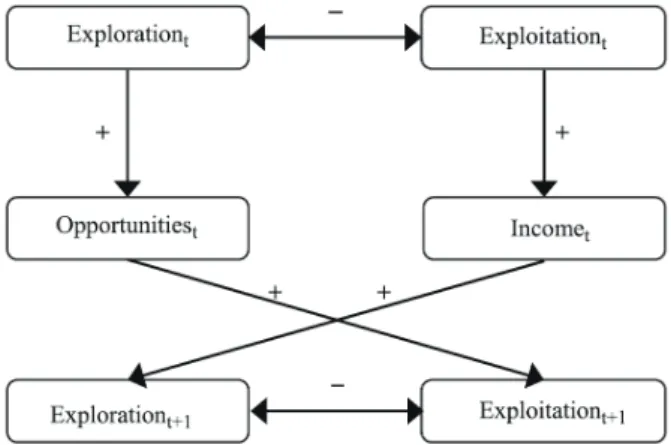
speed, proximity, and clarity dimensions of returns, we can find that the returns of exploitation have more certainty, faster, closer to current product or knowledge and clearer than the returns of exploration (March, 1991). However, an organization should pursue exploitation and exploration simultaneously if it aims at surviving and making progress in the long run. Although pursuing exploration may give an organization more opportunities to occupy emerging markets by developing radical innovation, exploitation should also be emphasized since the incomes produced by exploitation can be invested in exploratory management activities (Lavie et al., 2010). From the perspective of finance, Auh and Menguc (2005) indicated that the long-term performance of an organization could be created from exploration, in contrast, the short-term performance could be produced by exploitation. The senior management team could have a great influence on the management of the trade-off between exploitation and exploration in resource allocation and acquisition activities (Helfat and Peteraf, 2009).
2.1.4 Relationships between Organizational Ambidexterity and Organizational Performance
Many researchers have discussed the question about whether organizational ambidexterity has a relationship with organizational performance, and if this relationship exists, is there any condition or rule that organizations should follow? Although some scholars indicated that organizational ambidexterity might have no efficient on organizational performance under specific situations (March, 1991; Ebben and Johnson, 2005), most of researchers acknowledged that organizational ambidexterity and organizational performance had certain relationships indeed. For example, many scholars indicated that organizational ambidexterity could make great contributions to firmsʼ sales growth (Auh and Menguc, 2005), innovation development (Tushman et al., 2010), market valuation (Wang and Li, 2008) and subjective assessment of performance (Gibson and Birkinshaw, 2004). These factors are some measurable indicators of organizational performance. Besides, some scholars indicted that organizational ambidexterity and organizational performance could have an inverted U-shaped relationship (Caspin-Wagner, Ellis, and Tishler, 2012). By conducting case studies (e.g., OʼReilly Ⅲ, Harreld, and Tushman, 2009) and extensive samples surveys (e.g., Goosen, Bazzazian, and Phelps, 2012), researchers have found not only the certain relationships but also some conditions and rules that the relationships should meet and follow. Based on these studies, when an organization has sufficient resources, and the external environment is uncertain, organizational ambidexterity may have a positive relationship with performance (Caspin-Wagner, Ellis, and Tishler, 2012; Cao, Gedajlovic, and Zhang, 2009) and in general, this relationship is easier to be found in large firms than small- and middle-sized ones.
2.2 Exploitation and Exploration
2.2.1 Notions of Exploitation and Exploration
In the research field of organizational ambidexterity, a lot of researchers constructed their studies based on exploitation and exploration because the discussion of these two terms had become the core topic of this research domain. March (1991) indicated that “exploitation includes such things as refinement, choice, production, efficiency, selection, implementation, execution” (p. 71) and “the essence of exploitation is the refinement and extension of existing competencies, technologies, and paradigms” (p. 85). In contrast, “exploration includes things captured by terms such as search, variation, risk-taking, experimentation, play, flexibility, discovery, innovation” (p. 71) and “the essence of exploration is experimentation with new alternatives” (p. 85).
Followed by Marchʼs work (1991), a lot of scholars interpreted exploitation and exploration in different research streams of organizational ambidexterity study. For example, in the organizational learning stream, “exploitation refers to learning gained via local search, experiential refinement, and the selection and reuse of existing routines. Exploration refers to learning gained through processes of concerted variation, planned experimentation, and play” (Baum, Li, and Usher, 2000, p. 768). Based on this, we can infer that pursuing different organizational learning approaches, exploitation and exploration, may lead to different performances. In Organizational adaptation stream, “exploitation” equals to the organizational ability to maintain operative routines, and “exploration” equals to the ability to pursue radical changes to adapt to the external environment (Meyer and Stensaker, 2006). In organization design stream, exploitation relates to the mechanistic structure which aims at short-term efficiency, and exploration relates to the organic structure which aims at long-term development of an organization (Raisch and Birkinshaw, 2008). In the innovation management stream, exploitation is interpreted as incremental innovation; in contrast, exploration is interpreted as radical or discontinuous innovation (Tushman and OʼReilly Ⅲ, 1996). The innovation mentioned here often has different types, such as product, process, technology, and knowledge innovations, etc. In strategic management stream, exploitation means the variation-reducing strategic process that can be implemented in existing strategic scope and exploration means the variation-increasing strategic process that can be obtained outside the current strategic scope (Burgelman, 1991).
By explaining different notions of exploitation and exploration based on various research streams of organizational ambidexterity, we can find that although exploitation and exploration have different meanings and interpretations from different perspectives, in general, exploitation means an organization continually improves its existing competence and routines to pursue short-term efficiency, in contrast, exploration means the organization searches new opportunities or develops new competence so as to adapt to the unstable environment and obtain a sustainable competitive advantage in a long period. As for this research, exploitation refers to incremental innovation (knowledge, technology, experience) of an organizationʼs functional departments and individuals; in contrast, exploration refers to radical innovation (product) of the organization. These two kinds of innovations can connect, and they can also interplay within an organization across different levels.
2.2.2 Relationships between Exploitation and Exploration
According to the study of Lavie, Stettner, and Tushman (2010), although exploitation and exploration may have different meanings and objectives, they can interplay with each other, and they could also be reconciled within an ambidextrous organization. In general, some scholars regarded the relationship between exploitation and exploration as two ends of a continuum so that the manager of an organization should make a trade-off between them. In contrast, some researchers believed that exploitation and exploration had an orthogonal relationship so that a manager could keep a balance between them in an ambidextrous organization. Besides, excessive pursuing either of them may lead to relevant traps that need to be prevented.
1) Two Ends of a Continuum: Trade-Off
Based on the studies of March (1991, 1996), exploitation and exploration can be regarded as two ends of a continuum (Gupta, Smith, and Shalley, 2006) because they are inherently different and incompatible within an organization. March (1991) indicated that since an organization might have limited resource, exploitation and exploration utilized the scarce resource by competing with each other so that it could be tough for managers to
keep a balance between these two activities. Whatʼs more, considering the influence of organizational inertia, an organization could reinforce either exploitation or exploration when it operates at ordinary times. For example, when an organization pursues exploitation, it may receive outcomes very quickly after a manager invests resources into practice so that the manager may invest more resources after the organization receives the outcomes immediately. In contrast, when an organization pursues exploration, it is not easy for it to obtain outcomes after a manager invests resources so that the manager may invest more resources on exploratory activities continually as a reaction. The organizational inertia can speed up the separation of exploitation and exploration, and the more resources exploitation uses, the fewer resources exploration can use, vice versa. Also, March (1996, p. 280) indicated that “Exploiting interesting ideas often thrives on commitment more than thoughtfulness, narrowness more than breadth, cohesiveness more than openness”. From what March has pointed out, we can conclude that the psychological tendency of exploitation and exploration are different so that they could not be reconciled within an organization.
According to the study of Gibson and Birkinshaw (2004), an organization can develop a context, which encourages individuals of the organization to pursue exploitation and exploration separately by dividing their time personally, however, if the psychological tendency of these two activities are inherently different, how could an individual efficiently arrange their time and energy to achieve both exploitation and exploration simultaneously? We can infer that it is difficult for a person to keep a balance between exploitative activities and exploratory activities. Based on all what has been mentioned in this part, when we regard the relationship between exploitation and exploration as two ends of a continuum, we need to make a trade-off between these two activities, which means an organization may pursue exploitation at one time and pursue exploration at other times. Structural separation and temporal alternation could be two possible mechanisms to help organizations achieve ambidexterity under specific conditions and contexts.
2) Orthogonal Relationship: Keep Balance
Some scholars refuted the argument that exploitation and exploration could be regarded as two ends of a continuum. In contrast, they indicated that exploitation and exploration had an orthogonal relationship for the following reasons. First, according to the study of Shapiro and Varian (1998), although an organization may obtain limited resource under specific conditions, the resources like knowledge and information are not too scarce to be obtained and used. Second, a manager can search, control, and use resources both within and outside the scope of an organization, the interaction among different organizations may help them share valuable resources and exchange necessary resources with each other. Third, exploitation and exploration may belong to different domains so that no confliction could emerge when an organization pursues both of them in this situation. We can conclude that exploitation and exploration may have an orthogonal relationship under specific conditions. Katila and Ahuja (2002) studied how firms could search for possible solutions to develop new products in the global robotics industry. In their study, exploitation was replaced by search depth, and exploration was replaced by search scope, and they argued that “the interaction of search depth and scope is positively related to the number of new products introduced by a firm” (p. 1186). From their study, we could infer that the organizational ambidexterity could be achieved by coordinating the relationship between exploitation and exploration if they belong to different domains or interact across different hierarchical levels. Since exploitation and exploration are inherently different, they may need various organizational resources. Given this condition, we can infer that it is easy for an organization (not individuals) to achieve
ambidexterity, and temporally switch between exploitation and exploration because the organization can efficiently allocate different resources and exchange resources with other organizations. Based on the analysis in this part, we can conclude that when an organization pursues exploitation and exploration which belong to different domains, these two activities could keep an orthogonal relationship for a certain period so that a manager can help the organization keep a balance between exploitation and exploration, and achieve them simultaneously. Recently, some scholars paid attention to the performance and specific mechanisms for keeping a balance between exploitation and exploration (He and Wong, 2004; Lavie, Stettner, and Tushman, 2010), which facilitated the study on the relationship between exploitation and exploration more deeply and broadly.
3) Traps of Excessive Exploitation or Exploration
As the author mentioned above, exploitation and exploration are inherently different, and they have different objectives, need different resources, and could lead to different performances for an organization. Specifically, March (1991, p. 85) indicated that the outcomes of exploitation were “positive, proximate and predictable”, in contrast, the outcomes of exploration were “uncertain, distant and often negative”. The organization may meet two kinds of traps when it excessively pursues either exploitation or exploration in their day to day operations.
In general, if an organization wants to obtain returns as soon as possible from its investment of resources, it usually pursues exploitation for short-term performance. However, from the perspective of path dependence, when an organization gets expected outcomes, it may meet the threat of “success trap”, which means the organization will continually invest more resources in exploiting current competence and routines, but it will ignore the challenges of long-term success. This overlook could make the organization lose new opportunities on an emerging market, and new capabilities to adapt to the external environment. As Levinthal and March (1993, p. 105) indicated that “an organization that engages exclusively in exploitation will suffer from obsolescence”, the short-term competitiveness could become limitations of an organization in the long term (Leonard-Barton, 1995).
On the other hand, an organization could conduct exploratory activities to catch new opportunities and occupy new markets. However, from the perspective of organizational inertia, an organization usually continually invests more resources to exploration when it cannot get the returns soon from the previous investment, which makes the organization fall into the “failure trap”. Investing too many resources in exploration but ignoring exploitation could be a hazardous option because the continuous investment in a series of failed exploratory activities may make the organization consume too many resources, which will lead to an awkward situation that the organization could not achieve a long-term performance but lose existing competence on the changing market and external environment. According to the study of He and Wong (2004), some innovative firms failed to develop new competence and occupy new markets because they only pursued exploration and ignored the importance of investing enough resources in exploitative activities.
In order to obtain a sustainable competitive advantage, an organization should keep a balance between exploitation and exploration, which means it needs to invest enough resources for both activities and effectively coordinate the relationship between exploitation and exploration. Indeed, it is not easy for an organization to achieve the above objective so that how to overcome the challenge of this issue still needs to be studied by researchers around the world.
98 Yokohama Journal of Social Sciences, Vol. 24, No. 2
2.2.3 Mechanisms for Managing Exploitation and Exploration
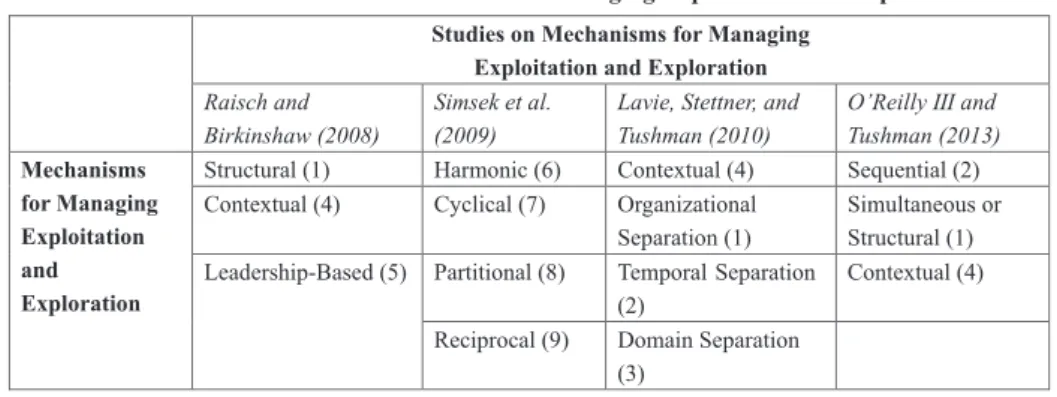
By studying the relationship between exploitation and exploration, we have found that although these two activities have different objectives, need various resources, and could lead to different outcomes for organizations, it is necessary for an organization to reconcile exploitation and exploration if it wants to obtain a sustainable competitive advantage in the long run. After March put forward the dilemma in 1991, a lot of researchers around the world studied the mechanisms for managing exploitation and exploration. There are several kinds of classifications of these mechanisms; typical classifications were put forward by Raisch and Birkinshaw (2008), Simsek et al. (2009), Lavie, Stettner, and Tushman (2010), OʼReilly Ⅲ and Tushman (2013). Table 2 shows some typical classifications that were put forward by these researchers. In the subsequent paragraphs, the author reviews specific studies of each mechanism by summarizing these researchersʼ studies and presenting other relevant studies and outcomes.
1) Structural/Organizational Separation/Simultaneous Mechanism
Since exploitation and exploration are inherently different (March, 1991), and they have different objectives, need various resources, and could lead to different performances for organizations. Some scholars put forward a managing mechanism to reconcile exploitation and exploration. Although this mechanism has different names, such as, structural mechanism (Raisch and Birkinshaw, 2008), organizational separation mechanism (Lavie, Stettner, and Tushman, 2010) and simultaneous mechanism (OʼReilly Ⅲ and Tushman, 2013), the main proposition could be summarized as an ambidextrous organization pursues exploitation and exploration separately in different subunits. Basically, “the exploitation units are larger, more centralized with tight cultures and processes”, aim at achieving organizational efficiency, and could be controlled by process management, in contrast, “the exploratory units are small and decentralized with loose cultures and processes”, aim at occupying new markets, and could be controlled by flexible management methods (Benner and Tushman, 2003, p. 247).
As Raisch and Birkinshaw (2008) indicated that some organizations utilized spatial separation mechanism to enable exploitative and exploratory activities “to be carried out in different organizational units” (p. 389), these units tightly connected internally but loosely interacted with each other (Tushman and OʼReilly Ⅲ, 1996, 2004). Also, some organizations used parallel separation mechanism so that they could conduct
Table 2 Classification of Mechanisms for Managing Exploitation and ExplorationTable 2 Classification of Mechanisms for Managing Exploitation and Exploration
Studies on Mechanisms for Managing Exploitation and Exploration Raisch and
Birkinshaw (2008)
Simsek et al. (2009)
Lavie, Stettner, and Tushman (2010) O’Reilly Ⅲ and Tushman (2013) Mechanisms for Managing Exploitation and Exploration
Structural (1) Harmonic (6) Contextual (4) Sequential (2) Contextual (4) Cyclical (7) Organizational
Separation (1)
Simultaneous or Structural (1) Leadership-Based (5) Partitional (8) Temporal Separation
(2)
Contextual (4) Reciprocal (9) Domain Separation
(3)
(Source: the author)
(Note: the numbers followed each mechanism match to the serial numbers in following paragraphs.)
Table 3 Definitions of Innovation Ambidexterity
Definition Source
IA is an ability that can help an organization reconcile alignment and revolution by pursuing incremental and discontinuous innovations simultaneously under different contexts of “structures, processes, and cultures within the same firm” (p. 24).
Tushman and O’Reilly Ⅲ, 1996 IA means the ability to keep a balance between exploitative innovation based on
current knowledge of an organization and exploratory innovation based on the organization’s new knowledge.
He and Wong, 2004 In the context of new product development, IA is defined as the ability that enables an
organization to keep a balance between alignment and adaptability by exploiting existing process efficiently and exploring radical innovation under changing market conditions.
Backman, Börjesson, and Setterberg, 2007 IA means an organization simultaneously pursues “exploiting existing products to
enable incremental innovation” and “exploring new opportunities to foster more radical innovation” (p. 696).
Andriopoulos and Lewis, 2009, 2013 IA means an organization simultaneously exploits incremental innovation for existing
customers and explores radical innovation for potential and new customers.
Mirzataghi Chaharmahali and Amir Siadat, 2010 IA refers to “organisational activities and strategies of exploiting existing knowledge
in the producing process to satisfy current demands while synchronously exploring unknown areas to adapt to environment changes that finally leads to both subsist at present and thrive in long-term” (p. 23).
Zang and Li, 2016
IA means an organization pursues both exploitative innovation and exploratory innovation simultaneously.
Zhang, Wang, and Wei, 2018
(Source: the author)
ordinary routines in primary structure and explore new opportunities at the same time by utilizing temporary project teams to supplement the disadvantages of the primary structure (Goldstein, 1985). Nonaka and Takeuchi (1995) conducted case studies to explain how a “hypertext organization” could reconcile stability and dynamism across different subunits within an organization. Recently, some scholars indicated that the structural mechanism could be extended into the inter-organization field. For example, Kauppila (2010) made an explanation on how an organization could achieve ambidexterity, reconcile exploitation and exploration, by utilizing internal structure and external partnerships.
2) Temporal Separation/Sequential Mechanism
From the perspective of evolutionary theory, an organization should change and adjust its structure and process to survive, adapt, and develop in the everchanging environment, and obtain a sustainable competitive advantage. Tushman and Romanelli (1985) put forward an organizational evolution model based on punctuated equilibrium. Their model indicated that discontinuous changes might punctuate the stability of an organization at certain times, and the executive could coordinate the two different forces by playing as an intermediate role. In the organizational ambidexterity domain, temporal separation (sequential) mechanism means an organization can pursue exploitation at a time and pursue exploration at other times. This means an organization can shift between exploitation and exploration back and forth based on the requirements of adapting to the external environment and organizational development.
Brown and Eisenhardt (1997) studied firms in the computer industry on how an organization could effectively coordinate the transition process between exploitation and exploration in different periods of product development activities. They put forward an idea of semi-structural organization, which could smoothly shift between exploitation and exploration and meet with success in new product development. Lavie and Rosenkopt (2006) explained how an organization could keep a balance between exploitation and exploration in an organizational alliance by gradually shifting the two different activities in the value-chain function. Venkatraman, Lee, and Iyer (2007) regarded the temporal mechanism as a time-paced sequence of exploitation and exploration, which was corresponding to Brown and Eisenhardtʼs study in 1997. The temporal mechanism escapes the pressure of simultaneously reconciling conflicting forces, exploitation and exploration, in an organization. However, since path dependence may have a significant influence on each period of exploitation and exploration, it could be a challenge for an organization to swiftly shift between exploitation and exploration regardless of the impact of organizational inertia. How to achieve this sharp and smooth shift between exploitation and exploration needs to be discussed in future studies.
3) Domain Separation Mechanism
Lavie, Stettner, and Tushman (2010) came up with a domain separation mechanism for managing exploitation and exploration in a review paper based on their previous studies. The structural mechanism divides exploitative and exploratory activities into different subunits of an organization while the sequential mechanism divides these two activities into different periods. Besides, an organization could also reconcile exploitation and exploration across different domains. Lavie and Rosenkopt (2006) put forward three different domains, function-based dimension (upstream and downstream alliances), structure-based dimension (familiar and unfamiliar partners), and attribute-based dimension (partners have similar and different attributes), and they indicated that an organization could pursue exploitation and exploration simultaneously across different domains. By utilizing the domain separation mechanism, an organization may lose a heavy pressure to invest
scarce resource to either exploitation or exploration in a specific situation. Whatʼs more, from Lin, Yang, and Demirkanʼs study (2007), we can find that keeping a balance between exploitation and exploration within the structure domain may not indeed lead to any performance. However, as Lavie, Kang, and Rosenkopf (2009) indicated, the balance of exploitation and exploration across multiple domains could improve performance (e.g., market value and net profit). More questions need to be answered on how an organization can take actions to keep a balance between exploitation and exploration across different domains and what kinds of domains need to be reconciled for an organization to pursue a sustainable competitive advantage.
4) Contextual Mechanism
Unlike the first three separation mechanisms that divide exploitation and exploration into different subunits, periods, or domains, the contextual mechanism is a synthetical mechanism indicates that an organization can achieve ambidexterity without any separation of resources. In 2004, Gibson and Birkinshaw put forward the contextual mechanism for managing ambidextrous organizations. Contextual organizational ambidexterity can be “defined as the capacity to simultaneously achieve alignment and adaptability at a business-unit level” (Gibson and Birkinshaw, 2004, p. 209). An organization that pursues ambidexterity by utilizing this mechanism needs to construct a supportive organizational context, which is characterized by “hard elements (discipline and stretch)” and “soft elements (support and trust)” (Gibson and Birkinshaw, 2004, p. 213). This context “encourages individuals to make their judgments as to how to best divide their time between the conflicting demands for alignment and adaptability” (Gibson and Birkinshaw, 2004, p. 211). Gibson and Birkinshaw (2004) also indicated that utilizing contextual mechanism could improve the performance of an ambidextrous organization.
In the study of Adler, Goldoftas, and Levine (1999), they deeply explored the daily operation of the Toyota Production System (TPS). In Toyota, production line workers usually not only conduct exploitation (e.g., automobile assembly activity) but also pursue exploration (e.g., constantly change works and update working methods) by using “meta-routines”. We can find that TPS could construct a proper organizational context and culture to support the frontline workers pursuing exploitation and exploration simultaneously. Many scholars believed that the culture, which was created by the specific organizational context, could help an organization achieve ambidexterity (Hargadon and Sutton, 1997; Khazanchi, Lewis, and Boyer, 2007). From these studies, we can find that the contextual mechanism gives individuals enough freedom to decide their time on either exploitation or exploration without many particular orders. However, as Kauppila (2010, p. 286) indicated that the contextual mechanism “does not really consider how a firm can simultaneously conduct radical forms of exploration and exploitation. It simply assumes that exploratory knowledge is produced somewhere and is available for use”. Therefore, the issue of how an organization can achieve ambidexterity by utilizing contextual mechanism still needs to be studied in the future.
5) Leadership-Based Mechanism
No matter what kind of mechanism an organization may use to pursue ambidexterity, the leadership of senior executives could have an important influence on organizational ambidexterity. Raisch and Birkinshaw (2008) put forward a leadership-based mechanism and indicated that the coordinating role of leadership could help an organization achieve ambidexterity. Many scholars agreed with Raisch and Birkinshawʼs opinion. For example, Gibson and Birkinshaw (2004) indicated that the leadership of senior executives could help an organization form a supportive context, which could allow individuals to conduct exploitative and
101 The Conceptual Development of Organizational Ambidexterity (Huaxing Shang)
exploratory activities based on their judgments. Smith and Tushman (2005) also argued that the leadership of senior executives could help an organization reconcile exploitation and exploration by utilizing a structural mechanism. While some scholars believed that the top management team could reconcile exploitation and exploration simultaneously (Volberda, Baden-Fuller, and van den Bosch, 2001), some scholars thought that exploratory activities were pursued by low-level workers or middle-level managers, and top management team made decisions only by choosing available options, which could be regarded as an exploitative activity (Floyd and Lane, 2000). Besides, some scholars studied the attributes of senior executives that pursued exploitation and exploration simultaneously. Mirzataghi Chaharmahali and Amir Siadat (2010) indicated that senior executives of an ambidextrous organization should have “a clear strategic intent, shared vision, social integration and reward” for their works (p. 21). The diverse composition of a senior management team is also important, some scholars (Perretti and Negro, 2006; Beckman, 2006) have found that a top management team which included common and different prior company affiliations had positive performance when pursuing organizational ambidexterity. Although some works on leadership-based mechanism have been published, more works need to be done on how the leadership can support an organization pursuing and achieving ambidexterity.
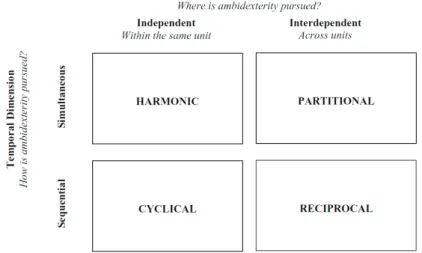
Besides the classifications presented above, Simsek and his colleagues (2009) grouped different mechanisms for managing exploitation and exploration into four categories based on temporal and structural dimensions. In the temporal dimension, some ambidextrous organizations pursued exploitation and exploration simultaneously, and some ambidextrous organizations pursued these two activities in different periods sequentially. In the structural dimension, some organizations “pursuing ambidexterity within an independent structural unit” (p. 868) and some organizations reconciled exploitation and exploration across different organizational units or domains. Simsek et al. (2009) designed a figure to show their classification, which included harmonic, cyclical, partitional, and reciprocal mechanisms (Figure 4). They also discussed “the theoretical grounding, antecedents, and outcomes of each ambidexterity” mechanism in their review paper (p. 869).
Figure 4 A Typology of Organizational Ambidexterity (Source: Simsek et al., 2009, p. 868)
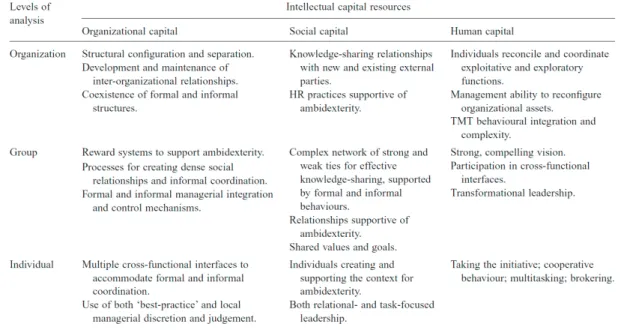
Figure 5 A Multi-Level Categorization of Ambidexterity Mechanisms (Source: Turner, Swart, and Maylor, 2012, p. 322)
Figure 4 A Typology of Organizational Ambidexterity
(Source: Simsek et al., 2009, p. 868)
6) Harmonic Mechanism
Simsek et al. (2009) indicated that harmonic mechanism meant an organization pursued exploitation and exploration simultaneously within an independent unit. However, achieving this mechanism could be very challengeable because these two activities are inherently different, and they may compete for the scarce resource of an organization (March, 1991). In order to solve this dilemma, Gibson and Birkinshaw (2004) put forward a contextual mechanism for organizations to pursue ambidexterity by “building a set of processes and systems that enable and encourage individuals to make their judgments about how to divide their time between conflicting demands for alignment and adaptation” (p. 210). As the author mentioned above, Gibson and Birkinshaw (2004, p. 213) indicated that the context had four characteristics: “hard elements (discipline and stretch)” and “soft elements (support and trust)”. An organization could utilize harmonic mechanism to achieve ambidexterity by using “meta-routines, job enrichment, and task partitioning” (Simsek et al., 2009, p. 881; Adler, Goldoftas, and Levine, 1999), which could help the organization reconcile exploitation and exploration within the scope of an independent unit. In order to support an organization in achieving ambidexterity within a unit, a manager should develop different capacities to produce diverse behavioral repertoires (Raisch and Birkinshaw, 2008). As for the outcomes of harmonic mechanism, some scholars indicated that the harmonic mechanism and an ambidextrous organizationʼs performance could have a positive relationship (Gibson and Birkinshaw, 2004; Hill and Birkinshaw, 2006). From the studies reviewed above, we can find that the harmonic mechanism could help an organization pursue exploitative and exploratory activities simultaneously to achieve ambidexterity within an independent unit, however, this mechanism transmits the coordinating pressure from organization to individuals so that the question on how to personally coordinate exploitation and exploration by individuals needs to be studied in the future.
7) Cyclical Mechanism
As Simsek and his colleagues (2009) indicated in their figure, if an organization pursued ambidexterity within an independent unit, it could achieve this objective by shifting exploitative activity and exploratory activity between different periods, which meant the organization might obtain exploitation and exploration sequentially. Typical theoretical examples are temporal separation mechanism (Lavie, Stettner, and Tushman, 2010), and sequential mechanism (OʼReilly Ⅲ and Tushman, 2013), which were developed based on punctuated equilibrium theory (Gersick, 1991). The studies of this mechanism often indicate that the process should include a long period of exploitative activities and a short period of exploratory activities (Gupta, Smith, and Shalley, 2006) but these studies usually emphasize the importance of the later one since exploration can rouse the organization from endless exploitative activities. Many examples illustrated the cyclical mechanism and its performance. For instance, from the perspective of product life cycle theory (Levitt, 1965), we can infer that at the beginning stage of a new product development process, exploration should be conducted until a formal design could be approved and established (Chen and Katila, 2008), after the design stage, exploitation is needed for manufacturing and commercialization. Besides, the dynamic interaction model of process and product innovations, which was put forward by Utterback and Abernathy (1975), is also a good example of the cyclical mechanism. At last, some studies have indicated the positive relationship between cyclical mechanism and performance in different fields (Burgelman, 2002; Venkatraman, Lee, and Iyer, 2007). More studies need to be done on how to promptly transit between exploitative and exploratory activities through this mechanism.
8) Partitional Mechanism
From the study of Simsek et al. (2009), we can find that partitional mechanism is the way that an organization may utilize to pursue ambidexterity by conducting exploitative and exploratory activities simultaneously across different units. Basically, these independent units have different objectives, strategies, operation systems, and cultures (Benner and Tushman, 2003). The partitional mechanism could be regarded as a ramification of Duncanʼs research (1976). One of the most typical theoretical examples is the structural mechanism (Raisch and Birkinshaw, 2008), other similar mechanisms are the organizational separation mechanism (Lavie, Stettner, and Tushman, 2010) and the simultaneous mechanism (OʼReilly Ⅲ and Tushman, 2013). Whatʼs more, the partitional mechanism can be achieved not only in different subunits of an organization but also in different partners of a strategic alliance (Rothaermel and Deeds, 2004), different members of an interfirm network (Lin, Yang, and Demirkan, 2007) and different domains (Lavie, Stettner, and Tushman, 2010). Studies of partitional mechanism also emphasize the common organizational mission (Jansen et al., 2008) and coordinating capability of senior executives or top management team in a specific operational process (OʼReilly Ⅲ and Tushman, 2008). Some studies have indicated the positive relationship between partitional mechanism and performance. However, partitional ambidexterity still meets some challenges. More attention needs to be paid on how an organization can achieve ambidexterity by conducting exploitative and exploratory activities in different subunits within an organization, different partners of a strategic alliance, or different members of an interfirm network.
9) Reciprocal Mechanism
The last category put forward by Simsek et al. in 2009 is the reciprocal mechanism. An organization could achieve ambidexterity by pursuing exploitation and exploration sequentially across different units. As Simsek and his colleagues (2009) indicated that this mechanism assumed the outcomes of exploitation in one unit could become the inputs of exploration in other units, vice versa. According to this specific attribute, the coordination between different units of exploitation and exploration should be very important for achieving organizational ambidexterity. Some studies explained the specific ways to conduct this mechanism. For example, in a strategic alliance, different partners may pursue exploitation and exploration in different domains in turn (Lavie, Stettner, and Tushman, 2010). In an interfirm network, intra-organization and inter-organization could be created by each other through the interaction between exploitation and exploration in different units (Holmqvist, 2004). From the studies presented above, we can find that the knowledge integration (Tiwana, 2008) with sufficient information flow (Mom, van den Bosch, and Volberda, 2007) are crucial for achieving ambidexterity through the reciprocal mechanism. We can reasonably infer that the reciprocal mechanism could make a great contribution to organizational ambidexterity because the interaction and mutual learning between exploitative and exploratory activities can create a virtuous circle for an ambidextrous organization. The question on how to manage exploitation and exploration by the reciprocal mechanism needs to be discussed in the future.
10) Multi-Level Mechanism
By reviewing the literature of organizational ambidexterity, Turner, Swart, and Maylor (2012) put forward a matrix model of ambidexterity mechanisms (Figure 5), which packaged different mechanisms into three levels of organization, group, and individual, with several intellectual capital resources (OC, SC, and HC). Based on the study of Kang and Snell (2009), Turner and his colleagues (2012) listed several means
104 Yokohama Journal of Social Sciences, Vol. 24, No. 2
and attributes of conducting these mechanisms on different levels based on various resources. In general, organizational capital (OC) refers to the “structures and processes within the firm”, social capital (SC) means “knowledge embedded within the network of relationships”, and human capital (HC) relates to “skills embodied within individuals” (p. 5). In their study, Turner, Swart, and Maylor (2012) explained different roles of OC, SC, and HC in pursuing ambidexterity across “organizational, group, and individual levels” (p. 318). Figure 5 could be continually filled with more contents, along with the development of management practices in the future. Turner and his colleaguesʼ study (2012) indicated that organizational ambidexterity could be achieved by utilizing some mechanisms across different levels, and their research reminded us to consider further on what mechanism(s) could support the interplay between exploitation and exploration within an organization, whether exploration could be created from exploitation, and how to achieve this objective. Indeed, some scholars have started to study these issues, and they have published some initial research outcomes to answer these questions.
2.2.4 Influence Factors of Managing Exploitation and Exploration
From the literature, we can find that there are three categories of factors have significant influences on organizational ambidexterity. Some factors belong to the environment out of an organization; some factors refer to the attributes of an organization itself and others relate to the management of an organization. The author explains each group of factors as follows.
1) Environmental Factors
From the studies on the influences of environmental factors on organizational ambidexterity, we know that an organization may pursue exploitation, exploration, or both of them under different environmental conditions.
Figure 4
A Typology of Organizational Ambidexterity (Source: Simsek et al., 2009, p. 868)Figure 5
A Multi-Level Categorization of Ambidexterity Mechanisms (Source: Turner, Swart, and Maylor, 2012, p. 322)Figure 5 A Multi-Level Categorization of Ambidexterity Mechanisms
(Source: Turner, Swart, and Maylor, 2012, p. 322) (234)