
日本人中学生による英語形態素の獲得順序
49
0
0
全文
(2) Acquisition Order of English Morphemes by Japanese Secondary School Students*. Taka-Yoshi Makino**. Department of English (English Linguistics) Hokkaido University of Education at Kushiro Shiroyama, Kushiro, Hokkaido 085 JAPAN. The present study was attempted to determine if the same acquisition order occurs for Japanese secondary school students learning English as a second language as the. orders observed by Dulay and Burt (1973, 1974a and b). In all, 777 subjects from 33 classrooms were sampled and stratified by three variables: 1) grade (8th and 9th graders), 2) English textbook used ( Total English and Prince English ) and 3) location of school (urban and rural). The data collected for this study were written responses. The test consisted of three pictures accompanied by several questions each pertaining to the pictures. The test contained twenty test questions altogether and included three to four expected contexts each for nine morphemes investigated here. The subjects were allowed 45 minutes to answer.. The data for obligatory occasions were analyzed by three different scoring methods from strict to lenient. Only analyzable responses were scored and unanalyzable responses were eliminated from the study. The three scoring methods were nearly perfectly correlated. Moreover, there were no remarkable differences between grades, textbooks or locations of schools, although there were some differences between sub-. groups and individuals covered in this study. The order of morphemes for all subjects was significantly correlated with orders obtained by Dulay and Burt, and also most of. * This article is a shortened form of a Ph. D. dissertation which was submitted to the University of New Mexico,. February, 1979. This research was in part supported by a Grant in Aid for Scientific Research for 1978 (General Research Project-D. No. 361199) from the Ministry of Education, Japan, and also supported by a subsidy for the Spring Semester, 1978, from the Graduate Student Association, the University of New Mexico. " I am grateful to my Ph. D. Dissertation Committee members: Dean G. Brodkey, Bernard Spolsky, John W. Oller, Jr., Louis A. Rosasco and Alan Hudson-Edwards for their invaluable advice and suggestions, and Randolph H.. Thrasher (Kwansei Gakuin University), Stephen D. Krashen (University of Southern California) and Diane Larsen-Freeman (The School for International Training) for their helpful comments and their constructive feedback during the progress of this work.. 101.
(3) Taka-Yoshi MAKING. other L2 studies including Bailey, Madden and Krashen (1974), the speaking and imitating tasks of Larsen-Freeman (1975a and b) and Rosansky (1976), but not the one given by Hakuta (1974a and b). The order also correlated with some sequences observed in LI studies: Method I of de Villiers and de Villiers (1973) and Porter (1977). The present result supports the hypothesis that strong similarities exist in the L2 acquisition process for all kinds of learners: children, adolescents and adults, even if the amount of exposure, learning situation and data collection procedures are different.,. CHAPTER I : INTRODUCTION One of the most important practical considerations in the teaching of English in Japan is the preparation of teaching materials. At present, the Japanese government uses a standard syllabus. for all schools. This influential syllabus provides, among other things, a list of grammatical structures to be taught, and the order in which they are to be taught. Yet there is no scientific research basis for this order of teaching. Recently, there has been considerable research on the "natural" order of acquisition of grammar. There have been studies of children learning their native language as well as studies of children and adults learning foreign languages. Usually, a limited set of grammatical morphemes is studied so that comparisons among different studies can be easier. Findings show that most often the "natural" learning sequence for these grammatical morphemes is quite different from the sequence prescribed in the textbooks. Some research controversies still exist. It is not clear whether the acquisition of these grammatical morphemes is exactly the same order for children and for adults, for first- and second-language learning, or for those who have had strong influence on their "natural" learning.. Hakuta's research (1974a and b) is only one significant study which has been done on a Japanese child, and there have been no studies specifically on teenagers learning English as a second language in secondary schools. This research attempts to add to theoretical knowledge in these areas.. At the same time, experts in language teaching have looked forward in anticipation to new. scientific knowledge about the actual sequences of learning. It is possible that this knowledge could be applied to present teaching materials to change and improve them. A study of the real sequence of learning of English grammatical morphemes by Japanese students could influence the design of the government Course of Study. Research in acquisition orders is in turn based on a research design called "error analysis". Much recent pedagogical and linguistic research has dealt with the analysis of learners' errors in second-language acquisition. Usually the error analysis has taken the form of classification of errors produced by the learners and has been undertaken for the purpose of gaining insights into. the language acquisition process (Richards, 1974). Dulay and Burt (1973 and 1974b) advocate a creative construction theory in language acquisition, which emphasizes the learners' innate ability. and creativity. According to this theory, the child has his own mechanisms which guide his 102.
(4) Acquisition Order of English Morphemes. discovery of the rules of the language; he constructs and creates rules of his own that are similar to and simpler than adult rules, without the help of explicit instruction in correct structures. A second-language learner can actually 'reconstruct' linguistic rules of the new language, largely. independent of the knowledge of the structure of his first language (Dulay and Burt, 1973: 247). In other words, the second-language learner, like the child, appears to use his simplified language to express himself in the early stages and to approximate the target grammar through successive. developmental steps involving the teaching of "hypotheses" as to the nature of the linguistic system that he is learning. Errors, then, may be natural and even necessary to second-language acquisition, but the types of errors the second-language learner produces might be different from those of first-language speakers. Over the past several years, research in second-language acquisition has focused on certain. grammatical features of the second language in terms of acquisition order. The majority of the second-language acquisition studies have attempted to analyze errors produced by children and adults, but not by adolescents. Grammatical morpheme studies seem to be most common:. Brown (1973), de Villiers and de Villiers (1973), Dulay and Burt (1973, 1974a and b), Bailey, Madden and Krashen (1974), Hakuta (1974a and b), Larsen-Freeman (1975a and b), Fathman (1975a and b), Krashen, Sferlazza, Feldman and Fathman (1976), Rosansky (1976), Porter (1977), Krashen (1977b), Krashen, Houck, Giunchi, Bode, Birnbaum and Strei (1978), Houck, Robertson and Krashen (1978) and Fuller (1978) have all attempted to establish an order of acquisition for certain morphemes. Most of these L2 morpheme acquisition studies result in "approximately the same" acquisition. order of English morphemes among children and adults learning English as a second language, regardless of their linguistic and cultural backgrounds. From this evidence, Dulay and Burt (1973, 1974a and b) hypothesize that the creative construction process results in a similar acquisition order of morphemes for all learners of English as a second language. A prominent ex-. ception to this hypothesis is Hakuta's study of a Japanese child (1974a and b). The study proposed here, conducted in Hokkaido, Japan, was designed to examine the. Dulay-Burt hypothesis in terms of Japanese adolescents between the ages of 13 and 15 who have received only formal instruction in English as a second language in Japan. The research also. attempted to determine the order of acquisition of nine English grammatical morphemes by the Japanese subjects according to the variables of grade (8th and 9th grade), English language textbook used (Total English and Prince English) and location of school (rural and urban). It is now commonly believed that error analysis might be of great help in preparing instructional materials. As to the design of pedagogical grammars, Corder states that "the effectiveness. of the preparation and practicing of linguistic materials must ultimately depend upon what is discovered about the actual processes and strategies of language learning, that is, on performance analysis" (1975: 213). Also concerning the relevance of performance analysis to the design of syllabuses, he says it "is based on the notion that there is some 'natural' sequence of elaboration of the approximative system of the second-language learner and that when/if this can be well. established it would provide a psychological logic to. the ordering of material in a syllabus." However, "up till now little experimental work has been done in actually trying out teaching. sequences in the light of error analysis" (1975: 213). This study proposes to examine these 103.
(5) Taka-Yoshi MAKING. sequences.. Chapter II of this study gives a review of literature on English morpheme acquisition studies emphasizing major works such as those of Dulay and Burt (1973, 1974a, b and c), and Bailey, Madden and Krashen (1974). Chapter III gives the plan of the study and major hypotheses, and Chapter IV presents the actual research design and method of the study. Chapter V provides the results of the analysis and a discussion of these results. Chapter VI gives the conclusion of the study, and includes implications for error analysis research and pedagogical implications for second-language acquisition in general and English language teaching in Japan.. CHAPTER II : REVIEW OF THE LITERATURE In the course of learning a second language, errors have been considered an indication of the. difficulties the learners have had with certain aspects of the language (Lado, 1957: 59). These errors have been also considered to appear whenever their first language and second language are different' at all linguistic levels. In one theory, the contrast between the first and second lan-. guage is the key to the difficulty of learning an item. Therefore, errors will vary according to the distance of the learner's first language from the second language. More recently, quite a differ-. ent point of view has emerged on these errors. Corder (1967), the first to introduce the Error Analysis Hypothesis, states that errors in second language are systematic and they play the same role in our study of second-language learning as differences between child and adult speech play. in the study of first-language acquisition. Corder (1967) believes: It is in such an investigation that the study of learmer's errors (in second language acquisition) would assume the role it already plays in the study of child language acquisition, since. . . the key concept. ..is that the learner is using a definite system of lan-. guage at every point in his development, although it is not the adult system in the one case, nor that of the second language in the other. The learner's errors are evidence of this system and are themselves systematic (p. 166).. If second-language learners' errors are systematic, how are they organized, and what do they imply about the nature of second-language acquisition? Recent studies in the analysis of second-language learners' errors take a cognitive development approach to 'error analysis' (Corder, 1967; Nemser, 1971; Selinker, 1972). A central point for. the investigations might be the analysis of the errors made by learners since they represent the most significant data on which a reconstruction of his knowledge of the target language could be made. It is argued that a language user possesses a set of cognitive structures acquired by certain processes, and "the child's errors are not indicative of faulty learning nor of a need for instructional intervention. Rather, making errors is a necessary condition in the learning process" (Dulay and Burt, 1974c: 135). It seems certain that one's first language is actually acquired. by making errors through first simplifying and over-generalizing the rules and then generalizing 104.
(6) Acquisition Order of English Morphemes. and reconstructing the rules of the target language with a much less degree of imitation (John-Steiner, personal communication, 1966). Corder concludes that it will be useful to use the term error to refer to the systematic errors of the learner from which we are able to reconstruct. his knowledge of the language to date, i.e., his transitional competence (1967: 167). From the discussion above, we can assume that a learner's errors provide evidence of the system of the. language that he is manipulating at a particular stage in the course of language acquisition. The terms "interlanguage"( Selinker,1972), "approximative system" (Nemser, 1971), and "idio-. syncratic dialects (Corder, 1971) are used to describe the progressive or transitional stages by which the learner moves from native language competence to the target language competence. Nemser's term "approximative system" emphasizes the transitional and dynamic nature of the language system, while Selinker's term "interlanguage" stresses the structurally intermediate. status in learning a second language, since it naturally differs from the actual rules of the second language. Selinker (1972) also devotes considerable space to the phenomenon of "fossilization" to refer to permanent characteristics of the second-language speech irrespective of the age at which. the second language is acquired or the amount of instruction in it. Oller and Vigil (1976) extend the notion of fossilization to any case where grammatical rules become relatively permanently. incorporated into a psychologically real grammar, and found "the tendency toward fossilization of either correct or incorrect forms is governed by feedback principally on the cognitive dimension". (p. 281). Corder (1971) refers to these systems as "idiosyncratic dialects" of the target language. In a series of studies, Dulay and Burt (1972, 1973, 1974a, b and c) have tried to find an appropriate theory of second-language acquisition as an alternative to the traditional 'habit-formation' theory. As the basis of their "creative construction" process, Dulay and Burt (1972: 242). have made explicit the assumptions on which the theory must rest: 1. The language learner possesses a specific type of innate mental organization which causes him to use a limited class of processing strategies to produce utterances in a language. 2 . Language learning proceeds by the learner's exercise of those processing strategies. in the form of linguistic rules which he gradually adjusts as he organizes more of the particular language he hears.. 3 . This process is guided in LI acquisition by the particular form of the LI system, and in L2 acquisition by the particular form of the L2 system. Dulay and Burt (1972 and 1973) argue that the errors made by children learning a second language are similar to those that children make in learning their native language. These errors typically involve simplification, rule over-generalization, and the reduction of morphological re-. dundancies in adult second-language acquisition. After Dulay and Burt (1973) discussed the differences between the "habit formation" and the "creative construction" hypotheses, they (1973) reached the conclusion that "the child is 'reconstructing' the new language independently of his knowledge of the structures of his first language. Thus, errors due to transfer of LI structures onto L2 structures should not occur" (p. 247). Errors made by second-language learners which do. 105.
(7) Taka-Yoshi MAKING. not derive from transfer from another language are called "intralingual" or "developmental" errors (Richards, 1971b). Richards extends the Dulay-Burt interpretation of errors made by second-. language learners by pointing out that "the error types (in second language acquisition) should be the result of the processing strategies the child uses to organize and produce the new language. These are called 'developmental' errors similar to those of children learning that language natively" (Dulay and Burt, 1973: 247). It seems that "developmental" errors reflect a speaker's competence at a particular stage, and "may represent either a transitional stage in the development of. grammatical rule or the final stage of the speaker's knowledge" (Richards, 1971b: 21). Bailey, Madden and Krashen (1974), Larsen-Freeman (1975a and b) and Fathman (1975a and b) found that the adults operate under a similar strategy of grammar simplification.. Dulay and Burt (1972, 1973, 1974a, b and c) analyzed the speech of children learning English as a second language. In their investigations of child second-language acquisition, they have. resorted to techniques similar to those proposed by Brown (1973) for the study of first-language acquisition. They have utilized a technique called the Bilingual Syntax Measure (Burt, Dulay and Hernandez, 1973) which is an instrument designed to elicit natural speech from children, and which consists of a set of cartoons and an accompanying set of questions which the children are. asked. They classified the errors2 of child learners of English as a second language into the four following categories (1972: 244-45 and 1973: 248): 1. Interference -like goofs— those that reflect the learner's LI structure, and are not. found in LI acquisition data of his target language. 2 . LI Developmental goofs— those that do not reflect the learner's LI structure, but. are found in LI acquisition data of his target language. 3 . Ambiguous goofs— those that can be categorized as either interference-like goofs or LI developmental goofs. 4 . Unique goofs— those that do not reflect LI structure, and are also not found in LI structure, and are also not found in LI acquisition data of the target language.. The first three of these errors are somewhat related to interlingual errors (Selinker, 1972), intralingual errors (Richards, 1971b), and hypothesizing false concepts (Richards, 1971a), respectively. Selinker's " interlingual" errors are caused by interference from the mother tongue. Dulay. and Burt (1974c) report that only 4.7% of all errors could be ascribed to this cause in the case of child learners (p. 132), while George (1972) notices that as many as one-third of the errors could be attributed to this kind of cause. Here, we must point out that various factors such as age, the amount of exposure to the target language, the methods of teaching motivation and attitude may result in different proportions of these transfer errors. Richards' "intralingual" errors (1971b) do not reflect features of the mother tongue at all, but result from the learning process per se. Any learner seems to make inductive generalizations about the target language system on the basis of the data to which he is exposed. He will tend to over-generalize the system by analogy first and reconstruct it afterwards. These types of errors may be regarded as developmental errors cate-. 106.
(8) Acquisition Order of English Morphemes. gorized by both'Richards (1971a) and Dulay and Burt (1973), since similar processes are regularly observed in child-language acquisition studies. These errors seem to be independent of the mother tongue of the learner, and Dulay and Burt (1973) suggest that some errors are common to. all learners of any given second language, regardless of their linguistic backgrounds. The third type of error is caused by faulty teaching techniques or strategies, which Richards refers to in this process as "hypothesizing false concepts" (1971a: 210). This type cannot be classified as either interlingual or intralingual errors. The same source of errors is regarded as "redundant error". (Corder, 1973) from a language acquisition point of view. Dulay and Burt (1972) believe that this kind of classification shows that the distribution and the nature of these errors are substantially the same as those of children acquiring their first language. The only difference in L2 learning is a very small proportion of first-language interference errors. This observation leads them to postulate the LI = L2 hypothesis. According to. Dulay and Burt (1972), this LI == L2 hypothesis, in opposition to the contrastive analysis hypothesis, "holds that children actively organize the L2 speech they hear and make generalizations about its structure as children learning a first language do.... Therefore, the goofs expected in. any particular L2 production would be similar to those made by children learning that same language as their first language" (p. 236). This contradicts the contrastive analysis hypothesis that "while the child is learning a second language, he will tend to use his native language structures in his second language speech, and where structures in his first language (LI) and his second language (L2) differ, he will goof" (p. 236). This hypothesis also brings out that the acquisition of a second language goes fundamentally through the same process, as far as children are concerned, as the acquisition of a first language, and that sequential development of the. approximative system is substantially the same in both cases regardless of the first language of the learner. Ervin-Tripp, moreover, suggests that when older children learn a second language, they may regress to processing strategies similar to those in first-language acquisition when faced. with data in a second language (1974: 126). In the area of second-language acquisition, many researchers such as Ravem (1968), Ervin-. Tripp (1974), Milan (1974), Dulay and Burt (1974a and b), Fathman (1975a and b), Krashen, Sferlazza, Feldman and Fathman (1976), Rosansky (1976), Krashen (1977b), Krashen, Houck, Giunchi, Bode, Birnbaum and Strei (1977), Houck, Robertson and Krashen (1978) and Fuller (1978) largely agree that a great many of the errors made by second-language learners cannot be derived from their first language, and there is a considerable agreement among them in acquisition order of grammatical morphemes. However, Hakuta's report (1974a) of a Japanese-speaking child learning English and some tasks of Larsen-Freeman's result show a different acquisition order. From these studies, I conclude that certain questions regarding L2 acquisition orders are yet unsolved at the present time. I believe that many more studies on L2 acquisition order are needed in order to determine whether there exists a single universal order. My study will provide more information as to second-language acquisition.. Using three methods of speech analysis (the Group Score, the Group Means and the Sy;ntax Acquisition Index), Dulay and Burt (1974a) found that the acquisition orders of eleven grammatical morphemes (eight in the 1973 study) of English obtained from Spanish- and Chinese107.
(9) Taka-Yoshi MAKING. Table 1 Comparison of LI and L2 Acquisition Orders of English Grammatical Morphemes3. LI Rank Orders de Villiers. Brown. Prog Plu Cop Pass Aux R-past. 3rd I-past. 1 5 2 8 4 9 6 7 3. Porter. Dulay-Burt. GS. II. I Art. L2 Rank Orders. 2. 1.5. 5 1 6 7 9 4 8 3. 4. 1.5. 6 5 9. 7.5 7.5. 3. 3 1 4 2 8 5 6 9 7. 1 6 2. 3 7 4 8 5. GM. SAI. 2.5. 2.5. 1 4. 2.5. 2.5. 5 1. 7.5. 6.5. 5 6 9. 4. 7.5. 6.5. 8.5 8.5. Hakuta. 2 7 6 2 4 2 9 8 5. L2 Rank Orders BMK. Cop. 1 4 3 2. Pass. 8. Aux. 5. Prog Art Plu. R-past. 3rd I-past. 7 6. Larsen-Freeman. Rosansky. GS. GM. 1 4 3 5 6. 1.5. 2. 8 9 7. 3. 1.5. 4 6 5 8 9 7. Speaking-I. Speaking-II. 1 3 5 2. 2 4 5 1 6 3 9 8 7. 9. 4 6 7 8. speaking children of ESL are approximately the same (1974a: 37), and the sameness provides strong evidence that children exposed to natural language acquire certain structures in a universal order. Again, Dulay and Burt (1974b) have compared nine out of Brown's fourteen grammatical morphemes in a study on second-language acquisition order with the ones studied by Brown. (1973) in first-language acquisition. Table 1 is a comparison of the first-language acquisition and the second-language acquisition orders obtained by major researchers: we may well ask if these varied rank orders demonstrate great similarity or substantial differences.. Dulay and Burt, by and large, have studied the natural speech of children learning English as a second language whose learning environment has been informal. The problems which still have to be resolved are the influence of the language learning settings, the nature of the language data, and communicative functions of the. target language4 studied. It seems that these variables may influence the 'natural' sequence and the nature of the approximative systems. Similarly, the exposure of adults to natural speech might also result in an order different from the one they obtained. At present, unfortunately, very little is known about the effects of such different types of language learning environments on the shape of the child's speech product.. Bailey, Madden and Krashen (1974) corroborated the adult acquisition order of of grammatical morphemes found for the children by Dulay and Burt (1974a). Their study seems to suggest that 108.
(10) Acquisition Order of English Morphemes. adults of different language backgrounds encounter a similar acquisition order for function words,. and that the adult orders of morphemes are very similar to those found for children learning English as a second language in the Dulay and Burt study (1974a). Bailey, Madden and Krashen found a "highly consistent order of relative difficulty in the use of the functors" (1974: 235) by seventy-three adult learners of English as a second language. The adult acquisition order, how-. ever, was significantly different from both of the LI orders discovered by de Villiers and de. Villiers (1973) and by Brown (1973) (see Table 1). Larsen-Freeman (1975a) administered a battery of five tasks (speaking, reading, writing, listening and imitating) to twenty-four adult ESL learners, six from each native-language background (Arabic, Japanese, Persian and Spanish), in order to assess whether the reported acquisition sequence of grammatical morphemes for second-language learners would be found to exist in. tasks other than those requiring speech production. Through the speaking test, the BSM, which was used as a means of data-elicitation, the acquisition order she obtained was nearly identical to. that found in Bailey, Madden and Krashen (1974) and it was not significantly different from that of the child order in the Dulay and Burt study (1974a). Larsen-Freeman also found a high level of concordance across language groups with regard to morpheme sequencing within each task,. although individual and language group variability was apparent (1975a). It is also interesting to note that a "natural order" (Dulay and Burt, 1973, 1974a, 1975a; Bailey, Madden and Krashen, 1974) does not emerge in Larsen-Freeman's written test, because, we may suppose, of the instrusion of conscious linguistic knowledge. The result of her written task, of course, affects the present writer's use of a writing test in the present study. Larsen-Freeman's. writing task asks her subjects to fill in with a correct word or rewrite the word in the parentheses in the space provided, while my test is designed to obtain written responses from my subjects in asking them to complete sentences, which is the so-called open-ended written test. In comparing morpheme sequencing across Larsen-Freeman's five tasks for all subjects (1975a), there was not the same high degree of relationship. That is, Larsen-Freeman found. relatively similar, but not identical, acquisition order5 in ten functors for the subjects with four different linguistic backgrounds to the one found in the Dulay and Burt study (1974a), as well as the one found in the Bailay, Madden and Krashen study (1974). Fathman (1975a), who used the SLOPE test, an oral production battery, had as subjects sixty Korean- and another sixty Spanish-speaking children between the ages of six and fourteen in. order to list the order of acquisition of certain morphemes and syntactic patterns. All of the children had been in the United States for one year and were learning English as a second language in public schools throughout the Washington, D. C. area in different types of learning situations, with the primary source of the general English speaking school environment. Her. findings showed that few differences existed in the acquisition order of the Korean and Spanish children, and in the order of which structures were learned for children from various schools, suggesting neither language background, age, nor learning situation in her study seemed to have a great effect on the order of acquisition in second language. However, in her study (1975a), she. concludes that there are no major differences observed in the ordering in which children of different ages learned to produce the structures included in the test. That is, age, language. 109.
(11) Taka-Yoshi MAKING. background and learning environment did not seem to change the order of morpheme acquisition, although there appeared to be a difference in the rate of learning of English phonology, morphology and syntax based upon differences in age. Her order is in agreement with the results. reported by Dulay and Burt (1974b), Bailey, Madden and Krashen (1974) and Krashen, Madden and. Bailey (1975). The studies of Hakuta (1974a and b) are unique in research on second-language acquisition.. He elicited data from the natural speech of a five-year-old Japanese girl learning ESL, but did not find the same orders as reported in other studies (such as Dulay and Burt, 1974a) of child second-language acquisition, nor with adults (see Bailey, Madden and Krashen, 1974, and parts of Larsen-Freeman, 1975a and b). Nevertheless, Hakuta examines the eight :morphemes- which are common to most second-language acquisition research projects reviewed in the present study.. Surprisingly, Hakuta's analysis of. acquisition order reached a statistically significant correlation with one of Larsen-Freeman's analyses for Japanese adults (Larsen-Freeman, 1975a: 418).. Hakuta, of course, took issue with the L1==L2 hypothesis which he argues is much too simplistic an explanation of a very complex process. Hakuta accordingly regards L2 acquisition "not as the. unfolding of anything grammatical but as the formation and effective execution of strategies" (1974a: 19). He draws a conclusion from his research as to the formation of these strategies that children use both their first language and generalizations from whatever data they have in their second language.. Two other studies on Japanese subjects, Milan (1974) and Gillis (1975), must be mentioned. Milan studied only one Japanese child learning English in Hawaii, while Gillis studied two Japanese children learning ESL in Canada; both studies done in a naturalistic setting. Milon restricted his analysis to the system of negation as it developed in the speech of three native speakers as described by Klima and Bellugi (1973). He has shown that the utterances of the subject were described by Klima and Bellugi's rules for Periods 1 and 2 and were moving toward the complexity that they show for Period 3. From his research, he hypothesizes that "any child who is learning a second language functionrng within the culture of that language.. . makes use of the same learning strategies used by native speakers of that language" (p. 143). On the other hand, Gillis analyzed those morphemes which were related to verbs (past regular and irregular, third person regular and irregular, copula, auxiliary and possessive). As a result, she (reported. with Weber, 1976) found "a striking basic similarity between first and second language learning" (p. 77) from the analysis and comparison of their subjects' language to first-language acquisition. data shown in the study of Klima and Bellugi (1973). Comparing the acquisition orders of three Japanese children (two boys for Gillis and one girl for Hakuta), Hakuta (1976) also notices that "even within the same LI background, the order seems variable, at least, for the verb-related morphemes" (p. 343). It is needless to say that the. two languages, Japanese and English, differ markedly at all linguistic levels. This is part of the motivation for the present research. More recently, Krashen, Sferlazza, Feldman and Fathman (1976) showed more evidence for a natural sequence in adult second-language acquisition, utilizing Fathman's SLOPE test which. consists of a series of pictures obligating occasions for target items. They found that difficulty 110.
(12) Acquisition Order of English Morphemes. order is virtually the same regardless of LI backgrounds and it is not significantly different from that found in children learning English as a second language in previous studies (Fathman, 1975a). These results, of course, confirm and extend the Bailey, Madden and Krashen findings (1974). This fact may suggest that all learners follow a "natural syllabus" that is independent of the way or order which the linguistic data is given to them. However, the importance of the Krashen,. Sferlazza, Feldman and Fathman study (1976) includes the following predictions: the change in difficulty order may have been brought about by the subjects' having altered their output, under the influence of a consciously learned and more idiosyncratic pedagogical grammar..... It is also predicted that formal learners will show a different. difficulty order on the SLOPE when more response time is allowed (p. 150). The statement above indicates that we should expect a different result from a consciously monitored task like writing than from a spontaneous task like an oral interview. This is another problem for the'present writer's research design. At any rate, their conclusion is that both child. and adult ESL learners have very similar acquisition orders in spoken English tests, regardless of their linguistic backgrounds and their learning environments. Here, again, there are some differences in rank order of morpheme acquisition among L2 studies, especially between data elicited from spoken and written responses. That is, L2 acquisition order has not been resolved.. Rosansky (1976) examined a one hour taped natural speech protocol for each of several untutored Spanish speakers learning English as a second language. The sample consisted of two children, two adolescents and two adults. Rosansky's morpheme order correlated with the other orders observed in several other studies; It did not correlate well with Hakuta's order, though it. did with de Villiers and de Villiers' LI order. Krashen (1977b) argues that when adult ESL performers produce English under "monitor-free". conditions, their difficulty order for grammatical morphemes is similar to that seen in child. ING PLURAL COPULA. second-language performance (Dulay and Burt,. 1975a). The appearance of the child's difficulty order under these conditions is hypothesized to. AUXILIARY ARTICLE. be the manifestation of the creative construction process in adults (Krashen, 1977a), and when pencil and paper "grammar" type tests are used,. I. PAST. adult performers can focus on form and have. time to think about specific rules, and the "natural order" of grammatical morphemes is. disturbed (1977b : 146). He also proposes "natural order" for second-language acquisition and. agrammatics (1977b:149) as shown in Figure 1.. R. PAST. Ill SINGULAR POSSESSIVE Figure I. Proposed "Natural Order" for Second Language Acquisition and Agramma-. ties (Adopted from Krashen,1977b:149) Ill.
(13) Taka-Yoshi MAKING. Fuller (1978) recently gave the SLOPE test both oral and written to ESL students in the U.S.and also found significant correlations with other. L2 studies,which we called the "natural. order" following Krashen (1977b). A hypothesis that explains her results, as well as most of other recent studies (Houck et al., 1978; Krashen et al., 1978), is that we get a natural order only when we give subjects a real grammar test (discrete-point test). This has been considered to be true for subjects acquiring a second language in a natural (second language, not foreign language) environment, where a great deal of acquisition was possible.. By and large, the L2 acquisition order of English grammatical morphemes across a variety of LI backgrounds holds not only in adults (Bailey, Madden and Krashen, 1974; Larsen-Freeman, 1975a; Fuller, 1978), but also in children (Dulay and Burt, 1973, 1974a and b; Fathman, 1975a and b), although, this order is different from LI orders. Of course, comparing these studies reported and reviewed in the present study so far is not simple at all, because methods of data collection and scoring procedures are different to some extent among these studies. Studies utilizing the. BSM and the SLOPE test show a strikingly high correlation in their acquisition, order (Dulay and Burt, 1973, 1974a; Bailey, Madden and Krashen, 1974; some tasks of Larsen-Freeman, 1975a;. Fathman, 1975a and b; and Krashen, Sferlazza, Feldman and Fathman, 1976), but the data elicited by Hakuta (1974a and b) resulted in different orders. It is not clear why the BSM and the SLOPE studies show invariant results or why Hakuta's findings are inconsistent with the others. As to. the BSM, Porter (1977) argued that "the previous order of morpheme acquisition obtained through research on L2 learners was probably in artifact of the Bilingual Syntax Measure testing situation" (p. 47). To Porter's conclusion, Krashen (1978) brought forth a counter-argument by showing clear agreement between BSM and spontaneous speech (and writing) morpheme orders that "the. LI order by Porter is not 'highly dissimilar' to child LI order obtained using spontaneous speech, and the degree of similarity between Porter's LI order and BSM LI order is not inconsistent with previous findings" (p. 187). Then, how can we explain Hakuta's results? Concerning the ques-. tion of individual variation in morpheme orders, Krashen (1977b) also hypothesized an average order for child and adult second-language acquisition, and argued that all studies that included at least ten obligatory occasions for each morpheme would show significant correlations with his 'natural order.'. As we have seen above, we cannot determine at present whether the L2 acquisition order is a universal or differential process. Most L2 studies seem to show a universal order, except some of Larsen-Freeman's tasks and Hakuta's study, and L2 performers under the Monitor Model conditions did not show this universal order. This is one reason for all of these matters to provide motivation for the present study. The procedures will be discussed in more detail in the next chapter. No work is available at present on the acquisition order of English morphemes using written data elicited from Japanese adolescents. Although there are several small and specific case studies on error analysis in general, there is no study of acquisition order of English morphemes.. 112.
(14) Acquisition Order of English Morphemes. CHAPTER III : PLAN OF STUDY AND MAJOR HYPOTHESES As reviewed in the previous chapter, there has been fairly extensive research on both the first. language acquired by children and the second language learned by children and adults. There are two competing hypotheses on second-language acquisition: Dulay and Burt believe the order of. English morpheme acquisition is universal regardless of first language (1974b). Yet contrastive analysis theory predicts that the order depends heavily on the contrast of LI and L2. Limited research supports both positions. Most of these studies above (except the one by Hakuta) resuited in "approximately the same" acquisition order of English morphemes among children and. adults learning English as a second language, regardless of their first language and cultural backgrounds. This acquisition order is, however, slightly different from those of children learn-. ing English as a mother tongue. Dulay and Burt hypothesize that the creative construction process results in similar acquisition order of morphemes for all learners.. Although Dulay and Burt denied the effect of native language interference on the ordering of morphemes (1972: 241—44), Hakuta (1974a and b) found a different order for his Japanese subject than that of Dulay and Burt for their Spanish and Chinese subjects. Larsen-Freeman's results were also different from the one obtained by Hakuta. However, interestingly enough, the orderings by Hakuta's Japanese subject and the Japanese subjects of Larsen-Freeman on a speaking task were significantly correlated at the .05 level. The Spearman rank correlation coefficient was .79 (Larsen-Freeman, 1975b: 75). Larsen-Freeman, at this point, states "Language background, then, does seem to have some effect in accounting for the different morpheme. ordering among language groups" (1975b: 75). That is, the research by Hakuta showing LI contrasts seems to be unique and important as well. However, Larsen-Freeman summarizes her. study by describing that an invariant order of morpheme acquisition does not exist when elicited by'different tasks, although there is high concordance among language groups for their ordering of morphemes on four of the five tasks.. In this respect, it would be interesting to see if the ordering of English morphemes in this study differs from those obtained by Dulay and Burt, and others, even if the amount of exposure to the target language, the number of years of instruction, the types of textbooks the subjects used and the locations of schools (rural and urban) are different. In short, the main purpose of. this study is to examine the Dulay and Burt hypothesis (1973, 1974a and b) in terms of Japanese adolescents (ages 13 to 15) who have received only formal instruction in English as a second language in Japan. The study proposed here will investigate the types and frequencies of errors. made by the subjects and attempt to determine the order of morpheme acquisition in English. There is no systematic and comprehensive research available for orders of morpheme acqui-. sition of Japanese adolescents learning English as a second language, although there is a little research on ESL Japanese children (Hakuta, 1974a and b; Gillis, 1975; and Milan, 1974) and adults (Larsen-Freeman, 1975a and b). No research has been available on written data in this area elicited from Japanese adolescents. Neither has any research been done on the learning of. English as a second language through different textbooks and different locations of schools. 113.
(15) Taka-Yoshi MAKING. The hypotheses tested in this study, therefore, are as follows: 1. There is no difference in acquisition order of the morphemes between Japanese 8th graders and 9th graders. 2 . There is no difference in acquisition order of the morphemes between Japanese adolescents using different textbooks. 3 . There is no difference in acquisition order of the morphemes between Japanese adolescents of rural and urban schools. 4 . There is no difference in acquisition order of the morphemes between written data elicited from Japanese adolescents and spoken data elicited from Dulay and Burt's subjects.. The present study will differ in details from other studies in the following aspects: a ) Adolescents versus children and adults: There is only one study on adolescents as sub-. jects learning English as a second language— that is the Rosansky study (1976). She used two adolescents as subjects. Her grouped rank ordering of means statistically correlates with the. BSM-generated order of morphemes observed by other researchers (1976: 418). In addition, Fathman (1975a and b) indicates that her children's order is not significantly affected by differences in ages from other studies of adults. b ) Written versus oral testing: There are several research studies on written testing, although most L2 morpheme acquisition studies are based on oral testing. Among these are. Larsen-Freeman (1975a and b), Krashen, Sferlazza, Feldman and Fathman (1976) and Fuller (1978). Larsen-Freeman's writing task correlated with her reading task in both Phases I and II, and with. speaking in Phase I at the .05 level of significance, but did not correlate with listening and imitating tasks in either Phase. Further, her writing task did not correlate with the Dulay and Burt BSM study (1974a). Krashen, Sferlazza, Feldman and Fathman (1976) found that when the SLOPE was administered to a subgroup of the subjects so that their responses were in writing, some traces of a different order were obtained. Fuller's study (1978), on the other hand, shows that the oral and written orders were found to be similar within each group. She also hypothesizes that "although... an order resulting from conditions that permitted monitoring (e.g.,. writing) would differ from an order produced under conditions when monitoring was not as likely (speaking naturally), the similarity in the oral and written orders indicates that a stable order was obtained in both modes" (1978: 14). This study will possibly clarify whether there is an invariant order between written and oral testing.. c ) Effect of differing textbooks: We should notice that there is a complete absence of research on the difference of textbooks. If the contrastive analysis theory holds, it seems possi-. ble that different textbook orders for teaching the morphemes could have variable results. d ) Effect of differing quality of schools: There is no research available on differing quality or locations of schools. In Japan, most English teachers have to teach subjects other than English, and moreover, non-licensed teachers teach English at schools in rural areas. In other words, most schools in rural areas are small and involve combined grade levels in a single class-. room. We might expect that the teaching of English in these conditions may result in a contrast with instruction in more ideal situations.. 114.
(16) Acquisition Order of English Morphemes. e ) Verification of longitudinal effects by inclusion of two levels: The present study will be the first in testing a possible longitudinal effect across two different grade levels, because this kind of study has not been done before as far as I know. One cause of variation in acquisition order might be the amount of exposure to or instruction of English. In short, many variables in this study are unique. Perhaps, the most important point to. stress is that adolescents had not been used as subjects largely in previous studies of English morpheme acquisition order. Dulay and Burt (1974a), Hakuta (1974a and b), Fathman (1975a and b), Gillis (1975), Larsen-Freeman (1975a and b), Krashen, Sferlazza, Feldman and Fathman (1976), Krashen (1977a and b) and Fuller (1978) used subjects living in the United States and learning English as a second language. The subjects in this research studied English as a second language living in a non-English speaking milieu and having English instruction as one of the school subjects from mostly non-native speakers of English for only three or four hours a week for two or three years. .. CHAPTER IV : RESEARCH DESIGN AND METHOD Subjects. .. The total number of subjects sampled was over 1,100 in 33 classrooms which were randomly selected and whose teachers, fortunately, all volunteered to participate in the study. The schools are located in the Prefecture of Hokkaido, the northern part of Japan, which is my native state, The classrooms were selected through stratified random sampling. There were eight subgroups. of subjects for this study: all combinations of the following variables: 1) grade: 8th and 9th, 2) English language textbook used: Total English and Prince English, and 3) location of school: rural and urban. All subjects, are native speakers of Japanese who received either two-years (for the. 8th graders) and three-years (for the 9th graders) of instruction in English as second language. Other subject-matter instruction is conducted, exclusively in Japanese in formal junior high school settings. However, only. 777 out of more than 1.100 subjects were scored, because some of them gave answers in Japanese, no answers at all, random answers, or gave just a few words for the whole test.. Textbooks All the textbooks used at school have to be authorized by the Minis.try of Education. However, there are now four kinds of English textbooks available to junior high school students in Japan, which are more or less based on structural linguistic approaches and/or learning theories. from general psychology. The two which are most widely used in Hokkaido are included in this study: Total English. Junior Crown Series {Total English) and New Prince English Course (Prince English). By and large, the contents of these textbooks such as the number of vocabulary words, structural patterns and morphemes as well, are quite similar and homogeneous, because these. items are prescribed in the Course of Study by the Ministry of Education. The only difference between the two textbooks is the order in which grammatical morphemes are introduced or. 115.
(17) Taka-Yoshi MAKING. Table 2 Arrangements of Grammatical Morphemes Introduced in Two English Textbooks. Total English Prince English 7th Grade 1 article (indef.) 1 copula 2 plural 2 article (indef.) 3 article (def.) 3 plural 4 3rd person singular 4 3rd person singular 5 copula 5 possessive. 6 possessive 6 article (def.) 7 auxiliary 7 auxiliary 8 progressive 8 progressive 8th Grade 9 past-regular 9 past-regular 10 past-irregular 10 past-irregular. arranged, although no remarkable difference is found in their arrangements, as shown in Table 2:. The Spearman rank order correlation coefficient for these sets is .813 which is statistically significant at the .01 level.. Schools The subjects were also differentiated by location of school. Most of the classrooms (especially in urban areas) have 45 students, which is the maximum number of students per classroom at the junior high level, while some of the classrooms (especially in rural areas) have only a few students or, frequently, a few seventh graders and a few eighth graders in the same room. Although there is legally no clear distinction between urban and rural schools, I draw a line between the two: by coincidence, urban schools have 20 or more students in a class and rural schools have less than 20 students in the same grade. There are some further difference to be. considered. According to a questionnaire that I circulated to junior high English teachers in 1977, while 96% of the teachers in the urban area deal only with English and only 5.5% of teachers of other subjects also teach English, a much higher percentage of English teachers in the rural area have to teach both English and something other than English (46%) and 39% of teachers of other subjects also teach English without a license for teaching English. Nowadays, eleven subjects are taught in junior high schools, but in a small school there are only five or six teachers in all and they have to cover all eleven subjects, dividing the work among themselves. These. may be significant variables in English instruction, and might affect the level of English achievement of students and, in turn, the order of morpheme acquisition. A very low level of Table 3 Number of Subjects Scored. Prince English. Total English. Urban Rural Sub-totgl. Urban Rural. Sub-total. Tota. 8 th Graders. 143 54 197. 121 70. 191. 388. 9th Graders. 109 86 195. 143 51. 194. 389. Sub-total 252 140 392 264 121 385 777. 116.
(18) Acquisition Order of English Morphemes. achievement might produce random morpheme acquisition orders. Table 3 shows the number of subjects scored.. Data Collection and Instrument The data collected were written responses. I made a written test which is designed to measure adolescents' acquisition of written English grammatical structures. Oral tests such as. the BSM (Bilingual Syntax Measure: Burt, Dulay and Hernandez, 1973) are designed to elicit spoken responses. It would have been natural to use an oral test rather than a written test in. order to compare results, but the BSM and other oral tests require that the subjects actually talk a great deal in the language tested. Japanese students are not accustomed to expressing themselves in their classes, either in English or even in Japanese. It is almost impossible for us to elicit spoken responses from those who have little practice in expressing themselves.. All of the data were collected using my test which is designed to elicit written responses. The test consists of three pictures accompanied by several test questions each pertaining to the pictures. The test questions are designed to elicit the use of the nine selected English grammatical morphemes common to second-language acquisition researchers and to be covered in class. by the end of 8th grade. The test is composed of 20 test questions altogether and includes three to four expected contexts each for the nine functors investigated in this study.. The test was given between February 25 and March 4, 1978. Each subject was allowed only about 45 minutes to answer the test questions. Some were not able to finish. The limit was necessary, however, because a class period is usually 50 minutes in a Japanese junior high school. In order to complete the unfinished or incomplete sentences, a subject has to write in at least one word and sometimes several words in a blank space given. In each case there is more than one possible correct answer. Different answers to the same questions can be supplied since the subjects may perceive the picture differently. The subject sometimes has to infer the answer, because the picture may not tell exactly how to answer. This kind of question was included on purpose. When a subject is learning a language, he is considered to creatively construct obligatory occasions for grammatical morphemes and he can have more freedom in this kind of test than in straight discrete-point-type tests. The freedom to complete items was judged to ap-. proximate the freedom offered in such oral tests as the BSM. Test questions were field tested three times to determine the maximum test length for 45 minutes and to judge the power of questions to elicit predicted answers. Native speakers of English were used to predict answers, too. At any rate, all of the sentences suggest occasions where certain grammatical items are required.. Grammatical Morphemes Article: Under the general category "article," all of a, the and 0 (zero) were combined. One allomorph of the indefinite article, "an," is not elicited in this study. In Japanese, there is no grammatical structure to express the notion of definite and indefinite. Contrastive analysis. predicts great difficulty for Japanese students to learn English articles. Auxiliary: "Auxiliary" under this category is BE, a part of progressive aspect, not modals. 117.
(19) Taka-Yoshi MAKING. such as can, will, etc. The singular and plural were lumped together, but only the "present tense" of auxiliary was dealt with in this study. In Japanese, there is no such structure as this BE in English. Again, contrastive analysis would predict slow learning. Copula: The copula must agree in number and person with the subject noun and carry tense in English. Singular and plural copulas were combined, but only the present tense was elicited under this category. Although there is a structure wa intervening between the subject and complement in Japanese, this is different from the English copula. Ano hito zua sensei da (or desu) "She is a teacher." sensei— "teacher". Wa is considered to be a topicalizer and da/desu is part of the inflection of the adjective or noun (Larsen-Freeman, 1975: 27). Consequently, there is no such grammatical structure as English. copula BE. Though the Japanese structure has a different function from the English copula, its location may signal to the Japanese student a slot to fill something in in English, since the Japanese syntax is the same as the English one as shown above.. Past Regular: Allomorph forms of the past regular (/t/, /d/ and /ad/) (spelled -ed) were included under this category. It modifies the weak verb stem and implies "pastness" as used in this study. This morpheme does not carry either number or person to the verb. Past Irregular: Past irregular conveys the same grammatical meaning as the regular past tense morpheme, and does not mark the verb for number or person. Irregular past morphemes. have such a variety of phonological and orthographical composition, so that it is almost impossible to list all the allomorph forms. Auxiliaries such as was and were which require passive voice were not included in this study. The irregular past tense morpheme is not incorporated into the verb system, but does conform to certain rules in its formation. This is considered to be one of the hardest obstacles in acquisition for both native and non-native speakers of English. Japanese past tense connotes a completed action. The past tense morpheme is formed in different ways, depending upon the class of verb and the final consonant. Since Japanese does. not have words ending in stops (Hakuta, 1974a: 31), it does not seem that Japanese students have difficulties in forming past tense forms, except for phonological composition (Larsen-Freeman,. 1975b: 25) and spelling problems : Informal: taberu —» tabeta iku —» itta "eat" "ate" "go" "went" yomu —> yonda "read" "read". Formal: taberu —> tabemashita iku —> ikimashita "ate" "went". Plural: Only the "short plural" (/s/ and /z/) was elicited under this category, such as inflections on nouns (for example, "pens", "books", etc.). The irregular plural ("teeth") which is a. morphologically conditioned allomorph was not included in this study. In Japanese, there are almost no plurals. Tachi, ra or clomo, sometimes, are attached to the noun to convey plural notion. Otherwise, there is no singular/plural distinction except that the. 118.
(20) Acquisition Order of English Morphemes. nouns can be modified by quantifiers, if needed. This is according to contrastive analysis another obstacle for Japanese students learning English.. Possessive: This has the orthographically-idiosyncratic feature of being written with an apostrophe, which makes it noticeable in written from. Under this category, only the possessive marker s of nouns was considered as a possessive morpheme. In Japanese, there is a possessive form similar to the one in English. No is intervened between the possessor and possessed. It conveys the same meaning as '"s" in English and at the same time functions as the agent in possessive pronoun formation. Progressive: "-ing" on main process verb was elicited. It has the notion of progressive action. The -ing ending was not elicited when it appeared as gerund, verb complement, etc. As mentioned, the auxiliary carries the number, person and tense. Japanese has a distinction between general present and present progressive like English. The Japanese present progressive is presented by a combination of a verb form and one of the verbs corresponding to the English BE. However, Japanese must use the present progressive to. indicate an action taking place more often than English (Larsen-Freeman, 1975b: 25). Third-Person Singular Present: Third-person singular present is inflected with a phonologically conditioned allomorph. This was elicited whenever a singular noun or pronoun occurred in. the subject position and was immediately followed by a main verb. In Japanese, there is no third-person singular present tense morpheme. This is again considered to be one of the obstacles for Japanese students.. Contrastive analysis theory has never offered a definitive hierarchy of difference which could predict a grammatical order from easiest to most difficult, but a feeling that some contrast! ve effect must operate has long been held by many language teachers.. Data Analysis Procedures Obligatory grammatical responses were scored by three different methods. Only analyzable responses in the given contexts were scored and unanalyzable responses were eliminated from the study. Consequently, the number of expected contexts was reduced depending upon the number of unanalyzable or unanswered items. Some subjects skipped some test items for some reason; some might not have had enough time to finish the test; and others wrote nonsense, gave answers in Japanese, etc. The nonsense or random answers cannot be scored as grammatical "errors" (Brodkey, personal communication, 1977) and these were excluded from the study, for these do not make sense in English. If some subjects supplied as unexpected morpheme which was appropriate to the context grammatically, then credit was given to the new morpheme and the number of expected contexts for that morpheme was naturally increased. The three different scoring. methods are illustrated below: METHOD I: This method is the strictest but simplest scoring. It counts all the analyzable answers "right" or "wrong," and does not give them any partial credit at all. For instance, a mature or educated native speaker of English would never put -ed on go as in She went to school yesterday. However, some native speaking children of English and many non-native speakers of. English add some inappropriate forms as in She goed to school yesterday, where a past indicative 119.
(21) Taka-Yoshi MAKING. is misformed. In the "right-wrong" system, each grammatical item in the expected context is scored as follows for Irregular Past, for instance:. (a). She. (b) She. (c). (d). (e). buy it.. = 0 (no form supplied). buyed it.. = 0 (misformed). She did buy it.. = 0 (misformed). She. buys it.. = 0 (misformed). She. was buy it.. = 0 (misformed). was bought it.. = 0 (misformed). (f) She. (s) She bought it. = 1 (correct form supplied) There are no questions about sentences (a), (d), (e), (f) and (g). One might question sentences(b) and (c), because these carry the notion of past tense in a sense. However, in this strict scoring system these misformed items are considered still ungrammatical.. METHOD II: This scoring method gives partial credit (0.5) to those which are misformed and carry the notion of past tense (i. e., one which makes sense as past tense in the given context). Among the example sentences above, (b) and (c) are given 0.5 instead of 0 point, because they can be considered to carry the notion of past tense, but cannot be considered to be 100% grammatical.. In the case of (b), one can see the subject understands the notion of past tense and its formation as a regular verb. This is called an error caused by "over-generalization." In this case, he or she applies a regular rule in the language to an exception. Sentence (c) is an emphatic sentence from an educated speaker's point of view, but subjects do not intend to emphasize the verb at this stage and intend to convey the idea of past tense. By and large,sentences (e) and (f) can be seen. as misformed, but could be seen as connoting the past tense. They pose a difficult problem of classification. Since they do not appear in studies of developmental errors of LI learners, they could be scored "wrong" altogether (Brodkey, personal communication, 1978). Developmental errors which have appeared frequently in studies of first-language learning are easy to credit as "partially right." Other errors are given partial credit solely on the author's judgment.. METHOD III: This is the least stringent method of marking. In this method, only sentences (a) and (d) are given 0 points, and the rest are given 1 point. In order to rank the order of the grammatical morphemes, I decided to use Dulay and Burt's. Group Score Method (1974a) in determining percentages of morphemes supplied in each obligatory context. The morphemes were ranked in descending percentage order for each group and for all subjects. This method works as follows: each experimental group of subjects received one single score for each grammatical morpheme. The group score for a particular morpheme is obtained by computing a ratio whose denominator is the sum of each expected context (where. each context is worth one point) for that morpheme for all subjects in the group as specified above, and the numerator is the sum of the scores for each produced context of that morpheme for. all subjects. The resulting quotient is multiplied by 100. The grammatical morphemes are ranked according to decreasing group scores to yield the order of morpheme acquisition. The orders of morpheme acquisition are obtained for each group separately, and can be compared and ranked by a Spearman rank order correlation.. 120.
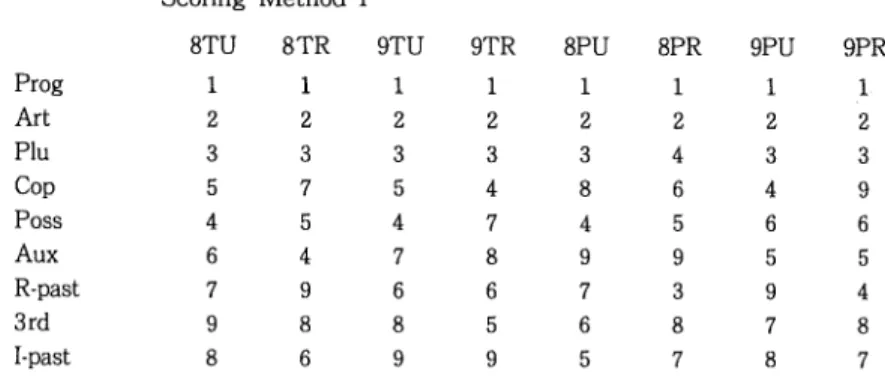
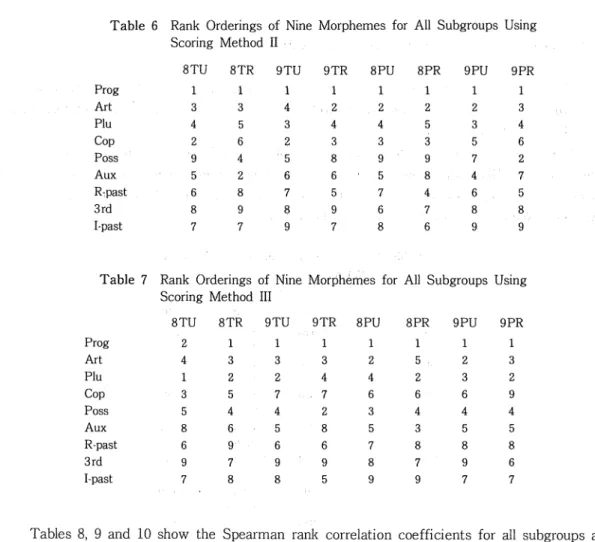
(22) Acquisition Order of English Morphemes. CHAPTER V : RESULTS AND DISCUSSION The subjects were sampled and stratified by three major variables: (1) grade, 8th graders [8]. and 9th graders [9) : (2) textbook, Total English CT] and Prince Euglish [P) and (3) location of school, urban [U] and rural [R] . I threw out "nonsense" replies. The number of "scorable" replies obtained in this study are. shown in Table.4(the upper row indicates the number of scorable replies and the lower sensible replies). The morphemes tested include Present Progressive, Article, Plural, Copula, Possessive, Auxiliary, Regular-Past, Irregular-Past and Third Person Singular.. Table 4. Numbers of Scorable and Sensible. Replies Scoring Method. n. I. in 1,226. Prog. 1,173. '1,205. Art. 1,296. 1,343. Plu. 1,332 1,588. 1,670. 1,697 2,139. 1,897. Cop. 1,389. 1,557 2,168. 1,637. 1,326. 733. Poss. Aux. 805. R-past. 818. 3rd. 917. I-past. 835. 831. 975. 964. 1,070. 978. 1,078. 1,001 1,760. 1,081. 1,205 1,435 1,496. 943. 1,610. 1,116. Tables 5, 6 and 7 show the rank orderings of nine English morphemes for all subgroups according to each scoring method:. Table 5 Rank Orderings of Nine Morphemes for All Subgroups Using Scoring Method. Prog Art. Plu. Cop Poss. Aux R-past. 3rd. I-past. I. 8TU. 8TR. 9TU. 9TR. 8PU. 8PR. 9PU. 9PR. 1 2 3 5 4 6 7 9 8. 1 2 3 7 5 4. I 2 3 5 4 7 6 8 9. 1 2 3 4 7 8 6 5 9. 1 2 3 8 4 9 7 6 5. 1 2 4 6 5 9 3 8 7. 1 2 3 4 6 5 9 7. 1 2 3 9 6 5 4 8 7. 9 8. 6. 8. 121.
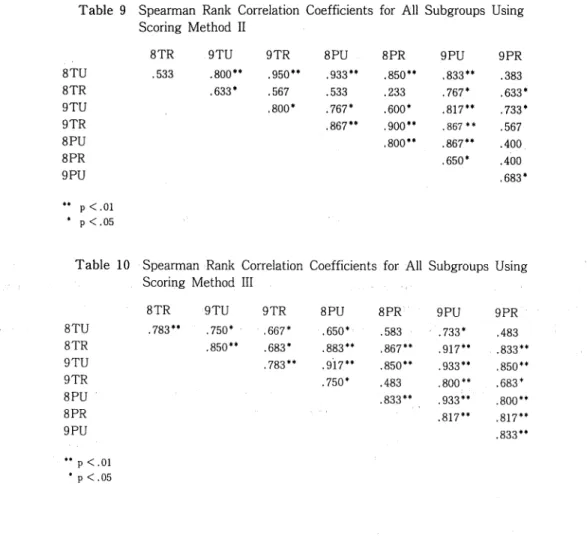
(23) Taka-Yoshi MAKING. Table 6 Rank Orderings of Nine Morphemes for All Subgroups Using. Scoring Method II 8TU. 8TR. 9TU. 9TR. 8PU. 8PR. 9PU. 9PR. 1 3 4 2 9 5 6 8 7. 1 3 5 6 4 2 8 9 7. 1 4. 1. 1 2 4 3 9 5 7 6 8. 1. 1 2 3 5 7 4 6 8 9. 1 3 4 6 2 7 5 8 9. Prog Art Plu Cop Poss. Aux R-past. 3rd I-past. 2. 4 3 8 6 5 9 7. 3. 2 5 6 7 8 9. 2. 5 3 9 8 4 7 6. Table 7 Rank Orderings of Nine Morphemes for All Subgroups Using. Scoring Method III. Prog Art Plu Cop Pass. 8TU. 8TR. 9TU. 9TR. 8PU. 8PR. 9PU. 9 PR. 2 4 1 3 5. 1 3 2 5 4 6 9 7 8. 1 3 2 7 4 5 6 9 8. 1 3 4 7 2 8 6 9 5. 1 2 4 6 3 5 7 8 9. 1 5 2 6 4 3 8 7 9. I 2 3 6 4 5 8. 1 3 2 9 4 5 8 6 7. Aux. 8. R-past. 6 9 7. 3rd I-past. 9. 7. Tables 8, 9 and 10 show the Spearman rank correlation coefficients for all subgroups ac-. cording to each method: Table 8 Spearman Rank Correlation Coefficients for All Subgroups Using. Scoring Method I. 8TU 8TR 9TU 9TR 8PU 8 PR 9PU " p<.01 • p < .05. 122. 8TR. 9TU. 9TR. 8PU. 8PR. 9PU. 9PR. .850". .967". .733*. .700*. .750*. .883". .733*. .733*. .533. .700*. .467. .867". .733*. .833". .717* ,. .833**. .833". .733*. .633*. .733*. .800". .567. .750*. .583. .683*. .500. .767* .567.
(24) Acquisition Order of English Morphemes. Table 9 Spearman Rank Correlation Coefficients for All Subgroups Using. Scoring Method II. 8 TO. 8TR 9TU 9TR 8PU 8PR 9PU. 8TR. 9TU. 9TR. 8PU. 8 PR. 9PU. 9 PR. .533. .800". .950". .933". .850". .833". .383. .633*. .567. .533. .233. .767*. .633*. .800*. .767*. .600*. .817". .733*. .867". .900". .867**. .567. .800". .867". .400. .650*. .400 .683*. p <.01 p <.05. Table 10 Spearman Rank Correlation Coefficients for All Subgroups Using. Scoring Method III 8TU 8TR 9TU 9TR 8PU 8 PR 9PU. 8TR. 9TU. 9TR. 8PU. 8 PR. 9PU. .783". .750*. .667*. .650*. .583. .733*. ,483. .850". .683*. .883". .867". .917**. .833". .783". .917". .850". .933". .850". .750'. .483. .800". .683'. .933". .800''*. .817". .817". .833". 9 PR. .833". " p <.01 • p<.05. For N = 9, the correlation coefficient must be .783 to be significant at the .01 level, and .600 at the .05 level, As can be seen in Tables 6, 7 and 8, twenty-two, twenty and twenty-five pairings correlated. significantly either at the .01 or the .05 level using scoring methods I, II and III, respectively, though some individual pairings (six, eight and three with respective scoring methods) did not attain correlations of statistical significance. This shows that there js a general homogeneity of morpheme orderings among all groups. Most groups exhibited similar orders in ranking the morphemes, in spite of the fact that they had different grade levels, textbooks, and urban/rural locations.. Now, we would like to discuss the results of the analysis in detail. First, our discussion will start with the relationship between the grades investigated. Table 11 shows the English proficiency of the two grades (8th and 9th).. 123.
(25) Taka-Yoshi MAKING. Table 11 Rate of Correct Responses of the Two Grades. (Scoring Method I) Order. 8th graders f9^. 9th graders W. Order. 1. 84.4. 88.4. 1. 2. 82.3. 85.4. 2. 3. 75.8. 81.0. 67.3. 68.7. 3 6 4 8 9 5 7. Prog Art Plu. 4 5 6 7. Pass. Cop R-past I-past. 8. Aux. 3rd. 9. 66.6. 72.8. 64.0. 65.3. 62.3. 63.9. 61.5. 69.7. 59.7. 66.5. We can see from Table 11 that on all the items the rate of correct responses increases from the. 8th grade to the 9th grade, though the orders change slightly. (However, see Table 13 below.) This evidence shows that students generally increase in proficiency as they advance in grades.. Table 12 is a list of the rank orderings of nine morphemes by grades for all subjects with the three scoring methods. Table 12 Rank Orders of Nine Morphemes by Grades for All Subjects Using Three Scoring Methods Method I. 8th 9th 1 2 3 5 4 8 6 9 7. Prog Art. Plu. Cop Poss. Aux R-past. 3rd I-past. 1 2 3 4 6 5 8 7 9. Method II 8th 9th 1 1 2 2 4 3 3 4 8 6 5 5 7 7 9 9 6 8. Method ffl 8th 9th 1 3. 1 2. 2. 3. 5 4 6 7 8. 6 4 5 7 9. The first null hypothesis to be tested for the present study is: There is no difference of acquisition order of the morphemes between Japanese 8th graders and 9th graders. Table 13 gives the Spearman rank correlation coefficients by grades:. Table 13 Spearman Rank Correlation Coefficients by Grades Method 1-8 th Method 11-8 th Method ffl-8th Method I-9th Method H-9th Method IH-9th " p<.01. 124. .783" .917' .950*.
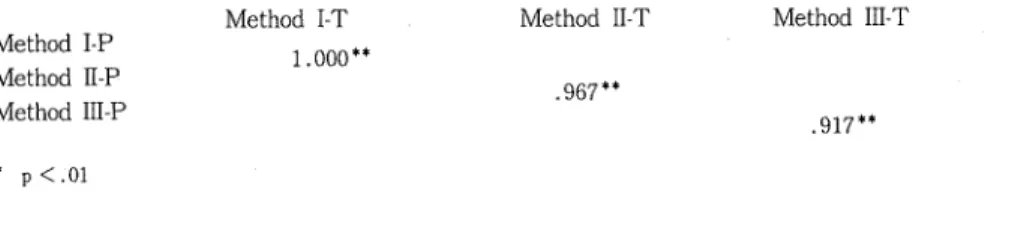
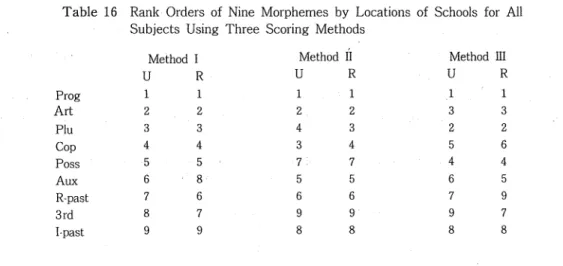
(26) Acquisition Order of English Morphemes. It is evident from Table 13 that all possible pairings of methods are significant at the .01 level. However, the rank orders changed little across scoring methods from the 8th grade to the 9th grade as can be seen in Table 11. We can conclude, consequently, that the amount of language instruction and/or exposure to English did not have much effect on the morpheme orderings.. Secondly, we will look at the differences between the two textbooks. Table 14 shows the rank orderings of nine morphemes by textbooks, regardless of grades and locations of schools:. Table 14 Rank Orders of Nine Morphemes by Textbooks for All Subjects Using Three Scoring Methods Method Prog Art. 2. Plu. 3 4 5 6 7 8 9. Cop Poss. Aux R-past. 3rd I-past. I p 1 2 3 4 5 6 7 8. T 1. Method II. Method Ill. T. p. T. 1. 1. 2. 2. 4 3 6 5 7 9 8. 3 4 7 5 6 9. 1 3 2 5 4 7 6. 9. 8. p 1 2. 3 6 4 5 7 8 9. 9. 8. Table 15 reveals the Spearman rank correlation coefficients by textbooks for subjects using the three scoring methods.. Table 15 Spearman Rank Correlation Coefficients by Textbooks Method I-T Method H-T Method ffl-T. Method!:p 1.000" Method. H-P. Method. „. m-P. „. p<.01. As can be seen in Table 15, textbooks also yield high correlations significant at the .01 level. We conclude that there is no difference of acquisition order of the morpbemes between Japanese adolescents using different textbooks. Thus, the second null hypothesis can be accepted for textbooks for all scoring methods. This was expected, since the textbooks orders themselves. correlated so highly (see Table 2). Thirdly, we will also note the relationship between the locations of schools. Table 16 gives the list of the rank orderings by locations of schools for all subjects:. 125.
(27) Taka-Yoshi MAKING. Table 16 Rank Orders of Nine Morphemes by Locations of Schools for All Subjects Using Three Scoring Methods Method II. Method I. u. R 1 2 3 4 5 8 6 7 9. 1 2 3 4 5 6 7 8 9. Prog. Art Plu. Cop Poss. Aux R-past. 3rd I-past. Method. u. R. u. 1. 1 2. 1 3 2 5 4 6 7 9 8. 2. 4 3 7 5 6 9 8. 3. 4 7 5 6 9 8. m. R 1 3 2 6 4 5 9 7 8. Table 17 shows the Spearman rank correlation coefficients by the locations of schools for all subjects: Table 17 Spearman Rank Correlation Coefficients by Locations of Schools for all Subjects Method I. u. Method I-R. Method H. u. Method HI. u. .950**. Method n-R. .983". Method m-R. '*•. " p<.01. For the locations of schools, all pairings were correlated significantly at the ,01 level. We conelude that there is no difference of acquisition order of the morphemes between Japanese adolescents in rural and urban schools. Finally, from the evidence above, we can state that there is a homogeneity of ordering morphemes across all subgroups. Subgroups showed very similar orders in ranking morphemes, in spite of differences in textbooks, grades and locations of schools. We should also compare the arrangements of grammatical morphemes in the two textbooks and the actual acquisition orders we obtained. Only eight morphemes were common to both textbooks. Table 18 gives the Spearman rank correlation coefficients by arrangements of items in the textbooks and the actual acquisition orders we found.. All these pairings had very low correlations and none of them reached any statistical significance even at the .05 level. That is, the arrangements of grammatical items in the textbooks seem to bear little relation to obtained acquisition orders.. One point which is very important at this stage is that, as can be seen in Table 12, there are very high correlation coefficients between the 8th and 9th graders. This evidence shows strong consistency though not invariability. Therefore, we may argue that the evidence for similar. 126.
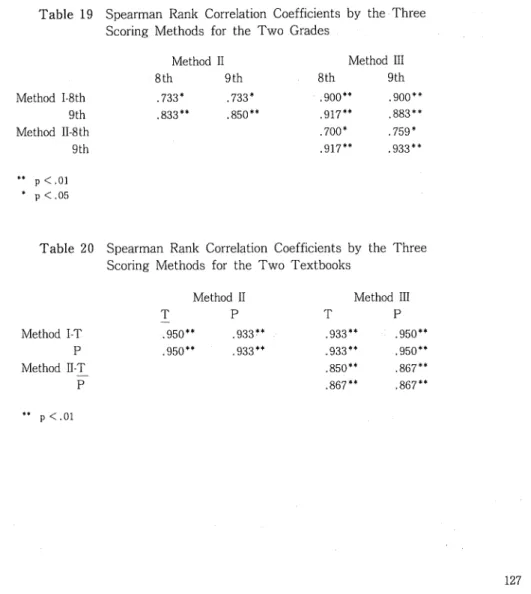
(28) Acquisition Order of English Morphemes. Table 18 Spearman Rank Correlation Coefficients by Arrangements According to Three Methods in Textbooks and Actual Acquisition Orders Orders of Acquisition. Arrangements in Textbooks. Total English Prince English i n in i n m Total English. .381 .179 .179 .452 .238 .286. Prince English. acquisition orders for the two grades supports the notion that there exists a consistent natural sequence in English morpheme acquisition, at least for Japanese junior high school students, as far as certain grammatical structures are concerned.. Tables 19, 20 and 21 show the Spearman rank correlation coefficients on the three scoring methods by each classification variable. Table 19 Spearman Rank Correlation Coefficients by the Three Scoring Methods for the Two Grades Method n. Method I-8th. 9th. Method HI. 8th. 9th. 8th. 9th. .733*. .733*. .900. .900". .833**. .850**. .917 «* .883". Method 11-8 th. .759*. .700. 9th. .917 ** .933". " p<.01 p <.05. Table 20 Spearman Rank Correlation Coefficients by the Three Scoring Methods for the Two Textbooks. T Method I-T. p. Method II-T. p. Method II. p. T. Method. m. p. .950. .933**. .933". .950. .950. .933". .933". .950. .850". .867. .867**. .867. " p<.01. 127.
図


+7

Outline
関連したドキュメント
The classical Ehresmann-Bruhat order describes the possible degenerations of a pair of flags in a linear space V under linear transformations of V ; or equivalently, it describes
An analogous procedure was used by the authors in an earlier paper, [2], to define order compatibility between a Cauchy structure and a partial order on X; the principal deviation
For any 2 -category (be it a priori tensored and cotensored or not) all notions of completeness and cocompleteness coincide: an order is order-cocomplete if and only if it
Let us suppose that the first batch of P m has top-right yearn, and that the first and second batches of P m correspond to cells of M that share a row.. Now consider where batch 2
In recent years, singular second order ordinary differential equations with dependence on the first order derivative have been studied extensively, see for example [1-8] and
We present a complete first-order proof system for complex algebras of multi-algebras of a fixed signature, which is based on a lan- guage whose single primitive relation is
In this paper, we investigate the existence of mild solutions on a com- pact interval to second order neutral functional differential and integrod- ifferential inclusions in
The proof of the main theorem relies on two preliminary results: existence of the solution to mixed problems for linear second-order systems with smooth coe ffi cients, and existence
