近年,癌化学療法や臓器移植の進歩に伴い免疫 低下による易感染性患者が増加し,深在性真菌感 染症の発生にも増加傾向がみられている。また, 深在性真菌感染症の予防や治療に使用されること が多いアゾール系抗真菌剤の耐性株または低感受 性株が臨床分離菌にみられつつあることも問題に なっている。抗真菌薬を適正に使用するためには, 臨床分離株の各種抗真菌薬に対する感受性を把握 しておくことも重要であると考える。そこで,今 回,我々は2001年から2007年の間に真菌性腹膜 炎から分離された真菌を用い,現在上市されてい る抗真菌薬7剤に対する感受性を測定したので報 告する。
真菌性腹膜炎症例から分離された
Candida
属に対する
抗真菌薬の薬剤感受性と真菌性腹膜炎のリスクファクター
のレビューおよびイトラコナゾールの臨床的
ブレイクポイントに関する検討
山岸由佳・寺田道徳・大木恵美子・三鴨廣繁
愛知医科大学大学院医学研究科感染制御学 (2009 年 2 月 27 日受付) 2001年1月から2007年6月に真菌性腹膜炎と診断された患者の腹水検体から分離したCandida属96株のitraconazole (ITCZ)およびその他抗真菌薬6薬剤に対する感受性を測 定し,in vitroに抗真菌活性を評価した。Candida属に対するMIC測定はClinical and Laboratory Standards Institute (CLSI) M27-A3に準拠した微量液体希釈法で実施した。抗 真菌薬は,amphotericin B (AMPH-B), fluconazole (FLCZ), itraconazole (ITCZ), micona-zole (MCZ), voriconamicona-zole (VRCZ), micafungin (MCFG)およびflucytosine (5-FC)を用いた。 Candida属96株の内訳は,C. albicans 37株(38%), C. glabrata 30株(31%), C. tropicalis 16株(17%), C. parapsilosis 13株 (14%)であった。薬剤感受性は,non-albicans Candida
に対して,概ねMCFG, VRCZ⬎ITCZ⬎FLCZの順であった。CLSIのブレイクポイント
に従うと,C. albicansではFLCZ耐性2株(5.4%), ITCZ耐性8株(21.6%), VRCZ耐性2株 (5.4%)を認めた。真菌性腹膜炎の症例においてITCZ静注薬で治療された16症例につい
てレトロスペクティブに,臨床効果について検討した結果,ITCZのMIC値が1mg/mL以
下は全例有効であったが,MIC値が2mg/mLでは無効例2例,有効例2例で,MIC値が
4mg/mL以上では無効であった。CLSI基準ではCandida属に対するITCZのブレイクポ イントは,S: ⬉0.125, S-DD: 0.25⬃0.5, R: ⭌1となっているが,自験例からはITCZのブレ
イクポイントをS: ⬉1, S-DD: 2, R: ⭌4のように設定するのが良いと考えられ,今後データ
I.
材料と方法
(1) 抗真菌薬の薬剤感受性 1. 臨床分離株 2001年1月から2007年6月の6年5ヵ月間に岐 阜大学医学部附属病院で真菌性腹膜炎と診断され た患者の腹水から分離された真菌96株を用いた。 真菌性腹膜炎の診断は,「深在性真菌症の診断・ 治療ガイドライン」1)を満たすものとした。 Can-dida属各菌種の同定は,アピ20Cオクサノグラム (bioMerieux Japan Ltd.)を用いた。 2. 使用抗真菌薬抗真菌薬は,amphotericin B(AMPH-B: Sigma Chemical Co., St. Louis, MO, USA), fluconazole (FLCZ: Pfizer, Groton, CT, USA),itraconazole (ITCZ: ヤンセンファーマ,東京),miconazole (MCZ: 持田製薬,東京),voriconazole (VRCZ: Pfizer, Groton, CT, USA),micafungin(MCFG:ア ステラス製薬,東京)およびflucytosine(5-FC: 和光純薬工業株式会社,東京)を使用した。
3. 感受性試験
Candida属に対するMICは,Clinical and Labo-ratory Standards Institute:CLSIが推奨する酵母の
感受性測定標準法M27-A32)に準拠した微量液体 希釈法を用いて測定した。摂種菌量は0.5⬃2.5⫻ 103CFU/mLとし,35°Cで48時間培養し,すべて の菌株について発育対照ウエルにおいて十分な発 育が認められた時点で,各ウエルの濁度をCLSI M27-A3の基準にしたがってスコア化(0⬃4)した。
MIC値の定義はM27-A3に準拠し,AMPH-Bお
よびMCFGはスコア0, 5-FC, FLCZ, ITCZ, MCZ およびVRCZはスコア2以下を示した最小薬剤濃 度とした。なお,精度管理株は,Candida parap-silosis ATCC 22019を用い,測定ごとに試験菌株 とまったく同じ条件で測定し,MIC測定範囲が CLSI M27-A3において設定されている範囲内に あることを確認した。 (2) イトラコナゾールの臨床的ブレイクポイン トに関する検討 今回検討対象としたCandida属96株のうち, 2006年12月以降にITCZ静注薬で治療された16 症例を抽出し,臨床効果について後方視的に検討 した。ITCZ投与により37°C未満への解熱を認 め,検出部位からの同真菌検出が陰性化したもの を臨床的に有効と判定した。
II.
結果
(1) 抗真菌薬の薬剤感受性 真菌性腹膜炎患者の腹水検体から分離された 真菌96株は, すべてCandida属で, 菌種別にみ る とCandida albicans 37株(38.5%), Candida glabrata 30株 (31.3%), Candida tropicalis 16株 (16.7%), Candida parapsilosis 13株(13.5%)で あ り ,Candida non-albicansの 分 離 頻 度 は59/96 (61.5%)であった。 次に,今回分離された腹水由来のCandida属の 菌種別に,現在上市されている抗真菌薬7種類の MIC値を測定した。Candida属の菌種別に各抗真
菌 薬 のMIC値 をTable 1に 示 す 。non-albicans
Candidaに対する薬剤感受性は,MCFGとVRCZ
は良好な抗真菌活性を示し,同じアゾール系でも
ITCZはFLCZよりも良好な抗真菌活性を示した
(MCFG, VRCZ⬎ITCZ⬎FLCZ)。
次に,CLSI (CLSI M27-A3, 2008)の感受性に 従い,各抗真菌薬に対する真菌別の薬剤感受性を 検討した。C. albicans 37株では,FLCZのMIC 値 ( 幾 何 平 均 値0.799mg/mL, MIC50 0.5mg/mL, MIC90 8mg/mL) は や や 高 値 を 示 し ,MIC値 ⭌64mg/mLのFLCZ耐性株を2株(5.4%)認めた。 FLCZ耐性株C. albicans 2株に対するその他の各
抗真菌薬のMIC値は,AMPH-B, 5-FC, MCFGが MIC値⬉1mg/mLと良好な抗真菌活性であった が ,ITCZ 32mg/mL, MCZ 2⬃4 mg/mL, VRCZ 8⬃16mg/mLと耐性を示した。また,ITCZに耐性 株は8株(21.6%),VRCZ耐性株は2株(54.1%)認 めた。 C. glabrata 30株 で は ,FLCZの MIC値 は 1⬃8mg/mL( 幾 何 平 均 値 2.297mg/mL, MIC50 2mg/mL, MIC908mg/mL)と高値であった。また, ITCZ耐性株は8株(26.7%)認めたが,その他の各 抗真菌薬のMIC値は治療域内にあった。 C. tropicalis 16株では,FLCZに対して低感受 性 株 が2株 (MIC値 は そ れ ぞ れ16mg/mL, 32 mg/mL)認められた。また,ITCZに耐性を2株 (12.5%) 認めた。その他の各抗真菌薬は強い抗真 菌力(MIC値の幾何平均値0.125⬃0.917mg/mL) を示した。 C. parapsilosis 13株では,CLSIのブレイクポイ ン ト に 従 う と ,I T C Zに1株 低 感 受 性( M I C ; 0.25mg/mL)を認めた。VRCZのMICは,すべて の 株 で⬉0.125m g/mLで あ っ た 。MCFGのC. parapsilosisに対するMIC値は,C. parapsilosis以 外のCandida属と比して,0.5⬃2mg/mLと高値で あった。
(2) イトラコナゾールの臨床的ブレイクポイン
トに関する検討
ITCZに対するMIC値が1mg/mL以下の症例は Table 1. MICs of antifungal agents for clinical isolates of Candida species.
AMPH-B: amphotericin B,5-FC: flucytosine, FLCZ: fluconazole, ITCZ: itraconazole, MCZ: miconazole, MCFG: micafungin, VRCZ: voriconazole.
全例有効であったが,MIC値が2mg/mLでは無効 例2例(C. albicans, C. tropicalis)と有効例2例(C. albicans, C. glabrata)を認め,MIC値4mg/mL以 上では無効例1例(C. glabrata)であった(Table 2)。
III.
考察
腹膜炎は,その炎症反応過程により一次性,二 次性,三次性に分類される。一次性は腸管損傷を 伴わない腹膜炎である。二次性腹膜炎は,最も多 い腹膜炎で,腸管穿孔などの消化管損傷を伴う腹 膜炎と定義される。三次性腹膜炎は,二次性腹膜 炎の適切な初期治療後にみられる持続性または反 復性腹膜炎として考えられている3)。特に,二次 性では外科やICUなどで頻度が高くみられ4),Candida属は院内感染型腹膜炎(nosocomial peri-Table 2. Association between MIC value and clinical efficacy in patients with Candida peritonitis
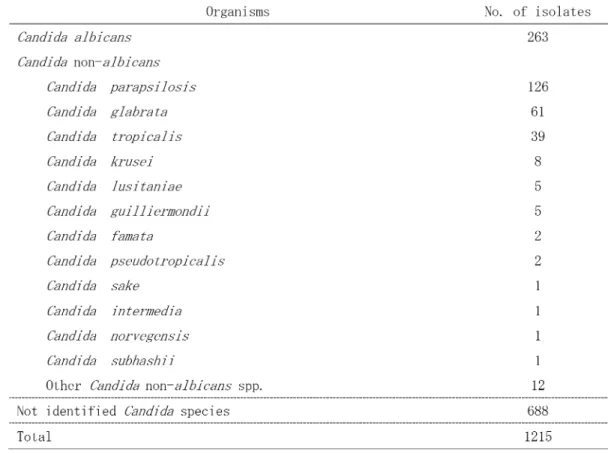
tonitis)の原因微生物として特に重要である5,6)。ま た,腹膜炎患者は在院日数やICU滞在期間,人 工換気の期間を長くする要因でもある7)。腹膜炎 に占める真菌の割合は,40%にまで上ると報告さ れており6,8,9),特に,Candida性腹膜炎では,無 治療の場合,死亡率が60⬃70%と高く10),また適 切な抗真菌治療をしても死亡率は,しばしば50% 以上と高い場合があるため,注目すべき病態と推 察される11⬃16)。 1949年⬃2008年に報告されたカンジダ性腹膜 炎では,「腹膜炎(peritonitis)」および「Candida」 をキーワードに,PubMedを用いて検索された352 文献のうち,英語および日本語による論文で,腹 膜炎の原因真菌がCandida属であり,患者背景が 調査可能であった原著論文と症例報告,167文献 1210症例を検討した5,9,11,17⬃179)。その結果,成人 が1090症例, 新生児を含む小児が120症例で あった。カンジダが検出された場合の病原性につ いては,検索文献ごとに従い,明らかなコロニー ゼーションである場合や,腹水から検出されたが, 無症候性である場合,明らかに病原性が考えられ にくい場合は除外した。その結果,重複例を含む カンジダ1215株のうち,分類可能であった
Can-dida属527株は,C. albicans 49.9%, non-albicans Candida 50.1%であり,non-alibicans Candidaは, C. parapsilosis 126株47.7%,C. glabrata 61株 23.1%,C. tropicalis 39株14.8%の順に多く検出
されていた(Table 3)。今回検討した真菌性腹膜炎
患 者 の 腹 水 由 来 株 で は ,C. albicansの 分 離 は 38.5%にとどまっており,non-albicans Candida
Table 3. Causative organisms isolated from patients with Candida peritonitis according to the previ-ous references.5,9,11,17⬃179)
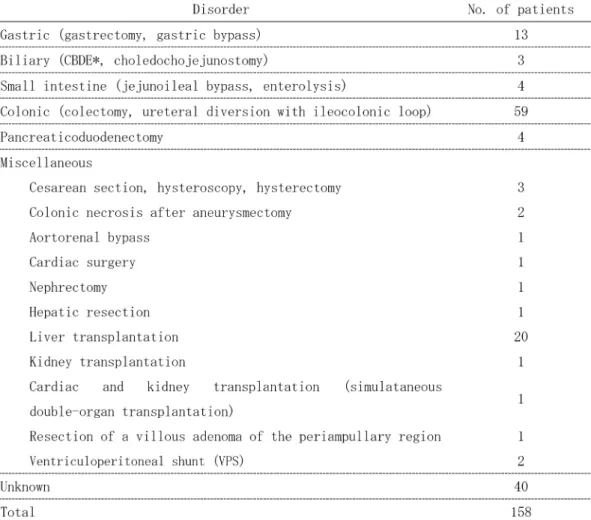
の分離頻度が高くなっていた結果であった。また, 透析関連カンジダ腹膜炎は,570例,術後カンジ ダ腹膜炎は,158例で内訳は腸管術後が最多で あった(Table 4, 5)。 腹腔内から真菌が検出された場合には予後不良 因子となり術後合併症が増加するという報告があ る一方で,その病原性や,抗真菌薬への投与の必 要性などについては未だ議論の多いところであ る180⬃182)。 深在性真菌症の病態には,原因真菌の種類,発 症病型,宿主の基礎疾患や医療的介入状態などの 多様な条件が関与しているため,単純に画一的な 抗真菌薬療法を実施するわけにはいかない。そこ で,日本でも2003年3月に「深在性真菌症の診 断・治療ガイドライン 第1版」1)が提唱され,深 在性真菌症の診断レベルに応じて行う標的治療, 経験的治療,予防投与に推奨される抗真菌薬が提 示された。2007年2月には,その後に明らかと なったエビデンスに基づいて,さらに治療選択に 第1版提唱後に臨床導入された抗真菌薬や新しい 剤型を含めた改訂版183)が提唱された。近年では, 深在性真菌症療法において抗真菌薬の種類や用 法・用量を適切に選択する有用な手がかりとし て,薬力学(pharmacodynamics: PD)の概念も注目
されている。そこで,今回,新規の抗真菌薬を含 めた抗真菌薬について真菌臨床分離株の感受性を 測定するとともに,PDの観点も踏まえて深在性 真菌症に対する適切な抗真菌薬の治療について考 察した。 今回,我々は,腹水由来のCandida属を用いて 7種類の抗真菌薬のMICを測定した。「深在性真 菌症の診断・治療ガイドライン2007」で外科領 域,救急・集中治療領域,産婦人科領域の経験 的 治 療 に お け る 第1選 択 薬 と し て 推 奨 さ れ る MCFGとFLCZのMICは,C. parapsilosisについ てはMCFGの幾何平均値が1.113mg/mLと高値で あったが,これ以外の菌種ではMICは概ね低値に 分布しており強い抗菌力を示した。MCFG 50 mg をヒトに投与した時の最高血中濃度は3.36⫾0.28 mg/mL (Mean⫾S.D.)と報告されており184),今回 測定した臨床分離株に対するMICを上回ってい る。一方で,MCFGはヒト血清またはヒト血清ア ルブミンを添加した培地では,MICは非添加時に 比 べ て50⬃100倍 程 度 増 加 す る と の 報 告 が あ る185,186)。MCFGは血清蛋白結合率が99.8%と非 常に高い184)ため,血清を添加すると血清アルブ ミンとの高率な結合によりMIC値が上昇すると考 えられている185,186)。このように,血清添加によ りMIC値が上昇するという事実を考慮すると,今 回測定したMIC値を実際の標的組織における MCFGのMIC値としてみなすことは難しく,in vitro試験から得られる情報の限界といえる。 次に,FLCZのMIC値をみるとC. albicansに対 する値はやや高く分布し,耐性株も37株中2株 (5.4%)に認められた。FLCZ耐性のC. albicansに 対 す る 各 抗 真 菌 薬 の 抗 菌 力 は ,ITCZ, MCZ, VRCZでも弱い抗菌力を示しており,PFALLER ら187)のMCFGに耐性でITCZに対し感受性である 結果と大きく異なっていた(自験例:ITCZ⭌32, PFALLERら:0.12⬃2mg/mL)。また,臨床での分離 頻度が増加しているnon-albicans Candidaのうち
C. glabrataに対するMICは高値で,C. tropicalis
の2株に対して低感受性を示した。その他の薬剤 のAMPH-B, 5-FC, ITCZ, MCZ, VRCZでは,臨床 分離株の各菌種に対してMICは比較的低値に分 布し,抗菌力にバラツキが少ないことが確認され た。ただし,ITCZ, MCZ, VRCZは,FLCZ耐性 のC. albicans 2株に対するMICは高値を示した。 近年,FLCZ耐性のC. glabrataやCandida krusei など一部のnon-albicans CandidaにはFLCZは抗 真菌活性が低いという報告188,189)が認められるが, 自験例ではnon-albicans Candidaに対するFLCZ の抗真菌活性は比較的良好であった。 本来,抗真菌薬のブレイクポイントは,侵襲性 カンジダ症の中で最も頻度の高いカンジダ血症に ついて検討されるべきかもしれないが,カンジダ 腹膜炎の予後がよいとはいえないこと,カンジダ 血症へ移行する可能性があること,組織内(この 場合腹水)濃度の測定が困難であることなどの理 由から,自験例では症例数は少ないものの,真菌 性腹膜炎から分離されたカンジダ属に対する各種 抗真菌薬の薬剤感受性試験の検討された報告が少 ないことから,各抗真菌薬に設定されているブレ イクポイントについて検討した。すると,ITCZ のブレイクポイントに問題点があると思われた。 ITCZ はステロール14-脱メチル化酵素阻害によ るエルゴステロール合成を阻害するという作用機 序を有する抗真菌薬である。日本では1993年7月 から,経口カプセル製剤(イトリゾールカプセ ル®)が,2006年7月から内溶液(イトラコナ ゾール®)が臨床使用され,2006年12月には,注 射用製剤が使用可能となった。深在性真菌症に対 するITCZのCandida属に対する抗菌活性は良好 であるという報告が多い188,190⬃192) (Table 6)。ま た,PDの観点からみると,脂溶性であるITCZは 血漿から各組織への移行が良好で,組織からの消 失も緩やかであると報告されている193)。したがっ て,ITCZを深在性真菌感染症療法に用いた場合,
標的組織における薬剤濃度は臨床分離株に対する
MIC値を上回る濃度で長時間維持されることが期
待できる。Candida属に対するITCZのブレイク
ポイントは,susceptible (S)が0.125以下,
suscep-tible-dose dependent (S-DD) が0.25⬃0.5, resistant (R)が1以上である(Table 7, 8)。しかし,自験例 では,ITCZに対するMIC値が1mg/mL以下の症
例は全例有効であったが,MIC値が2mg/mLでは
Table 6. In vitro susceptibility of Candida species to itraconazole in comparison with current large multicenter surveys on invasive candidiasis.188,191⬃193)
Susceptibility test performed by either CLSI or EUCAST recommended methods. n: number of isolates, MIC50, MIC90(mg/mL)
無効例と有効例を認め,MIC値が4mg/mL以上で は無効であった。Candida属の菌種による詳細な 検討が必要かもしれないが,少なくともPK-PD理 論を十分臨床応用するためには,薬剤感受性と ITCZの使用例の臨床成績からは,Sを1以下, S-DDを2,Rを4以上,のように設定するのが理 想と考えられ,ITCZのブレイクポイントを見直 すために,今後さらに症例を蓄積し検討する必要 があると思われた。「深在性真菌症の診断・治療 ガイドライン2007」183)におけるITCZの位置づけ は,標的治療の難治,血圧低下例など第二選択薬 に位置づけられているが,今回の検討から,ITCZ のCandida属に対する抗菌活性はnon-albicans Candidaを含めて良好であるうえに,同じアゾー ル系薬であるFLCZと比べると,ITCZは抗真菌 スペクトルが広い。今後もデータを蓄積して,深 在性カンジダ症, 特に真菌性腹膜炎における ITCZの推奨レベルを再考することも必要と考え られる。
引用文献
1) 深在性真菌症のガイドライン作成委員会編: 深在性真菌症の診断・治療ガイドライン第1 版 。p. 11, 医 歯 薬 出 版 株 式 会 社 , 東 京 , 20032) Clinical and Laboratory Standards Institute: Reference method for broth dilution antifun-gal susceptibility testing of yeasts; approved standard-Third edition M27-A3. Clinical and Laboratory Standards Institute, Wayne, Pa. 22(15), 2008
3) BLOT, S. & J. J. DEWAELE: Critical issues in
the clinical management of complicated intra-abdominal infections. Drugs 65: 1611⬃1620, 2005
4) LAMME, B.; M. A. BOERMEESTER, E. J. BELT,
et al.: Mortality and morbidity of planned relaparotomy versus relaparotomy on de-mand for secondary peritonitis. Br. J. Surg. 91: 1046⬃1054, 2004 T ab le 8 . Classification judged b y CLSI breakpoints (M27-S3, 2008). 2) Susceptib le (S), susceptib
le-dose dependent (S-DD), inter
mediate (I), resistant (R), nonsusceptib
5) MONTRAVERS, P.; H. DUPONT, R. GAUZIT, et
al.: Candida as a risk factor for mortality in peritonitis. Crit. Care Med. 34: 646⬃652, 2006
6) SANDVEN, P.; H. QVIST, E. SKOVLUND, et al.:
Significance of Candida recovered from in-traoperative specimens in patients with intra-abdominal perforations. Crit. Care Med. 30: 541⬃547, 2002
7) LAMME, B.; M. A. BOERMEESTER, E. J. BELT,
et al.: Mortality and morbidity of planned relaparotomy versus relaparotomy on de-mand for secondary peritonitis. Br. J. Surg. 91: 1046⬃1054, 2004
8) DUPONT, H.; A. BOURICHON, C. PAUGAM
-BURTZ, et al.: Can yeast isolation in
peri-toneal fluid be predicted in intensive care unit patients with peritonitis ? Crit. Care Med. 31: 752⬃757, 2003
9) EGGIMANN, P.; P. FRANCIOLI, J. BILLE, et al.:
Fluconazole prophylaxis prevents intra-abdominal candidiasis in high-risk surgical patients. Crit. Care Med. 27: 1066⬃1072, 1999
10) NATHENS, A. B.; O. D. ROTSTEIN & J. C.
MARSHALL: Tertiary peritonitis: clinical
fea-tures of a complex nosocomial infection. World J. Surg. 22: 158⬃163, 1998
11) SOLOMKIN, J. S.; A. B. FLOHR, P. G. QUIE, et
al.: The role of Candida in intraperitoneal infections. Surgery 88: 524⬃530, 1980 12) CALANDRA, T.; J. BILLE, R. SCHNEIDER, et al.:
Clinical significance of Candida isolated from peritoneum in surgical patients. Lancet 16: 1437⬃1440, 1989
13) ALDEN, S. M.; E. FRANK, L. FLANCBAUM:
Ab-dominal candidiasis in surgical patients. Am. Surg. 55: 45⬃49, 1989
14) MONTRAVERS, P.; R. GAUZIT, C. MULLER, et
al.: Emergence of antibiotic-resistant bacte-ria in cases of peritonitis after intraabdomi-nal surgery affects the efficacy of empirical antimicrobial therapy. Clin. Infect. Dis. 23: 486⬃494, 1996
15) DUPONT, H.; C. PAUGAM-BURTZ, C. MULLER
-SERIEYS, et al.: Predictive factors of
mortal-ity due to polymicrobial peritonitis with Candida isolation in peritoneal fluid in criti-cally patients. Arch. Surg. 137: 1341⬃1346, 2002
16) 三鴨廣繁,山岸由佳:深在性真菌症⬃新ガ
イドラインと最新知見 外科領域の深在性 真菌症。医学のあゆみ225: 237⬃242, 2008 17) NODAIRA, Y.; N. IKEDA, K. KOBAYASHI, et al.:
Risk factors and cause of removal of peri-toneal dialysis catheter in patients on contin-uous ambulatory peritoneal dialysis. Adv. Perit. Dial. 24: 65⬃68, 2008
18) ADAM, H.; M. GROENEWALD, S. MOHAN, et
al.: Identification of a new species, Candida subhashii, as a cause of peritonitis. Med. Mycol. 16: 1⬃7, 2008
19) PRAKASH, A.; D. SHARMA, A. SAXENA, et al.:
Effect of Candida infection on outcome in patients with perforation peritonitis. Indian J. Gastroenterol. 27: 107⬃109, 2008 20) GUCLU, E.; Z. SOYPACACI, M. YILDIRIM, et al.:
First case of continuous ambulatory peri-toneal dialysis peritonitis due to Candida sake. Mycoses Jun. 21 [Epub ahead of print], 2008
21) LIANG, C. C.; J. T. FANG, K. H. CHEN, et al.:
Candida parapsilosis peritonitis compli-cated with infected pancreatic pseudocysts in a peritoneal dialysis patient: a challenge for nephrologists. Clin. Nephrol. 69: 46146⬃46143, 2008
22) RAMPRABAHAR, M.; M. SIVAKUMAR, V. CHAN -DRASEKARAN, et al.: Peritoneal dialysis in a
patient with neurogenic bladder and chronic kidney disease with ventriculoperitoneal shunt. Blood Purif. 26: 274⬃278, 2008 23) PREDARI, S. C.; A. N. DEPAULIS, D. VERÓN, et
al.: Fungal peritonitis in patients on peri-toneal dialysis: twenty five years of experi-ence in a teaching hospital in Argentina. Rev. Argent. Microbiol. 39: 213⬃217, 2007 24) WONG, P. N.; K. Y. LO, G. M. TONG, et al.:
Treatment of fungal peritonitis with a com-bination of intravenous amphotericin B and
oral flucytosine, and delayed catheter re-placement in continuous ambulatory peri-toneal dialysis. Perit. Dial. Int. 28: 155⬃ 162, 2008
25) CAT, T. B.; W. CHARASH, J. HEBERT, et al.:
Po-tential influence of antisecretory therapy on the development of Candida-associated intraabdominal infection. Ann. Pharma-cother. 42: 185⬃191, Epub 2008 Jan. 22, 2008
26) TARIF, N.: Candida lusitaniae peritonitis in
a chronic ambulatory peritoneal dialysis patient. Saudi. J. Kidney Dis. Transpl. 15: 170⬃173, 2004
27) JANAKIRAMAN, H.; G. ABRAHAM, M. MATHEW,
et al.: Relapsing peritonitis due to co-infec-tion with Mycobacterium triviale and Can-dida albicans in a CAPD patient. Perit. Dial. Int. 27: 311⬃313, 2007
28) ROSA, N. G.; S. SILVA, J. A. LOPES, et al.:
Fungal peritonitis in peritoneal dialysis patients: Is previous antibiotic therapy an essential condition ? Mycoses 50: 79⬃81, 2007
29) BOER, W. H.; J. M. VAN AMPTING& P. VOS:
Successful treatment of eight episodes of Candida peritonitis without catheter re-moval using intracatheter administration of amphotericin. B. Perit. Dial. Int. 27: 208⬃210, 2007
30) CHEUNG, C.; Y. GUO, P. GIALANELLA, et al.:
Development of candidemia on caspofungin therapy: a case report. Infection 34: 345⬃ 348, 2006
31) RAAIJMAKERS, R.; C. SCHRÖDER, L. MONNENS,
et al.: Fungal peritonitis in children on peri-toneal dialysis. Pediatr. Nephrol. 22: 288⬃ 293, 2007
32) RODIGHIERO, M. P.; R. DELL’AQUILA, M.
BONELLO, et al.: Successful use of sodium
hypochlorite pack plus systemic and local antibiotic therapy for the treatment of Pseudomonas infection of peritoneal dialysis catheter exit-site. Contrib. Nephrol. 154: 125⬃128, 2007
33) FELGUEIRAS, J.; G. DEL PESO, A. BAJO, et al.:
Risk of technique failure and death in fungal peritonitis is determined mainly by duration on peritoneal dialysis: single-center experi-ence of 24 years. Adv. Perit. Dial. 22: 77⬃ 81, 2006
34) DAS, R.; E. VAUX, L. BARKER, et al.: Fungal
peritonitis complicating peritoneal dialysis: report of 18 cases and analysis of outcomes. Adv. Perit. Dial. 22: 55⬃59, 2006
35) SCHEELE, J. & P. KUJATH: Candida peritonitis
in a patient with necrotising cholecystitis and pancreatitis. Mycoses 49: 340⬃342, 2006
36) CHEN, K. H.; C. T. CHANG, C. C. YU, et al.:
Candida parapsilosis peritonitis has more complications than other Candida peritonitis in peritoneal dialysis patients. Ren. Fail. 28: 241⬃246, 2006
37) KOCH, M.; R. TRAPP& M. GOEPEL:
Success-ful maintenance of continuous ambulatory peritoneal dialysis in a patient after fungal peritonitis and dialysate leakage. Clin. Nephrol. 65: 294⬃298, 2006
38) SRIDHAR, A. V.; S. NICHANI, D. LUYT, et al.:
Candida peritonitis: a rare complication fol-lowing early dislodgement of percutaneous endoscopic gastrostomy tube. J. Paediatr. Child. Health 42: 145⬃146, 2006
39) GUPTA, A.; H. MI, C. WROE, et al.: Fatal
Candida famata peritonitis complicating sclerosing peritonitis in a peritoneal dialysis patient. Nephrol. Dial. Transplant. 21: 2036⬃2037, 2006
40) MONECKE, S.; K. HOCHAUF, B. GOTTSCHLICH,
et al.: A case of peritonitis caused by Rhizo-pus microsporus. Mycoses 49: 139⬃142, 2006
41) FOURTOUNAS, C.; M. MARANGOS, P. KALLIAK -MANI, et al.: Treatment of peritoneal dialysis
related fungal peritonitis with caspofungin plus amphotericin B combination therapy. Nephrol. Dial. Transplant. 21: 236⬃237, 2006
et al.: Successful treatment of Candida glabrata peritonitis with fluconazole plus flucytosine in a premature infant following in vitro fertilization. Eur. J. Clin. Microbiol. Infect. Dis. 24: 704⬃705, 2005
43) COATES, E. W.; M. G. KARLOWICZ, D. P.
CROITORU, et al.: Distinctive distribution of
pathogens associated with peritonitis in neonates with focal intestinal perforation compared with necrotizing enterocolitis. Pediatrics 116: e241⬃e246, 2005
44) 橋本ヒロコ, 守屋利佳, 鎌田貢壽, 他:
Candida parapsilosisによる重篤なCAPD関 連腹膜炎にミカファンギンの投与が奏功した
透析患者の1例。感染症学雑誌79: 195⬃
200, 2005
45) THOMAS, D. W.; P. MUNUSWAMY, K. ADU
-POKU, et al.: Candida albicans peritonitis in
a patient with Felty’s syndrome. J. Clin. Pathol. 58: 432⬃433, 2005
46) 石田健一郎, 柚原一哉, 蟹本雄右, 他:
CAPD患者に発症した真菌性精索膿瘍の1
例。泌尿器科紀要51: 37⬃39, 2005
47) ROILIDES, E.; E. FARMAKI, J. EVDORIDOU, et
al.: Neonatal candidiasis: analysis of epi-demiology, drug susceptibility, and molecu-lar typing of causative isolates. Eur. J. Clin. Microbiol. Infect. Dis. 23: 745⬃750, 2004 48) KLEINPETER, M. A.: Successful treatment of
Candida infections in peritoneal dialysis pa-tients: case reports and review of the litera-ture. Adv. Perit. Dial. 20: 58⬃61, 2004 49) NAKAMOTO, H.; Y. HASHIKITA, A. ITABASHI, et
al.: Changes in the organisms of resistant peritonitis in patients on continuous ambula-tory peritoneal dialysis. Adv. Perit. Dial. 2004; 20: 52⬃57, 2004
50) IINUMA, Y.; K. SENDA, N. FUJIHARA, et al.:
Surgical site infection in living-donor liver transplant recipients: a prospective study. Transplantation 78: 704⬃709, 2004
51) CHOI, S. H.; Y. SOOKIM, J. W. CHUNG, et al.:
Clinical significance of untreated Candida species isolated from ascites in cirrhotic pa-tients. Scand. J. Infect. Dis. 36: 649⬃655,
2004
52) CHEN, C. M.; M. W. HO, W. L. YU, et al.:
Fungal peritonitis in peritoneal dialysis pa-tients: effect of fluconazole treatment and use of the twin-bag disconnect system. J. Microbiol. Immunol. Infect. 37: 115⬃120, 2004
53) VARGEMEZIS, V.; P. PASSADAKIS, V. LIAKOPOU -LOS, et al.: Fungal colonization of peritoneal
catheter with persistently sterile cloudy effluent, in the absence of clinical findings of fungal peritonitis. Perit. Dial. Int. 24: 81⬃84, 2004
54) DÖNMEZ, O.; S. ALADAG, N. CIGERDELEN, et
al.: Outcome in children on chronic peri-toneal dialysis. Adv. Perit. Dial. 19: 269⬃ 272, 2003
55) PRASAD, K. N.; N. PRASAD, A. GUPTA, et al.:
Fungal peritonitis in patients on continuous ambulatory peritoneal dialysis: a single cen-tre Indian experience. J. Infect. 48: 96⬃101, 2004
56) MANZANO-GAYOSSO, P.; F. HERNÁNDEZ
-HERNÁNDEZ, L. J. MÉNDEZ-TOVAR, et al.:
Fun-gal peritonitis in 15 patients on continuous ambulatory peritoneal dialysis (CAPD). My-coses 46: 425⬃429, 2003
57) ROBERTSON, N. J.; J. KUNA, P. M. COX, et al.:
Spontaneous intestinal perforation and Can-dida peritonitis presenting as extensive necrotizing enterocolitis. Acta. Paediatr. 92: 258⬃261, 2003
58) BIBASHI, E.; D. MEMMOS, E. KOKOLINA, et al.:
Fungal peritonitis complicating peritoneal dialysis during an 11-year period: report of 46 cases. Clin. Infect. Dis. 36: 927⬃931, 2003
59) ISLAM, S.; A. K. ZAIDI & J. WILSON:
Peri-toneal infection with multiple species of Candida: a case report. Surg. Infect. (Larchmt.) 3: 35⬃37, 2002
60) HAWKINS, J. L. & L. M. BADDOUR: Candida
lusitaniae infections in the era of flucona-zole availability. Clin. Infect. Dis. 36: e14⬃ e18, 2003
61) DUPONT, H.; C. PAUGAM-BURTZ, C. MULLER
-SERIEYS, et al.: Predictive factors of
mortal-ity due to polymicrobial peritonitis with Candida isolation in peritoneal fluid in criti-cally ill patients. Arch. Surg. 137: 1341⬃ 1346, 2002
62) AKMAN, I.; S. IMAMO ˇGLU, M. DEMIRKOL, et
al.: Neonatal onset propionic acidemia with-out acidosis: a case report. Turk. J. Pediatr. 44: 339⬃342, 2002
63) LEE, S. C.; C. P. FUNG, H. Y. CHEN, et al.:
Candida peritonitis due to peptic ulcer per-foration: incidence rate, risk factors, progno-sis and susceptibility to fluconazole and am-photericin B. Diagn. Microbiol. Infect. Dis. 44: 23⬃27, 2002
64) KAITWATCHARACHAI, C.: Candida
parapsilo-sis peritonitis in patients on CAPD. Myco-pathologia 154: 181⬃184, 2002
65) CINAR, S.; A. NEDRET KOÇ, H. TAS¸KAPAN, et
al.: Case report. Candida lusitaniae peri-tonitis in a patient on continuous ambulatory peritoneal dialysis. Mycoses 45: 120⬃122, 2002
66) LEDERMANN, S. E.; L. SPITZ, J. MOLONEY, et
al.: Gastrostomy feeding in infants and chil-dren on peritoneal dialysis. Pediatr. Nephrol. 17: 246⬃250, 2002
67) KLEINPETER, M. A. & A. A. BUTT: Non
Can-dida albicans fungal peritonitis in continu-ous ambulatory peritoneal dialysis patients. Adv. Perit. Dial. 17: 176⬃179, 2001 68) TANAKA, M.; T. ONO, T. TAKEDA, et al.: A
case of Canadian peritonitis followed by me-diastinitis after esophageal perforation in peritoneal dialysis patient. Perit. Dial. Int. 21: 316, 2001
69) CHENG, V. C.; W. K. LO, P. C. WOO, et al.:
Polymicrobial outbreak of intermittent peri-toneal dialysis peritonitis during external wall renovation at a dialysis center. Perit. Dial. Int. 21: 296⬃301, 2001
70) NAIR, S.; K. S. KUMAR, P. SACHAN, et al.:
Spontaneous fungal peritonitis (Candida glabrata) in a patient with cirrhosis. J. Clin.
Gastroenterol. 32: 362⬃364, 2001
71) WANG, A. Y.; A. W. YU, P. K. LI, et al.:
Fac-tors predicting outcome of fungal peritonitis in peritoneal dialysis: analysis of a 9-year experience of fungal peritonitis in a single center. Am. J. Kidney Dis. 36: 1183⬃1192, 2000
72) BOND, S.; D. L. STEWART & R. W. BENDON:
Invasive Candida enteritis of the newborn. J. Pediatr. Surg. 35: 1496⬃1498, 2000
73) GADALLAH, M. F.; A. TAMAYO, M. SANDBORN,
et al.: Role of intraperitoneal urokinase in acute peritonitis and prevention of catheter loss in peritoneal dialysis patients. Adv. Perit. Dial. 16: 233⬃236, 2000
74) WARADY, B. A.; M. BASHIR & L. A.
DONALDSON: Fungal peritonitis in children
receiving peritoneal dialysis: a report of the NAPRTCS. Kidney Int. 58: 384⬃389, 2000 75) MIKAMO, H.; Y. SATO, Y. HAYASAKI, et al.:
Current status and fluconazole treatment of pelvic fungal gynecological infections. Chemotherapy 46: 209⬃212, 2000
76) WONG, P. N.; S. K. MAK, K. Y. LO, et al.: A
retrospective study of seven cases of Candida parapsilosis peritonitis in CAPD patients: the therapeutic implications. Perit. Dial. Int. 20: 76⬃79, 2000
77) LOCATELLI, A. J.; G. M. MARCOS, M. G.
GÓMEZ, et al.: Comparing peritonitis in
con-tinuous ambulatory peritoneal dialysis pa-tients versus automated peritoneal dialysis patients. Adv. Perit. Dial. 15: 193⬃196, 1999
78) MONTANE, B. S.; I. MAZZA, C. ABITBOL, et
al.: Fungal peritonitis in pediatric patients. Adv. Perit. Dial. 14: 251⬃254, 1998 79) BLOWEY, D. L.; U. C. GARG, G. L. KEARNS, et
al.: Peritoneal penetration of amphotericin B lipid complex and fluconazole in a pediatric patient with fungal peritonitis. Adv. Perit. Dial. 14: 247⬃250, 1998
80) CHOI, K. C.; T. K. JEONG, S. C. LEE, et al.:
Nitric oxide is a marker of peritonitis in pa-tients on continuous ambulatory peritoneal
dialysis. Adv. Perit. Dial. 14: 173⬃179, 1998
81) YANG, C.; C. T. YEH, C. F. HUNG, et al.: Case
report: Spontaneous peritonitis caused by Candida albicans. J. Gastroenterol. Hepatol. 14: 1041⬃1044, 1999
82) IBÁÑEZ, R. & R. SERRANO-HERANZ:
Pancre-atic infection with Candida parapsilosis. Scand. J. Infect. Dis. 31415⬃31416, 1999 83) ASIM, M.; J. A. MEIGH& M. J. FARR: Fungal
peritonitis caused by Candida parapsilosis and subsequently Rhodotorula glutinis in a CAPD patient. Perit. Dial. Int. 19: 183, 1999 84) YINNON, A. M.; D. GABAY, D. RAVEH, et al.:
Comparison of peritoneal fluid culture re-sults from adults and children undergoing CAPD. Perit. Dial. Int. 19: 51⬃55, 1999 85) BREN, A.: Fungal peritonitis in patients on
continuous ambulatory peritoneal dialysis. Eur. J. Clin. Microbiol. Infect. Dis. 17: 839⬃843, 1998
86) MARUYAMA, H.; T. NAKAMARU, M. OYA, et
al.: Posthysteroscopy Candida glabrata peri-tonitis in a patient on CAPD. Perit. Dial. Int. 17: 404⬃405, 1997
87) MIRZA, K. & A. Y. ELZOUKI: Peritonitis in
continuous ambulatory peritoneal dialysis in children living in Saudi Arabia. Pediatr. Nephrol. 11: 325⬃327, 1997
88) VANDE WALLE, J.; A. RAES, D. CASTILLO, et
al.: New perspectives for PD in acute renal failure related to new catheter techniques and introduction of APD. Adv. Perit. Dial. 13: 190⬃194, 1997
89) INOUE, Y.; S. ENDO, K. KONDO, et al.: Trial of
electrolyzed strong acid aqueous solution lavage in the treatment of peritonitis and in-traperitoneal abscess. Artif. Organs 21: 28⬃ 31, 1997
90) YANG, C. W.; T. L. HWANG, C. H. WU, et al.:
Peritoneal nitric oxide is a marker of peri-tonitis in patients on continuous ambulatory peritoneal dialysis. Nephrol. Dial. Trans-plant. 11: 2466⬃2471, 1996
91) NG, S. Y. & M. MORGAN: Candida
peritoni-tis treated with liposomal amphotericin B. Postgrad. Med. J. 72: 636⬃637, 1996 92) LO, W. K.; C. Y. CHAN, S. W. CHENG, et al.:
A prospective randomized control study of oral nystatin prophylaxis for Candida peri-tonitis complicating continuous ambulatory peritoneal dialysis. Am. J. Kidney Dis. 28: 549⬃552, 1996
93) MONTRAVERS, P.; R. GAUZIT, C. MULLER, et
al.: Emergence of antibiotic-resistant bacte-ria in cases of peritonitis after intraabdomi-nal surgery affects the efficacy of empirical antimicrobial therapy. Clin. Infect. Dis. 23: 486⬃494, 1996
94) GOLDIE, S. J.; L. KIERNAN-TRIDLE, C. TORRES,
et al.: Fungal peritonitis in a large chronic peritoneal dialysis population: a report of 55 episodes. Am. J. Kidney Dis. 28: 86⬃91, 1996
95) ELSHEIKH, T. M.; J. F. SILVERMAN, T. M. STUR -GIS, et al.: Cytologic diagnosis of bile
peri-tonitis. Diagn. Cytopathol. 14: 56⬃59, 1996 96) MONTENEGRO, J.; R. AGUIRRE, O. GONZÁLEZ,
et al.: Fluconazole treatment of Candida peritonitis with delayed removal of the peri-toneal dialysis catheter. Clin. Nephrol. 44: 60⬃63, 1995
97) NEIBERGER, R. E.: Peritoneal membrane
failure in children on peritoneal dialysis. Adv. Perit. Dial. 11: 277⬃280, 1995 98) AGUADO, J. M.; M. HIDALGO, J. L.
RIDRÍGUEZ-TUDELA: Successful treatment of
Candida peritonitis with fluconazole. J. Antimicrob. Chemother. 34: 847, 1994 99) QUINDÓS, G.; F. CABRERA, M. C. ARILLA, et
al.: Fatal Candida famata peritonitis in a patient undergoing continuous ambulatory peritoneal dialysis who was treated with fluconazole. Clin. Infect. Dis. 18: 658⬃ 660, 1994
100) CHAN, T. M.; C. Y. CHAN, S. W. CHENG, et
al.: Treatment of fungal peritonitis compli-cating continuous ambulatory peritoneal dialysis with oral fluconazole: a series of 21 patients. Nephrol. Dial. Transplant. 9: 539⬃
542, 1994
101) MICHEL, C.; L. COURDAVAULT, R. ALKHAYAT,
et al.: Fungal peritonitis in patients on peri-toneal dialysis. Am. J. Nephrol. 14: 113⬃ 120, 1994
102) AMICI, G.; S. GRANDESSO, A. MOTTOLA, et
al.: Fungal peritonitis in peritoneal dialysis: critical review of six cases. Adv. Perit. Dial. 10: 169⬃173, 1994
103) MINTZ, A. C. & H. APPLEBAUM: Focal
gas-trointestinal perforations not associated with necrotizing enterocolitis in very low birth weight neonates. J. Pediatr. Surg. 28: 857⬃ 860, 1993
104) LI, P. K.; C. B. LEUNG, A. K. LEUNG, et al.:
Posthysteroscopy fungal peritonitis in a pa-tient on continuous ambulatory peritoneal dialysis. Am. J. Kidney Dis. 21: 446⬃448, 1993
105) VALERI, A.; J. RADHAKRISHNAN, L. VERNOCCHI,
et al.: The epidemiology of peritonitis in acute peritoneal dialysis: a comparison between open- and closed-drainage systems. Am. J. Kidney Dis. 21: 300⬃309, 1993 106) HUANG, T. C. & W. K. CHUNG: Fluconazole
in the treatment of Candida peritonitis in continuous ambulatory peritoneal dialysis: report of a case. J. Formos. Med. Assoc. 92: 190⬃191, 1993
107) LLORENS, R.; G. DÁVALOS, D. INDABURU, et
al.: Use of biventricular circulatory support as bridge to simultaneous heart and kidney transplantation. Eur. J. Cardio-thorac. Surg. 7: 96⬃100, 1993
108) HOCH, B. S.; N. K. NAMBOODIRI, G. BANAYAT,
et al.: The use of fluconazole in the manage-ment of Candida peritonitis in patients on peritoneal dialysis. Perit. Dial. Int. 13: S357⬃S359, 1993
109) WADHWA, N. K.; H. SUH, T. CABRALDA, et al.:
Peritoneal dialysis with trained home nurses in elderly and disabled end-stage renal dis-ease patients. Adv. Perit. Dial. 9: 130⬃133, 1993
110) RFIDAH, E. I.; D. G. GILL, T. NIDHOMHNAILL,
et al.: Continuous ambulatory peritoneal dialysis in children. Ir. Med. J. 85: 107⬃ 109, 1992
111) YUEN, K. Y.; W. H. SETO, T. Y. CHING, et al.:
An outbreak of Candida tropicalis peritoni-tis in patients on intermittent peritoneal dial-ysis. J. Hosp. Infect. 22: 65⬃72, 1992 112) SHUSTERMAN, N. H. & J. JACOBS:
Manage-ment of refractory peritonitis to maintain the peritoneum for subsequent dialysis. Perit. Dial. Int. 12: 211⬃213, 1992
113) VERRINA, E.; A. EDEFONTI, S. BASSI, et al.:
Peritonitis in children undergoing chronic peritoneal dialysis (CPD): data from the Italian Registry of Pediatric CPD. Adv. Perit. Dial. 8: 419⬃422, 1992
114) GREAVES, I.; K. KANE, N. T. RICHARDS, et al.:
Pigeons and peritonitis ? Nephrol. Dial. Transplant. 7: 967⬃969, 1992
115) MÉHES, M.; L. MOHAI& G. SZÖLLÖSY:
Can-dida peritonitis: successful treatment with CAPD in two patients. Int. Urol. Nephrol. 24: 665⬃672, 1992
116) MURUGASU, B.; S. B. CONLEY, J. M. LEMIRE,
et al.: Fungal peritonitis in children treated with peritoneal dialysis and gastrostomy feeding. Pediatr. Nephrol. 5: 620⬃621, 1991
117) GARCÍA-MARTOS, P.; J. DÍAZ, M. CASTAÑO, et
al.: Peritonitis caused by Candida lusitaniae in patient on continuous ambulatory peri-toneal dialysis (CAPD). Clin. Nephrol. 36: 50, 1991
118) CASTALDO, P.; R. J. STRATTA, R. P. WOOD, et
al.: Clinical spectrum of fungal infections after orthotopic liver transplantation. Arch. Surg. 126: 149⬃156, 1991
119) CORBELLA, X. & J. M. SIRVENT CARRATALÁ:
Fluconazole treatment without catheter re-moval in Candida albicans peritonitis com-plicating peritoneal dialysis. Am. J. Med. 90: 277, 1991
120) KUJATH, P.; K. LERCH & J. DÄMMRICH:
Flu-conazole monitoring in Candida peritonitis based on histological control. Mycoses 33:
441⬃448, 1990
121) KAPLAN, M.; A. I. EIDELMAN, L. DOLLBERG,
et al.: Necrotizing bowel disease with Can-dida peritonitis following severe neonatal hypothermia. Acta. Paediatr. Scand. 79: 876⬃879, 1990
122) NIELSEN, H.; J. STENDERUP, B. BRUUN, et al.:
Candida norvegensis peritonitis and inva-sive disease in a patient on continuous am-bulatory peritoneal dialysis. J. Clin. Micro-biol. 28: 1664⬃1665, 1990
123) WALTER, E. B. JR.; J. L. GINGRAS, R. E. MC
-KINNEY JR.: Systemic Torulopsis glabrata
infection in a neonate. South. Med. J. 83: 837⬃838, 1990
124) DEBRUYNE, D.; J. P. RYCKELYNCK, M. MOULIN,
et al.: Pharmacokinetics of fluconazole in patients undergoing continuous ambulatory peritoneal dialysis. Clin. Pharmacokinet. 18: 491⬃498, 1990
125) VAN ZEIJL, J. H.; A. C. KROES, H. J. METSE -LAAR, et al.: Infections after auxiliary partial
liver transplantation. Experiences in the first ten patients. Infection 18: 146⬃151, 1990 126) DIGENIS, G. E.; G. ABRAHAM, E. SAVIN, et al.:
Peritonitis-related deaths in continuous am-bulatory peritoneal dialysis (CAPD) pa-tients. Perit. Dial. Int. 10: 45⬃47, 1990 127) CALANDRA, T.; J. BILLE, R. SCHNEIDER, et al.:
Clinical significance of Candida isolated from peritoneum in surgical patients. Lancet 2: 1437⬃1440, 1989
128) MOCAN, H.; A. V. MURPHY, T. J. BEATTIE, et
al.: Fungal peritonitis in children on contin-uous ambulatory peritoneal dialysis. Scott. Med. J. 34: 494⬃496, 1989
129) THOMAS, M. G. & R. B. ELLIS-PEGLER:
Flu-conazole treatment of Candida glabrata peritonitis. J. Antimicrob. Chemother. 24: 94⬃96, 1989
130) CHENG, I. K.; G. X. FANG, T. M. CHAN, et al.:
Fungal peritonitis complicating peritoneal dialysis: report of 27 cases and review of treatment. Q. J. Med. 71: 407⬃416, 1989 131) KUJATH, P. & K. LERCH: Secondary mycosis
in surgery: treatment with fluconazole. In-fection 17: 111⬃117, 1989
132) HARVEY, D. M.; K. J. SHEPPARD, A. G.
MORGAN, et al.: Neutrophil function in
pa-tients on continuous ambulatory peritoneal dialysis. Br. J. Haematol. 68: 273⬃278, 1988
133) MOLLITT, D. L.; J. J. TEPAS3RD. & J. L. TAL -BERT: The microbiology of neonatal
peritoni-tis. Arch. Surg. 123: 176⬃179, 1988 134) RIPPON, J. W.; R. A. LARSON, D. M. ROSEN
-THAL, et al.: Disseminated cutaneous and
peritoneal hyalohyphomycosis caused by Fusarium species: three cases and review of the literature. Mycopathologia 101: 105⬃ 111, 1988
135) BOZKURT, F.; E. KELLER, P. SCHOLLMEYER, et
al.: Candida peritonitis in 2 patients on con-tinuous ambulatory peritoneal dialysis (CAPD). Mycoses 31 (Suppl. 1): 69⬃74, 1988
136) TZAMALOUKAS, A. H. & P. S. AVASTHI:
Un-usual presentation of Candida albicans peri-tonitis in continuous ambulatory peritoneal dialysis. Int. J. Artif. Organs 10: 301⬃303, 1987
137) STRUIJK, D. G.; R. T. KREDIET, E. W.
BOESCHOTEN, et al.: Antifungal treatment of
Candida peritonitis in continuous ambula-tory peritoneal dialysis patients. Am. J. Kid-ney Dis. 9: 66⬃70, 1987
138) BASTANI, B. & F. B. WESTERVELTJR.:
Persis-tence of Candida despite seemingly ade-quate systemic and intraperitoneal ampho-tericin B treatment in a patient on CAPD. Am. J. Kidney Dis. 8: 265⬃266, 1986 139) THOBANI, S. U. & R. H. GEORGE: Candida
albicans arthritis in an infant. J. Infect. 13: 163⬃165, 1986
140) ROTSTEIN, O. D.; T. L. PRUETT & R. L.
SIMMONS: Microbiologic features and
treat-ment of persistent peritonitis in patients in the intensive care unit. Can. J. Surg. 29: 247⬃250, 1986
SIMMONS, et al.: Intra-abdominal infections
in pancreas transplant recipients. Ann. Surg. 203: 153⬃162, 1986
142) JOHNSON, R. J.; P. G. RAMSEY, N. GALLAGHER,
et al.: Fungal peritonitis in patients on peri-toneal dialysis: incidence, clinical features and prognosis. Am. J. Nephrol. 5: 169⬃175, 1985
143) POWELL, D.; E. S. LUIS, S. CALVIN, et al.:
Peritonitis in children undergoing continu-ous ambulatory peritoneal dialysis. Am. J. Dis. Child. 139: 29⬃32, 1985
144) AKL, K. & J. E. MILDER: Ketoconazole
treat-ment of Candida peritonitis during continu-ous peritoneal dialysis. Pediatr. Infect. Dis. 3: 487, 1984
145) CECCHIN, E.; G. PANARELLO& S. DEMARCHI:
Fungal peritonitis in ambulatory peritoneal dialysis. Ann. Intern. Med. 100: 321, 1984 146) POCHEVILLE, M.; B. CHARPENTIER, J. F.
BROCARD, et al.: Successful in situ treatment
of a fungal peritonitis during CAPD. Nephron. 37: 66⬃67, 1984
147) GIANGRANDE, A.; A. M. TORTORANO, A.
LIMIDO, et al.: Management of Candida
peri-tonitis in a CAPD patient by flucytosine therapy: importance of drug level monitor-ing in body fluids. Boll. Ist. Sieroter. Milan. 62: 478⬃481, 1993
148) KERR, C. M.; J. R. PERFECT, P. C. CRAVEN, et
al.: Fungal peritonitis in patients on continu-ous ambulatory peritoneal dialysis. Ann. In-tern. Med. 99: 334⬃336, 1983
149) POMERANZ, A.; Y. REICHENBERG, J. MOR, et
al.: Candida peritonitis-inefficacy of amphotericin-B and 5-fluorocytosine treat-ment. Int. J. Pediatr. Nephrol. 4: 127⬃128, 1983
150) RAHKO, P. S.; W. P. DAVEY, L. J. WHEAT, et
al.: Treatment of Torulopsis glabrata peri-tonitis with intraperitoneal amphotericin B. JAMA 249: 1187⬃1188, 1983
151) RAULT, R.: Candida peritonitis complicating
chronic peritoneal dialysis: a report of five cases and review of the literature. Am. J.
Kidney Dis. 2: 544⬃547, 1983
152) HOGG, R. J.; B. S. ARANT JR. & M. T.
HOUSER: Candida peritonitis in children on
continuous ambulatory peritoneal dialysis. Int. J. Pediatr. Nephrol. 3: 287⬃291, 1982 153) LEVIN, R. M.; C. JASON, S. BLACK, et al.:
Management of Candida peritonitis with intravenous amphotericin: Peritoneal fluid antibiotic levels. Clin. Pediatr. (Phila.) 21: 693⬃695, 1982
154) MURPHY, T. F. & M. BARZA: Treatment of
in-traabdominal infection with moxalactam. Rev. Infect. Dis. 4: S670⬃S675, 1982 155) CYTRYN, A.; P. SEN, H. R. CHUNG, et al.:
Severe pelvic infection from Chlamydia trachomatis after cesarean section. JAMA 247: 1732⬃1734, 1982
156) LEMPERT, K. D. & J. M. JONES:
Flucytosine-miconazole treatment of Candida peritoni-tis. Its use during continuous ambulatory peritoneal dialysis. Arch. Intern. Med. 142: 577⬃578, 1982
157) PRICE, C. G. & W. N. SUKI: Newer
modifica-tions of peritoneal dialysis: opmodifica-tions in the treatment of patients with renal failure. Am. J. Nephrol. 1: 97⬃104, 1981
158) ARFANIA, D.; E. D. EVERETT, K. D. NOLPH, et
al.: Uncommon causes of peritonitis in pa-tients undergoing peritoneal dialysis. Arch. Intern. Med. 141: 61⬃64, 1981
159) JOHNSON, D. E.; M. M. CONROY, J. E. FOKER,
et al.: Candida peritonitis in the newborn infants. J. Pediatr. 97: 298⬃300, 1980 160) KOPELSON, G.; M. SILVA-HUTNER& J. BROWN:
Fungal peritonitis and malignancy: report of two patients and review of the literature. Med. Pediatr. Oncol. 6: 15⬃22, 1979 161) HASSAN, K. E. & M. K. BROWNE: Candida
peritonitis and cimetidine. Lancet 2: 1054, 1978
162) STARK, F. R.; N. NINOS, J. HUTTON, et al.:
Candida peritonitis and cimetidine. Lancet 2: 744, 1978
163) PETERSON, L. R.; R. H. KELTY, W. H. HALL,
pene-tration of amphotericin B into peritoneal fluid. Postgrad. Med. J. 54: 340⬃342, 1978 164) ANDERSEN, K. E. & H. OLSEN: Candida
peri-tonitis in a patient receiving chronic inter-mittent peritoneal dialysis. Scand. J. Infect. Dis. 10: 91⬃92, 1978
165) BAYER, A. S.; M. J. BLUMENKRANTZ, J. Z.
MONTGOMERIE, et al.: Candida peritonitis.
Report of 22 cases and review of the Eng-lish literature. Am. J. Med. 61: 832⬃840, 1976
166) OLIVERO, J. J.; J. LOZANO & W. N. SUKI:
Acute pancreatitis, pancreatic pseudocyst, and Candida peritonitis in recipient of a kid-ney transplant. South. Med. J. 69: 1619⬃ 1620, 1976
167) MANDELL, I. N.; M. J. AHEM, A. S. KLIGER, et
al.: Candida peritonitis complicating peri-toneal dialysis: successful treatment with low dose amphotericin B therapy. Clin. Nephrol. 6: 492⬃496, 1976
168) BORTOLUSSI, R. A.; M. R. MACDONALD, R.
M. BANNATYNE, et al.: Treatment of Candida
peritonitis by peritoneal lavage with ampho-tericin B. J. Pediatr. 87: 987⬃988, 1975 169) HOLDSWORTH, S. R.; R. C. ATKINS, D. F.
SCOTT, et al.: Management of Candida
peri-tonitis by prolonged peritoneal lavage con-taining 5-fluorocytosine. Clin. Nephrol. 4: 157⬃159, 1975
170) PHILLIPS, I.; S. EYKYN, G. A. MACGREGOR, et
al.: Candida peritonitis treated with 5-fluo-rocytosine in a patient receiving hemodialy-sis. Clin. Nephrol. 1: 271⬃272, 1973 171) REEVES, K. O.; A. C. RIPEPI, R. E. CARTER
JR., et al.: Candida peritonitis in a
quadri-plegic: treatment with amphotericin B. South. Med. J. 65: 325⬃328, 1972
172) MONTEMARTINI, C.; G. SPECCHIA & B.
DANDER: Peritonitis caused by Candida
albi-cans. Digestion 3: 368⬃371, 1970
173) SHAPIRO, B. S.: Candida peritonitis. Conn.
Med. 30: 727⬃728, 1966
174) ROBERTS, F. J.: Peritonitis caused by Candida
albicans. Can. Med. Assoc. J. 91: 396⬃397,
1964
175) OHLWILER, D. A. & E. M. BRICKER: Candida
albicans peritonitis successfully treated with amphotericin B. N. Engl. J. Med. 260: 488⬃ 489, 1959
176) HURWICH, B. J.: Monilial peritonitis. Arch.
Intern. Med. 117: 405⬃408, 1966
177) ANDREASSEN, M.; K. R. ERIKSEN & A.
STENDERUP: Monilial peritonitis as a
compli-cation of preoperative intestinal sterilization. Lancet 2: 618, 1958172
178) PAVLICA, F.: Monilial peritonitis. Cas. Lek.
Cesk. 94: 3⬃5, 1955
179) REYNELL, P. C.; E. A. MARTIN & A. W.
BEARD: Monilia peritonitis. Brit. Med. J. 1:
919, 1953
180) PAPPAS, P. G.; J. H. REX, J. D. SOBEL, et al.:
Guidelines for treatment of candidiasis. Clin. Infect. Dis. 38: 161⬃189, 2004 181) SOLOMKIN, J. S.; J. E. MAZUSKI, E. J. BARON,
et al.: Guidelines for the selection of anti-infective agents for complicated intra-abdominal infections. Clin. Infect. Dis. 37: 997⬃1005, 2003
182) EDWARDS, J. E.; G. P. BODEY, R. A. BOWDEN,
et al.: International conference for the de-velopment of a consensus on the manage-ment and prevention of severe candidal infection. Clit. Infect. Dis. 25: 43⬃59, 1997
183) 深在性真菌症のガイドライン作成委員会 (編):深在性真菌症の診断・治療ガイドラ イン2007。協和企画,東京,2007 184) 東 純一,中原邦夫,加賀山彰,他: Mi-cafunginの第I相試験。日本化学療法学会雑 誌50(S-1): 104⬃147, 2002
185) TAWARA, S.; F. IKEDA, K. MAKI, et al.: In vitro
activities of a new lipopeptide antifungal agent, FK463, against a variety of clinically important fungi. Antimicrob. Agents Chemother. 44: 57⬃62, 2000
186) 池田文昭,大友寿美,中井 徹,他:キャ
ンディン系抗真菌薬micafunginのin vitro抗
真菌活性。日本化学療法学会雑誌50(S-1):
8⬃19, 2002
al.: In vitro susceptibilities of clinical iso-lates of Candida species, Cryptococcus neo-formans, and Aspergillus species to itra-conazole: global survey of 9,359 isolates tested by clinical and laboratory standards institute broth microdilution methods. J. Clin. Microbiol. 43: 3807⬃3810, 2005 188) KONTOYIANNIS, D. P.; G. P. BODEY & C. S.
MANTZOROS: Fluconazole vs. amphotericin B
for the management of candidaemia in adults: a meta-analysis. Mycoses 44: 125⬃ 135, 2001
189) PFALLER, M. A.; D. J. DIEKEMA, R. N. JONES,
et al.: Trends in antifungal susceptibility of Candida spp. isolated from pediatric and adult patients with bloodstream infections: SENTRY Antimicrobial Surveillance Pro-gram, 1997 to 2000. J. Clin. Microbiol. 40: 852⬃856, 2002
190) PFALLER, M. A.; S. A. MESSER, L. BOYKEN, et
al.: In vitro activities of voriconazole, posaconazole, and fluconazole against 4,169
clinical isolates of Candida spp. and Cryp-tococcus neoformans collected during 2001 and 2002 in the ARTEMIS global antifungal surveillance program. Diagn. Microbiol. Infect. Dis. 48: 201⬃205, 2004
191) CUENCA-ESTRELLA, M.; A. GOMEZ-LOPEZ, E.
MELLADO, et al.: Head-to-head comparison
of the activities of currently available anti-fungal agents against 3,378 Spanish clinical isolates of yeasts and filamentous fungi. An-timicrob. Agents Chemother. 50: 2248⬃ 2250, 2006
192) OSTROSKY-ZEICHNER, L.; J. H. REX, P. G. PAP -PAS, et al.: Antifungal susceptibility survey
of 2,000 bloodstream Candida isolates in the United States. Antimicrob. Agents Chemother. 47: 3149⬃3154, 2003
193) CORONEL, B.; J. C. LEVRON, D. DOREZ, et al.:
Itraconazole lung concentrations in haema-tological patients. Mycoses 43: 125⬃127, 1999
Antifungal susceptibility of Candida species isolated from patient
with invasive fungal peritonitis and investigation on clinical
breakpoints of itraconazole
Y
UKAY
AMAGISHI, M
ICHINORIT
ERADA, E
MIKOO
HKIand H
IROSHIGEM
IKAMODepartment of Infection Control and Prevention, Aichi Medical University Graduate School of Medicine
We investigated antifungal susceptibility of 96 Candida species strains (37 strains of Candida
albicans, 30 of Candida glabrata, 16 of Candida tropicalis and 13 of Candida parapsilosis) isolated from
patients with invasive fungal peritonitis. Antifungal activity showed micafungin (MCFG), voriconazole
(VRCZ)⬎itraconazole (ITCZ)⬎fluconazole (FLCZ). Judged by clinical breakpoints of Clinical and
Laboratory Standards Institute (CLSI), FLCZ-resistant C. albicans, ITCZ-resistant C. albicans and VRCZ-resistant C. albicans were detected in the frequency of 5.4% (2/37), 21.6% (8/37) and 5.4% (2/37), re-spectively. We also retrospectively investigated the association of both antifungal susceptibility judged by CLSI breakpoints and clinical efficacy in 16 patients with invasive fungal peritonitis treated by injectable
ITCZ. Clinical success and failure were obtained in cases of ITCZ MIC ⬉1mg/mL and ⭌4 mg/mL,