What does “lesson study” bring to science
education research?
著者
Yoshida Atsushi
journal or
publication title
THE NAGOYA GAKUIN DAIGAKU RONSHU; Journal of
Nagoya Gakuin University; SOCIAL SCIENCES
volume
55
number
3
page range
1-13
year
2019-01-31
ȐÁòôéãìåȑ
What does “lesson study” bring to
science education research?
Atsushi YOSHIDA
Faculty of Health and Sports Nagoya Gakuin University
Áâóôòáãô
ǽ This article focused on the role and meanings of Žlesson study.ž Lesson study has not been widely used among science education researchers. Lesson study is teacher development through active critiquing of one’s teaching in conjunction with a mentor or master teacher. Because lesson study is a deeply involved process, the researcher of lesson study must be doubly prepared to be in sync with planning of the lesson with the related lesson study personnel in terms of objective, materials, lesson plan, assessment, and so on. A further complication is that lesson plans do not normally go exactly as plannedźvarious factors in the course of a lesson affect a lesson one way or the other, and difficult to find out new ideas, or viewpoints to improve science class. Teachers and researcher have to define the objective, materials, lesson plan and assessment way before practice. In practice, teachers do it under lesson plan, however, lesson is affected variable incidents in a class. There were no same class activities by one teacher who develop teaching materials and lesson plan, because of teachers-students’ interactions. The activities of teacher and students should be analyzed and found out some points to improve cooperating with school teacher and educators. Science education researches should be developed both theoretically and practically, to improve science curriculum and teaching practice. Looking classrooms will give science educators how difference between ideal and practice. I would like to summarize the results and implementations through three year projects. Especially, qualitative analysis and general impressions will be comparing Japan, Korea, Taiwan and Hong Kong science lessons.
ëåù÷ïòäó: Science, Lesson study, Improvement, Teacher Qualification
టሟɂᴩJSPS ᇼᆅ៵ JP 25282037ᴥ2013ź2016ᴦɁӒɥՙȤȲɁˢȺȕɞǿ ᄉᚐஓǽ2019 ࢳ 1 ఌ 31 ஓ
ૌഈᆅሱɂျᇼଡ଼ᑎᆅሱȾͷɥɕȲɜȬȞᴼ
շǽႎǽǽǽງ
±® Ôèå Òïìå ïæ Ìåóóïî Óôõäù
ǽ Lesson Study (Jugyo Kenkyu) has been developed in all subject education in Japan. The objectives and content of all subjects are defined by the Course of Study about every 8ź10 years in Japan by the Ministry of Education, Sports, Culture and Science. School teachers usually teach subjects using textbooks which are edited under the Course of Study. Science textbook companies write and edit the content with texts and pictures. There are many textbook companies which have original theories and ideas to edit them. Therefore, there are many differences among textbook publishers. The companies’ writers and editors always improve their textbooks cooperating with science educators and school teachers. Lesson study with science teachers is better way for developing good textbooks. Especially, what materials and sentences are effective and motivated to both teachers and students? They are proved through lesson study and interviews for school teachers.
ǽ Lesson study is very effective to improve the quality of teaching-learning activities. If teacher wants to improve his/her teaching skills and develop teaching materials in science education, generally he/she has to develop lesson plan before lesson. His/ her peer teachers or teachers of other schools observe and analyze the practice. Additionally, they share ideas of the practice and propose how improve the teaching activity. Newly appointed teachers must do lesson study with supervisor of the board of education or peer teachers. Lesson study can effectively improve teaching materials, teaching skills, assessment for students for every teacher. In science education, many education research groups have developed lesson study elementary through senior high school level; they have annual meetings or conventions of national level or local levels. Especially, elementary and junior high school science teachers’ associations hold annual meetings which have lesson study after open-classes. Ministry of Education and municipal board of education, teachers’ union, some university professors have promoted lesson study. Their concerns are widespread, science curriculum, materials, using teaching instruments (including ICT), teaching skill, like as questioning, assessing. ǽ Lesson study is very common way for professional development. Ministry of Education (1998), required to do lesson study in undergraduate teacher training program, the board of education also set up lesson study for in-service training. Many graduate schools in teacher training programs were required to do lesson study by the Ministry of education. Many universities started to provide new type graduate schools (Kyoshoku Daigakuin) program that focused on professional development for both school teachers and young students graduated from bachelor degree courses. There is some teaching practice and lesson study in the program.
²® Èï÷ éó Óãéåîãå Åäõãáôéïî Ìåóóïî Óôõäù ðòåãåäåä¿
area, are designed to promote practical research, which will be done in two or three years. There are many research themes which are proposed by the board of education, or sometimes are proposed school itself. Elementary and junior high schools in Japan commonly are asked to study the latest themes which are proposed by the Ministry of Education prefectural or municipal board of education. Matsumoto, K (1991) introduced a general procedure as following;
1. Research objectives, hypotheses are set up according to research theme. Many objectives in science education are to foster students’ scientific skill and attitude towards science and to encourage science learning. As well as, cooperative learning, communication skill are emphasized in learning science.
2. Teaching methods or improving point of teaching-learning activities is set for each grader. For instance, students’ discussion or presentation should be encouraged, hands-on activities and making reports should be promoted. Those points should be done in the process of learning. 3. Developing teaching materials including ITC is popular among science teachers. Teachers
improve laboratory apparatus; develop unique demonstrations which students deeply impressed. Videos and computer graphics demonstrations instead of hands-on activities or supplementary of experiments have been developed school science teachers, JST (Japan Science and Technology Agency) or companies. Digital textbooks are gradually utilized in science classes. ICT education is one of popular theme that promoted by the government.
4. Research group in school will start from studying the real state in school, what teachers want to improve, problems and issues in subject teaching/learning, environment, students’ concerns or skills. The group tries to find real conditions through tests and interviews to teachers or students.
5. Research group defines objectives in every grade to achieve in one or two years, Teachers discuss how to develop one-year teaching plans, unit plans. It is very hard work for teachers to keep mind to research. They study once or twice in every term. They concentrate to do lesson study one unit or one class. They make detail lesson plan with colleagues.
6. Teaching practice carefully according to lesson plan. Teaching elementary science basically is developed the problem solving learning of students centered, that contains teacher’s question, student predict or hypothesis, students’ laboratory works and making simple conclusion. In junior high school science, lesson basically develop teacher centered, or guided inquiry learning which consist of teacher question, hypothesis (usually teacher prepared), students’ laboratory works, collecting data, graphing, analyzing data, making conclusion and teacher explanation and assessment.
7. The process of teaching-learning activities is recorded by video. Research group members observe totally, some teachers check what and how the teacher teach foster students’ activities.
As well as other teachers assess students’ activities individually, what students respond and share ideas with class mates. Lesson transcripts will be mad from recorded video.
8. Classroom teacher check students’ notes or worksheets. What and how they recorded in the class. Sometime teacher does small test to check students’ understandings. Students’ records are analyzed by classroom teacher or colleagues.
9. Usually teachers (evaluation) meeting for lesson study will be held after school. Initially the teacher regrets what and how he/she wanted to teach, and reflect the real situations in class. Peer teachers point out what happened in the class and students’ activities. The teacher and peer teachers promote to share ideas to improve teaching science in various viewpoints, teaching objectives, questioning, materials, assessing and so on.
10. Some schools develop lesson study meeting several times a year for promote practical research. Reports of lesson study are printed and distribute it to other schools and the municipal board of education. Good lesson study reports are presented in annual meeting or national convention of subject education conference.
ǽ Lesson study had been usually developed by active school teachers. Recently, lesson study became lesser active than before among teachers. Because, school teachers, especially young teachers do not want to study lessons and improve positively lessons by themselves. They have to spend more time to solve problems of bulling among students or students of learning disability.
³® Ìåóóïî Óôõäù Óôùìåó áó Óãéåîãå Åäõãáôéïî Òåóåáòãè
ǽ There are many presentations by school teachers in the National convention both SJST (Society of Japan Science Teaching) and JSSE (Japan Society for Science Teaching), those are two largest academic associations of science education in Japan. Lesson study researches (Nanano, K., Abiko, T., Shibata, T., Ikeno, N., Ichikawa, H., Fukazawa, H., Tanaka, K., and Mikami, K.) in National Association for the Study Educational Methods (2011) classified as followings;
(1) Lesson study for curriculum research
ǽ Curriculum study was very popular in schools. Curriculum was designed for students in each school. Science textbooks, those were approved by government. However, those should be arranged to meet students’ skills or natural environment. Teachers study natural environment around school to find adequate plants or animals to study biology. Students have many concern and different process skills. Therefore, science teachers group in same district developed original curriculum and revised them through lesson study.
(2) Lesson study for developing teaching methods
ǽ The Course of Study has been promoting students’ problem solving in learning science. Problem solving skill should be fostered as objectives of science education. Lesson plans are generally designed students’ problem solving. The initial question and problem is provided in science lesson. Teacher promotes students’ discussions, making predictions or hypothesis and observation and experiments for scientific investigation. Analyzing experimental data, making conclusion by students’ discussion are emphasized in science problem solving. There are many different methods in science lessons which depend on the area of the content of science and on teacher’s belief of teaching science. Teachers investigate how to develop good problem solving by students, so they try to device lesson plans and practices through lesson study.
(3) Lesson study for teaching materials
ǽ Many science teachers want to devise materials better than textbook content. They have been developing materials for students’ lab works or teacher demonstration. Junior and senior high school science teachers sometimes develop original worksheets or supplemental printed matters which students check and answer in lesson. Students’ concern and effects are tested using checking students’ answers in printed matters. This way of lesson study is very common to check and revise teaching materials. Some science teachers have special skill to develop ITC education. Demonstration videos and computer graphics are good teaching materials. Some ITC companies supply them cooperate with science teachers. They want to assess the effects of ITC programs through lesson study and simple tests.
(4) Lesson study for professional development
ǽ Teachers want to improve not only science education, all teaching subjects. Questioning, instructions, demonstration, explanation, encourage students, assessment are common skills in teaching subjects. Generally teacher’s communication skill is deeply affected to students’ learning. Usually, this skill will gradually develop in teaching experience. Mentoring young teachers is useful to improve teaching skills. Young teachers observe expert teachers or refer from videos of teaching by expert teachers. In-service training programs for young teachers, subjects teaching/learning by young teachers are recorded using videos for mentoring. Expert teacher sometimes comment young teachers’ misunderstandings of science content and procedure of laboratory works. Teaching styles and individual teaching activities are carefully checked by peer or expert teachers. Strategy is very important for students to understand the knowledge or to foster process skills. Teachers can reflect through lesson study by themselves or with peer teachers. Lesson study is one of good ways to develop teachers as in-service teacher training.
(5) Lesson study for assessment research
ǽ Ministry of Education, Culture, Sports and Science defined the Course of Study in every 8 or 10 years, Latest the Course of Study revised in 2008. Objectives in science education of the course of study consist of fostering students’ concern with natural phenomena, process skills, conducting observations/ experiments understanding of science knowledge and fostering perspectives and ideas. ǽ There are four points to assess in science, concerns and attitudes towards science, skills for conducting observations/ experiments, process skills for problem solving and understanding of scientific knowledge and fact. Teachers are required to assess those four points. Teachers develop tests for assess, observe students’ activities, check student s’ notes worksheets and homework. It is very hard task to check all students for assessment. Science lessons are recorded videos and check students’ activities or responses to questions. Teacher sometimes wants to check himself/herself to assess students more carefully.
ǽ School teachers and university educators have promoted lesson study research in many purposes. Looking classroom, teaching/learning activity is very important for lesson study. Teachers or educators usually define the purpose to observe a class. They have original or general viewpoints to do lesson study. Sharing ideas is useful and effective to improve something through discussion. Participants can gain something for themselves by lesson study researches.
´® Ñõáìéôáôéöå áîä Ñõáîôéôáôéöå íåôèïäó ïæ ìåóóïî óôõäù
ǽ In lesson study, teachers usually check what and how develop in the process of science lesson. The teacher mentions what students learned before, he/she sometimes the results of students’ concerns, skills or understandings individually. Expert teacher checks teacher’s communication as questioning/ demonstrations/assessing compering with himself or good teachers. Expert teacher or peer teachers can point out his/her good activities and suggestions to improve his/her teaching. Lesson study research usually carries out suggestively and share ideas to improve science teaching. They discuss impressions of teacher’s or students’ activities. This is qualitative way of lesson study, so participates intuitively consider and accept some points to improve. If expert teacher suggest traditionally, the participants believe traditional methods of teaching science. Ogura, Y. (2009) investigated lesson study in elementary and secondary science in the way of qualitative method, which expert teachers were cooperative for assessment.
ǽ Analyzing students’ communication content or how develop students’ ideas in science class are good way to assess misconceptions. Many psychologists have been investigating students’ communication. They have analyzed student’s conversations carefully. They have investigated why student make misunderstandings in science. And they developed the ideas of constructivism.
science lessons. It will take so long time that it is difficult the data to reflect participants. In 1960’s educators tried to analyze lesson quantitative ways. Flanders, N. A. (1960) suggested to categorize teacher/students activities to analyze teaching behavior. LESSON LAB (1999) have analyzed science and mathematics lessons from five countries comparatively. This research was done quantitatively to find the characteristics of subject lessons in each country.
ǽ The results of quantitative analysis are not only partially, but also all process of teaching/learning. Researchers want to compare objectively with many lessons and find characteristics, good points or some points to be improved in the lessons. Another aspect of quantitative lesson study permits to interactive analysis statistically. Quantitative way requires very complicated method of analysis, Teaching/learning activities, recording videos or voice of communication, making transcripts, categorizing of the content of communication, classifying categories. If researcher wants to analyze all content of students’ communication, recorders are needed as groups or individual students. This way requires huge efforts to get all data. Quantitative analysis is used among educational researchers rather than school teachers. Because of this way is not simple and effectively to reflect the teachers for improving his/her lessons.
µ® Ìåóóïî Óôõäù ïæ Åìåíåîôáòù áîä Êõîéïò Èéçè Óãéåîãå éî Êáðáî¬ ËïòåᬠÔáé÷áî áîä Èïîç Ëïîç
ǽ The results of international tests (for instance, TIMSS2011) of Japan, Korea, Taiwan and Hong Kong, have similarity, Students got high score in content and cognitive domain in science, knowledge and process skills. On the other hand, they are not superior in students’ affective and psychomotor domain like as ŽI like science lessonž, ŽI need to do well in science to get the job I wantž. National curriculum standards of four countries have been designed and revised for students who will develop the country in the future. Yoshida, A. has been developed lesson study of elementary and secondary science at Japan, Korea, Taiwan and Hong Kong. The results of this research are followings;
(1) Objectives
ǽ To make clear the reasons of the results of international tests, we should compare science curriculum and lessons.
(2) Method
ǽ There are some tasks to do lesson study internationally; the first task is communication gap. The second task is how to analyze them. The third task is implication and application of this research. The way of lesson study is done by following way;
ǽǽ1. Record videos of elementary and junior high school science lesson: Better lessons ǽǽ2. Make transcripts in mother languages, translate to Japanese, if possible
ǽǽ3. Translate transcripts to Japanese, ǽǽ4. Categorize and analyze the transcripts, ǽǽ5. Analyze quantitatively
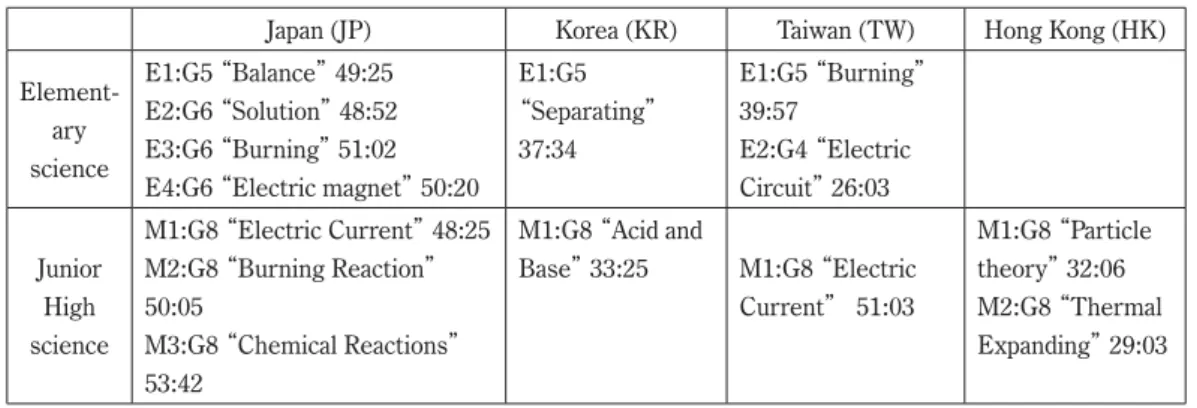
ǽ Fourteen Science lesson videos were collected from four countries in table 1.
Table 1. Collected Science Lesson Videos, (Grade, Content, Time of collected science lessons) Japan (JP) Korea (KR) Taiwan (TW) Hong Kong (HK) Element-ary science E1:G5 ŽBalancež 49:25 E2:G6 ŽSolutionž 48:52 E3:G6 ŽBurningž 51:02 E4:G6 ŽElectric magnetž 50:20
E1:G5 ŽSeparatingž 37:34 E1:G5 ŽBurningž 39:57 E2:G4 ŽElectric Circuitž 26:03 Junior High science M1:G8 ŽElectric Currentž 48:25 M2:G8 ŽBurning Reactionž 50:05 M3:G8 ŽChemical Reactionsž 53:42 M1:G8 ŽAcid and Basež 33:25 M1:G8 ŽElectric Currentž 51:03 M1:G8 ŽParticle theoryž 32:06 M2:G8 ŽThermal Expandingž 29:03
(3) Characteristics analysis of science lessons
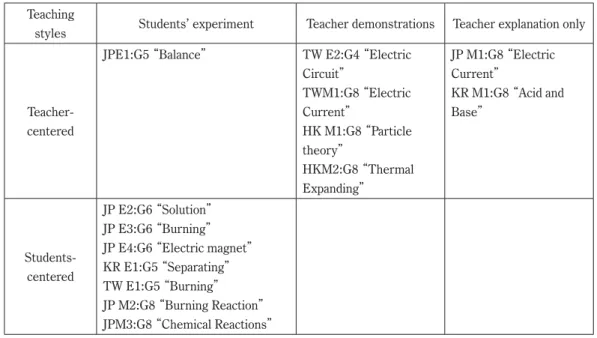
ǽ Fourteen science lessons can be classified in the characteristics of teaching/learning activity; Teacher-centered/ Students-centered, students’ experiments/teacher demonstrations or teacher explanation only. The result shows in Table 2.
ǽ Elementary science lessons are basically students-centered and including laboratory works. Junior high science lessons are teacher-centered and teacher demonstration instead of students experiment. Other two lessons (JP M1:G8 ŽElectric Currentž and KR M1 ŽAcid and Basež) are teacher explain only, because those content are introduction parts of abstract content.
ǽ Categorization is very important to analyze activities in the lessons. The content and activities of teacher /students are subdivided sentence or phrase, if the sentence is too long. The way of categorization is simplified followings as table 3.
(4) Quantitative Communication Analysis
ǽ There are many teaching/ learning activities in a lesson. Each communication and activities were put in excel columns and categorized and coded. All teaching/learning activities coded in seven elementary science lessons (Table 4) and seven junior high science lessons (Table 5). In elementary science lessons, JPE3 (Burning) lesson has more than 450 activities in 49 minutes lesson more
than other three Japanese lessons. Two Taiwan elementary lessons are relatively more than others. Distribution of codes are different each other, which indicates the teaching styles of teachers and interaction at laboratory works.
ǽ Activities in Junior high school science lessons are coded (Table 5). Teaching activities are more than students’ activities in a lesson. Typically, TE: teacher’s explanations of TI: teacher’s instructions are more than others. TWM1 (Electric current) has long laboratory work in which teacher always explained/instructed students for promoting experiment and students responded more than other lessons.
(5) Interactive Analysis
ǽ Generally, interactions teacher and students or students and students indicate that the lesson is
Table 2. Classification of characteristics of teaching/learning Teaching
styles Students’ experiment Teacher demonstrations Teacher explanation only
Teacher-centered
JPE1:G5 ŽBalancež TW E2:G4 ŽElectric Circuitž TWM1:G8 ŽElectric Currentž HK M1:G8 ŽParticle theoryž HKM2:G8 ŽThermal Expandingž JP M1:G8 ŽElectric Currentž KR M1:G8 ŽAcid and Basež Students-centered JP E2:G6 ŽSolutionž JP E3:G6 ŽBurningž JP E4:G6 ŽElectric magnetž KR E1:G5 ŽSeparatingž TW E1:G5 ŽBurningž JP M2:G8 ŽBurning Reactionž JPM3:G8 ŽChemical Reactionsž
Table 3. Categorization of communication content
Teacher’s Activities code Students’ Activities code Questioning: question and motivation TQ Responding: response to questions SR Explaining: explain and lectures TE Questioning: question and opinions SQ Indicating: indicate something students TI Laboratory Work: experiment/discussion SE Assessing: assessment to students TA Confirmation: confirm before act SC Presentation: writing on board or PPT TP Accepting: accept teacher/students SA Others: attention, and so on TO Others: writing on note and others SO
Table 4. Number of columns of codes (Elementary Science lessons) JP E1 Balance JP E2 Burning JP E3 Solutions JP E4 Electro Magnet KR E1 Classifying TW E1 Burning TW E2 Electric Circuit TQ 42 95 20 32 35 25 36 TE 34 56 36 11 18 64 61 TI 23 94 23 15 44 52 47 TA 61 40 27 71 11 48 60 TP 0 1 9 0 5 0 11 TO 3 6 6 1 0 8 6 SR 69 46 7 35 23 23 73 SQ 7 9 0 5 5 6 6 SE 38 114 38 44 34 56 64 SL 5 9 4 3 3 92 0 SA 1 5 5 10 10 14 11 SO 3 0 2 3 7 1 3 Total 286 475 177 230 195 389 378
Table 5. Number of columns of codes (Junior high Science lessons) JP M1 “Electric Current” JP M2 ŽBurning Reactionž JP M3 “Chemical Reactions” KR M1 Acid & Base TW M1 Electric Current HK M1 Particle Theory HKM2 Thermal Expand TQ 25 41 17 62 49 44 62 TE 105 79 36 88 145 29 47 TI 26 6 56 2 17 27 27 TA 18 28 35 10 25 52 39 TP 13 0 4 3 62 3 6 TO 3 18 13 13 3 3 2 SR 12 14 3 51 53 32 59 SQ 1 5 9 8 4 0 0 SE 5 11 49 4 43 17 28 SL 0 8 0 0 7 4 3 SA 1 0 30 9 12 1 2 SO 2 1 27 10 3 3 0 Total 211 211 279 260 423 215 275
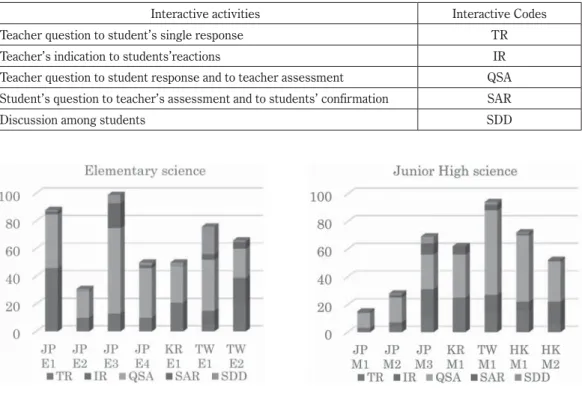
positive rather than passive atmosphere in lesson. Positive atmosphere develops students-centered, passive atmosphere develops negative for students. Interactive analysis was processed following way (Table 6).
Table 6. Codes for interactive analysis
Interactive activities Interactive Codes Teacher question to student’s single response TR
Teacher’s indication to students’reactions IR
Teacher question to student response and to teacher assessment QSA Student’s question to teacher’s assessment and to students’ confirmation SAR
Discussion among students SDD
Fig.1 Frequency of interactive codes (Elementary) Fig.2 Frequency of interactive codes (Junior high)
ǽ There were some differences among Japanese for elementary science lessons. Two Japanese elementary lessons (JPE1 and JPE3) have many interactive activities. Especially, JPE3 lesson has many ŻQSA’ interactions during laboratory work. KR, TW and HK junior high science lessons are more interactive than Japanese three lessons.
(6) Conclusion
ǽ We developed lesson study in quantitative analysis. There were many differences in science lessons not only among countries, also among same country. Science lessons Japan, Korea, Taiwan and Hong Kong, have some similarities and differences. Students are well controlled and trained by teachers. Elementary teachers are interactive both elementary and junior high schools. Especially, teacher question to students’ responses and teacher assessment (QSA) are frequently adopted in all lessons. School teachers recognize how to foster students understanding and skills, because of teacher high qualification.
ǽ Students responded lower than international average in affective and psychomotor domain. We do not make good answers to them in this research. I expect somebody to investigate it.
¶® Äéóãõóóéïî
ǽ Lesson study research should be promoted among school teachers cooperating with education researchers. As well as we must develop new methods of lesson study, because procedures of lesson study are complicated to do easily. If one teacher does practice according with same lesson plan, second teaching/learning activities will be different from first one. Lesson study is useful to improve lessons. I am looking forwards to ITC technology to do lesson study. The most important role of lesson study is reflection or assessment to improve lesson plans, teaching materials, teaching practice. Lesson study becomes popular in some developing countries. It is very hard research to share ideas in lesson study; therefore, there are many differences, educational policy, teaching environment, teachers’ qualification and students’ skills, etc. We already have experiences to compare with teaching/learning practices in many countries. However, we understood many differences among them without discussion.
Áãëîï÷ìåäçåíåîô
ǽ This article was presented EASE (East Asia Science Education) 2016, Tokyo. I would like to greatly appreciate the cooperative research members, Shoju Tonishi (Professor Emeritus, Aichi University of Education, Japan), Kong Young Tae (Professor, Chinju University of Education, Korea), Mei-Yu Chang (Professor, National Hsinchu University of Education, Taiwan) and Alice Siu Ling Wong (Associate Professor, University of Hong Kong, Hon Kong) .
Òåæåòåîãå
Ministry of Education, Culture, Sports and Science, Teacher Education using graduate schools? Promotion of recurrent education for in-service training (Second report), http://www.mext.go.jp/b_menu/shingi/old_ chukyo/old_shokuin_index/toushin/1315375.htm (Japanese), 1998
Matsumoto, K (1991), Lesson study in science, Chapter 12, Method of Science Education(Japanese), p124ź134, Sanko-Shobo, 1991
Nanano, K., Abiko, T., Shibata, T., Ikeno, N., Ichikawa, H., Fukazawa, H., Tanaka, K., and Mikami, K., Chapters 9 through 12, p223ź341, edited by National Association for the Study Educational Methods, Keisuisha, 2011 Ministry of Education, Culture, Sports and Science, the Course of Study, Elementary science, http://www.mext.
go.jp/component/english/icsFiles/afieldfile/2011/03/17/1303755_005.pdf (Japanese), 2008
Japanese), JSPS (KAKENHI 15200055) Report, 2006
Flanders, N. A. Teacher Influence, Pupil Attitudes and Achievement, University of Michigan, 1965 Lesson lab, TIMSS VIDEO study, http://www.timssvideo.com/timss-video-study, 1999
IEA, TIMSS 2011 International Science Report, http://timssandpirls.bc.edu/timss2011/downloads/T11_IR_ Science_FullBook.pdf, 2011
Atsushi Yoshida, et.al., Lesson Study and Factors of Elementary and Secondary Science in Japan, Hong Kong, Kores and Taiwan, Research final report of Grants-in-Aid for Scientific Research (KAKENHI 25282037), 2016