Stress Tolerance in Subjects with Myocardial Infarction
Kimiko Hiramatsu, Junko Nagasawa, Yuka Hirai, Sumiko Iyama, Rumiko Nagami, Keiko Kurashiki, Miyoko Matsuo and Tadasu Ikeda
Department of Adult and Geriatric Nursing, School of Health Science, Tottori University, Yonago 683-8503 Japan
In our course of surveys to study the relationship between stress and myocardial infarction (MI), we have investigated whether stress tolerance may play a significant role when MI develops. To elucidate the possible role of stress tolerance, we examined 96 patients with MI (68 men and 28 women, age 40–90 years) with a stress tolerance check list in which stress tolerance was quantified as total points for 20 self-evaluated items, each scored between 1 and 4 points. Their scores were compared with control values obtained from persons not suffering from MI, and further analyzed by dividing them into 3 groups according to their grade of stress tolerance; that is, low (39 or less in score), moderate (40–49) and high (50–80). The mean stress tolerance score (± SD) was significantly lower in the 96 MI patients (49.5 ± 8.90 points) than in the controls (60.8 ± 7.3 points). The stress tolerance grade was low in 13 of the 96 (13.5%), moderate in 34 (35.5%) and high in 49 (51.0%). In MI patients, lowly or moderately stress-tolerant persons were significantly higher in percentage (49.0%) than in the controls (6.3%). These results clearly indicate that low stress tolerance is a risk factor in the development of MI.
Key words: myocardial infarction; stress tolerance; stress tolerance check list
Abbreviations: MI, myocardial infarction; STCL, stress tolerance check list Stress is known to be a risk factor in the
devel-opment of myocardial infarction (MI). When stress is present in the human body, it activates reactions of the autonomic nervous system and endocrine system: catecholamine secretion in-creases, and blood pressure elevation and immunosuppression follow, which result in fa-cilitation of the aggregation and coagulation system of thrombocytes. If this facilitation con-tinues for a longer period, it may cause arterio-sclerosis, which could end up with the onset of MI (Nagata et al., 1992).
Some workers reported a high correlation between MI and stress generated in daily living (Rahe et al., 1976), while another reported no relevance (Romo et al., 1974). Generally con-sidering, the level of severeness in stress a per-son feels originates from individual perper-sonality characteristics. If their ability for stress toler-ance is sufficiently high, this helps to prevent
them from falling into stressful conditions (Murakami, 1992); that is, people with high stress tolerance can withstand stress even when they undergo a severe case of it. This suggests that stress tolerance may play a significant role in the development of MI. To our knowledge, stress tolerance in persons suffering from M I has not been reported yet. In this article, we in-vestigated what role stress tolerance plays when MI develops.
Subjects and Methods
Subjects
Subjects were selected from in- and outpatients diagnosed with MI whose symptoms were sta-bilized by medical treatment at Tottori Univer-sity Hospital between April 1992 and March
2002. They consisted of 68 men (78%) and 28 women (22%), aged 40 to 90 years. Written informed consent was obtained from all pa-tients, who clearly understood the object of the study. The period from the onset of MI to the present study ranged between 1 month and 10 years (mean, 3 years and 9 months).
The data reported from 272 persons who had no MI were used as controls (Settsu et al., 1990).
Methods
To quantify stress tolerance as a score, we used the stress tolerance check list (STCL) devised by K. Katsura (Settsu et al., 1990; Murakami, 1992), which was used for the 272 above-mentioned persons. The list consisted of 20 questions for the self-evaluation of personality characters as point(s), each between 1 and 4: 1 point for seldom, 2 points for sometimes, 3 points for often and 4 points for always (Table 1). The evaluation points were reversed for items number 5, 7, 9,18 and 19; that is, 4 for
seldom, 3 for sometimes, 2 for often and 1 for always. A full score was 80 points: stress tolerance was graded into 3 levels of low when the score was between 39 points or less, moder-ate when it was between 40 and 49 points, and high when it was between 50 and 80 points.
Statistical analysis
Data were expressed as mean ± SD. The analy-sis of variance was used for statistical analyanaly-sis to test differences between groups. P values of < 0.05 were considered statistically significant.
Results
Patients characteristics
Table 2 shows sex- and age-classified distribu-tions of the 96 MI patients graded by stress tol-erance as low, moderate and high according to the obtained score: of the 96, 13 (13.5%) were of low grade, 34 (35.5%) were of moderate Table 1. Stress tolerance check list
Seldom Sometimes Often Always
1 Making a calm judgment 1 2 3 4
2 Bright 1 2 3 4
3 Apt to express feelings 1 2 3 4
4 Joyful 1 2 3 4
5 Sensitive to others’ moods 4 3 2 1
6 Positive 1 2 3 4
7 Envious 4 3 2 1
8 Fond of exercising 1 2 3 4
9 Critical of others 4 3 2 1
10 Evaluating others’ merits 1 2 3 4
11 Flexible 1 2 3 4
12 Apt to reply to letters soon 1 2 3 4
13 Easygoing 1 2 3 4
14 Apt to make sure of things 1 2 3 4
15 Thoughtful of others 1 2 3 4
16 Able to thank others 1 2 3 4
17 Having many friends 1 2 3 4
18 Discordant within the family 4 3 2 1
19 Overloaded with work 4 3 2 1
20 Enjoying a hobby 1 2 3 4
Table 2. Patients’ characteristics
Age Stress tolerance grade
(year) Low* Moderate* High*
Male Female Total Male Female Total Male Female Total
40–49 0 0 0 ( 0 ) 2 0 2 ( 2.1) 3 0 3 ( 3.1) 50–59 0 0 0 ( 0 ) 4 0 4 ( 4.2) 10 2 12 (12.5) 60–69 1 0 1 ( 1.0) 8 1 9 ( 9.4) 10 3 13 (13.5) 70–79 5 4 9 ( 9.4) 6 6 12 (12.5) 10 5 15 (15.6) 80–90 1 2 3 ( 3.1) 5 2 7 ( 7.3) 3 3 6 ( 6.3) Total 7 6 13 (13.5) 25 9 34 (35.5) 36 13 49 (51.0)
( ), percentage out of the whole 96 patients.
* Stress tolerance score (mean ± SD): low, 36.5 ± 3.4; moderate, 45.5 ± 2.4; high, 55.7 ± 4.6. NS, not significant.
Differences among the 5 age-classified subgroups were not significant in each group; low-, moderate- or high-grade.
NS NS NS
grade and 49 (51.0%) were of high grade. Sta-tistical differences in age and sex were not sig-nificant.
Stress tolerance score in MI patients and controls
Table 3 compares stress tolerance scores be-tween our patients and normal controls. The mean stress tolerance score (± SD) was 60.8 ± 7.3 points out of the whole controls group and 49.5 ± 7.9 points out of the whole patients group. The difference between the paired groups com-pared showed a significantly lower level for patients (P < 0.01).
Sclassified differences were further ex-amined: comparison between male patients (50.1 ± 7.5 points) and male controls (60.6 ± 7.9 points) showed a significant difference (P < 0.01). The difference between female patients (48.1 ± 8.9 points) and female controls (61.3 ± 7.9 points) was also significant (P < 0.01).
Comparison of stress tolerance grade
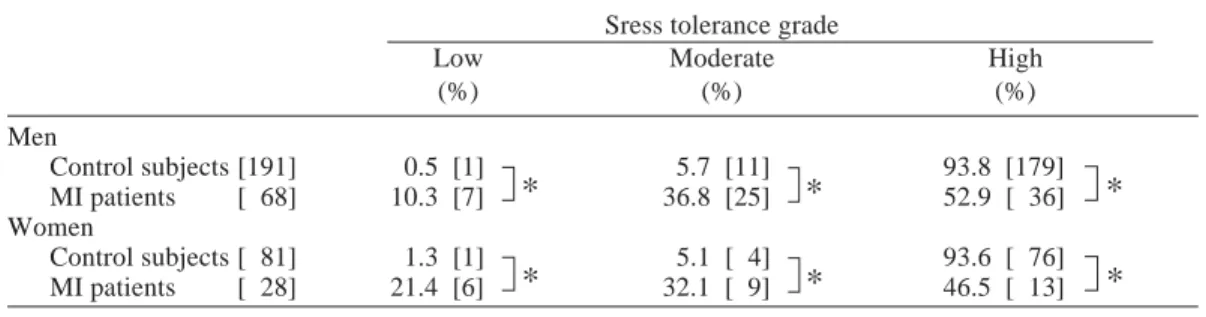
Table 4 compares grades of stress tolerance be-tween sex-classified patient and control groups. Stress tolerance was graded high in 93.8% of male controls and 52.9% of male patients, and similarly high in 93.6% of female controls but only in 44.8% of female patients.
Table 3. Sex-classified comparison of stress tolerance scores between MI patients and normal controls
Stress tolerance score
Men Women Total
Control subjects 60.8 ± 7.3 [272] 60.6 ± 7.9 [191] 61.3 ± 7.9 [81] MI patients 49.5 ± 8.0 [ 96] 50.1 ± 7.5 [ 68] 48.1 ± 8.9 [28]
Mean ± SD. [ ], number of subjects. MI, myocardial infarction.
* P < 0.01.
Data of control subjects were cited from Settsu et al. (1990).
*
*
Stress tolerance was moderate in 5.7% of male controls and 39.7% of male patients, and in 5.1% of female controls and 34.5% of female patients.
Low tolerance was observed in 0.5% of male controls and 7.4% of male patients, and in 1.3% of female controls and 20.7% of female patients.
In all grades of stress tolerance, the paired groups compared showed significant differ-ences (P < 0.01).
Discussion
Stress is known to act as a trigger for the onset of MI (Friedman and Rosenman, 1993; Sekiguchi, 1993). However, stress-induced symptoms do not appear if stress tolerance is high enough to withstand high levels of stress. That is, people with high stress tolerance have low or little probability to suffer an attack of MI.
The possible role of stress tolerance in the development of MI has not been elucidated yet. In the present study, we observed that stress tolerance in MI patients was lower than in controls. Among all the patients, those with low and moderate grades of stress tolerance oc-cupied significantly higher percentages than controls. As this result clearly indicates, stress tolerance is low in persons who have MI. Romo
et al. (1974) observed no correlation between MI and stress; however, his conclusion might have been different if he had counted stress tol-erance as one of the analytical measures.
When we investigate stress as a factor rele-vant to the onset of MI, it is quite significant in throwing light on a person’s individual ability to tolerate stress . To date, few papers have re-ported stress tolerance in persons with MI. It is obvious, however, if stress tolerance in a person is sufficiently high, the body may not identify stress so that catecholamine secretion is not in-creased when stressful events are experienced. The present study has explored the theory that stress is less tolerated in patients with MI than in normal persons: low stress tolerance must contribute to the occurrence of MI.
We used Katsura’s STCL for this study, as it is the only reported tool to evaluate stress toler-ance. We are now preparing a new checklist which may be more valid in assessig stress tolerance for further studies. On the other hand, the data we used as controls for comparison were collected by Settsu et al. (1990) as normal values on stress tolerance, which is the only study relevant to the present one. Of their subjects, 80% were in their 50’s and 60’s, both men and women together, and younger than our patients. Their study lacked any age-classifed analysis of stress tolerance: so, we did not com-pare in the present study stress tolerance grades by age between our patients and their subjects. Table 4. Sex-classified distribution of MI patients and control subjects analyzed by stress tolerance grade
Sress tolerance grade
Low Moderate High
(%) (%) (%) Men Control subjects [191] 0.5 [1] 5.7 [11] 93.8 [179] MI patients [ 68] 10.3 [7] 36.8 [25] 52.9 [ 36] Women Control subjects [ 81] 1.3 [1] 5.1 [ 4] 93.6 [ 76] MI patients [ 28] 21.4 [6] 32.1 [ 9] 46.5 [ 13] [ ], number of subjects. MI, myocardial infarction. * P < 0.01.
Data of control subjects were cited from Settsu et al. (1990).
*
*
*
*
*
*
In the analysis of age-classified groups of our patients, stress tolerance lowered as age ad-vanced but with no significant differences. Comparison between sex-classified subgroups showed no significant difference either.
In further studies, we will develop an age-matched design for statistical analysis, and compare stress tolerance grades between MI pa-tients and controls by collecting data of normal persons. As we were deeply inspired here, the possibility of contracting MI becomes higher when stress tolerance is lowered rather than at the onset of stress itself. It is difficult to avoid various causes of stress arising from daily liv-ing. People can have the ability to deal with these by heightening their ability to tolerate stress.
Stress management should be considered also from the viewpoint of stress tolerance. We would like to apply the present observations into a life guidance plan or patient education, especially for people with coronary risk factors such as hypertension, diabetes mellitus and hyperlipidemia.
References
1 Friedman M, Rosenman RH. Taipu A: Seikaku To Shinzobyo. Tokyo: Sogensha; 1993. p. 126– 133 (in Japanese). Sinzato R, translator. Type A behavior and your heart. New York: Alfred A.
Knofp Inc., 1974.
2 Kimura K. [Internal disease and type A]. Gendai No Esupuri (L’esprit d’aujourd’hui) 1995;(337): 43–53 (in Japanese).
3 Murakami M. [Stress test.] Nurse +1 1992;2 Suppl 13:36–49 (in Japanese).
4 Murakami M, Matsuno T, Nakamura N, Kasai T, Arai Y, Kamoshita I, et al. Investigation on stress-induced condition of healthy people: diag-nosis and management of stress-related symp-toms. Shinshin Iryo 1989;1:72–82 (in Japanese). 5 Nagata K. [Physiology and pathology of stress.] Nurse +1 1992;2 Suppl 13:14–19 (in Japanese). 6 Rahe RH, Arajarvi H, Arajarvi S, Punsar S,
Karvonen MJ. Recent life changes and coronary heart disease in east versus west Finland. J Psy-chosom Res 1976;20:431–437.
7 Romo M, Siltanene P, Theorell T, Rahe RH. Work behavior, time urgency and life dissat-isfactions in subjects with myocardial infarction: a cross-cultural study. J Psychosom Res 1974; 18:1–8.
8 Sekiguchi M. [Beginning of type A studies in Japan]. In: Momoo H, Hayano J, Hosaka T, Kimura K, eds. Taipu A Kodo Patan [Type A behavior patterns]. Tokyo: Seiwa Shoten; 1993. Chapter 3. p. 18-21 (in Japanese).
9 Settsu M, Murakami M, Katsura K. Life style and stress of healthy people. Shinshin Iryo 1990; 12:89-96 (in Japanese).
Received March 25, 2002; accepted May 7, 2002 Corresponding author: Dr. Kimiko Hiramatsu