CURRENT PROBLEMS AND SOLUTIONS OF
DRIVER IMPROVEMENT IN JAPAN
Yasuhiro NAGATSUKA
Prof. Dr., Department of Psychology, Niigata Chuoh Junior College
ABSTRACT
Considering the recent increasing tendency of traffic accidents in Japan, it seems urgently necessary for us to "improve drivers' behavior" by driver training for future accident reduction. In order to clarify what should be instructed in the training for safe driving, a driver training system was examined. It was pointed out that both beginner drivers and the licensed drivers were not yet adequately trained to be useful as safe drivers in considering especially the situations that beginner drivers are more liable to cause accidents than experienced drivers. It was also pointed out that although it is sure that current system of driver training in Japan is highly extensive and elaborated and contains all important problems, the contents and/or syllabus are absolutely exhaustive and too much jam-packed for drivers, especially for learner drivers, to learn. The desirable content and the way of driver training were discussed and it was emphasized that the training of drivers should be greatly focussed on the drivers' gaining the information needed for driving accurately both in and out of the driving school. A proposal was made that in order to avoid "improper lookout" and "perceptual failures" which are main causes in Japan, it may be desirable to focus driver training on "looking and attending by making a firm temporary stop at the crossings" on the ground of the author's effective model of suppression of accident.
Key words: Accident reduction, Driver training, Syllabus, Importance of perception in safe driving
b;6~ffiJO)~~*i!&O)~~fIifOJ~~;t~C, *i!&1!lJJl:O)t.:~ 1:~~tJ: L.C Ij:,
4-
B1::(0 \, 'Lt:,tJ::(o, :iI~~fX~~~ t.::-C r:iI~~O)~~ITMfJO)&-!f~ Ij:;6~~L.cJ C'2t>~J::ojI:~\bn~o C'Ij:, :iI~~O)t.:~O)ti~I::(o\"-cbnbnlj:, fnJ~ti;t, ID"~1"nl-;f'J:: \, ,O)t::6 oj;6~o L.n~BJIi?;6~I:1"~t.:~I:, *mC'Ij::iI~~m:~~*IJJl'
c
0)~:il0)t:,c
I:, :iI~~m:~~WJ~O)b;6~ffiJO):iI~~ti~*IJJl'I:§:&L."J"J, :iI~~~~1::(0 \,'-Cueffl2:n-c\,'~;fiTO):tJ1).:f-.:1. 7A:(oJ::a~~~*IiJ (V7r~A) I:"J\')L~B~IT\''' "J
~'O)J::ojtJ:rc~Jm,¢.i.~1~ti L.t.:o
(I) f)1Jl,\ (~m:~f~~~$) :iI~~O)*i!&~~fIifOJ~~Lt:1" ~
c,
fJJIL':iI~~Ij:1m*i!&·:t(:i::iI~~IToj1:J:E.~~tJJtJ:ti~ •IDII~~1iffi2:
n
Llj: \,)tJ: \,)o)C'Ij:tJ: \,)iJ~o-35-(2) ~rrO)ii~:'t!H&ff*,JJ3t'j:fi~L"~~tt-rc, ~*HIIi::§-:>L"f**dt~ tL L"to lJ, tiff~t iOOc~~fflti*~Ii: 'j:ii~Ii:&\~tJ~~'j::i:L"!Ji lJi6 * tL L"1t, Qo lA))l-fO)i*J§~ ~.'j:~lJ Ii:b~Raqli:~ ~"Qt':~Ii:, -f tL'd:ffllt't.:tiff ($Mti~~) 'j:, I~ ~
i:~±.J Ii: tJ -:> L"1t' Qo -fO)t.:~ii~:13, %1i:fJ]JC.\ii~:13'j:*:i:ii~Ii:&\~tJ~~
O)fk~'d:~J.HJTQ0)Ii:mlt'd:~
c:
QO)"C"j:tJIt'IJ)c~,t>:hQo£1.J:0)~~1i:~--j' ~, ii~:13tiffli:~* lit 'i*J§ c
15m
Ii:-:>It 'L"O)~g;f'd:rrtJ -:>t.: o -f l L"l3iblf[fj:~PJTli: to It Qtiff (~ffflf5l~Mtiff)to.1Lf~ffflf5l~~O)tiffO) It 'TtL0)~~1i:b, -f0);f-1 /' J-'d: lii~:13IJ~*:i:ii~Ii:&\~tJmfR'd:lf5llJ AtLQ"~1J'd:f*f~ ~-itQ i: c J Ii:~-:> L"rrtJ It" -fO)ftBO)fff~ ~ tLt.:~~*:rj'd: i:tLli:~;il--j'ItL"fj:.:t Q i:clJ~fi~L"~* llt'i:c'd:~~lt.:o TtJt>~, *~~l1::*'fJic lL"O)ii~:13tiffli:
tolt'L"'j:, t>1J~~0)*~JJj{lz;;l0) J-"J 7"'d:6~Q l~jltJJaJJU c I~Yt~:i:J clt'ojrl:J~
errib'd:~~~TQ i: c1J~1ff~"C'~Q i: C, -fO)t.:~Ii:,;t, %1i:3Z~B"C'O)-~l1::'d:l-:>
IJ)lJ c liftJrr l, -f oj T Q i: cli:.1 -:> L"mJImO):I7\¥R.'d: Ij: -:>~lJ C~Yt•
i±m
~-itQii~:13 tifflJ~~*lit' i: c'd::t=:1313~0) 1-~~11::· flt~J lUfJ!EO)1i.jtmli:~--j'It'L"m§l t.:o 4'--1]-r:
ii~:13tiff, ii~~m:*,JJ3t, ~~~7/'~:A, *:i:ii~li:toltQ~Yto)~~~, jltJJi±m·flt~Ii:;f-1/' J-'d:ii:
<
tiffPROBLEM
1. Increasing tendency of traffic accidents in Japan
Referring to the reduction of fatal accidents below 10,000 persons in 1996 after nine years, Kunimatsu, the former Director General of the National Police Agency, commented in a newspaper "the Asahi" (January, 5, 1997) that the accident situation in Japan was still open to conjecture because the number of accidents marked the worst recorded in the history (Fig. 1).
The present writer agrees with this comment because Japanese White Paper on traffic safety for 1996 told us that if we kept to the same tracks fatalities could be assumed to amount to 12,500 in 2000.
2. Need for innovative countermeasures: The content of training as a fundamental problem
The comment mentioned above means that for future accident reduction in Japan, innovative measures are needed, as the Mainichi editorial (June 6, 1996) stated.
What measure could be an innovative one? The writer thinks it is reasonable to seek the measure in the area of psychology, i. e., behavior on the road for several reasons. First, it is considered that "the only way that is left for us to obtain further reduction of accidents is to improve drivers' behavior" as Koshi (1985) wrote, after surveying conventional measures in Japan. Second, the direct causes of accidents may be attributable not so much to inadequacy of roads and/or accident-prevention devices as to the immediate driver behavior that preceded the accident (Shinar, 1978). Third,
(CaseS/Persons) 1,100,000 1,000,000 900,000 800,000 700,000 •••••."1,153,841 No. of Injuries ••••••
"'>....
01,050,397 958,925 ••••0·· o...~~;'·2Jl~···o..··990,675 930277 881,723 •••···922,677 ' 844'?'~~"""'878:6;~"D' 810~24~" ... 11,000 600,000 11,105 11,451 No. of Fatalities (Persons) 12,000 9,942 .. 9,640' 10,000 9,211 9,006 9,066 '91 '92 '93 '94 '95 '96 '97 '98 '99 '00 9,000 8,000 7,000Source: Monthly Journal of Mobility Management, 2001 March (Kigyo Kaihatsu Center)
Figure1. Changes in traffic accidents and casualties
and related to this, the writer is a psychologist who by definition studies people's behavior.
It seems to me urgently necessary for us to "improve drivers' behavior" as the accident situation is still grave and we are in a critical stage. In order to "improve drivers' behavior," we are naturally concerned with driver training. Here it is the content of the training that should be taken up as the basic problem.
PROBLEMS OF THE CURRICULUM, CONTENTAND/OR
SYLLABUS OF TRAINING FOR SAFE DRIVING 1. Progress of innovation
License system is regarded as a countermersure for the traffic accidents from an educational viewpoint. Obtaining a driver's license means that the licensed people are released from the general prohibition of driving on the road as they have satisfied the legal requirements for driving a vehicle on the road.
It is true that they may be regarded formally as "not-dangerrous"CMiller& Stacy,
-37-1997) only because they cleared the three necessary conditions of the driver's license examination, i. e., aptitude, technical skills and knowledge required for driving motor vehicle.
In reality, however, they are not considered as perfect drivers who filled not only the necessary conditions but also sufficient ones for safe driving on the road. Therefore the problem of training in a driving school as well as those after obtaining a license is of vital importance in Japan not only for fostering a perfect driver but also for preventing accidents.
In order to promote the attainment of the aims of the Japanese Road Traffic Law (mentioned hereafter as Law), in 1993 National Police Agency prepared a new curriculum in driving schools on the basis of the recognition that the traditional curriculum had some problems as shown in the following:
(1) Deap-seated tendencies of instruction rather toward the preparation for the driver's license examination in designated driving school.
(2) A scant relationship between technical instruction and academic instruction.
(3) Uniform education and lesson without considering the degree of achievement and / or the individual differences of pupils.
(4) Lessons were given without considering the situation that the driver drives his or her vehicle by himself or herself alone after obtaining a license on the road.
(5) Lessons are jam-packed.
On this reflections a new curriculum which has substantial information was prepared provisionally and tested following scientific procedures by the guidance of National Research Institute of Police Science and some of the effective innovations were put into practice.
2. Problems with respect to training before obtaining a license
It is often considered among the Japanese that the beginners should have been fully and properly trained in the designated driving school so as to be able to drive a vehicle safely. Further, the licensed person ought to have mastered all of the theoretical and technical training and developed a sufficient aptitude to drive a car.
In considering the following situations, however, it seems probable to the present writer that licensed drivers are not yet adequately trained to be useful as safe drivers.
(1) Statistics tell us that about 8% of all accidents are caused by learner drivers in the year after they obtain a license who amount to only 4% of all license-holders. Beginner drivers are more liable to cause accidents than experienced drivers. Accident rate is higer in the early period after getting a license. These tendencies are shown in Table 1. The numbers of fatalities caused by them are the largest in the first year after a driver is licensed. According to these data, a beginner drivers is not regarded as a reliable driver or "a perfect driver" in the meaning referred to by Miller& Stacy (1997).
(2) Takizawa (1990) gave a lecture, in which he pointed out that a gradual increase in traffic accidents in general as well as a lot of accidents caused by beginner drivers at the first stage may partly be attributable to the problematic situation that
Table1. Annual numbers of accidents after obtaining a license in five years Traffic Accidents by Driving Experience of Primary Parties
(Motor Vehicle and Moped 1st Class)
~
Less than Less than Less than Less than Less than The primary party 1 year 2 year 3 year 4 year 5 yearPersonal vehicle Passenger car Ordinary 31,526 28,833 26,054 20,858 24,178 Light 8,900 6,999 5,667 4,248 4,585 2-wheeled vehicle Motorcycle 3,260 2,239 1,406 942 1,126 Moped 1st class 9,476 5,417 3,050 1,631 1,687 Grand Total 61,002 51,794 44,114 34,399 40,173 Source: Statistics '00; Road Accidents Japan, Institute for Traffic Accident Reserch and Data Analysis (ITARDA), 2000.
training in the driving school was not sufficient for educating the way of perceiving the information essential for safe driving, although the successful training of beginner drivers achieved by the designated driving schools was highly evaluated, A similar observation was made by Matsuura (1998). He reported that the learners commited unsafe behavior because of their insufficient cognitive or judgmental driving skills rather than insufficient driving operational skills on the basis of the evaluation by instructors in driving schools of learner drivers' unsafe driving behaviors after pointing out that learner drivers had a tendency to have many accidents on the road.
3. Problems with respect to training after obtaining a license
A survey of a lot of guidelines, articles, textbooks, curriculums and syllabuses on the training after obtaining a license tells us that although it is sure that the current system of driver training in Japan is highly extensive and elaborated and the training materials and/or manuals contain all the important informations, they are absolutely exhaustive, too much jam-packed and lacking concreteness for drivers to learn as emeritus professor Y. Nagayama, a de facto writer of the 1982 IATSS report (1982), also has pointed out.
Most of the syllabuses cited in the report were typical examples which showed us that lecturers placed emphasis upon the problem of speeding, drunken driving, improper driving at the intersection, looking aside while driving and failure to stop temporarily. A similar tendency of enumeration was found in some recent syllabuses used in lessons.
-39-The writer thinks that this is, to be sure, a list of accident causes and most of them are possible causes of accidents. However, this is only an enumerated one arranged without considering the actual state of accidents, i. e., the order of the numbers of occurences or the seriousness of the causes.
It my even be said that "inattentive driving (including "looking aside while driving," "failure to observe surrounding traffic movement" and "failure to confirm safety factors"), which are the most frequent accident causes in Japan and should be taught most seriously in lessons are, so to speak, "embedded" in the jam-packed content of lessons. In this respect the Manual for drivers who want to have their licenses renewed published by the Prefectural Police Agency Niigata (1999) is thought to be informative in that it found out properly the real and serious causes of accidents and teaches them the actual situation of accidents in the prefectural area. The manual teaches that accidents happen at intersections and that they are mainly caused by "innattentive driving and failure of temporary stop."
WHAT SHOULD BE INSTRUCTED IN THE TRAINING FOR SAFE DRIVING?
1. The content and the way of the driver training -A
proposal-(1) Problems with the content of driver training
It is considered that in spite of every previous effort the recent curriculum and/or syllabuses of driver training in Japan have some problems in that they do not focus on the actual conditions of accidents. Especially it should have focused on the behavioral causes of the increase of accidents. In other words, more information and instruction are needed which are practially helpful in reducing accidents. It is because that it has been recognized by some researchers (Shinar, 1978; Nagayama, 1985; Kobayashi, 1997; Nagatsuka, 1991, 1993, 1997) and practitioners (Takizawa, 1991; Prefectural Police Agency in Niigata, 1999) that most cases of accidents have been caused by inaccurate, mistaken, delayed and/or missed way of drivers' getting informations needed for safe driving. The statistics in Table 2 also shows this.
(2) Training of "looking and attending" is more important than that of vehicle-control capabilities
Thus the training of drivers must be greatly concerned with the obtaining of the informations needed for safe driving both in and out of a driving school. Takizawa (1991) talked that it was especially more important for drivers to learn this as compared with learning how to operate the vehicle as a machine, such as switching on the ignition of a car, taking the wheel, putting on the brakes and stepping on the accelerator.
In this respect Shinar (1978) made some important remarks on the detailed analysis of Indiana University study with those sets of behavior and events (human direct causes) that immediately preceded the accident and were directly responsible for it. He revealed that drivers who made an error by pulling into a street from an intersecting
alley without checking properly for the presence of other traffic "looked but did not see" just as often as they "failed to look."
He wrote, "In general the predominance of attention/perception errors over response errors is common to all these studies Heading the list was improper lookout, followed by excessive speed, inattention, and improper evasive action." . "Improper lookout was the most frequent cause of accident caused by lapses in attention and impairements in the other information -processing tasks, rather than by poor vehicle-control capabilities." Also important are the remarks by Miller and Stacy. They wrote, "Although driving is predominantly a practical skill which can only be fully developed through practice and experience, it nevertheless involves a complex mixture of awareness, skill, knowledge and attitudes."
2. How to attain ulooking and attending"
Last but not least is the method of attaining "looking and attending" on the road. This is concerned with the important problem of "how to behave on the road." The
Table 2. Traffic and fatal accidents by type of violation involving primary parties in Japan, 2000
No. of No. of Accidents Fatalities
• Speed limit violation 8,845 1,417
• Failure to stop temporarily 49,800 339
• Drunken driving 1,085 340
• Infringement of safe driving Inattentive driving
Carelessness 54,361 956
Looking aside 155,489 1,004
Failure to observe surrouding traffic 88,217 223 movement
Failure to confirm safety factors 231,305 563
• Others 299,022 3,182
Total 888,124 8,024
Note: 1. The type of violation is arranged in in the order of Table shown in the Statistics '00.
2. Some items of tipe of violation are omitted from the Table and shown as "Others."
Source: Statisics '00. Road Accidents Japan, Institute for Traffic Accident Reseach and Data Analysis (ITARDA), 2001
-41-writer proposes a safety campaign model on the following ground (Nagatsuka, 1991, 1993, 1997).
It makes a proposition that "making a firm and temporary stop to look and attend at intersections. "For the purpose of suppressing traffic accidents Nagatsuka developed an approach to traffic education named Niigata model for driver improve-ment. This is all the effort of driver education which places special emphasis upon the importance of "driver's making a temporary stop" at intersections without traffic lights with no priority and/or with poor visibility for two reasons. First, it helps driver's precise perception of traffic environment; second, it is expected that a temporary stop may reduce accidents because in Japan more than half of accidents have been caused by the failure of perception and of a temporary stop at crossing as shown in Table 2.
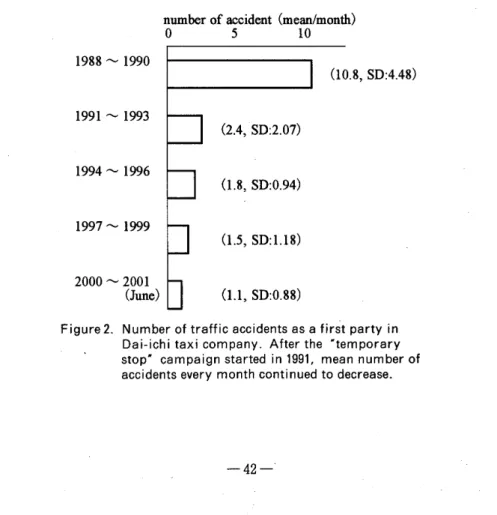
Action research was carried out in some transportation companies and in governmen-tal organizations for about ten years. Results were gained that drivers responsible for the accidents show a remarkable downward trend after the introduction of our model. The number of traffic accidents chiefly responsible for "failure of temporary stop" showed a remarkable downward trend for about ten years in the transportation compamny participated in our campaign, almost fully satisfying the objectives of our model (Fig. 2). This model which put special emphasis on a slogan "making a stop to perceive surroundings precisely" is increasingly spreading. In 1996 our society, the
number of accident (mean/month)
o
5 10 1988 "-' 1990 00.8, SD:4.48) 1991 "-' 1993 1994 "-' 1996 1997 "-' 1999 2000 "-' 2001 (June) (2.4, SD:2.07) 0.8, SD:0.94) 0.5, SD:1.18) OJ,SD:0.88)Figure 2. Number of traffic accidents as a first party in Da i-ich i taxi company. After the "temporary stop" campaign started in 1991, mean number of accidents every month continued to decrease.
Japanese Association of Traffic Psychology agreed unanimously in the annual meeting to announce the campaign as an effective measures of accident prevention.
TEMPORARY STOP: A SUCCESS AGAINST TRAFFIC ACCIDENTS IN JAPAN
Itis necessary for us to treat the problem of obtaining a driver's license and driver training from the angle of suppressing accidents on the road, since the primary aim of the Law is to prevent danger on roads as mentioned already. Itmay be natural that we should think that most effective way of suppressing accidents is to find the cause of the accident and eliminate it, just like a medical doctor removes a germ or an affected part of the body to cure disease. We think it important to take notice of the problem behaviors on the road brought about collisions, i. e., "human direct causes; behaviors that immediately preceded the accident."
Undoubtedly, in Japan, the main cause of accidents is "perceptual failures," such as "looking aside while driving" and by "failure to observe surrounding traffic movement." Specifically, both in the driving school and in other classes and lessons it is desirable to put strong emphasis on the importance of "getting information needed for safe driving" and "looking and attending to see" in order to eliminate "improper lookout" (the error that "looked but did not see" or "failed to look") and/or "perceptual failure" which has been the worst behavioral cause of accident in Japan.
Obtaining a licence is the commencement for attaining sufficient conditions for the safe driving. Regrettably, he or she is not yet well qualifild as a driver, because getting a license is often more a political issue than a safety one. After getting a driver's license, they must make many sfforts to be a reliable driver and possibly, be "a perfect driver." In doing so, it is considered very important that they put forth a special effort both to look and attend by avoiding mere scanning of the visual field.
How can we attain this? An effective way in Japan may be, first of all, taking every opprtunity to participate, experience and practice in "making a firm and a temporary stop at every intersection" in order to ensure "looking and attending" on the part of drivers. It is needless to say that drivers should learn fully both the motor skill in operating the vehicle as a machine and the social skills in transacting with other road users by aiming at becoming a "perfect driver."
REFERENCES
IATSS (1982) A research study on the evalution of lesson to a person who is desirous to have licence renewd. Proceedings of a 1980 research of IATSS (in Japanese). Kobayashi, M. (1997) Safety management in "vehicle society." Gijyutu Shoin, Tokyo. Koshi, M. (1985) Road safety measures in Japan. In L. Evans and R. C. Schwing
(Eds.) , Human behavior and traffic safety. Plenum Press· New Yoak-London.
-43-Matsuura, T. (1998) Evaluation of learner driver's unsafe driving behavior by instructors in driving school. Reports of the National Research Institute of Police Science. Research on Traffic Safety and Regulation. 72 - 77 (in Japanese with English summary).
Miller, J. & Stacy, M.(1997) The driving instructor's handbook. 10th ed., Kogan Page.
Nagatsuka, Y. (1991) Effectiveness of model driving with a campaign sticker on the rear outside of the body of buses, trucks and taxis-An action research- Proceed-ings of the second international conference on New Ways for the Improved Road Safety and Quality of Life. 9-10.
Nagatsuka, Y. (1993) A new approach to the development of scientific program for removing 'three big traffic evils' from the road. Alcohol, Drugs and Traffic Safet):'-T' 92-Ed. by Utzelmann, Berghaus and Kroj. Verlag TUV Rheinland GmbH, Koln. 1156-1160.
Nagatsuka, Y. (1997) Effectiveness of Niigata model for driver improvement. Berichte der Bundesanstalt fUr Strassenwesen, Mensch und Sicherheit, Heft M 93, 403-407.
Nagayama, Y.(1985) Psychology of Driving. Kigyo Kaihatsu Center, Osaka (in Japanese).
National Police Agency (ed.) (1998) A new handbook of lesson-A textbook for the teachers of the designated driving school. revised edition-The Japanese Association of the Designated Driving Schools (in Japanese).
Prefectural Police Agency in Niigata. (1999) Actual conditions of traffic accidents in Niigata prefecture and informations for the safe driving-A manual for the people who want to have their license renewed (in Japanese).
Shinar, D.(1978) Psychology on the road-The human factor in traffic safety-John Wiley& Sons, New York.
Takizawa, T. (1991) Some comments on the lessons in driving school. Proceedings of a symposium on the education in designated driving school in the 43rd annual conference of the Japanese Association of Traffic Psychology, 7-13 (in Japanese).