Corporate Governance of Japan in Transition
Hiroshi Fukumitsu
1. Introduction
The concern in Japan for the difference of corporate governance in countries has been increased in 1990s. Chart 1 shows the change of numbers of Japanese monographs, which have titlesincluding governance in each year. It is evident from the chart that the concern for governance has popularized and expanded in 1990s.
Chart 1: The Numbers of Japanese Monographs on Corporate Governance
And now everyone accepts some change has emerged in leading companies. Social scientistswho have written on governance are excited with this change. This is a typical and rare case that an argument of scholarshas brought a real change of societyin short time.
― 191 ―
And we are now in the midst of this argument. Let's clarify our common viewpoint and my own one. Our common viewpoint is that corporate governance is one of mechanisms to restrain the destructive power of large companies.
One of my points is that change is strongly connected with the decline of labor unions [cf. Kagono, 2000]. Labor unions had played a strong counter power to large companies in a society. But it's apparent the days of labor unions were over. We need a strong counter power to large companies to fill up the void that is brought by the decline of labor unions. I think what we are facing in corporate governance is the rational restructure of social powers.
And I think another point is the structural change of the Japanese labor market. Young people now changed their mind when they found a fulltime job for the firsttime. They do not regard it as a lifetime place for work any more as they used to be. This change reflects increasing liquidity of the labor market. Of course it has the negative side. The unemployment rate is high than ever (Chart 2). Chart 2 reveals the
Chart 2: Unemployment Rate and Rate of Wishing to Change the Job
−192 −
increasing rate of persons wishing to change their jobs. Those rates have tripled in last thirty years. It's a radical change in fact.
One of main theoretical grounds of Anglo‑Saxon governance is recognition that shareholders are the final‑risk taker of a company, so they have been entitled to the residual profit of the company. But in Japan the low liquidity of the labor market have obstructed the development of such
an argument until quite recently. It's argued as shareholders had benefited from the high liquidity of the stock market while laborers had been captured in their companies. However as I have noted the attitude of young people had changed dramatically and Anglo‑Saxon governance had got some reality in our society. And this method is supported by simple‑
minded scholars who believe market efficiency.
As a new counter power Professor Shibuya [1999] expressed his expectation that institutional investors such as pension funds, which are representing savings of the public, will play some role on behalf of the people. And concerning corporate governance by pension funds we have Professor Suto's pioneer works. (See, Suto and Suzuki 1998, Kamino 2000)
But I think there's another counter power. Another influential way to restrain large companies is that we can demand large companies to take customer‑first policy, which is not contradict with their maximizing profit policy in the long run. Putting priority on the final customer I think business can reconcile their making‑profit policy with social‑goals of communities. Or put it another way. We can say it's a problem called risk management. Large companies can keep their reputation high through maintaining good public relations. Though these possibilities aren't expatiated in this paper, I think we should discuss customers as stakeholders more seriously from now on.
As the working of bank‑based corporate governance our colleagues' appreciations are not high. Both Okumura [1998] and Ito [1999]
concluded that main banks didn't work well as a monitoring system in the
― 193 ―
bubble period.
Another point is cross shareholding. As Professor Hiroshi Okumura has pointed out repeatedly to restructure our social system what we should do at firstis to diminish mutual or cross shareholding. This recognition comes from definitive role of ownership structure of companies in corporate governance.
Government reports also reached some of these conclusions as I mentioned above. They admit void of corporate governance in the bubble period. And they also admit that cross shareholding is closely connected with bank‑based governance.
In this paper I want to show the outline of the transition of corporate governance in Japan. At firstI will follow the evolution of government officials'recognition. They conclude the importance of cross shareholding for corporate governance. Then I'll discuss limitations of reduction of cross shareholding. And I will follow the development of proposals on corporate governance chronologically. In the last section I'll show superi‑
ority of pragmatism as a conclusion for the present.
2. Evolution of Government Recognition on Corporate Governance
Keizaihakusyo, Economic Survey of Japan written by Economic Planning Agency, has published every year in July. It's regarded as the standard explanation of economic situation and also the official views on Japanese economy. We can see the evolution of government officials' recognition on corporate governance to follow these surveys.
The survey of 1996 had insisted the economic rationale of the main bank system.
"Japan's main bank system performs the following principal functions: lowering agency costs associated with the asymmetric information; providing insurance against risk; and exchanging various
types of information." [EPA, 1996]
The survey had written main banks
affirmatively as a means of corporate governance for shareholders.
"In theory, main banks act in concert
with other shareholders to exercise corporate governance, and
they reduce agency costs generated by the asymmetric information that
exists between shareholders and management." [op.cit.]
But it had also pointed out room for
debate concerning the working of main banks.
"There is room for debate, however,
concerning the question of whether main banks in Japan
have actually played this
role as shareholders, and whether it is appropriate
to put such demands upon them." [op.cit.]
So the survey of 1996 was at a
turning point of recognition, though it stillinsisted affirmative side of main
banks, it already suggested void corporate governance that would be of
treated by the survey of 1998.
The survey of 1997 admitted clearly
a failure of bank‑based corporate governance in Japan. "In the post
war era, banks played an important role in Japan's corporate governance...However,
banks' failure to prevent excessive land investment during
the bubble period cast doubt upon the adequacy of the risk management." [EPA, 1997]
The survey of 1997 just not only
admitted a failure of bank‑based corporate governance but asserted
the need for a new style of governance, which is market‑based corporate governance.
"Changes in the economic environment
are working to transform...
Japanese systems. This situation has
produced the need for a new style of governance, and it is hoped that
the transmission of accurate signals from the stock market will act as an incentive
in terms of the establishment of firms and investment in plants and
equipment, as well as the exit of some firms." [op.cit.]
― 195 ―
Another feature of the survey of 1997 is it expressed the recognition that the cross‑shareholding had been an indispensable part of Japanese system, namely bank‑based corporate governance. It became a common recognition even in government officials that we needed to dissolute the cross‑shareholding in order to make a change concerning the direction in corporate governance.
"Among governance by the capital market, the cross‑shareholding has long been strong in Japan, serving to stabilize corporate "sovereignty right." Prevention of takeovers by cross‑shareholding was a constituent element in the integrated "Japanese system," together with such elements as a main bank system and long term employment practices." [op.cit]
The role of cross‑shareholding recognized by the survey of 1997 was limited just to prevent takeovers. The recognition of the next year's survey went farther. It admitted the connection between cross‑
shareholding and defects in corporate governance. "...Mechanisms by which shareholders could discipline corporate management were weakened by these stable shareholders." [EPA, 1998]
The survey of 1998 asserted signs of change in the cross shareholding structure. Firstly merits for companies to maintain cross shareholding have diminished by the collapse of the bubble. Because "the collapse....reduced stock prices and greatly increased shareholding risk; secondary, because of the reduced dependency of large companies on bank borrowing: and thirdly, because financial institutions' bad debt are impairing their risk‑
taking capacity." [op.cit.]The survey also pointed out that the continuing long‑term slump in share prices had pushed up companies' capital procurement costs. It means that companies are more sensitive to capital cost efficiency.
It's clear for us that Economic Surveys have evolved their recognition of corporate governance year by year. In the survey of 1996 they had stuck to analyze the affirmative side of main bank system. But in the next
year they clearly admitted a failure of main bank system and the relation between cross‑shareholding and a main bank system. And in the survey of 1998 they reached the recognition not a main bank system but cross‑
shareholding is the key to understand the way of corporate governance in Japan.
3. Limitations of Reduction of Cross‑Shareholding
According to Nissey Life Institute of Research the percentage of cross shareholding of listing companies declined slightly from 17.97% at the end of Mar. 1991 to 17.35% at the end of Mar. 1995, but after then it declined at an increasing tempo to 10.53% at the end of Mar.2000 (Chart 3). It is undeniable that cross shareholding has loosened especially in the late 1990s. But how far this trend will go on is stillopen to argument.
This is the problem I want to deal about next.
It reported repeatedly that Toyota group has intensified their cross‑
Chart 3: Cross Shareholding Rate of Listing Companies, End of March
−197−
shareholding recently. It is said the purpose of the intensifying is to prepare against hostile takeovers and to strengthen their unity. On the other hand Nissan has accelerated the decreasing of cross‑shareholding.
Considering the financial difficulty of Nissan I hesitate to say that Nissan is the typical case for another Japanese companies.
I rather insist limitations of loosening. The limitations are showed well in the confusion concerning the emergence of hostile takeovers in Japan. It's very symbolic that we had experienced no hostile takeovers until quite recently. But as the cross‑shareholding loosened there appeared the firsthostile takeover in May 1999. After then the second and the third one both appeared in January 2000.
The firstcase: the buyer was Cables & Wires and the target firm was IDC, International Digital Company. The acquisition reflected the intention of C&W to intensify a competitive power in Japan. Supporting by British government C&W succeeded in the acquisition. This success reflected the trend of decreasing cross‑shareholding in Japan.
The second case: the buyer was Bohringer Ingenheim of Japan and the target was SS Pharmacy. SS Pharmacy is a small drug company in the world standard. This case was also successful.
Those two cases had common features: Foreigner‑on‑Japanese hostile takeover; the buyer was not a M&A fund.
Then the third and problematic case appeared. This was the first Japanese‑on‑Japanese hostile takeover in Japan. The buyer was MAC (a Japanese M&A fund) headed by Yoshiaki Murakami and the target was Shoei Co. Though attracted considerable attention,it was unsuccessful. It is impressive the first Japanese‑on‑Japanese hostile takeover was
prevented by main stockholders of Shoei such large companies as Canon, Fuji Bank and Yasuda Insurance. They said they had maintained neutrality.
That means they didn't sold their stocks to MAC.
Shoei is an old company founded in 1931 as a manufacturer and a
marketer of silk.From 1992 onward Shoei has streamlined her business to withdraw frem silk business and other marketing business. Now Shjoei is intensifying on real estate and electronic devices. The problem is that she
has a lot of shares and real estate as an idle asset. As she had got these asset at low prices, her latent asset were estimated over 66 billion yen.
But the stock price of Shoei hovered below 1000 yen, so the bidder's cost for the acquisition calculated only 14 billion yen.
Theoretically it's reasonable to select Shoei as a target of acquisition.
It is said that the side of Shoei made a defense to buy up Shoei's share. The TOB failed because Shoei' s price got a sudden rise and maintained well over the TOB price for the TOB period. Though it's just a conjecture the company who was upset most by the TOB may be Canon, the main cross shareholder of Shoei. It's seemed that Canon didn't want MAC became a large share holder of Canon indirectly through Shoei.
Table 1 shows that Canon has gradually increased holdings of specified holders. And holdings of small holders are relatively low. Each number is relatively stable. It reflects Canon's policy to stabilize these numbers.
This case clearly shows the limitations of reduction of cross shareholding. It's stilltoo early that we conclude that all managers have accepted the Anglo‑Saxon governance system. Many Japanese managers still want to maintain stable shareholders to prepare against hostile takeovers. As long as managers hold some policy on the composition of shareholders, for an example to maintain some minimum rate of stable shareholders, the line will be the defense line guarded firmly. The going reduction of cross‑shareholding just means sellings of excess holdings of each company. If the rate reached the minimum or bottom the company
would have no intention to reduce it farther.
Even if the reduction of cross‑shareholding has some limits, the reform of internal control is stillmeaningful. And it's interesting that the leaders of this argument have come from managers of manufacturers, not
― 199 ―
Table 1. Shareholders Composition of Canon
from institutional investors or stock exchanges. I think this reflects the imminent feelings among enlightened managers.
And concerning proposals we can classify it into two aspects. One aspect is management devices. The proposals of this aspect have not accepted well. The adoption rates are stillaround 20%. Another aspect is management practices. The adoption rate approaches 50%. The change of situation is striking in this aspect. I think this contrast comes from the pragmatism of mangers and their attitude of gradualism.
4. Leading Role of Enlightened Managers
It was early 1994 some members of Keizaidouyukai (Japan Association of Corporate Executives, JACE) has gathered and discussed corporate governance at a hotel in Urayasu. And this discussion brought the establishment of Corporate Governance Forum of Japan in November 1994.This forum has an aim to study and make a proposal on corporate governance. The directors of Corporate Governance Forum consists of scholars and managers of manufacturing companies, and does not include investors.
Keizaidouyukai was established in 1946 as a body of corporate managers and has been presenting farsighted proposals separated from the interests of individual corporations.
In August 1995 Sony introduced stock options and it became the first
company, which introduced stock options in Japan. In those days our Commercial Law didn't have clauses on stock options and didn't admit stock buybacks in the case of stock options. Sony surmounted this problem intelligently using warrants as para‑stock options.
Table 2 shows some features of Sony. Every rates fluctuated at random. It means Sony didn't take a policy to lead some of these rates to a fixed direction. But I think such Sony's policy is rare among Japanese companies.
Table 2. Shareholders Composition of Sony
In 1996 Keizaidouyukai took a leading role again. Keizaidouyukai published the first comprehensive proposal on corporate governance in Japan. It published the 12th Report on Firms in May 1996, which treated what Japanese corporate governance ought to be. I think this proposal is the firstcomprehensive one appeared in Japan.
The report also pointed out defects of decision‑making process of Japanese companies: insufficient discussion on decision of strategy;
uncountable independency of internal directors from CEO; weak function of boards to control CEO on behalf of shareholders; weak independency of auditors from CEO. [JACE, 1996]
The proposals of the 12th Report are following: introduction of stock options to connect board members' consciousness with shareholders' interests; introduction of outside directors to intensify autonomous
governance; reduction of numbers of board members; separation of functions of boards into policy making and operational management;
― 201 ―
introduction adequacy audit of auditors to give advice to the management;
improvement of independency of auditors.
In May 1997 Sony announced to take a leadership again. Sony decreased the numbers of directors from 38 to 10 and nominated 27 executive officers.The number of outside directors maintained at 2, so the relative importance of outside directors enhanced greatly. And it announced the number of outside directors would be to increase to 5 or 6 in future.
In Oct. 1997 Corporate Governance Forum of Japan (CGFJ) published the Interim Report. And CGFJ published the Final Report in May 1998.
The main proposals of the report are following: decreasing the number of directors; appointment of outside directors; disclosure of the results of the votes in the shareholders meeting; decreasing cross shareholding.
I think main proposals of reports of CGFJ are similar to the 12th Report of Keizaidouyukai. What they added is, they made it clear that managements should control themselves to give employees their fair share of profits. This restraint policy is persuasive by the fact that managements need stable cooperation with employees to pursue their duties that is to maximize shareholders' value.
"It goes without saying that the workability of a corporate governance system in a market economy depends on the effective functioning of management to coordinate the various interests of all stakeholders. Profit‑
seeking by shareholders means...that they expect to maximize residual profits after other stakeholders have been given their fair share of company profits." "Without stable cooperation between employees and
management, shareholders' value will never be maximized.... bonus system...employees' stockholding systems...stock option plans...The goal of these systems is to reconcile the dual aims of maximizing shareholders profit and maximizing the profit for all stakeholders." (CGFJ, Final Report)
5. Rapid Change in Management Practices
Seimeihokenkyokai (Life Insurance Association of Japan, LIAJ) is known as a body, which has investigated dividend policies of corporations in the standpoint of investors. LIAJ was founded in 1908. It is interesting that LIAJ had lagged in proposing corporate governance principles than enlightened managers.
In a report published in Dec. 1998 LIAJ has made concrete and comprehensive demands concerning corporate governance for the first time at last. The proposals are: setting up target rates of ROE;
announcement of the set‑up rates; application of share‑buybacks in order to increase ROE and to decrease cross‑shareholding; introducing stock options and outside directors to construct shareholders‑first management;
including corporate governance clauses into the listing requirement of the Stock Exchange. [LIAJ, 1998]
The feature of this report is concreteness. Comparing the Final Report of CGFJ, it's clear this report stresses on disclosure of target rates of ROE for the transparency of management goal. While the Final Report rather stresses on internal control itself, the report of LIAJ pursues
transparent management.
From the standpoint of investors the effects of board reformation is vague. What investors need is the clear results of market indexes. May be this is one of reasons that they had been indifferent to play an active role concerning the reformation of boards. But their feeling has tuned with majority of managers in this time. Managers regretted investments in the bubble period because it had ignored capital cost. Managers themselves became to long for the clear standard of investment to avoid criticism by investors to have made unnecessary investments.
From Table 3 and Table 4 we can recognize the rapid spread of the new management practices in Japanese companies: taking market indexes
― 203 ―
Table 3. IncreasingConcern for Target Rates (TR) on ROE
Table 4. Most Important Management Measures for CEOs
such as ROE as a criterion to appraise efficiency of capital investment. It is quite apart from the old management practices, which pursued scales of sales or current profits. I think such a change of management practices may be more important than an introduction of new devices. Because it will bring the change of Japanese corporate culture in many respects immediately. For an example from 1998 onward the new index‑EVA has
come. EVA has spread rapidly in leading companies such as HOYA, Matsushitadenko (Matasushita Electronic Warehouse), Kao, Kawasaki Steel,
Orix, Sony and TDK. This example is also not to be made light of.
Since EVA is calculated as the remainder of net operating profit after deduction of interests and shareholder's expected return, it can be said that it's an appropriate performance measure for shareholders. The spread of EVA, as a performance measure is deeply concerned with corporate governance from the standpoint of shareholders.
6. Pragmatism Delays Superficial Reformation while Bold Action by TSE is Unexpected
But it's seemed that other means of corporate governance such as stock options stilllag behind.
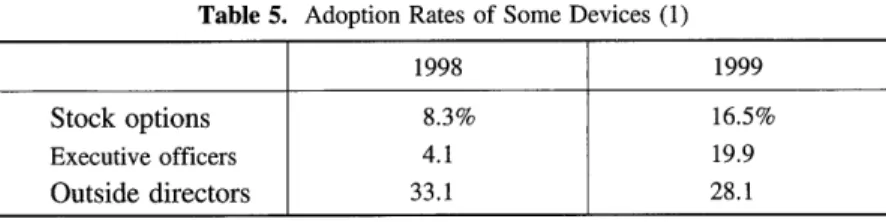
From Table 5 we can see the adoption rates of stock options and executive officers are stillfewer than 20% in even largest companies. The high percentage of outside directors doesn't mean positive side. Outside directors originally existed here and there in Japan, who are dispatched by parent companies, affiliated companies and banks for their own interests.
So outside directors who play a role of corporate governance are quite a few and new creature in Japan.
Table 5. Adoption Rates of Some Devices (1)
How do we evaluate this situation? I think this reflects the pragmatism of managers and general management staffs. In other words they like pragmatism. They are stillnot convinced that such devices for board are in dispensable. Their shareholders are well behaved and do not force to accept all of those means. Those means are not legal requirements either. Precisely it goes ahead of our Commercial Law. So managers delay and select to adopt devices.
And this is the situation that Tokyo Stock Exchange (TSE) standstills.
Though the report of LIAJ in 1997 and the Final Report of CGFJ in 1998 both demanded listing requirements to incorporate some devices of corporate governance, such as outside directors and executive officers,
― 205 ―
TSE didn't take the proposal. TSE insisted that they didn't want to take an unprecedented leading role on corporate governance.
A TSE report published in 1998 found that NYSE hadn't played a leading role to introduce outside directors and a independent audit committee: NYSE has required more than two outside directors to all inland listing companies by its Company Manual since 1956, while the
percentage of companies in top 300 companies, which outside directors were majority, had been 54% in 1953 and 61% in 1961; NYSE has required a independent audit committee to all inland listing companies by its Company Manual since 1978, while over 80% of NYSE listing
companies had already established audit committees in 1973 [ TSE, 1998b].
TSE have made their investigation by questionnaire in autumn 1998.
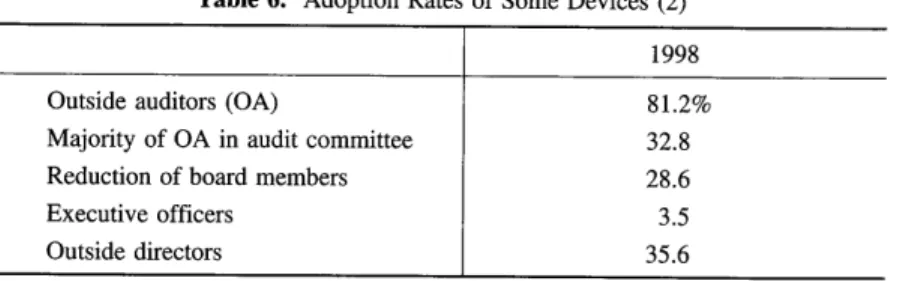
They said the results were negative for the immediate introduction of governance clauses. They concluded that apart from the adoption of outside auditors, adoption rates of devices of corporate governance were generally low. And though they did not mention, the high percentage of outside auditors dit not mean the positive side. Because some outside auditors are as outside directors dispatched by parent companies, affiliated companies and banks. At the conclusion TSE said we were stillin the period of groping and enlightenment [TSE, 1998b].
A report submitted to chairman of TSE by Policy Committee of TSE
Table 6. Adoption Rates of Some Devices (2)
― 206 ―
in Feb. 1999 avoided the immediate introduction of governance clauses into listing requirements but demanded positive participation to improve
corporate governance among public companies [1999]. Advisory Committee of TSE, which represented listing companies, also revealed negative opinions on the immediate introduction of governance clauses in
April 1999.
I understand well TSE do not want to stand out at the sacrifice of listing companies. But on the other hand it's undoubted that they'll get needless applause from scholars if they took some strong actions to follow
the formalities in corporate governance.
References
CalPERS, Market Principles,Japan, Mar.16, 1998. (Japanese and English)
Corporate Governance Forum of Japan [CGFJ], Corporate Governance Principles‑A Japanese View (Final Report), May 26, 1998. (Japanese and English)
Economic Planning Agency [EPA, 1996], Economic Survey of Japan 1995‑1996, PrintingBureau of MOF, 1996. (Japanese and English)
Economic Planning Agency [EPA, 1997], Economic Survey of Japan 1996‑1997, PrintingBureau of MOF, 1997. (Japanese and English)
Economic Planning Agency [EPA, 1998], Economic Survey of Japan 1997‑1998, PrintingBureau of MOF, 1998.(Japanese and English)
Fukumitsu, Hiroshi [1999], "Corporate Governance in Transition"Seijo Economic Papers 147, 1999. (Japanese)
Fukumitsu, Hiroshi [2000], "Explanatory Remarks on Mergers and Acquisitions"
Shoken Keizai Kenkyu 26, 2000. (Japanese)
Ito, Osamu [1999], "A Brief Survey of the Studies on the Corporate Governance and the Comparative Economic System", Shoken Keizai Kenkyu 22, 1999.
(Japanese)
Japan Association of Corporate Executives [JACE, 1996], 12th Report on Firms, May 1996. (Japanese)
Japan Association of Corporate Executives [JACE, 1998], 13th Report on Firms, April 1998. (Japanese)
Kamino, Masato [2000], "InstitutionalInvestors and Corporate Governance" DKB
― 207 ―
Research Institute Review 2, 2000. (Japanese)
Kagono, Tadao [2000], "Vitalizing management to make shareholders' responsibility clear", Bulletin of Japan Economic Research Center, July 1, 2000. (Japanese) Life Insurance Association of Japan [LIAJ, 1997], Situation of Returning Profits to
Shareholders. (Japanese)
Life Insurance Association of Japan [LIAJ, 1998], Situation of Coping with Enhancement of Shareholders' Value. (Japanese)
Life Insurance Association of Japan [LIAJ, 1999], Situation of Coping with Enhancement of Shareholders' Value. (Japanese)
Nissey Life Institute of Research [NLIR, 1999], "Corporate Governance by Institutional Investors", Report of Nissey Research Institute 10, summer 1999.
(Japanese)
Okumura, Hiroshi [1997], An Image of 21st Century Companies, Iwanamisyoten, 1997. (Japanese)
Okumura, Hiroshi [1998], Irresponsible Capitalism, Toyokeizaishinpousya, 1998.
(Japanese)
Otani, Hiroshi [1998], "Recent Trend of Corporate Governance" DKB Research Institute Review 3, 1998. (Japanese)
Shibuya, Hiroshi [1999], "Building the Analytic Viewpoint on American Institutional Investors and Corporate Governance" Shoken Keizai Kenkyu 22,
1999. (Japanese)
Suto, Megumi, and Yutaka Suzuki [1998], "Corporate Governance by Pension Fund in Japan" Security Analysts Journal 36‑8, Aug. 1998. (Japanese)
Tokyo Stock Exchange [1998a], "Recent Trend of Corporate Governance" Shoken, July 1998. (Japanese)
Tokyo Stock Exchange [1998b], "Results of Questionnaire Investigation on Corporate Governance" Shoken, Dec. 1998. (Japanese)
Tokyo Stock Exchange [1999], "A Future Image of Tokyo Stock Exchange" Shoken, March 1999. (Japanese)
The author is Professor of Financial Management at Seijo University in Tokyo. His e‑mail is [email protected].
Seijo‑Daigaku Keizaikenkyu(Seijo Economic Papers)No.l51, 2001.