A
Language Complete
for
the
Families
of
Polynomial-Size Binary
Decision
Diagrams
多項式サイズの二分決定グラフの族に対する完全言語
Hiroshi
SAWADA
Yasuhiko TAKENAGA
Shuzo YAJIMA
澤田宏 武永康彦 矢島脩三
Faculty of Engineering, Kyoto University
京都大学工学部
1
Introduction
A binary decision diagram (BDD) [1] is one of representation forms of Boolean functions.
It can represent many practical Boolean functions by feasible size and there exists a unique
canonicalform for each Boolean function. Therefore it is widely used formanipulatingBoolean functions on computers.
A BDD represents a Boolean function. On theother hand, a family of BDD’s repIesents
alanguage. The class oflanguagesaccepted by families ofpolynomial-sizeBDD’s (PolyBDD)
[2] can be seen as a complexity class which is computable by BDD’s of feasible size. A family
of symmetric functions, the language $\{0^{n}1^{n}\}$ andthe language $\{ww|w\in\{0,1\}^{*}\}$ areexamples
of elements of PolyBDD.
In this paper, we show a complete language for PolyBDD under constant-depth circuit
reducibility. It reflects the characteristics of PolyBDD and is the representative language of
PolyBDD. To clarify the relations between PolyBDD and other complexity classes, it is
suffi-cient to clarify therelations between a completelanguagefor PolyBDD and other complexity
classes.
Thispaper is organized as follows. In section2, we defineaBDD and PolyBDD. In section
3, we show a complete language for PolyBDD under constant-depth circuit reducibility. In
section 4, we conclude our discussion.
2
Preliminaries
2.1
Binary
Decision
Diagram
(BDD)
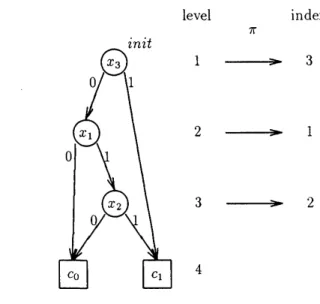
A binary decision diagram (BDD) (Figure 1) [1] which represents an n-variable Boolean func-tion $f(x_{1}, \cdots, x_{n})$ is a 6-tuple ($N_{V},$$N_{C}$, init, edge, level,$\pi$), where
$1V_{V}$ is a set of variable nodes,
$N_{C}=\{c_{0}, c_{1}\}$ is the set of constant nodes,
$init\in N_{V}$ is an initial node,
edge : $N_{V}\cross\{0,1\}arrow(1V_{V}\cup N_{C})$ is a set ofedges,
level : $(N_{V}\cup lV_{C})arrow\{1, \cdots, n+1\}$ is a mapping from the set of nodes to the set oflevels such that
level(init) $=1$,
level(v) $<$ level(edge(v,$b$)) $(b\in\{0,1\})$ if$v\in JV_{V}$,
level$(v)=n+1$ if$v\in 1V_{C}$,
$\pi$: $\{1, \cdots, n\}arrow\{1, \cdots, n\}$ is a permutation from theset of levels ofvariable nodes
level index $\pi$ 1 $arrow$ 3 2 $arrow$ 1 3 $arrow$ 2 4
Figure 1: A BDD representing a Boolean function $x_{1}\cdot x_{2}+x_{3}$
Each node $v$ of a BDD represents a Boolean function $f_{v}$ defined as follows,
$f_{c_{0}}=0$ (inconsistency), $f_{c_{1}}=1$ (tautology),
$f_{v}=\overline{x_{\pi(level(v))}}\cdot f_{edge\langle v,0)}+x_{\pi\{level(v))}\cdot f_{edge(v,1)}$if$v\in N_{V}$
.
A BDD ($N_{V},$$JV_{C}$, init, edge, level,$\pi$) represents the Boolean function
finit.
A BDD is calledreduced iftherearenot anynode$v$ such thatedge$(v, 0)=edge(v, 1)$ and anypairof nodes $v,$$v’$
such that level(v) $=level(v’),$ $edge(v, 0)=edge(v’, 0)$ and edge$(v, 1)=edge(v’, 1)$. A reduced
BDD represents a Boolean function with a variableorder is unique up to isomorphism.
2.2
Family of Polynomial-Size BDD’s
A BDD is one of representation forms of Boolean functions. On the other hand, a family
of BDD’s represents a language. A family $\{B_{n}\}$ of BDD’s is a sequence $B_{1},$ $B_{2},$ $\cdots$ of BDD’s,
where$B_{n}=$ ($4V_{V},$ $1V_{C}$,init,edge, level,$\pi$)isaBDD representingann-variableBoolean function.
Afamily $\{B_{n}\}$ of BDD’s is said to accept a language $L\subseteq\{0,1\}^{*}$ if and only if
$\forall n,$ $b_{1}\cdots b_{n}\in L\Leftrightarrow f_{n}(b_{1}, \cdots, b_{n})=1$ , where $f_{n}$ is the Boolean function which $B_{n}$
represents.
Wecan regard a family of BDD’s as acomputational model which accept a language.
Definition 1 Let PolyBDDbe the class oflanguages which are acceptedbyfamiliesofBDD’s whose size are boundedby a polynomialof the number of the variables. $\square$
In this paper, wedo not consider the uniformity, the property that the function $narrow B_{n}$ is
computable easily, offamilies $\{B_{n}\}$ of BDD’s. In order to characterize nonuniform families of
BDD’s, we use nonuniform on-line Turing machines.
A nonuniform Turing machine is a Turing machine with a two-way read-only input tape.
::.
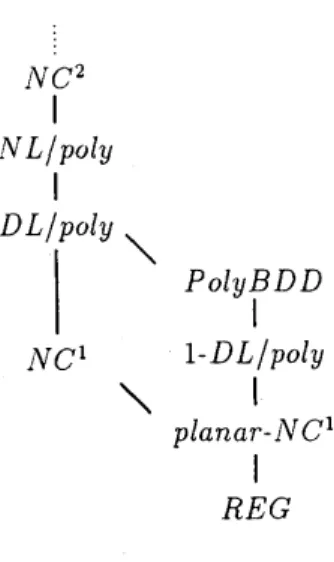
$NC^{2}$ $1$ N$L/poly$ $1$ $DL/poly\backslash$ $|$ PolyBDD $NC^{1}$ l-DL/poly $\backslash$ $|$ planar-NC1 $1$ $REG$Figure 2: The relations among the classes
$\{0,1\})$, a nonuniform Turing machine start its computation with $b_{1}\cdots b_{n}$ on the input tape
and with $\alpha(n)$ onthe advice tape, where $\alpha$ : $\{1, 2, \cdots\}arrow\{0,1\}^{*}$ is called an advice function.
A nonuniform on-line Turing machine is a nonuniform Turing machine whose input tape is
one-way.
Let $DL/poly,$ $NL/poly$and l-DL/poly be the class oflanguagesaccepted bylogarithm-space bounded deterministic nonuniformTuring machines with polynomial advice, logarithm-space
boundednondeterministicnonuniformTuringmachines with polynomial advice and
logarithm-spacebounded deterministic nonuniform on-line Turing machines with polynomial advice.
Let $NC^{k}(k=1,2, \cdots)$ be the class oflanguagesaccepted by nonuniformfamiliesof constant
fan-in logic circuits of$\log^{k}$n-depth and polynomial-sizefor $n$ inputs.
On the relations between PolyBDD and other classes, the following results are obtained
(Figure 2),
planar-NC’
$\subseteq$ l-DL/poly [3], l-DL/poly $\subset$ PolyBDD $\subset DL/poly[2][4],$ $NC^{1}\subseteq$$DL/poly\subseteq NL/poly\subseteq NC^{2}[5]$, where $REG$ is the classofregular languages and
planar-NC1
is the class oflanguages accepted by nonuniform families ofconstant fan-in planar circuits of
$\log$n-depthand polynomial-size for $n$ inputs.
3
A Complete
Language
for
the
class PolyBDD
3.1
Constant-Depth
Circuit
Reducibility
Let $L,$$L_{c}\subseteq\{0,1\}^{*}$. We say that $L$ is constant-depth reducible to $L_{c}$ (denote $L\leq_{cd}L_{c}$) if
and only if there exists a function $f$ : $\{0,1\}^{*}arrow\{0,1\}^{*}$ computable by a family of constant
fan-in logic circuits of constant-depth and polynomial-size such that for all $x\in\{0,1\}^{*},$ $i1^{\backslash }\in$
$L\Leftrightarrow f(x)\in L_{c}$. Note that $|f(x)|$ is bounded by a polynomial of $|x|$ since the circuits are
polynomial-size.
Foraclass $C$, if$\forall L\in C,$ $L\leq_{cd}L_{c}$, we say that $L_{c}$ is hard for$C$ under constant-depth circuit
reducibility. If$L_{c}$ is hard for $C$ and $L_{c}\in C$, we say that $L_{c}$ is completefor $C$. If$L_{c}$ is complete
12345
$42351\{\begin{array}{lll}00 0 l000l 00000l0 000 0l00000 \end{array}\}$
Figure 3: A directed graph and its adjacency matrix
3.2
A
Complete
Language-Topologically Arranged
Deterministic
Graph
Accessibility Problem
We show that Topologically Arranged Deterministic Graph Accessibility Problem (TADGAP)
[6] is a complete language for PolyBDD under constant-depth circuit reducibility. Before
defining the language TADGAP, we define adirected graph and its adjacency matrix (Figure
3). A directed graph is a2-tuple (V,$E$), where
$V=\{v_{1}, \cdots, v_{|V|}\}$ is a set ofnodes,
$E\subseteq\{(v_{i}, v_{j})|v_{i}, v_{j}\in V\}$ is a set of directed edges.
The adjacencymatrix $(x_{\mathfrak{i}j})$of a directedgraph $G=(V, E)$ is a $|V|\cross|V|$ matrixand itselement
$x_{ij},$ $(1\leq i,j\leq|V|)$ is defined as follows, $x_{ij}=\{\begin{array}{l}0if(v_{i},v_{j})\not\in Elif(v_{i},v_{j})\in E\end{array}$
We say that there exists a path from a node $v_{i_{1}}$ to anode$v_{i_{2}}$ in a directed graph (V,$E$) if
thereexist nodes$v_{j_{1}},$$v_{j_{2}},$$\cdots,$$v_{j_{k}}\in V$such that $(v_{i_{1}}, v_{j_{1}}),$ $(v_{j_{1}}, v_{j_{2}}),$ $\cdots,$ $(v_{j_{k}}, v_{i_{2}})\in E$. We define
that the outdegreeof a node $v_{i}$ is the value $|\{v_{j}|(v_{\mathfrak{i}}, v_{j})\in E\}$ . We say that a directed
graph (V,$E$) is topologically sorted if for all
$v_{i},$$v_{j}\in V,$ $(v_{\mathfrak{i}}, v_{j})\in E\Rightarrow i\leq j$ is satisfied.
Definition 2 TADGAP $=\{x_{11}x_{12}\cdots x_{1m}\cdots x_{mm}|$
$(x_{ij})$ is the adjacency matrix of a directed graph $G$ such that
$G$ is topologically sorted,
the outdegree of each node of $G$ is $0$ or 1,
there exists a path from $v_{1}$ tO $v_{m}$ of$G$ $\}$ 口
Theorem 1 TADGAP is constant-depth complete for PolyBDD.
[proof] From the followingtWO lemmas 口
Lemma 1 $TADGAP\in$ PolyBDD
[proof] We prove that TADGAP $\in$ l-DL/poly ($\subseteq$ PolyBDD). Let $M$ be a logarithm-space
bounded nonuniform on-lineTuring machine with polynomial advice. We design $M$ to accept
the language TADGAP. Let the input of$M$ be $y\in\{0,1\}^{*}and/|$ is the adjacency matrix of
a directed graph $G$. The advice of $M$ for the input of length $\uparrow\tau$ is the value of $\gamma\eta=\sqrt{n}$. $\wedge’\backslash /j$
can check the following three conditions using the logarithm-space since $M$ knows the value
of $m=\sqrt{n},$ $1$) $G$ is topologically sorted, 2) the outdegrees of nodes of $G$ is $0$ or 1. 3) there
exists a path from node $v_{1}$ to $v_{n}$ satisfying the conditions above. TherefoIe TADGAP $\in 1-$
index $\Rightarrow$ $C_{1}$ $b_{1^{1}}b_{1^{2}}b_{0^{3}}\in L$ $\Leftrightarrow$ $(x_{ij})=[0000100100010000000000000]$ $\in TADGAP$
Figure4: An exampleofreduction Lemma 2 $\forall L\in$ PolyBDD, $L\leq_{cd}$ TADGAP
[proof] For each $L\in$ PolyBDD, we consider the family $\{B_{n}\}$ of polynomial-size BDD’s
ac-cepting the language$L$. Let the n-variable BDD of$\{B_{n}\}$ be$B_{n}=$ ($N_{V},$$1V_{C}$,init, edge, level,$\pi$)
and $v_{i}’,$$v_{j}’\in(N_{V}\cup N_{C})$ such that
$v_{1}’=init$,
$v_{j}’=edge(v_{i}’, b)\Rightarrow i<j,$ $(\forall v_{\mathfrak{i}}’, v_{j}’, \forall b\in\{0,1\})$,
$v_{m}’=c_{1}(m=|1V_{V}\cup 1V_{C}|)$.
For $B_{n}$ and the input $b_{1}\cdots b_{n}\in\{0,1\}^{n}$ of $B_{n}$, we consider the directed graph $G=(V, E)$ (figure4), where
$V=(N_{V}\cup N_{C})$ such that $v;=v_{i}’(1\leq i\leq m)$,
$E=\{(v’, edge(v’,\cdot b_{\pi\langle level\langle v’))}))|v’\in N_{V}\}$
.
The directed graph $G$ has the outdegree of$0$ or 1 and is topologically sorted. It seems to be
clear that there exists apath from node$v_{1}$ to $v_{m}$ of $G$ if and onlyif$b_{1}\cdots b_{n}\in L$. Hence, ifwe
let the adjacency matrixof $G$ be$y$, $b_{1}\cdots b_{n}\in L\Leftrightarrow y\in$ TADGAP.
$|y|$ is boundedby a polynomial of$n$ because$m$, the size of$B_{n}$, is bounded by apolynomial of $n$. An element $x_{ij}(1\leq i,j\leq m)$ of$y$ is computable by the formula
$x_{ij}=_{b\in\{0,1\}}(b_{\pi(level\langle v’))}=b\wedge v_{j}’=edge(v_{i}’, b))$.
3.3
The
Relation between PolyBDD and
$NC^{1}$It is known that $NC^{1}\not\subset$ PolyBDD because the Boolean function of the n-th bit output of
the n-bit binary multiplier can not be represented by a BDD of polynomial-size whereas can
be represented by a logic circuit of logarithm-depth [7]. Here, we have a question whether PolyBDD $\subset NC^{1}$ or not (Figure 2). From the result of theorem 1, we have the following
result.
Corollary 1 TADGAP $\in NC^{1}\Leftrightarrow PolyBDD\subset NC^{I}$ 口
We conclude that the necessary andsufficientcondition for $PolyBDD\subset NC^{1}$ is TADGA$P\in$
$NC^{1}$. However, thefollowing result indicate thattoclarify whether$(1- DL/poly\subseteq)PolyBDD\subset$ $NC^{1}$ is as difficult as to clarify whether $DL/poly\subseteq NC^{1}$, which is one of the famous open problems.
Theorem 2 $([3])1-DL/poly\subseteq NC^{1}\Leftrightarrow DL/poly\subseteq NC^{1}$ 口
4
Conclusion
In this paper, we show that TADGAP is a complete language for PolyBDD under
constant-depth circuit reducibility and that the necessary and sufficient condition for $PolyBDD\subset NC^{1}$
is TA$DGAP\in A’C^{1}$. However, to clarify whether PolyBDD $\subset NC^{1}$ is as difficult as to clarity
whether $DL/poly\subseteq NC^{1}$, one of the famous open problems.
Acknowledgment
The authors would like tothank all the membersof Yajima Lab. at Kyoto University for their
valuablediscussion and suggestions.
References
[1] R. E. Bryant. Graph-based algorithms for boolean function manipulation. IEEE Tran$.
Comput., $C- 35(8):677-691$, August 1986.
[2] N. Ishiura and S. Yajima. Aclass oflogic functionsexpressible by apolynomial-sizebinary
decisiondiagram. In Proc. Synthesis and SimulationMeetingandInt. Interchange (SASIMI
90). pages 48-54, October 1990.
[3] 池川将夫. 論理回路の複雑さに関する一考察. $LA$ シンポジウム, .Iuly 1989.
[4] H. Sawada, Y. Takenagaand S. Yajima. Onthe relationsbetween binarydecision diagrams,
Turing machines and combinational logic circuits. IEICE, COMP92-66, November 1992.
[5] Allan Borodin. Onrelating time and spacetosizeand depth. SIAM Journal on Computing.
$6(4):733-744$, December 1977.
[6] J. Hartmanis and S. Mahaney. Languages simultaneously complete for one-way and
two-way log-tape automata. SIAM Journal on Computing, $10(2):383-390$, May 1981.
[7] R. E. Bryant. On the complexity of VLSI implementations and graph representations of boolean functions $\backslash vith$ application to integer multiplication. IEEE Trans. Comput..