NLS
方程式のホモクリニック解と数値的周期性
東大理 梅木 誠
Generalized homoclinic solutions and numerical periodicity of the NLS equation Makoto Umeki
Department of Physics, University of Tokyo Abstract
A generalization is given of the Ablowitz &Herbst’s exact
solu-tions ofthe nonlinear Schrdinger (NLS) equation, which are
tempo-rally homoclinic and periodic in space. It is found that, in numerical
simulations ofthe integrable difference scheme of the NLS equation,
periodic and quasi-periodic motions are generated instead of $\mathrm{h}\mathrm{o}\mathrm{m}(\succ$
clinic orbits. The periods are proportional to $-\ln\epsilon/\Omega_{i}$, where $\epsilon$ is
the magnitudeof numerical errors and $\Omega_{i}$ is the growth rate of the
unstable modes.
Homoclinicity in dynamical systems plays acrucial role in understanding
a mechanismof creationof chaos. Inlow-dimensional systems, it is knownas
the Melnikov’s theorem that a perturbation often destroys the unperturbed
homoclinic orbits in integrable systems and create the Smale’s horseshoe
mapping inthevicinity of them. Inthissense,homoclinicitymaybe regarded
as the
fouffi
route to chaos, in addition to period-doubling, quasi-periodicityand intermittency. In contrast withlow-dimensional systems,thehomoclinic
structures in higher or infinite dimensions have been studied very recently
[1, 3, 4, 6] and the study should be applied to physical phenomena including
parametrically forced water waves [7].
On the other hand, the nonlinear Schr\"odinger equation, which is one of
themost-understood integrable equationsby soliton theory, is still attractive
for study ifweconsideritsperiodicboundaryproblem. Inaremarkablepaper
[1] Ablowitz and Herbst first showed that the focusingnonlinearSchr\"odinger
equation
$iu_{t}+u_{xx}+2\sigma|u|^{2}u=0$, (1)
with $\sigma=1$ possesses analytically expressed exact solutions which are
homo-clinic to the periodic solution $u=a$$\exp 2ia^{2}t$. The $N$-homoclinic solution
was derived through the transform $xarrow ix,$$tarrow-t$ of 2N-dark-hole
with $\sigma=-1$ ) with the evenness condition $u(x, t)=u(-x, t)$, which can
be derived directly by Hirota’s bilinear method. However, we show that the
evenness condition is just sufficient but not necessary.
The $M-\mathrm{d}\mathrm{a}\Gamma \mathrm{k}$-hole soliton solutionof thedefocusing NLSequation is given
by
$u(x,t)=a\exp(-2ia^{2}t)g(x,t)/f(x, t)$, (2) where
$f(x,t)= \sum_{=\tilde{\mu}0,1}\exp[\sum_{j>k}^{M}\alpha_{jk\mu_{j}}\mu_{k}+\sum_{j}M=1\mu_{j}\eta_{j}]$ , (3)
$g(x, t)= \sum_{\overline{\mu}=0,1}\exp[\sum_{j>k}^{M}\alpha jk\mu j\mu k+\sum_{1j=}\mu j(\eta_{j}+2iM\phi_{j})]$ , (4)
and
$\exp(\alpha_{jk})=[\frac{\sin(\phi_{j}-\phi_{k})/2}{\sin(\phi_{j}+\phi_{k})/2}]^{2}$ (5)
$\eta_{j}=p_{j}(x-X_{j})-\Omega_{j}t+\gamma_{j}$ (6)
$p_{j}=2a\sin\phi_{j}$ (7)
$\Omega_{j}=\pm p_{j}\sqrt{4a^{2}-p_{j}^{2}}$, (8) $\phi_{j},$ $\gamma_{j}$ and $x_{j}$ are real constants, $\sum_{\overline{\mu}=0,1}$ is the summation over all possible
combination of$\mu_{j}=0$ and 1 for $j=1,$$\cdots,$$M$ and $\sum_{j>k}^{M}$ denotes the
sum-mation over all possible pairs chosen from $M$ elements. Here the definition
of the phase $\gamma_{j}$ is different ffom that in [1] since we introduced $x_{j}$. In order
to obtaingeneral homoclinic solutions, we put
$x=iX,$ $t=-T$ and $x_{j}=iX_{j}$
.
(9)We denote, under the above transform, the relation between the solutions $u$
and $U$ ofthe defocusing and focusingNLS equations, respectively, as
$u(x, t;x_{j})=U(x, T;x_{j})$. (10)
Theremaining condition that we should impose is the real-valuedness of
$f(x, t)$
.
This cannot be not satisfied if $M$ is odd, but if$M$ is even, it can besatisfied by letting $p_{2j-1}=-p2j,$$\gamma 2j-1=\gamma_{2j},$ $\Omega_{2j-1}=\Omega_{2j},$$\phi_{2j-}1=\phi_{2j}+\pi$
not only periodic solutions in space but also quasi-periodic solutions if$p_{j}$ are
incommensurate.
The solutionfor $N=1$ is given explicitlyby
$U(X,T)=a \mathrm{e}\frac{1+2\cos\varphi \mathrm{e}^{\theta+i}\emptyset+A_{12}22\mathrm{e}\theta+4i\emptyset}{1+2\cos\varphi \mathrm{e}^{\theta}+A12\mathrm{e}2\theta}2ia^{2}T$, (11)
where $\theta=\Omega T+\gamma,$ $\varphi=p(X-X_{1}),$ $p=2a\sin\phi$ and $A_{12}=\cos^{-2}\phi_{\mathrm{J}}$ The
asymptotic behaviors of$U(X, T)$ as $Tarrow\pm\infty$ are respectively given by
$U_{-}=a\mathrm{e}^{2iaT}2[1+4i\sin\phi \mathrm{e}^{\theta}\cos\varphi]+i\emptyset$ , (12)
$U_{+}=a\mathrm{e}^{2ia^{2}}[T+4i\phi 1-4iA^{-1}12\sin\phi \mathrm{e}-\theta-i\emptyset\cos\varphi]$ . (13)
Thereisnoessentialdifference between [1] and thepresentsolutionfor$N=\dot{1}$,
since the solution is invariant under the translation. If $N=2$, however, we
obtain afamily ofnew solutions
$U(X, T;X_{j})=a\exp(2ia2T)G(x, T)/F(X, T)$ (14)
where
$G(X, T)$ $=$ $1+2\mathrm{e}^{\theta_{1+}}2i\phi 1\cos\varphi_{1}+A_{12}\mathrm{e}^{2\theta_{1}4}+i\phi 1+2\mathrm{e}^{\theta 2i}\mathrm{c}\mathrm{o}3+\emptyset 3\mathrm{s}\varphi_{3}$ $+A_{\mathrm{s}}4\mathrm{e}+2\theta_{3+}4i\phi s2\mathrm{e}2\theta_{1+3+}\theta i(\emptyset 1+\phi 3)\{A_{13}\cos(\varphi_{1}+\varphi_{3})$
$+A_{2\mathrm{s}^{\mathrm{c}}}\mathrm{o}\mathrm{s}(\varphi 1-\varphi_{3})\}+2A_{13}A2\mathrm{s}A\mathrm{s}4\mathrm{e}^{\theta 2\theta}1+3+i(2\emptyset 1+4\emptyset 3)\mathrm{c}:0.\mathrm{s}\varphi_{1}$
$+2A_{12}A13A23\mathrm{e}2\theta_{1}+\theta 3+i(4\phi_{1+}2\phi \mathrm{s})\cos\varphi_{\mathrm{s}}$
$+A_{12}A_{1}^{2}3A^{2}23A34\mathrm{e}^{2()+4}\theta_{1}+\theta_{3}i(\phi 1+\phi_{3})$ (15)
and
$F(X, T)=G(X, T)$ with $\phi_{i}=0$ for all $i$, (16)
where$\theta_{i}=\Omega_{i}T+\gamma_{i}$and $\varphi_{i}=p_{i}$(X-Xi). We seethat there exists necessarily
aconjugate counterpart ofeverycomplexterm in (4) under thetransform (9)
for arbitrary $N$, which implies that the real valuedness of$f$ is satisfied. Note
that thereis apossibility of the applicationof this solution to the motion of
a knotted closed filament.
Next, we show how these homoclinic solutions
are
affected by numericalprecise as possible and examine the effect of errors, we perform a following
numerical experiment.
1) We adapt the Ablowitz-Ladik system [2]
$iu_{nt}+(u_{n+1^{-}}2u_{n}+u_{n-1})/h^{2}+|u_{n}|^{2}(u_{n+1}+u_{n-1})=0$, (17)
whichis the integrablefinite-differenceschemeanddoes not showanychaotic
motions. The number ofspatial discretization $N_{p}$ is taken as 64.
2) We use three numerical codes written in single, double and quadruple
precisions, which have about 7, 16 and 33 effective decimal digits offloating
point numbers. The truncation error is reduced to the level ofthe round-off
error. For this purpose, we choose as the scheme of time integration the
$\mathrm{f}_{\mathrm{o}\mathrm{u}\mathrm{r}\mathrm{t}}.\mathrm{h}$-order Runge-Kutta method in the former two
codes, and the
sixth-order eight-stage method by $\mathrm{H}\mathrm{u}\mathrm{t}\mathrm{a}[5]$ in the quadruple case. The temporal
steplength$\Delta t$ is takenas $\Delta t=10^{-2},10^{-}3$ and $10^{-4}$ so that thelocal
trunca-tionerroris roughly estimated as $10^{-8},10^{-}15$ and $10^{-28}$, which are on a level
of the round-off
errors.
Then, we denote the total size of the local numericalerror by $\epsilon_{n}$
3) The initial conditionsaregiven according to the asymptotic form$Tarrow-\infty$
of the solution, (12) for $N=1$. They are expressed by the
sum
of the fixedpoint $a$$\exp(2ia^{2}\tau)$ plus a small disturbance which denotes unstable modes.
The magnitude of the disturbance is $\epsilon_{n}$. This may be considered as one of
the best implementations ofhomoclinic orbits in a numericalsense.
First, a 1-homoclinic solution is examined. We put $L=2\sqrt{2}\pi$ and the
initial condition is
$U(X, T=0)=0.5[1-\epsilon(1+i)\cos(pX)]$ (18)
with $p=2\pi/L$ and $\epsilon=\epsilon_{i}=\epsilon_{n}$
.
The $\mathrm{s}\mathrm{p}\mathrm{a}\mathrm{t}\mathrm{i}\mathrm{c}\succ \mathrm{t}\mathrm{e}\mathrm{m}\mathrm{p}\mathrm{o}\mathrm{r}\mathrm{a}\mathrm{l}$ behavior of $|U|$ inFigure 1 shows not homoclinic but periodic motion in time. We observe
the sequence of appearance of bumps, whose positions are fixed or changed
alternatively. It should be noted that the periodsof three
cases
are different.The lefi side of Figure 2 shows the temporal evolution of the amplitude
$A=\sqrt{|\tilde{U}_{1}|^{2}+|\tilde{U}-1|}$where the Fourier coefficients $\tilde{U}_{j}$ is defined by
$\tilde{U}_{j}=\frac{1}{N_{p}}\sum_{l=1}U(x_{\iota})N_{\mathrm{p}}\mathrm{e}-ikjX_{l}$,
Theright sideof Figure 2shows the temporal plots of$({\rm Re}(V), {\rm Im}(V))$ at $X=$
$0$, where a new variable $V=U\exp(-2ia^{2}\tau)$ is introduced. This periodic
motion and its period can be explained as follows.
The initial condition is expressedas
$V=0.5+\epsilon_{i}\exp(i\varphi i)\cos(pX)$
.
(20) Comparing (12) with (18), we may estimate$\epsilon_{i}\approx\exp(\Omega T_{i}+\gamma)$ and$T_{i}=(\ln\epsilon_{i}-\gamma)/\Omega$ (21)
Similarly, we can estimate the final time $T_{f}$ of the single bump. The final
statemay be approximated as
$V=\exp(4i\phi)[0.5+\epsilon_{f}\exp(i\varphi_{f})\cos(px)]$. (22)
Letting $\epsilon_{f}\approx\exp[-(\Omega T_{f}+\gamma)]$, we have
$T_{f}=-(\ln\epsilon_{f}+\gamma)/\Omega$ (23)
Then, the lifetime ofthe numerical homoclinic solution is
$T_{f}-T_{C}=-(\ln\epsilon i+\ln\epsilon_{n})/\Omega$ (24)
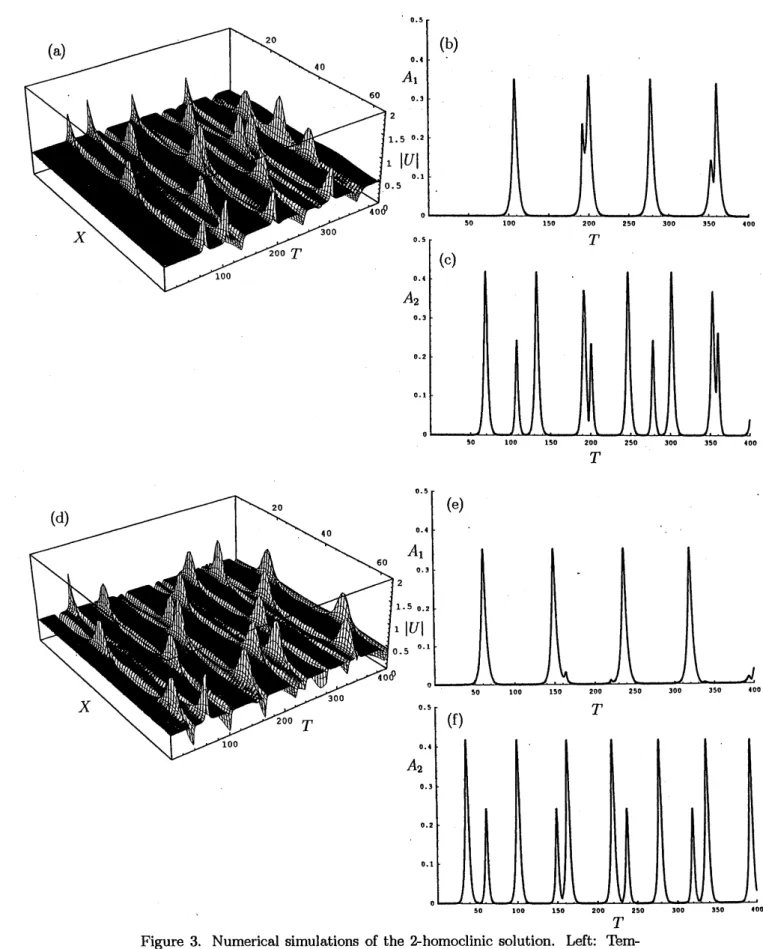
Next, a -homoclinic solution is investigated by an initial condition
$V=0.5\{1+\epsilon_{1}\exp(i\varphi i1)\cos[p_{1}(X-X1)]+\epsilon_{2}\exp(i\varphi i2)\cos[p_{2}(x_{-}X_{2})]\},$ (25)
with $p_{1}=2\pi/L=p_{2}/2,$ $X_{1}=0,$ $L=4\sqrt{2}\pi$ and $\epsilon_{1}=\epsilon_{2}=10^{-15},$ $X_{2}=0$
for one case and $\epsilon_{1}=\epsilon_{2}=10^{-8},$ $X_{2}=\pi/2$ for the other. A doubly-periodic
motion is observed numericallyinstead of the homoclinic solution. Following
the above argument on the temporal period,
we
may estimate the periodsbetween bumps as
$T_{\mathrm{P}^{i}}=-(\ln\epsilon i+\ln\epsilon_{f})/\Omega_{i}$ (26)
Then, the ratio of the two periods is determined by the ratio of the linear
growth rates as
The present example gives $\Omega_{1}=\sqrt{7}/8,$$\Omega_{2}=1/2$ and $\nu--0.661$ and the
numerically obtained values are$T_{p1}=84,$$T_{p2}=57$and $\nu=0.679$. Therefore,
the theoretical prediction is confirmed by this numerical simulation.
A generalized homoclinic solution ofthe NLS equation is given and it is
shown that it appears as periodic and quasi-periodic motions in numerical
simulations with minimized numerical errors. The dependenceofthe period
on the magnitude of errors may not be restricted to this example but is
expectedto be applicable to systems having homoclinic structures and small
perturbations or noise.
I thank Professor M. J. Ablowitz for his two seminars given in
Profes-sor Wadati’s group in Department of Physics, University of Tokyo, which
motivated me to study this subject.
References
[1] Ablowitz, M. J. and Herbst, B. M., SIAM J. Appl. Math. 50, 339 (1990).
[2] Ablowitz, M. J. and Ladik, J. F., Stud. in Appl. Math. 55, 213 (1976).
[3] Ablowitz, M. J., Schober, C. and Herbst, B. M., Phys. Rev. Lett. 71,
2683 (1993).
[4] Calini, A., Ercolani, N. M., McLaughlin, D. W. and Schober, C. M.,
Physica D89,227 (1996).
[5] Huta, A., Acta Fac. Rerum Natur. Univ. Comenian. Math. 2, 21 (1957).;
Lambert, J. D. Computational Methods in Ordinary $D$,
ifferential
Equations(John Wiley&Sons, 1973)
[6] McLaughlin, D. W. and Schober C. M., Physica D, 57,447 (1992).
Figure 1. Numerical
simulations ofthe
1-homoclinic solution
$\mathrm{F}\mathrm{i}\mathrm{u}\mathrm{r}_{2}\mathrm{e}\mapsto_{||}^{2\mathrm{L}}|U_{1}+U-1|0^{\cdot}\mathrm{f}\mathrm{t}\mathrm{h}\mathrm{e}\mathrm{s}\mathrm{p}\mathrm{a}\mathrm{t}\mathrm{i}\mathrm{a}\mathrm{l}\mathrm{F}\mathrm{o}\mathrm{u}\mathrm{r}\mathrm{i}\mathrm{e}\mathrm{r}\mathrm{C}\mathrm{o}\mathrm{m}\mathrm{e}\mathrm{f}\mathrm{t}\cdot \mathrm{T}\mathrm{e}\mathrm{m}\mathrm{p}\mathrm{o}\mathrm{r}\mathrm{a}\mathrm{l}\mathrm{e}\mathrm{V}\mathrm{o}1\mathrm{u}\mathrm{t}\mathrm{i}\mathrm{o}\mathrm{n}\mathrm{o}\mathrm{f}\mathrm{p}\mathrm{o}\mathrm{n}\mathrm{e}\mathrm{n}\mathrm{t}_{\mathrm{S}}\tilde{U}\mathrm{l}\mathrm{a}\mathrm{n}\mathrm{d}\tilde{U}\mathrm{h}\mathrm{t}\mathrm{e}\mathrm{a}\mathrm{m}\mathrm{p}1\mathrm{i}\mathrm{t}\mathrm{u}\mathrm{d}\mathrm{e}A=-1$
.
Right: Plots of $({\rm Re}(V), {\rm Im}(V))$ at $X=0$
.
$T$
Figure 3. Numerical simulations of the -homoclinic solution. Left:
Tem-poral evolution of $|U|$ with double precision. Rght: Temporal evolution of
$A_{1}=\sqrt{|\tilde{U}_{1}|^{2}+|\tilde{U}-1|}$and $A_{\mathit{2}}=\sqrt{|\tilde{U}_{2}|^{2}+|\tilde{U}-\mathit{2}|}$. The initial condition is $U=$
$0.5[1|\epsilon \mathrm{e}^{i\phi 0}1\cos p_{1}X+\epsilon \mathrm{e}^{i}\emptyset 02\cos p_{1}(X-x\mathit{2})],$ $L=4\sqrt{2}\pi,p_{1}=\mathrm{p}_{2}/2=2\pi/L$, and (a-c) $\epsilon=10^{-\mathrm{l}_{\backslash }})r,d\mathrm{v}_{2}=0$, (d-r) $\epsilon=10^{-\hslash},\mathfrak{l}^{\gamma}2\Delta \mathrm{Y}2=\pi/2$