Synt hes i s of Rar e- Ear t h Sul f i des ( RE=Yb, Eu,
and Sm
) w
i t h Val enc e- Fl uc t uat ed Char ac t er s and
Thei r Appl i c at i ons
その他(別言語等)
のタイトル
価数揺動状態がある希土類の硫化物合成とその応用
著者
LI Li ang
学位名
博士(工学)
学位の種別
課程博士
報告番号
甲第390号
研究科・専攻
創成機能工学専攻
学位授与年月日
2016- 09- 28
I
Synthesis of Rare-Earth Sulfides (RE=Yb, Eu, and
Sm) with Valence-Fluctuated Characters and Their
Applications
(
価数揺動状態がある希土類の硫
物合成とそ
の応用
)
A Dissertation
Submitted to Muroran Institute of Technology
Division of Science for Composite Functions
In Partial Fulfillment of the Requirements
For the Degree of Doctor of Engineering
By
Liang Li
Muroran Institute of Technology
Muroran, Hokkaido, Japan
II
Certificate of Approval
This dissertation entitled:
Synthesis of Rare-Earth Sulfides (RE=Yb, Eu, and Sm) with
Valence-Fluctuated Characters and Their Applications
(
価数揺動状態がある希土類の硫
物合成とその応用
)
Written by Liang Li
has been approved for the Division of Science for Composite Functions Muroran Institute of Technology Hokkaido, Japan
Date: ____________________ __________________________________
Professor Dr. Shinji Hirai
Singed by the final examining committee:
_______________________________ _
Professor Dr. Akira Sakai
_______________________________ _
Professor Dr. Chihiro Sekine
III
Acknowledgments
First and foremost I have to thank God for being my strength and guide in the
writing of this thesis. Without Him, I would not have had the wisdom or the physical
ability to do so.
I would like to express my deepest thanks and humble supplication to my
supervisor Prof. Dr. Hirai Shinji for his untiring guidance and efforts during the entire
course of the research and preparation of this dissertation. I would also like to thank
Prof. Dr. Sakai, Prof. Dr. Sekine and Prof. Dr. Nakamura for their instructions and
valuable comments.
I would like to express my sincere gratitude to Dr. Toshihiro Kuzuya and Dr.
Kawamura for enormous help and guidance throughout. I would also like to thanks all
my friends and my laboratory staffs for all kinds of helps during my study in Muroran
institute of technology.
I also need to thank the Japanese Government (MONBUKAGAKUSHO: MEXT)
Scholarship for financial support during these three years.
Last, I would like to thank my wife and my parents for their spiritual support
IV
Abstract
In some rare earth compounds, valences of rare earth elements take non-integer
values, because valence values of rare earth elements fluctuate spatially and
temporally. The fluctuated valences depend strongly on the synthesis temperature. In
this study, Yb, Eu, Sm based sulfides with valence-fluctuation characters were to study
the synthesis and stability and expected to discover new applications.
Ytterbium sulfides were prepared from CS2 sulfurization of Yb2O3 and then heat
treatments. Ytterbium sulfides (Yb3S4 and YbS) are expected to be employed as high
temperature n-type thermoelectric materials due to their large Seebeck coefficient.
The influences of particle size and specific surface area of Yb2O3 powders,
sulfurization temperature and time and CS2 gas flow rate on preparation of ytterbium
sesquisulfide (Yb2S3) were researched. Small particle size (< 1 μm) and large specific
surface area (> 2 m2/g) of Yb
2O3 are necessary for fabrication of pure Yb2S3. Single
orthorhombic -Yb2S3and hexagonal -Yb2S3 were synthesized by the sulfurization of
fine Yb2O3 powders at 700 ~ 800 °C and 1000~1050°C with CS2 gas flow rate of 1.67
mL/s, respectively. Orthorhombic -Yb2S3 transformed to hexagonal -Yb2S3 with
increase of temperature. The heat treatments of Yb2S3 were investigated. Upon heat
treatment at 1000 °C for 3 hr in Ar/CS2 atmosphere, orthorhombic Yb2S3 phase
underwent phase transition to hexagonal Yb2S3 phase. Moreover, orthorhombic Yb3S4
was main phase after heat treatment at 1050°C for 8 hr under Ar atmosphere and
Yb2S3 disappeared upon prolonged (12 hr) heat treatment. Single Yb3S4 phase could
be obtained after treatment at 1000 °C for 3 hr, or at 1200 °C for 1 hr, under vacuum
(~1.2×10⁻³ Pa). Single-phase YbS with a homogeneity range of YbS1.11-1.15 could be
synthesized by treatment at 1500 °C for 3 hr.
Secondly, europium sulfides were synthesized by CS2 sulfurization of Eu2O3. EuS
is a ferromagnetic semiconductor with NaCl type crystal structure. As this temperature
is in the proximity of the boiling point of hydrogen, EuS is a potential magnetic
refrigeration material.
The effects of Eu2O3 character and sulfurization conditions on the preparation of
europium sulfides were researched. Single-phase Eu3S4 and EuS can be obtained by
CS2 gas sulfurization of spherical Eu2O3 with larger specific surface area and small
V
EuS can be fabricated from self-prepared needle Eu2O3 at 750 °C for 8 hr. The higher
sulfurization temperature and shorter sulfurization time accelerated the formation of
high purity EuS. Specific surface area of synthetics lessened with the rising of
sulfurization temperature and time. Synthetic pure Eu3S4 were treated under
rich-sulfur atmosphere, inert atmosphere and vacuum, respectively. Single EuS phase
was obtained at 973 K under rich-sulfur atmosphere or at 1073 K under inert
atmosphere. The stability of Eu3S4 during annealing is weaker than all above
mentioned conditions and the transformation finished at 873 K under vacuum of 1.2
*10-5 Pa. The transformation of Eu3S4 to EuS was attributed to stability of Eu2+ at high
temperature. The synthetic EuS powders were sintered under a uniaxial pressure of 50
MPa in vacuum. The large reversible magnetocaloric effect of polycrystalline EuS was
observed, which underwent second-order ferromagnetic to paramagnetic transition at
16.8 K. The maximum of magnetic entropy change is as large as 6.32 J/mol/K and the
adiabatic temperature change is 9.1 K under a vary magnetic field change of 5 T. The
entropy value for polycrystalline EuS was revised by the combination of the
magnetization and heat capacity data. The relative cooling power for polycrystalline
EuS reached 69.26 and 125.39 J/mol for ΔH = 3 T and 5 T, respectively.
Finally, non-stoichiometric samarium monosulfide (SmSx, 0.55<x<1.2) was
synthesized from Sm2S3 and SmH3 at 1273 K for 3 hr under vacuum. Until now,
polycrystalline SmS prepared from the direct reaction between samarium and sulfur,
has a thermoelectric figure of merit ZT ~0.9 with the optimal composition SmS0.96.
The influence of reaction ratio of Sm2S3 to SmH3 on the fabrication of SmS was
investigated.
The fabrication of SmS required the mole ratio of Sm2S3 to SmH3 above 1.
Lattice parameter of synthetic SmS increases firstly and then decreases to saturate
following with the addition of SmH3 content. SmS compact was sintered at 1373 K by
spark plasma sintering. Density of synthetic SmS is about 99% of theory density.
Seebeck coefficient of n-type semiconductor SmSx decreases as temperature rises. The
absolute value is distributed between 170-β80 μV·K-1. The electrical conductivity of
SmSx (0.86<x<1.07) decreases with temperature increasing and shows similar
temperature dependence. The surplus Sm which randomly distributed in the SmSx
VI
VII
概要
価数揺動状態 価数 時間的 揺 こ 整数値 離
中途半端 値を 場合 こ あ 価数揺動 特徴 一 価数 強
温度依存 こ あ 研究 価数揺動状態 あ Sm, Eu, Yb い
用途 見合う単相 硫化物を合成 こ を目的
最初 Yb2O3 CS2ガス硫化 熱処理 イッテル ウム硫化物を合 成し 斜方晶Yb3S4 p型熱電材料 立方晶YbS 773 K付近 い ゼー ベック係数 1000μV/K 達し 後 1023~1173 K付近 高温 n型
熱電材料 し 期 さ い
硫化実験 結果 粒 細 比表面積 大 Yb2O3 場合 973~
1073 K 温 硫化 -Yb2S3 1273~1373 K 高温 硫化 -Yb2S3 単
相 生成し こ 対し さ 大 比表面積 Yb2O3 場合 873K 硫化 -Yb2S3単相 生成 確認さ -Yb2S3を真空中 熱処理
Yb3S4 生成し 長時間 高温 熱処理 YbSを得 こ
次 Eu2O3 CS2 ガス硫化 ユーロ ウム硫化物を合成し EuS
NaCl 型結晶構造を有 強磁性半導体 あ 磁気相転移温度 水素液化
温度 20 K 近 あ 水素液化磁気冷凍 液化段 利用 磁気
冷凍材料 候補材料 あ
Eu2O3 細粒 粗粒を用意し 細粒 場合 硫化時間 わ 773 K
硫化 Eu3S4単相 1073K 硫化 EuS単相 生成し EuS 生成
Eu2O3 EuS2を経 Eu3S4を生成し 次い 一部Eu2O2Sを生成し EuS
を生成 推定し 一方 細粒 場合 硫化条件 わ Eu3S4
生成 硫化時間 1.8 ks 28.8 ks 場合 温 生成し Eu2O2S
1273 K 1073 K 高温 消滅し EuS単相 わち Eu2O3
Eu2O2Sを経 EuSを生成 こ 確認さ
EuS 焼結体 磁気ゼロ及び磁場中 5T 比熱を測定し こ
磁気ゼロ 場合 16.5 K 磁気転移 伴う大 ーク 一方 磁場中
ーク 磁場 広 高温 シ ト い う強磁性 -常磁性 状態
を二次相転移 常磁性体 典型的 変化を示し MPMSを用い 磁
化測定 求 単 体積当 磁気エントロ ー変化 温度依存性
16.8 K付近 山型 ーク 確認さ 単結晶 見 磁気エントロ ー変
化 値 一致し わち EuS焼結体 単結晶 同等 磁気熱量効果を有
こ 明
最後 Sm2S3 粉 SmH3 粉 反応 焼 結法 非化 学量論 組成
SmSx, 0.55<x<1.2 焼結体を作製し こ Sm金属 硫黄 直接反応
SmS0.96 合成さ 1000 K い 性能指数 Z 0.9×10⁻³ K-1 達
こ 報告さ い 最初 BN坩堝中 所定 配合比 Sm2S3 SmH3
混合粉 を焼成後 パルス通電焼結法 焼結体を作製し
焼結体 電気抵抗 ρ Sゼーベック係数を測定し こ ρ 仕込
組成 化 学量論組 成付近 焼結体 高 温ほ 減少 半導 体的挙動 を示
VIII
仕込 電気抵抗率 金属的 挙動を示し 仕込 組成 化学量
論組成付近 温度 共 ゼーベック係数 増加 傾向 見
SmH3を過剰 加え 場合 焼結体 ゼーベック係数 明確 温度依
存性 見 出力因子 Sm過剰 焼結体 1000~1500µWK-2m-1
IX
Contents
Dedication I
Acknowledgments III
Abstract IV
Chapter 1 Introduction 1
1. 1 Background rare-earth sulfide 1
1.1.1 Structure and characters of rare earth sulfide 1
1.1.2 Synthesis of Rare-earth sulfides 2
1.1.3 Application, 5
1.2 Valence-Fluctuation rare-earth sulfides 8 1.3 Research purpose and motivation 12 Chapter 2 Synthesis, sintering and heat capacity of ytterbium sulfides 15
2.1 Introduction 15
2.2 Experimental details 16
2.2.1 Characters of Yb2O3 powders 16
2.2.2 Sulfurization, heat treatment and sintering of ytterbium sulfides 18 2.2.3. Analysis and characterization of as-synthesized materials 19
2.3 Sulfurization of ytterbium sesquisulfides 20
2.3.1 XRD results of Yb2S3 20
2.3.2 Dependence of temperature, time and GFR on the formation of Yb2S3 24
2.3.3 Morphology, particle size distribution and specific surface area of Yb2S3 28
2.3.4 Kinetic analysis of reaction rate 33
2.3.5 Comparison of synthesis process of rare-earth sesquisulfides 34
2.4 Heat treatment and sintering of ytterbium sulfides 35
2.4.1 Heat treatment of Yb2S3 under Ar or Ar/CS2 gas 35
2.4.2 Heat treatment of Yb2S3 under vacuum 37
2.5 Sintering and Heat capacity of Yb3S4 and YbS 39
2.6 Conclusions 41
Chapter 3 Preparation, sintering and large magnetocaloric effect of europium
sulfides 43
3.1 Introduction 43
3.2 Experimental procedure 45
3.3 Influence of Eu2O3 character and sulfurization conditions on the preparation
of EuS 47
3.3.1 Preparation of Eu3S4 and EuS by CS2-gas sulfurization of Eu2O3 47
3.3.2 Influence of sulfurization conditions on the formation of EuS 53
3.3.3 Morphology and specific surface area of EuS particles 55
3.3.4 Thermodynamic analysis of sulfurization process 62
3.4 Heat treatment of synthesized Eu3S4 65
3.5 Sintering and large magnetocaloric effect of synthesized EuS 71
3.5.1 Sintering of synthetic EuS powder 71
3.5.2 Magnetization of polycrystalline EuS compacts 73
X
3.5.4 Comparison specific heat of polycrystalline and singe crystal EuS 81
3.6 Conclusions 81
Chapter 4 Synthesis and sintering of samarium rich SmSx and its electrical
property 83
4.1 Introduction 83
4.2 Experimental procedure 84
4.2.1 Synthesis of SmSx powders 84
4.2.2 Sintering of SmSx compacts 84
4.2.3 Electrical properties of SmSx compacts 85
4.3 Experimental results 85
4.3.1 Synthesis of SmSx powders 85
4.3.2 Sintering of SmSx compacts 90
4.3.3 Electrical transport properties of SmSx compacts 92
4.4 Conclusions 95
Chapter 5 Conclusions 96
1
Chapter 1 Introduction
1. 1 Background rare-earth sulfides
Sulfides are promising candidates for environment-friendly and cost-effective
materials. The rare-earth elements, Ln, are the elements which atomic numbers are 21,
39 and 57 through 71 in the periodic table. The characteristics of rare-earth elements
are unfilled and filled 4f shell and lanthanide contraction.
Rare-earth, Ln, can combine with sulfur to procedure rare-earth sulfides with
different formulas, such as rare-earth sesquisulfide (Ln2S3), monosulfide (LnS), Ln3S4,
and LnS2.
1.1.1 Structure and characters of rare earth sulfide
Lanthanide monosulfides, LnS, adopt the cubic NaCl-type structure. Magnetic
measurements show that most rare-earth monosulfides contain trivalent metals
implying an unbonded electron, Ln3+(e-)S2-. The extra electron is delocalized in the 5d
conduction band giving rise to metallic type conduction. However, the monosulfide of
ytterbium, europium and samarium contain divalent metals, Ln2+S2-, and behave as
semiconductors [1]. The variation of the lanthanide oxidation state is a result of the
change of lanthanide electronic configuration. Although the valence configuration of
most gas phase Ln2+ ions is 4fn+1, it appears that in some divalent lanthanide
compounds, the 4fn5d1 configuration is more stable resulting in an electron occupying
the broad 5d band [2, 3]. This is also reflected in their cell parameters, with the
genuine Ln2+S2- compounds having larger cell dimensions than Ln3+(e-)S2-[4]. The
lanthanides that usually remain divalent in their compounds are those that have
relatively accessible divalent state (i.e. Eu, Yb, and Sm). Generally, the stability of
their divalent state increases with decreasing anion electronegativity. These divalent
lanthanide compounds varied the lanthanide oxidation state leading to the change in
the lanthanide electronic configuration.
Lanthanide sesquisulfides, Ln2S3, exist in a variety of polymorphic forms and
larger lanthanides favoring higher coordination[5]. For a limited range of lanthanide
elements, Light Ln2S3 (light δn: δa, Pr, and σd) exhibit three polymorphic forms (α,
and ) structure types where the lanthanides are 7- to 8-coordinate [6]. The
orthorhombic α-Ln2S3 is stable at low temperature with exactly stoichiometric and
2
limiting composition of Ln10S14τ. εoreover, the phase is transformed to phase
with Th3P4structure at higher temperature. This cubic phase has a wide composition
range varying from Re2S3 to Re3S4. In addition, the phase exists in all sesquisulfides
from La to Lu [7-9]. The composition of phase is expressed by R2.67V0.33S4 (V:
vacancy, where V0.33 represents the maximum number of metal vacancies); the
vacancy can be occupied by an R composition up to R3S4 (R2.25S3)[6]. The
sesquisulfides of Dy to Tm (δu) exist in the monoclinic -phase with 6- and 7- coordinate lanthanide ions [10, 11]. The heavier lanthanides (Tm to Lu) typically give
sesquisulfides of the -form, having the rhombohedral corundum-type structure, with the lanthanides being 6-coordinate[12]. Low temperature varieties of these
sesquisulfides exist in the cubic Tl2O3-type -phase[13].
1.1.2 Synthesis of Rare-earth sulfides
Both the monosulfide and sesquisulfides can be obtained from direct combination
of elements in stoichiometric properties held at temperature range from 600 to
1050 °C for 2 to 3 days [14]. The monosulfides can be synthesized from their
corresponding sesquisulfides through a variety of ways: (1) reduction in the pressure
of aluminum (~1500 °C)[15], (2) reaction with lanthanide metal (1350 °C) [16], and (3)
thermal dissociation under vacuum (1650 °C)[17].
Cerium, the most fascinating member of the periodic and abundant resources
among rare earth elements, is an antiferromagnetic or a superconductor under various
conditions of temperature and pressure[18]. My supervisor Professor Hirai had
synthesized cerium monosulfide (CeS) powders by the reduction of Ce2S3 powder
with an excess amount of metallic Ce at 1273 K for 10.8 ks[15]. Ce2S3 was obtained
from with CS2-gas sulfurization of ceria (CeO2) powder[19]. The synthetic CeS
powders contained a small amount of Ce, Ce2O2S, and -Ce2S3 as impurities[15]. The
oxygen content of CeS compact gradually decreases as the sintering temperature
increases due to the evaporation of the volatile CeO[15].
Single-phase CeS compact was formed by sintering at 2173 K[15]. To evaluate
the activation energy for densification of CeS, a CeS powder was prepared by milling
an initial sintered compact and was used as an ingredient for hot-press
experiments[15]. Densification data during hot-press sintering were analyzed using a
3
results suggest that this boundary diffusion model can explain well the densification
data, with apparent activation energy of 479 kJ· mol-1[15].
Rare-earth sesquisulfides can be synthesized by the direct reaction of rare-earth
and sulfur in a sealed tube [20] or reductive gas sulfurization of rare-earth oxide[6] or
slat (carbonate, sulfate, nitrate and oxalate)[21]. However, there are some problems for
the direct reaction method. It is difficult to control the partial pressure of rare earths
and sulfur to obtain rare earth sulfides with desired compositions. And then the
residual oxysulfide leaves in the products from the oxidation of the rare earth surfaces.
The frequently-used reducing agent is H2S gas or CS2 gas[19, 22]. Figure 1.1
shows temperature dependences of ΔG° values for the sulfurization reactions of δa2O3
powders using CS2 and H2S gases. The temperature dependences of the ΔG° values for
the sulfurization reaction of several rare earth oxide powders using CS2 and H2S gases
were calculated from the thermodynamic data. The ΔG° values of almost all the
sulfurization reactions with CS2 progress at a lower temperature because the ΔG°
values are negative and significantly lower than those of the reactions using H2S.
Fig. 1.1 temperature dependences of ΔG° values for sulfurization reactions of δa2O3
To improve this method, our lab has synthesized some lanthanide sesquisulfides
with CS2-gas sulfurization of their oxides [6, 19, 23]. In the synthesis of light Ln2S3
via the CS2-gas sulfurization of Ln2O3 powder, single-phase -La2S3 were finally
synthesized at above 1023 K for 8 h [6]. The α-Pr2S3 having a trace of -Pr2S3 was
formed for a shorter period of time at above 1123 K[6]. And α-Nd2S3 having a trace of
4
1073 and 1123 K, respectively[6]. Ln2O2S were also formed in the initial stage of
reaction [6]. In all cases, the impurity oxygen content in synthetic powders decreased
gradually with an increase in sulfurization temperature. Moreover, the carbon content
in these powders increased gradually with an increase in the sulfurization
temperature[6].
Single-phase orthorhombic α-Ln2S3 (Ln= Gd, Tb, and Dy) is prepared at 1023K,
1323 K, 1203 K for 8 h, respectively. Single-phase monoclinic -Ho2S3 is formed at
1323 K for 8 h [23]. Gadolinium and holmium sesquisulfides were also synthesized
via the CS2-gas sulfurization of their oxalate, acetate, carbonate, and nitrate[21].
Single phase cubic -Gd2S3 was formed by the sulfurization of octanoate at 1073 K
and oxalate at 873 K[21]. It has also found that gadolinium salts are thermally
decomposed at temperatures high than 500 K[21]. The thermal decomposition leads to
the formation of gadolinium oxide via an oxycarbonate. In the case of holmium
sesquisulfides, the sulfurization of holmium oxide and nitride provide the mixture of
-Ho2S3 and Ho2O2S impurity, while pure -Ho2S3 is exclusively formed from oxalate,
acetates, or carbonates[21]. These results reveal that the formation of oxycarbonate
such as Gd2O2CO3 and Ho2O2CO3 play an important role in the formation of -Gd2S3
and -Ho2S3[21]. εoreover, -Ho2S3 phase transformed to -Ho2S3 phase at above
107γ K and -Ho2S3 phase was stable at 1773 K[21].
To reduce the residual carbon content in the synthetic rare earth sulfides prepared
by CS2-gas sulfurization, especially at higher temperatures, the thermal decomposition
of NH4SCN was employed as the sulfur source. According to the
thermogravimetry-differential thermal analysis (TG-DTA) and mass spectrometry
analysis, NH4SCN decomposed to NH3, CS2, H2S, and HNCS at 400-550 K with a
large mass reduction and endothermic peak [24].
Figure 1.2 shows schematics of the sulfurization apparatus. Different CS2-gas
sulfurization, the mixture gases from the thermal decomposition of NH4SCN were
introduced with Ar gas into a silica-glass reaction tube. Single phase of -La2S3 and
-Gd2S3 were synthesized using these mixture gases from La2O3 and Gd2O3 at 1173
-1373 K. the residual carbon content of the obtained sesquisulfides from NH4SCN
sulfurization was significantly lower than that of CS2-gas sulfurization. So the
5
generated H2S gas is too dangerous and the temperature of mantle heater is unstable
during the sulfurization process. Therefore, the NH4SCN sulfurization is not fit for the
industrial production.
Fig. 1.2 Schematics of the sulfurization apparatus
1.1.3 Application,
Rare earth sulfides have been widely used for luminescent[25], magnetic and
electronic materials[26]. In the last decade, these materials are essential in the energy
storage, energy saving and renewable energy technology, which enable us to realize
the sustainable society. Effective application of rare earth sulfides contains three
aspects: pigment; crucible; thermoelectric materials.
1.1.3.1 Application of pigment
Rare earth sesquisulfides doping with at least one alkali/alkaline earth metal are
well suited for the coloration of cosmetic, plastics, paints and rubbers[27]. Novel
environmental friendly colorant/pigment can be prepared via precipitation technology
and consisted of a core/shell structure [28]. The core is rare earth sesquisulfides doped
with alkali/alkaline earth metal and the shell contains a coating layer of at least one
transparent oxide deposited onto the external surface of the doped core particles[28].
The fluorination treatment of the core of doped rare earth sesquisulfide can improve
the chromatic (both thermal and chemical stability) properties [29]. Moreover, the
mean particle size of colorant products can be controlled with the value of 1.5 μm by
the variation and optimization of the starting materials and sulfurization agent and
6
New ecological pigment Mg-Yb-S system [32] and Ca-Yb-S system [33]have
been synthesized and characterized. MgS-Yb2S3 system[32] gives yellow color while
CaS-Yb2S3 system [33] has variable color (blue-green) and controllable crystal
structure (NaCl-type and Yb3S4-type) with different Yb concentration.
Recently, unfilled and sodium doped Ce2S3 with Th3P4 structure, as the most
common red paint, has been widely investigated. SiO2 coated Ce2S3 was prepared as
red pigment to improve the thermal stability[34]. Compared with the heavy rare earth
ion (Dy3+, Ho3+, Er3+) doping of Ce2S3, the adjacent light rare earth element La was
doped to Ce2S3 to improve the stability and check the possibility as red pigment[35].
Moreover, to quest the nontoxic alternatives based on rare-earth elements, the color of
cerium fluorosulfide (CeSF, a typical example of the new class of rare-earth pigments)
and mercury sulfide α-HgS (also known as cinnabar red or vermilion) were computed
from first principles and the power of modern computational methods implicated the
theoretical design of materials with specific optical properties[36].
1.1.3.2 Application of crucible
Another possible application for rare earth sulfide is crucible. Cerium
monosulfide with high melting point is possible to consider as a refractory
material[15]. Cerium sulfides, CeS, Ce3S4 and Ce2S3, have been considered as
refractory sulfide crucibles[37, 38]. These refractory sulfide crucibles have prepared
from the cold-press of the grinded sulfide powders and then sintered with different
procedures and technologies[37]. Sulfides powders was prepared by H2S gas
sulfurization of CeO2 for Ce2S3, vacuum heating Ce2S3 near its melting point for Ce3S4
and direct reaction of Ce2S3 and slight excess of Ce for CeS[38].
Test and evaluation of individual sulfide refractory as containers for various
metals have been summarized[37]. The operating temperature of CeS crucible is less
than 1800 °C and it cannot be used for platinum[37]. The Ce3S4 crucible is more
susceptible to reduction of reactive metal for the formation of CeS protective layer and
easily attacked by the alkaline earth-metal at its volatile temperature[37]. The
properties of Ce2S3 crucible are intermediate between CeS and Ce3S4 so it cannot be
used at temperature above 1500 °C[37]. Moreover, the properties of crucible are
dependent on the consideration of optimal melting techniques, purification of gas
7
results are obtained. Here, we take titanium and CeS crucible as an example to discuss.
When titanium was melted in CeS crucible at 1500 °C for 10 min, sound ingot coated
with CeS can be obtained but stuck to crucible. However, Ti melted in CeS crucible
with a heavy precipitate. This situation can be explained by three possible elements
(porosity, gas atmospheres or melting condition).
1.1.3.3 Application of thermoelectric materials
Excellent thermoelectric materials have a large ZT, which means that the
thermopower (S) is large, the electrical resistivity (ρ) and the thermal conductivity (κ)
are small. The rough standard for practical use is ZT= 0.8-1. The cubic rare earth
sesquisulfides with Th3P4 structure is an important high-temperature thermoelectric
material [39].
The solid solution Ln2S3-Ln3S4 (Ln = La, Ce, Pr, Gd, Dy) with cubic structure
have been extensively investigated for high temperature thermoelectric conversion
materials. All -Ln2S3 compounds are insulator without any vacancy while Ln3S4 has
one ninth conduction electron in per formula unit. The content of rare-earth vacancy is
dependent on the ration of Ln/S from 1.33 to 1.5. As the quantity of vacancy increases,
the n-type carrier concentration increases. Namely, the electron concentration and
power factor can be increased by self-doping. Further, the lattice thermal conductivity
can be kept low because of the complex crystal structure. Additionally, most rare earth
sesquisulfides have melting points of greater than 2000 K. Theoretically speaking; it is
possible to optimize the electrical conductivities, carrier concentrations and
charge-carrier mobilities by adjusting the vacancy contents.
Actually, we need to consider which specific rare-earth element is the best choice
for the highest potential thermoelectric performance before we optimize the vacancy
concentrations. However, it is a very difficult problem to answer. Because rare earth
elements are similar in properties and the differences of electrons numbers of 4f layer
have no direct influence on thermoelectric properties, which is different with magnetic
materials. Secondly, the most suitable sulfide is difference from the published data,
e.g., Takeshita et al. [40] reported a ZT value of 0.75 for LaS1.42 at 1273 K, while
Gadzhiev et al. [41] reported GdS1.48 has a ZT value of 0.74 at 1200 K. Furthermore,
Taher and Gruber [42] estimated a ZT value of 0.41 for NdS1.49 at 770 K and
8
The reasons caused the difference included the following aspects: (1) the
influence of impurity content on the thermoelectric property, e.g., if the measured
sample contained oxygen contamination or the formed -phase on the grain boundary
of -phase, which may cause a concomitant deterioration of the electrical conductivity. (2) The effects of preparation methods. Preparation methods employed
by different authors may also cause differences between different stoichiometry. (3)
In the calculation process of the above mentioned ZT values, the thermal
conductivity is not experimentally determined, but analogy. Because there is the
assumption, these ZT values may include some errors. (4) Not only the preparation
process may affect the thermoelectric properties, different testing gas atmospheres
may also cause slightly changes in the chemical composition, because different gas
atmosphere will affect the stability of sample dissociation energy. These variations
are so small and little that there is little literature made a detailed characterization of
microstructure structure or the composition for the tested sample. According to
another expression of ZT, effective mass and mobility are proportional to ZT value.
Gadzhiev et al. have compared effective masses and mobilities of La3S4, Dy3S4, Pr3S4,
and Gd3S4 and found that La3S4 had large effective mass and mobility. However,
Vickery R.C. et al. concluded that the shift point occurred at the Gd in the research of
the influence of different chalcogenides and rare earth elements on the thermoelectric
properties. So, Gd-based sulfides are also possible for the high performance
thermoelectric materials. For the element of Pr or Dy, there is some problem for the
hypothesis of calculation of thermal conductivity thermal conductivity (detail
analysis process in reference [39]) so these two elements are low probability. After
determining the matrix elements, the different doping elements are chosen to
optimize the thermoelectric performance for different systems.
Based on the above analysis, our lab chose La2S3 and Gd2S3 as a matrix. For
La2S3, stability was improved by doping different transition metal elements (Ti, Zf)
and thermoelectric properties of La2S3 were optimized by a novel preparation method.
For Gd2S3, ternary and non-stoichiometry method were employed to optimize the
carrier concentration and the optimized ZT reached 0.51 at 950 K for NdGd1.02S3[43].
1.2 Valence-Fluctuation rare-earth sulfides
9
Mixed-valence or mixed-configuration rare-earth compound and sometime as
fluctuating-valence or fluctuating-configuration rare-earth compound are a number of
compound with the character of atomic-like f levels and the wide s-d band coexist at
the Fermi surface[44]. The nature of fluctuating-valence of rare-earth element is that
both the 4fn and 4fn-1 configurations contribute to the intermediate-valence
wavefunction[45]. The mixed-valence state can be thought of as a mixture of 4fn and
4fn-1 ions, the energies of which are nearly degenerate[45]. Three elements (pressure,
temperature and element substitution) can cause these valence-fluctuation phenomena.
In rare earth systems, elements with valence fluctuation feature involving Ce, Sm,
Eu, Tm and Yb, are energetically found to be near each other and can be inverted by
externally applied or internally generated constraints. Such inversion involves a
change in the valence state of the rare earth ion. In this study, we just studied Yb, Eu,
and Sm related sulfides.
1.2.2 Property and structure characteristic of valence change rare-earth sulfide
The archetypal valence instability occurs in FCC samarium monosulfide (SmS)
due to the pressure-induced phase transformation from semiconducting to metallic
phase [46]. Both lattice parameters and resistances of SmS have an abrupt decrease
under the effect of pressure without any change in the crystal structure [46]. The
reduction of lattice constant is connected with the diameter of Sm ion because the
diameter of bivalent and trivalent Sm ion is 1.14 and 0.96 Å, respectively. The
reduction of cell constant is attributed to the partial transformation of Sm2+ to Sm3+
resulting from the hybridization of 4f electrons and the 5d conduction band with the
decrease of energy gap. The energy band gap of SmS with NaCl structure reduced
from 0.2 eV to 0.065 eV following the increase of pressure to around 6.5 kbr [47].
In order to determine the presence or absence of the mixed-valence and electronic
structure, semiconductor and metallic SmS were analyzed by optical reflectivity[48]
and angle-resolved photoemission spectroscopy[49]. X-ray absorption and resonance
photoemission spectroscopy show mixed valency of Sm2+ and Sm3+ states in
semiconducting SmS at low temperature (T=30 K) and high-resolution
temperature-dependent valence-band photoemission spectroscopy show a pseudogap
within 20 meV of the Fermi level at low temperatures [50]. In order to further
10
Other rare earth elements (Y[51, 52], La[53] and Eu[54]) and transition metal
elements (nickel [55] and manganese [56]) diffusion in samarium sulfide single crystal,
polycrystalline and film were studied to improve the thermovoltaic effect in samarium
sulfide based materials.
Europium monosulfide (EuS) is very similar with SmS in crystal structure and
atom size. Similar with SmS, EuS also has phase transformation under hydrostatic
pressure. The effect of pressure on magnetic transitions of EuS under hydrostatic
pressure up to 10 kbars was reported and the magnetic exchange interactions vary in
an important way with volume [57]. The behavior of EuS under pressure is an example
of the competition between a structural NaCl-CsCl transition and f - d mixing[58].
EuS, as the ideal Heisenberg ferromagnet, had attracted sustained interest as the
model crystals for investigations of magnetism in magnetic semiconductors[59]. In
NaCl structure of EuS, only nearest-neighbor J1 and next-nearest-neighbor J2 exchange
interactions are important[60]. the exchange-parameter J1 and J2 are in essential
agreement with the inelastic-neutron-scattering but in marked disagreement with
Swendsen's Green's-function theory and its application to the calculation of the
ferromagnetic and paramagnetic Curie temperature[60].
Electron-beam-excited luminescence spectra for EuS show a series of low-energy
broad corresponding to 4f7-4f 65d transition and high-energy sharp peaks arising from
intra-atomic transitions within the 4f configuration in the Eu ions [61]. A proposed
energy level diagram for EuS has been derived previously from the optical data [62]. A
slight indication of two crystal-field split 5d subbands can be deduced from the
calculated density of states of EuS [62]. EuS microcrystal-embedded oxide thin films
[63]and novel EuS nanocrystal containing paramagnetic Mn(II), Co(II), or Fe(II) ions
[64] were prepared and their effective optical Faraday effects were investigated.
Specific heat measurements of EuS between 10 K and 35 K show a sharp peak at
16. 2 K and the dominant exchange interaction is between nearest neighbor Eu2+ ions
[65]. The ferromagnetic Curie temperature of EuS increases linearly for hydrostatic
pressures up to 4 kbar at a rate of 0.28 K/kbar because the interaction of the magnetic
moments in EuS depends much stronger on the volume than the common
superexchange mechanism [66]. The variation of specific heat is connected with the
11
properties of EuS for the possible application of magnetic refrigerant materials, which
is based on the isothermal entropy change induced by the variation of an applied
magnetic field [67]. The high magnetocaloric effect of EuS, as compared to the usual
Gd3Ga5O12, made it as a first candidate for a low field refrigeration cycle (~ 1T)[67].
YbS differed from SmS and EuS by the presence of hole-type conduction and the
energy band structure of YbS can be determined with the optical investigations[68].
Diffusive reflection spectra of YbS powders had a step due to electronic transitions
with energies near 1.2 eV[68]. The optical-absorption band gap of YbS due to the
lowest 4f- 5d transition has been studied as a function of pressure and the rate of
closure of this gap with pressure lead to a metal-semiconductor transition in YbS [69].
The optical response and lattice-parameter measurements indicated the onset of a
4f-shell instability near 100 kba [70]. In these above mentioned researches, the
influence of pressure on the stability and band structure of YbS had been researched.
In the metallic and semiconductor SmS, both bivalent and trivalent Sm ions had
the crystallographic equivalence of the cation sites and a metallic like conductivity
band is present near the Fermi energy. Moreover, a thermally activated hopping of the
charge carriers occurred for Eu3S4 and Sm3S4 with the Th3P4 structure. However,
cations with different valence in Yb3S4 occupy inequivalent lattice site so the valence
distribution is static and no fluctuation is possible. The energy gaps of Sm3S4 are
similar with these of SmS and its band conduction involved a thermal activation of
charge carriers and a hopping conduction with temperature dependence frequency
factor [71].
1.2.3 Research and application of valence change rare-earth sulfide
Similar with other heavy rare-earth sulfides, there is little research about
preparation and characterization of ytterbium monosulfide. SmS based film can be
employed as strain-sensing layer of resistant strain gauge. This application is based on
the sensitivity of SmS under pressure. On the other hand, SmS based sulfides are
expected to be employed as high temperature thermoelectric materials. Kazanin M. M.
et al.[72] have optimized thermal electromotive force by slightly variation and control
of composition or rare-earth/transition element doping. The mechanism of the
formation of thermal electromotive force and influence elements were investigated.
12
material to improve the magnetic and optical properties.
1.3 Research purpose and motivation
The reasons for the study of rare earth sulfides were listed in below:
(1) Sulfides are promising candidates for environment-friendly and cost-effective
functional materials [73]. The extensive research devoted to the physics and chemistry
of rare-earth sulfides during the end of the last century has led to great advances the
understanding of the properties of solids in general.
(2) Several years ago, the demand for rare earths is expected to increase because
of their expansion into the fields of high-performance motors and automotive exhaust
catalysts. However, serious overcapacity is a long-standing problem in China’s rare
earths market. China's expanding economy is posing a risk to supply of REEs
worldwide [74].
(3) The physical properties of rare-earth compounds are essentially influenced by
the rare earth’s 4f electrons[75]. Among the rare-earth compounds there is a fascinating class of solids called intermediate (or homogeneously mixed) valence
compounds [75]. To develop the novel application for sulfide related compound is
meaningful and important.
(4) Mixed-valence rare earth sulfides had special electrical structures and then
possessed many potential applications.
In this task, we dedicated to research on the following topics;
(1) Research of preparation and sulfurization technology of valence fluctuation
rare-earth sulfides. In order to achieve industrial production of rare earth sulfides, it is
necessary to study the influence of characteristics of starting material on the
sulfurization process. Meanwhile, we need to further optimize the sulfurization
process based on the former researches. Compared with light rare earth sulfides,
crystal structures of heavy rare earth sulfides are more complex. Moreover, there are
some difficulties on the preparation of heavy rare earth sulfides, especially for Yb and
Lu in our lab. Therefore, this study chose ytterbium sulfide with characteristics of
valence fluctuation state as the initial study content. We employed four kinds of Yb2O3
with different specific surface area, grain size and particle size distributions as starting
materials, systematically researched the influences of sulfurization temperature,
13
sulfurization products. We wish to understand the influence of characteristics of
starting material on the sulfurization processes. Meanwhile, raw materials with
different characteristics can be obtained optimal process parameters in order to provide
a meaningful reference for future industrial production. The sulfurization process of
Eu2O3 is different with other rare earth sulfide because there is no Eu2S3. Therefore, it
is meaningful to systematically study the sulfurization process of Eu2O3.
(2) Research of phase transformation processes and sintering for mixed-valence
rare earth sulfides. Stability of rare earth sulfides is defining factors of rare earth
sulfides during industrialization application. Stability of rare earth sulfides is
connected with dissociation energy on the surface layer of sulfide, so the vapor
pressure of sulfur affected the stability of rare earth sulfide and phase transformation
processes. In this study, synthetic ytterbium sulfides and europium sulfides were
treated under different atmospheres to study their stability and phase transformation.
We also researched the sintering process for valence fluctuation rare earth sulfides.
(3) Novel and possible application of valence fluctuation rare earth sulfide
For the application of rare earth sulfide, we should consider the different
characteristics for different rare earth elements and compounds and then choose
different application fields. How to choose the application of rare earth sulfides? What
factors need to be considered?
We take EuS as an example. To store and transport hydrogen fuel, it is effective to
liquefy hydrogen; therefore, a magnetic refrigerant material with a large specific heat
near the liquid hydrogen temperature is required. Near the liquid helium temperature,
medium and heavy rare-earth compounds exhibiting large specific heats due to
magnetic phase transitions and possessing large total angular momentum quantum
numbers are at the level practically required of magnetic refrigerant materials.
However, Er3Ni and HoCo2 have minimum specific heat values near the liquid
hydrogen temperature, and oxysulfides that contain heavy rare-earth elements and
possess specific heat peaks have small specific heats near the liquid hydrogen
temperature. Recently, we discovered that polycrystalline EuS, which also contains a
bivalent cation (Eu2+), has a large specific heat peak (0.7 J·K-1·cm-3) near 16.5 K,
which is the liquid hydrogen temperature. So, it is interesting and meaningful to
14 hydrogen.
Different with YbS and EuS, SmS has small resistivity, so it is possible to be used
as high temperature thermoelectric materials. It is expected to optimize the
thermoelectric properties by controlling the composition.
Not every valence fluctuation rare earth sulfides (even rare earth sulfide) can find
a suitable or possible new application. Such as ytterbium sulfide, it is not fitting for
thermoelectric materials due to large resistivity and magnetic refrigerant material. It
15
Chapter 2 Synthesis, sintering and heat capacity of ytterbium sulfides
2.1 Introduction
Rare-earth sulfides have been considered as the candidate for pigments [36, 76,
77], high temperature thermoelectric materials [22, 43], refractory materials [15] and
optical materials [78]. Ytterbium sulfides have received considerable attentions for
their interesting thermoelectric properties [79] and optical properties. Especially,
ytterbium monosulfide (YbS) has been researched as high temperature thermoelectric
materials for its p-type electrical conductivity while most rare earth chalcogenides
have n-type electrical conductivity [79]. Furthermore, YbS is also expected to be used
as refractory materials for its high melting point (2130°C) [80].
In former studies, binary rare-earth sesquisulfide Ln2S3 (Ln = rare-earth element)
had been formed via the sulfurization of their oxides or salts under CS2 gas [19, 21, 81,
82]. Moreover, some remarkable breakthroughs have been made on thermoelectric
properties of non-stoichiometric ternary and quaternary rare-earth sulfides (LaGd1+xS3
[22], SmGd1+xS3 [22], SmEuGdS4 [83], NdGd1+xS3 [43]) by tuning their chemical
compositions with rare-earth element self-doping [84]. These investigations imply the
preparations of Ln2S3 with CS2 gas become feasible at lower temperature in
comparison with the sulfurization of H2S gas [85]. The volatile liquid CS2 is easier to
handle for its less toxic compared with H2S [86]. However, there is no report about
the influences of particle size and specific surface area (denoted as SSA hereafter) of
Ln2O3 on sulfurization process via CS2 gas.
In literature [80], the sulfurization temperature of 1250 °C is too high for the
synthesis of Yb2S3. Partial CS2 molecular decomposed to carbon. Residual carbon
affects the color of products, which limited its application as pigment materials. It is
necessary to study the possibility of preparing Yb2S3 at lower temperature by
controlling Yb2O3 characters or sulfurizing Yb2O3 in proper CS2 gas flow rate
(denoted as GFR hereafter) to lessen residual carbon content.
Different with light rare-earth sesquisulfides, heavy rare-earth sesquisulfide
Yb2S3 has several polymorphic forms. Hexagonal -Yb2S3 [87] transforms into
monoclinic -Yb2S3 at 897 °C [12]. Cubic ϕ-Yb2S3 with lattice parameter a=10.3 Å
transforms into Th3P4-type -Yb2S3 at a higher temperature [12]. In spite of the
extensive polymorphisms in Yb2S3, the above transformations are not presented in the
16
transformations and sulfurization products are dependent on reaction condition, e. g.,
Yb3S4 phase has been synthesized by the sulfurization of Yb2O3 at 1300 °C via H2S
gas [89]. Is it achievable to obtain different polymorphic Yb2S3 by control
sulfurization condition?
In Yb-S binary system, polymorphic Yb2S3, Yb3S4[89, 90]and YbS [91] had
been checked by electron diffraction. Different with light rare-earth sesquisulfides,
Yb2S3 has several polymorphic forms. Hexagonal -Yb2S3 [87] transforms into
monoclinic -Yb2S3 at 897 °C [12]. Cubic ϕ-Yb2S3 with lattice parameter a=10.3 Å
transforms into Th3P4-type -Yb2S3 at a higher temperature [12]. These phase
transformations and sulfurization products are dependent on reaction condition, e. g.,
Yb3S4 phase has been synthesized by the sulfurization of Yb2O3 at 1300 °C via H2S
gas [89]. Is it achievable to obtain different polymorphic Yb2S3 by control
sulfurization condition? Moreover, there is little report about the synthesis of
ytterbium sulfides, whether Yb3S4 or YbS, by heat treatment of Yb2S3 under different
atmospheres.
2.2 Experimental details
2.2.1 Characters of Yb2O3 powders
Herein, Yb2O3 powders provided by different companies (specific surface area
50 m2/g, purity 99.8%, Shin-Etsu Chemical Co., Ltd., remarked as Yb2O3-A; specific
surface area 10 ~ 25 m2/g, purity 99.9%, mean particle size 0.η ~ β μm, NIPPON
Yttrium Co., Ltd., remarked as Yb2O3-B; particle size 0.γ7 μm, purity 99.8%,
Shin-Etsu Chemical Co., Ltd., remarked as Yb2O3-C; specific surface area 2 m2/g,
particle distribution γ ~η μm, purity 99.99%, Shin-Etsu Chemical Co., Ltd., remarked
as Yb2O3-D) were examined.
Figure 2.1 shows SEM microstructure of ytterbia powders with different SSA
and particle size. Yb2O3-A particle has bigger SSA (Table 2.1) and irregular shape
(Figure 2.1a). Compared with Yb2O3-A, Yb2O3-B has smaller particle size (Figure
2.1b) and SSA. Homogeneous spherical particle of Yb2O3-C has a uniform size of ~
0.37um (Table 2.1 and Figure 2.1c). Polygonal tabular particle of Yb2O3-D is different
with others Yb2O3 and has bigger particle (Figure 2.1d) and smaller SSA (Table 2.1).
Figure 2.2 shows particle size distribution of Yb2O3 powders. The average
particle size of Yb2O3-A is γ.9β μm. The distribution of Yb2O3-B reflects a broad
17
below 1 micron in size (Figure 2.1), Yb2O3-B would have a reunion. The first peak
corresponds Yb2O3-B primary particles with particle size of ~ 1μm. The agglomerate
of Yb2O3-B causes average particle size of second particle (7.89μm) is larger than that
showed in Figure 2.1b. The particle size distribution of Yb2O3-C contains two parts.
The left part is primary particle distribution and right part is aggregated particle
distribution. For Yb2O3-D, the average particle size is large (8.θ8μm) as showed in
Figure 2.1d.
Table 2.1 Information of Yb2O3 powders with different characteristic
Raw material SSA(m2/g) Size(μm) Purity (%) Producer
Yb2O3-A 50 ~1 99.8 Shin-Etsu Chemical Co., Ltd.,
Yb2O3-B 10~25 0.5 ~ 2 99.9 NIPPON Yttrium Co., Ltd.,
Yb2O3-C 13.31 0.37 99.8 Shin-Etsu Chemical Co., Ltd.,
Yb2O3-D 2 3 ~ 5 99.99 Shin-Etsu Chemical Co., Ltd.,
18
Figure 2.2 Particle size distributions of Yb2O3 powders
2.2.2 Sulfurization, heat treatment and sintering of ytterbium sulfides
The sulfurization experiment was conducted via the following procedure. A silica
boat loaded with Yb2O3 was inserted into a silica-glass tube in the furnace
(ARF3-500-60KC, Asahi Rika Mfg. Co., Ltd.) and then the pressure in the tube was
pumped into less than 0.1 Pa. After the tube was filled with argon gas, the boat was
heated to setting temperature (500 ~ 1050 °C). Reagent-grade liquid CS2 (Kanto
Chemical Co., Tokyo, Japan) was carried into the reactor by flowing carrier argon gas
through a bubbler in a flow rate of 0.83 mL/s ~ 3.33 mL/s. The sulfurization
experiments were continued up to 0.5 ~ 8 hr. The reactor system was cooled to room
temperature in a stream of Ar gas.
The heat treatments of synthetic Yb2S3 contain three conditions; 1) 1000
~1050 °C for 3 hr ~ 12 hr under Ar/CS2 or Ar gas: three grams of synthetic Yb2S3
were treated with the same apparatus for sulfurization. 2) 1000 ~1500 °C for 1 hr ~ 5
hr under vacuum less than 1.2×10⁻³ Pa: above one grams of synthetic single
orthorhombic -Yb2S3or hexagonal -Yb2S3 was placed on a BN boat (inner diameter
of 15 mm) and inserted into an alumina tube. The reactor system was heated to
500-1550 °C with 10 °C/min. 3) Closed system: synthetic Yb2S3 was placed in a
19
stress of 25 MPa. And then it was sintered at 1000 ~ 1400 °C with heating rates of
0.42 K·s-1 under 50 MPa by spark plasma sintering (Model SPS-511L, Sumitomo
Coal Mining Co. Ltd, Tokyo, Japan). The sintering vacuum is lower than 7×10⁻³ Pa.
And then synthetic Yb3S4 or YbS powders were sintered at 1000°C-1900 °C for 1- 5
hr under 50 MPa by spark plasma sintering.
2.2.3. Analysis and characterization of as-synthesized materials
X-ray diffraction (XRD, Model Rint-Ultima+, Rigaku Corp., Tokyo, Japan) with
monochromatic Cu Kα radiation at 40 kV and 20 mA was applied to check phase
compositions of sulfurization products and polymorphic forms of Yb2S3. Cell
parameters of synthetic powders were measured with the scan step of 1.0×10⁻³ degree
for 2s. The reaction degree was estimated from the normalized intensities of the
diffraction lines of each reaction product. Morphology of synthetic Yb2S3 was
characterized by scanning electron microscopy (SEM, JSM-5310LV, JEOL Ltd.
Tokyo, Japan) to study the change of Yb2O3 powders before and after sulfurization.
The effect of impurity content on particle size of Yb2S3 powders was also studied.
Chemical compositions of synthetic powders were measured by oxidizing them
to stoichiometric Yb2O3. And 0.2~0.5 g of each powder was placed in a quartz
crucible and inserted into an electric furnace. The powders were heated to 1000 °C for
3 hr with heating rate of 0.37 °C· s-1 and subsequently cooled to room temperature in
air. The thermal analysis showed that Yb2S3 was completely oxidized to Yb2O3 at
800 °C. Ytterbium (Yb) content and sulfur (S) content were calculated from the
weight of Yb2O3 and weight change caused by the complete oxidation of the sulfide to
the oxide. The oxygen content and carbon content of synthetic powders were
determined by an oxygen determinator (Model TC-436, LECO Corp., St. Joseph, MI)
and a carbon determinator (Model CS-444LS, LECO Corp., St. Joseph, MI),
respectively.
SSA of synthetic Yb2S3 was measured by a surface area and pore size analyzer
(AUTOSORB-1, QUANTACHROME INSTRUMENTS, Florida, USA) using the
Multi-point Brunauer, Emmett and Teller (BET) method with N2 adsorption to
indirectly reveal particle size of sulfurization product. Particle size distributions of
Yb2O3 and Yb2S3 were measured by laser diffraction particle size distribution
analyzer ( Nikkiso Co, Ltd., Japan).
20
in the temperature range between 2 and 100 K by using a physical properties
measurement system (PPMS, Quantum Design).
2.3 Sulfurization of ytterbium sesquisulfides
In this study, four kinds of Yb2O3 powders with different characters (remarked as
Yb2O3-A~D, detail informations listed in Table 1) were sulfurized via CS2 gas to
investigate the influence of Yb2O3 characters on fabrication of single Yb2S3 phase.
The chemical compositions of sulfurization products were measured. Dependences of
temperature on the formation of Yb2S3 were systematically researched. Morphology
and SSA of sulfurization products were characterized. Based on experimental results,
the elements on sulfurization reaction rate were discussed and synthesis process of
Yb2S3 was compared with that of light Ln2S3.
2.3.1 XRD results of Yb2S3
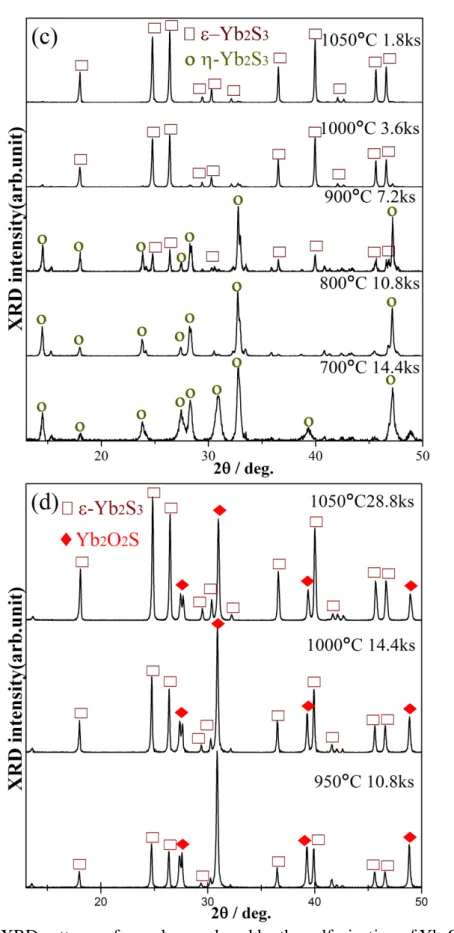
Figure 2.3 shows representative XRD patterns of synthetics with sulfurization at
600 ~1050 °C for 0.5 ~ 8 hr and GFR of 1.67 mL/s. In Figure 2.3a, a new
polymorphic form of Yb2S3(named -Yb2S3) formed by the sulfurization of Yb2O3-A
at 600°C for 8 hr. This -Yb2S3 poses similar XRD pattern and lattice plane (Table 2.2)
with those of -Lu2S3 with orthorhombic structure [92], which has a space group of
Fddd (Sc2S3 type)[93]. Single -Yb2S3 can be gained at 600 ~ 900 °C for Yb2O3-A.
Hexagonal Yb2S3 phase (named -Yb2S3) formed at 1000 °C for 1 hr. For higher
sulfurization temperature of 10η0 °C, the intensities of -Yb2S3 characteristic peaks
strengthened while those of -Yb2S3 weakened. Moreover, the mass content of
-Yb2S3 is 20.9% at 1000 °C for 1 hr and 57.8% at 1050 °C for 0.5 hr, respectively.
For the sulfurization of Yb2O3-B, single -Yb2S3 phase appeared at 700 °C for 4
hr. Different with the sulfurization of Yb2O3-A, -Yb2S3 phase formed at 800 °C for 3
hr with the mass content of 4.88%. The -Yb2S3 becomes main phase with the mass
content of 75.7% and weak peaks of -Yb2S3 have been perceived simultaneously at
900 °C for 2 hr. The products completely translated into -Yb2S3 phase at 1000 °C for
1 hr. Single -Yb2S3 phase can be obtained for a short sulfurization time of 0.5 hr at
1050 °C.
In the sulfurization of Yb2O3-C, the formation temperature of -Yb2S3 or
-Yb2S3 is similar with that of Yb2O3-B. Small amount of -Yb2S3 phase formed at
900 °C, which is lower than that of Yb2O3-A (1000°C). The content of -Yb2S3 phase
21
the sulfurization of Yb2O3-C at 1000 °C for 1 hr and 1050 °C for 0.5 hr.
Different with the former sulfurization results, Yb2O2S appeared as a transitional
product for the sulfurization of Yb2O3-D. Yb2O2S and -Yb2S3 phase coexisted at 950
~ 1050 °C for 3 ~ 8 hr. Moreover, the intensities of characteristic peaks of -Yb2S3
obviously added while those of Yb2O2S decreased following temperature increase.
Table 2.2 X-ray diffraction patterns for -Yb2S3 and -Lu2S3
Miller indices d-spacing (nm) Intensity
h k l Yb2S3 Lu2S3 Yb2S3 Lu2S3
1 1 1 0.60856 0.60445 65 49
0 0 4 0.57703 0.57182 10 7
0 2 2 0.49111 0.48732 14 11
1 1 5 0.37254 0.3695 30 18
2 0 2 0.36747 0.3651 5 5
1 3 1 0.3246 0.32225 15 11
2 2 0 0.31544 0.31337 44 38
0 2 6 0.31384 0.31118 40 37
1 1 7 0.29222 0.28974 7 7
0 0 8 0.28851 0.28591 3 2
2 2 4 0.27678 0.27481 8 5
2 0 6 0.27306 0.27098 100 100
0 4 0 0.27135 0.26934 50 49
1 3 5 0.2673 0.26521 11 7
3 1 1 0.24993 0.24836 6 6
0 4 4 0.24555 0.24366 3 2
23
Figure 2.3 XRD patterns of samples produced by the sulfurization of Yb2O3-A (a),
24
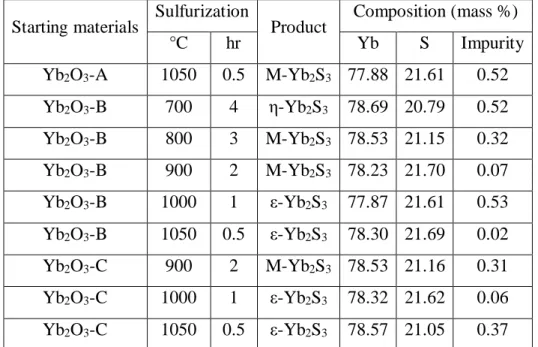
Chemical compositions of sulfurization products with GFR of 1.67 mL/s are
listed in Table β.γ. Yb content of -Yb2S3 is close to 78.28%, which suggests this
-Yb2S3 is an isomer of Yb2S3. For Yb2O3-B, the minimum of impurity content of
0.02% grained at 1050 °C for 0.5 hr while the minimum of impurity content is 0.06%
for Yb2O3-C sulfurized at 1000 °C for 1 hr.
Table 2.3 Chemical composition of Yb2S3 with gas flow rate of 1.67 mL/s
Starting materials Sulfurization Product Composition (mass %)
°C hr Yb S Impurity
Yb2O3-A 1050 0.5 M-Yb2S3 77.88 21.61 0.52
Yb2O3-B 700 4 -Yb2S3 78.69 20.79 0.52
Yb2O3-B 800 3 M-Yb2S3 78.53 21.15 0.32
Yb2O3-B 900 2 M-Yb2S3 78.23 21.70 0.07
Yb2O3-B 1000 1 -Yb2S3 77.87 21.61 0.53
Yb2O3-B 1050 0.5 -Yb2S3 78.30 21.69 0.02
Yb2O3-C 900 2 M-Yb2S3 78.53 21.16 0.31
Yb2O3-C 1000 1 -Yb2S3 78.32 21.62 0.06
Yb2O3-C 1050 0.5 -Yb2S3 78.57 21.05 0.37
Theory value WYb= 78.28%; Ws= 21.72%; M-Yb2S3: mixture of -Yb2S3 and
-Yb2S3.
2.3.2 Dependence of temperature, time and GFR on the formation of Yb2S3
Figure 2.4 shows temperature dependences of diffraction intensity of Yb2O3
(222), Yb2O2S (011), -Yb2S3(β0θ) and -Yb2S3 (110) formed via the sulfurization of
Yb2O3 at 700 °C ~ 1000 °C for 1 hr and 3 hr with GFR of 1.67 mL/s. The reaction
sequence is Yb2O3→Yb2O2S→ -Yb2S3→ -Yb2S3 with increasing temperature.
However, there is no intermediate product Yb2O2S occurred for the sulfurization of
Yb2O3-A because larger specific surface area does not only increase the adsorption of
CS2, but also supply a large interface. This interface accelerates the solid-gas reaction
rate. For Yb2O3-B and Yb2O3-C, Yb2O2S faded at 800 °C and the formation of Yb2S3
25
Figure 2.4 Temperature dependences of diffraction intensity of reaction product
26
Figure 2.5 shows temperature dependences of diffraction intensity of Yb2O3
(222), Yb2O2S (011), -Yb2S3(β0θ) and -Yb2S3 (110) formed via the sulfurization of
Yb2O3 at 500 °C ~ 1050 °C for 8 hr with GFR of 0.83 mL/s. For the sulfurization of
Yb2O3-A, single -Yb2S3 phase appeared at 600 °C, reached its maximum intensity at
9η0 °C and disappeared at 1000°C. τrthorhombic -Yb2S3 phase was observed at
700°C for Yb2O3-B and Yb2O3-C powders, and the maximum of diffraction intensity
of -Yb2S3 was detected at 850°C for Yb2O3-B and 800 °C for Yb2O3-C powders,
respectively.
Different with the sulfurization process of Yb2O3-A, Yb2O2S phase emerged as
intermediate product. Yb2O2S phase was observed at 700 °C for Yb2O3-B and
Yb2O3-C. The corresponding maximum diffraction intensity of Yb2O2S was detected
at 700°C, and disappeared at 800 °C for Yb2O3-B and 930°C for Yb2O3-C,
respectively.
Hexagonal -Yb2S3 emerged at different temperature and enhanced gradually as
the temperature increased. Single-phase -Yb2S3 was confirmed at above 1000°C
except for the sulfurization of Yb2O3-D. For the sulfurization of Yb2O3-D, Yb2O2S
phase existed until 1050 °C for 8 hr.
The compositions of synthetics sulfurized for 8 hr were listed in Table 2.4. For
Yb2O3-A, sulfurization product is single -Yb2S3 at 600~ 850 °C (Figure 2.5) and its
composition becomes equal to theoretical value of Yb2S3. The impurity content of
Yb2S3 formed by sulfurized Yb2O3-B at 930 °C for 8 hr increased to 0.78% but the
impurity content reduced to 0.22% for the sulfurization of Yb2O3-C at same
conditions.
The oxygen content and carbon content for -Yb2S3 produced by sulfurized
Yb2O3-C at 1050°C for 8 hr with GFR of 3.33 mL/s were 0.62% and 0.86%,
respectively. When GFR lessened to 0.83 mL/s, the oxygen content and carbon
content were 0.48% and 0.23%, respectively. It showed the impurity contents of
Yb2S3 powders are dependent on GFR. Therefore, purer samples can be made in
proper GFR and sulfurization temperature to void the decomposition of excess CS2
27
Figure 2.5 Temperature dependences of diffraction intensity of reaction products
28
Table 2.4 Chemical composition of Yb2S3 sulfurized for 8 hr
Starting materials Condition Product Composition (mass %)
°C mL/s Yb S Impurity
Yb2O3-A 850 0.83 -Yb2S3 78.07 21.66 0.27
Yb2O3-B 930 0.83 M-Yb2S3 78.88 20.34 0.78
Yb2O3-C 850 0.83 M-Yb2S3 78.58 21.03 0.39
Yb2O3-C 930 0.83 M-Yb2S3 78.11 21.67 0.22
Yb2O3-C 1050 0.83 -Yb2S3 78.0 21.7 0.71
Yb2O3-C 1050 3.33 -Yb2S3 77.5 21.4 1.48
Theory value WYb= 78.28%; Ws= 21.72%; M-Yb2S3: mixture of -Yb2S3 and
-Yb2S3.
2.3.3 Morphology, particle size distribution and specific surface area of Yb2S3
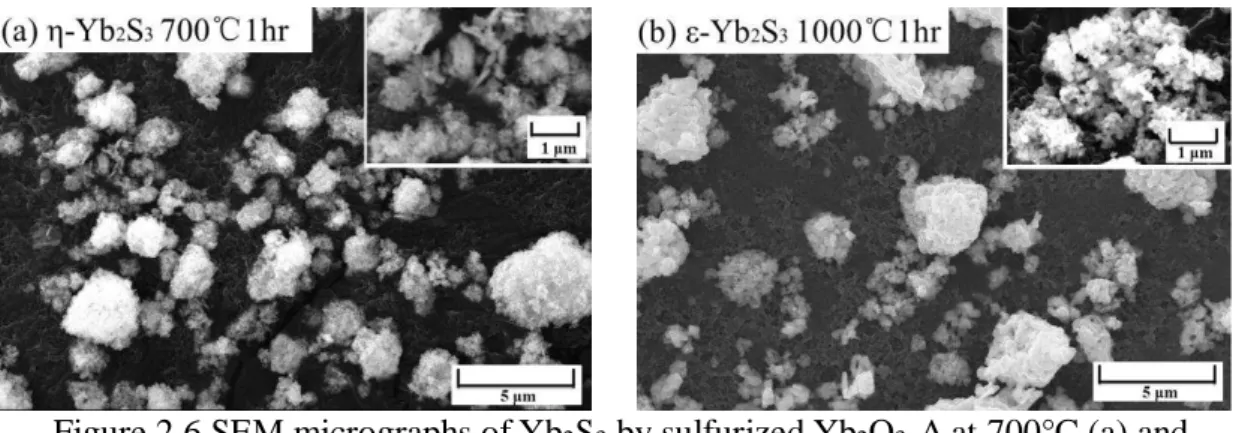
Figure 2.6 shows typical SEM micrographs of Yb2S3 formed by the sulfurization
of Yb2O3-A powders. The shape of -Yb2S3 produced at 700°C for 1 hr with GFR of
1.67 mL/s (Figure 2.6a) is similar with that of Yb2O3-A (Figure 2.1a). Following
sulfurization temperature increased to 1000 °C, -Yb2S3 phase transformed to -Yb2S3
phase (Figure 2.6b).
Figure 2.6 SEM micrographs of Yb2S3 by sulfurized Yb2O3-A at 700°C (a) and
29
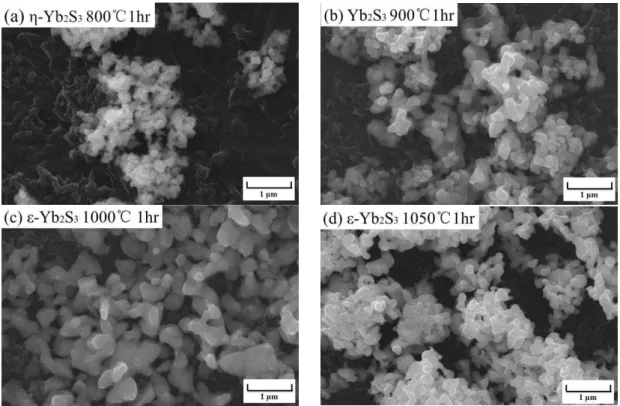
Figure 2.7 shows SEM micrographs of Yb2S3 prepared by the sulfurization of
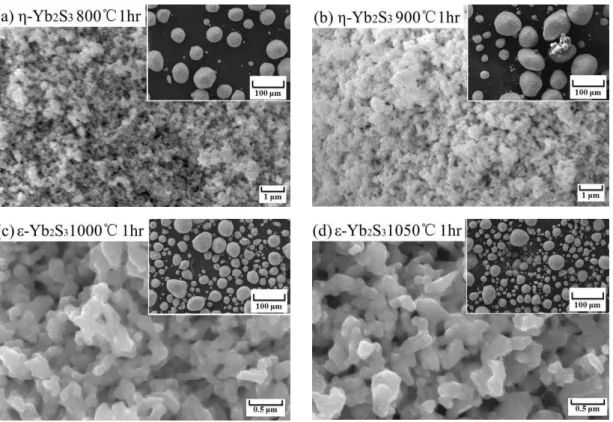
Yb2O3-B at 800 ~ 1050 °C for 1 hr with GFR of 1.67 mL/s. Figure 2.7a shows the
partial agglutination of single -Yb2S3 phase. In Figure 2.7b, the sulfurization product
has larger particle size than that of -Yb2S3 in Figure 2.7a, implying that -Yb2S3
particle grows as the temperature increases to 900 °C. From 900 °C to 1000°C,
residual -Yb2S3 (mass fraction β4%) transformed to single -Yb2S3, which was
accelerated by increase of impurity content (Table 2.3), just like the effecting of
carbon on the sintered La2S3 powders[81]. The important point to note is particle size
of single -Yb2S3 reduces after sulfurization at 1050°C.
Figure 2.7 SEM micrographs of Yb2S3 formed by the sulfurization of Yb2O3-B at
800°C (a), 900°C (b), 1000 °C (c) and 1050 °C (d) for 1hr with gas flow rate of 1.67
mL/s.
Figure 2.8 shows SEM micrographs of Yb2S3 produced by the sulfurization of
Yb2O3-C powders with GFR of 1.67 mL/s. In Figure 2.8a and 2.8b, particle size of
-Yb2S3 is bigger than that of primary Yb2O3-C particles (Figure 2.1c). It is mainly
due to sulfur atom having a bigger diameter than oxygen atom. During the
sulfurization process, oxygen atoms in sites of Yb2O3 lattice are replaced by sulfur
atoms and the density lessens from 9.22 g/cm-3 of Yb2O3 to 6.02 g/cm-3 of Yb2S3. On
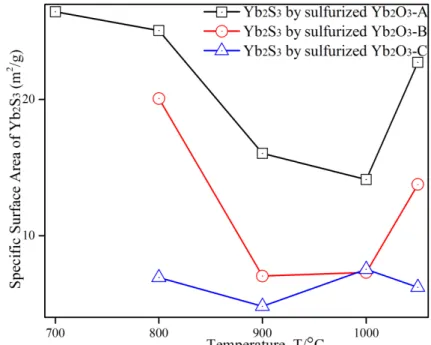
the other hand, the agglomeration of Yb2S3 produces rounded balls with different size,