Source Phrase Segmentation and Translation
for Japanese-English Translation Using Dependency Structure
Junki Matsuo Graduate School of System Design, Tokyo Metropolitan
University, Japan
Kenichi Ohwada Graduate School of System Design, Tokyo Metropolitan
University, Japan
Mamaru Komachi Graduate School of System Design, Tokyo Metropolitan
University, Japan
Abstract
There are various approaches to statistical machine translation (SMT). In particular, phrase-based SMT (PBSMT) is used as a de facto standard for many language pairs because it works robustly across languages and it is easy to implement. However, the results of PBSMT can include ungram-matical sentences, since it typically does not take syntactic structure into account. To overcome this problem, we propose a linguistically motivated approach based on segmenting a source phrase using a de-pendency structure and translating each phrase with PBSMT. This paper presents the results of our method on Japanese-English translation and discusses potential improvements.
1 Introduction
It is difficult for statistical machine translation (SMT) to perform translation between languages such as Japanese and English, which have a sys-tematic difference in their word orders: typically, Japanese is a subject-object-verb (SOV) language, whereas English is a subject-object-verb (SVO) language.
Although PBSMT is used as a de facto stan-dard for many language pairs because it works ro-bustly across languages and it is easy to imple-ment; it typically does not take syntactic struc-ture into account. It is difficult to recognize syn-tactic information for phrase-based SMT therefore it cannot handle long-distance reordering that fre-quently occurs in these language pairs.
To incorporate syntactic information into the PBSMT framework, we attempt to identify the
SOV of the source language (Japanese) and then correctly produce the SVO of the target language (English). Concretely, we devise a dependency-based method that extracts a sentence’s frame (hareafter “basic frame”), consisting of the pred-icate and its direct children (hereafter “anchor words”), and its dependent phrases consisting of the anchor words and their all descendants. Af-ter extracting these words and phrases, our method translates them separately and then combines their translation.
We conducted an experiment with the proposed method on a Japanese-to-English task at the Sec-ond Workshop on Asian Translation (Nakazawa et al., 2015). Although the results of our method are not positive, we discuss potential improvements.
The rest of this paper is organized as follows. In the next section, we discuss related work. In Section 3, the details of our method are explained. Then, we describe our experiments and analyze the results.
2 Related Work
A substantial, systematic difference in word or-ders creates difficulty for SMT, especially, PB-SMT, which is not based on syntactic phrases. Good translation can be achieved in such situa-tions by segmenting the input sentences into por-tion for simpler and adequate scale inputs.
For translating a long and complex sentence composed of several clauses in English into Japanese translation, Sudoh et al. (2010) pro-posed segmenting the sentence into clauses that include non-terminals as placeholders correspond-ing to embedded clauses uscorrespond-ing an HPSG parser, translating the clauses, and then replacing the non-terminals with the corresponding clause’s transla-tions. By representing an embedded clause with
99
Proceedings of the 2nd Workshop on Asian Translation (WAT2015), pages 99‒104,
Figure 1 : Illustrative example of our method.
a non-terminal as a placeholder, they reduced the problem of reordering a complex sentence to a simple problem of word-level reordering. For each clause translation, non-terminals are treated as words and the clause including them is trans-lated using the model trained on a clause-level aligned corpus that they developed. Their method uses a high-quality HPSG parser to segment an English sentence, but such a rich parser is not publicly available for Japanese. Thus, we opt to use dependency analysis to segment Japanese sen-tences. In addition, they segmented a sentence into clauses, whereas we segment a sentence into linguistically-motivated phrases, and in contrast to their approach, we do not arrange the corpus to be suitable for segmentation unit.
There are other segmentation methods in ma-chine translation. Roh et al. (2001) proposed a method that recognizes the range of sub-sentences such as a relative and a conjunctive clause us-ing sentence pattern information to overcome the problem of a syntactic ambiguity in a long sen-tence. Doi et al. (2003) split an input sentence into some smaller units to deal with long sentences in speech translation. Their method does not split sentences in a pre-processing phase or a parsing phase. It uses partial translation results and some criteria that judge the results to determine the best split positions. Other than that, Lee et al. (2012) proposed training a phrase segmentation model using a PBSMT decoder. The model is
incorpo-rated into the log-linear model of PBSMT, and the phrase segmenter based on the decoder annotates the source language phrase boundaries. The anno-tated data are used to train a new phrase segmen-tation model, which is then reused by the decoder. This process is performed iteratively, improving the phrase segmentation model.
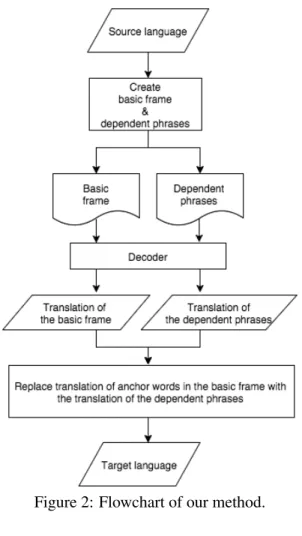
Figure 2: Flowchart of our method.
3 Source Phrase Segmentation and Translation Using Dependency Structure
Because of its ignorance of syntax, PBSMT may output ungrammatical sentences. Thus, we pro-pose a source-phrase segmentation and translation approach to compensate for the lack of linguis-tically motivated information in the source lan-guage. We propose two methods. First method is “segmentation and translation”, and second method is “segmentation and translation without preposition”. “Segmentation and translation” is the method described in Subsection 3.1, and “seg-mentation and translation without preposition” is described in Subsection 3.2. In Subsection 3.3, we describe an additional rule for our method (for a sentence that includes a substantive verb).
Figures 1 and 2 show an example and outline of our method, respectively. Although our method is similar to that of Sudoh et al. (2010)’s work, we segment a sentence into its basic frame con-sisting of a predicate, anchor words and the de-pendent phrases that are the phrases consisting the subtrees rooted at the anchor words (Figure 3) by
Figure 3 : Image of a basic frame, anchor words, and dependent phrases.
segmenting a sentence. The basic frame and de-pendent phrases are translated using a decoder. In the translation of a basic frame, each clause ex-cept for the predicate is subject to replacement. We replace the anchor words in the basic frame with the translations of the corresponding depen-dent phrases.
3.1 Segmentation and Translation
First, a basic frame is created by extracting the predicate and its direct children. Then, dependent phrases are created by segmenting the phrases that depend on the predicate. Second, the translation of the basic frame and those of the dependent phrases are obtained.
Finally, the output is created by replacing the translations of anchor words in the basic frame with those of the corresponding dependent phrases except for the translation of the predicate in the ba-sic frame.
3.2 Segmentation and Translation without Preposition
We propose another but similar method that does not replace the preposition in the translation of the basic frame with one in the translation of dent phrases. Because the translation of depen-dent phrases in our first method uses the language and translation models optimized for a sentence, our first method might not be able to use a model optimized for translating phrases.
ener
gy
fluctuation is sho
wn
.
エネルギー ■
揺らぎ ■
を ■
示した ■
。 ■
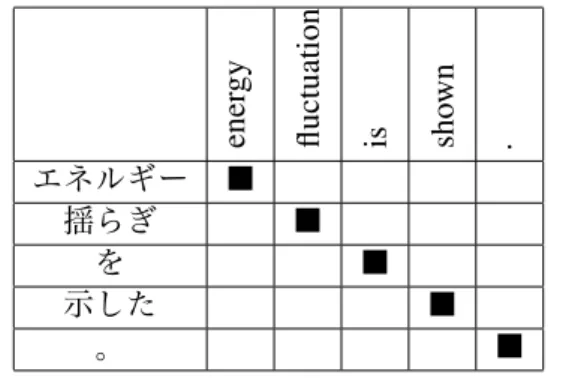
Table 1: Alignment example to which the rule applies. The English word “is” is aligned to “を”
included in the bunsetsu-chunk “揺らぎを”. Hence, without the rule, “is” is replaced by the
translation of “揺らぎを” and deleted.
not to replace the correct prepositions, our second method preserves the preposition coming from the basic frame.
3.3 Additional Rule for Predicate Alignment
We observe that there is a problem in aligning a Japanese predicate to an English counterpart. Here, if a word governed by VP in an English sen-tence is not aligned to one of the words included in the corresponding predicate bunsetsu-chunk of the Japanese sentence, the word of the English side will be deleted by our replacement.
For example, when translating “エネルギー揺
らぎを示した (energy fluctuation is shown)” in Table 1, the predicate of Japanese sentence “示し
た” is not aligned to the English words “is shown” but to the word “shown”. In this case, the English word “is” is not aligned to the word in the Japanese predicate bunsetsu-chunk “示した”; hence, the word will be deleted by the dependent phrases.
To avoid this unwanted occurrence, we add a rule to take effect that if there is a substantive verb in the translation of a basic frame, the replace-ment will not be applied to the substantive verb, since this accident occurs only for the substantive verb in our observation. As a result of this rule, “is shown” remains in the resulting sentence.
Our method uses this rule for both “segmenta-tion and transla“segmenta-tion” and “segmenta“segmenta-tion and trans-lation without preposition”.
4 Experiments
4.1 Experimental Settings
We use three million parallel sentences from the Asian Scientific Paper Excerpt Corpus. We
BLEU RIBES no-seg&trans 18.32 0.641456 seg&trans 15.85 0.628897 seg&trans (w/o prep) 15.72 0.628463
Table 2: BLEU and RIBES of the baseline and our methods.
error types frequency
Dependency parsing 3
Translation of a basic frame 18 Translation of dependent phrases 46 Total (Each error may overlap) 57
Table 3: Types of errors in the first 100 sentences of the test-set.
use JUMAN (version 7.0) for segmentation, and GIZA++ (version 1.0.7) for alignment. We use Moses (version 2.1.1)’s default configurations: monotone, swap, and discontinuous. The lan-guage and translation models of Moses are trained with the ASPEC. In translating the basic frame and dependent phrases, we use the same language and translation models. MERT is performed on the full dev-set. We follow the split of dev-set and test-set provided by the organizer of the workshop.
To preprocess the input sentences, basic frames and dependent phrases are extracted by a depen-dency parser CaboCha (version 0.68).1
We use Moses as a baseline. Moses’s settings are the same as the above settings. Our method is evaluated using Bilingual Evaluation Understudy (BLEU) and Rank-based Intuitive Bilingual Eval-uation Score (RIBES).
4.2 Experimental Results
Table 2 reports our official evaluation results for the WAT 2015 and an additional experiment after the official evaluation campaign. Both BLEU and RIBES deviated from the baseline.
5 Discussion
In Figure 1, we present an example for which our first method fails but our sec-ond method succeeds to translate. Our first method creates “DERSソフトウェアを用いて”, “「ふげん発電所」の線量率を”, “詳細に”, and 1We do not use CaboCha for segmentation but only to
“計算できる” as the dependent phrases. These de-pendent phrases are translated into “using DERS software”, “the dose rate ‘Fugen power plant”’, “detailed”, and “calculated”, respectively. Our first method combines them with a translation of the basic frame to create output “using DERS soft-ware the dose rate ‘Fugen power plant’ can be cal-culated detailed”, but this is ungrammatical.
This problem is caused by lack of contextual formation in the the dependent phrases. For in-stance, the reason why the translation of the de-pendent phrase “詳細に” lacks any preposition is that the proper preposition corresponding to the particle “に” cannot be identified only by the in-formation obtained from the input “詳細に”. Our second method can solve this problem. It does not replace the preposition following the predicate to preserve the plausible preposition that seems to be translated properly in the translation of the basic frame.
However, the BLEU and RIBES scores of our second method are lower than those of our first method. Especially, the BLEU scores of our meth-ods differ more than the RIBES scores. We will discuss the reason below.
We count the number of the pairs of input and reference that have different voices from the sam-ple data, which comprises 100 sentences that we selected as the top 100 sentences from the test-set. Thirty-five percent of the translation outputs differ in their voice from the corresponding refer-ence, and we suppose that this is the cause of the degradation in BLEU. For example, suppose a ref-erence is in the active voice and the output of our methods is in the passive voice. Since BLEU pe-nalizes incorrect translation based on n-gram pre-cision, mis-ordering affect BLEU more than RI-BIES.
In addition, the proposed methods have prob-lems in the translation and language models. Since dependent phrases are typically noun phrases, the baseline decoder trained on parallel sentences might not produce appropriate translations. Moses tends to translate a noun phrase into a sentence if the dependent phrase contains a verb in a relative clause construction. For example, the dependent phrases “水の運動(the water movement)の基本
である(a basis of)水素結合ネットワークの変化
を(the change of hydrogen bond network)” were translated into “the change of hydrogen bond net-work is a basis of the water movement”. From this
perspective, we need to perform translation with different models for a basic frame and for depen-dent phrases.
In order to perform error analysis, we evalu-ate our methods quantitatively. Table 3 shows the number of errors in using a dependency parser (CaboCha in Table 3), translating a basic frame and dependent phrases (Translation of a basic frame and Translation of dependent phrases in Ta-ble 3). The errors resulting from CaboCha are very few; there are only three instances out of 100.
The most prominent errors originate in phrase translation. We can solve the problem by creat-ing optimized language and translation models for noun phrases. Because the language and transla-tion models must create a noun phrase when de-pendent phrase is noun phrase, they must be opti-mized for noun phrases.
The next most frequent errors are translations of basic frames. We count this type of error when the translation of a basic frame is not a sentence. In contrast to the case of dependent phrases, the translation of a basic frame must output a sentence with a predicate. Alternatively, we can re-rank the output to remove ungrammatical translations of a basic frame.
6 Conclusion
This paper proposed segmentation and translation methods for Japanese to English translation and presented its evaluation. We discussed the sam-ple data consisting of the top 100 sentences that we had selected from the test-set. As a result, we found that the output has three problems: depen-dency parsing, translation of a basic frame, and translation of dependent phrases. In the future, we plan to optimize the language and the translation models suitable for phrase translation.
References
Takao Doi and Eiichiro Sumita. 2003. Input
Sen-tence Splitting and Translating. InProceedings of
the HLT-the North American Chapter of the Associ-ation for ComputAssoci-ational Linguistics 2003 Workshop on Building and using parallel texts: data driven machine translation and beyond-Volume 3, pages 104–110.
Sho Hoshino, Yusuke Miyao Katsuhito Sudoh, and
Masaaki Nagata. 2013. Two-Stage Pre-ordering
Conference on Natural Language Processing 2013, pages 1062–1066.
Hideki Isozaki, Katsuhito Sudoh, Hajime Tsukada, and Kevin Duh. 2010. Head Finalization: A Simple
Re-ordering Rule for SOV Languages. InProceedings
of the Joint 5th Workshop on Statistical Machine Translation and MetricsMATR, pages 244–251.
Jason Katz-Brown and Michael Collins. 2008.
Syntactic Reordering in Preprocessing for
Japanese→English Translation: MIT System
Discriptioin for NTCIR-7 Patent Translation Task. In Proceedings of the NII Testbeds and Commu-nity for Information access Research-7 Workshop Meeting, pages 409–414.
Mamoru Komachi, Yuji Matsumoto, and Masaaki
Na-gata. 2006. Phrase Reordering for Statistical
Machine Translation Based on Predicate-Argument Structure. InProceedings of the International Work-shop on Spoken Language Translation, pages 77–82.
Hyoung-Gyu Lee and Hae-Chang Rim. 2012.
Decoder-based Discriminative Training of Phrase Segmentation for Statistical Machine Translation. InProceedings of International Conference on Com-putational Linguistics, pages 611–620.
Toshiaki Nakazawa, Hideya Mino, Isao Goto, Gra-ham Neubig, Sadao Kurohashi, and Eiichiro Sumita.
2015. Overview of the 2nd Workshop on Asian
Translation. In Proceedings of the 2nd Workshop
on Asian Translation (WAT2015).
Yoon-Hyung Roh, Young-Ae Seo, Ki-Young Lee, and ung Kwon Choi. 2001. Long Sentence Partition-ing usPartition-ing Structure Analysis for Machine
Transla-tion. InProceedings of the Sixth Natural Language
Processing Pacific Rim Symposium, pages 646–652.
Katsuhito Sudoh, Kevin Duh, Hajime Tsukada, Tsu-tomu Hirao, and Masaaki Nagata. 2010. Divide and Translate: Improving Long Distance Reordering
in Statistical Machine Translation. InProceedings
of the Joint 5th Workshop on Statistical Machine Translation and MetricsMATR, pages 418–427.
Peng Xu, Jaeho Kang, Michael Ringgaard, and Franz
Och. 2009. Using a Dependency Parser to
Im-prove SMT for Subject-Object-Verb Languages. In