ASIAN DEVELOPMENT BANK
ASEAN+3 MULTI-CURRENCY BOND
ISSUANCE FRAMEWORK
Implementation Guidelines for Japan
ASEAN+3 BOND MARKET FORUM
SUB-FORUM 1 PHASE 3 REPORT
August 2015
Creative Commons Attribution 3.0 IGO license (CC BY 3.0 IGO)
© 2015 Asian Development Bank
6 ADB Avenue, Mandaluyong City, 1550 Metro Manila, Philippines Tel +63 2 632 4444; Fax +63 2 636 2444
www.adb.org; openaccess.adb.org Some rights reserved. Published in 2015. Printed in the Philippines.
ISBN 978-92-9257-079-8 (Print), 978-92-9257-080-4 (e-ISBN) Publication Stock No. RPT157592-2
Cataloging-In-Publication Data Asian Development Bank.
ASEAN+3 multi-currency bond issuance framework: Implementation guidelines for Japan—ASEAN+3 Bond Market Forum sub-forum 1 phase 3 report
Mandaluyong City, Philippines: Asian Development Bank, 2015.
1. Regional cooperation. 2. Regional integration. 3. ASEAN+3. 4. Bond market I. Asian Development Bank. The views expressed in this publication are those of the authors and do not necessarily relect the views and policies of the Asian Development Bank (ADB) or its Board of Governors or the governments they represent.
ADB does not guarantee the accuracy of the data included in this publication and accepts no responsibility for any consequence of their use. The mention of speciic companies or products of manufacturers does not imply that they are endorsed or recommended by ADB in preference to others of a similar nature that are not mentioned.
By making any designation of or reference to a particular territory or geographic area, or by using the term “country” in this document, ADB does not intend to make any judgments as to the legal or other status of any territory or area. This work is available under the Creative Commons Attribution 3.0 IGO license (CC BY 3.0 IGO)
https://creativecommons.org/licenses/by/3.0/igo/. By using the content of this publication, you agree to be bound by the terms of said license as well as the Terms of Use of the ADB Open Access Repository at openaccess.adb.org/termsofuse
This CC license does not apply to non-ADB copyright materials in this publication. If the material is attributed to another source, please contact the copyright owner or publisher of that source for permission to reproduce it. ADB cannot be held liable for any claims that arise as a result of your use of the material.
Attribution—In acknowledging ADB as the source, please be sure to include all of the following information: Author. Year of publication. Title of the material. © Asian Development Bank [and/or Publisher]. https://openaccess.adb.org. Available under a CC BY 3.0 IGO license.
Translations—Any translations you create should carry the following disclaimer:
Originally published by the Asian Development Bank in English under the title [title] © [Year of publication] Asian Development Bank. All rights reserved. The quality of this translation and its coherence with the original text is the sole responsibility of the [translator]. The English original of this work is the only oicial version.
Adaptations—Any adaptations you create should carry the following disclaimer:
This is an adaptation of an original Work © Asian Development Bank [Year]. The views expressed here are those of the authors and do not necessarily relect the views and policies of ADB or its Board of Governors or the governments they represent. ADB does not endorse this work or guarantee the accuracy of the data included in this publication and accepts no responsibility for any consequence of their use.
Please contact [email protected] or [email protected] if you have questions or comments with respect to content, or if you wish to obtain copyright permission for your intended use that does not fall within these terms, or for permission to use the ADB logo.
Note: In this publication, “$” refers to US dollars.
Contents
Tables iv Abbreviations v
I. AMBIF Elements in Japan 1
Summary of AMBIF Elements in Japan 1
Description of AMBIF Elements and Equivalent Features in Japan 1
Domestic Settlement 1
Harmonized Documents for Submission (Single Submission Form) 1 Registration or Profile Listing in ASEAN+3 (Place of Continuous Disclosure) 3
Currency 3
Scope of Issuers 4
Scope of Investors 4
II. AMBIF Bond and Note Issuance: Relevant Features in Japan 6
Governing Law and Jurisdiction 6
Language of Documentation and Disclosure Items 6
Credit Rating 6
Lead Managing Underwriter List 7
Appointment of Entrustment of Bond Manager 7
Note Issuance Programs 7
Selling and Transfer Restrictions in TPBM 8
Financial Reporting Standards 9
III. AMBIF Bond and Note Issuance Process in Japan 11
Overview of Regulatory Processes in Japan 11
Regulatory Process Map: Overview 11 Market Issuance Procedure in Local Currency or Foreign Currency 12
Listing for Profiling on TSE’s TPBM 12
Issuance Procedures and Subjects Specific to Japan 14
Additional Procedures Related to Settlement 14
Disclosure-Related Matters 14
Listing Fees 14
Minimum Trading Unit 15
OTC Trading of Bonds and Notes 15
Appendixes 16
1 Resource Information 16
2 Glossary of Technical Terms 17
Tables
TABLES
1 AMBIF Elements and Equivalents in Japan 2
2 Classification of Investors in Japan 5
3 Regulatory Processes by Corporate Issuer Type 11
Abbreviations
ABMF ASEAN+3 Bond Market Forum
ADRB AMBIF Documentation Recommendation Board AMBIF ASEAN+3 Multi-Currency Bond Issuance Framework ASEAN Association of Southeast Asian Nations
ASEAN+3 ASEAN plus the People’s Republic of China, Japan, and the Republic of Korea
FIEA Financial Instruments and Exchange Act FSA Financial Services Agency
ISIN International Securities Identification Number J-GAAP Japanese Generally Accepted Accounting Principles JPY Japanese yen (ISO code)
JSDA Japan Securities Dealers Association OTC over-the-counter
SF1 Sub-Forum 1 of ASEAN+3 Bond Market Forum SSF Single Submission Form
SSI Specified Securities Information
TPBM TOKYO PRO-BOND Market
TSE Tokyo Stock Exchange, Inc.
US-GAAP United States Generally Accepted Accounting Principles
AMBIF Elements I
in Japan
This chapter describes the key features of the ASEAN+3 Multi-Currency Bond Issuance Framework (AMBIF), also known as AMBIF Elements, and puts into perspective the equivalent features of the domestic professional bond market in Japan.1
Summary of AMBIF Elements in Japan
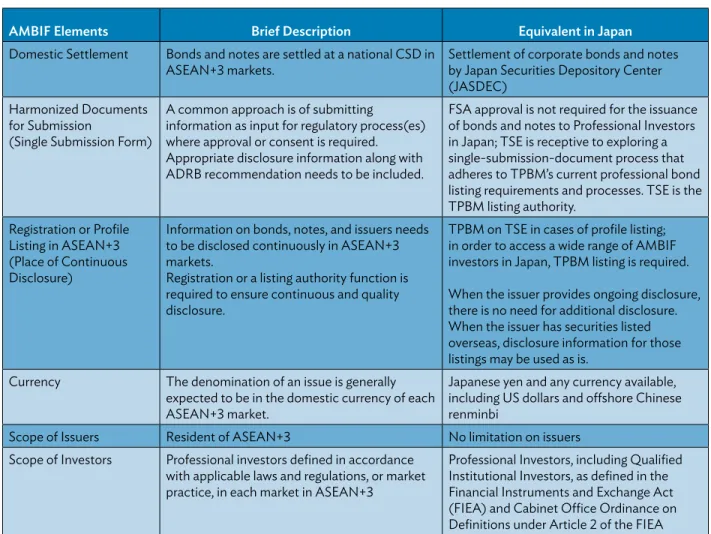
Bonds and notes issued domestically through the TOKYO PRO-BOND Market (TPBM) qualify as AMBIF bonds and notes since TPBM satisfies the eligibility requirements of the AMBIF Elements as stated below. Table 1 identifies the features and practices of the domestic bond market in Japan that directly correspond with or are equivalent to the AMBIF Elements.
Description of AMBIF Elements and Equivalent Features in Japan
Domestic Settlement AMBIF
AMBIF is aimed at supporting the domestic bond markets in ASEAN+3. To be recognized as a domestic bond or note, an AMBIF bond or note needs to be settled at the designated central securities depository. Hence, domestic settlement needs to be a key feature of an AMBIF bond or note.
In Japan
JPY-denominated corporate bonds and notes issued in the domestic market are
predominately cleared and settled at the Japan Securities Depository Center (JASDEC), regardless whether these bonds and notes are traded over-the-counter (OTC) or on an exchange.
Harmonized Documents for Submission (Single Submission Form) AMBIF
Based on the review of application forms for issuance approval, offering circulars, information memorandum, and program information formats in ASEAN+3, the essential core information was similar or comparable across markets. Hence, the Single Submission Form (SSF) that can be applied to all of the relevant regulatory processes for bond and note issuance across markets was proposed. The information contained in the SSF can be submitted to all relevant regulatory authorities and market institutions for relevant approvals
1 ASEAN+3 refers to the 10 members of the Association of Southeast Asian Nations (ASEAN) plus the People’s Republic of China, Japan, and the Republic of Korea.
Japan AMBIF Implementation Guidelines
2
or consent, or used in the context of the submission (e.g., as a checklist) in anticipation of AMBIF bond or note issuance.
In Japan
Financial Services Agency (FSA) approval is not required for the issuance of bonds and notes to Professional Investors in Japan; the Tokyo Stock Exchange (TSE) is the listing authority of TPBM and provides the TPBM-related rules and regulations, including governing disclosure document requirements. Disclosure requirements under the Financial Instruments and Exchange Act (FIEA), such as the Securities Registration Statement for public offering, do not apply to the securities listed on TPBM. Instead, disclosure requirements are stipulated in the rules and regulations of TSE, such as the Specified Securities Information (SSI) and Issuer Filing Information.
To be listed on TPBM for profiling purposes, TSE is receptive to exploring a single- submission-document process, as long as its application procedures and all listing
Table 1: AMBIF Elements and Equivalents in Japan
AMBIF Elements Brief Description Equivalent in Japan
Domestic Settlement Bonds and notes are settled at a national CSD in ASEAN+3 markets.
Settlement of corporate bonds and notes by Japan Securities Depository Center (JASDEC)
Harmonized Documents for Submission
(Single Submission Form)
A common approach is of submitting
information as input for regulatory process(es) where approval or consent is required. Appropriate disclosure information along with ADRB recommendation needs to be included.
FSA approval is not required for the issuance of bonds and notes to Professional Investors in Japan; TSE is receptive to exploring a single-submission-document process that adheres to TPBM’s current professional bond listing requirements and processes. TSE is the TPBM listing authority.
Registration or Profile Listing in ASEAN+3 (Place of Continuous Disclosure)
Information on bonds, notes, and issuers needs to be disclosed continuously in ASEAN+3 markets.
Registration or a listing authority function is required to ensure continuous and quality disclosure.
TPBM on TSE in cases of profile listing; in order to access a wide range of AMBIF investors in Japan, TPBM listing is required. When the issuer provides ongoing disclosure, there is no need for additional disclosure. When the issuer has securities listed overseas, disclosure information for those listings may be used as is.
Currency The denomination of an issue is generally expected to be in the domestic currency of each ASEAN+3 market.
Japanese yen and any currency available, including US dollars and offshore Chinese renminbi
Scope of Issuers Resident of ASEAN+3 No limitation on issuers
Scope of Investors Professional investors defined in accordance with applicable laws and regulations, or market practice, in each market in ASEAN+3
Professional Investors, including Qualified Institutional Investors, as defined in the Financial Instruments and Exchange Act (FIEA) and Cabinet Office Ordinance on Definitions under Article 2 of the FIEA ADRB = AMBIF Documentation Recommendation Board; AMBIF = Asian Multi-Currency Bond Issuance Framework; ASEAN+3 = Association of Southeast Asian Nations plus the People’s Republic of China, Japan, and the Republic of Korea; CSD = central securities depository; FSA = Financial Services Agency; TPBM = TOKYO PRO-BOND Market; TSE = Tokyo Stock Exchange.
Source: ABMF SF1.
AMBIF Elements in Japan
3
requirements are fulfilled. The SSF can be treated as the SSI by mentioning clearly on the SSF that it is the SSI. Then, the SSF can be applied for the listing process on TPBM. The use of English in documentation for TPBM is accepted in TSE rules.
Registration or Profile Listing in ASEAN+3 (Place of Continuous Disclosure) AMBIF
Information on issuers, bonds, and notes needs to be disclosed continuously in ASEAN+3 markets. A registration or listing authority function to facilitate continuous disclosure is required. This can ensure the quality of disclosure and facilitate a well-organized market for AMBIF issuances with transparency and a quality of information that differentiates AMBIF issuances from ordinary private placements for which information is often neither available nor guaranteed. Owing to this important feature, an AMBIF secondary market is expected to emerge as the number of issuances increases.
A profile listing is a listing without trading on an exchange. The objective of the listing is to make bonds and notes visible with more information available to investors via a recognized listing place, particularly those investors with more restrictive mandates, such as mutual and pension funds. A profile listing at a designated listing place can ensure the flow of continuous disclosure information and possibly even reference pricing in some markets.
In Japan
TPBM on TSE is the single market in Japan for listed programs or listed bonds and notes aimed at Professional Investors, and acts as a Specified Financial Instruments Exchange Market pursuant to Article 2, Paragraph 32 of the FIEA.
Issuers need to list a note issuance program and/or bonds and notes on TPBM in order to issue bonds and notes through TPBM. To apply for a new listing, the SSF (as the SSI) and other prescribed information, including written assurance for listing, are to be submitted to TSE. There is no need to submit any documents to regulators such as a local finance bureau or the FSA. In principle, information on listed bonds and notes, and information on their issuers shall be disclosed pursuant to TSE’s Listing Regulations and Enforcement Rules for TPBM. At the time of a new listing (time of issuance) of a corporate bond or other instrument, applicants (issuers) need to provide the SSI.
Efforts have been made to reduce the cost and time required to prepare additional documentation at TPBM. Overseas issuers can use English disclosure information
documents submitted to the authorities or exchanges in the economies where their bonds and notes are already listed, or the company is registered.
Bonds and notes listed on TPBM or issued based on the program information submitted to TSE are included within the Japan Securities Dealers Association’s (JSDA) Reference Statistical Prices (Yields) for OTC Transactions.
Currency AMBIF
In the context of AMBIF, the denomination of an issue is generally expected to be in the domestic currency of each ASEAN+3 market. But this does not exclude the possibility of issuing in other currencies if market practice regularly supports these other currencies and the relevant domestic currency or cash clearing capabilities exist. At this stage, US dollars,
Japan AMBIF Implementation Guidelines
4
Japanese yen, and offshore Chinese renminbi are the currencies other than domestic currencies in which bonds and notes tend to be issued in ASEAN+3 markets.
In Japan
TPBM on TSE does not have any limitations on the choice of currencies. Domestic bonds and notes in the Japanese market are typically issued in yen. In addition to settlement for bonds and notes issued in yen, JASDEC is able to transfer (on a free-of-payment basis) foreign-currency-denominated bonds and notes issued by governments or companies, such as those denominated in US dollars or other currencies.
Scope of Issuers AMBIF
As AMBIF is aimed at supporting the development of domestic bond markets in the region and promoting the intraregional recycling of funds, an issuer needs to be a resident of an ASEAN+3 market.
In Japan
The regulations and practices on TPBM do not distinguish between resident and nonresident issuers. The scope of issuers on TPBM include
1. foreign corporations, 2. foreign financial institutions,
3. sovereign and government-sponsored issuers, 4. Japanese corporations, and
5. Japanese public entities (e.g., local governments).
All issuers may utilize note issuance programs as a form of bond or note issuance. Scope of Investors
AMBIF
Professional investors are defined in accordance with regulations and/or market practice in each market in ASEAN+3. Some jurisdictions have a clear definition of professional investors, while other jurisdictions may need to establish the concept through agreements.
Professional investors are institutions defined by law and licensed or otherwise registered with regulators by law in their economy of domicile and, hence, are subject to governance and inspection based on securities market and/or prudential regulations. In addition, most of them are also subject to oversight as well as professional conduct and best practice rules by a self-regulatory organization, such as an exchange or a market association.
In Japan
Japan features one of the most comprehensive definitions of professional investors in ASEAN+3, which includes institutional and high net worth investors with specific qualifying criteria, and also foreign institutional investors.
In Japan, the definition of Professional Investor is stipulated in Article 2, Paragraph 31 of the FIEA and in the Cabinet Office Ordinance related to the definition stipulated in Article 2 of the FIEA. The term “Professional Investor” as used in the FIEA comprises (i) Qualified Institutional Investors; (ii) the state (the Government of Japan); (iii) the Bank of Japan; and (iv) Investor Protection Funds prescribed by Article 79-21 and other juridical persons
AMBIF Elements in Japan
5
Table 2: Classification of Investors in Japan Professional
Investor
1. Cannot request nonprofessional treatment a. Qualified Institutional Investor
b. Government of Japan c. Bank of Japan
Always treated as a professional investor
2. Can request nonprofessional treatment (designated companies and organizations) a. local governments
b. public companies
c. joint-stock companies whose capital is reasonably believed to be JPY 500 million or more
d. foreign corporations (foreign juridical persons) others
Option to be nonprofessionala
General Investor 3. Can request professional treatment (designated
individuals)
a. individuals (i) with trading experience of 1 year or more, and (ii) whose net assets and invested assets are reasonably believed to each be worth JPY300 million or more b. others
Option to be professionala Cannot request professional treatment (individuals
other than those included in 3.)
Always treated as a general investor
a Opt-in–opt-out treatment
Source: Financial Services Agency, ABMF SF1.
specified by Article 23 of the Cabinet Office Ordinance related to the definition stipulated in Article 2 of the FIEA.
Professional Investors include pension funds, life insurance companies and other accredited institutional investors, listed companies, joint-stock corporations with at least JPY500 million in capital, government agencies, the Bank of Japan, and other approved corporations and local governments, together with approved individuals with net financial assets of at least JPY300 million and at least 1 year of trading experience. (Here, approved means that the entity must first seek and obtain approval from a securities company.) In effect, only (i) Professional Investors and (ii) nonresident (foreign) investors are able to participate in TPBM.
As shown in Table 2, a change of status from that of a professional investor to a general investor, or vice versa, is carried out within the relationship with each securities company by the investor making a request to such a securities company. In consequence, a securities company may from time to time assure itself of the status of the investor based on the investor’s intentions.
Resident Professional Investors in Japan can invest in overseas bonds and notes without any legislative restrictions.
II AMBIF Bond and Note Issuance:
Relevant Features in Japan
In addition to the market features corresponding to the AMBIF Elements, a number of general market features for AMBIF bond and note issuance to Professional Investors in the Japanese domestic bond market need to be considered, and are described in this chapter.
Governing Law and Jurisdiction
Governing law and the jurisdiction for specific service provisions in relation to a bond or note issuance may have relevance in the context of AMBIF since potential issuers may consider issuing under the laws or jurisdiction of an economy or market other than the place of issuance. The choice of governing law or the contractual preferences of stakeholders can affect the accessibility to a specific investor universe that may otherwise not be accessible if bonds or notes were issued under the laws of the place of issuance. However, it is necessary to point out that laws related to bond and note issuance and settlement must be governed by the laws and regulations of the place of issuance since AMBIF bonds and notes are domestic bonds and notes.
Governing law and jurisdiction, with respect to the Terms and Conditions of the Notes, may be agreed among the contract parties, subject to relevant provisions in applicable laws and regulations. For bonds and notes settled in Japan, at present, JASDEC requires that the Terms and Conditions of the Notes shall be governed by Japanese law.
Language of Documentation and Disclosure Items
It is envisaged that most of the ASEAN+3 markets participating in AMBIF will be able to accept the use of a common document in English; however, some markets may require the submission of approval-related information in their prescribed format and in the local language. In such cases, concessions from these regulatory authorities for a submission of required information in English, in addition to the local language and formats, may be sought. Documentation in English language is accepted by TPBM.
Credit Rating
Note issuance programs or corporate bonds and notes listed on TPBM must obtain a rating from a credit rating agency recognized internationally and/or by Japanese investors. The rating needs to be disclosed, but the level of the rating is not an eligibility criterion for TPBM.
AMBIF Bond and Note Issuance: Relevant Features in Japan
7
With regard to the bonds and notes issued by a foreign government or local government (both domestic and foreign), or guaranteed by a national or local government (domestic or foreign), or by certain financial institutions recognized by TSE, a credit rating is not required. Currently, credit rating agencies recognized by TPBM include
1. Standard & Poor’s, 2. Moody’s,
3. Fitch Ratings,
4. Rating and Investment Information, 5. Japan Credit Rating Agency, and 6. RAM Rating Services.
Lead Managing Underwriter List
In Japan, an issuer needs to choose a lead managing underwriter for a note issuance program or bonds and notes to be listed on TPBM from among the Lead Managing Underwriter List prepared by TSE. The Lead Managing Underwriter List is simply a list of securities companies that could potentially serve as a lead managing underwriter when listing bonds or notes on TPBM or when disclosing program information. The current list can be found at http://www .jpx.co.jp/english/equities/products/tpbm/listing/04.html
This list will be updated by TSE according to the applications from securities companies. A securities company wishing to register on the list is to file an application with TSE. TSE, which will then examine the application while considering such factors as that party’s appropriate domestic and overseas experience as a lead managing underwriter. Conversely, if TSE deems the continued inclusion on the list of a party to be inappropriate (as would be the case, for instance, if that party decides to withdraw from the bond underwriting business), TSE, at its discretion, may remove that party from the list.
A securities company is not required to pay a fee for inclusion on the Lead Managing Underwriter List.
One exception exists for the need to select an underwriter from the Lead Managing
Underwriter List in case a financial institution deemed suitable by TSE were to purchase the whole amount of a bond issue. Here, the financial institution would confirm the quality of the bonds or notes.
Appointment of Entrustment of Bond Manager
The appointment of a bond trustee or commissioned company or person (bond manager) for bonds or notes to be listed on TPBM is optional. The majority of bonds and notes listed on TPBM instead feature a fiscal agent as an agent of the issuer.
Note Issuance Programs
AMBIF promotes the use of note issuance programs, such as the medium-term note format, because they not only give funding flexibility to issuers but also represent the most
Japan AMBIF Implementation Guidelines
8
common format of bond and note issuance in the international bond market. This means that potential issuers, as well as investors and intermediaries, are likely to be familiar with note issuance programs and related practices. Hence, this would make AMBIF comparable to the relevant practices in the international bond market. At the same time, it is expected that potential issuers may benefit from reusing or adopting existing documentation or information on disclosure items.
Note issuance programs are well established and widely accepted on TPBM. Program information is equivalent to the euro medium-term note program and indicates the maximum limit for the value of bonds that can be issued within a set period together with basic financial and other information. Program information is basically to be rated, and a candidate for lead managing underwriter is to be listed. Once this is done, one can flexibly issue and list the bonds on TPBM at the time of issuance. Program information is basically treated as SSI, as prescribed in Article 27-31 of the FIEA. Therefore, by submitting program information to the exchange for public announcement, one can start solicitation for the investment in bonds that are newly issued based on said program information.
Selling and Transfer Restrictions in TPBM
Selling and transfer restrictions in the Japanese market are comprehensive and specific. Bonds and notes issued through TPBM shall not be sold or transferred to any person other than Professional Investors or nonresident (foreign) investors, as mentioned in Chapter I. The FIEA requires that a contract on restriction on transfer (transfer restriction agreements) should be entered into between the issuer and the person (Professional Investor) seeking to purchase the bonds or notes, and between the solicitor or offeror (securities company) and the purchaser or acquirer. The FIEA also requires notification to the purchaser to the effect that if the bonds or notes are not notified to the authority, the securities registration statement or the shelf-registration statement is not registered with the FSA, and the bonds or notes may be sold only to Professional Investors.
In addition, a restriction on transfer contract and notification with a Professional Investor for all TPBM-related bonds and notes transactions in a comprehensive way may be allowed in current market practice. For further details, please refer to Questions 55 and 56, and the answers thereto, in the Q&A section on the TPBM website.2
In July 2015, the FSA opened a public consultation on the potential relaxation of the defined measures for selling and transfer restrictions laid out in Article 12 (i) (b) of the related Cabinet Office Ordinance.3 According to the FSA proposal, in addition to the current entering into contracts between issuer and acquirer and between intermediary and professional investor, the current method could be replaced by other methods, including a description of the selling and transfer restrictions in the Terms and Conditions of the Notes,
2 Japan Exchange Group. Q&A about the TOKYO PRO-BOND Market. http://www.jpx.co.jp/english/ equities/products/tpbm/outline/tvdivq00000006xw-att/201503Q&AinEnglish.pdf
3 Article 12, (i) (b) of the Cabinet Oice Ordinance on Deinitions under Article 2 of the FIEA (Current description): that the Solicitation of Ofers to Acquire includes, as a condition of the acquisition, the conclusion of a contract on transfer specifying the matters provided in paragraph (1) of the preceding Article between the Issuer of the relevant Securities and the person who wishes to acquire said Securities in response to the Solicitation of Ofers to Acquire them (hereinafter referred to as the “Acquirer” in this item), and between the person who is carrying out the Solicitation of Ofers to Acquire said Securities and the relevant Acquirer.
AMBIF Bond and Note Issuance: Relevant Features in Japan
9
or in the SSI, in combination with other measures that will relate this information to the Professional Investor by the intermediary; in turn, the Professional Investor would have to acknowledge the contents, including the observance of these selling and transfer restrictions. One possible such combination would be the description of selling and transfer restrictions and the aforementioned acknowledgement process in the Terms and Conditions of the Notes, or in the SSI, and the sending of the information to the Professional Investor by the intermediary, as long as a record of sending the document to the registered e-mail address on the investor’s trading account with the intermediary is retained. The forms of the acknowledgment could be expected to develop in line with market practices following the public consultation and resulting changes to the aforementioned Article 12.
Inclusion of selling and transfer restrictions in the Term and Conditions of the Notes is one way to fulfill a part of the requirements of the FIEA. The sample wording is shown in the text box for reference.
Financial Reporting Standards
TSE recognizes Japanese Generally Accepted Accounting Principles (J-GAAP), United States Generally Accepted Accounting Principles (US-GAAP), and International Financial Reporting Standards as financial reporting standards for an issuer. The TSE rules prescribe that any alternative accounting standard may be recognized if TSE deems it to be equivalent to J-GAAP, US-GAAP, or International Financial Reporting Standards.
Japan AMBIF Implementation Guidelines
10
Restriction on Transfer of Notes (1) Japanese Transfer Restriction
The Notes shall not be sold, transferred or otherwise disposed to any person other than Professional Investors, Etc. (Tokutei Toushika tou) (“Professional Investors, Etc.”), as defined in Article 2, paragraph (3), Item 2 (b) 2. of the Financial Instruments and Exchange Act of Japan (Act No. 25 of 1948, as amended) (“FIEA”), except for the transfer of the Notes to the following:
(a) the Issuer, or the Officer (meaning directors, company auditors, executive officers or persons equivalent thereto) thereof who holds shares or equity pertaining to voting rights exceeding 50% of all the voting rights in the Issuer which is calculated by excluding treasury shares or any nonvoting rights shares (the “Voting Rights Held by All the Shareholders, Etc.” (Sou Kabunushi Tou no Giketsuken)) (as prescribed in Article 29-4, paragraph (2) of the FIEA, the same shall apply hereinafter) of the Issuer under his/her own name or another person’s name (hereinafter such Officer shall be referred to as the “Specified Officer” (Tokutei Yakuin) in this Paragraph), or a juridical person (excluding the Issuer) whose shares or equity pertaining to voting rights exceeding 50% of the Voting Rights Held by All the Shareholders, Etc. are held by the Specified Officer (the “Controlled Juridical Person, Etc.” (Hi-Shihai Houjin Tou) including a juridical person (excluding the Issuer) whose shares or equity pertaining to voting rights exceeding 50% of the Voting Rights Held by All the Shareholders, Etc. are jointly held by the Specified Officer and the Controlled Juridical Person, Etc. (as prescribed in Article 11-2, paragraph 1, Item 2 (c) of the Cabinet Office Ordinance on Definitions under Article 2 of the Financial Instruments and Exchange Act (MOF Ordinance No. 14 of 1993, as amended)); or
(b) a company that holds shares or equity pertaining to voting rights exceeding 50% of the Voting Rights Held by All the Shareholders, Etc. of the Issuer in its own name or another person’s name.
(2) Matters Notified to the Noteholders and Other Offerees
When (i) a solicitation of an offer to acquire the Notes or (ii) an offer to sell or a solicitation of an offer to purchase the Notes (collectively, “Solicitation of the Notes Trade”) is made, the following matters shall be notified from the person who makes such Solicitation of the Notes Trade to the person to whom such Solicitation of the Notes Trade is made:
(a) no securities registration statement (pursuant to Article 4, paragraphs 1 through 3 of the FIEA) has been filed with respect to the Solicitation of the Notes Trade;
(b) the Notes fall, or will fall, under the Securities for Professional Investors (Tokutei Toushika Muke Yukashoken) (as defined in Article 4, paragraph 3 of the FIEA);
(c) any acquisition or purchase of the Notes by such person pursuant to any Solicitation of the Notes Trade is conditional upon such person entering into an agreement providing for the restriction on transfer of the Notes as set forth in (1) above, (i) with each of the Issuer and the person making such Solicitation of the Notes Trade (in the case of a solicitation of an offer to acquire the Notes to be newly issued), or (ii) with the person making such Solicitation of the Notes Trade (in the case of an offer to sell or a solicitation of an offer to purchase the Notes already issued);
(d) Article 4, paragraphs 3, 5 and 6 of the FIEA will be applicable to such certain solicitation, offers and other activities with respect to the Notes as provided in Article 4, paragraph 2 of the FIEA;
(e) the Specified Securities Information, Etc. (Tokutei Shouken Tou Jouhou) (as defined in Article 27-33 of the FIEA) with respect to the Notes and the Issuer Information, Etc. (Hakkosha Tou Jouhou) (as defined in Article 27-34 of the FIEA) with respect to the Issuer have been or will be made available for the Professional Investors, Etc. by way of such information being posted on (i) the web-site maintained by the TOKYO PRO-BOND Market ( http://www.jpx.co.jp/english/equities/products/tpbm/announcement/index.html / http://www.jpx.co.jp/ english/equities/products/tpbm/issues/index.html ), or (ii) the Issuer’s web-site that discloses the information concerning the respective Issuers (the URL of which will be made available on the web-site maintained by the Tokyo PRO-BOND Market above), in accordance with Articles 210 and 217 of the Special Regulations of Securities Listing Regulations Concerning Specified Listed Securities of the Tokyo Stock Exchange; and (f) the Issuer Information, Etc. will be provided to the Noteholders or made public pursuant to Article 27-32 of
the FIEA.
Source: Excerpt from Financial Instruments and Exchange Act, as edited by ABMF SF1.
Sample Wording of the Selling Restriction in the Terms and Conditions of the Notes
AMBIF Bond and Note Issuance III
Process in Japan
Overview of Regulatory Processes in Japan
To issue AMBIF bonds and notes in Japan, no statutory regulatory processes needs to be observed, except for submitting a listing application (the SSF and other forms) to TSE. In order to make the issuance processes by issuer type more comparable across ASEAN+3 markets, Table 3 features common issuer type distinctions that are evident in regional markets. Not all markets will distinguish all such issuer types. Sovereign issuers may be subject to different regulatory processes.
Table 3: Regulatory Processes by Corporate Issuer Type
Type of Corporate Issuer TSE -TPBM
Resident issuer
Submitting the listing application (SSF and other forms) to TSE as the listing authority
Resident nonfinancial institution issuer Resident financial institution
Resident issuer issuing FCY-denominated bonds and notes Nonresident issuer
Nonresident nonfinancial institution issuer Nonresident financial institution issuer
Nonresident issuer issuing FCY-denominated bonds and notes
FCY = foreign currency, SSF = Single Submission Form, TPBM = TOKYO PRO-BOND Market, TSE = Tokyo Stock Exchange.
Source: TSE, ABMF SF1.
Regulatory Process Map: Overview
In Japan, the regulatory process map is very simple, as illustrated in the figure overleaf; the necessary process is only the listing on TSE’s TPBM.
Japan AMBIF Implementation Guidelines
12
Market Issuance Procedure in Local Currency or Foreign Currency
There is no distinction between the issuance and listing process for local currency and foreign currencies.
There are two methods for issuing bonds and notes on TPBM: (i) a Note Issuance Program listing and drawdown issuance from the Note Issuance Program, and (ii) an individual bond or note listing with stand-alone issuance. Method (i) will be explained in this section. Listing for Profiling on TSE’s TPBM
Typically, the issuer is represented by a lead arranger, underwriter, or law firm that will file or submit the necessary application for listing and required documentation to TSE as the listing authority.
The following steps will need to be undertaken by the issuer of bonds or notes (or agent of the issuer) in the domestic bond market in Japan.
Step 1: Submit Application for Listing to TSE’s TPBM
Any issuer (or its agent) intending to list on TSE’s TPBM will need to submit a Listing Application, accompanied by the required documentation and disclosure items for the type of listing selected.
In the case of a planned listing for profiling targeted at Professional Investors, the issuer (or agent) needs to select TSE’s TPBM when applying. As a result, the specific documentation and disclosure requirements for TPBM, which differ significantly from the requirements for public offerings on the TSE main board, need to be observed when submitting the application.
Regulatory Process Map: Overview
Lead Arranger / Law Firm
TSE-TPBM Issuer
1 – Listing Application 2 – Listing
Approval
TPBM = TOKYO PRO-BOND Market, TSE = Tokyo Stock Exchange. Source: ABMF SF1.
AMBIF Bond and Note Issuance Process in Japan
13
Listing eligibility criteria—how the note issuance program or bonds or notes qualify for a listing on TSE’s TPBM—include the following:
1. A Note Issuance Program for a corporate issuer must have a rating from a rating agency.
2. In cases of a stand-alone issuance, corporate bonds or notes to be listed must have a rating from a rating agency.
3. The securities companies acting as principal underwriters for the issuance must be registered on the TPBM’s Lead Managing Underwriter List.
The listing criteria for the general investors (retail) market differ significantly.
As for the key documentation and disclosure items, TSE offers standard forms for program information, SSI, and issuer information, but TSE’s TPBM typically accepts an information memorandum or offering circular prepared for the relevant bonds and notes, together with additional documents as may be necessary. (The SSF for AMBIF will be treated as a new TSE-approved form.)
In principle, TSE requires an issuer to disclose basic information as follows: 1. securities information (Terms and Conditions of the Notes to be listed), 2. corporate information (outline of company and financial statements), 3. matters related to other securities (if any), and
4. information on guarantor of the company (if any). The SSF will cover all of the necessary information listed above.
Step 2: TSE Checks Application for Listing and Issues a Listing Approval
TSE will check the application for listing, following the submission of the relevant information in documentation and disclosure items. TSE will confirm that the bonds or notes satisfy the necessary conditions for listing eligibility in accordance with TSE rules. TSE will simply confirm that certain formal requirements have been met and, therefore, TSE’s examinations will not require much time.
In principle, under the standard schedule, the administrative review for the acceptance of program information (Type-P of the SSF) submitted to the TSE may be completed by the acceptance date. TSE may, at its discretion, request from the issuer supplementary information.
When individual bonds or notes are to be issued and listed based on the program
information, if the listing application (Type-D of the SSF) is submitted simultaneously with the determination of the Terms and Conditions of the Notes as in the model case, TSE may approve the listing—normally within the same day but no later than the following business day—after promptly confirming that the listing eligibility requirements are satisfied. When an issuer intends to issue and list bonds or notes under note issuance program information (Type-P of the SSF) after its submission, the issuer is required to submit a supplemental SSI (Type-D of the SSF) to TSE. A supplemental SSI contains disclosure information describing the final terms and conditions of the bonds or notes to be issued, and referencing the program information for other disclosure items.
Japan AMBIF Implementation Guidelines
14
Step 3: Actual (Effective) Note Issuance Program Listing or Notes Listing
Under the standard schedule, the submission date of the program information (or SSF) will be the disclosure date of the Program Information, which will also be the Note Issuance Program listing date.
The listing date of book-entry transfer bonds or notes is usually 1 business day after the settlement date. In the case of book-entry transfer bonds or notes, the Terms and Conditions of the Notes are generally determined within 4 business days before the settlement date in order for the paying agent to complete the necessary procedure.
Issuance Procedures and Subjects Specific to Japan
Additional Procedures Related to Settlement
An issuer using the services of JASDEC must submit an application for participation in the JASDEC system.
An issuer that does not have an Issuer Identification Code—a five digit code that constitutes part of the International Securities Identification Number (ISIN)—must obtain one from the Securities Identification Code Committee in advance. The Issuer Identification Code is not a requirement for program listing, but it is encouraged to expedite the application process. In order to obtain an ISIN, an issuing entity must provide the Securities Identification Code Committee with the necessary information by the settlement date, after the determination of the Terms and Conditions of the Notes.
Disclosure-Related Matters
Issuers are required to update their issuer information once a year. Companies that continually file Annual Securities Reports with the FSA (or issuer information) do not need to state corporate information such as financial statements in the respective forms. Overseas issuers may simply refer to the reporting documents, including the SSF, they provide to their domestic financial authorities or foreign listing places. Referring existing disclosure information by noting the URL of the relevant website may also be allowed. (For this purpose, the SSF can be utilized.)
Listing Fees
Listing fees to be paid by the issuer of bonds or notes to be listed on TSE are charged at the time of registration of the program information and the listing of the bonds or notes. In the TSE Enforcement Rules, listing fees are divided into two categories: (i) the fee for program listing (program fee) and (ii) the fee for listing bonds and notes (bond etc. listing fee).4 The program fee is JPY1 million. Any drawdown issuance of notes under the program will not incur an additional listing fee. The bond etc. listing fee (in the case where program information is not used) is JPY1 million for any new listing.
4 Tokyo Stock Exchange. Enforcement Rules for Special Regulations of Securities Listing Regulations Concerning Speciied Listed Securities, Rule 220. http://www.jpx.co.jp/english/rules-participants/ rules/regulations/tvdivq0000001vyt-att/speciied_securities_special_regulations_20141201.pdf
AMBIF Bond and Note Issuance Process in Japan
15
No fees would normally be incurred at the annual renewal of the program, but an additional procedural fee of JPY1 million would be incurred if the issuer intends to raise the maximum outstanding amount under the program (program amount).
The fees are subject to applicable consumption taxes. Minimum Trading Unit
For a JPY-denominated bond, the minimum trading unit would be JPY100 million (face value). For a bond denominated in a foreign currency, it would be the face value of that series.
OTC Trading of Bonds and Notes
In Japan, it is assumed that the main secondary trading market will be the OTC market; investors typically choose to trade on the OTC market.
TSE’s trading regulations do not apply to bonds and notes traded OTC or off the TSE markets. At the same time, JSDA’s self-regulatory rules apply to secondary market transactions across market segments.
Appendix 1
Resource Information
For easy reference and access to further information about the topics discussed in the AMBIF Implementation Guideline for Japan—including the relevant regulatory authorities, securities market-related institutions, and the Japanese bond market at large—interested parties are encouraged to utilize the following links (most of the websites are in English): ASEAN+3 Multi-Currency Bond Issuance Framework—Single Submission Form (as accepted by the Tokyo Stock Exchange)
http://tinyurl.com/AMBIF-Single-Submission-Form ASEAN+3 Bond Market Guide—Japan
https://wpqr4.adb.org/LotusQuickr/asean3abmf/Main.nsf/h_Index/4CC53EFBD63D7BA34 82579D4001B5CED/$file/abmf%20vol1%20sec4%20jpn.pdf
Ministry of Finance
http://www.mof.go.jp/english/jgbs/publication/debt_management_report/ Japan Securities Research Institute—Securities Market in Japan
http://www.jsri.or.jp/web/publish/market/index.html Japan Securities Dealers Association
http://www.jsda.or.jp/en/index.html http://www.jsda.or.jp/index.html Tokyo Stock Exchange
http://www.jpx.co.jp/english/ TOKYO PRO-BOND Market
http://www.jpx.co.jp/english/equities/products/tpbm/outline/index.html Japan Securities Depository Center
http://www.jasdec.com/en/ http://www.jasdec.com/ Financial Services Agency
http://www.fsa.go.jp/en/index.html http://www.fsa.go.jp/
Appendix 2
Glossary of Technical Terms
filing Proposed term for action of submitting documentation
listing Typically, action of submitting a bond issue or other securities to an exchange for the purpose of price finding, disclosure, or profiling registration Action of registering a bond issue, for reference pricing or disclosure
purposes
Type-D Selection of issuance type (single issuance) in the Single Submission Form
Type-P Selection of issuance type (program issuance) in the Single Submission Form