Proceedings of the 55th Annual Meeting of the Association for Computational Linguistics- Student Research Workshop, pages 36–42 Proceedings of the 55th Annual Meeting of the Association for Computational Linguistics- Student Research Workshop, pages 36–42
Building a Non-Trivial Paraphrase Corpus
using Multiple Machine Translation Systems
Yui Suzuki Tomoyuki Kajiwara
Graduate School of System Design, Tokyo Metropolitan University, Tokyo, Japan
{suzuki-yui, kajiwara-tomoyuki}@ed.tmu.ac.jp,[email protected] Mamoru Komachi
Abstract
We propose a novel sentential paraphrase acquisition method. To build a well-balanced corpus for Paraphrase Identifi-cation, we especially focus on acquiring both non-trivial positive and negative in-stances. We use multiple machine trans-lation systems to generate positive can-didates and a monolingual corpus to ex-tract negative candidates. To collect non-trivial instances, the candidates are uni-formly sampled by word overlap rate. Fi-nally, annotators judge whether the candi-dates are either positive or negative. Using this method, we built and released the first evaluation corpus for Japanese paraphrase identification, which comprises 655 sen-tence pairs.
1 Introduction
When two sentences share the same meaning but are written using different expressions, they are deemed to be a sentential paraphrase pair. Para-phrase Identification (PI) is a task that recognizes whether a pair of sentences is a paraphrase. PI is useful in many applications such as information retrieval (Wang et al., 2013) or question answer-ing (Fader et al.,2013).
Despite this usefulness, there are only a few cor-pora that can be used to develop and evaluate PI systems. Moreover, such corpora are unavailable in many languages other than English. This is be-cause manual paraphrase generation tends to cost a lot. Furthermore, unlike a bilingual parallel cor-pus for machine translation, a monolingual paral-lel corpus for PI cannot be spontaneously built.
Even though some paraphrase corpora are avail-able, there are some limitations on them. For ex-ample, the Microsoft Research Paraphrase Corpus
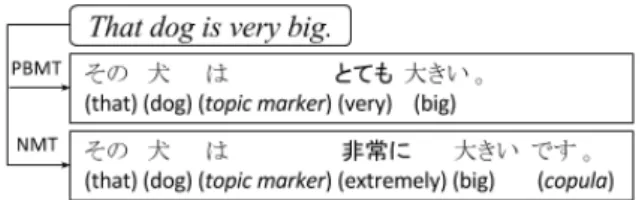
Figure 1: Overview of candidate pair generation.
(MSRP) (Dolan and Brockett,2005) is a standard-ized corpus in English for the PI task. However, as Rus et al. (2014) pointed out, MSRP collects candidate pairs using short edit distance, but this approach is limited to collecting positive instances with a low word overlap rate (WOR) (non-trivial positive instances, hereafter)1. In contrast, the Twitter Paraphrase Corpus (TPC) (Xu et al.,2014) comprises short noisy user-generated texts; hence, it is difficult to acquire negative instances with a high WOR (non-trivial negative instances, here-after)2.
To develop a more robust PI model, it is impor-tant to collect both“non-trivial”positive and neg-ative instances for the evaluation corpus. To cre-ate a useful evaluation corpus, we propose a novel paraphrase acquisition method that has two view-points of balancing the corpus: positive/negative and trivial/non-trivial. To balance between posi-tive and negaposi-tive, our method has a machine trans-lation part collecting mainly positive instances and a random extraction part collecting negative in-stances. In the machine translation part, we gen-erate candidate sentence pairs using multiple ma-chine translation systems. In the random extrac-tion part, we extract candidate sentence pairs from a monolingual corpus. To collect both trivial and non-trivial instances, we sample candidate pairs
1
Non-trivial positive instancesare difficult to identify as semantically equivalent.
2Non-trivial negative instancesare difficult to identify as
semantically inequivalent.
using WOR. Finally, annotators judge whether the candidate pairs are paraphrases.
In this paper, we focus on the Japanese PI task and build a monolingual parallel corpus for its evaluation as there is no Japanese sentential paraphrase corpus available. As Figure1 shows, we use phrase-based machine translation (PBMT) and neural machine translation (NMT) to gener-ate two different Japanese sentences from one En-glish sentence. We expect the two systems provide widely different translations with regard to sur-face form such as lexical variation and word order difference because they are known to have differ-ent characteristics (Bentivogli et al.,2016); for in-stance, PBMT produces more literal translations, whereas NMT produces more fluent translations.
We believe that when the translation succeeds, the two Japanese sentences have the same mean-ing but different expressions, which is a positive instance. On the other hand, translated candidates can be negative instances when they include fluent mistranslations. This occurs since adequacy is not checked during an annotation phase. Thus, we can also acquire some negative instances in this man-ner.
To actively acquire negative instances, we use Wikipedia to randomly extract sentences. In gen-eral, it is rare for sentences to become paraphrase when sentence pairs are collected randomly, so it is effective to acquire negative instances in this re-gard.
Our contributions are summarized as follows:
• Generated paraphrases using multiple ma-chine translation systems for the first time
• Adjusted for a balance from two viewpoints: positive/negative and trivial/non-trivial
• Released3 the first evaluation corpus for the Japanese PI task
2 Related Work
Paraphrase acquisition has been actively studied. For instance, paraphrases have been acquired from monolingual comparable corpora such as news ar-ticles regarding the same event (Shinyama et al.,
2002) and multiple definitions of the same con-cept (Hashimoto et al., 2011). Although these methods effectively acquire paraphrases, there are not many domains that have comparable corpora. In contrast, our method can generate paraphrase
3https://github.com/tmu-nlp/paraphrase-corpus
candidates from any sentences, and this allows us to choose any domain required by an application.
Methods using a bilingual parallel corpus are similar to our method. In fact, our method is an extension of previous studies that ac-quire paraphrases using manual translations of the same documents (Barzilay and McKeown, 2001;
Pang et al., 2003). However, it is expensive to manually translate sentences to create large num-bers of translation pairs. Thus, we propose a method that inexpensively generates translations using machine translation and Quality Estimation.
Ganitkevitch et al. (2013) and Pavlick et al.
(2015) also use a bilingual parallel corpora to build a paraphrase database using bilingual piv-oting (Bannard and Callison-Burch,2005). Their methods differ from ours in that they aim to ac-quire phrase level paraphrase rules and carry out word alignment instead of machine translation.
There are also many studies on building a large scale corpora utilizing crowdsourcing in related tasks such as Recognizing Textual Entailment (RTE) (Marelli et al.,2014;Bowman et al.,2015) and Lexical Simplification (De Belder and Moens,
2012; Xu et al., 2016). Moreover, there are studies collecting paraphrases from captions to videos (Chen and Dolan, 2011) and im-ages (Chen et al.,2015). One advantage of lever-aging crowdsourcing is that annotation is done inexpensively, but it requires careful task design to gather valid data from non-expert annotators. In our study, we collect sentential paraphrase pairs, but we presume that it is difficult for non-expert annotators to provide well-balanced senten-tial paraphrase pairs, unlike lexical simplification, which only replaces content words. For this rea-son, annotators classify paraphrase candidate pairs in our study similar to the method used in the TPC and previous studies on RTE.
As for Japanese, there exists a paraphrase database (Mizukami et al., 2014) and an evalua-tion dataset that includes some paraphrases for lexical simplification (Kajiwara and Yamamoto,
Jaccard # Sentence Average Sentence Length # Sample # Positive # Negative # Unnatural # Other
source PBMT NMT
[0.0,0.1) 228 19.42 20.65 19.75 200 2 1 (0) 80 117
[0.1,0.2) 2,117 21.56 24.81 22.01 200 11 14 (0) 147 28
[0.2,0.3) 14,080 21.56 26.50 23.37 200 20 9 (0) 162 9
[0.3,0.4) 51,316 23.48 29.69 26.29 200 24 15 (0) 161 0
[0.4,0.5) 100,674 24.40 31.35 28.08 200 27 16 (0) 151 6
[0.5,0.6) 134,101 23.16 29.90 27.26 200 34 16 (0) 142 8
[0.6,0.7) 100,745 21.04 27.32 25.30 200 38 13 (0) 129 20
[0.7,0.8) 55,610 18.83 24.57 23.04 200 53 12 (40) 131 4
[0.8,0.9) 26,884 16.23 21.31 20.24 200 81 3 (80) 94 22
[0.9,1.0) 8,071 13.79 18.40 17.55 200 73 3 (70) 56 68
[1.0,1.0] 6,174 10.10 13.07 12.96 0 0 0 (0) 0 0
Total 500,000 19.42 24.32 22.35 2,000 363 102 (190) 1,253 282
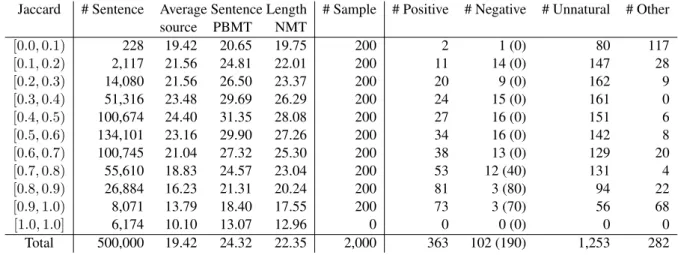
Table 1: Statistics on our corpus. The number inside ( ) of Negative column is the number of instances extracted from Wikipedia and the other is that of machine-translated instances.
3 Candidate Generation
3.1 Paraphrase Generation using Multiple Machine Translation Systems
We use different types of machine translation sys-tems (PBMT and NMT) to translate source sen-tences extracted from a monolingual corpus into a target language. This means that each source sen-tence has two versions in the target language, and we use the sentences as a pair.
To avoid collecting ungrammatical sentences as much as possible, we use Quality Estimation and eliminate inappropriate sentences for paraphrase candidate pairs. At WMT2016 (Bojar et al.,2016) in the Shared Task on Quality Estimation, the win-ning system YSDA (Kozlova et al., 2016) shows that it is effective for Quality Estimation to employ language model probabilities of source and target sentences, and BLEU scores between the source sentence and back-translation. Therefore, we cal-culate the language model probabilities of source sentences and translate them in the order of their probabilities. To further obtain better translations, we select sentence pairs in the descending order of machine translation output quality, which is de-fined as follows:
QEi = SBLEU(ei,BTPBMT(ei))
×SBLEU(ei,BTNMT(ei))
(1)
Here, ei denotes the i-th source sentence, BTPBMT denotes the back-translation using PBMT, BTNMT denotes the back-translation us-ing NMT, andSBLEUdenotes the sentence-level BLEU score (Nakov et al.,2012). When this score is high, it indicates that the difference in sentence
meaning before and after translation is small for each machine translation system.
3.2 Non-Paraphrase Extraction from a Monolingual Corpus
This extraction part of our method is for acquiring non-trivial negative instances. Although the ma-chine translation part of our method is expected to collect non-trivial negative instances too, there will be a certain gap between positive and nega-tive instances. To fill the gap, we randomly collect sentence pairs from a monolingual corpus written in the target language.
To check whether the negative instances ac-quired by machine translation and those ex-tracted directly from a monolingual corpus are dis-cernible, we asked three people to annotate ran-domly extracted 100 instances whether a pair is machine-translated or not. The average F-score on the annotation was 0.34. This means the negative instances are not distinguishable, so this does not affect the balance of the corpus.
3.3 Balanced Sampling using Word Overlap Rate
To collect both trivial and non-trivial instances, we carefully sample candidate pairs. We classify the pairs into eleven ranges depending on the WOR and sample pairs uniformly for each range, except for the exact match pairs. The WOR is calculated as follows:
Jaccard(TPBMT(ei),TNMT(ei))
=
TPBMT(ei)∩TNMT(ei) TPBMT(ei)∪TNMT(ei)
Label Example
Positive Input: My father was a very strong man.
PBMT: 私の父は非常に強い男でした。 My father was a very strong man.
NMT: 父はとても強い男だった。 My father was a very strong man. Negative Input: It is available as a generic medication.
PBMT: これは、一般的な薬として利用可能です。 It is available as a generic medicine.
NMT: ジェネリック医薬品として入手できます。 It is available as a generic medication.
Unnatural Input: I want to wake up in the morning
PBMT: 私は午前中に目を覚ますしたいです* I wake up want to in the morning*
NMT: 私は朝起きたい I want to wake up in the morning
Other Input: Academy of Country Music Awards :
PBMT: アカデミーオブカントリーミュージックアワード: Academy of Country Music Awards : NMT: アカデミー・オブ・カントリー・ミュージック賞: Academy of Country Music Awards :
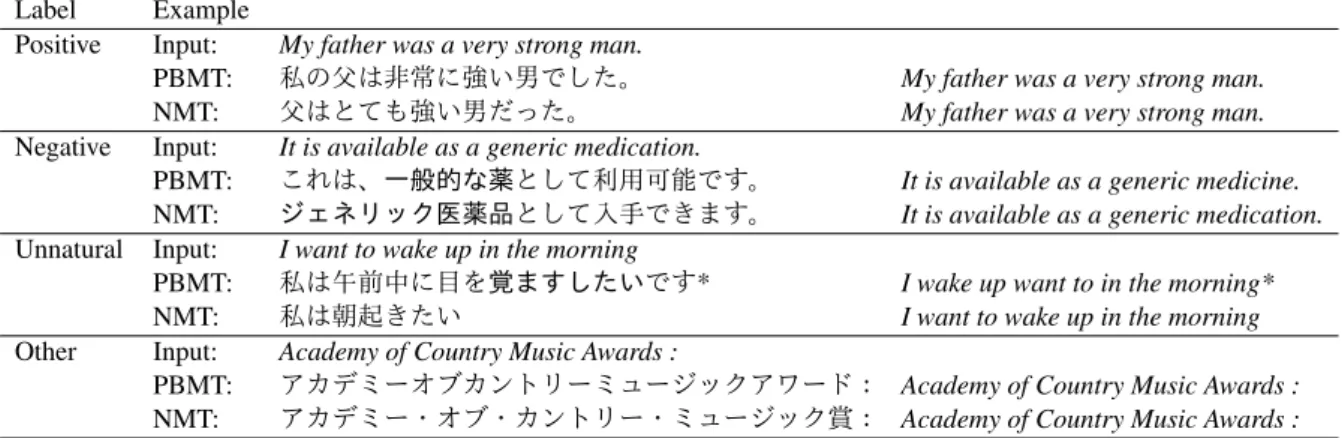
Table 2: Annotation labels and examples.
Here, TPBMT andTNMT denote the sentence in
the target language translated by PBMT and NMT respectively.
4 Corpus Creation
4.1 Acquiring Candidate Pairs in Japanese
We built the first evaluation corpus for Japanese PI using our method. We used Google Trans-late PBMT4and NMT5(Wu et al.,2016) to trans-late English sentences extracted from English Wikipedia 6 into Japanese sentences7. We cal-culated the language model probabilities using KenLM (Heafield,2011), and built a 5-gram lan-guage model from the English Gigaword Fifth Edition (LDC2011T07). Then we translated the top 500,000 sentences and sampled 200 pairs in the descending order of machine translation output quality for each range, except for the exact match pairs (Table1).
4.2 Annotation
We used four types of labels; Positive, Negative,
Unnatural, andOther (Table2). When both sen-tences of a candidate pair were fluent and semanti-cally equivalent, we labeled it asPositive. In con-trast, when the sentences were fluent but seman-tically inequivalent, the pair was labeled as Nega-tive. PositiveandNegativepairs were included in our corpus. The labelUnnaturalwas assigned to pairs when at least one of the sentences was un-grammatical or not fluent. In addition, the label
4
GOOGLETRANSLATE function on Google Sheets.
5
https://translate.google.co.jp/
6https://dumps.wikimedia.org/enwiki/20160501/ 7We trained Moses and translated the sentences from
Wikipedia; however, it did not work well. This is the reason why we chose Google machine translation systems, which work sufficiently well on Wikipedia.
Otherwas assigned to sentences and phrases that comprise named entities or that have minor differ-ences such as the presence of punctuation, even though they are paraphrases. UnnaturalorOther
pairs were discarded from our corpus.
One of the authors annotated 2,000 machine-translated pairs, then another author annotated the pairs labeled eitherPositiveorNegativeby the first annotator. The inter-annotator agreement (Co-hen’s Kappa) wasκ=0.60. Taking into considera-tion the fact that PI deals with a deep understand-ing of sentences and that there are some ambigu-ous instances without context (e.g.,good childand
good kid), the score is considered to be sufficiently high. There were 89 disagreements, and the final label was decided by discussion. As a result, we acquired 363 positive and 102 negative machine-translated pairs.
Although the machine translation part of our method successfully collected non-trivial positive instances, it acquired only a few non-trivial nega-tive instances as we expected. To fill the gap be-tween positive and negative in higher WOR, we randomly collected sentence pairs from Japanese Wikipedia8and added 190 non-trivial negative in-stances. At the end of both parts of our method, we acquired 655 sentence pairs in total, compris-ing 363 positive and 292 negative instances.
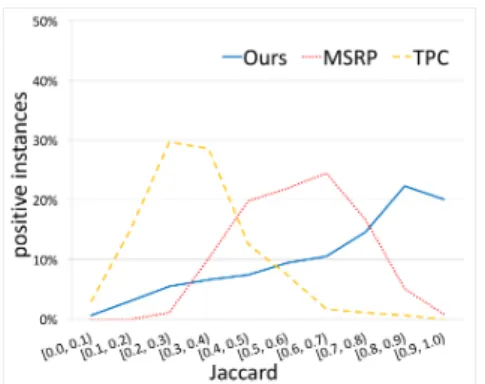
Figures 2and3indicate the distribution of the instances in each corpus. Compared to MSRP and TPC, our corpus covers all ranges of WOR both for positive and negative instances.
Figure 2: Distributions of positive sentence pairs in each WOR.
Figure 3: Distributions of negative sentence pairs in each WOR.
Category %
Content word replacement 63.1 Phrasal/Sentential replacement 25.0 Function word replacement 23.2 Function word insertion/deletion 14.3 Content word insertion/deletion 9.5
Word order 6.5
Lexical entailment 4.2
Table 3: The result of corpus analysis.
5 Discussion
5.1 Corpus Analysis
Table 3 shows the result of corpus analysis on machine-translated instances. We randomly sam-pled ten pairs from each range of WOR for both positive and negative pairs, i.e., 168 pairs in total, and investigated what type of pairs are included.
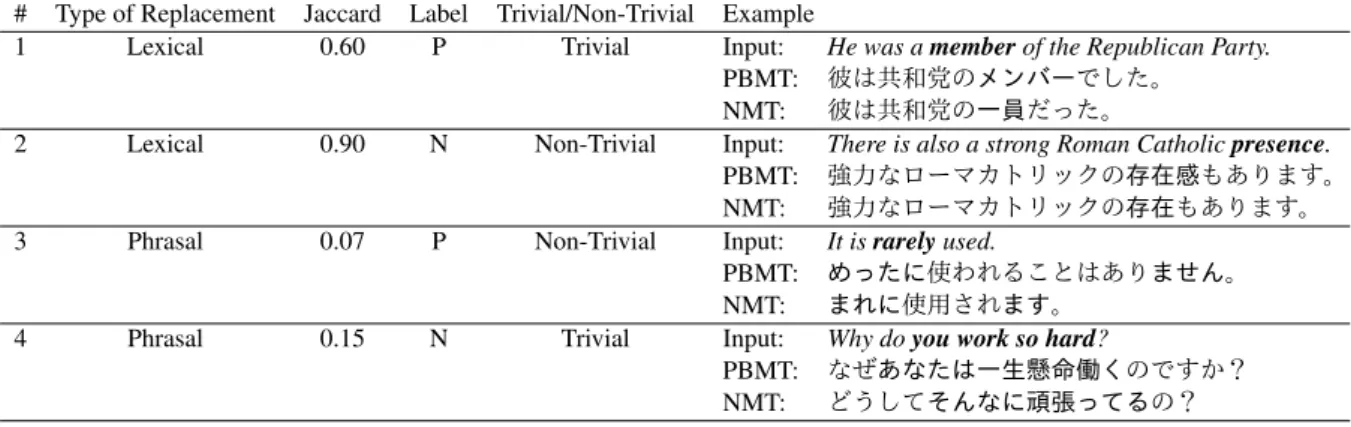
We found that most of the data comprises con-tent word replacement (63.1%). Further investiga-tion of this category shows that 30.2% are related to a change in the origin of words and transliter-ations. In Example # 1 in Table 4, PBMT out-puts a transliteration of amember, and NMT out-puts a Japanese translation. Next, the second most common type of pair is phrasal/sentential replace-ment (25.0%). When a pair has a bigger chunk of sentence or the sentence as a whole is replaced, it is assigned to this category. This implies that our method, which focuses on sampling by WOR, works to collect non-trivial instances like Exam-ples # 2 and # 3. On the contrary, Example # 4 is an example of instances where machine trans-lations demonstrate each characteristic like that mentioned in Section 1 (PBMT is more literal and
Figure 4: Accuracy of PI using WOR.
NMT is more fluent), so negative instances are produced as we expected. The outputs are seman-tically close, but the surface is very different. In this example, the PBMT output entails the NMT output.
5.2 Paraphrase Identification
We conducted a simple PI experiment ―an un-supervised binary classification. Here, we clas-sified each sentence pair as either paraphrase or non-paraphrase using WOR thresholds and evalu-ated its accuracy. Figure4shows the results from each corpus. Achieving around accuracy of 80% does not mean that the corpus is well built in any language. In that respect, this result proves that our corpus includes more instances that are diffi-cult to be solved with only superficial clues, which helps develop a more robust PI model.
6 Conclusion
triv-# Type of Replacement Jaccard Label Trivial/Non-Trivial Example
1 Lexical 0.60 P Trivial Input: He was amemberof the Republican Party.
PBMT: 彼は共和党のメンバーでした。
NMT: 彼は共和党の一員だった。
2 Lexical 0.90 N Non-Trivial Input: There is also a strong Roman Catholicpresence.
PBMT: 強力なローマカトリックの存在感もあります。
NMT: 強力なローマカトリックの存在もあります。 3 Phrasal 0.07 P Non-Trivial Input: It israrelyused.
PBMT: めったに使われることはありません。
NMT: まれに使用されます。
4 Phrasal 0.15 N Trivial Input: Why doyou work so hard?
PBMT: なぜあなたは一生懸命働くのですか?
NMT: どうしてそんなに頑張ってるの?
Table 4: Examples from our corpus. Bold words/phrases were replaced.
ial and non-trivial instances. With this method, we built the first evaluation corpus for Japanese PI. According to our PI experiment, our method made the corpus difficult to be solved.
Our method can be used in other languages, as long as machine translation systems and monolin-gual corpora exist. In addition, more candidates could be added by including additional machine translation systems. A future study will be under-taken to explore these possibilities.
Acknowledgments
We thank Naoaki Okazaki, Yusuke Miyao, and anonymous reviewers for their constructive feed-back. The first author was partially supported by Grant-in-Aid for the Japan Society for Promotion of Science Research Fellows.
References
Colin Bannard and Chris Callison-Burch. 2005. Para-phrasing with Bilingual Parallel Corpora. In Pro-ceedings of the 43rd Annual Meeting of the Associa-tion for ComputaAssocia-tional Linguistics. pages 597–604.
Regina Barzilay and Kathleen R. McKeown. 2001. Ex-tracting Paraphrases from a Parallel Corpus. In Pro-ceedings of 39th Annual Meeting of the Association for Computational Linguistics. pages 50–57.
Luisa Bentivogli, Arianna Bisazza, Mauro Cettolo, and Marcello Federico. 2016. Neural versus Phrase-Based Machine Translation Quality: a Case Study. In Proceedings of the 2016 Conference on Empiri-cal Methods in Natural Language Processing. pages 257–267.
Ondˇrej Bojar, Rajen Chatterjee, Christian Federmann, Yvette Graham, Barry Haddow, Matthias Huck, Antonio Jimeno Yepes, Philipp Koehn, Varvara Logacheva, Christof Monz, Matteo Negri, Aure-lie Neveol, Mariana Neves, Martin Popel, Matt
Post, Raphael Rubino, Carolina Scarton, Lucia Spe-cia, Marco Turchi, Karin Verspoor, and Marcos Zampieri. 2016. Findings of the 2016 Conference on Machine Translation. InProceedings of the First Conference on Machine Translation. pages 131– 198.
Samuel R. Bowman, Gabor Angeli, Christopher Potts, and Christopher D. Manning. 2015. A large anno-tated corpus for learning natural language inference. In Proceedings of the 2015 Conference on Empiri-cal Methods in Natural Language Processing. pages 632–642.
David Chen and William Dolan. 2011. Collecting Highly Parallel Data for Paraphrase Evaluation. In
Proceedings of the 49th Annual Meeting of the Asso-ciation for Computational Linguistics: Human Lan-guage Technologies. pages 190–200.
Jianfu Chen, Polina Kuznetsova, David Warren, and Yejin Choi. 2015. D´ej`a Image-Captions: A Corpus of Expressive Descriptions in Repetition. In Pro-ceedings of the 2015 Conference of the North Amer-ican Chapter of the Association for Computational Linguistics: Human Language Technologies. pages 504–514.
Jan De Belder and Marie-Francine Moens. 2012. A Dataset for the Evaluation of Lexical Simplification. InProceedings of the 13th International Conference on Computational Linguistics and Intelligent Text Processing. pages 426–437.
William B. Dolan and Chris Brockett. 2005. Auto-matically Constructing a Corpus of Sentential Para-phrases. In Proceedings of the Third International Workshop on Paraphrasing. pages 9–16.
Anthony Fader, Luke Zettlemoyer, and Oren Etzioni. 2013. Paraphrase-Driven Learning for Open Ques-tion Answering. InProceedings of the 51st Annual Meeting of the Association for Computational Lin-guistics. pages 1608–1618.
the North American Chapter of the Association for Computational Linguistics: Human Language Tech-nologies. pages 758–764.
Chikara Hashimoto, Kentaro Torisawa, Stijn De Saeger, Jun’ichi Kazama, and Sadao Kurohashi. 2011. Extracting Paraphrases from Definition Sen-tences on the Web. InProceedings of the 49th An-nual Meeting of the Association for Computational Linguistics: Human Language Technologies. pages 1087–1097.
Kenneth Heafield. 2011. KenLM: Faster and Smaller Language Model Queries. In Proceedings of the Sixth Workshop on Statistical Machine Translation. pages 187–197.
Tomoyuki Kajiwara and Kazuhide Yamamoto. 2015. Evaluation Dataset and System for Japanese Lexical Simplification. InProceedings of the ACL-IJCNLP 2015 Student Research Workshop. pages 35–40.
Tomonori Kodaira, Tomoyuki Kajiwara, and Mamoru Komachi. 2016. Controlled and Balanced Dataset for Japanese Lexical Simplification. InProceedings of the ACL 2016 Student Research Workshop. pages 1–7.
Anna Kozlova, Mariya Shmatova, and Anton Frolov. 2016. YSDA Participation in the WMT’16 Quality Estimation Shared Task. InProceedings of the First Conference on Machine Translation. pages 793– 799.
Marco Marelli, Stefano Menini, Marco Baroni, Luisa Bentivogli, Raffaella bernardi, and Roberto Zampar-elli. 2014. A SICK cure for the evaluation of compo-sitional distributional semantic models. In Proceed-ings of the Ninth International Conference on Lan-guage Resources and Evaluation. pages 216–223.
Masahiro Mizukami, Graham Neubig, Sakriani Sakti, Tomoki Toda, and Satoshi Nakamura. 2014. Build-ing a free, general-domain paraphrase database for Japanese. In Proceedings of the 17th Ori-ental Chapter of the International Committee for the Co-ordination and Standardization of Speech Databases and Assessment Techniques (COCOSDA 2014). pages 1–4.
Preslav Nakov, Francisco Guzman, and Stephan Vo-gel. 2012. Optimizing for Sentence-Level BLEU+1 Yields Short Translations. InProceedings of COL-ING 2012, the 24th International Conference on Computational Linguistics: Technical Papers. pages 1979–1994.
Bo Pang, Kevin Knight, and Daniel Marcu. 2003. Syntax-based Alignment of Multiple Translations: Extracting Paraphrases and Generating New Sen-tences. In Proceedings of the 2003 Human Lan-guage Technology Conference of the North Ameri-can Chapter of the Association for Computational Linguistics. pages 102–109.
Ellie Pavlick, Pushpendre Rastogi, Juri Ganitkevitch, Benjamin Van Durme, and Chris Callison-Burch. 2015. PPDB 2.0: Better paraphrase ranking, fine-grained entailment relations, word embeddings, and style classification. InProceedings of the 53rd An-nual Meeting of the Association for Computational Linguistics and the 7th International Joint Confer-ence on Natural Language Processing. pages 425– 430.
Vasile Rus, Rajendra Banjade, and Mihai Lintean. 2014. On Paraphrase Identification Corpora. In
Proceedings of the Ninth International Confer-ence on Language Resources and Evaluation. pages 2422–2429.
Yusuke Shinyama, Satoshi Sekine, and Kiyoshi Sudo. 2002. Automatic Paraphrase Acquisition from News Articles. InProceedings of the 2002 Human Language Technologiy Conference. pages 1–6.
Chenguang Wang, Nan Duan, Ming Zhou, and Ming Zhang. 2013. Paraphrasing Adaptation for Web Search Ranking. InProceedings of the 51st Annual Meeting of the Association for Computational Lin-guistics. pages 41–46.
Yotaro Watanabe, Yusuke Miyao, Junta Mizuno, To-mohide Shibata, Hiroshi Kanayama, Cheng-Wei Lee, Chuan-Jie Lin, Shuming Shi, Teruko Mita-mura, Noriko Kando, Hideki Shima, and Kohichi Takeda. 2013. Overview of the Recognizing Infer-ence in Text (RITE-2) at NTCIR-10. InProceedings of the 10th NTCIR Conference. pages 385–404.
Yonghui Wu, Mike Schuster, Zhifeng Chen, Quoc V. Le, Mohammad Norouzi, Wolfgang Macherey, Maxim Krikun, Yuan Cao, Qin Gao, Klaus Macherey, Jeff Klingner, Apurva Shah, Melvin Johnson, Xiaobing Liu, ukasz Kaiser, Stephan Gouws, Yoshikiyo Kato, Taku Kudo, Hideto Kazawa, Keith Stevens, George Kurian, Nishant Patil, Wei Wang, Cliff Young, Jason Smith, Jason Riesa, Alex Rudnick, Oriol Vinyals, Greg Corrado, Macduff Hughes, and Jeffrey Dean. 2016. Google’s Neural Machine Translation System: Bridging the Gap between Human and Machine Translation. In
arXiv preprint arXiv:1609.08144. pages 1–23.
Wei Xu, Courtney Napoles, Ellie Pavlick, Quanze Chen, and Chris Callison-Burch. 2016. Optimizing Statistical Machine Translation for Text Simplifica-tion. Transactions of the Association for Computa-tional Linguistics4:401–415.