A Learner Corpus-based Approach to Verb Suggestion for ESL
Yu Sawai Mamoru Komachi∗
Graduate School of Information Science Nara Institute of Science and Technology 8916-5 Takayama, Ikoma, Nara, 630-0192, Japan {yu-s, komachi, matsu}@is.naist.jp
Yuji Matsumoto
Abstract
We propose a verb suggestion method which uses candidate sets and domain adaptation to incorporate error patterns produced by ESL learners. The candi-date sets are constructed from a large scale learner corpus to cover various error pat-terns made by learners. Furthermore, the model is trained using both a native cor-pus and the learner corcor-pus via a domain adaptation technique. Experiments on two learner corpora show that the candidate sets increase the coverage of error patterns and domain adaptation improves the per-formance for verb suggestion.
1 Introduction
In this study, we address verb selection errors in the writing of English learners. Selecting the right verb based on the context of a sentence is difficult for the learners of English as a Second Language (ESL). This error type is one of the most common errors in various learner corpora ranging from ele-mentary to proficient levels1.
They?connect/communicatewith other businessmen and do their jobs with the help of computers.2
This sentence is grammatically acceptable with either verb. However, native speakers of En-glish would less likely use “connect”, which means “forming a relationship (with other busi-nessmen)”, whereas “communicate” means “ex-changing information or ideas”, which is what the sentence is trying to convey.
∗Now at Tokyo Metropolitan University.
1For example, in the CLC-FCE dataset, the replacement
error of verbs is the third most common out of 75 error types. In the KJ corpus, lexical choice of verb is the sixth most com-mon out of 47 error types.
2This sentence is taken from the CLC-FCE dataset.
Previous work on verb selection usually treats the task as a multi-class classification problem (Wu et al., 2010; Wang and Hirst, 2010; Liu et al., 2010; Liu et al., 2011). In this formaliza-tion, it is important to restrict verbs by a candi-date setbecause verb vocabulary is more numer-ous than other classes, such as determiners. Can-didate sets for verb selection are often extracted from thesauri and/or round-trip translations. How-ever, these resources may not cover certain error patterns found in actual learner corpora, and suffer from low-coverage. Furthermore, all the existing classifier models are trained only using a native corpus, which may not be adequate for correcting learner errors.
In this paper, we propose to use error patterns in ESL writing for verb suggestion task by using candidate sets and a domain adaptation technique. First, to increase the coverage, candidate sets are extracted from a large scale learner corpus derived from a language learning website. Second, a do-main adaptation technique is applied to the model to fill the gap between two domains: native cor-pus and ESL corcor-pus. Experiments are carried out on publicly available learner corpora, the Cam-bridge Learner Corpus First Certificate of English dataset (CLC-FCE) and the Konan JIEM corpus (KJ). The results show that the proposed candidate sets improve the coverage, compared to the base-line candidate sets derived from the WordNet and a round-trip translation table. Domain adaptation also boosts the suggestion performance.
To our knowledge, this is the first work for verb suggestion that uses (1) a learner corpus as a source of candidate sets and (2) the domain adaptation technique to take learner errors into ac-count.
2 Verb Suggestion Considering Error Patterns
The proposed verb suggestion system follows the standard approach in related tasks (Rozovskaya and Roth, 2011; Wu et al., 2010), where the candi-date selection is formalized as a multi-class classi-fication problem with predefined candidate sets.
2.1 Candidate Sets
For reflecting tendency of learner errors to the can-didate sets, we use a large scale corpus obtained from learners’ writing on an SNS (Social Net-working Service),Lang-83. An advantage of using the learner corpus from such website is the size of annotated portion (Mizumoto et al., 2011). This SNS has over 1 million manually annotated En-glish sentences written by ESL learners. We have collected the learner writings on the site, and re-leased the dataset for research purpose4.
First, we performed POS tagging for the dataset using the treebank POS tagger in the NLTK toolkit 2.10. Second, we extracted the correction pairs which have “VB*” tag. The set of correction pairs given an incorrect verb is considered as a candi-date set for the verb.
We then performed the following preprocessing for the dataset because we focus on lexical selec-tion of verbs:
• Lemmatize verbs to reduce data sparseness.
• Remove non-English verbs using WordNet.
• Remove incorrect verbs which occur only once in the dataset.
The target verbs are limited to the 500 most common verbs in the CLC-FCE corpus5. There-fore, verbs that do not appear in the target list are not included in the candidate sets. The topmost 500 verbs cover almost 90 percent of the vocabu-lary of verbs in the CLC-FCE corpus6.
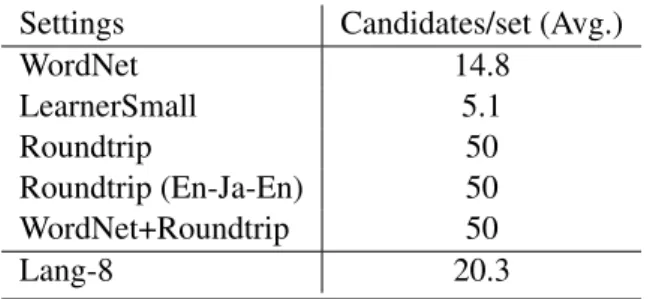
The average number of candidates in a set is 20.37. Note that the number of candidates varies across each target verb8.
3http://lang-8.com
4Further details can be found athttp://cl.naist.
jp/nldata/lang-8/. Candidate sets will also be avail-able at the same URL.
5They are extracted from all “VB” tagged tokens, and
they contain 1,292 unique verbs after removing non-English words.
6This number excludes “be”.
7In this paper, we limit the maximum number of
candi-dates in each set to 50.
8For instance, the candidate set for “get” has 315
correc-tion pairs, whereas “refund” has only 4.
2.2 Suggestion Model
The verb suggestion model consists of multi-class classifiers for each target verb; and based on the classifiers’ output, it suggests alternative verbs. Instances are in a fill-in-the-blank format, where the labels are verbs. Features in this format are extracted from the surrounding context of a verb. When testing on the learner corpus, the model sug-gests a ranking of the possible verbs for the blank corresponding to a given context. Note that un-like the fill-in-the-blank task, the candidate sets and domain adaptation can be applied to this task to take the original word into account.
The model is trained on a huge native corpus, namely the ukWaC corpus, because the data-size of learner corpora is limited compared to native corpora. It is then adapted to the target domain, i.e., learner writing. In our experiment, the Lang-8 corpus is used as the target domain corpus, since we assume that it shares the same characteristics with the CLC-FCE and the KJ corpora used for testing.
2.3 Domain Adaptation
To adapt the models to the learner corpus, we em-ploy a domain adaptation technique to emphasize the importance of learner domain information. Al-though there are many studies on domain adap-tation, we chose to use Feature Augmentation technique introduced by (Daum´e III, 2007) for its simplicity. Recently, (Imamura et al., 2012) pro-posed to apply this method to grammatical error correction for writings of Japanese learners and confirmed that this is more effective for correct-ing learner errors than simply addcorrect-ing the target do-main instances.
In this study, the source domain is the native writing, and the target domain is the ESL writing. Our motivation is to use the ESL corpus together with the huge native corpus to employ both an ad-vantage of the size of training data and the ESL writing specific features.
In this method, adapting a model to another model is achieved by extending the feature space. Given a feature vector of F dimensions as x ∈
RF(F > 0), using simple mapping, the aug-mented feature vectors for source and target do-mains are obtained as follows,
Source domain:<xS,xS,0> (1)
where 0 denotes a zero-vector of F dimensions. The three partitions mean a common, a source-specific, and a target-specific feature space. When testing on the ESL corpora, the target-specific fea-tures are emphasized.
2.4 Features
In previous work, various features were used: lex-ical and POS n-grams, dependencies, and argu-ments in the verb context. (Liu et al., 2011) has shown that shallow parse features, such as lexi-cal n-grams and chunks, work well in realistic set-tings, in which the input sentence may not be cor-rectly parsed. Considering this, we use shallow parse features as context features for robustness.
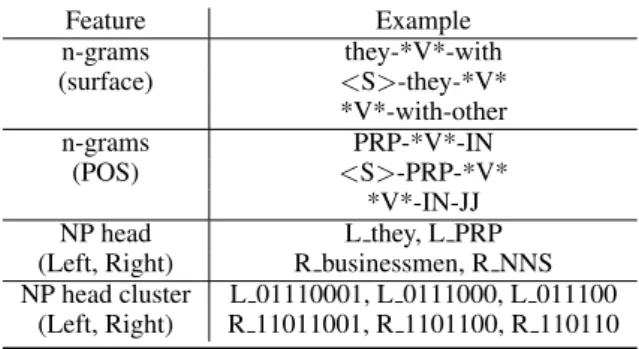
The features include lexical and POS n-grams, and lexical head words of the nearest NPs, and clustering features of these head words. An ex-ample of extracted features is shown in Table 2.4. Note that those features are also used when ex-tracting examples from the target domain dataset (the learner domain corpus). As shown in Table 2.4, the n-gram features are 3-gram and extracted from±2context window. The nearest NP’s head features are divided into two (Left, Right).
The additional clustering features are used for reducing sparseness, because the NP’s head words are usually proper nouns. To create the word clus-ters, we employ Brown clustering, a hierarchical clustering algorithm proposed by (Brown et al., 1992). The structure of clusters is a complete bi-nary tree, in which each node is represented as a bit-string. By varying the length of the prefix of bit-string, it is possible to change the granularity of cluster representation. As illustrated in Table 2.4, we use the clustering features with three lev-els of granularity: 256, 128, and 64 dimensions. We used Percy Liang’s implementation9 to create 256 dimensional model from the ukWaC corpus, which is used as the native corpus.
3 Experiments
Performance of verb suggestion is evaluated on two error-tagged learner corpora: CLC-FCE and KJ. In the experiments, we assume that the tar-get verb and its context for suggestion are already given.
For the experiment on the CLC-FCE dataset, the targets are all words tagged with “RV”
(re-9https://github.com/percyliang/
brown-cluster
Feature Example
n-grams they-*V*-with
(surface) <S>-they-*V* *V*-with-other
n-grams PRP-*V*-IN
(POS) <S>-PRP-*V* *V*-IN-JJ
NP head L they, L PRP
(Left, Right) R businessmen, R NNS NP head cluster L 01110001, L 0111000, L 011100
(Left, Right) R 11011001, R 1101100, R 110110 (e.g.,They (communicate) with other businessmen and do
their jobs with the help of computers.)
“<S>” denotes the beginning of the sentence, “*V*” denotes the blanked out verb.
Table 1: Example of extracted features as the fill-in-the-blank form.
placement error of verbs). We assume that all the verb selection errors are covered with this error tag. All error tagged parts with nested correction or multi-word expressions are excluded. The re-sulting number of “true” targets is 1,083, which amounts to 4% of all verbs. Therefore the dataset is highly skewed to correct usages, though this set-ting expresses well the reality of ESL wriset-ting, as shown in (Chodorow et al., 2012).
We carried out experiments with a variety of re-sources used for creating candidate sets.
• WordNet
Candidates are retrieved from the synsets and verbs sharing the same hypernyms in the WordNet 3.0.
• LearnerSmall
Candidates are retrieved from following learner corpora: NUS corpus of learner English (NUCLE), Konan-JIEM (KJ), and NICT Japanese learner English (JLE) corpus.
• Roundtrip
Candidates are collected by performing “round-trip” translation, which is similar to (Bannard and Callison-Burch, 2005)10.
• WordNet+Roundtrip
A combination of the thesaurus-based and the translation table-based candidate sets, similar to (Liu et al., 2010) and (Liu et al., 2011).
• Lang-8
The proposed candidate sets obtained from a large scale learner corpus.
• Lang-8+DA
Lang-8 candidate sets with domain
adapta-10Our roundtrip translation lexicons are built using a subset
Settings Candidates/set (Avg.)
WordNet 14.8
LearnerSmall 5.1
Roundtrip 50
Roundtrip (En-Ja-En) 50
WordNet+Roundtrip 50
Lang-8 20.3
Table 2: Comparison of candidate set size for each setting.
tion via feature augmentation.
Table 3 shows a comparison of the average number of candidates in each setting. In all config-urations above, the parameters of the models un-derlying the system are identical. We used a L2-regularized generalized linear model with log-loss function via Scikit-learn ver. 0.13.
Inter-corpus Evaluation
We also evaluate the suggestion performance on the KJ corpus. The corpus contains diary-style writing by Japanese university students. The pro-ficiency of the learners ranges from elementary to intermediate, so it is lower than that of the CLC-FCE learners. The targets are all verbs tagged with “v lxc” (lexical selection error of verbs).
To see the effect of L1 on the verb sugges-tion task, we added an alternative setting for the Roundtrip using only the English-Japanese and Japanese-English round-trip translation tables (En-Ja-En). For the experiment on this test-corpus, the LearnerSmall is not included.
Datasets
The ukWaC web-corpus (Ferraresi et al., 2008) is used as a native corpus for training the suggestion model. Although this corpus consists of over 40 million sentences, 20,000 randomly selected sen-tences are used for each verb11.
The Lang-8 learner corpus is used for domain adaptation of the model in the Lang-8+DA config-uration. The portion of data is the same as that used for constructing candidate sets.
Metrics
Mean Reciprocal Rank (MRR) is used for evalu-ating the performance of alternative suggestions. The mean reciprocal rank is calculated by taking
11e.g., a classifier with a candidate set containing 50 verbs
is trained with 1 million sentences in total.
the average of the reciprocal ranks for each in-stance. Givenr goldi as the position of the gold correction candidate in the suggestion listSi fori -th checkpoint, -the reciprocal rankRRi is defined as,
RRi =
1
r goldi
(goldi ∈ Si)
0 (otherwise)
(3)
4 Results
Tables 5 and 5 show the results of suggestion per-formance on the CLC-FCE dataset and the KJ cor-pus, respectively. In both cases, the Lang-8 and its domain adaptation variant outperformed the oth-ers. The coverage of error patterns in the tables is the percentage of the cases where the sugges-tion list includes the gold correcsugges-tion. Generally, the suggestion performance and the coverage im-prove as the size of the candidate sets increases.
5 Discussions
Although the expert-annotated learner corpora contain candidates which are more reliable than a web-crawled Lang-8 corpus, the Lang-8 setting performed better as shown in Table 5. This can be explained by the broader coverage by the Lang-8 candidate sets than that of the LearnerSmall. Sim-ilarly, the WordNet performed the worst because it contains only synonym-like candidates. We can conclude that, for the verb suggestion task, the coverage (recall) of candidate sets is more impor-tant than the quality (precision).
We see little influence of learners’ L1 in the re-sults of Table 5, since the Roundtrip performed better than the Roundtrip (En-Ja-En). As already mentioned, the number of error patterns contained in the candidate sets seems to have more impor-tance than the quality.
sug-Settings MRR Coverage
WordNet 0.066 14.0 %
LearnerSmall 0.128 23.5 %
Roundtrip 0.185 48.1 %
WordNet+Roundtrip 0.173 48.1 %
Lang-8 0.220 57.6 %
Lang-8+DA 0.269* 57.6 %
The value marked with the asterisk indicates statistically sig-nificant improvement over the baselines, where p < 0.05 bootstrap test.
Table 3: Suggestion performance on the CLC-FCE dataset.
Settings MRR Coverage
WordNet 0.044 5.0 %
Roundtrip 0.241 53.8 %
Roundtrip (En-Ja-En) 0.188 38.8 % WordNet+Roundtrip 0.162 53.8 %
Lang-8 0.253 68.9 %
Lang-8+DA 0.412* 68.9 %
The value marked with the asterisk indicates statistically sig-nificant improvement over the baselines, except “Roundtrip”, wherep<0.05bootstrap test.
Table 4: Suggestion performance on the KJ cor-pus.
gestions. The improvements appeared for fre-quent confusions of Japanese ESL learners such as “?see/watch” and “?tell/teach”.
Comparing the results of the Lang-8+DA on both test-corpora, the domain adaptation tech-nique worked more effectively on the KJ cor-pus than on the CLC-FCE. This can be explained by the fact that the style of writing of the addi-tional data, i.e., the Lang-8 corpus, is closer to KJ than it is to CLC-FCE. More precisely, unlike the examination-type writing style of CLC-FCE, the KJ corpus consists of diary writing similar in style to the Lang-8 corpus, and it expresses more closely the proficiency of the learners.
We think that the next step is to refine the sug-gestion models, since we currently take a simple fill-in-the-blank approach. As future work, we plan to extend the models as follows: (1) use both incorrect and correct sentences in learner corpora for training, and (2) employ ESL writing specific features such as learners’ L1 for domain adapta-tion.
Acknowledgments
We thank YangYang Xi of Lang-8, Inc. for kindly allowing us to use the Lang-8 learner corpus. We also thank the anonymous reviewers for their in-sightful comments. This work was partially sup-ported by Microsoft Research CORE Project.
References
Colin Bannard and Chris Callison-Burch. 2005. Para-phrasing with bilingual parallel corpora. In Pro-ceedings of the 43rd Annual Meeting of the Associa-tion for ComputaAssocia-tional Linguistics, pages 597–604.
Peter F Brown, Vincent J Della Pietra, Peter V DeS-ouza, Jenifer C Lai, Robert L Mercer, and Vincent J Della Pietra. 1992. Class-Based n-gram Models of Natural Language. Computational Linguistics, 18(4):467–479, December.
M Cettolo, Christian Girardi, and Marcello Federico. 2012. WIT3: Web Inventory of Transcribed and Translated Talks. In Proceedings of the 16th Con-ference of the European Association for Machine Translation (EAMT), pages 28–30.
Martin Chodorow, Markus Dickinson, Ross Israel, and Joel Tetreault. 2012. Problems in Evaluating Gram-matical Error Detection Systems. InProceedings of the 24th International Conference on Computational Linguistics (Coling2012), pages 611–628.
Hal Daum´e III. 2007. Frustratingly easy domain adap-tation. InProceedings of the 45th Annual Meeting of the Association of Computational Linguistics, pages 256–263.
Adriano Ferraresi, Eros Zanchetta, and Marco Baroni. 2008. Introducing and evaluating ukWaC, a very large web-derived corpus of English. In Proceed-ings of the 4th Web as Corpus Workshop (WAC-4), pages 45–54.
Kenji Imamura, Kuniko Saito, Kugatsu Sadamitsu, and Hitoshi Nishikawa. 2012. Grammar error correc-tion using pseudo-error sentences and domain adap-tation. In Proceedings of the 50th Annual Meet-ing of the Association for Computational LMeet-inguis- Linguis-tics, pages 388–392.
Xiaohua Liu, Bo Han, Kuan Li, Stephan Hyeonjun Stiller, and Ming Zhou. 2010. SRL-based verb se-lection for ESL. In Proceedings of the 2010 Con-ference on Empirical Methods in Natural Language Processing, pages 1068–1076.
Tomoya Mizumoto, Mamoru Komachi, Masaaki Na-gata, and Yuji Matsumoto. 2011. Mining revi-sion log of language learning SNS for automated Japanese error correction of second language learn-ers. In Proceedings of the 5th International Joint Conference on Natural Language Processing, pages 147–155.
Alla Rozovskaya and Dan Roth. 2011. Algorithm selection and model adaptation for ESL correction tasks. In Proceedings of the 49th Annual Meet-ing of the Association for Computational LMeet-inguis- Linguis-tics, pages 924–933.
Tong Wang and Graeme Hirst. 2010. Near-synonym lexical choice in latent semantic space. In Proceed-ings of the 23rd International Conference on Com-putational Linguistics (Coling 2010), pages 1182– 1190.