ANNU AL R EP OR T 2013–2014
NATIONAL LIBRAR OF AUSTRALIA
ANNUAL
REPORT
2013–2014
Published by the National Library of Australia Parkes Place
Canberra ACT 2600 T 02 6262 1111 F 02 6257 1703
National Relay Service 133 677 nla.gov.au/policy/annual.html ABN 28 346 858 075
© National Library of Australia 2014 National Library of Australia
Annual report / National Library of Australia.–8th (1967/68)– Canberra: NLA, 1968––v.; 25 cm.
Annual.
Continues: National Library of Australia. Council. Annual report of the Council = ISSN 0069-0082.
Report year ends 30 June.
ISSN 0313-1971 = Annual report–National Library of Australia. 1. National Library of Australia–Periodicals.
027.594
Prepared by the Executive and Public Programs Division Printed by Union Offset
Cover image:
Nicolaes Visscher (1618–1679)
Orbis terrarum nova et accuratissima tabula 1658 (Amsterdam: J. Jansson, 1658)
nla.map-rm4641
Canberra ACT 2600
T +61 2 6262 1111 F +61 2 6257 1703
Hearing or speech impaired-call us via the National Relay Service on 133 677 nla.gov.au
ABN 28 346 858 075
8 August 2014
Senator the Hon. George Brandis QC Attorney-General
Minister for the Arts Parliament House CANBERRA ACT 2600
Dear Minister
National Library of Australia Annual Report 2013–2014
The Council of the National Library of Australia has pleasure in submitting to you, for presentation to each House of Parliament, its annual report covering the period 1 July 2013 to 30 June 2014.
The report is submitted to you in accordance with section 9 of the Commonwealth Authorities and Companies Act 1997 and the Commonwealth Authorities (Annual Reporting) Orders 2011. The report has been prepared in conformity with the requirements set out under Clause 1 of Schedule 1 of the Commonwealth Authorities and Companies Act and with select regard to the Requirements for Departmental Annual Reports, approved by the Joint Committee of Public Accounts and Audit under subsections 63(2) and 70(2) of the Public Service Act 1999 and made available by the Department of the Prime Minister and Cabinet on 29 May 2014.
We commend the Annual Report to you.
Yours sincerely
Mr Ryan Stokes Ms Anne-Marie Schwirtlich
Chair of Council Director General
INTRODUCTION
1 Chair’s Report 3Director General’s Review 6
Summary of Financial Performance 12
CORPORATE OVERVIEW
19 Role 21Legislation 21 Organisation 21
Corporate Governance 23 Public Accountability 28 Corporate Management 34 Information Technology 47
REPORT OF OPERATIONS
53Outcome and Strategies 55
Strategic Direction One: Collect and Preserve Australia’s Documentary Heritage 56 Strategic Direction Two: Make the Library’s Collections and Services Accessible
to All Australians 61
Strategic Direction Three: Deliver National Leadership 66 Strategic Direction Four: Achieve Organisational Excellence 71 Cross-agency Key Performance Indicators 73
FINANCIAL STATEMENTS
77 Audited Financial Statements 79APPENDICES
129Appendix A: The Council of the National Library of Australia and Its Committees 131 Appendix B: National Library of Australia Foundation Board 137
Appendix C: National Library of Australia Committees 138 Appendix D: Principal Supporting Policies and Documents 140 Appendix E: Consultancy Services 142
Appendix F: Stafing Overview 143
Appendix G: Gifts, Grants and Sponsorships 147 Appendix H: National Library of Australia Fund 149 Appendix I: Notable Acquisitions 157
GLOSSARY AND INDICES
161 Glossary 163Shortened Forms 164 Compliance Index 165 Index 166
Figures
1.1 Income, 2013–14 and 2012–13 12 1.2 Expenses, 2013–14 and 2012–13 13 1.3 Total Assets, 2013–14 and 2012–13 15 1.4 Total Liabilities, 2013–14 and 2012–13 16 1.5 Net Cash Flow, 2013–14 and 2012–13 17
2.1 Organisational and Senior Management Structure, 30 June 2014 22 2.2 Corporate Governance Structure, 2013–14 23
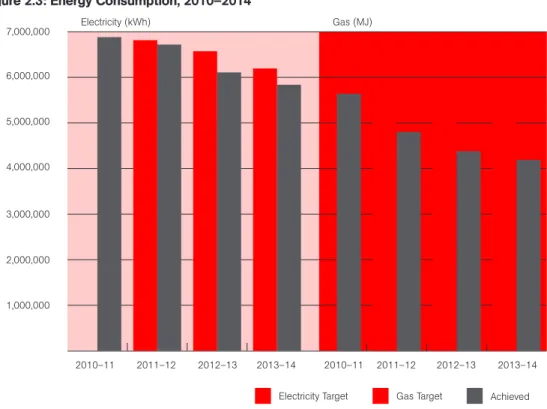
2.3 Energy Consumption, 2010–2014 43 2.4 Paper Consumption, 2010–2014 43
2.5 Ten-year Growth in Digital Collection Storage 48 2.6 Digital Collection Storage by Material, 30 June 2014 48 2.7 Use of Web Services, 2000–01 to 2013–14 49 3.1 Number of Collection Items Stored and Maintained 59
3.2 Number of Collection Items Catalogued or Indexed 60 3.3 Number of Physical Collection Items Delivered to Users 65 3.4 Number of Agencies Subscribing to Key Collaborative Services 69 3.5 Number of Records and Items Contributed by Subscribing Agencies 70
Tables
2.1 Compliments Received, 2013–14 31 2.2 Complaints Received, 2013–14 32 2.3 Library Expenditure, 2013–14 33
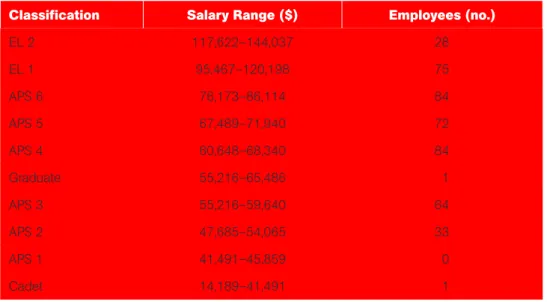
2.4 Salary Ranges below SES Level and Number of Employees, 30 June 2014 36
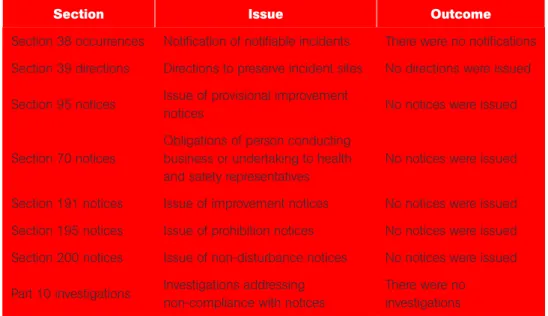
2.5 Reporting Requirements under the Work Health and Safety Act 2011, 30 June 2014 39 2.6 Premiums for Injuries Suffered, 2011–15 (as a percentage of wages and salaries) 40 2.7 Availability of Ten Key Service Areas, 2013–14 50
3.1 Develop, Store and Maintain the National Collection—Deliverables and Key Performance Indicators, 2013–14 59
3.2 National Collection—Storage (%) 60 3.3 National Collection—Processing (%) 60
3.4 Provide Access to the National Collection and Other Documentary Resources— Deliverables and Key Performance Indicators, 2013–14 65
3.5 Collection Access—Service Charter (%) 65
3.6 Provide and Support Collaborative Projects and Services—Deliverables and Key Performance Indicators, 2013–14 69
3.7 Collaborative Services—Percentage of Speciied Service Standards and Timeframes Met (%) 70
3.8 Summary of Results against the Cross-Agency Key Performance Indicators, 2013–14 73 3.9 Cross-Cultural Agency Key Performance Indicators, 2013–14 74
E.1 Consultancy Services Engaged, 2013–14 142 F.1 Staff Distribution by Division, 30 June 2014 143
F.2 Ongoing and Non-ongoing Full-time and Part-time Staff by Classiication and Gender, 30 June 2014 144
F.3 Staff by Equal Employment Opportunity Group and APS Classiication, 30 June 2014 145
F.4 Training Days, 2013–14 146
INTRODUCTION
CHAIR’S
REPORT
Nicolaes Visscher (1618–1679)
Orbis terrarum nova et accuratissima tabula (detail) 1658 (Amsterdam: J. Jansson, 1658)
nla.map-rm4641
It is my pleasure to report that over 2013–14 the National Library has continued to broaden its reach and to build and preserve its collection innovatively and successfully. The Library’s signiicant achievements are set out in this report.
For some years now, the Library has been at the forefront of research and action by collecting institutions around the world to meet the collecting, access and preservation challenges presented by the dynamic digital environment in which we operate. The Library is part-way through an ambitious and challenging project to replace existing digital infrastructure to provide the required capability and capacity to eficiently collect digital content, digitise paper and other analogue collections, preserve digital material, and deliver digital content.
This project is core to the Library’s ability to protect and deliver digital collections and to meet collecting and access obligations into the future. Using a mix of commercial products, open-source software and in-house development, in January the Library released a system to support the end-to-end digitisation, management, preservation and delivery of published books and journals held in its collections. Given the centrality of the project to the Library’s work and success, and its complexity, the Library Council takes a close interest in its progress and governance.
On the access front three things stand out as highlights of the year: the extraordinary success of the exhibition, Mapping Our World: Terra Incognita to Australia; the continuing growth and success of Trove; and the careful planning, design work and preparation for the integration of the Petherick, Maps, and Pictures and Manuscripts Reading Rooms, and the integration of the Newspapers and Microforms and Main Reading Rooms.
Mapping Our World brought together spectacular maps from international collections and those from the Library and other public and private Australian collections to tell the story of European mapping of Australia, from early notions of a vast southern land to Matthew Flinders’ published map of 1814. With 118,264 visitors to the exhibition, from around Australia and abroad, it has broken previous attendance records and ranks as the most popular exhibition in the Library’s long exhibiting history. The exhibition was made possible only by the generous support of lenders: the Australian and ACT Governments; the exhibition’s Principal Partner, Shell; its Major Partners, Australian Capital Equity, Esri Australia, Planet Wheeler, Channel Seven and Crowne Plaza Canberra; its Airline Partners, Etihad and Virgin Australia; and its Accommodation Partner, Toga Hotels.
The Council has taken a keen interest in the Public Management Reform Agenda and in the proposals for corporate planning for entities such as the Library. The Library’s existing Strategic Directions will serve it well for another year. In June, the Council initiated the process to develop strategic directions for 2015–2019 in preparation for the implementation of the new corporate planning arrangements on 1 July 2015.
I would like to acknowledge the contribution of my fellow Council members: the Hon. Mary Delahunty, Mr John M. Green, Dr Nicholas Gruen, Mr Chris Hayes MP, Ms Jane Hemstritch, Dr Nonja Peters, Professor Janice Reid, Senator Zed Seselja and Ms Deborah Thomas. The Council farewelled the Hon. Dick Adams, Ms Glenys Beauchamp PSM and Senator Gary Humphries in 2013, and thanked all three for their work on Council.
On behalf of Council I would like to acknowledge and extend our appreciation to the Library’s Corporate Management Group led by Director General Anne-Marie Schwirtlich, and to all Library staff. Through their collective efforts and passionate dedication to the Library we are able to achieve our goals. We thank them for their efforts.
Ryan Stokes Use of Trove, the Library’s free, online national delivery and discovery service, continued to
grow, as did its content. In June 2013, Trove had an average of more than 60,000 visits a day; by June 2014 the igure had grown to 66,000. More than 24 million visits to Trove, from Australia and the world, were recorded for the year—an increase of 16 per cent over the previous year— with visitors completing more than 93 million searches. The number of unique visitors rose to 15 million—an increase of 25 per cent over last year.
The Library conducted the irst major evaluation of customer satisfaction with Trove and was heartened by the results, with the overwhelming majority of users (84 per cent) rating Trove as
‘excellent’ or ‘very good’, a further 14 per cent rating it ‘good’, and a total of 98 per cent of Trove users happy with their experience. The Library is particularly pleased that the evaluation showed Trove’s reach extending to Australians in regional, rural and remote areas, with many respondents thanking the Library for this new form of easy access to Australian documentary heritage. Consistent with the master plan for the Library’s building, design work for the expansion of the Main Reading Room on the ground loor and relocation of the Petherick, Maps, and Pictures and Manuscripts Reading Rooms to a new space on the irst loor of the building was completed. This work will also ensure that signiicant portions of three levels of the building will be upgraded to meet building codes, work health and safety requirements and government standards for the comfort of individuals, the protection of the collection and building heritage values. Following receipt of the Minister’s approval to proceed, work commenced in May.
The Library’s work on building, managing and preserving the collection continued. The Library gave priority to working with the Attorney-General’s Department on preparations to amend the Copyright Act 1968 (Copyright Act) to provide for the legal deposit of electronic resources. The Library is eager to see legislative change achieved in 2014–15 to ensure that the national collection of material published in Australia is comprehensive and best able to serve future research and study needs.
In March, the Library released, in proof-of-concept form, a new web archive service—the Australian Government Web Archive. The archive preserves Commonwealth government websites and online publications, with collecting beginning in 2011. The service complements the Library’s long-established PANDORA archive which makes available, by permission, a range of web material published by individuals and organisations and selected government websites prior to 2011. Development work on the website will continue, particularly to bring it under the Library’s single discovery service, Trove.
With its Audit Committee, the Library Council has taken particular interest in matters concerning the valuation of the Library’s collection and the impact valuation requirements and processes have on the work and resources of the Library. The Council is grateful to the Australian National Audit Ofice for its assistance in resolving these issues.
year was collecting websites relating to the September 2013 federal election, resulting in more than 500 websites collected, including those of candidates, lobby and interest groups, and registered political parties, and media, commentary, social media and video sites. In addition, many of the websites of outgoing ministers and sites relating to discontinuing programs, including the website of the Climate Institute of Australia, were collected.
Despite the acceleration of digital publishing, for the foreseeable future the Library will be collecting both paper-based and digital material, and 2013–14 has seen remarkable additions to the national collection, some of which are highlighted in Appendix I.
Over the course of the year, the Library completed an analysis of its newspaper holdings against its Collection Development Policy and the Australian Newspaper Plan, an agreement with all state and territory libraries concerning newspaper preservation. The Library collects and preserves print copies of national titles, such as The Australian and Australian Financial Review, and, with the ACT Heritage Library, all ACT papers including suburban weeklies. The Library also collects and preserves print copies of capital city dailies, ethnic newspapers and subject-based newspapers such as The Queensland Graingrower. To ensure that the Library is able to support the research needs of most onsite researchers, it also collects and retains signiicant regional papers Australia wide; higher use newspaper titles (those used more than ten times over the past seven years); as well as copies of newspapers from nearby areas such as Braidwood, Cooma, Goulburn, Queanbeyan and Yass. Initially, the Library collects these titles in print but does not retain the print copy once a microilm copy has been acquired. Local and community newspapers outside the ACT—that is, those which are not regional in their coverage— have not been considered collecting priorities since 1990 and have been out of the Library’s collecting scope since 1999. The Library commenced repatriating copies of selected local print newspapers outside the scope of its Collection Development Policy to the state and territory libraries in whose jurisdictions they were published to ensure that the collections of record are comprehensive.
One beneit of the Library’s long-standing collaboration with state and territory library partners on newspaper collecting has been the highly successful Australian Newspaper Digitisation Program funded jointly by the Library and contributing partners. This year the largest number of newspaper pages was digitised since the program began in 2007, with 3.6 million pages added to Trove. The Digital Excellence Program at the State Library of NSW was a major contributor to this result. By the end of the year, over 13 million pages were accessible. Trove newspapers is by far the largest collection of digitised newspapers in the world and this content continues to drive usage of Trove, with over 24 million visits recorded in the period.
As the Chair has reported, use of Trove, which assists people to access content held by the Library and collecting institutions across Australia, rose steadily and users continue to express great satisfaction with it. In May and June 2013, the Library conducted an online survey to
DIRECTOR GENERAL’S
REVIEW
The Library has made notable progress in advancing its Strategic Directions for 2012–14, which focus on developing the national collection, promoting access and engaging audiences, collaboration and leadership, and achieving organisational excellence.
The Library shapes its strategic thinking with reference to its broader context. Over the course of the reporting year, the Library has monitored developments in the policy environment, trends in use and information-seeking behaviour, and changes in the digital domain. Three developments have been of particular interest. The Minister has articulated six principles by which he will shape policy for the Arts, namely excellence, integrity, artistic freedom, self-conidence, sustainability and accessibility. The Library believes that it is well positioned to contribute to these principles. The second development was the tabling of the Australian Law Reform Commission’s report on Copyright and the Digital Economy. The Library welcomes the Commission’s recommendation that a ‘fair use’ exception replace many of the existing ‘purpose-based’ exceptions in the Copyright Act. Finally, the Library has taken account of the Public Management Reform Agenda and followed keenly the proposed changes to the inancial accountability, corporate planning and online security frameworks, all of which will have an impact on the Library.
Responding to the dominance of the digital in the information world, the Library is developing more robust worklows and systems to enable it to collect, preserve, digitise and provide access to an increasing number of online resources. In January, Stage 1 of the Digital Library Infrastructure Replacement (DLIR) project was completed. This enables the digitisation, management and delivery of published books and journals in the Library’s collections and will support the bit-level preservation of the Library’s digital collections. Stage 2 of the project commenced in February and when concluded will support the digital appraisal, management and delivery of manuscripts and pictures and develop prototypes for web archiving and preservation. The DLIR project is innovative, complex and signiicant and a mid-point review of the project will commence early in 2014–15.
The legislative environment does not support the Library’s collecting work in the digital domain. As the Chair has noted, the Library is eager to see amendments to the Copyright Act which will extend the legal deposit provisions to ensure that material published in digital form can be preserved by the Library. To prepare for this vital amendment to the Copyright Act, Library staff have worked on Regulation Impact Statements and assessed the cost of the compliance obligations for publishers. The Library stands ready to work closely with the Attorney-General’s Department and publishers to ensure the smooth implementation of these new arrangements. In the absence of legal deposit for electronic material, the Library seeks permission to collect and preserve, in the PANDORA archive, a selection of web-based publications. A focus for the
acclaim. Audience evaluation by Environmetrics revealed that 98 per cent of visitors gave the content the top ratings, approximately half of the audience came from outside Canberra/ Queanbeyan and the economic beneit to the ACT economy was nearly $25,000,000.
December 2013 brought to a close the Library’s signiicant contribution to the ACT Government’s Centenary of Canberra program. In the second half of the calendar year, the Library was able, with the generous assistance of many donors, to complete the digitisation of issues of The Canberra Times dating from 1955 to 1995. This is a lasting legacy for the Centenary year, ensuring that Canberra’s history is readily available to future generations.
The Friends of the National Library of Australia continued to promote the Library through a diverse program of events and activities for its 2,000 members. These included the 2013 Kenneth Myer Lecture, delivered in August by Professor Julian Disney AO on ‘Media Standards in an Internet World’. The Executive Committee of the Friends also approved two very handsome contributions to the Library. The Friends will fund a project to digitise irst-hand accounts of the Federation of Australia. The Friends will also fund, for four years commencing in 2014–15, an annual Friends of the National Library Creative Arts Fellowship. This fellowship has long been imagined and will open the collection in new ways.
Highlights of the Library’s own busy events program included the Kenneth Binns Lecture delivered in August by Australian author Murray Bail; the Seymour Biography Lecture, ‘The Informed Imagination’, delivered in September by Dr Drusilla Modjeska; and the extraordinarily successful education and public programming in association with the record-breaking exhibition, Mapping Our World.
It was a pleasure for the Library to work with the many generous lenders to, and sponsors of, Mapping Our World. The inclusion of Fra Mauro’s Map of the World was made possible by the willingness of the Biblioteca Nazionale Marciana to lend it and the support of Kerry Stokes AC, Noel Dan AM and Adrienne Dan, Nigel Peck AM and Patricia Peck, and Douglas and
Belinda Snedden.
The Library’s two appeals for donations, the End of Year Appeal launched in December 2013 and the Tax Time Appeal launched in May 2014, were most successful. The End of Year Appeal sought inancial donations to assist with the preservation of Joan Blaeu’s rare map Archipelagus Orientalis, sive Asiaticus (Eastern or Asian Archipelago) dating to 1663, and donations received were double the target. The 2014 Tax Time Appeal was launched in May and will support the preservation and digitisation of the Library’s rare medieval manuscripts, as well as access programs for the Treasures Gallery. The target for this appeal was also well exceeded. Collaboration with institutions in Australia and overseas is a hallmark of the Library’s culture. The Library has continued its efforts to achieve Reimagining Libraries, the vision of National and State Libraries Australasia (NSLA). Library staff have led and contributed actively to NSLA groups, working on a range of strategic priorities to improve and harmonise public access to collections and services. During the year, issues on which groups collaborated included the preservation of digital heritage, the implications and challenges of digital collecting, and the accessibility of large pictures and map collections—all with the aim of beneiting library users for generations to come.
evaluate Trove customer satisfaction. This gathered demographic information about Trove users and about why and how they use Trove; asked about the value they place on the service and how they would like to see Trove develop. Analysis of the data was completed this year. It is most gratifying that Trove users are very satisied and are proportionally representative of state and territory, and metropolitan, regional and rural, populations.
In order to maintain Trove’s usability, the Library continued to redevelop the Trove newspapers service over the second half of the reporting year. Originally designed to handle 4 million newspaper pages, Trove is now delivering access to 13 million pages, requiring a major platform upgrade to deliver higher performance and to position the service for expected content growth in newspapers over the next several years. In addition, the implementation of Trove 6.1 in May 2014 saw some long-awaited improvements to the newspapers interface, including the ability to group newspaper titles by state. The Library is now focusing on upgrading the entire newspapers interface in an environment in which almost 25 per cent of Trove visits are via mobile devices.
Other notable growth in Trove content included: transcripts of ABC Radio National shows, which increased more than 1,000 per cent, from 19,667 to over 200,000 items (Radio National content will appear in Trove hours after irst broadcast following a new approach to harvesting the historic content); increased exposure of unique local collections, such as a collection of postcards from Ashield Library; and all 18,002 images of the Fairfax Archive Glass Plate Collection, donated to the Library by Fairfax Media in December 2012, and whose preservation, cataloguing and digitisation was funded by the Australian Government’s National Cultural Heritage Account. The Library works with purpose and skill in the digital domain but its importance as a physical venue cannot be underestimated. It remains a place to consult the overwhelming majority of the collection that is in paper form (or is in digital form that, for reasons of licensing or other agreements, must be consulted onsite), as well as to enjoy exhibitions and participate in events and learning programs. The Library takes great pride in the services provided in its landmark building.
The Chair has reported on progress on the project to integrate reading rooms and to create spaces that support learning and knowledge creation and eficient worklows for researchers and staff. The project will enable the modernisation and improvement of facilities and services and will ensure that the aesthetic and heritage values of the building are enhanced. Following completion of schematic and detailed design work early in the year, the tender process for the associated building works was conducted, with Manteena Pty Ltd appointed as head construction contractor. The project is scheduled for completion in early 2016.
The Library’s two galleries continued to be strong attractions. The Treasures Gallery drew an interested audience to its regularly refreshed content, offering visitors an extraordinary range of viewing. The Library’s Exhibition Gallery saw three well-received and very different shows: City of Trees, which was commissioned by the Centenary of Canberra from British artist Jyll Bradley; the Library’s hugely successful international exhibition, Mapping Our World; and Luminous World: Contemporary Art from the Wesfarmers Collection.
Russell Crowe launched Mapping Our World in November before a record crowd. As the Chair has noted, the exhibition drew a record number of visitors and received public and critical
2014. The Library was re-accredited as an ACTSmart Business site and has achieved signiicant reductions (from 44 per cent in 2010 to 24 per cent in 2014) in waste to landill.
This report provides me with a welcome opportunity to thank the Library Council, volunteers, Friends, members of the Foundation Board, donors and partners. The generosity with which they contribute their time, energy, goodwill and expertise to the Library is inspiring.
It is with gratitude that I also note the counsel received from colleagues in the department, which was, as always, immensely useful.
Each year I say that the Library is conscious of the signiicant challenges it faces. The year ahead is no different as the Library seeks to manage a doubling of the eficiency dividend while endeavouring to maintain the investment in technology and systems development to support digital library services, to identify a cost-effective solution to long-term storage needs and to manage continuing pressure on its budget. Financial constraints will require the Library to reduce its collecting and cataloguing work; to reduce its opening hours for reading rooms; to suspend the Harold White Fellowships; to cease its e-publishing and curtail its trade publishing program.
As part of the 2014–15 Budget measures, ive corporate back-ofice functions at the Library will be consolidated with those of six other Canberra collecting institutions and delivered by the Attorney-General’s Department’s Shared Services Centre. The ive functions are payroll, accounts, records management, information and communications technology corporate systems support, and common goods and services purchasing. The Library will transition to this consolidated service by 30 June 2016. Over the next two years, with departmental colleagues, the Library will work to ensure that affected staff are best placed and that the quality and scope of services provided under the new arrangements strongly support the Library’s business and accountability needs.
Nonetheless, the Library will advance its strategic directions. To ensure that Australians can access, enjoy and learn from a national collection that documents Australian life and society, the Library will progress its work on the DLIR project; continue to press and to prepare for the extension of legal deposit to electronic materials; continue work to develop a sustainable business model for Trove; manage the construction of a specialist integrated reading room and the expansion of the Main Reading Room; mark the centenary of the First World War with an exhibition drawn from the Library’s collections; maintain its digitisation program; continue to assess options for a new Integrated Library Management System (ILMS); and prepare a new corporate plan for 2015–2019.
Library staff take pride in advancing the institution’s role in supporting learning, scholarship, curiosity and cultural life. They pursue vital long-term goals with industry, innovation and intelligence, conscious of the extraordinary legacy of which they are stewards. The pages ahead tell the story.
Anne-Marie Schwirtlich Libraries Australia is a membership-based collaboration which meets the collection
management needs of more than 1,200 member libraries. The redevelopment of its search service was a priority for the year and the new service will be released to members in July 2014. This redevelopment will deliver improved capacity and performance, together with a refreshed and more usable online interface.
The Library continued to collaborate with members of the Australian diplomatic community. In particular, the embassies of the United States of America, France and Italy made signiicant contributions to the Library’s public programs. The Library also hosted visits by delegations from a number of embassies, including the United States of America and the Kingdom of
the Netherlands.
A senior delegation from the National Library of China, led by Mr Sun Yigang, Assistant Director of that library, was welcomed in December. The visit furthered the collaboration which will bring to the National Library of Australia a major exhibition of the treasures of the National Library of China.
In February, the Library hosted the Conference of Directors of National Libraries in Asia and Oceania, welcoming 24 participants from 18 countries and regions. India, Japan, Korea, Malaysia, New Zealand, the Philippines, Thailand, Singapore, Taiwan and Vietnam participated, as did several countries in Oceania. The conference focused on library initiatives and activities in the region and also enabled a day of discussion between international colleagues and colleagues from NSLA about collaborative collecting initiatives, copyright, digital preservation and digital collecting.
As it enters its twentieth year, the Community Heritage Grants program continues to be an important source of support for community groups. The program is managed by the Library on behalf of funding partners, including the Attorney-General’s Department Ministry for the Arts; the National Archives of Australia; the National Film and Sound Archive; and the National Museum of Australia. Grants of up to $15,000 are awarded to libraries, archives, museums, genealogical and historical societies and multicultural and Indigenous groups. In 2013, 125 applications were received for Community Heritage Grants. Of these, 78 organisations received grants averaging $5,400. Awardees received their grants from Mr Roger Wilkins AO, Secretary of the Attorney-General’s Department, on 29 October. The 2014 grant round closed on 2 May and received 134 applications.
Planning for, and building the capability of, the Library’s workforce continues to be a corporate focus. The production of the Library Leadership Development Resource Kit and launch of the Library’s Indigenous Employment Strategy were both proud and signiicant moments. Arrangements affecting recruitment have had an impact on the Library’s ability to manage stafing levels smoothly in the second half of the operating year.
The Library continues to reduce its energy consumption and improve its environmental management. Energy consumption for air-conditioning in the two large offsite repositories was signiicantly reduced last year and, this year, trials in the stack areas of the main building yielded promising results. Stage 2 of the project to improve the eficiency and performance of lighting in the Foyer and Main Reading Room was commenced and is due for completion in
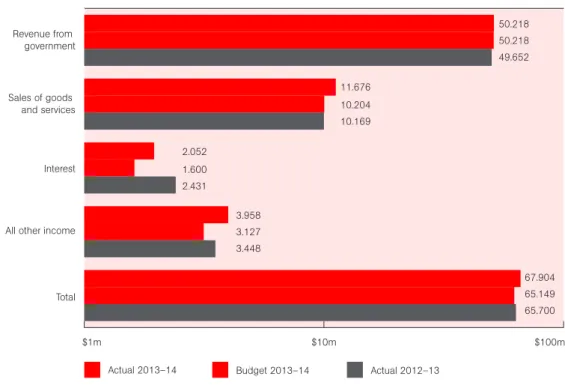
The major variations between inancial years relate to an increase in government revenue ($0.566 million), which is the net effect of eficiency dividends, parameter adjustments and previous budget measures, and increases in the sales of goods and services ($1.507 million), largely due to increases in revenue received from corporate sponsorship ($0.649 million), Library shop ($0.752 million) and publications ($0.210 million), much of which related to the Mapping Our World exhibition. The reduction in interest revenue (-$0.379 million) is largely the result of a decline in deposit interest rates to approximately 3.7 per cent during 2013–14, compared with rates of above 4 per cent during 2012–13. The increase in the category, All other income, ($0.510 million) is primarily a result of increased grant revenue ($0.380 million) mainly for the Mapping Our World exhibition; increased donations ($0.264 million), including to support the preservation of the Joan Blaeu map and to fund an exhibitions curator position; and a reduction (-$0.125 million) in resources received free of charge.
EXPENSES
The total expenses of $77.542 million for 2013–14 were $0.365 million above budget and
$2.287 million more than 2012–13.
Figure 1.2 shows a comparison of expenditure across items against budgets for 2013–14 and 2012–13.
Figure 1.2: Expenses, 2013–14 and 2012–13
$0m 12.5 25.0 37.5 62.5$10m 75.0 87.5 $100m
Total Other Depreciation and amortisation Suppliers Employees
38.476 40.349 39.066
16.652 16.233 15.389
20.309 19.980 20.074
2.105 0.615 0.726
77.542 77.177 75.255
Actual 2013–14 Budget 2013–14 Actual 2012–13
$1m
Note: A logarithmic scale is used.
SUMMARY OF FINANCIAL
PERFORMANCE
OPERATING OUTCOME
During 2013–14, income, including revenue from government, amounted to $67.904 million and expenses were $77.542 million, resulting in a deicit of $9.638 million. From an income-statement perspective, the Library does not receive appropriation funding for depreciation of the national collection (totalling $12.431 million), which forms part of operating expenses. Government funding for the purchase of collection material is provided through an equity injection totalling $9.861 million.
INCOME
The total income of $67.904 million for 2013–14 was $2.755 million above budget and
$2.204 million more than 2012–13.
Figure 1.1 shows a comparison of income across items against budgets for 2013–14 and 2012–13. Figure 1.1: Income, 2013–14 and 2012–13
$1m 12.5 25.0 37.5 $10m 62.5 75.0 87.5 $100m
Total All other income Interest Sales of goods and services Revenue from government
50.218 50.218 49.652
11.676 10.204 10.169
2.052 1.600 2.431
3.958 3.127 3.448
67.904 65.149 65.700
Actual 2013–14 Budget 2013–14 Actual 2012–13
Note: A logarithmic scale is used.
TOTAL ASSETS
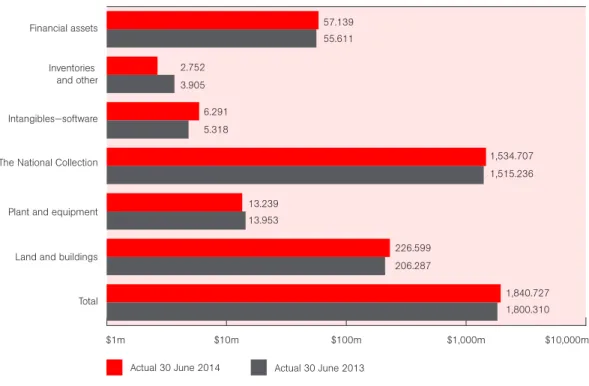
Figure 1.3 shows that the total value of the Library’s assets increased by $40.417 million to
$1,840.727 million in 2013–14.
Figure 1.3: Total Assets, 2013–14 and 2012–13
$1m $10m $100m $1,000m $10,000m
Actual 30 June 2014 Actual 30 June 2013 Total
Plant and equipment Intangibles—software Inventories and other
Financial assets 57.139
55.611
2.752 3.905
1,534.707 1,515.236
13.239 13.953
1,840.727 1,800.310 Land and buildings
The National Collection
6.291 5.318
226.599 206.287
Note: A logarithmic scale is used.
The increase in non-inancial assets ($38.889 million) was largely the result of the revaluation of the Library’s collections, land and buildings (a net increment of $41.425 million) and the net difference between current-year assets acquisitions, disposals and current-year depreciation expenses (-$1.383 million). In addition, there was a decrease in the value of inventories (-$1.224 million) and an increase in the value of prepaid supplier expenses ($0.071 million). The increase in inancial assets ($1.528 million) relates primarily to an increase in investments ($2.543 million) and cash at bank ($0.251 million), offset by decreases against other inancial assets (-$0.800 million) and receivables (-$0.466 million).
There was a decrease in employee expenses (-$0.590 million) compared to 2012–13. The majority of this variation relates to a decline in leave expenses (-$0.884 million), largely due to a favourable movement in the discount rate, which is used to calculate the present value of the long service leave liability.
Supplier expenses were higher ($1.263 million) than 2012–13, largely due to increases in the cost of goods sold ($0.520 million), exhibitions freight ($0.344 million) and promotion of library services ($0.409 million), all of which relate to the Mapping Our World exhibition.
The increase in other expenses ($1.379 million) was primarily due to increased write-downs ($1.224 million), most of which were the result of revised procedures following a review of Library trade publications by an independent consultant. Also contributing to the variation in other expenses was a loss from asset sales ($0.238 million) due to revised timing arrangements for the replacement of some information technology equipment.
EQUITY
The Library’s total equity increased by $41.648 million to $1,823.861 million in 2013–14. The net increase was a result of an equity injection for collection acquisitions ($9.861 million), a net revaluation increment ($41.425 million) following the revaluation of the Library’s collection, land and buildings, and the net operating result (-$9.638 million) for 2013–14.
CASH FLOW
In 2013–14, there was a minor increase in the Library’s cash balance, which increased by
$0.251 million to $5.857 million as at 30 June 2014.
Figure 1.5 shows a comparison of cash low items for 2013–14 and 2012–13. Figure 1.5: Net Cash Flow, 2013–14 and 2012–13
Net operating Net investing Net financing Total
-$20m -$15m -$10m -$5m
$0m
$5m
-$25m
$15m
$10m
Actual 2013–14 Actual 2012–13
11.524 9.450
-21.134 -19.119
9.861 9.832 0.251 0.163
The increase in net cash from operating activities ($2.074 million) relects the comments under
‘Income’ and ‘Expenses’. The increase in net cash used by investing activities ($2.015 million) primarily relects the net movement of funds from investments to cash at bank between years ($2.691 million) and a decrease in the purchase of property, plant, equipment and intangibles (-$0.781 million). There was a minor increase in net cash from inancing activities between inancial years ($0.029 million) as a result of the Library’s equity injection, provided by government to fund collection acquisitions, being slightly increased.
TOTAL LIABILITIES
As Figure 1.4 shows, the Library’s total liabilities decreased by $1.231 million from last inancial year to $16.866 million.
Figure 1.4: Total Liabilities, 2013–14 and 2012–13
$1m $10m $100m
Actual 30 June 2014 Actual 30 June 2013 Total
Provisions 11.833
12.744 5.033
5.353 Payables
16.866 18.097
The changes in liabilities relate to decreases in supplier payables (-$0.250 million), employee provisions (-$0.923 million), which relate mostly to the favourable movement in the discount rate used to calculate the present value of the long service leave liability, and other payables (-$0.096 million) offset by increases in grants payable ($0.026 million) and other provisions ($0.012 million).
CORPORATE
OVERVIEW
Claes Jansz. Visscher (c. 1586–1652)
Nova totius terrarum orbis geographica ac hydrographica tabula (detail) 1652 in De zee-atlas ofte water-waereld ... by Hendrick Doncker
(Amsterdam: Hendrick Doncker, 1659) Petherick Collection
nla.map-ra10-s12
ROLE
The functions of the Library are set out in section 6 of the National Library Act 1960. They are: a. to maintain and develop a national collection of library material, including a comprehensive
collection of library material relating to Australia and the Australian people;
b. to make library material in the national collection available to such persons and institutions, and in such manner and subject to such conditions, as the Council determines with a view to the most advantageous use of that collection in the national interest;
c. to make available such other services in relation to library matters and library material (including bibliographical services) as the Council thinks it, and, in particular, services for the purposes of:
• the library of the Parliament
• the authorities of the Commonwealth
• the Territories
• the Agencies (within the meaning of the Public Service Act 1999);
d. to cooperate in library matters (including the advancement of library science) with authorities or persons, whether in Australia or elsewhere, concerned with library matters.
The Library is one of many agencies within the Attorney-General and Minister for the Arts portfolio with responsibilities for collecting Australian cultural heritage materials and making them available to the Australian public. The former Minister for Regional Australia, Regional Development and Local Government and Minister for the Arts, the Hon. Tony Burke MP, had responsibility for the Library until September 2013. His successor, appointed Minister for the Arts on 18 September 2013, is Senator the Hon. George Brandis QC. The affairs of the Library are conducted by the Library Council, with the Director General as executive oficer.
LEGISLATION
The Library was established by the National Library Act 1960, which deines the Library’s role, corporate governance and inancial management framework. As a Commonwealth statutory authority, the Library is subject to the Commonwealth Authorities and Companies Act 1997 (CAC Act) which provides the reporting and accountability framework. From 1 July 2014, the Library will be subject to the Public Governance, Performance and Accountability Act 2013 (PGPA Act).
ORGANISATION
The Library’s senior management structure comprises the Director General and six Assistant Directors General.
Figure 2.1 shows the Library’s organisational and senior management structure.
Figure 2.1: Organisational and Senior Management Structure, 30 June 2014
Access and Digital Services Australian Collections Management Digitisation and Photography Overseas Collections Management Preservation Services Collections ManagementResource SharingInformation TechnologyExecutive and Public ProgramsCorporate Services
DIRECTOR GENERAL Ms Anne-Marie Schwirtlich Australian Collections and Reader Services Ms Margy Burn Assistant Director General Collection Delivery and Storage Maps Oral History and Folklore Pictures and Manuscripts Reader Services
Ms Amelia McKenzie Assistant Director General
Dr Marie-Louise Ayres Assistant Director General Collaborative Services Database Services Ms Cathy Pilgrim Assistant Director General Collection Access Collection Infrastructure IT Services Web Publishing
Mr Mark Corbould Assistant Director General
Mr Gerry Linehan Assistant Director General Communications and Marketing, Community Programs and Performance Management Community Outreach Executive Support Exhibitions Publications and Production Sales and Promotion
Accountability and Reform Building and Security Services Contracts and Legal Support Finance Human Resources
CORPORATE
GOVERNANCE
Figure 2.2 shows the principal elements of the Library’s corporate governance structure. Figure 2.2: Corporate Governance Structure, 2013–14
AUDIT COMMITTEE
PERFORMANCE MEASUREMENT
COMMONWEALTH AUTHORITIES AND COMPANIES
ACT 1997 Reporting and accountability legislation
Roles and responsibilities set out by the CAC Act
REPORTING OBLIGATIONS
Set out by the CAC Act
PORTFOLIO BUDGET STATEMENT Approved budget and
performance targets
Deliverables and key performance
indicators Performance
measures against stakeholder, customer,
inancial, process and learning and growth
perspectives NATIONAL LIBRARY
ACT 1960 Enabling legislation
Established by the National Library
Act 1960
ACCOUNTABILITY TO PARLIAMENT
Annual Report
ACCOUNTABILITY TO GOVERNMENT
Through CAC Act reporting requirements
BALANCED SCORECARD Translates strategic
directions into operational initiatives
and processes DIRECTIONS FOR THE
NATIONAL LIBRARY OF AUSTRALIA Strategic Directions
2012–14
CORPORATE GOVERNANCE
COMMITTEE COUNCIL
OF THE NATIONAL LIBRARY OF AUSTRALIA
COUNCIL
The National Library Act provides that a council shall conduct the affairs of the Library. The Council has 12 members, including the Director General, one senator elected by the Senate and one member of the House of Representatives elected by the House.
At 30 June 2014, there was one vacancy on Council. Appendix A lists Council members and their attendance at Council meetings.
In 2013–14, in addition to general administrative, compliance and inancial matters, Council considered a range of matters, including:
• integration of the Library’s reading rooms;
• the DLIR project;
• the 2014–15 Budget;
• the Trove evaluation survey;
• the Library’s contribution to the Anzac Centenary Program;
• the Information Technology Strategic Plan 2013–2016;
• collection storage;
• use of the Trust Funds;
• new acquisitions;
• strategic workforce planning;
• work health and safety;
• environmental management;
• the activities of the Library’s Foundation Board;
• signiicant factors affecting the development of the Australian collections;
• national infrastructure for libraries and the Library’s leadership role;
• Council’s evaluation of its performance;
• the implications of the PGPA Act;
• strategic directions.
Council has two advisory committees: the Audit Committee and the Corporate Governance Committee.
AUDIT COMMITTEE
The role of the Audit Committee is to:
a. support the Library and Council members in complying with their obligations under the CAC Act;
b. provide a forum for communication among Council members, senior managers and internal and external auditors;
c. ensure there is an appropriate ethical climate in the Library, and review policies relating to internal controls and risk management.
The Audit Committee comprises a minimum of three non-executive Council members. Council may appoint external members to the Audit Committee. The Chair of Council and Director General also attend meetings. Details of Audit Committee members and meeting attendance can be found at Appendix A.
In 2013–14, the Audit Committee considered a range of matters, including:
• inancial statements for 2012–13;
• Library trust account disbursements;
• internal assessment of the Audit Committee’s performance;
• review of the Audit Committee’s role and charter;
• the internal audit schedule;
• the Australian National Audit Ofice’s 2013–14 inancial statement audit strategy;
• the compliance report (required under the CAC Act);
• the Internal Audit Plan 2014–15;
• internal audits of:
– procurement and purchasing – workforce planning
– IT security
– sales and promotion, and the Bookshop’s annual stocktake – management of social media
– digital collection management – digitisation for other libraries;
• Australian National Audit Ofice reports and recommendations;
• discussion papers on the Commonwealth Financial Accountability Review, including the PGPA Act and Public Management Reform Agenda;
• valuation of the collection;
• reports on legal services, compliance, fraud and ethics, risk management and business continuity, insurance, whistleblower and related complaints, contract management and training, probity and purchasing thresholds.
CORPORATE GOVERNANCE COMMITTEE
The role of the Corporate Governance Committee is to:
a. evaluate Council’s effectiveness in its corporate governance role; b. evaluate the Director General’s performance and remuneration;
c. oversee the development of a list of prospective members for appointment to Council, subject to consideration and approval by the Minister.
The Corporate Governance Committee comprises three non-executive Council members (the Chair, the Deputy Chair and the Chair of the Audit Committee) and has the authority to co-opt other non-executive Council members.
Appendix A lists the Corporate Governance Committee members. In February 2014, the Corporate Governance Committee met to consider the results of the 2013 Council Self-Evaluation Survey and, in June 2014, it met to discuss the Director General’s performance.
CORPORATE MANAGEMENT GROUP
The Corporate Management Group (CMG), consisting of the Director General and the six Senior Executive Service (SES) staff, provides strategic and operational leadership for the Library. In particular, it monitors the achievement of objectives and strategies, oversees budget matters, develops policy, coordinates activities across the organisation and oversees a range of operational issues. CMG meets weekly.
A number of cross-organisational committees advise CMG in areas such as workforce
planning, asset management, building works, emergency planning, collection development and management, events and education, exhibitions, and publications.
CORPORATE PLANNING FRAMEWORK
The Balanced Scorecard continues to be the Library’s principal planning support system, facilitating the integration of strategic, operational and budget planning. Since its introduction in 2000–01, the Balanced Scorecard has proved to be a successful performance management tool accepted by staff and other stakeholders. All scorecard achievements, initiatives and targets are reviewed regularly as part of strategic management planning and monitoring processes.
RISK MANAGEMENT FRAMEWORK
The Library’s Risk Management Framework continues to provide effective tools for identifying, evaluating and responding to risks that may affect the collection, core business functions and resources, staff and visitors and/or strategic decision-making.
The Library’s Risk Management Register, which is subject to annual review, is central to this framework. The register lists risks to the Library, as well as risk-reduction strategies. These strategies are managed through established procedures and plans, such as the Collection Disaster Plan, the IT Disaster Recovery Plan, the Business Contingency Plan for Critical Building Systems, and the Business Continuity Framework.
Risk management within the Library is overseen by the Library’s Emergency Planning
Committee, which is chaired by the Assistant Director General, Corporate Services, and includes SES staff representing all business areas. The committee provides a clear control structure to identify, monitor, respond to and mitigate risks that may affect the Library.
PUBLIC
ACCOUNTABILITY
OMBUDSMAN
During 2013–14, the Commonwealth Ombudsman did not advise referral of any issues relating to the Library.
PRIVACY
The Library introduced a new Privacy Policy in response to the amendments to the Privacy Act 1988 (Privacy Act) which came into effect on 12 March 2014. The Library provided training to staff in the new amendments and audited functions to ensure compliance with the amendments.
The Library made two submissions to the Ofice of the Australian Information Commissioner’s public consultation on the draft guidelines for the new Australian Privacy Principles. The Library responded to one request for access to information under the Privacy Act in 2013–14.
PUBLIC INTEREST DISCLOSURE
The public interest disclosure legislation took effect on 15 January 2014. From that date until 30 June 2014 no public interest disclosures were lodged with the Library.
FREEDOM OF INFORMATION
The Library inalised three requests, including a subsequent appeal, under the Freedom of Information Act 1982 (FOI Act). Partial access was granted in respect of the requests. Agencies subject to the FOI Act are required to publish information as part of the Information Publication Scheme (IPS). This requirement of the FOI Act has replaced the former requirement to publish a Section 8 statement in an annual report. Each agency must display on its website a plan showing what information it publishes in accordance with IPS requirements. The Library complies with IPS requirements, and a link to the scheme is provided on the Library’s website.
INDEMNITIES AND INSURANCE PREMIUMS
Premiums under the Library’s insurance coverage with Comcover encompass general liability, directors’ and oficers’ indemnity, property loss, damage or destruction, business interruption and consequential loss, motor vehicles, personal accidents and oficial overseas travel. The Library’s insurance premium attracted a 9.3 per cent discount as a result of its performance measured by Comcover’s Risk Management Benchmarking Survey. Under the terms of the insurance schedule of cover, the Library may not disclose its insurance premium price.
The Library participated in the Insurance and Risk Management Corporate Insurance Forum of cultural agencies, which holds regular meetings with Comcover to discuss insurance issues.
EXTERNAL AND INTERNAL AUDIT
The Library’s Audit Committee met three times to consider external and internal audit reports. AUSTRALIAN NATIONAL AUDIT OFFICE REPORTS
During 2013–14, the Library implemented the Auditor-General recommendations contained in the following Australian National Audit Ofice reports:
• Control of Credit Card Use (No. 35, 2012–13);
• Agencies Implementation of Performance Audit Recommendations (No. 53, 2012–13). INTERNAL AUDIT REPORTS
The Audit Committee considered a number of internal audit reports, see pages 25–26.
PARLIAMENTARY COMMITTEES AND
GOVERNMENT INQUIRIES
The Library made a submission in response to the Discussion Paper arising from the Australian Law Reform Commission’s inquiry into copyright and the digital economy.
MINISTERIAL DIRECTIONS
Under section 48A of the CAC Act, the Minister for Finance and Deregulation (Finance Minister) may make a General Policy Order specifying an Australian Government general policy applicable to the Library, provided the Finance Minister is satisied that the Minister for the Arts has consulted the Library on the application of the policy. No General Policy Orders applying to the Library are in place.
LEGAL ACTION
A claim was lodged in the ACT Supreme Court in 2003 on behalf of Wagdy Hanna and Associates Pty Ltd, seeking damages for an alleged disclosure of information in respect of a 1996 tender process for one of the Library’s offsite storage facilities. The court proceedings were held in December 2008, with Justice Richard Refshauge reserving his decision. In August 2012, the court found in favour of the Library. The outcome is under appeal by Wagdy Hanna and Associates Pty Ltd at the Court of Appeal of the ACT. The Court of Appeal conducted hearings into the appeal in February 2014.
SOCIAL JUSTICE AND EQUITY
The Library serves a culturally and socially diverse community and aims to make its collection accessible to all. The Library’s collection includes material in over 300 languages. Its programs and services are developed with an emphasis on public accessibility, and adhere to the
principles outlined in the Australian Government’s Charter of Public Service in a Culturally Diverse Community. The Library is conscientiously implementing the charter, and seeks to provide all Australians with the opportunity to access documentary resources of national signiicance. In particular, during 2013–14, the Library:
• provided an introductory program to international students of English as an additional language or dialect;
• provided exhibition and education tours for adults and young people with special needs, and senior citizens groups;
• supported community projects, including National Reconciliation Week, the Indigenous Literacy Foundation, National Simultaneous Storytime, Children’s Book Week, National Volunteer Week, and Libraries and Information Week;
• supported the development of youth arts activities through events and education programs;
• conducted oral history interviews with thalidomide survivors regarding their experiences living with the severe and ongoing effects of this drug, with Vietnamese veterans who migrated to Australia after the war, and with Indigenous elders for the Centenary of Canberra oral history project;
• supplied gratis photographs from the Library’s collections for various Aboriginal history research projects, including for Arrernte families who were part of the Little Flower/Santa Teresa Mission;
• hosted a group of senior Indigenous artists from Kalkarindji (Gurindji) in the Northern Territory to view and listen to special collection material relating to the Wave Hill walk-off;
• continued to offer a range of assistive technologies in the reading rooms to help people with sight, hearing or mobility impairments to access services and collections;
• provided an ongoing customer service training program for front-of-house staff and volunteers, including training in mental health awareness;
• reviewed online accessibility in relation to event podcasts and promotional videos to ensure transcripts are available;
• established a formal Memorandum of Understanding with the Australian Institute of Aboriginal and Torres Strait Islander Studies enabling Link-Up staff to receive regular training about Library resources and services.
SERVICE CHARTER
The Library’s Service Charter sets out its commitment to users, the standards of service that users can expect, and the mechanisms for providing feedback or making a complaint. Revised in 2011–12, the Service Charter is available online (nla.gov.au/service-charter) and as a print publication.
During 2013–14, the Service Charter standards were met as follows:
• 98 per cent of general reference inquiries were answered within timeframes (target 90 per cent);
• 94 per cent of collection items were delivered within timeframes (target 90 per cent);
• the Library’s website was available 24 hours a day for 100 per cent of the time (target 99.5 per cent).
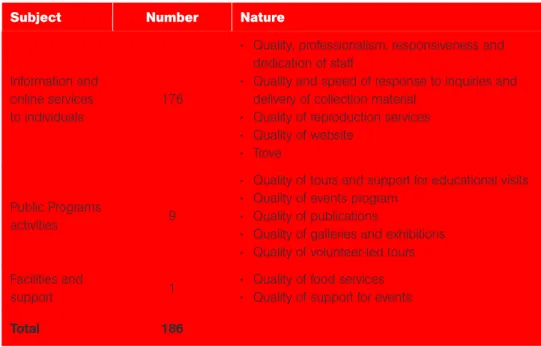
The Library welcomes feedback and suggestions for service improvements. Feedback forms are placed throughout the Library and on the website (nla.gov.au/feedback). During the inancial year, 186 formal compliments and 72 formal complaints were received from users, as indicated in Tables 2.1 and 2.2 respectively.
Table 2.1: Compliments Received, 2013–14
Subject Number Nature
Information and online services to individuals
176
• Quality, professionalism, responsiveness and dedication of staff
• Quality and speed of response to inquiries and delivery of collection material
• Quality of reproduction services
• Quality of website
• Trove
Public Programs
activities 9
• Quality of tours and support for educational visits
• Quality of events program
• Quality of publications
• Quality of galleries and exhibitions
• Quality of volunteer-led tours Facilities and
support 1
• Quality of food services
• Quality of support for events
Total 186
In addition, several hundred informal compliments were received from visitors for the Mapping Our World exhibition and from users of the Library’s Trove, Copies Direct and reading room services.
Table 2.2: Complaints Received, 2013–14
Subject Number Nature
The collection 3 • Cataloguing information for collection material
• Online access to collection material
Information and online services to individuals
42
• Use of mobile phones by Library users
• Wireless connectivity problems and slow response times
• Access to e-resources
• Use of new scanners
• Delays, misunderstandings and perceived lack of assistance relating to requesting/receiving and discharging material
• Reader registration processing
• Copying and inter-library lending fees and delays in delivery
Public Programs
activities 8 • Content and display of exhibitions Facilities and
support 19
• Car-parking availability
• Restrictions in reading rooms
• Cloaking arrangements
Total 72
The Library provided explanations and/or apologies in response to all complaints, and undertook remedial action to address them as appropriate. Complaints relating to car parking were referred to the National Capital Authority as the responsible body.
CONSULTANCY SERVICES
The Library entered into 21 new consultancy contracts during 2013–14 involving total actual expenditure of $163,446 (inclusive of GST). Appendix E lists the new consultancies with an individual value of $10,000 or more. There were also 12 ongoing consultancy contracts that were active during the same period, involving total actual expenditure of $900,523, bringing the total level of expenditure on consultancy contracts in 2013–14 to $1,063,969.
ADVERTISING AND MARKET RESEARCH
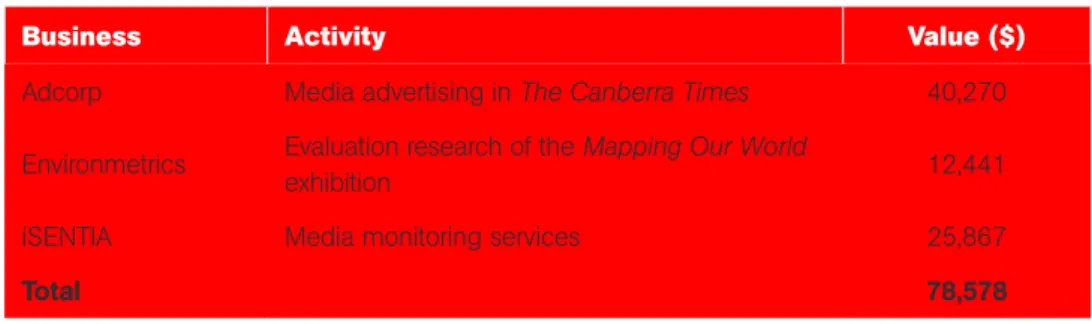
Advertising and market research in excess of $12,400 for non-recruitment and non-tender services amounted to $78,578 (inclusive of GST).
Table 2.3 summarises expenditure by the Library in 2013–14. Table 2.3: Library Expenditure, 2013–14
Business Activity Value ($)
Adcorp Media advertising in The Canberra Times 40,270
Environmetrics Evaluation research of the Mapping Our World
exhibition 12,441
iSENTIA Media monitoring services 25,867
Total 78,578
CORPORATE
MANAGEMENT
The Library’s corporate management activities aim to maximise service to clients by realising the full potential of staff and other available resources. Major activities during the inancial year focused on implementing the Leadership Capability Model, Strategic Workforce Plan, Strategic Building Master Plan, and Work Health and Safety and Environmental Management Systems, and preparations for the PGPA Act that takes effect on 1 July 2014. Through participation in the Corporate Management Forum and related subcommittees, the Library also played a part in corporate management across other collecting and portfolio agencies, displaying a supportive, collaborative and cooperative working style to other organisations.
PEOPLE MANAGEMENT
The current Strategic Workforce Plan is the irst in a series of plans with a medium- to long-term focus on change and the digital environment, career sustainability and building internal capability. During the reporting period, a number of initiatives were undertaken to meet these identiied workforce planning objectives and the Library’s strategic goal of organisational excellence.
By way of example, a Library-wide relective leadership forum for executive level staff was developed and implemented. The forum consisted of three separate groups which were each allocated an organisationally relevant topic to investigate over an extended period. This initiative used both the content and the process of the leadership forum to develop the skills and knowledge of senior staff.
Another signiicant piece of work was the development of a bespoke Leadership Capability Model which includes capabilities considered fundamental to effective and successful leadership at the Library. A supporting kit has been developed with a range of self-assessment and management tools to establish capability gaps and development opportunities. The model has been used to drive a modular approach to leadership training with ‘Four Pillar’ workshops delivered in the reporting period.
Mentoring has been reinvigorated with a new program and supporting framework developed. Ten pairs completed the mentoring program in 2013, with a further nine pairs commencing in 2014. Participants in the 2013 cycle were very positive about their experience and reported that the program was valuable to themselves as individuals and to the Library as an institution.
The Library also created a cross-divisional working group to focus speciically on Workforce Planning Priority Area 2: building responsiveness to change and to new and emerging digital opportunities. This working group completed extensive internal and external research and made a series of recommendations about how to enhance the digital conidence of Library staff. These initiatives are now in the implementation phase.
An Indigenous Employment Strategy was also developed and launched. The strategy includes three sub-plans that each detail a range of operational initiatives that the Library will undertake over six years to create an attractive and supportive employment environment for Indigenous Australians.
STAFF ENGAGEMENT
The Consultative Committee is a mechanism to explore issues of relevance to both staff and management. Staff representatives were speciically invited to engage with the review of the Performance Management Framework undertaken at the beginning of 2014. It is expected that changes to the framework will be implemented next inancial year.
Additionally, in October 2013, staff were surveyed to solicit their thoughts prior to the next round of enterprise bargaining. Preparations for a new Enterprise Agreement included offering brieings for staff on bargaining processes in February 2014.
An Enterprise Agreement communication strategy was endorsed by CMG. To support open communication on the bargaining process, staff have been invited to contribute their ideas through multiple channels such as the Consultative Committee, branch meetings, a dedicated webpage and email options.
In March 2014, the Government published its public sector workplace bargaining policy, which requires that agencies demonstrate both the affordability and productivity of any changes to a proposed Enterprise Agreement to fund improvements to salaries and conditions. The Library is committed to providing fair and sustainable remuneration for its staff within the context of the Government’s bargaining policy.
REMUNERATION
In accordance with the Australian Government’s regime for Principal Executive Oficers, Council determines the Director General’s remuneration.
At 30 June 2014, terms and conditions of employment for SES staff, such as non-salary beneits including access to motor vehicles (or payment in lieu) and mobile phones, continued under common law contract.
At 30 June 2014, nine non-SES staff had enhanced beneits through Individual Flexibility Arrangements.