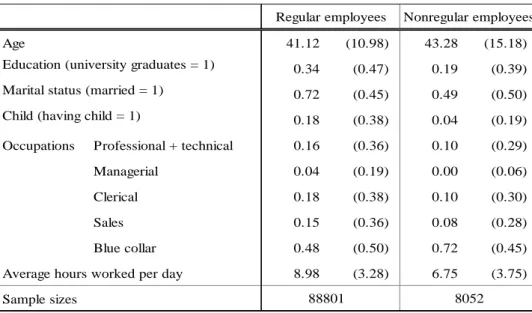
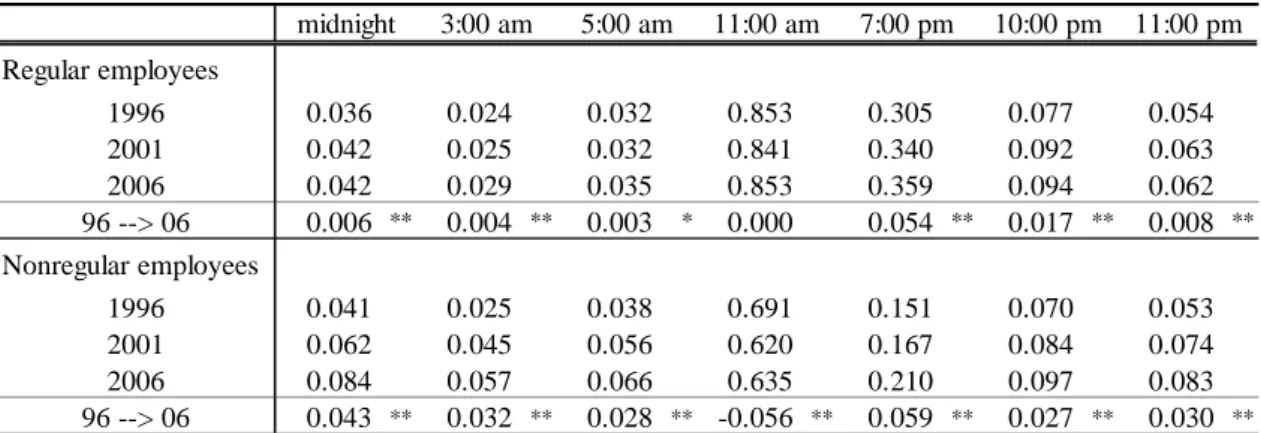
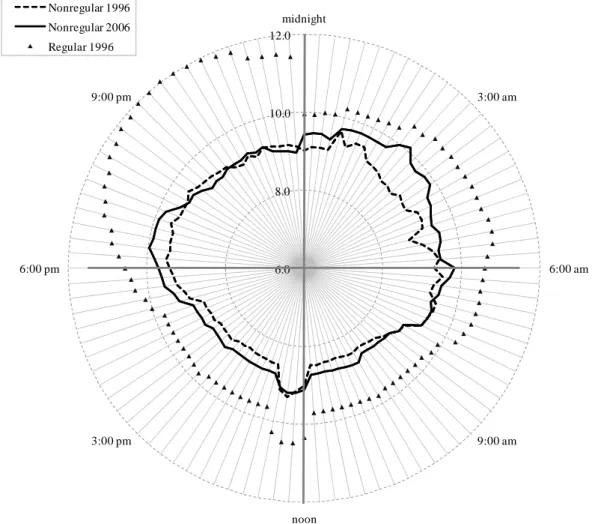
Third, an increase in the average number of hours worked per working day by full-time employees, probably due to the extension of the five-day working week since then. This paper focuses on the growing number of irregular workers with relatively lower wages in the Japanese labor market. The extent of change in employment rates is quite different between regular and occasional employees.
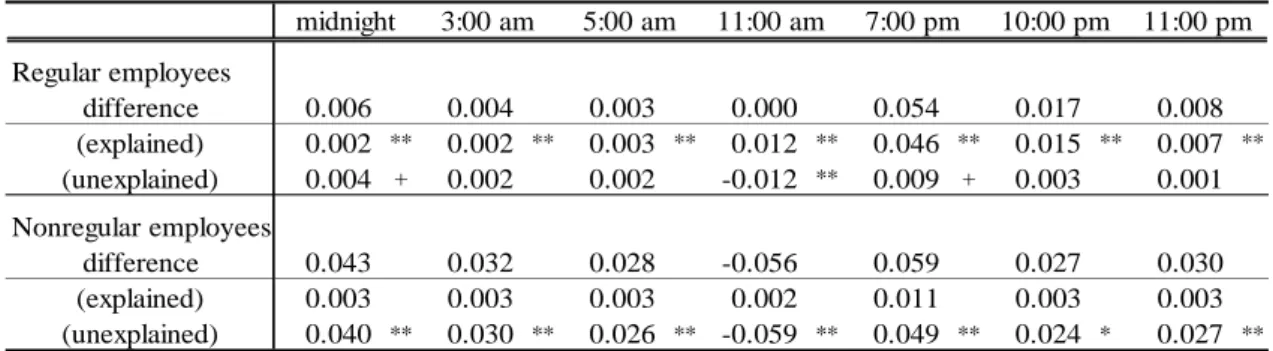
Thus, one can argue that the observed change in the timing of work for regular. However, we first check whether there were any changes in the timing of work, even after adjusting for the number of hours worked in the next section. The explained factor Fe represents the changes in the employment rate caused by changes in the number of hours worked.
The table suggests that most of the changes in the fraction of regular employees in each time period can be explained by the 'explained factor', that is, changes in the number of. Regarding non-regular workers, however, changes in the fraction in each time period cannot be explained by changes in the number of hours worked. This implies that the reason for the increase in the fraction of non-regular employees who work unusual hours is due to factors other than changes in the length of working hours.
In the next section, we focus on non-regular workers and look for the reasons for the increased proportion of employment at unusual times.
Causes of Increased Employment Rates at Unusual Hours
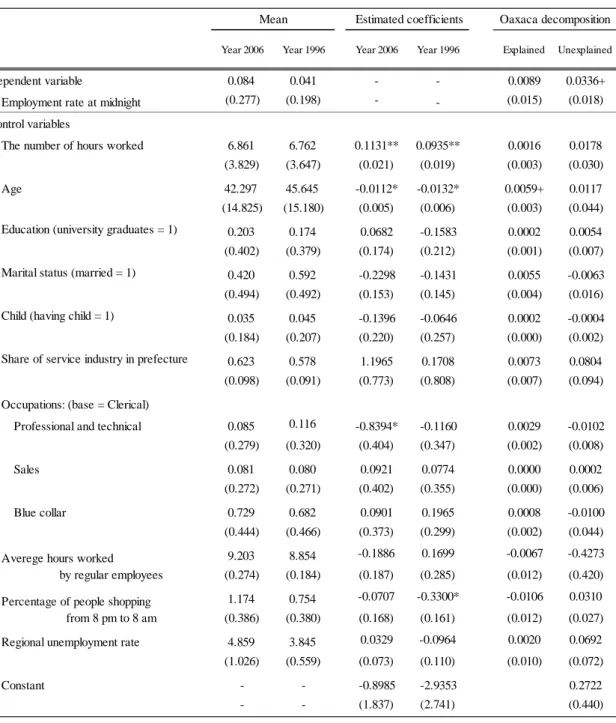
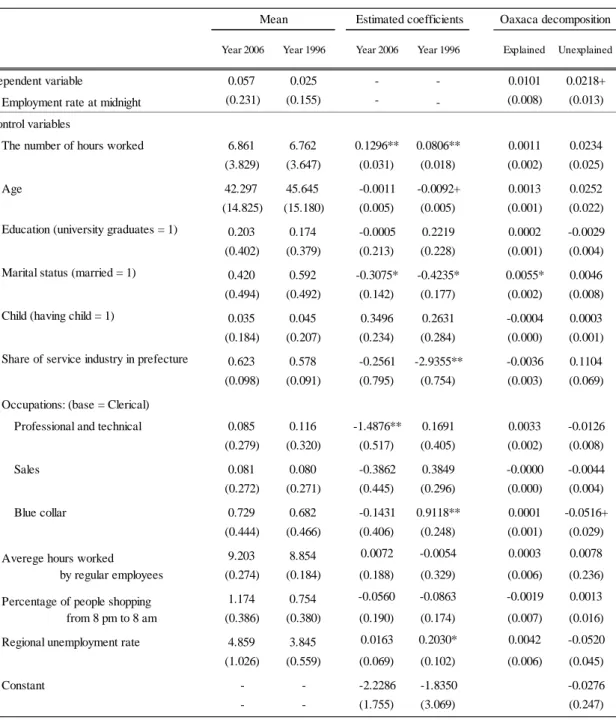
As explained in the previous paragraph, the average number of hours worked per weekday by regular employees has increased in these years, possibly as a result of the spread of the five-day working week. To capture only the effect of the changes in legislation, we use only samples of non-employees to calculate the shopping percentage. First, if we look at midnight in Table 5(1), when labor force participation increased by 4% between 1996 and 2006, age is the only component that significantly explains the increase in labor force participation.
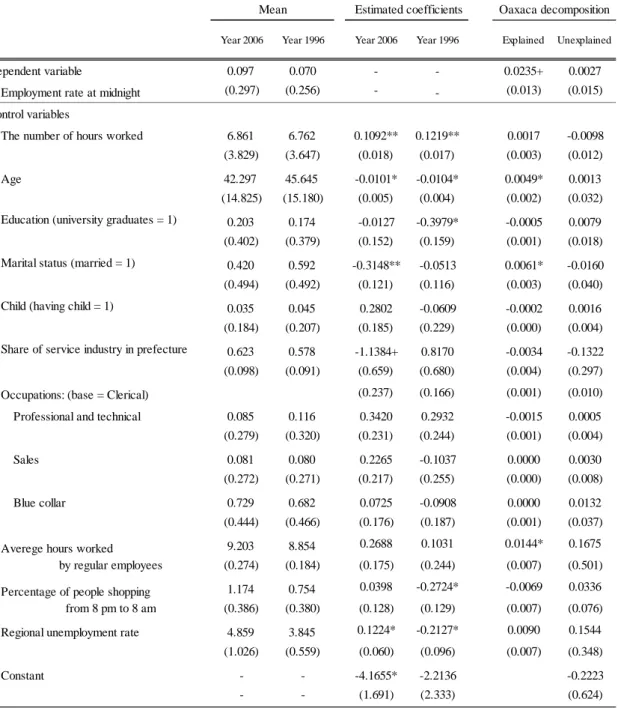
Because the average age fell from 45.6 to 42.3 years, the increasing number of younger employees is one of the factors that explains the increase in the employment rate of non-regular employees at midnight. Table 5(2) for 03.00 also shows that even after controlling for various factors, two-thirds of the increase in the employment rate at this time is still unexplained. The increase in the number of single workers is the only explained factor at this time, while the blue-collar dummy shows a significant negative contribution in the unexplained factor.
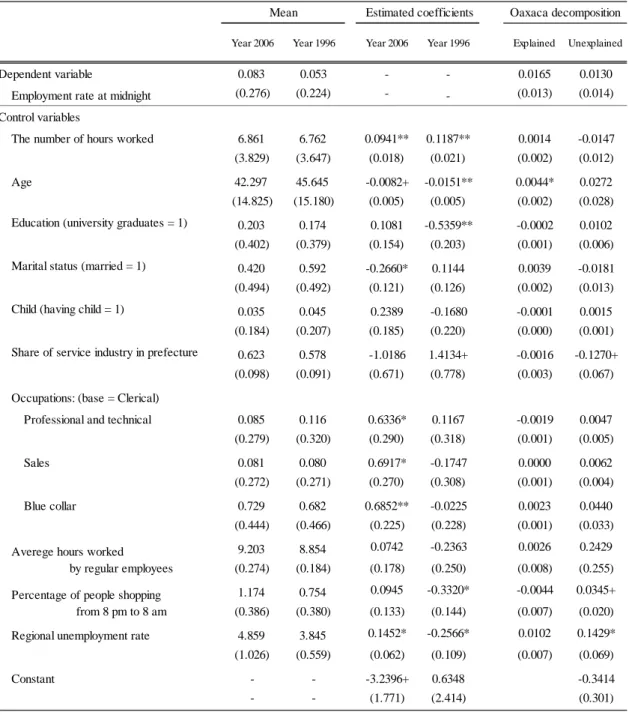
Then, the results shown in Table 5(3) for 22:00 provide a slightly different picture, as most of the increase in the employment rate is explained by changes in the control variables. The increase in the share of young and single employees is again significant at the level of 5%. In addition, the increase in the average number of working hours of full-time employees explains almost three quarters of the total change in
We interpret this finding to imply that there have been increases in the demand for services and goods at later times on the way home among regular employees who work into the night. One possibility is that the major unexplained factor leading to the increase in the nighttime employment rate is the negative income effects of nonregular employees, which is the opposite of the phenomenon observed in the United States. As we explained, Hamermesh (1999a) found a decline in the US overnight employment rate along with an increase in the average real wage.
This may have resulted in more educated and higher-income workers working desirable hours of the day as regular employees, while other workers, having been squeezed out, had no choice but to work shifts others.9 We assume that these factors come from both the supply side and the labor demand side, has led to an increase in the employment rate of non-regular employees at unwanted times. In fact, it can be observed that the increased rate of night employment is associated with longer working hours. 9 Another possibility could be an increase in the fraction of workers working odd hours as a result of more widespread use of the Internet.
Conclusion
This finding may also be evidence of the negative income effect for those who work at undesirable times as described in Section II. That is, workers who need to earn more at low wage rates tend to work longer hours to earn more. suggested that such increases in the average working hours of regular employees partly explain the increase in the employment rate of non-regular employees at unusual times. We conclude that the remaining factor relates to the negative income effect that causes low-wage non-regular workers to take night jobs to earn a wage premium.
Another interpretation is that job opportunities are limited to non-regular work at night, leaving people with no choice but to accept jobs at those undesirable hours due to the prolonged recession. This increase in work timing differences during a prolonged economic downturn can likely be interpreted as evidence that people were happy just to have the opportunity to work, even during undesirable times. If so, income inequality is smaller than it would have been if there had been absolutely no change in the work timing gap.
In other words, another way to frame these phenomena is that although gaps in the timing of work arose during Japan's lost decade, they were a successful way to avoid unemployment and brought the added benefit of suppress the increase in income inequality. There has been an increase in health problems related to overwork and stress in Japan in recent years; however, this may be related to the increasing number of people working late night and early morning hours. Some interesting issues for further study are the causes of differences in the timing of work and whether late night work has anything to do with Japan's increase in overwork and stress-related health problems. 2005).
An extension of the Blinder-Oaxaca decomposition technique to logit and probit models, Journal of Economic and Social Measurement. Labor market responses to legal working time limitation: evidence from Japan, ESRI Discussion Paper Series No.202, Economic and Social Research Institute, Cabinet Office, Government of Japan. Ohta, K., (2005) Rising income inequality in Japan - a sign of bipolarization?, paper presented at the ESRI International Conference Options for Sustainable Economic Growth in Japan, Economic and Social Research Institute, Cabinet Office, Government of Japan.