- 51 -
The effect of work-family policy on fertility in Japan
Masaaki Mizuochi
1 Introduction
Japan’s birth rate has been declining for four decades and is now far below the replacement level, the latest Total Fertility Rate, in 2010, being 1.39. A low birth rate causes serious problems for social security systems such as public pensions and medical insurance.
Accordingly, in the past two decades, the Japanese government has implemented policies intended to improve the declining birth rate. The first policy, what we call the Angel Plan, was enacted in 1994, and the next plan, the New Angel Plan, followed in 19991. However, these policies primarily intended to increase child-care facilities and did not focus on firms’ role, proving ineffective in improving the birth rate. These inadequate results thus forced the Japanese government to develop a more effective policy to promote childbirth, the Act on Advancement of Measures to Support Raising Next-Generation Children, enacted in April 2005.
This Act compels large firms to support their employees in bearing and raising children by reducing the overall cost of having children. It particularly helps working women to pursue their careers, which in turn could increase childbirth. Introduction of this Act, which has such a compulsory requirement, as a measure to reverse the declining birth rate is considered a major policy change in Japan. Thus, determining the Act’s effect on fertility is politically important.
One of the Act’s features, from the perspective of scientific analysis, is that firms having over 300 ordinary employees (large firms) are compelled to follow the Act, whereas those with 300 or less (medium and small firms) are not2. Therefore, the degree of firms’
support for employees differs by firm size and probably has different effects on employees’
childbirth. This quasi-experimental condition enables us to determine the Act’s effect on childbirth.
The Act does not compel medium and small firms to submit their plan to the government, although some exceptional firms do so. According to the Ministry of Health, Labor, and Welfare, 1,422 medium and small firms submitted their plan in December 2006, the
1 For more detail, see the website of the Ministry of Health, Labor, and Welfare, http://www.mhlw.go.jp/english/wp/wp-hw4/07.html.
2 Employees are classified into four categories as per government definition: executive, ordinary, temporary, and daily. Temporary employees are employed on a term of a month or more, but less than a year; daily employees are employed on a daily basis or a term of less than a month. Thus, employees other than executive, temporary, and daily are ordinary employees.
- 52 -
percentage of which however is not reported. Thus, the submission rate of medium and small firms is calculated using the official survey, the 2006 Establishment and Enterprise Census (EEC) conducted by the Ministry of Internal Affairs and Communications (MIC); the rate found was only 0.03%. Thus, we may affirm that there is a clear difference in the Act’s effects between large and smaller firms.
One limitation of this analysis is that the Act does not specify the measures that firms should undertake. Thus, large firms can choose among many possible measures to support their employees, such as extending the duration of parental leave more than the standard quota or decreasing the amount of overtime work. Although this flexibility in choosing measures prevents us from identifying the effects of specific measures on fertility, we can observe the Act’s overall effect.
The remainder of this paper is organized as follows. Section 2 reviews theory and related papers. In Section 3, the data and sample used in this study is introduced. Section 4 describes the issues of using firm size as the key factor in this analysis. Section 5 explains the empirical model and reports the estimation results. Section 6 summarizes the results obtained and suggests a policy implication.
2 Theory and related literature
Economists such as Becker (1960, 1981), Willis (1973), and others have viewed children as a durable goods and analyzed its production mechanism. These studies suggest that the cost of having children is one of the major determinants of childbirth, i.e., a decrease in the price of children increases the demand for children. Considering the recent increase of women’s labor force participating in developed countries, the opportunity cost caused by women’s job interuption becomes a crucial factor in the declining birth rate.
In Japan, a strong trade-off between women’s work retention and childbirth continues to exist. As a concrete value, the Japanese Cabinet Office notes that roughly 60% of women working prior to giving birth quit their job after childbirth. This suggests the difficulty working women experience in continuing work while rearing children. Therefore, firms’ support required by the Act could ease the trade-off and enable women who have given birth to continue their job. Thus, the Act can reduce the price of children, which in turn would increase childbirth.
To the best of our knowledge, no studies have analyzed the effect of the Act on childbirth in Japan, despite the policy’s importance. Therefore, no directly related papers are referred to here. However, the effect of the Act appears to be similar to that of
- 53 -
parental/maternity leave in reducing the cost of having children, as mentioned above. Thus, here, previous studies investigating the effect of parental/maternity leave on fertility are discussed3.
Averett and Whittington (2001) find that maternity leave has a positive effect on childbirth in the US. Adserà (2004) also reveals that maternity benefits have a positive effect on fertility using panel data of 23 OECD nations. Kalwij (2010) indicates that maternity/parental leave has a positive effect on childbirth using individuals’ data from 16 European countries.
Gupta, Smith, and Verner (2008) investigate the relationship between fertility and family- friendly policies, including maternity/paternal leave using aggregated country level data, and note a positive relationship. However, Zhang, Quan, and Van Meerbergen (1994) find no such effect of maternity leave on fertility using time series data from Canada. Among studies on Japan, Higuchi (1994) and Morita and Kaneko (1998) remark that child-care leave positively affects childbirth.
The above-mentioned studies suggest that policies supporting women to continue their job while raising children have a positive effect on childbirth. Moreover, if the Act reduces the cost of having children, as the effect of maternity/parental leave demonstrates, it should promote childbirth in Japan.
3 Data and sample
This study uses an official survey, the Employment Status Survey (ESS), conducted by MIC, which has the largest scale of all labor-related surveys in Japan. The number of those included in the sample, i.e., from children aged 15 to the retired elderly, is about a million. The ESS is conducted in October every five years, and the latest one was conducted in 2007. Because the Act was implemented in 2005, the pre-act 2002 survey and the post-act 2007 survey are used to investigate the Act’s effect.
The sample used in this study comprises married women, who were 35 years old or younger, working at the time of the survey as regular employees in industries other than
3 In reducing the cost of having children, there are two other major factors: childcare facility and financial benefit. In the former, Del Boca (2002), Yoshida and Mizuochi (2005), and Haah and Wrohlich (2011) reveal that an increase in the supply of facilities has a positive effect on childbirth. Concerning financial benefit, Zhang, Quan, and Van Meerbergen (1994), Whittington, Alm, and Peters (1990), Schellekens (2009), McNown and Ridao-cano (2004), Azmat and González (2010), and Tanaka and Kouno (2009) suggest that family allowance, child tax deduction, and similar benefits promote childbirth.
- 54 -
agriculture, forestry, fisheries, and governments4. As a result, 12,753 samples were used in this analysis.
As mentioned above, the Act compels large firms to submit their plan for supporting their employees in bearing and raising children to the government. According to the Act’s regulations, plan submission began in April 2005. Although no statistics verify when these firms actually initiated their plans, by evaluating several firms’ plans, we can assume that such firms implemented and submitted their plans simultaneously. Therefore, we regard the time of submission as the initiation of the plan.
Fig. 1 shows that the submission rate of large firms in April 2005 was only 36.2%, and by December 2005, the rate reached 97.0%. Thus, we may consider that the Act affected most employees in large firms by this time. Considering the submission rate, women with continous employment since January 2006 were used for the 2007 survey. Correspondingly, women who had worked since January 2001 were selected for the 2002 survey. In other words, this study examines the difference in the probability of childbirth of women who worked continuously for at least 21 months prior to each ESS survey. If the Act had a positive effect on job retention after giving birth, the probablity of having children for women who continued their job would increase in the 2007 survey compared to that in the 2002 survey.
Fig. 1 Plan submission rate (2005)
4 Employees other than executives are classified into two categories: regular and irregular. Although the law can be applied to the irregular employees, we excluded them from the sample for the following two reasons. First, the firms’ welfare programs usually do not apply to irregular employees. Second, many married women re-enter the labor market as irregular employees after childbirth, which means that the irregular female employees have no immediate plan for an additional child and would be unaffected by the Act.
36.2
59.5
84.9
97.0
0 10 20 30 40 50 60 70 80 90 100
End of Apr. End of Jun. End of Sep. End of Dec.
%
Source: Ministry of Health, Labor, and Welfare
- 55 - 4 Firm size in the Act and the ESS
Firm size is the most important factor in this study. However, there are two possible problems regarding firm size because of the difference in the definition of “size” between the Act and the ESS. The problems are as follows.
First, the Act distinguishes between firms with more than 300 employees and those with 300 or less, whereas the ESS in its questionnaire distinguishes between firms with 300 employees or more and those with fewer, resulting in a difference of one person between the Act and the ESS. Unfortunately, whether the distribution of firm size concentrates at 300 or 301 is unclear. If there was such a concentration of distribution, the distinction of firm size used in the study would be unreliable. However, it is reasonable to assume that such a distributional concentration does not exist.
Second, the firm size of the ESS can include temporary and daily employees as well as ordinary employees. The ESS asks the respondents about the number of employees in their firm
“including part-time and other types of workers”; the number of employees reported by the ESS includes irregular employees. According to the ESS in 2007, about 40% of irregular employees are temporary or daily employees. As a result, the rate of ordinary employees working in large firms in the ESS might exceed the actual rate. Thus, we compare the rate of the ESS with that of the EEC in 2006. We find that the rate for the ESS and EEC is 38.9% and 44.0%, respectively.
Contrary to the problem-causing prediction, the rate of the ESS does not exceed that of the EEC; in fact, these two values are similar. One reason for this result is probably that employees tend to recognize the number of ordinary employees as the total number of employees working in their firms. Therefore, the firm size obtained from the ESS captures the actual condition with sufficient accuracy.
Although the two possible problems regarding firm size might interrupt the estimation results, neither problem is considered to be serious. Therefore, the ESS firm size is used as a factor that can capture the effect of the Act.
5. Empirical analysis
5.1 Empirical model
First, let us define the dependent variable. As mentioned above, January 2006 is considered as the starting point, i.e., when the Act began to affect all employees in large firms. Thus, if women working in large firms had decided to have a child in January 2006, at the earliest, the child would be zero-year-old in October 2007, when the ESS was conducted. Consequently, whether women have a child aged zero is regarded as the indicator of childbirth encouraged by the Act’s benefits.
- 56 -
Indeed, some large firms submitted their plan before January 2006; thus, employees in such large firms had already been affected by the Act, and those women may have a child aged one as a result of the Act. However, we cannot know which firms had already submitted the plans before January 2006. Further, children aged one could have been in their mother before April 2005, i.e., before the Act’s implementation. Therefore, if we include the children aged one as the subject of the dependent variable, we would obtain a biased effect of the Act. Moreover, because we cannot know the birth month of children from the ESS, only children aged zero as attributable to the Act’s effects are used. About 12.6% of women had a zero-year-old child at the time of the survey in this sample.
The difference-in-differences (DID) analysis is used to determine the effect of the Act on childbirth. The estimation equation is as follows:
0 0 1 1
Birth AfterTreatAfter Treat γX, (1)
where Birth is the dependent variable and takes 1 if the respondents have a child aged zero, and 0 otherwise. After is a dummy variable that takes 1 for the sample of the 2007 survey and 0 otherwise, and captures the time trend of childbirth behavior. Treat is a dummy variable that takes 1 for the treatment group (employees working in large firms) to obtain the effect of the difference in the easiness of balancing childbirth and work retention by firm size.
The variable to test the Act’s effect on fertility is an interaction term After*Treat. If the Act encourages employees to have children, its coefficient 1, the DID parameter will show a significant and positive sign. Note here that the After*Treat might pick up another related policy’s effect implemented between 2002 and 2007. There certainly were changes of the Child Care and Family Care Leave Law in 2004 and the Equal Employment Opportunity Law in 2006.
However, these changes do not distinguish the targeted firms by size. Thus, we can obtain the Act’s effect by this specification.
Finally, X is a vector of other factors influencing the probability of childbirth, and is an i.i.d. error term. Control variables, the vector X, are the number of children aged between 1 and 14, wife’s age, wife’s education, wife’s experience in the firm, husband’s annual income, wife’s industry, wife’s occupation, and residency prefecture. The number of children aged between 1 and 14 indicates the number of children the woman already has before being affected by the Act. The number of existing children is normally a strong constraint on additional childbirth. Wife’s education has four categories: junior high school, high school, junior/tech.
college, and college/graduate. Higher education could have a negative impact on childbirth because of the higher opportunity cost for working women. However, the Act would have a larger positive effect on higher educated women because of the higher opportunity cost. Thus, this factor’s effect is ambiguous. Husband’s income is also an important factor in childbirth as well as the wife’s work. We may also consider that the conditions women experience vary
- 57 -
between industries and occupations, and thus control its effect. Residence area should also be controlled because the labor market condition or availability of child-care facilities would vary widely by area. Making Tokyo the reference category, 46 area dummy variables are employed;
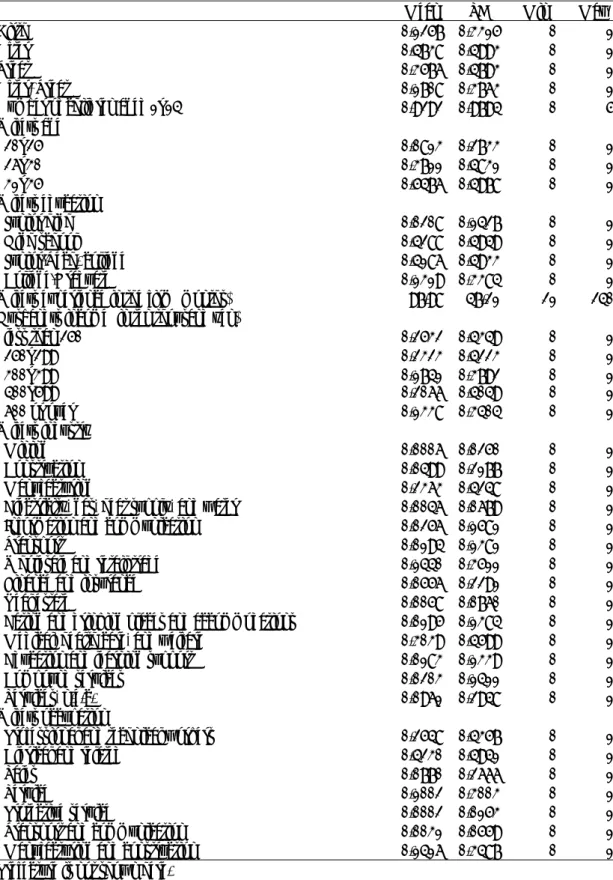
however, results are not reported in this paper for brevity. Descriptive statistics are shown in Table 1.
Table 1 Descriptive statistics (N = 12,753)
Mean SD Min Max
Birth 0.1257 0.3315 0 1
After 0.4738 0.4993 0 1
Treat 0.3576 0.4793 0 1
After*Treat 0.1708 0.3763 0 1
Number of children aged 1–14 0.9292 0.9794 0 5
Wife’s age
20–25 0.0813 0.2733 0 1
26–30 0.3711 0.4831 0 1
31–35 0.5476 0.4978 0 1
Wife’s education
Junior high 0.0208 0.1427 0 1
High school 0.4288 0.4949 0 1
Junior/Tech. college 0.4186 0.4933 0 1
College/Graduate 0.1319 0.3384 0 1
Wife’s experience in the firm (months) 97.98 47.21 21 240
Husband’s income (in ten thousand yen)
less than 250 0.2532 0.4349 0 1
250–299 0.2323 0.4223 0 1
300–399 0.1741 0.3792 0 1
400–599 0.2066 0.4049 0 1
600 or over 0.1338 0.3404 0 1
Wife’s industry
Mining 0.0006 0.0250 0 1
Construction 0.0499 0.2177 0 1
Manufacturing 0.2363 0.4248 0 1
Electricity, gas, heat supply, and water 0.0046 0.0679 0 1
Information and communication 0.0256 0.1581 0 1
Transport 0.0194 0.1381 0 1
Wholesale and retail trade 0.1440 0.3511 0 1
Finance and insurance 0.0556 0.2291 0 1
Real estate 0.0058 0.0760 0 1
Eating and drinking places and accommodations 0.0195 0.1384 0 1
Medical, health care, and welfare 0.3039 0.4599 0 1
Education and learning support 0.0183 0.1339 0 1
Compound services 0.0203 0.1411 0 1
Services, n.e.c. 0.0961 0.2948 0 1
Wife’s occupation
Professional and technical workers 0.2548 0.4357 0 1
Clerical and related 0.4230 0.4941 0 1
Sales 0.0770 0.2666 0 1
Service 0.1002 0.3003 0 1
Protective service 0.0002 0.0153 0 1
Transport and communication 0.0031 0.0559 0 1
Manufacturing and construction 0.1416 0.3487 0 1
Prefecture is not shown here.
- 58 - 5.2 Estimation results
Table 2 reports the estimation results, and the robustness of the policy effect by three models are tested. Model 1 includes only basic control variables. In this model, the coefficient of After*Treat shows a positive and significant effect, although it is at the 10% significance level.
Model 2 adds wife’s industry and occupation to Model 1. Some industry categories exhibit a statistically significant effect, and the sign and significance level of the coefficient of After*Treat does not change. Model 3 includes residency prefecture, and the coefficient of the After*Treat remains significantly positive in the full model. Therefore, the Act has a positive effect on the probability of childbirth.
We find a positive effect of the Act on childbirth, but its significance level is not very high. There seem to be three reasons for this result. First, sufficient time has not passed since the Act’s implementation. Large firms actually began to support their employees’ child bearing and rearing after the policy was implemented. However, it is reasonable to assume that the policy’s influence on household behavior requires a rather longer time. The second reason is that the Act provides only an intangible incentive, a certification of good practice for compliant firms, but no punishment for non-compliant firms. This weak enforcement might undermine the policy. Third, Japan already has policies related to children and work retention, such as child allowance and paid maternity leave. The Act does not introduce a new system in this area, and thus its impact on the estimation equation for fertility might be weak. Nevertheless, our results demonstrate that the Act has had a positive effect on birth decisions, which indicates that the policy is effective in reversing the declining fertility.
Next, results of other variables in Model 3 are discussed. The number of children aged between 1 and 14 has a statistically significant, negative effect on childbirth. However, the effect of wife’s age is not clear, possibly because the range of age in the sample is not very wide.
Wife’s education also has no significant effect because, as mentioned above, the effect is offset.
However, wife’s experience in the firm has a significant effect on fertility. This variable is used to capture the phenomenon that the longer women work in a firm, the more easily they balance work and child rearing. According to the estimate, after the peak at roughly 98 months of working at a firm, it is unlikely for women to give birth. Although the correlation between age and experience is not very high, the experience variable might reflect age as well. Husband’s high annual income decreases the probability of childbirth because of the interaction between the parents’ demand for quality and quantity of children, as suggested by Becker (1960, 1981).
Certain industries show a negative effect on childbirth compared to the medical, health care, and welfare industries. Occupation’s effect on childbirth is also unclear.
- 59 -
Table 2 Estimation results
Model 1 Model 2 Model 3
After 0.0191 −0.0117 −0.0100
(0.0370) (0.0378) (0.0381)
Treat 0.0361 0.0509 0.0621
(0.0416) (0.0444) (0.0449)
After*Treat 0.0831 0.1075 * 0.1076 *
(0.0597) (0.0606) (0.0610) Number of children aged 1–14 −0.2571 *** −0.2603 *** −0.2708 ***
(0.0177) (0.0184) (0.0187) Wife’s age (Ref: 31–35)
20–25 0.1301 ** 0.0985 * 0.0926
(0.0523) (0.0593) (0.0598)
26–30 0.1000 *** 0.0252 0.0208
(0.0318) (0.0356) (0.0358) Wife’s education (Ref: High)
Junior high −0.1649 −0.1633
(0.1263) (0.1271)
Junior/Tech. college 0.0567 0.0595
(0.0357) (0.0363)
College/Graduate 0.0549 0.0638
(0.0506) (0.0516)
Wife’s experience 0.0067 *** 0.0067 ***
(0.0015) (0.0015)
Wife’s experience squared/10 −0.0003 *** −0.0003 ***
(0.0001) (0.0001) Wife’s industry (Ref. Medical etc.)
Mining 0.2687 0.3771
(0.5792) (0.5869)
Construction −0.2301 *** −0.2184 **
(0.0849) (0.0857)
Manufacturing −0.1903 *** −0.1718 ***
(0.0612) (0.0619) Electricity, gas, heat supply, and water −0.1340 −0.0866 (0.2205) (0.2231)
Information and communication −0.3669 *** −0.3540 ***
(0.1028) (0.1042)
Transport −0.1606 −0.1415
(0.1181) (0.1196)
Wholesale and retail trade −0.2360 *** −0.2210 ***
(0.0617) (0.0622)
Finance and insurance −0.2224 *** −0.2156 ***
(0.0823) (0.0831)
Real estate −0.2259 −0.2136
(0.2058) (0.2080)
Eating and drinking places −0.1966 * −0.1771
(0.1183) (0.1193)
Education, learning support 0.0078 0.0326
(0.1036) (0.1040)
Compound services 0.0094 0.0098
(0.1079) (0.1088)
Services, n.e.c. −0.2718 *** −0.2599 ***
(0.0620) (0.0627) Wife’s occupation (Ref: Clerical and related)
Professional and technical workers 0.0434 0.0463
- 60 -
(0.0502) (0.0506)
Sales 0.0381 0.0374
(0.0639) (0.0643)
Service 0.0892 0.0990
(0.0597) (0.0602)
Protective service 0.6819 0.7225
(0.7792) (0.7975)
Transport and communication −0.4218 −0.4189
(0.3536) (0.3564)
Manufacturing and construction 0.0299 0.0365
(0.0565) (0.0570) Husband’s income (Ref: less than 250)
250–299 0.0796 * 0.0993 **
(0.0410) (0.0418)
300–399 0.0544 0.0816 *
(0.0456) (0.0468)
400–599 −0.0377 0.0022
(0.0457) (0.0476)
600 or over −0.2966 *** −0.2762 ***
(0.0549) (0.0555)
Prefecture No No Yes
Constant −1.0354 *** −1.1682 *** −1.2344 ***
(0.0349) (0.0952) (0.1281)
Log likelihood −4664.1 −4576.6 −4537.8
Likelihood ratio 316.2 *** 491.1 *** 568.8 ***
Pseudo R-squared 0.0328 0.0509 0.0590
Number of sample 12753 12753 12753
***:p<0.01, **:p<0.05, *:p<0.1
Robust standard errors are in parentheses.
5.3 Marginal effect of the Act
In this section, Act’s marginal effect on fertility is discussed. However, we must be careful in interpreting the marginal effect of the interaction term. Ai and Norton (2003) note that we should be cautious in evaluating the marginal effect of the interaction term in a nonlinear model, such as a probit or logit model. The sign, magnitude, and significance of the interaction term depend on all the covariates in the model; thus, in certain cases, the marginal effects could have different signs and significance for different observations. Thus, we may confirm that the marginal effect of the Act using the result of Model 3.
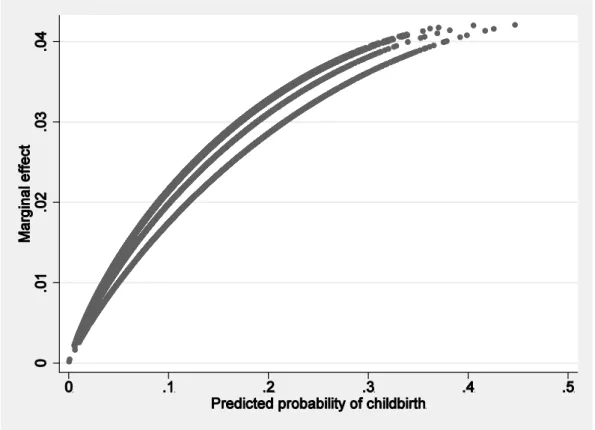
Fig. 2 depicts the relationship between the predicted probability of childbirth, on the x- axis, and the marginal effect, on the y-axis. We find that there are no different signs in marginal effects. The range of the marginal effect is from 0.02 to 4.21%5. The higher the predicted probability, the larger is the effect of the act. In other words, the policy is more effective, for example, for households with fewer children or with husbands having lower income.
5 The marginal effect is calculated using the “inteff” command in Stata. For details of the command see Norton, Wang, and Ai (2004).
- 61 -
Next, Fig. 3 illustrates the significance of the marginal effects of each sample. Two horizontal lines indicate the significance level: the upper line is the 5% level and the lower is the 10% level. That is, the sample above either line has a significant marginal effect. There are no samples above the 5% significance line, confirming that for each value, the marginal effects are significant in about 97% of the samples. As Fig. 3 also shows, above the 0.2 point of predicted childbirth probability, there are few insignificant samples. Thus, the Act does have an effect on the probability of childbirth.
Fig. 2 Marginal effect of the Act
- 62 -
Fig. 3 Significance of marginal effect
6 Conclusion
The Japanese government has recently changed the policy direction for measures to reverse the birth rate’s decline, now focusing on the role of firms. To tackle this problem, the Act on Advancement of Measures to Support Raising Next-Generation Children was enacted in 2005.
The Act compels large firms to support their employees in bearing and rearing children.
Thus, this study investigates the effect of the Act on childbirth. Our DID estimation, using the quasi-experimental condition, demonstrates that the policy has a significant positive effect on the probability of childbirth. This indicates that the Act can reduce the cost of having children for working women. The marginal effect of the Act on the probability is roughly a maximum 4% increase.
This result also suggests that firms’ role is crucial in improving Japan’s birth rate. The Japanese government, till date, attempts to increase the availability of child-care facilities and introduce systems to support working women. However, even if there are sufficient facilities or systems, without firms’ support it is difficult for women to use them, suggesting that this change in policy direction was successful.
An existing problem is that this study could not determine the effect of this particular measure on fertility. Future research should determine which measure is the most effective and calculate its magnitude.
- 63 - Acknowledgement
The Employment Status Survey is provided by The Ministry of Internal Affairs and Communications. This research is supported by Health Labour Sciences Research Grant (The Ministry of Health, Labour and Welfare).
References
Adserà A (2004) Changing fertility rates in developed countries. The impact of labor market institutions. J Popul Econ 17:17–43.
Ai CR, Norton EC (2003) Interaction terms in logit and probit models. Econ Lett 80(1):123–
129.
Averett AL, Whittington LA (2001) Does maternity leave induce birth? South Econ J 68(2):403–417.
Azmat G, González L (2010) Targeting fertility and female participation through the income tax. Labor Econ 17:487–502.
Becker GS (1960) An economic analysis of fertility in Demographic and Economic Change in Developed Countries, Universities-National Bureau Conference Series 1. Princeton Univ.
Press:209–240.
Becker GS (1981) A treatise on the family. Harvard Univ. Press.
Del Boca D (2002) The effect of child care and part time opportunities on participation and fertility decisions in Italy. J Popul Econ 15:549–573.
Gupta ND, Smith N, Verner M (2008) The impact of Nordic countries’ family friendly policies on employment, wages, and children. Rev Econ Househ 6:65–89
Haah P, Wrohlich K (2011) Can child care policy encourage employment and fertility?:
Evidence from a structural model. Labor Econ 18:498–512.
Higuchi Y (1994) Ikuji Kyugyo Seido no Jissho Bunseki (An empirical analysis on the parental leave). In Shakai Hosho Kenkyujo (eds) Gendai Kazoku to Shakai Hosho: Kekkon, Shussho, Ikuji (Contemporary Family and Social Security: Marriage, Childbirth, and Childcare) University of Tokyo Press, pp 181–204.
Kalwij A (2010) The impact of family policy expenditure on fertility in western Europe.
Demogr 47(2):503–519.
McNown R, Ridao-Cano C (2004) The effect of child benefit policies on fertility and female labor force participation in Canada. Rev Econ Househ 2:237–254.
- 64 -
Morita Y, Kaneko Y (1998) Ikuji Kyugyo Seido no Fukyu to Josei Koyosha no Kinzoku Nensu (The effect of the child care leave on women in the workforce). Nihon Rodo Kenkyu Zasshi 40(9):50–62.
Norton EC, Wang H, Ai CR (2004) Computing interaction effects and standard errors in logit and probit models. Stata J 4(2):154–167.
Schellekens J (2009) Family allowances and fertility: Socioeconomic differences. Demogr 46(3):451-468.
Tanaka R, Kouno T (2009) Shussan Ikuji Ichijikin ha Shusshouritu wo Hikiageruka: Kenko Hoken Kumiai Panel Data wo Mochiita Jisshou Bunseki (Do childbirth allowances matter for fertility?: Evidence from the Japanese health insurance data) Nihon Keizai Kenkyu 61:94–108.
Willis R (1973) A new approach to the economic theory of fertility behavior. J Polit Econ 81(2):S14–S64.
Whittington LA, Alm J, Peters HE (1990) Fertility and the personal exemption: Implicit pronatalist policy in the United States. Am Econ Rev 80(3):545–556.
Yoshida H , Mizuochi M (2005) Ikuji Shigen no Riyo Kanosei ga Shusshouryoku oyobi Josei no Shugyo ni Ataeru Eikyo (The effect of childcare resources on fertility and women’s labor supply) Nihon Keizai Kenkyu 51:76–95.
Zhang J, Quan J, Van Meerbergen P (1994) The effect of tax-transfer policies on fertility in Canada, 1921–88. J Hum Resour 29(1):181–201.