Social network approach on multilingual
society among middle class people in Tunisia
その他(別言語等)
のタイトル
チュニジア中流階層の多言語社会における社会ネッ
トワークからのアプローチ
著者
中挾 知延子
著者別名
NAKABASAMI Chieko
journal or
publication title
東洋大学大学院紀要
volume
54
page range
1-24
year
2017
URL
http://id.nii.ac.jp/1060/00009751/
Abstract
This paper tries to find some novel features of the Tunisian middle class using ego network analysis as well as to evaluate what past sociolinguistic studies have said concerning language use in the multilingual and multicultural Tunisian society. Revealing individual language usage in diverse situations better identifies the tendencies of the general population of the middle class. We also focus on the efficiency of a mixed approach, combined methods of qualitative and quantitative data. The paper shows that the middle class change languages according to various alters under various situations and reveals how language diversity can reflect Tunisian society.
1. Introduction
The middle class is said to have great potential for developing local communities and the country itself. In Tunisia, we have been investigating the situation of multilingualism, especially focusing on middle class citizens. Knowing the comportment of middle class people from diverse perspectives is important for the future development of local communities and is of cultural interest for area studies. As a target area, we focused on La Marsa (El Marsa), a city with a population of about 93,000, situated approximately 18 kilometers from Tunis, Tunisia’s capital. In La Marsa, a variety of social classes (upper, upper middle, middle, working, and lower)* can be found, and their habitations are separated
according to social class. By analyzing ego-alter interpersonal networks, we tried to verify some results from previous sociolinguistic research and to get some novel findings. Tunisia is an Arab country where Arabic is the official language; however, the current language
** Professor of Faculty of Regional Development Studies, Toyo University.
Social network approach on multilingual society
among middle class people in Tunisia
situation is complex and dynamic. Tunisian people speak plural languages for everyday use, in particular, Tunisian Arabic (TA) and French (FR), and also code-switching between TA and FR. TA is a spoken version of classical Arabic (Bouzemmi, 2005). Different generations of Tunisians have had different experiences with the languages used in daily life and the work environment, the educational system, government, and the media (Daoud, 1991). From the perspective of interpersonal networks, we conducted a questionnaire for 300 inhabitants of La Marsa, and collected 3,000 cases and determined with which language they were talking to their collocutors in three situations: the workplace, families, and others. Each person is considered to be an ego that is conversing with interlocutors as alters, and certain languages are used between them. The language used in the conversation is considered a resource attribute between egos and alters. Regarding what languages are used in social life, many contributions have been made in the sociolinguistic field over a long time. However, few studies can be found that apply social network analysis for this field. Our main purpose is to extract some novel features of the Tunisian middle class using social network analysis as well as to evaluate what past sociolinguistic studies have said concerning language use in the multilingual and multicultural Tunisian society. At the same time, we are also focusing on the efficiency of a mixed approach, combined methods of qualitative and quantitative data mentioned in Crossley (Crossley et al., 2015). During a field survey, the attitude and behavior of interlocutors can play an important role in reflecting the language use and something sentimental behind the scenes in the conversation. Additionally, through the lens of language usage, we hope to find hints about Tunisian social life.
2. Current language situation in Tunisia
Tunisia, one of the Mediterranean countries as well as an Arabic country, is generally considered to be one of Maghreb countries, along with Libya, Algeria, Morocco, and Mauritania, situated in the north of the African continent. Tunisia, especially, has three outstanding characteristics: 1) women have high social status, 2) the literacy rate is high†,
and 3) Tunisia has a middle class. In Africa, a middle class is very rare, and Tunisia’s modernized and developed features are notable among many African countries. In particular, the existence of a middle class is very powerful for its development, and it can become a potential force for changing the society through modernization and democratization.
Tunisia’s official language is Arabic; however, its current language situation is complex and dynamic. Tunisian Arabic, TA, has a very rich, special vocabulary that matches Tunisians’ lifestyles. Tunisians have been developing TA according to their own needs, sometimes modifying it for their own use, even in small groups. Historically, Tunisia was French protectorate from 1881 until it gained independence from France in 1956. Since then, various generations of Tunisians have had different experiences with the languages used in social and work environments, the educational system, government, and the media. Especially, there exist highly literate bilinguals with French who are shaping the country’s higher classes (middle, upper-middle, and rich) of the country (Tamzini, 2013). Recently, English has been emerging on the Tunisian linguistic landscape, in particular, among the young generation and the international business scene. The Internet accelerates this phenomenon. In fact, many Tunisians consider English to be the first language when they are searching something useful on the Web, and then French and Arabic follow English (Bouzemmi, 2005; Nakabasami, 2013). In Sonia S’hiri’s Speak Arabic Please!, in spite of such diverse language usage, Tunisians do not feel a loss of identity because the ability to switch among plural languages, perceived as prestigious in their culture, is part of their positive identity.
3. Code-switching in Tunisia
Code-switching (CS), a widespread phenomenon throughout the world, has generated much discussion and debate (Lawson-Sako and Sachdev, 1997; Romaine, 1995). In sociolinguistic studies, CS has been generally considered a stigmatized variety of speech. One well-acknowledged definition of CS found in many sociolinguistic books is “the alternate use of elements from two different languages or dialects within the same conversation or even the same utterance” (Gardner-Chloros, 1997; Bentahila, 1983; Eastman, 1992; Grosjean, 1982; Gumperz, 1982; Heller, 1988; Milroy and Muysken, 1995; Scotton, 1993). In Myers-Scotton’s terms (Myers-Scotton, 1993), this CS definition suggests that CS may be considered an informal Tunisian variety in casual speech with in-group members. Also, according to (Bouzemmi, 2005), a specific word from one of the languages involved may be semantically more appropriate for a given concept, and Tunisians switch codes to impress the other participants in the conversation by showing their language skills. He said that it has been rooted on pedagogical inconveniences since the first reforms for teaching Arabic in 1949. In the Tunisian context, French had connotations of modernity, while Arabic was associated with tradition. In several studies from a gender perspective, in Tunisia and the Maghreb, women generally are perceived not only to speak more French but also to use the
Arabic-French code-switched variety more often than men. It can be interesting to evaluate the use of CS among women according to their social class. As mentioned earlier, in Tunisia, women have higher social status than in other African countries; in other words, they engage in top jobs such as manager, director, etc. Some studies have shown that modernity reflects the use of CS, which indicates that Tunisian women are working as actively as men in society (Lawson-Sako and Sachdev, 1997).
4. Target region - La Marsa
As a target area, we focused on La Marsa (El Marsa), a coastal city with a population of approximately 93,000, situated in far northeastern Tunisia, approximately 18 kilometers from Tunis, the Tunisian capital (Gammarth Web, 2016). In La Marsa, a variety of social classes can be found, and their habitations are separated according to social class. One remarkable thing about La Marsa is that members of some local communities are actively making life better in their city. For example, they collect garbage on the street, in particular in areas where poorer households live. Lately, some redevelopment has been undertaken in the city to accommodate immigration from rural regions of Tunisia. Year by year, immigration has been increasing so much that the city authority needs to provide public housing. Immigrants may be relatively poor, and certain areas of the city have been shaped by the housing of the lower class. Other areas include a commercial area, a so-called downtown, and calm residential areas where the middle and upper middle classes live, including a few wealthy classes. We focused on the middle (including the upper middle) class for our research target because the middle class has potential for developing the city, and we believe that knowing better their interpersonal relationships in their lives and culture provides clues for understanding their multilingual and multicultural society. As one perspective, we emphasized the language situation in the community, and, through their speech, we would like to envision a society led by the middle-class citizens. Historically, La Marsa has been a city where the Beys (district administrators sent by the ancient Ottoman Empire) lived until 1957, when the Ottoman Empire came to an end (Martin, 2003; Boularès, 2012; Feriel and Brun, 2012). Even today, we can find some chic reminders of the Beys era; at the same time, the city is very open to outside influences. Additionally, several universities and institutions are close to the city, as well as casual restaurants, cafes, hotels, and bars, which attract young people to the city.
5. The middle class in La Marsa and some observations
As we mentioned earlier, in La Marsa, there are various social classes: upper, upper middle, middle, working, and lower. According to observations from our field survey, many inhabitants in La Marsa (hereafter, Marsois) consider themselves to be middle class or upper middle class. Interestingly, even those who are undoubtedly rich have a tendency to think of themselves as middle or upper middle class. On the other hand, those who engage in jobs without high status, e.g., cashier, sales clerk, or barber, think of themselves as middle class, although their income must be limited. More than a few middle-class Marsois have studied overseas, mostly in France, or their family members live outside Tunisia. In addition, some family members married non-Tunisians, or they themselves were born from a mixed couple. Such people belong to upper middle class, and they have studied overseas for a long time to attain their current higher-status professions. They are very open-minded and were very welcoming during our field survey. Apparently, they use CS or FR fluently, more than they used TA, during our survey conversations.
Many people consider themselves to be middle class or upper middle class. Even those who are undoubtedly rich tend to think of themselves as middle or upper-middle class. On the contrary, those who engage in job without high status, e.g., cashier, sales clerk, or barber, regard themselves to be middle class, although their income is limited.
Marsois adolescents who work as sales clerks are, in fact, from the working class or lower class. They use CS and FR with clients who are middle class or foreign tourists from mainly francophone countries. Interestingly, the youth are much accustomed to using CS and FR at their daily jobs, which makes them naturally communicate with their siblings and cousins in CS and French. Conversations among young Marsois include many French phrases, which they feel are “cool.” They use such French words positively, especially using the words in a phrase in TA. That may also stem from the fact that more than a few young people have been studying at lycées, high schools taught in French.
6. Research questions
From the discussion mentioned above, we have formulated research questions as follows. Q1. Does the middle class use diverse languages in Tunisian social life?
Q2. In multilingual Tunisian society, what is the role of CS for TA and FR? Q3. How can language diversity reflect Tunisian society?
7. Data
We prepared a questionnaire in French and asked respondents the questions face to face. Target people were randomly selected in some residential areas in the city, in which it was generally said that the majority of inhabitants belonged to the middle class. We went door to door, and then we explained the objective of the questions, and asked the inhabitants to answer them. Sometimes, we asked pedestrians on the street who seemed to be local people who lived nearby. The questionnaire was available in French, but in most cases we asked each question of individual informants. Three researchers targeted individuals from various groups; at the end of the day, we met to discuss what had happened during the day and to share helpful information for more effectively advancing the questionnaire on subsequent days. Sometimes there were more than a few persons who refused to answer. Our field survey took about a month and a half from mid-July to the beginning of September in 2015. Three kinds of questions were asked, using a pseudo name generator with symbols like alphabet letters (A, B, etc.). A maximum of 5 names were associated with each person surveyed. TIn building questionnaires, we referenced in (Grossetti and Bidart, 2011).
(1) In your workplace or school, with whom do you talk often?
(2) From either your workplace or your school, with whom do you talk about something serious?
(3) Within one week, with whom have you talked for more than 5 minutes? Do not include the persons you indicated above.
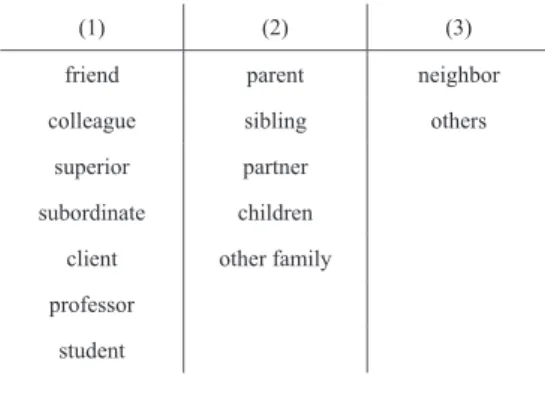
For each question, interlocutors were asked their relationship with those they spoke with and what language they use in conversations. Some example relationships were indicated in advance: friend, colleague, family member, neighbor, acquaintance at the café, etc. In fact, we categorized all answers received and listed them in Table 1. Other family means uncle, aunt, nephew, niece, brothers- and sisters-in-law, and all other relations except parents, siblings, partners, and children. Partner includes husband, wife, fiancé, or couple. Regarding the respondents’ individual attributes, they were asked to which social class they belong, as well as their gender, age, and occupation. Concerning their social class, they were asked to declare the respondents’ class in their own right - upper, upper-middle, middle, working, and lower. We collected 300 answer sheets and a total of 3,002 records.
7-1. Language
According to the field survey, there were 33 varieties of language use‡. In Table 2, more
than 1.5% of relative variety frequencies are listed. In Table 2, TA/FR indicates that two kinds of languages are written, meaning that the target’s answerers use mainly TA and sometimes FR, but not always. CS indicates that they use TA and FR nearly equally in conversation, and then we used these two varieties differently in the survey.
7-2. Social class
Of 300 respondents, 86% described themselves as middle and upper-middle classes, as shown in Table 3. This is not surprising, as we conducted our survey in areas generally inhabited by the middle class. Evidently, in Tunisia, middle-class people include a large range of people, for example, from an art director who manages a number of staff to a simple clerk in a clothing shop. Looking at from another perspective, one group of young neo-rich, whose parents are rich, consider themselves to be middle or upper middle class. They are studying at school, generally in a French-speaking environment, and after
Table 1. Categories of ego and alter relationships
(1) (2) (3)
friend parent neighbor
colleague sibling others superior partner
subordinate children client other family professor
student
Table 2. Major varieties of language use
Language frequency relative frequency cumulative relative frequency TA 1442 0.481 0.481 CS 787 0.262 0.743 TA/FR 280 0.093 0.836 FR 270 0.090 0.926 EN 53 0.018 0.944 FR/EN 36 0.012 0.956
‡ In all, we found Tunisian Arabic, French, English, Modern Standard Arabic, Lebanese Arabic, German, Spanish, Italian, Portuguese, Turkish, their various combinations, and code-switching between TA and FR.
finishing their studies expect to get a good job. Though one part of them is unemployed, they are living a good life, thanks to their parents’ money.
7-3. Age and gender
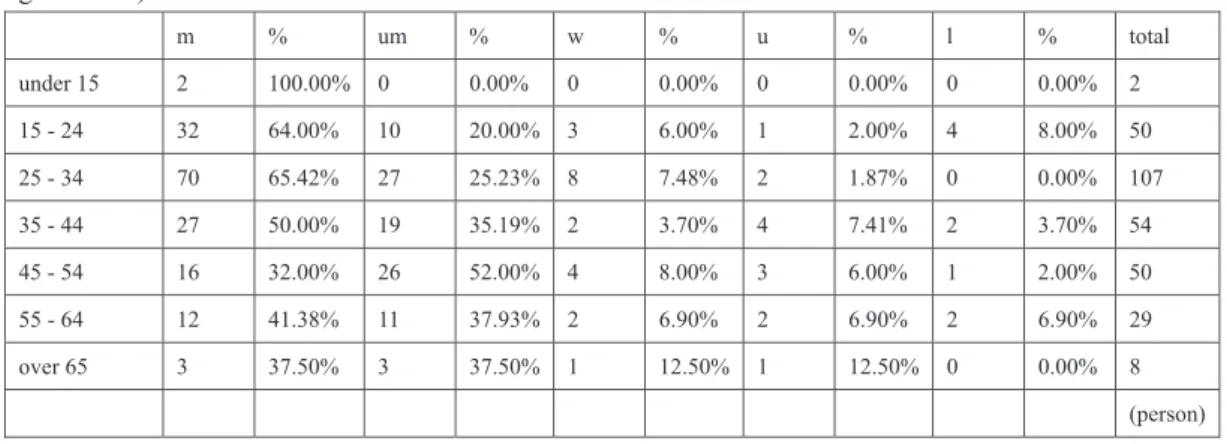
The ages and genders of respondents are indicated in Table 4. In advance, we divided respondents into 7 groups based on the age structure in Tunisia as cited in the CIA World Factbook (Central Intelligence Agency, 2016). In the CIA World Factbook, 5 groups of age are used: under 15, 15–24, 25–54, 55–64, and over 65. We divided the 25–54 age group into 3 (25–34, 35–44, and 45–54) to be more specific according to age. Within the same generation, gender difference is not perceptible except over 65. In Table 4, age by social class is indicated. Apparently, the age range of 25–34 comprised a majority in the survey; this is normal, for this age range comprises a major part of the middle and upper-middle classes. Of the 300 respondents, 57% were male, and 43% were female. The distribution of gender by social class is shown in Table 5.
Table 3. Social class as evaluated by 300 Marsois
social class person middle (m) 162 upper middle (um) 96
working (w) 20
upper (u) 13
lower (l) 9
total 300
Table 4. Ages and percentages of males and females from each generation
male % female % total %
under 15 1 0.6% 1 0.8% 2 0.7% 15 - 24 27 15.9% 23 17.7% 50 16.7% 25 - 34 55 32.4% 52 40.0% 107 35.7% 35 - 44 29 17.1% 25 19.2% 54 18.0% 45 - 54 33 19.4% 17 13.1% 50 16.7% 55 - 64 18 10.6% 11 8.5% 29 9.7% over 65 7 4.1% 1 0.8% 8 2.7% total 170 130 300 (person)
7-4. Job
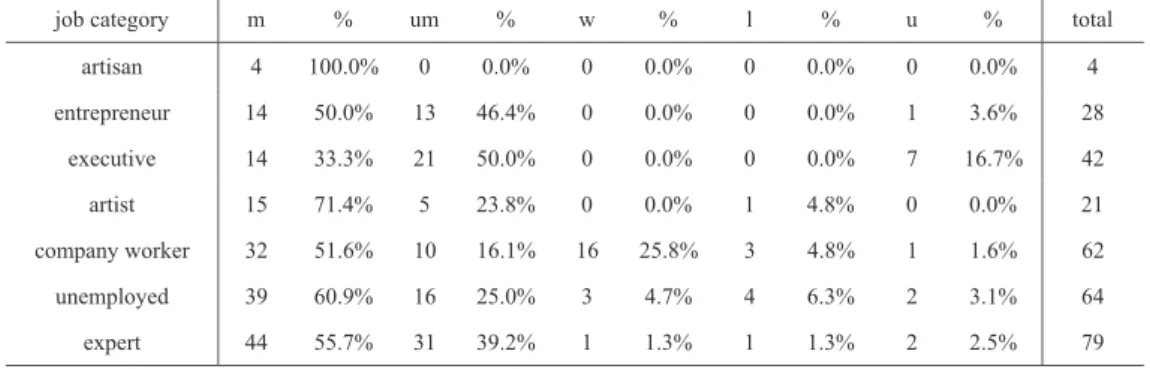
The survey showed that the interlocutors are engaged in a wide variety of jobs. Some are unemployed; however, the number of truly unemployed is very low, as many are students, housewives, or retired. First, we grouped their jobs into 7 categories based on their social status and a general sense of the job’s context. In Table 7, job categories are shown with example jobs and the number of persons so employed. In Table 8, we indicate the number of person in each job category and social class.
Table 5. Age by social class (% indicates the percentage of a social class within the same generation) m % um % w % u % l % total under 15 2 100.00% 0 0.00% 0 0.00% 0 0.00% 0 0.00% 2 15 - 24 32 64.00% 10 20.00% 3 6.00% 1 2.00% 4 8.00% 50 25 - 34 70 65.42% 27 25.23% 8 7.48% 2 1.87% 0 0.00% 107 35 - 44 27 50.00% 19 35.19% 2 3.70% 4 7.41% 2 3.70% 54 45 - 54 16 32.00% 26 52.00% 4 8.00% 3 6.00% 1 2.00% 50 55 - 64 12 41.38% 11 37.93% 2 6.90% 2 6.90% 2 6.90% 29 over 65 3 37.50% 3 37.50% 1 12.50% 1 12.50% 0 0.00% 8 (person)
Table 6. Gender by social class (% indicates the percentage of a social class by gender)
m % um % w % u % l % total male 90 52.9% 59 34.7% 9 5.3% 8 4.7% 4 2.4% 170 female 72 55.4% 37 28.5% 11 8.5% 5 3.8% 5 3.8% 130 (person)
Table 7. Job categories and example jobs
job category examples person
artisan baker, patissier, jeweler, … 4
artist art director, actress, graphic designer, musician, hair stylist, singer, … 21 entrepreneur clerk, secretary, factory worker, hotel receptionist, bus driver, waiter, … 28 executive shop owner, agent manager, agent director, freelancer,… 42 company worker diplomat, ministry secretary, CEO, business person, school inspector, … 62 unemployed pilot, medical doctor, architect, IT engineer, teacher, sport instructor, … 64
expert housewife, retired, student, unemployed, … 79
8. Ego-net analysis for sociolinguistic study
With the above data, we analyzed ego networks. In this context, egos correspond to the Marsois we interviewed, and alters are people with whom each ego indicated they spoke, using the name generator. We used E-NET (Borgatti, 2006) for ego network analysis.
8-1. Ego network analysis for sociolinguistic study
In this research, we chose the ego network to analyze the language usage of 300 Marsois. In some ways, ego network analysis is well suited to the target research questions (Borgatti et al., 2013). As Crossley (Crossley et al., 2015) said, ego network analysis affords a means of analyzing large networks. In our context, large networks do not mean a large number of nodes in a network but in general populations. As compared with the analysis of a whole network, if we are interested in a relatively small population of actors, it is feasible for us to conduct a census survey of our node set, and we can analyze the whole network. On the other hand, if we are interested in processes that affect bigger populations, such as the general public, a census survey will not be possible in most cases, which rules out analyses of the whole network. The target population of our research is the middle class. It is not possible to study all language uses of the middle class in La Marsa; however, our purpose is to grasp some general characteristics of language usage based on the research questions. From this perspective, ego network analysis is thought to be appropriate for the research. In addition, ego network analysis enables standard statistical analysis methods. On the contrary, whole network data contradict the assumptions of standard statistical approaches. In addition, another important reason is that the data can be obtained from intersecting social circles (Simmel, 1955). The network characteristics of human social life are much easier to understand by means of an ego network survey. It is very important for a language usage survey to obtain results from various sources. We must ask individual egos about the
Table 8. Job category by social class
job category m % um % w % l % u % total
artisan 4 100.0% 0 0.0% 0 0.0% 0 0.0% 0 0.0% 4 entrepreneur 14 50.0% 13 46.4% 0 0.0% 0 0.0% 1 3.6% 28 executive 14 33.3% 21 50.0% 0 0.0% 0 0.0% 7 16.7% 42 artist 15 71.4% 5 23.8% 0 0.0% 1 4.8% 0 0.0% 21 company worker 32 51.6% 10 16.1% 16 25.8% 3 4.8% 1 1.6% 62 unemployed 39 60.9% 16 25.0% 3 4.7% 4 6.3% 2 3.1% 64 expert 44 55.7% 31 39.2% 1 1.3% 1 1.3% 2 2.5% 79 (person)
various social circles in which they mix and the various sets of alters with whom they use different languages. Revealing individual language usage in diverse situations better identifies the tendencies of the general population of the middle class.
8-2. Mixed approach with qualitative and quantitative data
As said in (Crossley et al., 2015), network analysis is amenable to a mixing of methods, qualitative and quantitative approaches. Statistical analysis can be a very efficient method for analyzing data; however, what we want to know about the network is not always being talked about. Talking about language usage, we may want to know more about the meaning of its usage behind the scenes. Especially in a sociolinguistic survey, the conversation for the survey would be an important source for analyzing language usage; moreover, it would provide a valuable occasion for observing people’s communication behavior. In addition, trivial small talk can be a good reference point.
As an example from our observations during the survey, we saw in the results diverse foreign languages spoken besides French: e.g., English, German, Italian, Portuguese, Spanish, Turkish, and Lebanese Arabic. These languages are strongly connected to jobs. Those who can speak relatively more languages engage in higher-status jobs, such as professor, entrepreneur, or government officer. Intellectuals were very cooperative with the survey to give more efficient information regarding the language situation around them. On the contrary, wealthy people were not very cooperative, particularly those over 50, and were reluctant to accept the questionnaire. Unfortunately they do not want to understand the objective of the survey. Exceptionally elderly women whose husbands were foreigners or who studied overseas were very cooperative, and they managed both TA and FR fluently. The children of the wealthy, who are mostly students or unemployed after finishing the university, are cooperative, except that they did not concentrate on the questionnaire’s content. Wealthy young people generally use CS or FR, influenced by their familial and educational environment because their parents frequently use FR based on their jobs and personal networks extending beyond Tunisia. The wealthy young are conscious of themselves as upper-middle class, interestingly, rather than wealthy. We would have to say that women seemed more serious about the survey than did men. During the survey, men were apt to joke and talk about irrelevant things. Elderly men, especially, often talked about their families - sons, daughters, and grandchildren.
A majority of people chose not to fill out the questionnaire themselves. We asked them directly each question and, at the same time, wrote out their answer. Otherwise, many
misspelling were found, and we corrected them, confirming each time what they meant. We filled out the questionnaire by ourselves because it was the best way to complete each field. Each time we asked the interlocutor which language we should use, which was very important for getting a correct answer. Some people refused to answer the moment they were asked a question in French because they feared their incompetency in the language would be revealed and we would ridicule them. We carefully chose the language used among TA, FR, and CS according to their social situation, as judged immediately by us. Those who live in houses alone, as well as those who live in large residences, responded very favorably to our survey; however, those who live in small apartments often refused. We supposed that those in the small apartment—in other words, disfavored people—had enormous feelings of distrust in the current Tunisian society. In addition, women responded more favorably to the survey than did men; especially, more modernized women with short hair and western style dress cooperated very amiably. We captured the people’s comportment as well as linguistic situation through the field survey, for instance, their attitude, voice tone, facial expression, and small talk during the questionnaire. Though certain that the climate after the revolution in 2011 caused a feeling of distrust everywhere in the city, we confirmed that the altruism and open-mindedness in Tunisian society have not changed.
8-3. Heterogeneity of language usage
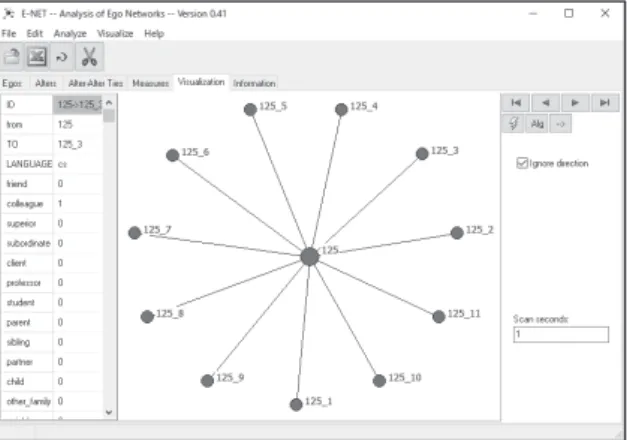
With the data gathered in the previous section, we used Agresti’s index of qualitative variation (IQV) (Agresti and Agresti, 1978) to measure the data. During the conversation, egos whose alters mostly use the same language with egos will have small heterogeneity scores, while those with more diverse languages will have a value closer to 1. As one of our research questions asks about the middle class’ use of diverse languages in their social lives, IQV has been adapted to evaluate answers to the question. Using E-Net software (Borgatti et al., 2006), IQV has been calculated for 300 egos with language as the categorical variable (average = 0.70, standard deviation = 0.303, max = 1.0, min = 0.0). Figure 1 shows an example of ego alters network using E-Net. The square test showed these results: chi-square = 338.34, degrees of freedom = 8, p-value = 2.78E-68. This test is a homogeneity test, which means that every IQV interval has been equally distributed or not. If not, it can be said that the IQVs are unequally distributed, and, from the p-value (〈 0.05) and the histogram of Figure 2, IQVs are inclined to 1.0. It can be deduced that the heterogeneity of language usage is high, and many Marsois are using diverse languages with their interlocutors.
8-4. Correspondence analysis results
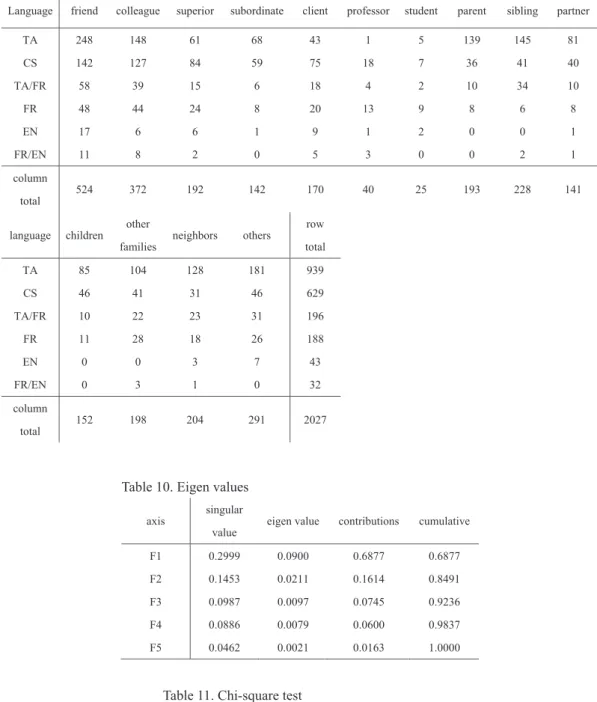
Correspondence analysis (CA) is a multivariate statistical technique that is conceptually similar to principal component analysis but that applies to categorical rather than continuous data (Benzécri, 1973). We think that CA is a very suitable analytical tool for clarifying our target goal. There are 3002 records obtained from the name-generator method; then, after having filtered out all but the major 6 varieties shown in Table 2, 2872 records were left. The 6 x 14 contingency table was generated with rows for languages and columns for relationships, as shown in Table 9. CA has been conducted with Excel-Toukei 2015 for Windows (Social Survey Research Information Co., Ltd., 2015). Table 10 shows an output of the CA with the above table.
Figure 1. An example of ego-alters network using E-Net
Table 9. Language and relationship contingency table
Language friend colleague superior subordinate client professor student parent sibling partner
TA 248 148 61 68 43 1 5 139 145 81 CS 142 127 84 59 75 18 7 36 41 40 TA/FR 58 39 15 6 18 4 2 10 34 10 FR 48 44 24 8 20 13 9 8 6 8 EN 17 6 6 1 9 1 2 0 0 1 FR/EN 11 8 2 0 5 3 0 0 2 1 column total 524 372 192 142 170 40 25 193 228 141
language children other
families neighbors others
row total TA 85 104 128 181 939 CS 46 41 31 46 629 TA/FR 10 22 23 31 196 FR 11 28 18 26 188 EN 0 0 3 7 43 FR/EN 0 3 1 0 32 column total 152 198 204 291 2027
Table 10. Eigen values
axis singular
value eigen value contributions cumulative
F1 0.2999 0.0900 0.6877 0.6877
F2 0.1453 0.0211 0.1614 0.8491
F3 0.0987 0.0097 0.0745 0.9236
F4 0.0886 0.0079 0.0600 0.9837
F5 0.0462 0.0021 0.0163 1.0000
Table 11. Chi-square test
axis chi-square degrees of
freedom p-value F1 269.7477 17 0.0000 F2 61.0721 15 0.0000 F3 28.0349 13 0.0089 F4 22.5527 11 0.0204 F5 6.1248 9 0.7274
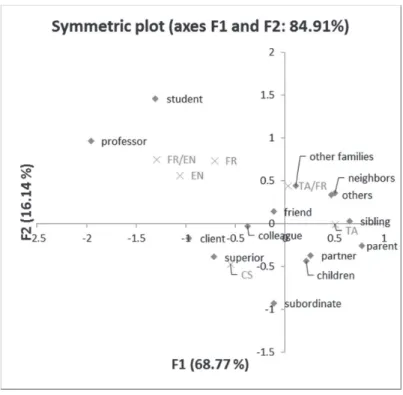
As shown in Tables 9, 10, and 11, we obtained 5 axes in all, and the first and second axes occupied 84.91% of the contributions. Also, from the chi-square test, first and second axes having p-values of less than 0.001 indicate statistical significance. Some interesting results have been drawn from the analysis. Considering what the two axes mean, the F1 axis can be said to represent informativeness, which means how rich knowledge and information can be obtained, and the F2 axis represents informal sociability. In the survey, professor is a person from whom an ego learns something valuable and useful for his career, and student is a person to whom an ego teaches something academic and practical for his study. When egos exchange richer knowledge from/to professors and students, egos use FR or EN. On the other hand, egos use TA or sometimes FR in more intimate relationships. Among strong intimacies, egos obtain richer knowledge from other family members, especially uncles, as observed in the survey.
9. Findings and discussion
In this section, we are reporting our findings obtained from our survey in accordance with the questions posed in this research.
Q1. Does the middle class use diverse languages in Tunisian social life? Q2. In multilingual Tunisian society, what is the role of CS for TA and FR? Q3. How can language diversity reflect Tunisian society?
For these research questions, we would like to discuss our qualitative and quantitative mixed approach.
Q1. The middle class’ use of diverse languages in Tunisian social life
As explained in Section 8-3, measuring with Agresti’s IQV, we can deduce that the heterogeneity of language usage is high, and many Marsois are using diverse languages. As seen in Table 2, TA and CS are found to be two high majorities of all; however, from this table, we see only that TA and CS are generally used very much in the target society. Using ego network analysis, we learned that each ego uses not just one language; in other words, speakers change languages according to various alters under various situations. Q2. In multilingual Tunisian society, what is the role of CS for TA and FR?
The sentiment toward and consciousness of CS are differently assimilated among Marsois. Through our interviews, we discovered that CS can be used in two ways in daily life. First, CS complements professional communication. A majority of people use practical French words in the professional field, especially science and technology. As shown in Figure 3, FR and EN are close to professor and student, positioned as more formal socializations, which indicates that they are receiving or giving knowledge in FR and EN. When their French language skill is not enough for communication in the professional context, they are embedding French words in the TA phrases to make professional terms mutually understandable. Considering CS between clients, in this context, clients are shoppers or tourists from non-Arab countries. Tunisians use CS to communicate with them because their French or English language skills are insufficient. Second, another way of using CS is for self-confidence. People use CS to let other Tunisians see that they can manage French while speaking about intelligent subjects, showing others they are higher than their current life condition might seem to indicate. This has been revealed through the interviews. Respondents often started talking of politics, the economy, and even football. Evidently, they are committing some errors, e.g., grammar, singular-plural, and gender. However, for them, speaking French is a sign of being well educated and having good taste for modern culture; therefore, they are willing to use French words or phrases in TA. As they have spoken in such a manner for a long time, they are capable of employing CS nearly naturally in their conversation in their own style. The same situation can be adapted in the workplace. CS is often used with superiors, subordinates, and colleagues, as professional communication would be needed in some situations with them. CS is also rather close to colleague in Figure 3.
We found that colleagues consist of two groups: one is very close to friends; the other is connected only socially. Normally, Tunisians use TA with the first group. However, they use CS—as well as French - with the latter group; this demonstrates a kind of self-promotion, whereby they would like their colleagues to recognize them as belonging to a more culturally sophisticated social group.
TA is definitely used for expressing intimacy, called informal sociability in Figure 3. However, partner and children stand in an interesting position. Respondents are more likely to converse in CS with them, as compared with other family members, siblings, and parents. From our interviews, we found that many couples who have studied abroad shortly or for a long time, mainly in France, use perfect French in daily life, as well as more than a few of their children, who are also studying at school where many subjects are taught in French. This may be the reason why partner and children are positioned near CS. Also from the interview, FR is favored by middle-class parents for the purpose of letting their children to get used to French from their early childhood. The children go to French mission schools (lycées), where a greater number of close and dense small, prestigious social groups are organized. When the adolescents of middle- or higher-class families graduate from the lycée, they have come to use French even to express deep sentiments. This deepens the social divide from the lower classes of the same generation. Such a social divide between those who favor FR and those who do not can grow larger and become an increasingly serious matter in Tunisian society. Incidentally, this does not seem to happen much, for Tunisians on both sides of the divide become colleagues in the workplace, and young lower class workers use CS to communicate with their colleagues from the higher classes.
Third, CS is for rapid communication. In Figure 3, Friend and colleague are put at nearly equal distances from the various languages used: TA, TA/FR, and CS. This fact would reflect that egos use TA and FR very flexibly with their friends and colleagues according to the situation. From another viewpoint, CS is at a position that is a little less intimate and less informative. As CS is a mixing language, in light of its definition, egos do not think that CS is appropriate for obtaining knowledge. With some relationships close to CS - client, superior, and subordinate—egos use CS very often. We suppose that, for them, the most important thing is to communicate as quickly as possible; that may be why egos are using CS with alters.
Our field survey was focused on the middle class; however, some aspects of Tunisian society could be identified. In La Marsa, more than a few people regard the French language as a symbol of prestige; however, in parallel, certain people think that it is not good to use only French, and they feel the excessive use of French in a prestigious manner is uncomfortable and unpatriotic. One middle class inhabitant said that La Marsa has historically been a city where many middle class people live; sadly, however, the life level and living environment have been increasingly degraded recently. They are ashamed of this situation, and, ironically, certain people think that keeping fluent French speaking in the community should also maintain the high status of La Marsa’s citizens. This opinion may be narcissistic but expresses certain feelings of the middle and more favored classes. More than a few Marsois have studied overseas, mostly in France, or their family members live outside of Tunisia. In addition, some family members have married non-Tunisians, or they themselves were born of a mixed couple. Such people generally belong to the upper-middle class, and they have studied overseas for a long time to qualify for their current higher-status professions. They are very open-minded and welcomed us warmly. Apparently, such people used CS or fluent FR more than TA during the survey conversation. How they are educated has an important impact on orienting their future use of each language. In the case of engineers who were educated in French, they started expressing their ideas in French by inserting French words into a TA phrase, even in daily conversation. They cannot think of their ideas properly without using French.
On the other hand, the youth of the lower classes (working or lower) are much more conscious of the social divide. We could interview some of the young of the lower class in the survey, but not many. The divide causes them certain level of hatred against French itself. Conversely, the young upper classes ostentatiously display their superiority to the less favored young by speaking fluent French. The social divide between the favored classes and those not favored, which starts in early childhood, is getting worse. The use of FR could be said to reflect this social divide. However, in the workplace, no matter what class the young may belong to, they share the same value system in their social lives and use the same language environment.
As indicated from our interviews of the young middle class, although many earned diplomas in a professional field, because they cannot find a professional job after graduation, many give up on a professional career and work at call centers, where they can earn a decent salary. This is a sad reality, and it is also why they want to master French, as being able to speak French is necessary for young people to work in call centers in Tunisia. Generally,
such young people come from relatively poor families, which explains why many young across many social classes use FR at work and CS to communicate with colleagues.
Finally, we would like to mention Modern Standard Arabic, MSA, in part based on the field survey. MSA is rarely used among Tunisians. One case in which MSA is used is for communicating with the people of other Arab countries for the purposes of business and education. In our survey, we found MSA used with Lebanese. In addition, we could hear Tunisians speaking MSA with Egyptians or Libyans on the street. Actually, MSA is used less and less among people, and we suppose this tendency may continue to accelerate in the future. We think that the semi-disappearance of MSA can be ascribed to economic and sociocultural situations. People do not need to use MSA on the business scene, and they give more value to French, generally speaking, modern European cultures in their society, and Western languages such as English, German, Italian, and Spanish. This proposal does not contradict Daoud’s discussion of multiculturalism, in which Tunisian people rediscover their own cultural identity by using TA. TA is essentially culturally different from MSA. MSA is taught at school but is limited to higher education. Some MSA are for their studies, for example, Arabic classic history, literature, poetry, and theater. They communicate with the professor in MSA during the class; however, outside of class, they are not using MSA. As for the job market, apparently those who master French or English are able to find good jobs (good means a good salary), and they are no longer interested in mastering MSA, except in a few cases for business reasons.
10. Concluding remarks
In La Marsa, people often classify themselves as middle class because they are ashamed to admit they are from a lower class. In Tunisia, the working class has been treated as poor without any scientific research based on sociology and economics, until now. After the revolution of 2011, many people felt lost and unsure of their future, for even those who enjoyed life before have suffered due to rising prices. They can no longer afford to enjoy their free time by going out, eating at a restaurant, joining clubs, traveling, etc. However, they want to think of themselves as middle class by seeing around them some favored group of people who are profiting by the confusion caused by the revolution to gain money and have a good life.
In conclusion, we would like to make two points. The first regards the connection between multilingualism and multiculturalism in Tunisian society. As Daoud (Daoud, 1991) has said, the ruling elite’s contradictive language policy since independence in 1956 has been making
Tunisian society face the question of where their cultural identity should be directed. In Tunisia, Arabization by the ruling elites did not at all consider people’s cultural and economic backgrounds. It also makes the social divide deeper between favored classes and those that are not, thus degrading Tunisian society. We excerpt his proposition as follows.
Later on, when it became clear that French was going to be maintained indefinitely, the forces at both ends of the rope came to be seen as supporters either of Arabic, the national language, or French, the foreign language. Thus, a cultural dimension complicated the situation, because each language is not only the symbol but the vehicle of a cultural model. And thus Tunisia once again has had to face the question of which societal model it was aiming for, not only from the linguistic, but also the cultural and ideological point of view.
The second point is that more and more Tunisians have started using English. Lately, English has assumed the next position of priority after French; moreover, the passion for learning English is accelerating among the young. This may allow them to put several English words into TA phrases without difficulty. Also, we cannot ignore the influence of online Social Networking Service (SNS) communication using Facebook, Twitter, etc. SNS are growing increasingly popular more rapidly than ever among adolescents and even small children, with the dramatic prevalence of smart media. Freedom of expression over the Internet must be one strong factor for using English, French, and mixed language expressions.
Acknowledgments
I am deeply grateful to Professor Mosbah, Saïd. He always gave me insightful comments and suggestions for advancing my research. I would particularly like to thank some friends of Ms. Belkhiria. They helped me for interviewing local inhabitants of La Marsa and encouraged me to complete my research. Then I owe my deepest gratitude to all Tunisian people who have been helping and supporting me through my research. Without their help, this paper would not have materialized. This work was financially supported by JSPS KAKENHI (Japan Society for the Promotion of Science Grants-in-Aid for Scientific Research) (C) Grant Number 26360027.
References
Methodology 9(204), 204-237.
Bentahila, A., 1983. Language Attitudes among Arabic-French Bilinguals in Morocco. Clevedon, Avon, England: Multilingual Matters.
Benzécri, J.P., 1973. L'Analyse des Données. Volume II. L'Analyse des Correspondances. Dunod, Paris, France.
Borgatti, S.P., 2006. E-NET Software for the Analysis of Ego-Network Data. Analytic Technologies, Needham, MA. Available online at:
https://sites.google.com/site/enetsoftware1/.
Borgatti, S.P., Everett, M.G., Johnson, J., 2013. Analysing Social Networks. Sage, London.
Boularès, H., 2012. Histoire de la Tunisie: Les grandes dates, de la Préhistoire à la Révolution. Cérès Editions.
Bouzemmi, A., 2005. Linguistic Situation in Tunisia: French and Arabic Code Switching. Interlingüística 16(1), 217–223.
Central Intelligence Agency, 2016. The World Factbook, Africa, Tunisia. Accessed 28.02 2016, at https://www.cia.gov/library/publications/the-world-factbook/geos/ts.html.
Crossley, N., Bellotti, E., Edwards, G., Everett, M.G., Koskinen, J., Tranmer, M., 2015. Social Network Analysis for Ego-Nets. Sage.
Daoud, M., 1991. Arabization in Tunisia: The Tug of War. Issues in Applied Linguistics 2(1), 7-29. Eastman, C.M., 1992. Codeswitching as an Urban Language‐Contact Phenomenon. Journal of
Multilingual and Multicultural Development 13, 1-17.
Feriel, B.M., Brun, M., 2012. Tunisie, un siècle d'images. Place des Victoires
Gammarth Web, 2016. Information portal of the North of Tunis. Available online at: http://www. gammarthweb.com/lamarsa.html.
Gardner-Chloros, P., 1991. Language Selection and Switching in Strasbourg. Oxford University Press, Oxford.
Grosjean, F., 1982. Life with two languages: An introduction to bilingualism. Harvard University Press, Cambridge, MA.
Grossetti, M.D.A., Bidart, C., 2011. La vie en réseau - Dynamique des relations sociales. Presses Universitaires De France : Le lien social.
Gumperz, J.J., 1982. Discourse strategies. Cambridge University Press, Cambridge.
Heller, M. (ed.), 1988. Code-switching: Anthropological and linguistic perspectives. Mouton de Gruyter, Berlin.
Lawson-Sako, S., Sachdev, I., 1997. Accommodation Communicative en Tunisie: Une étude empirique. Plurilinguisme et Identité au Maghreb, 101-114. Publications de l’Université de
Rouen.
Martin, J.F., 2003. Histoire de la Tunisie Contemporaine. : De Ferry à Bourguiba 1881-1956. Editions L'Harmattan.
Milroy, L., Pieter M., 1995. Introduction: Code-switching and Bilingualism Research. In: Milroy, L. and Muysken, P. (eds.), One Speaker, Two Languages. Cross-disciplinary Perspectives on CS, Cambridge University Press, Cambridge, 1-14.
Myers-Scotton, C., 1993. Social Motivations for CS. Evidence from Africa. Clarendon, Oxford. Nakabasami, C., 2013. Will the Internet Change the Multilingual Society of Tunisia? Bulletin of
the Graduate School, Toyo University. Graduate School of Regional Development Studies, 16, 139-150.
Romaine, S., 1995. Bilingualism 2nd edition. Blackwell Publishing.
Shiri, S., 2002. Speak Arabic Please! : Tunisian Arabic Speakers’ Linguistic Accommodation to Middle Easterners. In: Rouchdy, A. (ed.), Language Contact and Language Conflict in Arabic Variations on a Sociolinguistic Theme. Routledge Curzon Press, New York.
Simmel, G., 1955. Conflict and the Web of Group Affiliations. Free Press, New York. Social Survey Research Information Co., Ltd., 2015. BellCurve – Excel Toukei. Tamzini, W., 2013.Tunisie. De Boeck.
本論文は、チュニジアの多文化・多言語社会の諸相について、中流階層に焦点をあてたエ ゴネットワーク分析から分かったいくつかの新しい知見を述べるとともに、多言語社会につ いて社会言語学の観点からの既存の研究成果を検証したものである。ネットワーク分析では、 日常生活の多様な場面での言語使用状況を、人々の間柄との関係を調べることで行った。 地中海に面し、北アフリカに位置するチュニジア共和国は、古くはフェニキア人の土地と して地中海の海洋貿易で栄え、現代に至るまで多様な文化や言語が入り乱れた「文明の交差 点」として知られてきた。そのような歴史を反映するように、チュニジア人は非常に開放的 で、異なる文化そして言語を寛大に受け入れてきた。チュニジアはとりわけ、多くのアラブ 諸国の中でも次に挙げる際立った特徴を有している。1)女性の高い社会的地位、2)高い 識字率、3)中流階層の存在の3つである。アフリカ諸国においては一部を除き、女性の社会 的地位は低いことからも、チュニジアの開発の高さには目を惹くものがある。一般的に社会 における中流階層の存在は、地域開発においてとても強力であり、近代化や民主化の潜在的 な原動力となりうる。筆者はこのようなチュニジアの中流階層の人々のネットワークに着目 し、多言語の側面から調査をすることで、チュニジアの現代社会の一面も明らかにすること ができると考えた。 チュニジアでは、公用語はアラビア語であるが、通常人々はアラビア語チュニジア方言で あるチュニジア語を使っている。しかしながら、実際は歴史的経緯からもフランス語が広く 流布しており、さらに南部の砂漠地帯ではベルベル語も話されている。約5年間にわたるチ ュニジアでの現地調査を経て分析した結果、中流階層は多様な状況下で多様な他者によって 言語を使い分けていることが、統計学的にも検証できた。本論文では、以下に述べる3点を 明らかにした。 (1) チュニジアの中流階層は多様な言語を日常生活でどのように用いているのか (2) チュニジアの多言語社会において、チュニジア語(アラビア方言)とフランス語のコ ードスイッチングの役割はどのようなものか (3) 言語の多様性はチュニジアの社会にどのように影響を及ぼしているのか さらに、アンケート調査に加えて実施したインタビューを通じて、人々がチュニジア語、
チュニジア中流階層の多言語社会における
社会ネットワークからのアプローチ
国際学部国際地域学科教授
中挾 知延子
フランス語、そして最近では英語といった多様な言語を使い分ける動機などを把握できた。 会話の際に、その言語が単に話しやすいといった理由を超えた様々な感情が入り込んでいる こともわかり、社会言語学的にも興味深い知見が得られた。