Management Perspective
著者
吉岡 勉
著者別名
Tsutomu YOSHIOKA
journal or
publication title
Journal of Tourism Studies
volume
20
page range
67-76
year
2021-03
URL
http://doi.org/10.34428/00012640
Creative Commons : 表示 - 非営利 - 改変禁止 http://creativecommons.org/licenses/by-nc-nd/3.0/deed.jaJournal of Tourism Studies (2021) 67
Resolving Labour Productivity Challenges of the Japanese Lodging Industry:
A Revenue Management Perspective
Tsutomu YOSHIOKA
AbstractLow labour productivity is a problem for the service industry in Japan, especially in the lodging industry. Moreover, the labour productivity of Japan is the lowest among the most advanced seven countries in the Organisation for Economic Co-operation and Development. Hence, labour productivity of the service industry requires immediate improvement.
Labour productivity is generally calculated with a formula such as [Labour Productivity = Value Added / Number of Labourers or Number of Hours Worked]. Moreover, it is industry practice that Value Added of lodging companies is measured simply by calculating “Revenue - Cost of goods purchased from outside the company.” This paper examines both numerator and denominator of this formula and focuses on increasing the numerator. This paper, rather than using statistical data analysis, presents simple simulations that are conducted by referring to previous researches. And this paper shows that hotels can improve labour productivity by utilizing well-considered revenue management strategies.
This paper argues that the increase in revenue from revenue management contributes to the increase in Value Added and the improvement of labour productivity in lodging businesses.
Keywords
labour productivity; value added; revenue increasing; hospitality management; hotels; revenue management
1
. Introduction
Low labour productivity is a problem for the service industry in Japan, especially for the lodging industry. Table 1 shows the labour productivity of selected countries in the Organisation for Economic Co-operation and Development (OECD). The productivity values in the bottom row of the table below are averages calculated across all 36 OECD member countries.
Moreover, the labour productivity of Japan is the lowest among the seven most advanced countries in the OECD. See Table 2.
Table 1 Labour Productivity of Selected Countries in the OECD
Labour productivity per person Labour productivity per labour hour
Rank Country (US$) Country (US$)
1 Ireland 178,879 Ireland 102.3
2 Luxembourg 153,423 Luxembourg 101.9 3 United States 132,127 Norway 86.7
4 Norway 129,621 Belgium 77.4
5 Switzerland 123,979 Denmark 77.2
: : : : :
21 Japan 81,258 Japan 46.8
Average --- 98,921 --- 56.1
Source: Author using data from Japan Productivity Centre (2019, pp.3,8)
Table 2 Labour Productivity of Seven Most Advanced Countries in the OECD Labour productivity per person Labour productivity per labour hour
Rank Country (US$) Country (US$)
1 United States 132,127 United States 74.7
2 France 111,988 Germany 72.9
3 Italy 108,890 France 72.2
4 Germany 106,315 United Kingdom 60.6
5 Canada 95,553 Italy 57.9
6 United Kingdom 93,482 Canada 54.8
7 Japan 81,258 Japan 46.8
Source: Author using data from Japan Productivity Centre (2019, pp.3,8)
Source: Author using data from Policy Research Institute, Ministry of Finance, Japan (2015) Figure 1 Labour Productivity by Industry in Japan
The labour productivity of Lodging and Food & Beverage is quite low in Japan.
トー一 -->-- --! ---[―---1---,--- -(1 O,OOOJPY) 8、000 6,000 4,000 2,000
ト 各
ぶ ぶ ふ ぶ ぶ ≪ 大 大
令 ° ゃ 心 心 令 心 心
Manufacturing
A
l
l
I
n
d
u
s
t
r
i
e
s
[
Non Manufacturing
S
e
r
v
i
c
e
s
Lod
YOSHIOKA:Resolving Labour Productivity Challenges of the Japanese Lodging Industry 69
industries, is quite low.
Therefore, it is clear that labour productivity of the lodging industry urgently needs to be improved.
2
. Literature Review
2.1. Productivity
Stewart and Johns (1996, p.20) state “Productivity may broadly be defined as the ratio of output to input.” Productivity is generally calculated with the formulas below.1
From these formulas, it can be derived that “Value Added” is the key factor of productivity. As seen in Figure 2, Value Added is well explained by Mizuno (2019, p.8) and Kajiura (2016, p.64):
According to Mizuno (2019, p.8) and Kajiura (2016, p.64), it is clear that Value Added contains some values added by companies. Moreover, according to Kajiura (2016, p.59), Value Added is measured simply by calculating “Revenue - Pre-payment cost (or prior benefit costs)”
In Japan, there are many approaches to this problem, not only by academic researchers but also by government. In fact, Japan Government established SPRING: Service Productivity & Innovation for
Source: Mizuno (2019, p.8) and Kajiura (2016, p.64) (modified by author) Figure 2 Structure of Value Added
The table shows how to calculate Value Added. The Bank of Japan and the Ministry of Finance use the addition method. The Japan Productivity Centre uses the deduction method.
Labour productivity per person = and/or Value Added Number of Labourers Labour productivity per labour hour = Value Added Labour Hours ValueAdded
l
Kindsof_JValue Added Ministry of Finance (Japan) Bank of Japan Japan Productivity Centre '' Cost of Cost of Interest Net Taxes Human rental for expense operational Resources movable profit properties (operational and real profit -estates interest expense) Labour I Cost of NetI
OperationalI
TaxesI
Depreciation costs I rental FinancialI
profit afterI
I
expense cost I taxes Net Sales-{(Material cost+ Cost of sales goods and services+ Depreciationexpense)+ Opening stocks-Closing stocks+ (or -) adiustments}Growth (The abbreviated Japanese name is The Council of Productivity in Service Industry) in 2007. According to the report of this council (SPRING, 2013, pp.2-8), some areas like human resource development, innovation for operations, globalization, scientific and engineering approaches, and best practices are focused upon. In other words, it focuses on the denominator of the formulas for labour productivity.
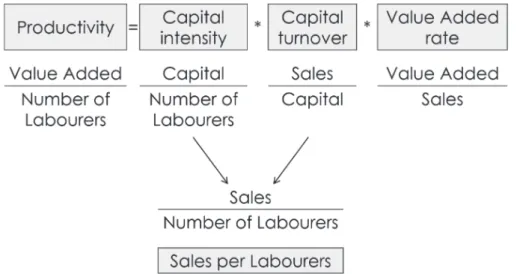
As seen in Figure 3, Tsujimoto (2016, pp.12-13) has cited a “Productivity Improvement Formula.”
Source: Tsujimoto (2016, pp.12-13) (modified by author)
Tsujimoto (2016, p.13) stated
“Even if capital is increased, if it does not lead to sales, productivity will not increase. Also, even if sales are increased, if Value Added does not increase, productivity will decrease. The balance of capital, sales, Value Added, and labour is important.”
Therefore, it is essential to focus on Value Added (along with other factors) in the discussion of labour productivity.
2.2. Revenue management
According to Kimes (2009, p.15), revenue management (in other words, yield management) “is about selling the right room at the right price at the right time.” Moreover, Huyton and Peters (1997, p.202) have explained revenue management using the case of airlines:
“In the case of an aircraft, once it has taken off, the revenue from unfilled seats is lost forever. The same is true of hotel rooms unsold on any given night. The basic concept is that during periods of high demand for hotel rooms the prices are set at the highest rate so as to maximize revenue. At times of lower demand, the rates are set so as to encourage occupancy.”
So, it could be said that revenue management is a method that service industries with limited capacity employ to maximize revenue (Aoki, 2006, p.147).
Figure 3: Productivity Improvement Formula This formula shows how labour productivity is structured.
Productivity
I
=
Capital * Capital * Value Addedintensity turnover rate Value Added Capital Sales Value Added
Number of Number of Capital Sales Labourers Labourers
¥ I
Sales Number of Labourers Sales per LabourersYOSHIOKA:Resolving Labour Productivity Challenges of the Japanese Lodging Industry 71
3
. Research design
Research conducted for this study was a kind of qualitative and theoretical research. The author conducted interviews to collect data. The volume of data collected, however, was small because only a few hotel companies cooperated. Due to this, the author was unable during research to collect sufficient data for statistical analysis. So, for this study, instead of statistical data analysis, simple simulations are conducted in accordance with previous research.
4
. Discussions
4.1. Limitations to cost reduction
It is well understood that there is a limit to cost reduction. According to the aforementioned formulas for calculating Value Added, it can be understood that cost reduction is not an effective means to increase Value Added.
For example, in the hotel industry (as well as in others), labour costs account for a large percentage of total cost. However, reducing labour costs has no impact on Value Added. As Figure 2 shows, with the addition method of the Bank of Japan and the Ministry of Finance, even if labour costs are reduced, it will increase operating income or net income. In addition, under the Japan Productivity Centre’s deduction method, only pre-payment costs are deducted and labour costs are irrelevant. Thus, labour cost reduction has no impact on Value Added.
Expenses that affect Value Added are primarily pre-payment costs. In other words, pre-payment costs are the Value Added created by other companies. To reduce these costs, it is necessary to negotiate or otherwise reduce purchase prices which can be difficult. From the foregoing discussion, it can be understood that focusing on cost reduction is not meaningless, but it has limitations.
4.2. Limitation of denominators reduction: labours and labour hours
In the formulas for calculating Labour Productivity, there is a limit to reduction of the denominator, that is, the reduction of the number of labourers and labour hours. This method is attracting particular attention in Japan recently. As mentioned above, various methods to solve the labour productivity issue are being considered by the government, government-related organizations, practitioners, think tanks, and companies in Japan. However, reducing the number of labourers and labour hours is likely to reduce service levels or service quality.
A luxury hotel in Japan, where the author stayed, provides an example for this research. In 2013, despite the fact that fresh orange juice was on the menu, the hotel served frozen orange juice. In addition, food ingredients differed from the descriptions on the menu.
The author stayed at this hotel the day after the hotel self-reported the incident. He had stayed at this hotel several times, but this was the first time that he had to unload his own luggage from the taxi. There was no bell staff at the front door. Just after the check-in procedure, he was asked to wait for a while. He
had to wait in the lobby for about 15 minutes. This was how the staff responded a day after the incident was reported - there was no bell staff at the entrance to help guests unload their luggage and there was nobody at the reception or lobby to welcome the guests.
In this case, the services that customers expected, for whatever reason, could not be provided. When a hotel is unable to provide the services that guests expect or that it has traditionally provided, it is a decline in the level of service. It can be said that the service level declines as the number of labourers decreases. It is clear that there is a limit to the number of labourers and labour hours can be reduced, and reductions beyond that limit can lead to low productivity and efficiency.
4.3. Increasing the numerator; sales or revenue
The previous discussions have shown that there is a limit to reducing costs as well as a limit to reducing the number of labourers and labour hours. In the formulas for calculating Value Added, the addition method of the Ministry of Finance and the Bank of Japan consists of the addition of costs and profit. However, the deduction method of the Japan Productivity Centre consists of revenue (sales) and the subtraction of pre-payment costs. A factor not considered in the previous discussions is revenue (sales).
Revenue is generally calculated by the formula: [unit price * quantity]. According to this formula, revenue can be increased by increasing unit price, quantity, or both. However, although this formula is simple, it is not easy to increase both the unit price and quantity. Consequently, this study focuses on how revenue can be increased to improve labour productivity. Since Value Added is one of the most important factors of labour productivity, this paper concentrates on how to increase Value Added, and it suggests that revenue management is an effective method for increasing Value Added.
4.4. Revenue management contributes to increasing the numerator
If the formula [unit price * quantity] is applied to the lodging business, it becomes [room unit price * number of rooms sold]. However, in lodgings such as hotels, the unit price often varies even for the same room. Hence, it is possible to change the selling price depending on the time of reservation, the sales channel, the time of stay, and the day of the week.
As described above, Revenue Management is the method of maximizing sales volume and maximizing revenue by changing sales prices and controlling sales channels. It is described using Figure
4 based on Aoki (2018, p.15).
Figure 4 shows the demand curve of guest rooms of a hotel (the demand curve is shown by a straight line for simplification). As seen in Figure 4, demand disappears when the price per room reaches $200, and all 150 rooms can be sold at a price of $50. In this case, how should the sales price be set?
If only one selling price is determined, the point at which the area of the rectangle indicated by [the price * the number of rooms sold] for sales is the largest is the sales price at which the largest revenue can be obtained. In other words, if this hotel sells its rooms for $100 each, then the revenue is maximized ($100 * 100 rooms = $10,000). However, if the selling price is set to a single point, two additional
YOSHIOKA:Resolving Labour Productivity Challenges of the Japanese Lodging Industry 73
opportunities for earning revenue are lost.
The first lost opportunity is the revenue from customers who are willing to pay a price higher than $100. A customer who can pay $150 to stay at this hotel will pay only $100. And for the hotel, that is a loss of $50 per such customer. As seen in Figure 4, it is the part of the rectangle named “A” which corresponds to $2,500 for 50 rooms. The second lost opportunity is the revenue from customers who will purchase for a price less than $100. There are guests who will purchase the room if the price is $75. But those guests may stay at another hotel or may decide not to book at all. This scenario, as seen in Figure
4, is the part of the rectangle named “B” which corresponds to $1,875 for 25 rooms.
Therefore, if the rooms are sold at three prices ($150, $100, $75) according to the sales opportunity (the time of reservation, or purchase) or the sales channel, an additional $4,375 of revenue can be earned than if the rooms are sold at only the single price of $100.
Thus, revenue management is an effective way to maximize revenue. It can aid in increasing Value Added as well. However, labour hours will also increase slightly as the number of rooms sold increases. In other words, the denominator in the labour productivity formula will also increase.2
As seen in the case of the first simulation presented in Figure 4, the number of rooms sold has increased by 25. Taking housekeeping work as an example, the incremental labour hours are assumed to be about 8 hours according to the experience of the author (housekeeping takes 20 minutes for a single labourer per room). For 100 rooms, the incremental labour is 33 hours, and in the case of 125 rooms, it is about 41 hours. This represents an increase of about 25% (similar to an increase in variable costs). Now, if only the sales of rooms sold at $75 are taken into account, revenue increased by $1,875 for the sale of
100 rooms̶an increase of about 19%. Of course, this reduces labour productivity.
However, taking into account the sales of rooms sold at $150, revenue increased by $4,375 for the sale of 100 rooms̶an increase of approximately 44%, which is larger than the increase in labour hours. This will certainly increase productivity. Therefore, considering the small increase in the denominator, it can be said that the increase in revenue from revenue management has certainly contributed to the
Source: Aoki (2018, p.15) (modified by author) Figure 4: Structure of Revenue Management
If a hotel sets different room prices, the hotel is able to capture more revenue.
Demand curve
o
f
guest rooms
(
S
t
r
a
i
g
h
t
l
i
n
e
f
o
r
s
i
m
p
l
i
c
i
t
y
)
. .
" " " ". . . . . .
. ,
. . . . . .
" ". . . .
••
. .
••
. .
│
5
0
7
5
←
a,.a-½,a
へへへ
〇 へ 勺S
o
l
d
rooms
improvement of labour productivity in the hotel industry. Figure 5 shows what will happen if the range of prices of room sales increases. In Figure 4, there is only one price over $100: $150. But in Figure 5, there are three prices over $100: $125, $150, and $175, rectangles labelled “D,”“A,” and “C.” In this case, the number of rooms sold does not change, only the total revenue is changed; it has increased by $1,250. This means that there is no increase in denominators, the number of labourers, or labour hours. As seen in Figure 5, this simulation shows that if the hotel implements revenue management well, it is effective in achieving a variation of room prices on the high price range to increase total revenue. This increase in revenue causes labour productivity to increase.
5
. Contribution and limitations of this study
The contribution of this study is to clarify the relation between the well-known concept of labour productivity and the theory of revenue management. Recently, productivity has been discussed not only in the manufacturing industry but also in the service industry, including the lodging industry. As for revenue management, in addition to Kimes (2009), Huyton and Peters (1997), and Aoki (2006, 2018) mentioned above, there are many previous studies.3 Moreover, labour productivity is a method already
utilized in the lodging industry. However, the author was unable to find prior research that links productivity discussions and revenue management theory.
By utilizing revenue management theory, hotels can increase not only labour productivity but also profit, and other indicators of business analysis such as return on assets and return on equity. However, this paper specifically focuses on increasing labour productivity in the lodging industry of Japan.
The author recognizes that this study has limitations. In this paper, statistical analysis and case studies are lacking. This is because the author was unable collect data on labour productivity in particular. The
Source: Aoki (2018, p.15) (modified by author) Figure 5: Structure of Revenue Management (elements added)
If a hotel sets different and higher room prices properly, the hotel can capture more revenue.
20
1
7
1
5
1
2
10
Demand curve
o
f
guest rooms
(
S
t
r
a
i
g
h
t
l
i
n
e
f
o
r
s
i
m
p
l
i
c
i
t
y
)
. .
" " :`·…•……•••
••
" O O.
.
.
`
. . . . . .
. . . . . .
. .
••
••
⋮。⋮、⋮⋮⋮. .
•
••
│
5
0
7
5
~/~^ウ心^~,<;)~old
rooms
ヘ
勺
YOSHIOKA:Resolving Labour Productivity Challenges of the Japanese Lodging Industry 75
author asked some companies in Japan to provide data, but has not to date been able to collect the data. In the future, the author would like to continue interviewing companies in order to collect data on labour productivity that is necessary to advance this research. It would then be possible to set up research designs and carry out statistical analysis.
6
. Results and conclusions
This paper demonstrates that companies operating in the lodging industry can improve labour productivity by utilizing revenue management. The low labour productivity of this industry in Japan is a major problem. The discussions on productivity of the service industry in Japan have focused on reducing costs, reducing the number of labourers, and reducing labour hours. However, this paper argues that the increase in revenue resulting from revenue management contributes to the increase of Value Added and the improvement of labour productivity.
The author hopes that the labour productivity of the lodging industry in Japan will improve and that labourers in this industry will be able to enjoy higher salaries and wages. Low salaries and wages in the hotel industry in Japan are another problem, but one strongly related to this research about productivity. In particular, Value Added is the source of allocation to stakeholders of companies, and an increase in Value Added contributes to an increase in salaries and wages, which can be considered as an allocation to employees, who are important stakeholders. The author would like to add this point of view in future studies. The author believes that this paper will serve as a basis for future research of this problem.
Acknowledgements
This work has been supported by JSPS KAKENHI Grant Numbers JP20H04445, The INOUE ENRYO Memorial Grant, TOYO University.
The author would like to thank Editage (www.editage.com) for English language editing.
Notes
1 In discussions that follow, the terms “numerator” and “denominator” are used, which mean the numerator and denominator in these formulas.
2 Changes in labour costs associated with changes in the number of labourers and labour hours do not affect Value Added. Taking the method of the Ministry of Finance and the Bank of Japan in Figure 2 as an example, Value Added is the total of Labour costs, operating profit, and other items.
3 E.g. Cross (1997), Talluri and van Ryzin (2004), Huefner (2015) etc. References
Aoki, A. (2006). Revenue management in capacity-constrained service industries: Integration of yield management with customer profitability analysis (Japanese), Business Review of Senshu University, (83), 147-165.
Aoki, A. (2018, April 2). What is Revenue Management - Sell at different rates for different customer groups. The Nikkei
(Morning newspaper), pp. 15.
Cross, R. (1997). Revenue management: Hard-Core tactics for market domination. New York, NY: Broadway Books. Huefner, R.J. (2015). Revenue Management: A Path to Increased Profits (2nd ed.). New York, NY: Business Expert
Press.
Huyton, J.R. and Peters, S.D. (1997). Application of Yield Management to the Hotel Industry, Yeoman, I. and Ingold, A. (ed). Yield Management: Strategies for Service Industries, 202-217. London: Cassel.
Japan Productivity Centre. (2019). International comparison of labour productivity 2019 (Japanese), Retrieved from https://www.jpc-net.jp/research/list/pdf/comparison_2019.pdf
Kajiura, A. (2016). (Chapter 4) Productivity components and the reality of Value Added Distribution, productivity improvement theory and practice (Japanese), Kajiura, A. (ed), Productivity improvement theory and practice (Japanese), 55-72. Tokyo: Chuo Keizai-sha.
Kimes, S.E. (2009). Hotel revenue management in an economic downturn: Results of an international study, Cornell
Hospitality Report, 9(12), 6-17.
Mizuno, I. (2019). Basic philosophy and purpose of new value added analysis. The Centre of Productivity Comprehensive Research (ed.), Value Added concept today for high Value Added management (Japanese), 4-20. Policy Research Institute, Ministry of Finance, Japan. (2015). Monthly Report of Financial Statistics (773) (Japanese),
Retrieved from https://www.mof.go.jp/pri/publication/zaikin_geppo/hyou/g774/774.htm.
SPRING. (2013). Toward New Development of Service Innovation Initiatives - Proposal book (Japanese), Retrieved from https://www.service-js.jp/modules/contents/?ACTION=content&content_id=348.
Stewart, S. and Johns, N. (1996). Total quality: An approach to managing productivity in the hotel industry, Johns, N. (ed.), Productivity Management in Hospitality and Tourism, 19-37. London: Cassell.
Talluri, K.T. and van Ryzin, G.J. (2004). The theory and practice of revenue management (International Series in Operations Research & Management Science). New York, NY: Springer.
Tsujimoto, K. (2016). (Chapter 1) Productivity and Management, Kajiura, A. (ed), Productivity improvement theory and
practice (Japanese), 2-22. Tokyo: Chuo Keizai-sha.
Yoshioka, T. (2019). Revenue Management that Contributes to Increasing Productivity on Hotel Businesses, The