ナノカルシウムを用いる複合汚染土壌の浄化技術
Decontamination of complex polluted soil using
nano-size calcium dispersing reagent
県立広島大学 三苫 好治
Dr. Yoshiharu Mitoma
Pref. Univ. of Hiroshima,
Hiroshima, Japan
研究背景(汚染の現状)
環境基準又は土壌汚染対策法の指定基準を
超える汚染が判明した事例は798件
(H25年度環境白書より)
増加傾向
*再開発・売却のために自主的な汚染調査が増加。
*地方公共団体の常時監視体制構築や関連条例の整備が進んだため。
有害物質とは? 複合汚染とは?
鉛,ふっ素,砒素などの重金属類,揮発性有機化合物(VOCs),あるいは
,残留性有機汚染物質(POPs)との複合汚染土壌についても報告あり.
土壌浄化は重要!
~長期的にはあらゆる汚染物質が土壌に沈着・濃縮のため~
研究の概要
ナノカルシウム(金属Ca/酸化Ca and/or 鉄
粉)
を用いて重金属類含有汚染土壌を常温常
圧下で迅速に
不溶化
あるいは
分離除去
する技
術を提供する。このプロセスは
全く廃水を出さ
ず
、必要に応じてワンポットで
POPsの脱塩素
化や放射性セシウム汚染土壌の同時除去も可
能
とする。
金属カルシウム(金属Ca):
<市販品あり>
- 粒子径: 2-2.5 mm
- 比表面積: 0.43-0.48 m
2/g
- 純度: 99% ⇒ 工業ベース 97%
~純度低ければ粉砕容易~
大気条件下でも取り扱いが容易.
• 表層は炭酸カルシウムで薄く覆われており,
それ以上,内部浸食をうけない.
活性の回復容易.
• 洗浄あるいは衝撃によって不活性な表層膜
の除去.
Ca
:
99.30
%
Mg
:
240 ppm
Fe
:
100 ppm
Al
:
40 ppm
Cu
:
80 ppm
Mn
:
90 ppm
金属カルシウムとは!?
大気条件下手法
土壌中PCBs濃度
初期濃度
(
m
g/g)
a,b
処理後濃度
金属Ca法:
Ca/Alcohol
c
1,300
ろ液
340
m
g/g
a
残渣
1.8
m
g/g
a
金属Ca触媒法:
Ca/Catalyst/
Alcohol
d
全 PCBs
c
0.62
m
g/g
a,e
全
co
-PCBs
c
34 ng/g
e,f
a
GC-ECD;
b5wt%含水土壌;
cCa:10mmol, EtOH: 10mL, 撹拌:24H, 室温;
dCa: 10mmol, 0.1gの5wt% Rh/C, EtOH:
10mL, 撹拌:24H, 室温;
eろ液及び残渣の合計;
fHRGC/HRMS.
コストが課題
(溶媒,触媒)
Y. Mitoma et al,
Chemosphere,
74, 968 (2009),
e.g.
for Soil Pollution
Y. Mitoma et al,
Environ. Sci. Technol.
, 43(15), 5952 (2009),
e.g.
for Chemoselectivity of Chlorobenzenes
これまでの取り組み(4) ~土壌処理~
Y. Mitoma et al,
Chemosphere,
83, 1326 (2011),
Cent. Eur. J. Chem
., 10(5), 1547(2011),
e.g.
for Fly Ash
フィールドテストへの
チャレンジ
狙う条件:
ナノカルシウムの調製と粒子径
金属カルシウムなど
99%, 粒径分布 2–2.5 mm, 表面積0.43–0.48 m2/g http://www.retsch.com遊星ボールミルに乾燥CaOを添加
条件
撹拌
600 rpm, 1h, Rot/Rev. = -1:2, 20個, 32g/SUS ball.
室温, Ar雰囲気, 乾燥CaO (825
oC, 2時間), Fe/Ca/CaO=2/2/5等
粉砕混合物(Ca/CaO)の
SEM写真:
2.80 mmol Ca/g-混合物
遊星ボールミル例 0 200000 400000 600000 800000 1000000 1200000 1400000 0 200 400 600 800 Concentration (particles/m l) Particle size (nm)Nano-Fe/Ca/CaO
⇒ Ca組成の考慮で
大型化容易
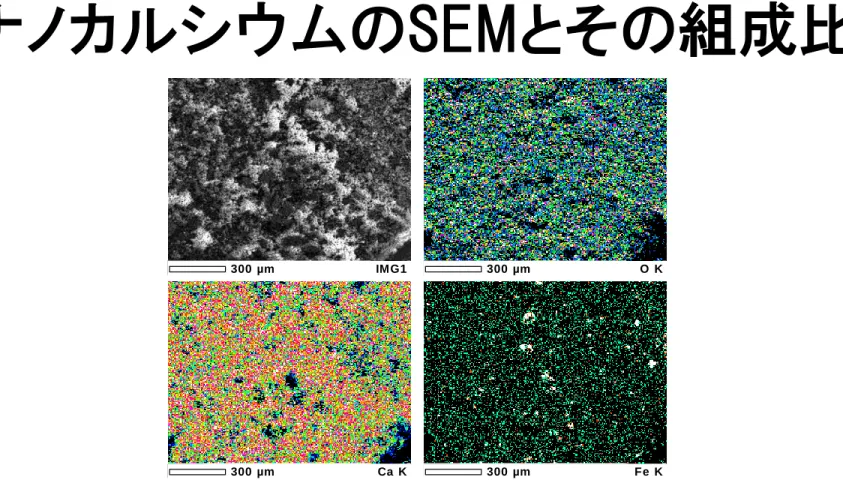
Element
Detection energy / keV
Mass / %
errors
O
0.525
33.41
0.63
Ca
3.690
62.71
0.41
Fe
6.398
3.88
1.27
Sum
-
100
100
Table Quantitative analysis of element composition by ZAF method
1ナノカルシウムのSEMとその組成比
IMG1 300 µm Ca K 300 µm O K 300 µm Fe K 300 µm 1Impressed voltage: 15kV< GC-QMS Analysis for PCBs> Components: JEOL JMSQ1000GC
Column: 30 m of SPELCO equity 5 column (i.d. 0.25 mm, Film Thickness 0.25 µm)
Ionization: 70 eV electron-impact (EI) GC programs::
- initial temperature of the column = 100°C (1 min), - T increase 1 = 30oC/min to 160°C
- T increase 2 = 4oC/min to 250°C
- T increase 3 = 20oC/min to 300°C.
- final temperature of the column = 300°C (2 min).
Assignment of structures was performed through a search of the GC-MS library.
Labotec Co. in Hiroshima
ナノサイズのCa混合物
<GC Analysis for PCBs>
Components: GC-14B; Shimadzu Co. Column : 2 m, i.d. 3.0 mm,
Column Packing:OV-17, 2% Chromosorb WAW DMCS 80/100). Detector: ECD (63Ni 370MBq, 10mCi; cell current, 0.05 nA).
GC program: initial temperature of column = 205°C (220 kPa). The injection was performed in a splitless mode.
The carrier gas was N2. Temperatures of the injection port and detector were 230°C and 250°C, respectively. Standard: a mixture of Kanechlors (300, 400, 500, KC-600=1:1:1:1)
<HRGC-HRMS> analysis according to JIS K 0312-1999 standard.
Environmental Technology Co. in Tokyo.
複合汚染土壌 (9g)
条件 (乾式開放系)
撹拌
マグネティックスターラ―: 100rpm
室温, 1時間~
24時間
,
10 日間 (放置),
土壌/Ca-CaO etc =1/0.05~
0.11
, 大気中
aq
. HCl と エタノール
Mortar Machine
反応停止
8複合汚染土壌の無害化
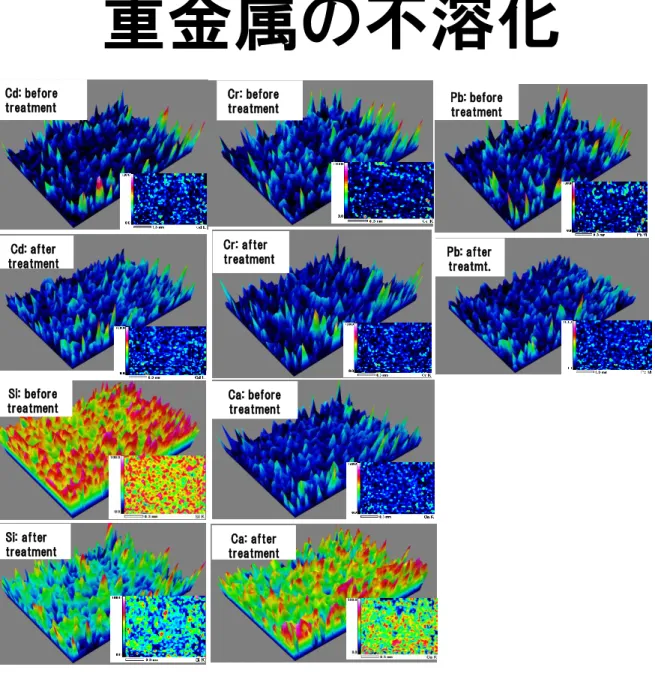
重金属の不溶化
Cd: before treatment Cd: after treatment Cr: before treatment Cr: after treatment Pb: before treatment Pb: after treatmt. Si: before treatment Si: after treatment Ca: after treatment Ca: before treatmentFig. SEM-EDS 3D element maps of heavy metal contaminated soils before
and after nanometallic Ca/CaO treatment.
土壌種
aと処理区
重金属類の濃度 (mg/L)
As
Cd
Cr
Pb
砂
状
土
壌
土壌中重金属類の初期濃度
1.147
1.425
1.214
0.952
溶出量
撹拌のみ
0.232
0.240
0.238
0.202
Fe-nCa処理
0.008
0.002
0.006
0.002
磁着分
b0.007
0.002
0.005
0.005
残渣分
c0.001
0.000
0.002
0.002
粘
土
土壌中重金属類の初期濃度
0.690
0.711
1.402
0.787
溶出量
撹拌のみ
0.102
0.127
0.193
0.149
Fe-nCa処理
0.006
0.008
0.005
0.009
磁着分
b0.002
0.006
0.002
0.005
残渣分
c0.007
0.000
0.001
0.001
a用いた土壌は,砂状土壌,粘土,畑土であり,その組成や粒度分布の情報は参考論文8を引用.
b土壌微粒子(約100µm以下),
c比較的大きい粒子(100µmより大きい粒子).
ナノカルシウムによる重金属類汚染土壌の
分離除去と不溶化(1)
土壌種
aと処理区
重金属類の濃度 (mg/L)
As
Cd
Cr
Pb
畑
土
土壌中重金属類の初期濃度
0.925
0.780
1.666
0.925
溶出量
撹拌のみ
0.194
0.140
0.193
0.202
Fe-nCa処理
0.011
0.010
0.015
0.011
磁着分
b0.008
0.007
0.002
0.009
残渣分
c0.001
0.000
0.001
0.001
a用いた土壌は,砂状土壌,粘土,畑土であり,その組成や粒度分布の情報は参考論文8を引用.
b土壌微粒子(約100µm以下),
c比較的大きい粒子(100µmより大きい粒子).
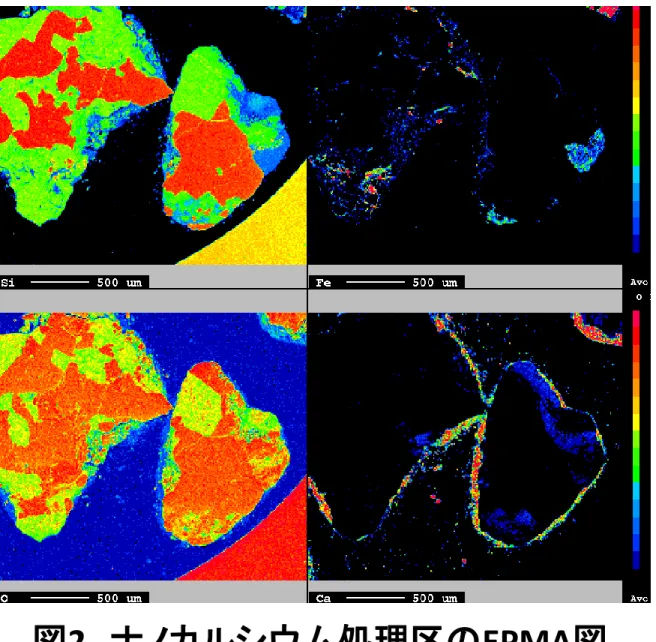
高濃度区画となる約100µm以下の土壌量は全体の30~
40%程度となり,全重金属量の85~95wt%が上記画分内に
濃縮分離された.
同時に各画分の溶出試験を行うと,カルシウム系被膜形成
の効果により,高度に不溶化されていることを明らかにした.
ナノカルシウムによる重金属類汚染土壌の
分離除去と不溶化(2)
図2 ナノカルシウム処理区のEPMA図
nCaによる土壌中POPsの常温乾式分解
Entry 汚染物質
処理条件
a
初期濃度
/ 全量
処理後濃度
/ 全量
分解率
(%)
撹拌
水分 (%
b)
1
PCDDs
c乳鉢
d1.00
19,600 pg
1,660 pg 91.5
2
PCDFs
e乳鉢
d1.00
23,100 pg
227 pg 99.0
3
4.36
5,930 pg 74.3
4
9.61
8,920 pg 61.4
5
PCBs
乳鉢
d1.00
2,850
m
g
34.0
m
g 98.8
6
5.00
1.06
m
g
0.0380
m
g 96.2
7
1.00
21,000
m
g
1.40
m
g 99.9
8
Co-PCBs
f乳鉢
d1.00
9,000 pg
252 pg 97.2
9
PCBs
ドラム
g1.00
1.06
m
g
0.391
m
g 63.1
a処理土壌中の金属Ca成分:1.12 wt%,
b土壌水分量:wt%,
cPCDDsとは,2,3,7,8-TeCDD,1,2,3,7,8-PeCDD,
1,2,3,4,7,8-HxCDD,1,2,3,6,7,8-HxCDD,1,2,3,7,8,9-HxCDD,1,2,3,4,6,7,8-HpCDD,及びOCDD,
d100 rpm, 24 h
撹拌,
ePCDFsとは,2,3,7,8-TeCDF,1,2,3,7,8-PeCDF,2,3,4,7,8-PeCDF,1,2,3,4,7,8-HxCDF,1,2,3,6,7,8-HxCDF,
1,2,3,7,8,9-HxCDF,2,3,4,6,7,8-HxCDF,1,2,3,4,6,7,8-HpCDF,1,2,3,4,7,8,9-HpCDF,及びOCDF.
f全coplanar
PCBs,
g60 rpm, 24 h 粉砕ボールを加えずにドラムのみ撹拌.
γ‐HCHの脱塩素化反応
エントリー
還元剤
土壌水分率 %
分解率 %
1週間後
3週間後
1
Fe-Ca/CaO
2
100
-
2
Fe-Ca/CaO
8
93.6
93.7
3
Fe-Ca/CaO
18
86.0
91.1
4
Fe-Ca/CaO
24
65.6
86.4
5
Ca/CaO
8
73.9
88.4
6
Ca/CaO
24
27.3
30.0
7
Fe/CaO
24
37.5
38.3
8
CaO
2 ~24
No reaction
No reaction
1) Decomposition conditions: 1g of Ca/CaO(11.9%Ca in total weight, 2.80mmol); 9g of polluted soil; 10 minute stirring; room temperature; atmospherically-exposed system (Dry open system), The treated samples were kept in dark and cooling place.
2) GC/MS analysis.
3) Decomp. ratio=[Init. conc.-Treated conc.]/Init.conc.×100
Ca/CaOによる分解率は土壌水分率の増加とともに徐々に減少した。
反応機構(POPs分解と重金属類不溶化)
Enlarged view of nCa
→ secondary particles, I.D. ~100 nm
1.
Spreading
of powder
(I.D~ 100 nm)
to the surface of soil particles
2.
Hydrodechlorination
in soil with containing moisture
3. Deactivated surface
on nCa with excess moisture
→
Renewal
of activated surface
Dioxin-like compounds Polluted soil
It includes moisture
Enlarged view of Fe-nCa
→ secondary particles, I.D. ~100 nm
Deactivated surface on nCa
Activated surface on Fe from nCa It is reaction point !
Very sensitive for much moisture… Improvement ! New idea !
nCa:
The metal surface must be renewed at periodic intervals. The breaking of a piece of the aggregate creates a new surface to react with gap moisture in soil.
In all cases, multi-chlorine substituted types can easily be reduced to lower-chlorine substituted types. It implies the mechanism by electron transfer.
Fe-nCa:
The iron acts as a conducting wire from inside to the surface. In alkaline conditions with calcium additives, iron is resistant to water.
応用例(1)~PCB油の直接処理~
1. 高分解率.
2. Ni-nCa処理では溶媒不要.
→投入エネルギー最小化へ
Entry
PCBs
Reaction conditions
Reagent
Reac.
aConc.
Decomp. / %
bSolvent
Temp.
(ºC)
Time
(h)
Reducing A. Catalyst
1
KC-400, 1mL
EtOH /
10 mL
rt
24
Ca, 0.4 g
(10 mmol)none
OG
99.97
2
80
2
99.997
3
KC-400
transformer oil
c,
55 mL
EtOH
40 mL +
2-PrOH
10 mL
40
24
Ca, 0.4 g
(10 mmol)Rh/C
d,
0.1 g
PRSUS
89.2
(0.13 ppm)
4
nCa, 15 g
(42 mmol Ca)
none
PRSUS
99.1
(0.011 ppm)
5
none
180
2
Ni-nCa,
18 g
Ni
eC
74.2
(0.31 ppm)
aOG:Open glass reactor, PRG:Pressure tight glass reactos (38 mL), PRSUS:SUS reactor (85 mL~ 135 mL),C:colume-type
reactor,bTotal PCBs concentration by GC/MS after separation of alcohols, cKC-400 in transformer oil (1.2 ppm), dRhodium on carbon (5 wt%), e0.1 wt% of Ni to nCa (nano-calcium).