Solvent Extraction — ICP Atomic Emission Spectrometry on Determination of Trace Heavy Metal Elements in
Macro-component Calcium
Osamu Fujino,
Hiroaki Fukui and MasahiroKitatuji Research Institute for
Science and Technology,Kowakae, Higashi-Osaka 577-8502,
Kinki University, Japan
(Received, November 29, 2004)
Abstract
Determination of manganese, iron, zinc and copper in macro-component calcium such as shell and pearl was examined using solvent extraction — ICP atomic emission spectrometry. Spectral interference and negative interference for these elements were existed simultaneously. Therefore, these elements tried on the method for separating from the solution including the macro-component calcium ion by the solvent extraction method. Sodium diethyldithiocarbamate was used as a chelating reagent, and hexyl acetate was selected as an organic solvent. These elements were quantitatively extracted over pH 6, and could be separated from macro-component calcium.
Keywords: ICP-AES, shell, calcium, solvent extraction, trace heavy metal elements
1. Introduction
The main inorganic component in hard tissues of the living body is calcium phosphate for bones and teeth 1' 2 and calcium carbonate for coral, shell and pearl3. From an geo-chemical and circumstance chemical viewpoint, the content and distribution of micro-component elements (Mn, Fe, Cu, Zn) in these samples which contained a large quantity of calcium as the macro-component are important 4' 5. However, few studies on these elements have been reported.
In this research, using ICP-AES, we examined about analytical the method in determination of the these elements in solution of a large of
calcium. As a result, it became clear that these elements interfered by macro-component calcium6. Therefore, in order to establish a highly
sensitive and precise quantitative analysis method for the determination of these elements, the combination of the ICP-AES measurement system and the solvent extraction separation method using chelating agent of diethyl- dithiocarbamate (DDTC) and hexyl acetate as the extraction organic solvents has dissolves in water less easily, and does not extinguish plasma
flames have been examined.
2. Experimental
The ICP emission spectrometer employed was a Japan Janel-Ash Model 575 - ICAP with a 0.75 focal length Czerny - Turner type, holographic grating, 1800 grooves per mm, and a cross-flow type nebulizer. Slit widths are:
entrance 10[tm and exit 10 µm. The RF power is supplied by a 27 MHz generator.
Standard stock solutions (1 mg/ml) of the elements (Mn, Fe, Cu, Zn) except for calcium
3. Result and Discussion
3.1. Effect of a large amount of coexisting calcium for detected elements
The calcium component of shells and pearl were 103 to 105 times greater than other detected elements (Mn, Fe, Cu, Zn). The effect of coexisting calcium at concentrations of 0.1 to 100 mg/ml for 0.1 or 1ppm these 4 elements was studied. On these results, the intensity of copper increased at a higher concentration of calcium ions 6. The intensity of manganese, iron and zinc decreased when the concentration of calcium becames 104 fold or greater 6. From these results above, it was required to separate detected elements from the macro-component calcium prior to the measurement to enable precise quantification with ICP-AES. For this purpose, the solvent extraction method was adopted and the various examinations described below have been carried out.
3.2. Solvent Extraction for detected elements 3.2.1. Selection of the extraction reagent and organic solvent
The stable chelate was formed for detected element in order to separate the element from a large of calcium using the solvent extraction method, and chelating reagent, which were hard to react for calcium were necessary. Therefore, sodium diethyldithiocarbamate (DDTC), which could suit this purpose as a chelating reagent
should be used.
Some organic solvents extinguish plasma flame or cause adhesion of carbon deposits to the plasma torch. Here, esters in which extraction
were urchased from Nakarai Tesque Co. and were diluted as required. The standard solution for calcium was prepared by dissolving calcium carbonate in concentrated hydrochloric acid. The calcium carbonate used was superpure material from Aldrich Chemical Co. All other solvents and reagents were of reagent-grade or super pure materials and were used without further purification.
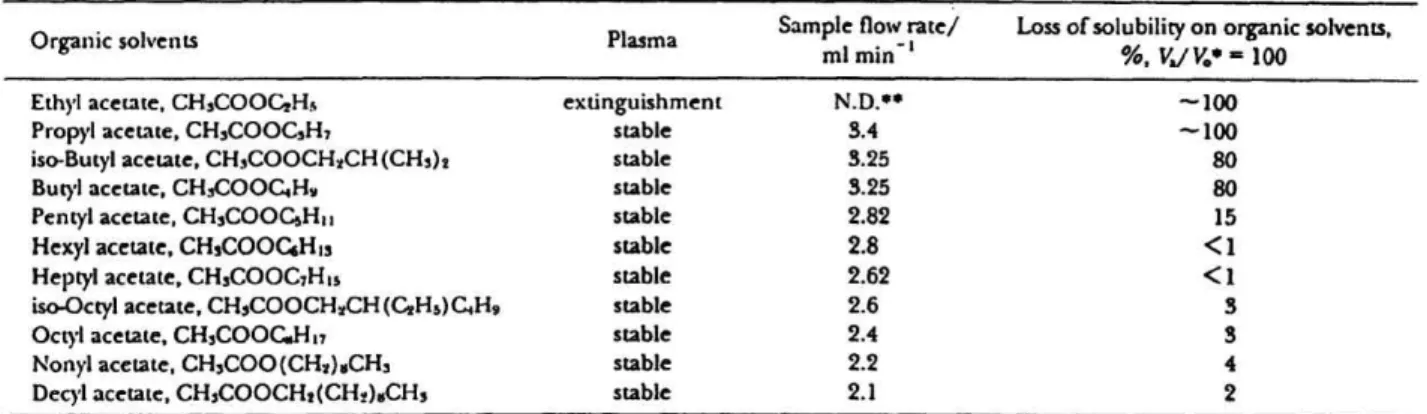
effect of metal ions seemed to be high from many organic solvents was chosen. Detailed examination was carried out on the suitability of the chosen esters to ICP. The results are shown in Table 1. When the plasma, which contained O2 for argon to 5 % was used, the organic solvents which had 5 or more carbons proved to be suitable for direct injection to the ICP-AES.
However, when the number of carbon are excessive, the viscosity becomes higher and the suction speed of the sample into the instrument slower. When the organic solvent over butyl acetate was introduced in ICP throughout long time, the adhesion of the carbon to torch was at generated. However, propyl acetate and butyl acetate are easy to be dissolved in the water. This is improper, when ions in the natural water are concentrated. For these, it was shown that organic solvent with carbon number over hexyl acetate was very hard to dissolve in the water, when volume ratios of water layer (Va) vs.
organic layer (Vo) were 100 times. However, the viscosity rapidly increased over nonyl acetate, and the nebulizer became easy to be stuffed up.
From the above result, 3 kinds of acetate were optimum as extraction organic solvent of this system.
3.2.2. Effect of various organic solvents of esters on the extraction efficiency of Mn
The effect of pH on the extraction of manganese into hexyl acetate, heptyl acetate and octyl acetate containing 4 x 10⁻³mol / L-DDTC was examined. The results are shown in Fig.1, where the volume ratio (Va/Vo) was set to 1.
Extraction efficiency (E,%) was calculated from
the equation(1) of the following.
E(%)=Dx 100/(D + Va/Vo) (1) where D is the distribution ratio. The difference for extraction behavior of manganese between 3 kinds of organic solvents examined here was quantitatively extracted at pH6 without recognizing. Therefore, for future experiment, the viscosity was lowed, it was hard to dissolve in the water, and it was cheap, and hexyl acetate with the high purity was used.
PM
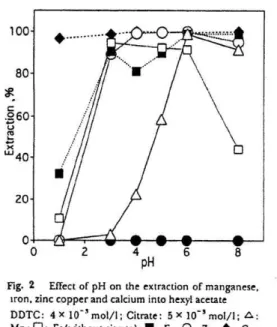
Fig. 2 Effect of pH on the extraction of manganese, iron, zinc copper and calcium into hexyl acetate DDTC: 4 X 10⁻³ mol/1; Citrate: 5 X 10⁻³ mo1/1; G:
Mn; 0: Fe(without citrate); ^: Fe; 0: Zn; •: Cu;
• : Ca
Fig. 1 Effect of pH on the extraction of manganese on esters
DDTC: 4 X 10⁻³ mo1/1; Citrate: 5 X 10-' mo1/1; A:
hexyl acetate; A : heptyl acetate; 0: octyl acetate
acetate were examined. The extraction behavior when DDTC concentration was in the range from 10-4 to 10-1 mol/L was examined. The results are shown in Fig.3. Though it was shown that the DDTC concentration necessary for the separation with calcium differed by the element, 4x10⁻³ mol /L were necessary in order to separate simultaneously 4 elements from calcium.
3.2.3. Effect of pH on the extraction of Fe, Cu, Zn and Mn into hexyl acetate
Effect of pH on the extraction of manganese, iron, zinc, copper and calcium into hexyl acetate were examined. The result is shown in Fig.2, where extraction efficiencies of these elements were plotted against pH. These elements was quantitatively extracted at pH6, and not completely extracted calcium. These results showed that the separation of specified elements could be sufficiently carried out from the calcium at pH6.
3.2.4. Effect of DDTC concentrations on the extraction of Fe, Cu, Zn and Mn into hexyl acetate
Effect of DDTC concentrations on the extraction of Fe, Cu, Zn and Mn ions into hexyl
U.UUU I U.UU I U.0 1 U.1 1 Concentration of DDTC / mot I' Fig. 3 Effect of DDTC concentrations on the extrac- tion of manganese, iron, zinc and copper into hexyl acetate at pH 6
Citrate: 5 X 10-' mo1/1; A: Mn; •: Fe; 0: Zn; •:
Cu
L3. Determination of Fe, Cu, Zn and he synthetic shell sample solution ,olvent extraction method
Mn by
in the
Calcium ions severely interfered with the determination of Mn, Fe, Zn and Cu in a large of calcium solution. Therefore, we used solvent extraction method mentioned above as separation processing method before the measurement.
Synthetic shell sample solution including 75, 10, 0.7 and 1 ppm of Mn, Fe, Zn,Cu for a large of Ca(10mg/ml) were determined by ICP-AES using this solvent extraction method. As a result, the value in measuring Mn, Fe, Cu, Zn to five times was 75.4±5.4, 10.3±0.06, 0.75±0.05,
1.06±0.06, respectively. Like this, theoretical value and measured value of four elements agreed well under the existence of a large of calcium.
Therefore, it became clear that this solvent extraction method was excellent as pretreatment method at the ICP-AES of trace Mn, Fe, Cu and Zn ions in hard tissue of the organism which made the calcium like shell and bone to be main component.
Table 1 Stability of the plasma against the organic solvents on esters
Organic solvents Plasma Sample flow rate/
ml min-1
Loss of solubility on organic solvents,
%, V,/ V,* = 100 Ethyl acetate, CH,CO005Hs
Propyl acetate, CH,COOC,H,
iso-Butyl acetate, CH,COOCHYCH(CH3)s Butyl acetate, CH,COOC4H9
Pentyl acetate, CH,COOC,H,, Hexyl acetate, CH,COOC6H„
Heptyl acetate, CH,COOC,H,s
iso-Octyl acetate, CH,COOCH„ CH (C„H5) C4H9 Octyl acetate, CH,COOCmH„
Nonyl acetate, CH,COO (CH,r),CH, Decyl acetate, CH,COOCH,(CH:),,CH,
extinguishment stable
stable stable stable stable stable stable stable stable stable
N.D.**
3.4 3.25 3.25 2.82 2.8 2.62 2.6 2.4 2.2 2.1
—100
—100 80 80 15
<1 <1 3 3 4 2 Measuring condition : carrier gas flow rate, 0.501/min ; RF power, 2.0 kW; Ar( + 5% 02), 0.201/min.
times of aqueous and organic phases, respectivity. ** No data
* V, and V. are the total vol-
References
1. M.Okazaki, Phosphorus Letter, 24, 3 (1995).
2. D.McConnell, "Apatite", Springer-Verlag,
New York (1973).
3. Y.Kitano, "Geochemistry of the the Carbonate Sedimen", Tokaidaigaku-
shupankai, Tokyo(1990).
4. H.Haraguti, "The Principles of Bio-inorganic
Chemistry" , Maruzen, Tokyo(1992).
5. S.Kayano, H.Saito, "Heavy Metal and Biology", Hakuyusha, (1988).
6. Osamu Fujino, Kazuhiro Orimi, Takeshi Kotani, "Fundamental Examination in
Determination of Macro- and Micro-
component Elements in Shell Sample by
ICP-AES", Bull. Res. Inst. Sci. Tech, Kinki Univ., No.12, 21(2000).
7. Zeev B.Alfassi. Chien M.Wai,
"Preconcentration for Techniques Trace Elements", CRC Press, Boca Raton, (1992).