Determination of Uranium in Apatite Minerals by Solvent Extraction - Inductively Coupled
Plasma Atomic Emission E)pectrometry
Osamu Fujino*, Atsushi Shi1na** and Shiro Goda**
*Research Institute for Science and Technology,
J(inki University, J( owakae, Iiigashi-Osaka, Osaka 577, Japan
** Deparl7nent of Chen"istry, Faculty of Science and Technology, J(inki University
(Received Nove1nber 21, 1£192)
Abstract
Solvent. extraction - ICP at.olllic emission spectrometry was applied to the determination of uranium in apatite minerals.
Apatite minerals were treated wit.h nitric acid. Aft.er removing a small quantity of insol- uble residue, uranium was extract.cd wit.h 0.05 mol/dm3 1-phenyl-3-met.hyl-4-t.riftuoroacetyl-5- pyrazolone- diisobntyl ketone at. pH 0.8.
The uranium content. in the apat.it.e was found to be (20.3 "" 132.9) x 10-4%.
Key words: Uranium, apat.it.c mineral, solvcut. cxt.ract.ion, ICP-AES.
1 Introduction
Several ppb of uranium IS fonud iu natu- ral water, several ppm in rocks and it is dis- tributed widely by sparsely in other uatnral sam- ples. In addition, uraininm is an radioactive el- ement which exists in nature and is chemically a very interesting element.. Dccansc compara- tively large quantities of nrainium arc found in apatite minerals 1 l containing calcium phospat.e as its macro-component and approximately 1%
of nue earth elenH'nts, the authors arc inter- ested in the distribution behavior of this uranium.
To establish a trace and highly precise quantita-
2 Experimental
2.1 Apparatus and reagents
The inslnunentation used was a Japan .Jarrell- Ash mofkl 575 indurtiwly-cnupl"d plasma emis-
t.ive method for uranium, we adopted the induc- tively coupled plasma atomic emission spectrome- try (ICP-AES) method, utilized in many fields as t.he system of measurement and the solvent extrac- tion separation method using l-phenyl-3-methyl- 4-trifluoroacetyl-5-pyrazolone(HPMTFP)2l - eli- isobutyl ketone (hereafter abbreviated as DIBK) system for pre-processing, and then we examined these in detaiL As a result, it wa-, proved to be an cxt.rcmely superior quantitative method for evalu- ation of urainium in apatite minerals.
sion spectronH't.er, wit.h a 0. 75-m focal length Czerny-Turner type, holographic grating, 1800 groovesfmm, a noss-fiow type nebulizer. Slit-
Table 1: Operatiug conditions for measnremeuts Plasma
RF power(k\V) Carrier gas( Kg/ cmh) Plasma gas(l/min) Coolant gas(l/min) 0 bservat.ion height( nun)
\Vawl<'ngth( mn)
\vidths were entrance 10fllll and exit 10ftlll. The RF-power supplied by 271\Hiz geucrator.
Stock solution of the maninm aud rare earth clements were prepared by dissolving U02(N03)2·6H20 and their pure oxides (!:>9.99"' 99.!)!)9!)%) in hot concentrated nitric acid.
HPiviTFP was synthesized according to .Jensen's method:!). All other solvents and reagents were reagent-grade or superpurc materials and \Vere used without further purification.
2.2 Procedure
Apatite minerals were dissoln·d with hot cotwru- trated nitric acid. Therefore, 1g of powdered sam pic in a covered 100 ml beak<'r wns he a ted with 10 ml of concentrated uitric acid on a hot
3 Results and Discussion
3.1 The optimtun 1neasuring con- ditions and calibration curves
\Ve examined the influence of nF power, flow rate of carrier, coolant and plasma gas on the emis-
\Vater Organic solvents 1.3 2.0
1.5 1.3 0.8 1.6 12.8 20.0 14.5 18.0 385.96 263.55
plate at 200"' 300°C for 30"' 60miu. After cool- iug, the sample was diluted with pure water, passed through a filter paper(No.5c) to remove any residue and then diluted to 100ml(10mg sam- plc/ml) with pure water.
20"' 50ml(apatit.e 0.2"" 0.5g) of the apatite mineral sample solution was placed in a sepa- ratory funnel, the pH was adjusted to 1. To the funnel 10ml of diisobutyl ketone containing HPMTFP(0.05 mol/dm3) was added, the mixture was shaken for 1 ()"' 20 minutes. The organic phase was transferred into centrifuge tube ami centrifu- gally separated.
The organic phase obtained was injected di- rectly iuto ICP nuder the operating conditions in Tahlcl.
the aqueous solution. A fairly linear caliblat.ion cmTe was obtained in the range of 0.5"' 50 ppm of the concentration of uranium.
sion intensity of nrainium in au aqu<'ons solution
3.2 Effect of coexisting salts
and DIDK and its distribution in a plasma flame.
The optimum 1neasming conditions based ou the results are shown in Table 1. U mlcr these nwa- sming conditions, detection limit of uranium in DIDK was 0.05 ppm and their reproducibility was 0.1 "'0.2 %, which is highly precise. In the case of DIDK, to preYent extinguishing of the fiamc and adhesion of carbon to a container, the output of flF power wns set at 2 k\Y. Scusitivity aud repro- ducibility \Vcre almost the same as in the case of
Interference of coexisting elements and selectivity of wavelength
To mea.5ure t.he emission intensity of uranium by the ICP-AES method, it is necessary to use a wavelength \vhich is highly sensitive \Vith interfer- ence by coexisting clements very low. Here we se- lected some types of wavelength meeting the above conditions based on previously announced data:1>.
The emission intensity of the elements ex-
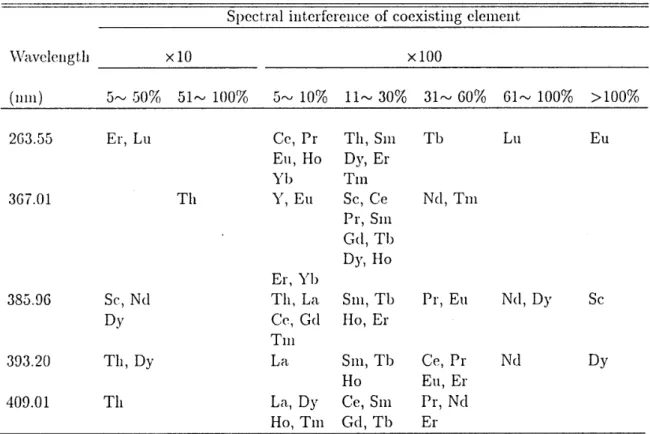
pected t.o be couta.inecl in minera.ll'l at. a level higher than 0.01% were measured and the elements which were likely to interfere a.ud their degrees of inter- ference arc shown in the Table 2. It shows that most clements will interfere with urauium, if they coexist 10 or more times as mnd1 as uranium.
However, quantities of each of these elements in minerals were less than the equivalent of urainium, and so we did not have to consider the interference with respect to these coexisting clements.
Hov,:ever apatite minerals contained tens of thousands times as much calcium phosphate, a macro component, as uranium. Here, there- fore, we examined the effects in detail in respect to v,ravclcngths 263.55, 36/.01, 385.06, 303.20 and 409.01nm whose emission inteilsity is strong.
Among these, a result of wavelength 263.55nm is shown in Fig.l. Spectral interference by calcium within the macro component and negative inter- ference by the macro component existed simnlt.a- neously. In addition to this, it shows that. their interfcreuce iucreascd iu accordauce with the in- crease in their concentration. I3ccause this nega- tive interference shows the same phenonH'noll in every wavelength, it is assumed that almormality in temperature or form of plasma flame aud/or the change in distribution of uranium in a plasma flame arc caused by a high concentration compo- nent. Spectral in t.erfcrcnce by calcium also ex- isted in every wavelength examined and shO\vcd a virtually similar tendency ct.<; Fig. 1. However, a considerable difference in degree of spectral in- terference among wavelengths WRS noticed, espe- cially iu the cctse of wavclC'ngth 303.20 nm, whNe tens of times of spectral interference with emission int.cusity of ura.uium(10 ppm) was ~hown, when calcium,a macro component. coexisted 1000 times.
From the above results, in order to quantify ura- nimn by the ICP-AES it \Vas necessary to separate uranium from a macro component. before mea- suring. For that purpose, the solvent extraction method was adopted, as mentioned in the intro- duction, and various examinations shown belO\v were cmricd out..
3.3 Solvent Extraction
3.3.1 Selection of chelate reagent
A samplc solution of apatite minerals used in this research \vcre treated \Vit.h hot conceutrated ni-
tric ariel. If the pH of the solution becomes higher than 1.5, precipitate of phosphate will develop and the extraction of uranium will be- come difficult. Therefore, it is desirable to use a reagent in which uranium is quantitatively ex- tracted from its solution with 0.1 mol/dm3 or more acid concentrations, developing no precipi- tation, and separation from interfering elements is possible. In this regard, the chelating reagent, 4-Acyl-5-Pyrazolones (pKa:3"" 4) is easy to dis- sociate and has a large hydrophobic component, and so it has merits such as high distribution ratio to the organic phase of metal chelate. In addition, it is a very stable compound and easy to syuthesi7:e. Moreover 1-phenyl..:3-mcthyl-4-tri- fluoroacetyl-5-pyrazolone(pKa:2.7) (hereafter ab- breviated as HPMTFP), to which radical fluorine is introduced, has very large dissociation, and it is possible to coiHluct quantitative extraction of nrainimn at th(~ strong acid side. Therefore we decided to usc HPl\ITFP here.
3.3.2 Applicability of various solvents to plasma. flame
Some solvents extinguish plasma or cause the ad- hesion of carbon to a plasma torch. As a result of detailed examination by t.he authors5l, organic solveuts, which has 8 "" 9 or more of number of carbon, proved to be most suitable.
However, if the quantity of mimber of carbon is excessive, the viscosity will be higher and suc- tion speed of the sample into an introduction in- stnuncnt will be slo\\·er. \Ve therefore selected DII3K(CgH180), dibut.yl ether (C8Hn;O), n-decane ( C10H22) and cyclooct.ane( C8Hw) having 8 "" 10 of number of carbon from system ketone, ether, alkane and cycloalkane, and we examined their combustion behavior in plasllla flame. As a result, none of the soh-cuts caused either extinguishing of plasma flames or the adhesion of carbon to the plctsma torch, described above. \Ve cxctmined into background accompanying the emission of organic solvents in the wavelengths described in 3.2. The result is that. ten tim<"s or more of backgrouud ex- isted in wavelength 409.01 and 389.56nm as com- pared with other \Vavelcngths. However, other 3 types of wavelength had less background than wa- ter.
Table 2: Spectral interference of coexisting clement on determination of uranium in apatite minerals Spectral interference of coexisting clement
\Vavelcugt.h xlO xlOO
( lllll) 5.-v 50% 51"-' 100% 5"-' 10% llrv 30% 31.-v GO% 6lrv 100% >100%
263.55 Er, Lu Cc, Pr Th, Sm Tb Lu Eu
En, Ho Dy, Er
Yb Tm
367.01 Th Y,Eu Sc, Ce Ncl, Tm
Pr, Sm Gd, Tb Dy,Ho Er, Yb
385.96 Sc, Ncl Th, La Sm,TL Pr, Eu Nd,Dy Sc
Dy Cc, Gel Ho, Er
Tm
393.20 Th,Dy La. Sm,Tb Ce, Pr Nd Dy
Ho Eu, Er
409.01 Th La, Dy Ce, Sm Pr, Ncl
Ho, Tm Gel, Tb Er
Table. 3 Dct.rnninat.ion of uranium in apatite minerals.
Sample Sample weight Uranium found Uranium in sample
( mg) (p.g) (lo-4%)
Apatite 200 20.73 103.1
(USA)
Apatite II 3.98 20.3
(China)
Apatite II 4.23 21.06
(Vietnam)
ApaJite II 16.19 80.92
( .J or clan) Apatite
"
28.23 132.9(Israel)
Apatite II 22.04 107.4
(Morocco)
~
c:
-
0 CJ nl...
50-
)(w
Ul c:
....
Ql c:c:
0 Ul Ul
w E
I I I I I
0.1 1 10 100
Ca10(P04)6(0H)2, mg/ml
Fig.l: Effect of synthetic hydroxyapatite concentrations on ura.n.[um emission intensity.
(l)e: Apatite alone. (2)0: U+Apatitc,(3).6: (2)-(1)
Fig.2 Extraction efficiencies of uranmm with HPMTFP in various organic solvents. Cl : n- Butyl ether, 0: DIBK,
0:
Butyl acetate, A.: Cy- clooctanc, ~: n-Dccane, U: lOppm, HPI\ITFP:0.05mol/dm3, Ya/Vo=l
>
-
C/1 cGl
i:
.2 c
ell
·e
ellw
0 5 10 15 20
Ca10(P04)6(0H)2, mglm!
Fig.3 Extraction efficiencies of uranium in syn- thetic apatite solution with HPMTFP in various organic solvents. 0: DIBK, A: n-Butyl ether,
0:
Butyl acetate U: lppm, 1-IPMTFP: 0.05mol/dm3 ,
Va/Vo=2
3.3.3 Extraction behavior of uranium us- 3.3.4 Extraction behavior of uranium ing various solvents. from synthetic apatite mineral solu-
tion Based 011 the results of above, we cxamiHccl ex-
traction behavior of uranium at 0.05 mol/clm3, in which concentration of HPMTFP is close to satu- ration. The result when the volume ratio (Va/Vo) of the phase of water (Va) to the phase of DIBK (Vo) was one to one, is shown Fig.2. In the case of n-decane, the third phase, in which precipitation and solvent seems to be mixed between the phase of water and the phase of DIBK, was deposited after extraction. The ratio of extraction was ir- regular, and no quantitative charac~cr was found.
l\loreover, solubility of HPl\JTFP to 11-decane was relatively low among these solvents.
On the contrar.r, DIBK and n-dibntyl ether ex- traded uranium quantitatively at more than pH 0.8. Therefore, we deeidcd to usc DIBK, which is highly soluble in an extraction solvent in this examination.
4 Conclusion
As described above, the isolation method used in this examination wa<> able to selectively extract and isolate uranium within apatite mineral from strong acid solution, introduce the DIBK directly into plasma flame, and then measure and qnan-
References
Here we examined extraction behavior of uranium from an artificial sample solution of apatite min- eral. The result is, as shown in Fig.3, that the extraction ratio of uranium decreased with in- creasing the concentration of apatite mineral. As demonstrated, extraction of uranium from sam- ples contai11ing a high concentration of phosphate ion is difficult.
3.4 Analysis of the real sample
\Ve tried to quantify uranium in a real sample ap- atite minerals. Based on the mentioned procedure in 2, we added the known quantity of urainium to the real sample solution and measured. The quan- titative results by extrapolation method are shown in Table 3. These results were also quite compa- rable with the results of the inductively coupled plasma mass spectrometry.
tify using the ICP-AES method. In addition, this method is expected to be an effective means as to isolate the processing method of uranium con- tained in many samples as well as in apatite min- eral.
[1] McConnel: "Apatite", (1973), (Springer-Verlag, New York).
[2] O.Fujino, l'vi.Matsui, S.Umct.a.ui, K.Hiraki: Nippon Kagaku 1\:aishi, 1989,39 [3] B.Jensen: Acta Chcm. Scaud., 13, 1GG8(1959).
[4] P.\V . .J .M.Baumaus: "Line Coincidenrr Table for Inductively Coupled Plasma Atomic Emission Spectrometry", ( 1981 ), (Pergamon Pn'ss,Oxford ).
[5] O.Fnjino, Y.Kometani; M.Sugiymna, 11.1\Iatsni: Bunseki Kagakn, 33, 4G5(1984).