II. 分担研究報告
別添
4
55
1. 全国がん登録を基盤とした長期記述疫学研究用特定匿名化情報の整備に関す る研究‐記述疫学研究担当‐
研究分担者 堀 芽久美、片野田 耕太 付録 1 SEER Data 利用手続き
付録 2 SEER Linked Database 利用手続き
2. 全国がん登録を基盤とした長期記述疫学研究用特定匿名化情報の整備に関す る研究‐宮城県をモデルとした基盤整備と方策に関する検討‐
研究分担者 金村 政輝
付録 1 ユタ州がん登録視察結果 付録 2 米国の仕組み
3. 全国がん登録を基盤とした長期記述疫学研究用特定匿名化情報の整備に関す る研究‐仕組み検討(モデル地域候補)‐
研究分担者 大木 いずみ
4. 全国がん登録情報を基盤とした長期記述疫学研究用の特定匿名化情報の整備 について‐米国 SEER にデータを提供しているユタがん登録訪問により見え てくる課題‐
研究分担者 伊藤 秀美
5. 全国がん登録を基盤とした長期記述疫学研究用特定匿名化情報の整備に関す る研究‐記述疫学研究担当‐
研究分担者 林 櫻松
6. 全国がん登録を基盤とした長期記述疫学研究用特定匿名化情報の整備に関す る研究‐記述疫学研究(国際比較)疫学研究として活用するためのデータベ ースの条件‐
研究分担者 井上 真奈美
7. 全国がん登録を基盤とした長期記述疫学研究用特定匿名化情報の整備に関す る研究‐全国がん登録情報利用者に求められる安全管理措置‐
研究分担者 西野 善一
56
厚生労働科学研究費補助金(がん対策推進総合研究事業)
(分担)研究報告書
全国がん登録を基盤とした長期記述疫学研究用特定匿名化情報の整備に関する研究
‐記述疫学研究担当‐
研究分担者 堀 芽久美 国立がん研究センター がん対策情報センター がん統計・総 合解析研究部 研究員
研究分担者 片野田 耕太 国立がん研究センターがん対策情報センターがん統計・総合 解析研究部 部長
研究要旨
SEER
研究データの取得方法、提供データの粒度調査およびSEER
データの記述統計 解析によってSEER
研究データの利用可能範囲、研究活用への有用性を評価した。また、SEER を訪問し、SEER研究データ提供体制の詳細を調査することで、日本で実現可能なデータ提供体 制のあり方を検討した。SEERは研究へのデータ利活用の推進を重視しており、容易な手続きで のデータ取得が可能で、1症例の罹患例も入手可能となる情報粒度を持つ。組織型別罹患率、稀 少がんの罹患率もSEER
研究データから算出可能であり、SEERから入手できる情報は現在日本 で必要とされるがん統計の整備に有用であった。日本ではデータ提供に関わる個人情報の保護は 大きな課題である。SEERのようのデータ利用手続きの簡易性、情報粒度を実現するには患者、医療者、行政、企業、研究者等が協力してさらなる検討を進めていく必要がある。全国がん登録 データの利活用の促進に向けては、一般ユーザーでも理解しやすく使いやすい全国がん登録デー タ解析用ソフトウェア等の開発が望まれる。
A.
研究目的Surveillance, Epidemiology, and End Results (SEER)
は米国National Cancer Institute (NCI)
のSurveillance Research Program (SRP)
が支 援するがん対策に資するがん統計情報の提供を目 的としたプログラムである。本研究では
SEER
で提供されるデータの取得 方法、提供データの粒度を調査し、さらにSEER
から取得したデータを利用した記述研究を行うこ とによって、SEER研究データの利用可能範囲、研究活用への有用性を評価した。また、SEERの データ提供に対する指針を調査し、日本で実現可 能なデータ提供体制のあり方を検討した。
B.
研究方法SEER
ウェブサイト(https://seer.cancer.gov/)か ら、SEER 1973-2014 research data取得の利用 申請を行った。SEER研究データの取得方法はSEER*Stat
からSEER
研究データベースへアクセスする方法、SEERのウェブサイトからバイナ リー形式か
ASCII
テキスト形式のデータをダウ ンロードする方法の2
通りがある。SEER*Stat とはSEER
や他のがんに関するデータベースの 解析に有用な統計ソフトウェアで、SEERのウェ ブサイトから誰でも入手可能である。本研究ではSEER*Stat
からデータを取得した。取得したデータは卵巣がんの組織型別罹患率の算出に利用 し、この解析を通して提供データの精度を調査し た。
SEER
のデータ提供体制の詳細を調査するた め、SEERの支援組織である米国NCI
を訪問 し、SEER研究データの管理に関わるスタッフに インタビューを行った。(倫理面への配慮)
本研究で用いた
SEER
研究データは個人情報 を含まないため、倫理面への問題は生じないと判 断される。57
C.
研究結果SEER*Stat
からSEER
研究データベースへア クセスするには、SEERのウェブサイトからオン ラインでの利用申請および電子メールでの誓約書 の送付が必要であった。オンライン利用申請、誓 約書の内容は以下のとおりである。<利用申請書>
アクセス方法
当該データに対する過去の利用申請および誓 約書提出の有無
申請者情報<誓約書>
研究目的以外で利用しない
個人が特定されるデータを公表しない、少数 例の集計値の公表を避ける
他のデータベースの個人単位のレコードとの リンケージをしない
個人を特定しようとしない
個人が特定された場合には、その情報を使用 しない、SEER にインシデント報告、特定さ れた個人を知らせない SEER
の承認を得た人以外にデータを利用さ せない
適切なデータ保管措置を行う SEER
から提供されるソフトウェアの適切な 使用
結果公表の際の適切な引用誓約書の送付後、データ利用が承認されると、
SEER*Stat
のクライアントサーバーへのログインパスワードがメール送信され、SEER 研究デー タへのアクセスが可能となる。
SEER*Stat
か らSEER 1973-2014 research data
へアクセスし、卵巣がんの組織型別罹患率を 算出した。SEER から取得きるデータでは罹患数 は1
歳刻みの年齢区分が利用可能であるが、人口 データは対応していない。年齢区分に関係なく、罹 患 少 数 例 の セ ル も 表 示 さ れ る 。 地 域 分 類 は
County
までが利用可能であった。また、Countyに対応した
American Community Survey (ACS)
データの利用が可能で、地域別の社会・経済指標とがん罹患・死亡との関連検討に適用できる。組 織型については、
ICD-O-3
分類に基づく組織型/性 状情報が含まれ、診断年や、他の患者情報(性別、年齢階級、人種等)と組み合わせた集計が可能で あった。
SEER*Stat
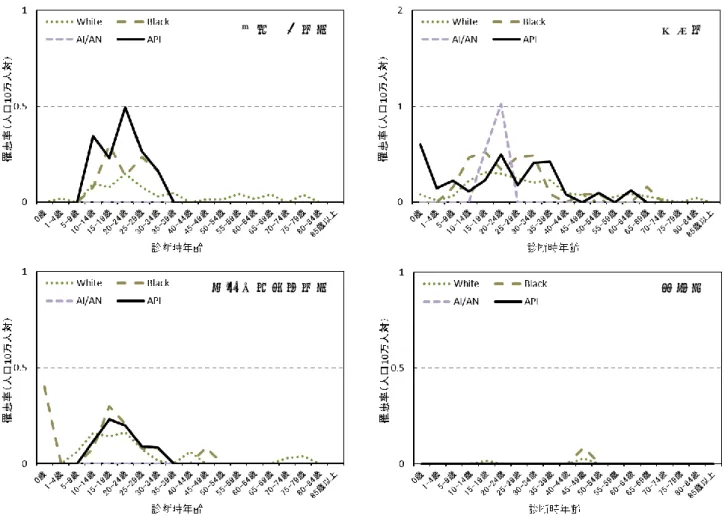
から取得したデータを用いて算出した年齢階級・人種・組織型別罹患率を図に示す。
White, Black, American Indian/Alaska Native(AI/AN), Asian or Pacific Islander(API)別
では、40歳代から50
歳代の明細胞線癌、類内膜 腺癌においてAPI
が他の人種に比較して罹患率が 高く、その後の減少傾向が顕著であった。一方、White、Black
の罹患率は50
歳代後半から60
歳 代にピークをむかえるが、その後の減少はAPI
と 比較して緩やかである。他の組織型では罹患数が 少なく比較や解釈は難しいが、SEER 研究データ を活用した場合、組織型別罹患率の算出は容易に 行うことができた。SEER データを利用して他国 と比較する場合では、組織型登録の不明率などデ ータの登録の質に関する比較が必要である。SEER
のデータ提供に対する考え方を調査する ため、米国NCI
を訪問し、SEER
データの管理に 関わるスタッフにインタビューを行った。SEER
データ利用手続きの簡易性は、研究への 利 活 用 を 重 視 す る 姿 勢 に よ り 実 現 し て い た 。SEER
データでは少数罹患例も集計可能であるが、たとえ
1
例になっても、その患者を知らない限り 個人が特定される可能性は低いと考えられている。どの程度少数になるとデータの提供を控えるのか といった基準はない。また、
SEER
はSEER*Stat
のような、SEER データの解析に有益なソフトウ ェアの開発・提供も行っていた。統計に詳しくな い一般のユーザーでも、簡単に罹患率や生存率が 推計できる仕組みであった。さらに、統計的に正 しい解釈ができるようにツールの利用が工夫され ている。D.
考察SEER
研究データはオンライン申請および誓約58
書の提出のみで用意に取得が可能であった。提供 されるデータも日本では一般的には入手できない 情報粒度を持つ。SEER研究データの情報粒度は 今後わが国で整備が必要とされる稀少がんの罹患 率や組織型別罹患率の算出に有用なものであっ た。ただし、SEERは米国全体をカバーしたデー タではなく、SEER 1973-2014 research dataは
18
州のデータをまとめたものである。これに対 して、日本で実施されている全国がん登録は日本 全体をカバーており、データの悉皆性は現在のSEER
にない強みである。日本においてデータ提供に関わる個人情報の保 護は大きな課題である。SEERの研究への活用を 重視する姿勢は日本より強い。SEERと同程度の 情報粒度や利用手続きの簡易性を実現するには、
患者、医療者、行政、企業、研究者の各方面から の意見収集・検討が必要であろう。今後、全国が ん登録データの提供に対応して
SEER*Stat
のよ うな誰もが簡単に入手・利用できるソフトウェア の開発はがん登録データの利活用促進に向けて有 用であると考えられる。E.
結論SEER
研究データは簡易な手続きで粒度の高い情報を取得することができる。SEERが提供する 情報粒度は、今後わが国での整備が期待されるが ん統計情報の整備に有益であった。しかし、
SEER
と同程度の情報粒度や手続きの簡易性を実 現するには更なる検討を要する。今後、全国がん登録データの提供に対応して利活 用促進に向けたソフトウェアの開発の実現が望ま れる。
F.
健康危険情報総括研究報告書にまとめて記載する
G.
研究発表1.
論文発表なし
2.
学会発表なし
H.
知的財産権の出願・登録状況1.
特許取得なし
2.
実用新案登録 なし3.
その他 なし59
明細胞腺癌 類内膜腺癌
漿液性嚢胞腺癌 乳頭状漿液性嚢胞腺癌
ん
粘液性のう胞腺癌 粘液性腺癌
未分化胚腫 胎児性癌
図 卵巣がんの組織型別・人種別・年齢階級別罹患罹患率
60
卵黄のう腫瘍 奇形腫
混合性胚細胞腫瘍 絨毛癌
図 卵巣がんの組織型別・人種別・年齢階級別罹患罹患率(つづき)
61
2017/6/27
日本版SEER
研究班第
1
回班会議1
SEER site
:Accessing the 1973-2014 SEER Data
の説明国立がん研究センターがん対策情報センター がん統計・総合解析研究部 堀 芽久美
SEER
ホームページにおいて、SEER Data
の利用申請、インターネットを経由したSEER Data
へのアクセス、
SEER Data
集計ができるソフトウェアSEER*Stat
のダウンロードが可能A) SEER Data 1973-2014
へのアクセスa)
取得できるデータ
ファイル形式:SEER*Stat
用のバイナリ形式ファイル、ASCII
テキスト形式
アクセス方法:①SEER*Stat
を利用したインターネット経由(SEER*Stat’s client-server mode
) でアクセス、②圧縮ファイルをダウンロード、③DVD
の郵送
含まれるデータセット、アクセス方法別:データセット アクセス方法
① ② ③
SEER Research Data, 1973-2014 (9, 13, and 18 registries databases)
○ ○ ○County Attributes data
○ ○ ○US Mortality
○Previous submissions of SEER data
○Incidence with SEER Delay Factors
○US Populations
○Specialized SEER*Stat Datasets
○Multiple primaries-standardized mortality ratios (MP-SMRs)
○Automatic SEER*Stat software updates
○ASCII text version of the SEER 1973-2014 data
○62
2017/6/27
日本版SEER
研究班第
1
回班会議2 b)
データ取得までの手順
オンライン利用申請(申請書提出→ID
取得→誓約書提出→承認・パスワード通知)» 申請内容:アクセス方法(インターネット経由、
DVD
郵送)、当該データに対する過去の 利用申請および誓約書提出の有無(図1
)、申請者の情報(図2
)
申請書の提出後、個別の誓約書フォーマットのURL
がメールで知らされるため、署名し、3
)» 誓約書の内容
1)
研究目的以外で利用しない2)
個人が特定されるデータを公表しない、少数例の集計値の公表を避ける3)
他のデータベースの個人単位のレコードとのリンケージをしない4)
個人を特定しようとしない5)
個人が特定された場合には、その情報を使用しない、SEER
にインシデント報告、特 定された個人を知らせない6) SEER
の承認を得た人以外にデータを利用させない7)
適切なデータ保管措置を行う8) SEER
から提供されるソフトウェアの適切な使用9)
結果公表の際の適切な引用
承認されるとSEER*Stat’s client-server
へのログインパスワードがメール送信されるB) SEER*Stat
を利用したインターネット経由での利用a)
手順(Session
→Database
→(Statistic), Selection, Table, Output
) Session
:Frequency, Rate, Survival, Prevalence, MP-SIR, Life-Table, Case Listing
から選択 Database
:Database
の選択 データベース名Incidence- SEER 18 Regs Research Data + …, Nov 2016 Sub (1973-2014 varying) Incidence- SEER 18 Regs Research Data + …, Nov 2015 Sub (1973-2013 varying)
・・・
Incidence- SEER 9 Regs Research Data, Nov 2003 Sub (1973-2011)
・・・
Mortality- All COD, Aggregated With State, Total U.S. (1969-2014) …
・・・
Populations- Total U.S. (1969-2015) …
・・・
County Attributes- Total U.S., 1969-2015 Counties.
・・・
Statistic
:集計方法の設定 Selections
:集計対象の指定 Table
:集計・抽出する変数の選択63
2017/6/27
日本版SEER
研究班第
1
回班会議3 b)
出力例・図
4
卵巣がんの組織/
性状別、年齢階級別罹患数Session
:Frequency Session
Database
:Incidence- SEER 18 Regs Research Data + …, Nov 2016 Sub (1973-2014 varying) Statistic
:Statistic=Frequencies, Percentage=None
Selection
:Year of diagnosis = ”2014”
Table
:Row= Age, Colum= ICD-O-3 Hist/behave
・図
5
卵巣がん症例リストSession
:Case Listing Session
Database
:Incidence- SEER 18 Regs Research Data + …, Nov 2016 Sub (1973-2014 varying) Selection
:Year of diagnosis = ”2014”
Table
:Column=Age, Race, ICD-O-3 Hist/behave c)
データセットに含まれる項目(別添1
)C) SEER Linked Databases
へのアクセスa) SEER-Medicare Linked Database
SEER Data
に含まれる人と、そのMedicare
請求をNCI
とCenters for Medicare and Medicaid Services
(CMS
)がリンケージしたデータ
個人特定される項目は削除・暗号化*
非暗号化項目は必要な場合に申請可
保険受給者データからランダムに5%
抽出した非がん患者を含むb)
データ取得までの手順
以下の書類を添付してメール送付(NCI
のSEER-Medicare
窓口へ)(別添2
)» 申請書の提出(研究計画の概要)
» 誓約書
» 所属機関の倫理審査委員会の承認書
» (必要な場合のみ)特定の項目(非暗号化の患者や医療機関・保険者の郵便番号、患者の 人口調査標準地域、医療機関コード)の利用申請書
* SEER
の各登録からの承認が必要
承認審査は4
~6
週間、有料(図6
) NCI
とSEER
の代表者が承認審査を行う(
SEER
参加登録による調査・研究の場合)»
SEER
の研究責任者からのレター*SEER
登録室主体の研究であること、その研究の協同 研究者であることを示す内容» 誓約書
» 所属機関の倫理審査委員会の承認書
年4
件まで無料64
2017/6/27
日本版SEER
研究班第
1
回班会議4
図1
図
2
65
2017/6/27
日本版SEER
研究班第
1
回班会議5
図3
66
2017/6/27
日本版SEER
研究班第
1
回班会議6
図4
図
5
67
2017/6/27
日本版SEER
研究班第
1
回班会議7
図6
68
Dear Investigator
Thank you for your interest in the SEER-Medicare data. Please use this application form to request SEER-Medicare files from the SEER-Medicare 2016 linkage. In order to facilitate the review process, you must complete and provide all items on this form. Do not say “see attached”. Be sure to review and include all required elements as listed in the application checklist. Incomplete applications will be delayed. You must submit this completed form electronically to the SEER- Medicare contact along a completed and signed Data Use Agreement (DUA), documentation of IRB approval and, if necessary the request for restricted variable form. Instructions for submitting a request can be found at http://healthservices.cancer.gov/seermedicare/obtain/requests.html . Thank you
NCI SEER-Medicare Staff
Questions should be sent to the SEER Medicare contact:
Elaine Yanisko
[email protected]
69
Application form – Page 1 Revised January 2017 Application Checklist (for your use only)
To be sent by email attachment to the SEER-Medicare contact:
Application:
Your description of the project must include:
o statement of main hypothesis / specific research question
o description of study subjects and cancer sites/phases to be included in the analysis o brief explanation of how key components of the study will be obtained/identified within
the PEDSF and/or claims data– specifically:
o cohort selection criteria o covariates
o outcomes
o a list of requested files and how each will be used, (for example: MEDPAR will be used
…. NCH will be used….).
o how the 5% population (non-cancer and/or other cancer) will be used, if requested o description of the personnel involved
o timeline for completion
o references can be included, if relevant.
You must include an explanation of data storage and protection. Please be specific as to the location of all files and media and all protections that will be in place.
Completed and signed Data Use Agreement (DUA) Documentation of IRB approval
Completed and signed Request form for restricted variables (if applicable) Letter from funder (if applicable)
Please send any questions to the SEER-Medicare contact at [email protected]
70
Application form – Page 2 Revised January 2017 APPLICATION FOR SEER-MEDICARE DATA
(Please complete all information in this form) I. Contact information
Project Title: < enter project title >
Principal Investigator: (students or fellows may NOT be listed as the PI)
Name:
Institution:
Address:
City, State Zip Email:
Phone
Alternate contact: Student / fellow contact / assistant / Co-PI: (indicate type)
Name:
Institution:
Address:
City, State Zip Email:
Phone:
71
Application form – Page 3 Revised January 2017 II. Project Description:
A. Title
B. Brief overview of your project (one or two sentences) C. Cancer sites being requested (e.g.Lung):
D. Description of the Project (between 1-5 pages). This description must include:
statement of main hypothesis/research question
description of study subjects and cancer sites/phases to be included in the analysis
brief explanation of how key components of the study will be obtained/identified within the PEDSF and/or claims data– specifically:
cohort selection criteria
covariates
outcomes
a list of requested files and how each will be used, (for example: MEDPAR will be used ….
NCH will be used….)
how the 5% population (non-cancer and/or other cancer) will be used, if requested
description of the personnel involved
timeline for completion
references can be included, if relevant.
E. Data Storage and Protection:
The preferred method of data storage is on an institutional server with all the protections that provides. If you are choosing an alternate data storage method, please provide the rationale as to why you made that choice. Please be aware that Cloud Storage of data does NOT meet privacy rules and will not be approved for storing SEER-Medicare data.
This section must include the following items:
the specific location of the data and where/how the data will be stored
details on how the data will be protected from unauthorized access.
information on the storage/protection of the media you receive containing the original files.
assurances that no attempt will be made to identify individual patients, hospitals or physicians
assurances that publications and presentations of the data will not allow identification of patients, hospitals or physicians.
F. Funding Source: If your organization is a consulting firm, contractor, or pharmaceutical company, then your application must include a letter from the funder indicating that you are free to work and publish your findings without limitations by the funder. This letter must come from a person in authority on company letterhead.
G. Restricted Variables: Selected variables are not released without the permission of the Principal Investigator of each of the SEER Registries. These variables include census tract of the patient, zip code of the patient, physician or hospital, and unencrypted provider numbers. If you are requesting access to any of these variables, you must include the justification in your
description of the project and also submit the completed request form for restricted variables.
Please see http://healthservices.cancer.gov/seermedicare/privacy/variables.html for
information. NCI will provide a researcher with contact information for each of these registries;
however it is the responsibility of the researcher to obtain permission from each registry.
72
Application form – Page 4 Revised January 2017 III. Data Files Requested: Please list specific SEER-Medicare data files and years of data required.
Project description must describe how each file will be used.
Name of file
Years
available Years requested Patient Entitlement and Diagnosis Summary File (PEDSF)
(SEER cases) 1973-2013
Summarized Denominator File (SUMDENOM)
5% non-cancer sample 1991-2013
5% PEDSF **
5% cancer sample (Medicare enrollment data only) 1991-2013
MEDPAR 1991-2014
NCH - Carrier (physician/supplier) 1991-2014
Outpatient 1991-2014
Home Health (HHA) 1991-2014
Hospice 1991-2014
Durable Medical Equipment (DME) 1994-2014
Part D Event (PDE) 2007-2014
Chronic Conditions Flag 1999-2014
Hospital File
1996, 1998, 2000-2014
(** To receive the 5%PEDSF, you must also be approved to receive the SUMDENOM file. In this case, your SUMDENOM file will include persons in the 5% sample who never had any cancer (SUMSTAT = 1) and patients in the 5% sample reported to have cancer, but no additional information (SUMSTAT
= 2).
Note: Medicare claims prior to 1998 are available only for cases diagnosed with cancer before 2003.
Cases diagnosed 2003-2005 have claims from 1998+; cases diagnosed 2006 -2007 have claims from 2000+; cases diagnosed 2008-2009 have claims from 2002+; cases diagnosed 2010-2011have claims 2004+; Cases diagnosed 2012-2013 have claims 2006+
73
Revised May 2017 – Page 1 Investigator:
Date Project title:
SEER-MEDICARE DATA USE AGREEMENT (DUA) PRINCIPAL INVESTIGATOR
Information pertaining to an individual’s health status and medical treatment is sensitive. Therefore, specific laws, including the Privacy Act of 1974 and the Health Insurance Portability and
Accountability Act of 1996, have been enacted to ensure the confidentiality of health information. In utilizing health data for research purposes, it is absolutely necessary to ensure, to the extent possible, that uses of such data will be limited to research. Uses for any other reason, particularly those
resulting in personal disclosures, will be prosecuted to the full extent of the law. In addition, release of information about providers, i.e., the physicians and hospitals that provide care for cancer patients, may compromise the willingness of these providers to cooperate with the activities of the cancer registries. Therefore, considerations regarding the privacy of providers are also of great importance
In order for the National Cancer Institute to provide the linked SEER-Surveillance, Epidemiology and End Results (SEER)-Medicare data to you, it is necessary that you agree to the following provisions:
1. You agree that the statements and methods made in your attached research proposal are complete and accurate.
2. You will not use the data for purposes other than described in your research proposal.
3. You will not permit others to use the data except for collaborators at your institution involved with the research as described in your proposal. Access to the SEER-Medicare data shall be limited to the minimum number of individuals necessary to achieve the purpose stated in your proposal. The number of locations where the data are located shall also be minimized and specific location details must be provided in your proposal’s data storage and management plan.
If you plan to move the data to a new location at your institute you must contact NCI in writing prior to moving the data for instruction on how to handle the SEER-Medicare data.
4. You will establish and maintain the appropriate administrative, technical, and physical safeguards to protect the confidentiality of the data and to prevent unauthorized use or access to it, as described in your proposal. The safeguards shall provide a level and scope of security that is not less than the level and scope of security established by the Office of Management and Budget (OMB) in OMB Circular No. A–130, Appendix III—Security of Federal Automated Information Systems http://csrc.nist.gov/drivers/documents/appendix_iii.pdf ), which sets forth guidelines for security plans for automated information systems in Federal agencies.
5. You agree not to place the SEER-Medicare data on personal computers, portable devices and removable media without permission. Portable devices include any non-fixed equipment that contains an operating system which may be used to create, access or store SEER-Medicare data.
This includes but is not limited to laptops, personal digital assistants (PDAs), and smart phones.
74
Revised May 2017 – Page 2 Removable media include, but are not limited to: CDs, DVDs, MP3 players, removable memory, and USB drives (thumb drives). If approved, all data stored on any of these devices must be password protected AND encrypted. Approved encryption standards must be FIPS-140 compliant and include Advanced Encryption Algorithm (AES) that uses a 128, 192, or 256-bit key size. In the event that the data are lost or stolen, you agree to report the loss to the SEER-Medicare contact within 24-hours/first business day of discovering the loss. Cloud storage does not meet privacy rules and is not acceptable for storing SEER-Medicare data.
6. You may use an institutionally provided VPN to link to a time sharing system for data access. In this case, the remote PC may support the VPN but the SEER-Medicare data must remain on the institution’s server.
7. You will store all media on which the SEER-Medicare data are delivered in a secure location, such as a locked file cabinet in a locked office, only accessible by you or appropriate designated staff.
8. You must maintain all datasets containing restricted variables physically separate from any other SEER-Medicare files. Separate access controls with strong user authentication
(username/password, digital certifications, etc.) must be established to allow limited access to these files. You should be able to track all access to these files.
9. All SEER-Medicare data must reside at your institution under your purview. If you plan to move to a different institution, you must contact NCI in writing prior to moving for instructions on how to handle the SEER-Medicare data. You may not duplicate any SEER-Medicare files prior to moving nor can you take SEER-Medicare data with you without written permission from NCI. If you chose not to take the data with you, you must destroy the files or designate a new PI prior to moving.
10. You will not attempt to link nor permit others to link the SEER-Medicare data with individually identified records in another database without the written consent from the applicable SEER registries.
11. No one having access to the data will attempt to learn the identity of any persons with cancer in these data and/or their physicians or treating hospitals. In the event that you discover or are able to deduce the identity of a specific patient or provider (individual or institution), you agree that you will not attempt to contact these individuals or institutions.
12. No findings or information derived from the SEER-Medicare data may be released if such findings contain any combination of data elements that might allow the deduction of a patient’s or
providers’ (individual or institution) identity. Numbers less than 11 (eleven) must be suppressed.
Also, no use of percentages or other mathematical formulas may be used if they allow the derivation of patient, facility, or provider counts less than 11. Mapping of data related to reflect incidence, treatment, or survival at the registry-specific level or at other small areas is not permitted without prior approval from NCI and the involved registries. Although it is permissible to report registry names with registry-specific cancer rates (e.g., incidence, complications, mortality), registry names must be anonymized when reporting the quality or completeness of registry-specific data (e.g., case or treatment ascertainment). You agree that NCI shall be the sole judge as to whether the anonymization sufficiently precludes one from identifying or deducing
75
Revised May 2017 – Page 3 the identity of a specific patient, provider (individual or institution) or registry with a reasonable degree of certainty.
13. You agree to provide NCI with a copy of all manuscripts to be submitted for publication prior to submission. You further agree not to submit such findings to any third party until receiving NCI’s approval to do so. NCI agrees to make a determination about approval and to notify you within 4 weeks of receiving any manuscript. NCI’s review of the manuscript is for the sole purpose of assuring that data confidentiality is maintained (e.g., individual patients and/or providers cannot be identified) and that the focus of the manuscript was outlined in the approved SEER-Medicare proposal. NCI may withhold approval for publication only if it determines that the format in which data are presented may result in identification of individual patients and/or providers or if the scope of the manuscript is not consistent with the approved proposal.
14. You agree that in the event NCI determines or has a reasonable belief that you have violated any terms of this agreement, NCI may request that you return the data and all derivative files to NCI.
You understand that as a result of NCI’s determination or reasonable belief that a violation of this agreement has taken place, NCI may refuse to release further SEER-Medicare data to you for a period of time to be determined by NCI.
15. All files received may be retained for a maximum of five years. At the completion of the project or five years from receipt all files including all back-up files and original media must be destroyed and notification of destruction must be sent to NCI. Investigators who need to retain files beyond that period must contact NCI.
Please indicate the SEER-Medicare files you will use:
Patient Entitlement and Diagnosis Summary File) (PEDSF) Years Summarized Denominator File (SUMDENOM) Years
MEDPAR Years
NCH - Carrier (physician/supplier) Years
Outpatient Years
Home Health Agency Years
Hospice Years
Durable medical equipment Years
Part D Event (PDE) Years
Chronic Conditions Flags Years
These files will include:
Cancer cases Non-cancer cases
76
Revised May 2017 – Page 4 Signature of Principal Investigator (In the case of students and fellows, the department chair or advisor from the student's academic institution must sign the data request)
Your signature indicates that you agree to comply with the above stated provisions. Deliberately making a false statement regarding any matter within the jurisdiction of any department or agency of the Federal Government violates 18 USC 1001 and is punishable by a fine up to $10,000 or up to five years in prison.
Name – (printed or typed)
Institution/Organization
Street Address
City/State/ZIP code
Phone number – including Area Code
Email address
Signature Date
77
February 2017
Request for restricted or unencrypted variables on the SEER-Medicare file
Investigator Name:
Organization:
Telephone:
Email Project title:
Project Abstract:
Check the variable(s) requested. Please be aware that:
Unencrypted Census tracts and ZIP Codes are NOT needed to link the Census data to the PEDSF or SUMDENOM information. All Census tracts and ZIP Codes on SEER-Medicare data are encrypted in a uniform manner so Census data can be merged using the encrypted variables . Selected Census data from 1990, 2000 and ACS 2008-2012 by ZIP code and Census tract are provided with every data request.
Unencrypted hospital numbers are NOT needed for volume outcomes studies. All provider numbers on SEER-Medicare data are encrypted in a uniform manner so volume can be calculated from the encrypted numbers.
patient ZIP Code patient Census tract
Provider/ Hospital ZIP Code unencrypted hospital provider numbers (NPIs)
Please describe how the requested variables will be used in your project (ex. unencrypted patient and hospital Zip code will be used to determine distance to care)
This project is funded by: NCI DOD Other (please specify):
I agree that if these variables are released to me that they will not be used to identify any individual cancer patient, hospital or physician. I will publish findings from this analysis at a sufficient level of aggregation to make it impossible to identify individual patients and providers, and I will not make public any information that may result in the identification by others of
individual patients, hospitals or physicians. I understand that I can only access the SEER-Medicare data to work on the project as described in my application. Furthermore, the dataset with restricted variables can be used only for this particular project and cannot be used for any subsequent analysis.
Date Investigator’s printed name Investigator’s signature
78
厚生労働科学研究費補助金(がん対策推進総合研究事業)
(分担)研究報告書
全国がん登録を基盤とした長期記述疫学研究用特定匿名化情報の整備に関する研究
-宮城県をモデルとした基盤整備と方策に関する検討-
研究分担者 金村 政輝 宮城県立がんセンター研究所 がん疫学・予防研究部
研究要旨
本研究班では、米国の
SEER
のように全国がん登録を基盤とした長期にわたる疫学研究 を実現するためのモデルの提案を目指している。今年度は、米国ユタ州がん登録を対象に 情報収集を行い、現地調査を行った。ユタ州では、SEER などのプログラムからの資金提 供を受け、スタッフの雇用が可能となっており、関係団体による支援によってデータの内 容や形式の定義、トレーニングの機会の提供と認証が行われ、質が担保されるとともに、標準化されたデータの登録・提供が可能となっていた。州のがん登録は、各州の法律・規 則に基づき運営されているが、ユタ州では、様々な工夫をしながら情報の収集を行ってお り、州の保健当局との取り決めに従い、Advisory Research Committeeによる助言を受け ながら、データの公表・提供が行われていた。我が国において
SEER
のような仕組みを実 現するための課題としては11
項目が抽出された。宮城県をモデルとして、全国がん登録の 届出対象項目にはないがん診療情報を追加で収集するためには、大きく2
つの方法が考え られた。特定匿名化情報の提供においては、仕組み自体は全国共通のものとして整える必 要があるものの、少数例の取扱いが宮城県においても悩ましい課題であり、実際にモデル 地域での取り組みなどを通して解決することが必要と考えられた。A.
研究目的米国では、全米を対象としたプログラム で あ る
Surveillance, epidemiology, and End Results
(SEER)が長期にわたり実施 されており、このSEER
によるデータを用 いたがん疫学研究の研究成果が数多く報告 されている。全国がん登録が開始された我 が国において、今後、このSEER
のような 全国がん登録を基盤とした長期にわたる疫 学研究の実現が期待されている。そのため には、診療に関するより詳細な情報を収集 し、提供する仕組み(がん診療情報の追加 収集・提供)を構築し、匿名化した上で情報提供すること(特定匿名化情報の提供)
が必要である。
本研究班では、長期にわたり地域がん登 録を実施し、高い精度での情報収集が行わ れてきた愛知、栃木及び宮城の
3
県をモデ ル地域と位置付け、モデルの提案を目指し ている。本年度は、宮城県でのモデル事業 の実施を念頭に置いた上で、その実現のた めの課題抽出を行い、今後必要な事項につ いての提案を行うため、以下の研究活動を 行った。B.
研究方法79
(1) ホームページ等調査・米国視察 米国の
SEER
における情報収集と提供の 仕組み、特に、州のがん登録室と医療機関 との間において、詳細ながん登録情報、診 療情報の収集をどのように実現しているの かをホームページ等から調査を行った。そ の後、米国ユタ州のがん登録室を実際に訪 問し、情報収集と提供の仕組みについて現 地調査を行った。現地調査の結果について は、モデル地域として参加している他の仕 組み検討班のメンバー(※)と分担し、班 会議に報告を行うとともに、記述疫学検討 班などの共同研究者と情報交換・意見交換 を行った。(2) 課題抽出と提案
上記の結果を踏まえ、宮城県でのモデル 事業の実施を念頭に置いた上での課題抽出 を行うとともに、今後必要な事項について の提案を行った。
C.
研究結果(1) ホームページ等調査・米国視察 ホームページ等の調査を行い、現地調査 を行った結果を【別紙1】に示す(ただし 金村の担当分のみを提示)。米国においては、
SEER
によるプログラムとは別に、CDC
が 資 金 提 供 し て い るNPCR
(National Program of Cancer Registries)というプロ
グラムがあり、前者は15
州、後者は46
州 と参加規模の違いがある。疫学研究では、SEER
のデータが使われていることが多い が、開始から長期にわたること、最終的な目標が
survival
であることなどの違いがあることが確認出来た。いずれのプログラム からも資金提供が行われており、登録士
Registrar
の雇用が可能となっていた。関係団体による支援によって、データの内容や
形式の定義、トレーニングの機会の提供と 認証が行われることで、質が担保され、標 準化されたデータの登録・提供が可能とな っていた。米国では、各州独自の法律・規 則によってがん登録について種々の規定が なされ、それに基づき各州のがん登録が運 営されているが、ユタ州では、実務上、様々 な工夫をしながら情報の収集を行うととも に、ユタ州の保健当局との取り決めに従い、
Advisory Research Committee
による助言 を受けながら、データの公表・提供を行っ ていた。(2) 課題抽出と提案
上記の結果については、仕組み検討班の 小班会議において情報交換・意見交換を行 った後、課題抽出を行い、視察結果と合わ せて班会議に報告した(【別紙2】。ただし、
金村の担当分のみを提示)。課題としては全 部で
11
項目が抽出された(①外部資金によ るスタッフの継続雇用、②収集部門と情報 提供部門それぞれへの専門職種マネージャ ーの配置、③対象症例抽出用のツールの開 発、④病理報告の様式の標準化、⑤病理報 告の電子データ化と収集の仕組みの構築、⑥非匿名化情報の研究利用を可能とする制 度設計、⑦二次利用の方法の仕組みづくり、
⑧全国がん登録届出対象外項目抽出のため のデータ収集機関・会社等の利用、⑨デー タ収集機関・会社等へ支払う予算・財源の 確保、⑩届出対象外項目の収集の際のデー タの標準化の担保、⑪病院に対する情報提 供やトレーニングの機会の提供)。その後、
班会議での議論を踏まえ、宮城県でのモデ ル事業の実施を念頭に置いた上で、その実 現のための課題抽出と具体的な提案を行っ た(【別紙3】)。全国がん登録の届出対象項 目にはないがん診療情報を追加で収集する
80
ためには、大きく
2
つの方法が考えられた。ひとつは既存の院内がん登録全国集計を活 用する方法、もうひとつは、都道府県が主 体となって実施する方法で、後者の場合に は、①必要性、②周囲からの期待や要請、
③都道府県の考え方・熱意・環境、④地域 に対する後押しにより、その実現性が変わ るものの、合意形成を図りながらの実施が 必要であり、サンプリング調査では、漏れ がないように、さらに、出張採録も検討す ることが必要と考えられた。特定匿名化情 報の提供においては、仕組み自体は全国共 通のものとして整える必要があるものの、
少数例の取扱いが宮城県においても悩まし い課題であり、実際にモデル地域での取り 組みなどを通して解決することが必要と考 えられた。
D.
考察米国視察を通して課題抽出を行ったが、
彼我の違いは大きく、解決すべき課題とし て
11
項目が抽出された。これらは、スタッ フの雇用と配置(①、②)、抽出・収集のた めの支援・標準化・機関等の活用(③~⑤、⑧、⑩、⑪)、そのための仕組みづくりや予 算・財源の確保(①、⑥、⑦、⑨)の3つ に区分される。このうち、予算・財源なし に着手できる部分については、今後、その 実現に向けて具体的な提言につなげていく 必要がある。しかし、予算・財源を伴うも のについては、直ちに実現することが難し く、今後の課題である。
全国がん登録の届出対象項目にはないが ん診療情報を追加で収集するためには、大 きく
2
つの方法が考えられたが、実際に宮 城県で実施する際には、合意形成などの課 題があり、また、特定匿名化情報の提供においては、少数例の取扱いが課題であるこ とが確認された。今後、宮城県を対象にモ デル事業を実施する際には、米国視察を通 して抽出した課題と併せて解決する必要が あると考えられた。
E.
結論米国の
SEER
のように全国がん登録を基 盤とした長期にわたる疫学研究を実現する ため、米国ユタ州を対象として、情報収集 を行い、現地調査を行った。我が国におい てSEER
のような仕組みを実現するための 課題として11
項目が抽出された。宮城を対 象にモデル事業として届出対象項目にはな いがん診療情報を追加で収集するためには、大きく
2
つの方法が考えられた。一方で、特定匿名化情報の提供においては、少数例 の取扱いが地域としても悩ましい課題であ り、実際にモデル地域での取り組みなどを 通しての解決が必要と考えられた。
※ 仕組み検討班(50音順)
伊藤 秀美(愛知県がんセンター研究 所、モデル地域候補)
大木いずみ(栃木県立がんセンター、
モデル地域候補)
柴田亜希子(国立がん研究センター、
研究代表者)
松田 智大(国立がん研究センター)
G.
研究発表1.
論文発表1) Liu Y, Shu XO, Wen W, Saito E, Rahman MS, Tsugane S, Tamakoshi A, Xiang YB, Yuan JM, Gao YT, Tsuji I, Kanemura S, Nagata C, Shin MH, Pan WH, Koh WP, Sawada N, Cai H,
81
Li HL, Tomata Y, Sugawara Y, Wada K, Ahn YO, Yoo KY, Ashan H, Chia KS, Boffetta P, Inoue M, Kang D, Potter JD, Zheng W: Association of leisure-time physical activity with total and cause-specific mortality: a pooled analysis of nearly a half million adults in the Asia Cohort Consortium.Int J Epidemiol.doi:10.
1093/ije/dyy024.2018
2)
金村政輝:がん転移学(上)Ⅱがんの疫学 2.臓器別のがん転移に関する疫学情報(3)
乳 が ん.
日 本 臨 床75
巻 増 刊841-45.2017
2.
学会発表1)
長澤あかね,佐藤優希,目崎はる香,齋藤 美登里,佐々木真理子,鈴木智子,鈴木美 裕紀,只野尚子,金村政輝:宮城県におけ る全国がん登録への対応-届出病院支 援の取り組み-(第2
報).日本がん登 録協議会第26
回学術集会,松山,2017年6
月2)
金村政輝,佐藤真弓,新田彩子:全国のが ん診療連携拠点病院における院内がん 登録の実施体制.日本がん登録協議会第26
回学術集会,松山,2017年6
月3)
佐藤真弓,新田彩子,金村政輝:自動集計プログラムの構築と全国集計公表デー タを使った他院の比較.日本がん登録協 議会第
26
回学術集会,松山,2017年6
月4)
金村政輝:全国のがん診療連携拠点病院における院内がん登録の現状分析-実 施体制と実績との関連.第
76
回日本公 衆衛生学会総会,鹿児島,2017年10
月H.
知的財産権の出願・登録状況なし
82
1
米国における情報収集と提供の仕組み(ユタ州がん登録視察結果)
1 Oversight and Relationship to US Federal and State Agencies
(1) 米国には 2 つのがん登録プログラムがある 官庁 National Cancer Institute
(NCI)
Centers for Disease Control and Prevention
(CDC) がん登録
プログラム
Surveillance, Epidemiology, and End Results
(SEER)
National Program of Cancer Registries
(NPCR)
略称 NCI SEER CDC NPCR
参加州数 15
※1970 年に 9 州からスタート し、ユタ州は 1973 年から参加
※地域的に偏りあり
46
※今年 6 月からユタ州が参加し 46 州になった
姿勢 ・罹患と生存のトレンドを追跡
※最終的な目標は survival
・がん研究 へのデータ提供
・罹患と生存のトレンドを追跡
・がん対策 へのデータ提供 URL https://seer.cancer.gov/ https://www.cdc.gov/cancer/
npcr/index.htm
(2) がん登録プログラムへの参加州
(3) SEER と NPCR とそれぞれの州のがん登録の関係
SEER は NCI との契約、NPCR は CDC との協力協定に基づき、参加したがん登 録に資金提供を行っている。
※ この資金提供によって、Registrars の雇用が可能となっている。
それぞれのがん登録は、SEER 及び/又は NPCR に個人同定できない形式でデー
CDC NPCR に参加
…多くの州が参加
NCI SEER に参加
…数州に限られる
※ユタ州は 6 月から NPCR に参加 したので図に誤りあり
SEER 及び NPCR に参加
…数州に限られる
別紙1
83
2 タを提出する。
SEER と NPCR は、がん登録からのデータを集めて大きなデータセットにし、が ん罹患のトレンド評価やがん研究に利用可能としている。
(4) SEER や NPCR での登録方法の発展プロジェクトの役割
参加したがん登録は、登録方法の発展と品質保証のための特別プロジェクト(※)
に参加申請をする機会が得られる。
※ メールでの情報提供やトレーニングの機会など
UCR における最近のプロジェクトの例
SEER Virtual Tissue Repository
15-month Resubmission to Improve Completeness
UCR Data Linkage with Utah All-Payer Claims
※ 米国では日本と保険制度が異なり、保険が変わることもあるため重要
※ データリンケージは UCR で行っていて、Social Security Number がある ため、リンケージは高い確率で一致している。Social Security Number が 提供してもらえないときは、リンケージには出生日と名前を利用するが、
ラストネームが変わったり、ニックネームや略称などがあるため、困難を 伴うことがある。
Pilot to Collect Screening Information for Breast Cervical Cancer Cases
(5) 登録データの標準化と品質に対する SEER や NPCR の役割
NCI との契約、CDC との協力協定により、報告対象とするがん、それぞれの症例 における項目、データの提出期限が明らかにされている。
SEER と NPCR は、提出されたデータを完全性(※)と質で評価している。
※ 完全性は過去のデータのレビューの結果により行われている。
(6) 米国における他のがん登録の組織
NCI と CDC という連邦政府の官庁に加え、いくつかの専門家組織がデータの内 容と形式の定義、トレーニングと認証についての標準化に関わっている。 (※いずれ の団体は全く別個のものである。)
North American Association of Central Cancer Registries (NAACCR)
※ Central registries(population-based registries)が参加し、重要な役割をは たしている。
American College of Surgeons Commission on Cancer (CoC)
※ 外科医の専門団体で、 ”Cancer Hospital”の認証を行っている。がん登録は この認証を受けた Cancer Hospital からデータの提供を受けている。
National Cancer Registrars Association(NCRA)
※ Cancer Registrar が各個人で参加。トレーニングの機会(有料)を提供し、
Certified Tumor Registrar (CTR)の認証を行っている。トレーニングはい くつかのコースがあり、期間が異なる。通常、 2 年間の実務期間の後に認
84
3 証の試験を受ける。
※ 州によって違いはあるかもしれないが、CTR の認証を受けることは雇用 に重要となっている。実際に入職する前にもトレーニングを受けている。
American Joint Commission on Cancer(AJCC)
※ pathologist が多く、Staging の決定に関与。
(7) がん登録に対する州法の権限
米国では、各州に独自の法律と規則があり、サーベイランス目的での健康データの 報告について規定している。
(8) がん登録に対する州法の権限の特徴
典型的には、以下のような記載になっている。
病院及び他のケア提供施設は、がんの報告が求められている。
中央登録室は、個人同定が可能ながんのデータを受け取る。
※ 複数の施設を受診した同一の患者を 1 人に同定するためには、名前、 social security number、出生日が必要。
中央登録室は、プライバシーと機密性を保護することが求められている。
(9) Utah Cancer Registry (UCR)
ユタ州全域を対象とした population-based のがん登録
1966 年からユタ大学で運営
1973 年から SEER プログラムに参加
2017 年から CDC の NPCR に参加
※ ユタ州は広大で、大部分の人々は限られたエリアである主要な高速道路沿いの都 市部に済み、ヘルスケアへのアクセスもよいが、その他は小さなタウンで、ネイテ ィブ・アメリカンなども住んでいる。有名なところでは、ナバホ国があり、ナバホ・
インディアンが住んでいる。
※ Ethnicity については、例えば、提供を受けた 2004-2013 の報告書の 7 ページの
table3 に Hispanic or Latino として、罹患数、罹患率、死亡数の記載があるが、ネ イティブ・アメリカンの数は少ない。
※ 都市部以外ではヘルスケアへのアクセスは必ずしもよくなく、ネイティブ・アメリ カンでは複雑な問題だが、すべてがソルトレイクシティなどの都市部の施設を受 診するわけではなく、コロラド州、ラスベガス、ネバダ州などの州外への受診も多 い。
(10)ユタ州におけるがん登録に対する報告についての権限付与 ユタ州では、以下の州法と行政規則がある。
州法:Utah Code Title 26 Utah Health Code, Chapter 5 Chronic Disease Control, Section3,
System for detecting and monitoring diseases established by department
行政規則:Utah Administrative Code Rule R384-100, Cancer Reporting Rule
85