• 検索結果がありません。

Supporting the professional development of Japanese teachers of English (JTEs) : a report on a teachers' license renewal Seminar

N/A
N/A
Protected

Academic year: 2021

シェア "Supporting the professional development of Japanese teachers of English (JTEs) : a report on a teachers' license renewal Seminar"

Copied!
25
0
0

読み込み中.... (全文を見る)

全文

(1)

Supporting the professional development of

Japanese teachers of English (JTEs) : a report on a teachers' license renewal Seminar

著者名(英) Alice N. Lee, Michael J. Torpey journal or

publication title

言語教育研究

volume 22

page range 53‑76

year 2012‑11

URL http://id.nii.ac.jp/1092/00000933/

(2)

Supporting the Professional Development of Japanese Teachers of English (JTEs): A Report

on a Teachers’ License Renewal Seminar

Alice N. Lee Michael J. Torpey

Abstract

Since 2009, Kanda University of International Studies (KUIS) has been

conducting an annual summer professional development seminar for junior

high school and senior high school Japanese Teachers of English (JTEs)

seeking to renew their English teaching license. This seminar has hosted 75

participants to date. The authors of this paper have been directly involved in

the design and implementation of the seminar and were also members of the

teaching staff. From the outset, the aim has been to support the JTEs in their

profession while trying to facilitate the uptake of a more communicative

language teaching approach adapted to the local context, encourage peer

reflection on the applicability of such approaches within their own classrooms,

and promote self-directed experimentation and inquiry concerning teaching

practices. In this paper, we first explain the background, rationale, goals, and

structure of the seminar. We then focus on some data findings from the 24

participants of the 2010 Seminar. In doing so, we hope to provide some insight

with regards to the following: (1) the professional backgrounds of the JTEs; (2)

what they believe they gained from the KUIS seminar; (3) how they fared in

their professional development after completing the KUIS Seminar; and (4) the

changes in practice that individual JTEs have tried to enact within their local

contexts.

(3)

Background/Introduction

In recent decades, English language education in Japan has undergone great scrutiny, resulting in various governmental efforts to articulate and implement nationwide reforms aimed at addressing the perceived lack of English proficiency among the general population. In 1998 and 1999, the Ministry of Education (now called Monbukagakusho) proposed the New Course of Study for junior high and senior high schools which shifted the focus of English courses to that of develop- ing better communicative abilities in children. In 2003, the Monbukagakusho outlined a sweeping 5-year action plan in order to ‘cultivate Japanese with English abilities’. These reform policies have been heavily and widely criticized for their failure to include the views of Japanese teachers of English (JTEs) who are called upon to change their classroom practices to be more in line with the Communicative Language Teaching (CLT) approaches (Riley, 2008: 109).

Language educators in Japan point to the gap between public policy ideals and the daily realities and cultural/situational contexts faced by the JTEs (see Arani and Matoba, 2006; Kizuka 2006; Lamie, 2004; Nishino and Watanabe, 2008;

Murphey and Sato, 2006; Pocaro 2006; Sakui 2004; Shimahara 2002; Smith and Imura, 2004; Takanashi 2004). Studies of government initiatives in teacher training and professional development introduced from the mid-1980s onwards show that significant change in Japanese teaching practice has not subsequently taken place (Shimahara, 2002), primarily because of the failure of such initiatives to build on local conditions and traditions (Smith and Imura, 2004).

In order to hold JTEs more accountable, the Monbukagakusho instituted

Section 2 of the Action Plan titled ‘Improving the teaching ability of English

teachers and upgrading the teaching system’ (Ministry of Education, Culture,

(4)

Sports, Science, and Technology, 2003). One goal mentioned in Section 2 is to have every JTE take the STEP, TOEFL, or TOEIC tests, with only those achieving the requisite scores (and thereby demonstrating their English communicative competence) allowed promotions. In addition, JTEs must undertake training in the five years from 2003 through 2007 to improve on both their English skills and language teaching skills. A more recent scheme is to require JTEs to renew their English teaching license every ten years by completing a government-approved professional development program. Responsibility for overseeing the intensive training of JTEs would be allocated to the prefectural boards of education.

Within this context, Kanda University of International Studies (KUIS), which had already been running a general in-service summer workshop on Communicative Language Teaching (CLT) since 2003

1

the auspices of Chiba Prefectural Board of Education, was successful in its application to provide an additional Teachers’ License Renewal Seminar starting in 2009 for junior high school and senior high school JTEs. The authors of this paper were involved in the design and implementation of this seminar and were also members of the teaching staff. From the outset, we were mindful that the seminar was an imposition on the JTEs, and that we ourselves and our institution were committed to a view of language as a means for communicative interaction. At the same time, we wished to accommodate the views of the JTEs and validate their own teaching experiences as much as possible. The key question in designing the workshop was how to support the professional development of individual JTEs while trying to facilitate the uptake of a more communicative language teaching approach. In the

1
See Torpey, 2007 and Torpey, 2009 for details about the general teacher in-service

(5)

next sections we first highlight some pertinent issues in second language teacher education before elaborating on the usefulness of a sociocultural perspective in developing the KUIS seminar.

Adopting a Sociocultural Perspective for Informing Second Language Teacher Education

In a review of the literature on second language teacher education, Velez-Rendon (2002) points to the paucity of research into understanding how teachers actually learn the ‘how to’ of teaching. In Cross and Gearon’s view (2004: 7), the only substantial research in second language teaching practice falls ‘into either of two main categories: teacher talk … or classroom interaction’ both of which focus on the importance of instruction on acquisition as opposed to an appreciation or deep- er understanding of ‘the nature and practice of second language teaching itself’

(2004: 3). They assert that in the field of second language teacher education

‘pedagogy has tended to be driven by the linguistic theories of the day rather than the educational research into second language teaching itself as it occurs in natural, realistic settings’. Such trends help explain the discord between the theory which informs the knowledge base of language teacher education (LTE) and the actual classroom practice of language teachers. As Cross (2006: 7) notes,

‘What the literature often holds as “good practice” … may not necessarily resonate with the reality of teaching as a socioculturally-constructed activity which, instead, emerges from the very real social and cultural context that we cannot continue to ignore’.

Drawing on earlier studies (Freeman and Johnson, 1998; Freeman and

Richards, 1996), Velez-Rendon (2002: 465) stresses the need to probe teachers’

(6)

cognitive worlds and personal teaching practices so as to better ‘understand more about how language teachers conceive of what they do: what they know about language teaching, how they think about their classroom practices, and how that knowledge and those thinking processes are learned through formal teacher education and informal experiences on the job’.

The authors of this paper have been particularly interested in this sociocultur- al perspective highlighting the dynamic, evolving practice of teaching as situated within wider social, cultural and historical contexts -- in designing, implementing, and conducting research on the process and practice of the KUIS Teachers’

License Renewal Seminar. Such a perspective acknowledges a shift from ‘a transmissive model whereby teachers are provided with a body of codified knowledge to be applied to the classroom’ to a more reflective stance in which learning to teach is recognized as ‘an ongoing and complex process and the sum of many cognitive, affective, individual, and contextual factors’ (Velez-Rendon, 2002: 465).

According to Johnson (2009: 1), while the term sociocultural is used with slightly different meanings and with different applications depending on the discipline, a sociocultural perspective fundamentally ‘defines human learning as dynamic social activity that is situated in physical and social contexts, and is distributed across persons, tools, and activities’. Moving from the general to the specific Johnson elaborates on five ways a sociocultural approach can inform sec- ond language teacher education by adopting (2009: 2-6):

• A view of language as social practice which calls for teachers to recognize

that language use is a form of situated ‘meaning making’;

(7)

• A view of teaching as dialogic mediation in which attention is focused on the quality and characteristic of interaction between learners and teachers which may lead both parties to discern/reflect on opportunities for development;

• A view of teacher learning which emphasizes the ‘inherent intercon- nectedness of the cognitive and social’ as a way to explore how teachers learn and develop in their given contexts;

• A contextualised view of the L2 teaching profession which promotes a broader awareness of ‘how an individual teacher’s activities shape and are shaped by the social, cultural and historical macro-structures’;

• An inquiry-based view of professional development which supports a re-conceptualisation of professional development to go beyond traditional sites (coursework, workshops, seminars) to include more informal social and/or professional networks with priority given to the teachers’ own

‘classrooms as sites for professional learning’.

The above views have underpinned our efforts to scaffold the professional development of JTEs via the Teachers’ License Renewal Seminar, which will be described in the next section.

Overview of the KUIS Teachers’ License Renewal Seminar

The first seminar took place over 4 days (4.5 hours per day) from late July to early August 2009 and hosted 22 JTEs. In 2010, 24 JTEs attended, and in 2011 there were 29 participants. Thus, a total of 75 JTEs have completed the seminar thus far.

The content of the seminar reflects five goals in accord with the perceived

(8)

professional development needs of the JTEs. These goals, outlined in the seminar manual which was sent out to each participant a month beforehand, are as follows:

• Goal 1: To reflect on your own English learning needs;

• Goal 2: To consider various strategies and resources (including the internet) for improving your English;

• Goal 3: To reflect on your English teaching

• Goal 4: To think about ways to integrate the various skills (reading, listening, speaking, writing), in your teaching of English;

• Goal 5: To work on your Professional Development Action Plan.

The above goals were manifest in each of the seminar’s nine 90-minute input sessions. The input sessions were further organized around specific themes.

Following the input, sessions 10-12 were devoted to small group micro-teaching preparation and demonstration:

• Session 1: Orientation and Self-introduction

• Session 2: Text-based (form-focused) and Task-based (meaning-focused) Activities

• Session 3: Self-directed Professional Development

• Session 4: Online Resources for English Learning

• Session 5: Integrating the Skills – Reading

• Session 6: Integrating the Skills – Listening

• Session 7: Integrating the Skills – Speaking

• Session 8: Integrating the Skills – Writing

• Session 9: Teaching Plan Preparation

(9)

The seminar requires the JTEs to become learners in a communicative instructional system. This experiential focus is intended to provide JTEs with a better sense of CLT, its strengths and weaknesses in building language proficiency, its applicability to various classroom contexts, its demands on both teachers and students, and its potential effect on student performance and motivation. In addition, time was built into the sessions for the JTEs to interact in pairs and small groups to voice their own ideas and opinions regarding each of the themes. The JTEs were also encouraged to reflect together on their own experiences learning and teaching English.

After engaging in the various input activities, peer discussions, and personal reflections, the participants work in groups of 3-4 to prepare their final project, an English lesson plan in which at least two skills are integrated into a communi- cation-oriented 30-minute classroom activity. On the last day of the seminar, each group team teaches their lesson in front of their colleagues who act as “students”.

After the demonstration, the groups discuss their own performance and then receive both peer and instructor feedback for further reflection.

Besides completing the final project, each of the JTEs are asked to submit a written individual Professional Development Action Plan on the final day in order to satisfy the seminar requirements. This Action Plan must address the question

“How can I develop as a professional?” and focus on either/both improvement of

English learning and/or English teaching skills. The JTEs receive written

feedback from the seminar instructors on their Action Plan and are encouraged to

follow-up on their ideas once they return to their own local context.

(10)

Research Focus, Findings, and Discussion

In order to discern the impact of the KUIS Seminar, we collected data from the 24 participants of 2010 to investigate the following: their professional backgrounds;

their perceptions of what they gained from the seminar; how they fared in their professional development after completing the seminar; and the types of changes in practice that they have tried to enact within their local contexts.

The data were gathered via 3 methods: an anonymous end-of-workshop ques- tionnaire in August 2010, an anonymous follow-up online survey in December 2010, and a small group discussion (video-recorded) in January 2011.

All of the 2010 seminar participants were asked to complete a questionnaire in English during the seminar and submit it on the last day. The 54-items on the questionnaire were organized according to 6 categories: Demographics, Professional Development, About Your Students, Your Teaching Style, About Your Teaching Environment, About the KUIS Seminar. Some general findings and discussion for each category are as follows (the number in parenthesis indicates the number of participants).

Table 1: Demographics

Sex Male (7) Female (17)

Age 31-40 (10) 41-50 (10) 51+ (4)

Teaching junior high senior high Not any (1)

institution school (12) school (11)

Years of teaching < 5 (1) 6-10 (7) 11-15 (4) 16-20 (6) 21-25 (4) 26+ (2)

As the data shows, 58% of the seminar participants were over the age of 40, and

(11)

individuals, the JTEs brought to the license renewal seminar considerable knowledge and teaching background. Naturally, they also came with certain beliefs and assumptions about their field developed over time in their given cultural and local contexts.

Although we had taken into account the teaching experience of the JTEs when designing the seminar, the data reconfirmed the importance of continuing to acknowledge and validate the professionalism of the JTEs each year. At the same time, the seminar sought to encourage JTEs to reconsider and challenge their personal views on language learning and their role as language teachers.

Table 2: Professional Development

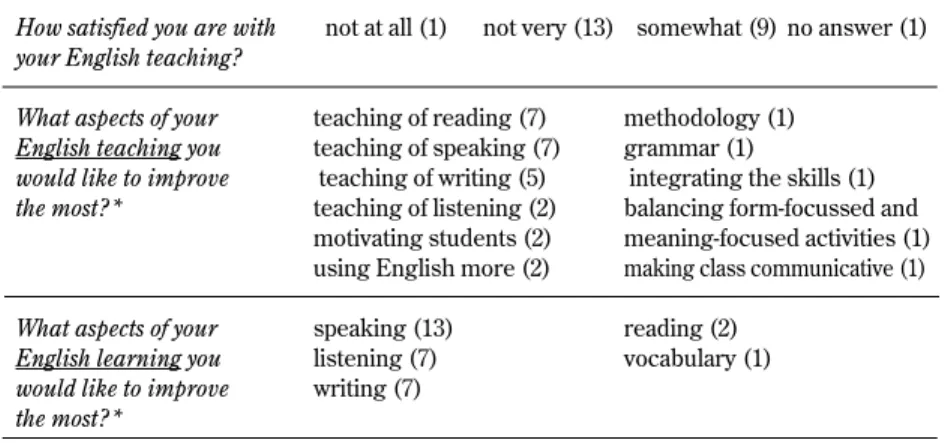
How satisfied you are with not at all (1) not very (13) somewhat (9) no answer (1) your English teaching?

What aspects of your teaching of reading (7) methodology (1) English teaching you teaching of speaking (7) grammar (1)

would like to improve teaching of writing (5) integrating the skills (1) the most?* teaching of listening (2) balancing form-focussed and

motivating students (2) meaning-focused activities (1) using English more (2) making class communicative (1) What aspects of your speaking (13) reading (2)

English learning you listening (7) vocabulary (1) would like to improve writing (7)

the most?*

* JTEs were allowed to name more than one aspect.

Despite their vast professional experience, most of the JTEs expressed a

certain degree of dissatisfaction with their English teaching. As a group, they would

most like to improve their teaching of reading, speaking, and writing. JTEs have

traditionally been noted for their exceptional knowledge of grammar and thus it

was not surprising that this particular skill was hardly mentioned. As for what they

(12)

wished to improve as far as their own English skills, speaking and then listening were the most mentioned. Overall, the responses of the JTEs are in accord with the movement (albeit imposed by the national curriculum) towards a focus on communication and meaning in the English teaching profession in Japan, and thus resonate with the goals of the KUIS seminar.

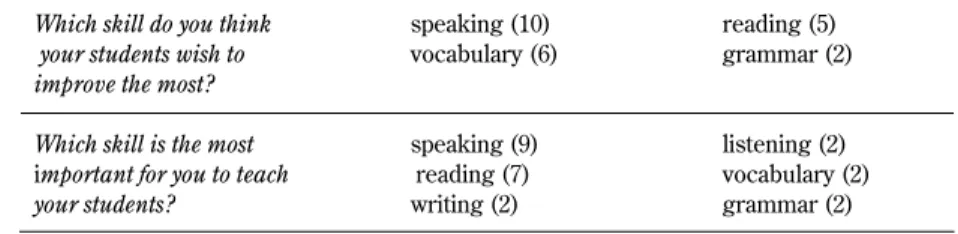
Table 3: JTEs’ Perceptions of Their Students Which skill do you think speaking (10) reading (5)

your students wish to vocabulary (6) grammar (2)

improve the most?

Which skill is the most speaking (9) listening (2)

important for you to teach reading (7) vocabulary (2)

your students? writing (2) grammar (2)

Overall, the JTEs view speaking as the most important skill for their students

as well as the most important for them to teach, with reading as the second most

mentioned. Although the JTEs thought that their students valued vocabulary, the

skill was not as important to be taught in relations to speaking and reading. On

closer breakdown of the data, however, only 7 (or 30%) of the teachers were in

agreement with their students; that is, although a JTE may think that his/her

students valued one particular skill, he/she thought that a different skill was more

important to teach. This seems to indicate a tension in the classroom between what

the students want to learn and what the teacher thinks is best to impart, which is a

perhaps challenging dynamic for the JTEs to try to negotiate. One solution, as

implied in the design of the seminar, would be to find better ways to integrate the

(13)

Team teaching typically occurs when Assistant Language Teachers (ALTs) are sent to work with JTEs in the classroom; this practice has been in place since the start of the Japan Exchange Teaching (JET) program in 1978. The above seems to indicate that most of the JTEs work with an ALT who may provide English language support and ideas for communicative activities in the classroom. The presence of the ALT, however, differs from once a week to everyday and the overall impact of having an ALT is yet to be researched. A more recent idea in Japan is to have two JTEs team teach in a classroom; this trend seems to be somewhat substantiated by the seminar participants as 29% report having this experience, implying that the JTEs within one school share their ideas and provide professional support for each other. Peer team teaching may be a good alternative or additional support in professional development for the JTEs who often complain of the lack of serious teaching training on the part of the young ALTs. The group lesson planning and demonstration project components of the seminar can be viewed as activities that facilitate peer-to-peer classroom support.

Table 4: Team-Teaching Environment

Do you team-teach with an Assistant Language yes (19) no (5) Teacher (ALT)?

Do you team-teach with other JTEs at your yes (7) no (17)

school?

(14)

Based on the information above, it seems that overall the seminar was perceived by the participants as useful. However, it remained to be seen whether the participants would take away what they learned and actively apply their knowledge upon leaving the seminar.

In order to find out how the participants fared in their professional development after completing the seminar, we contacted them in December 2009 and asked them to reply to an optional anonymous follow-up survey in English which was created by the Survey Monkey tool. A total of 11 out of the 24 JTEs replied to this 10-item survey. The most significant findings are as follows.

Question 1 asked the JTEs whether they had been trying to improve their own English skills since the seminar. All 11 responses were affirmative with the following information provided:

• I stayed in America for 2 weeks in October.

• I am more aware and open to my own development.

Table 5: Perceived Impact of the Seminar Compared with before the workshop,

how would you rate your knowledge of ways increased a little (5) increased a lot (19) to improve your own English learning?

Compared with before the workshop,

how would you rate your knowledge of increased a little (2) increased a lot (21) ways to improve your own English

teaching?*

Compared with before the workshop,

how would you rate your confidence in increased a little (7) increased a lot (17) your ability to integrate the various skills

in your teaching?

*1 person did not circle an answer

(15)

• I’ve been trying to use English.

• I listen to podcast or watch iTunes while commuting.

• I’m reading books related to English teaching.

• I’ve been studying English through more resources, such as the internet, the radio, novels, etc.

I watch English movies with English subtitles. I listen to English during my free time or while driving.

Question 2 sought to investigate whether the teachers had made any changes in their approach to English teaching. 9 indicated that they had with 2 reporting no change:

I borrowed ideas I learned at KUIS and try to put communicative activities into classes. Also, I always think about integrating the four skills in my English classes.

• I taught 7th graders with the ALT without using any Japanese. Actually my students learned more than when we use Japanese explanations

• I tend to teach English by balancing both form-focused and meaning-focused activities

• I showed some good English learning websites to my students. I am trying to introduce a variety of learning ways to students.

• I try to let students write, read, and listen to English by themselves as much as possible.

• I have been using English as much as possible in my teaching.

• I don’t have a class to teach at the moment

• I haven’t changed my approach because I have always used communicative

(16)

activities even before attending the KUIS seminar

The results of the online survey indicate that of the JTEs who responded, many are trying different methods in order to improve their own English learning. In addition, the majority of the respondents have attempted to implement teaching ideas that they learned from the KUIS seminar.

To try to gain richer data about the individual situations of the JTEs, we decided to ask the 24 seminar participants whether they would be willing and able to join a peer group discussion at KUIS in January 2011. Although 5 JTEs (2 male, 3 female) expressed a desire to participate, only 3 (1 male, 2 females) were able to make the final commitment and attend in late January. In order for the JTEs to be able to prepare in advance, they were sent a set of questions (see Appendix A) which they would have to talk about together on the day by using either English or Japanese. The discussion was divided into two parts: Part I from 10:15 – 11:15 AM and Part II from 11:30AM - 12:15 PM; both sessions took place in a small self-contained classroom and were videotaped. The JTEs were provided with lunch and an honorarium to reimburse them for their time and transportation fees.

The video recording of the peer group discussion was later transcribed and

analysed. The participants spoke much in English but at times switched to

Japanese in order to further understand each other’s ideas. Within the scope of this

paper, we provide some general background of the three JTEs and attempt to sum-

marize a few of the key points that emerged from their discussion.

(17)

All three JTEs emphasized their long-time love of English and talked about their continuous efforts to improve their own English skills. Ms. S watches movies and NHK programs in English and plays English games with her cell phone applications. She also takes English proficiency exams like STEP (Eiken) in order to understand her students’ feelings toward these types of exams. Mr. O said he would take the Test of English for International Communication Exam (TOEIC) exam for a third time. Although he does not need the test score, TOEIC provides him with motivation to study English. He also reads contemporary English novels, watches Youtube clips on occasion, and accesses e-learning websites such as the ones he was exposed to during the KUIS seminar. Ms. Y likes to practice vocabulary on Freerice, a website introduced during the seminar. She takes an English conversation class on Friday evenings taught by Church volunteers. In addition, she makes time to talk to and exchange cultural information with her Canadian ALT.

As far as their teaching, the JTEs iterated that they are dedicated to their students and they truly wish to implement communicative language teaching ideas from the KUIS seminar. At the same time, they face a number of tensions and constraints in carrying out their ideas. In his writing classes, Mr. O tries to use English and to get his students to do so as well. However, he needs to allot most of Table 6: Background Details of the JTEs Who Participated in the Peer Discussion

Ms. S Mr. O Ms. Y

number of years teaching 11 22 11

type of institution junior high senior high junior high

main students 9

th

grade 11

th

grade 7

th

grade

type of course(s) teaching now integrated skills writing integrated skills

(18)

the 45-minute class time to preparing his students for the upcoming university entrance exam. In addition, some of his colleagues at his school oppose the use of English in class (though he did not mention why). Thus, Mr. O compromises by doing quick 1 or 2 minute English speaking activities during each class period. Ms.

Y mentioned that she has had to deal with working in a troubled junior high school where students broke school property and did not sit down during class time.

She also works with students with low level of English ability who need much scaffolding for their learning. Despite this, she has managed to maintain the attitude that “students want to understand” after talking with a colleague who encouraged her to just focus on fostering some interest in English and acknowledging each student. Although most of her students say they do not like English she now tells them, “If you try to understand the directions in English, you can play the game.” Though she realizes that there is much that students have to know from the standard curriculum, she came up with a strategy to deal with this.

She writes all that the students need to know on the blackboard (in Japanese) at

the start of class each day and tells them to copy it down; then she used the rest of

the class time to work on communicative language activities and praising students

when they can do something in English. Ms. S struggles between the desire to use

English in class and her perceived need to use Japanese translations to help

students understand key points. At her school, many students do not like studying

but have to pass the entrance exam for high school. She said that if students do not

understand her English, they would not want to comply in class even during games

with ALTs. She finds it difficult to motivate her students at all, let alone get them to

learn English. Because she wants students to really understand that the purpose

(19)

makes this type of explanation in Japanese.

Despite the issues they face, the JTES have introduced to the classroom some ideas from the KUIS seminar in order to create variety and student interest. Ms. S uses online games to motivate lower ability students. Ms. Y had students conduct a survey on the topic “If you can travel to another country, where would you like to go?” and produce a pie chart of their data. She liked this type of activity because students could integrate and use all the skills of reading, speaking, listening, and writing in making a summary or presentation. Mr. O has tried 3 types of activities:

speed reading, computer assistant learning with the British Council website, and interview games, for example one in which students used the “should/shouldn’t have…” pattern to express regrets about their winter vacation. The JTEs reaffirmed that their profession is challenging but they see some progress/

success.

When asked what they thought were the most useful aspects of the KUIS seminar, Mr. O said that he was able to understand the difference between text based (form-focused) and task based (meaning focused) activities. He is now thinking a lot about how to change his teaching style to balance these two types of activities in the classroom. Ms. S mentioned regaining the motivation and stimulus to study for herself and finding out about many kinds of learning/

teaching materials. She also emphasized the importance of being able to meet

other JTEs, talk to them about their common professional situations, and hear

about their solutions to challenges. She felt she gained encouragement, renewed

energy and the mindset of a student by participating in the seminar. Ms. Y

seconded the words of Ms. S and added that even though the seminar was required

for their teaching license renewal, she has benefited and wants more of this type

(20)

of seminar.

Conclusion

In order to create a useful and positive professional development experience for the JTEs, who are required to undergo such re-accreditation processes, we followed certain principles in creating and implementing the KUIS Teachers’

License Renewal Seminar:

• Build upon and augment the JTEs’ knowledge and understanding of com- municative approaches to language teaching by having them directly expe- rience a variety of activities.

• Provide opportunities for the JTEs to reflect with their peers on how to apply such approaches/activities within their own classroom

• Encourage classroom-based action research to promote experimentation on the part of individual JTEs and to encourage self-directed inquiry concern- ing their teaching practices.

These efforts are illustrative of the ways in which the seminar has been informed by a sociocultural perspective. From our experience, this perspective has been valuable in two fundamental ways. Firstly, it reorients notions of what constitutes second language teacher education by shifting the focus from

‘transmissive models’ to more ‘reflective stances’ whereby teaching -- and learning

to teach -- is viewed as a more dynamic, complex, interactive process. Secondly, a

sociocultural approach to professional development helps to develop an

appreciation of learning as an ongoing process of socially situated inquiry

(21)

and local needs as well as to the wider social, cultural and historical contexts.

The data gathered from the participants of the 2010 seminar has provided some insight about their general background, the impact of the seminar on their English learning and teaching, as well as the challenges they may individually face in their workplace. As the Monbukagakusho continues to set national targets for English language education, for example, aiming for at least half of 9

th

graders pass the 3

rd

level of the (STEP) Eiken test and asking all high school JTEs to use only English to teach English by 2012, it becomes even more important to strive for ways to provide support and encouragement for these professionals.

References

Arani, M. R. S. & Matoba, M. (2006). Challenges in Japanese teachers’ professional development: A focus on an alternative perspective. Comparative Education in Teacher Training, 4: 107-115.

Cross, R. (2006). Identity and language teacher education: The potential for sociocultural perspectives in researching language identity. Paper presented at the Annual Conference of the Australian Association for Research in Education (AARE), Melbourne, Victoria.

Cross, R. & Gearon, M. (2004). Second language teacher education: sociocultural directions for the future. Paper presented at Annual Conference of the Australian Association for Research in Education (AARE), Adelaide, South Australia.

Day, R. (1991). Models and the knowledge base of second language teacher edu- cation. University of Hawaii Papers in ESL, 11(2): 1-13.

Honna, N. & Takeshita, Y. (2004). English education in Japan today: the impact of

changing policies. In H. Kam and R. Wong (eds.), English language teaching

in East Asia today: changing policies and practices. Singapore: Eastern

(22)

Universities Press, 195-220.

Hooghart, A. M. (2006). Educational reform in Japan and its influence on teachers’

work. International Journal of Educational Research, 45: 290-301.

Johnson, K. E. (2009). Second language teacher education: A sociocultural perspec- tive. NY: Routledge.

Kizuka, M. (2006). Professionalism in English language education in Japan.

English Language Teacher Education and Development, 9(1): 55-62.

Lamie, J. M. (2004). Presenting a model of change. Language Teaching Research, 8(2): 115-142.

Ministry of Education, Culture, Sports, Science, and Technology. (2003).

Regarding the Establishment of an Action Plan to Cultivate ‘Japanese with English Abilities.’ Available at:

http://www.mext.go.jp/english/topics/03072801.htm

Ministry of Education, Culture, Sports, Science, and Technology. (2003) The Course of Study for Foreign Languages. Available at:

http://www.mext.go.jp/english/shotou/030301.htm

Murphey, T. & Sato, K. (2006). Reality testing: teachers pass, board of education fails. The Teacher Trainer, 20(1): 12-16.

Nishino, T. & Watanabe, M. (2008). Communication-oriented policies versus classroom realities in Japan. TESOL Quarterly, 42(1), 133-138.

Porcaro, J. W. (2006). SELHi classroom perspectives. Kokusai kyoui gakubu kiyo, 2, 149-166.

Richards, J. & Nunan, D. (1990). Second language teacher education. Cambridge:

Cambridge University Press.

Sakui, K. (2004). Wearing two pairs of shoes: Language teaching in Japan. ELT Journal, 58(2), 155-163.

Shimahara, N.K. (2002). Teaching in Japan: A cultural perspective. NY: Routledge

Falmer.

(23)

Singh, G. & Richards, J. (2006). Teaching and learning in the language teacher edu- cation course room: A critical sociocultural perspective. RELC Journal, 37(2), 149-175.

Smith, R. & Imura, M. (2004). Lessons from the past: traditions and reforms. In V.

Makarova & T. Rodgers (Eds.), English language teaching: The case of japan.

(pp. 29-48). Munich: Lincom Europa.

Takanashi, Y. (2004). TEFL and communication styles in Japanese culture. Language, Culture, and Curriculum, 17(1), 1-13.

Torpey, M. (2007). Developing teachers’ confidence in their ability to teach English communicatively: A model of inservice teacher-training within a Japanese context. Studies in Linguistics and Language Education, 18, 291- 314.

Torpey, M. (2009). Second language teacher education: Supporting the professional development of Japanese teachers of English. Studies in Linguistics and Language Education, 20, 307-330.

Velez-Rendon, G. (2002). Second Language Teacher Education: A Review of the

Literature. Foreign Language Annals, 35(4), 457-467.

(24)

Appendix A: Questions for the Peer Group Discussion (Preparations Handout) The following are the information and questions that you will be asked during the group interview on January 22. Before you arrive at KUIS, please prepare your answers to these questions.

--- Please write your answers to the following

Your name ______________________________________

Number of years you have been teaching English ______________

Circle the type of school you are teaching at right now: junior high senior high other:

Circle the grade(s) you are teaching right now: 7

th

8

th

9

th

10

th

11

th

12

th

other:

Circle the type(s) of courses you are teaching right now:

integrated skills reading writing oral communication other:

--- Please write some notes (in Japanese is fine) for the following. You will use these notes to discuss with the other JTEs at the interview

Why did you decide to become an English teacher?

Are you doing anything right now to improve your own English learning? Please explain.

Are you doing anything right now to improve your English teaching? Please explain.

At your current school, what are your most difficult challenges in teaching English? Have you been able to overcome these challenges?

Have you been experimenting with new activities/teaching techniques since the 2010 KUIS Summer Seminar? Please explain.

What kinds of English learning activities generally work well in your classrooms? Why do they work well?

What kinds of English learning activities generally do not work well in your classrooms? Why do they not work well?

How successful (0% - 100%) do you think you have been this past semester at integrating the skills in your English classrooms? Please explain.

How successful (0% - 100%) do you think you have been this past semester at improving the students’ ability to communicate in English?

How successful (0% - 100%) do you think you have been this past semester at improving your

(25)

What was/were the most useful thing(s) you gained/learned from the 2010 KUIS Summer Seminar?

If you could design a Professional Development Workshop for JTEs, what specific things would you include in this workshop?

In your opinion, what other kinds of things need to be done to support the professional development of JTEs?

What are some questions you would like to ask the other JTEs attending this interview?

Table 2: Professional Development
Table 3:  JTEs’ Perceptions of Their Students Which skill do you think speaking (10) reading (5)

参照

関連したドキュメント

Compared to working adults, junior high school students, and high school students who have a 

in [Notes on an Integral Inequality, JIPAM, 7(4) (2006), Art.120] and give some answers which extend the results of Boukerrioua-Guezane-Lakoud [On an open question regarding an

Giuseppe Rosolini, Universit` a di Genova: [email protected] Alex Simpson, University of Edinburgh: [email protected] James Stasheff, University of North

Someone's intentionality (action or indication) inevitably and evidently links to other's one. Such co-ascription constructs an inter-bodily chain among these

The purpose of the Graduate School of Humanities program in Japanese Humanities is to help students acquire expertise in the field of humanities, including sufficient

Amount of Remuneration, etc. The Company does not pay to Directors who concurrently serve as Executive Officer the remuneration paid to Directors. Therefore, “Number of Persons”

JAPAN STUDIES PROGRAMS IN ENGLISH AT THE GRADUATE SCHOOL OF HUMANITIES THE INTERNATIONAL MASTER’S PROGRAM (IMAP) IN JAPANESE HUMANITIES AND THE INTERNATIONAL DOCTORATE (IDOC)