Eigenvalues and Dislocation of Lattice
by Dexie Lin
T
UNIVERSITY OF TOKYO
GRADUATE SCHOOL OF MATHEMATICAL SCIENCES
KOMABA, TOKYO, JAPAN
Eigenvalues and Dislocation of Lattice
Dexie Lin
1(Graduate School of Mathematical Sciences, The University of Tokyo) Abstract
Can one hear the shape of a drum? It proposed by Kac in 1966. The simple answer is NO as shown through the construction of iso-spectral domains. However, the method and the idea to detect the shape of the domain can be applied to many fields. In this paper, we give an analytic method to detect the dislocation of the lattice. Moreover, if the dislocation became the acute trapezoid, we give a method to distinguish the shape by getting the eigenvalue.
格子の固有値と 転位
林徳燮
(東京大学数理科学研究科)
概要
太鼓の形が聞こ えま すか
.
それは1966
年にKac
によ っ て提案さ れま し た.
簡単な答えは等スペ ク ト ル領域の構築を 通し て 示さ れる よ う にNO
です.
し かし ながら,
ド メ イ ン の形状を 検出する 方 法およ びアイ デアは,
多く の分野に適用する こ と ができ る.
本論文では,
格子の転位を 検出する た めの解析法を 与え る.
さ ら に,
転位が鋭い梯形にな っ た場合,
固有値を 求める こ と で形状を 区別す る 方法を 示し ま す.
1 Introduction
In crystallography, crystal structure is a description of the ordered arrangement of atoms, ions or molecules in a crystalline material [3]. Ordered structures occur from the intrinsic nature of the constituent particles to form symmetric patterns that repeat along the principal directions of three- dimensional space in matter. The dislocation of lattice is one of popular tops in studying the lattice, in this paper we focus on the two-dimensional lattice and show how to detect the dislocation by analysis techniques. The theory describing the elastic fields of the defects was originally developed by Volterra [9]. The term ’dislocation’ referring to a defect on the atomic scale, which was coined by Taylor [8]. Some types of dislocations can be visualized as being caused by the termination of a plane of atoms in the middle of a crystal. In such a case, the surrounding planes are not straight, however they bend around the edge of the terminating plane so that the crystal structure is perfectly ordered on either side. This phenomenon is analogous to the following situation related to a stack of paper: If half of a piece of paper is inserted into a stack of paper, the defect in the stack is noticeable only at the edge of the half sheet. In this paper, we give an analytic method to detect the dislocation and categorize the dislocation into some cases. From Oct. 2017 to Oct.
2018, the author joined the program of Mathematical science practice research(数理科学実践研究) at Graduate School of Mathematical Sciences, The University of Tokyo. During the practice, the author found the relation between eigenvalues and dislocation. The purpose of this paper is to understand the dislocation from the viewpoint of the eigenvalue or equation.
In this paper, we focus on 2-dimensional crystallography. First, we give a brief introduction to the Kac problem in mathematical viewpoint to the readers who are not so familiar with. On the plane R
2, given a bounded region Ω. If one makes drum with exactly the same shape of Ω, then we can hear the rhythms of the drum. Weyl [10] discovered the first geometric spectral invariant: If two drums sound the same, then they have the same area. Kac [6] posed a question: whether or not the drum must have the same shape? The methods used to understand this problem draw on diverse areas: e.g. partial differential equations, dynamical systems, group theory, number theory and probability.
1
[email protected]
We translate the problem into mathematical language as following: Suppose that we know all the eigenvalues 0 < λ
1< λ
2< · · · → ∞ of a bounded region Ω, i.e. each λ
isolves the equation
− ∆u = λ
iu in Ω,
u = 0 on ∂Ω, (1)
where ∆ =
∂x∂22+
∂y∂22. Then, can we determine the shape of Ω uniquely?
For example, in 1-dimensional case, as for any connected bounded set Ω of R is an interval with length l. Without loss of generality, we assume Ω = [0, l].
− ∆u = λu (0, l),
u = 0 { 0, l } . (2)
We know λ
n= (nπ/l)
2, u
n(t) = sin(
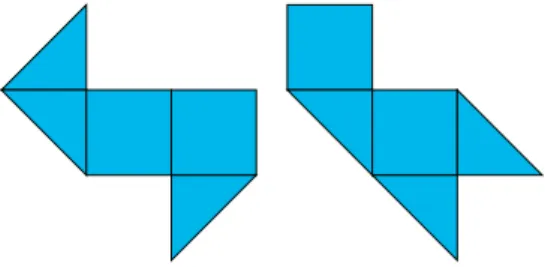
nπlt). Thus, if we get all the eigenvalues, we know the length of this region, i.e. it is uniquely determined. However, the answer is NO in 2-dimensional case. The example was given by Carol Gordon, David Webb, and Scott Wolpert [5]. The following pictures show that even though they are different, their corresponding eigenvalues are exactly the same.
Figure 1: different shapes with the same eigenvalues
In this paper, we introduce an analytic method to distinguish the shape of some special trapezoid.
For a two-dimensional lattice, by hearing the spectrum, we know the the shape, i.e. width and height of each unit. To distinguish the shapes of the dislocation, we need some assumptions:
Assumption 1 We assume that the standard crystallography is a rectangle. Moreover, we assume that dislocation becomes a trapezoid.
Under the above Assumption 1, we can distinguish the dislocations by the following Theorem.
Theorem 2 Let Ω be a bounded in region of R
2. Suppose that we know all the eigenvalues 0 <
λ
1< λ
2< · · · → ∞ , of Laplacian operator with Dirichlet boundary on ∂Ω ,i.e. each λ
isolves the following equation
− ∆u = λ
iu in Ω,
u = 0 on ∂Ω. (3)
If Ω is either acute trapezoid, isosceles trapezoid or right trapezoid, then the exact shape of Ω can be uniquely determined.
The organization of the paper is the following: in Section 2, we give a preliminary to the heat
kernel and asymptotic formula about the trace of the heat kernel, asymptotic formula about the
trace of the heat kernel and the sketch proof of Theorem 2.
2 History and sketch proof of Theorem 2
Firstly, we recall the heat kernel of the Euclidean space. The heat kernel in R
2is given by H(p, q, t) = 1
4πt exp
− dist
2(p, q) 4t
,
where dist(p, q) denotes the Euclidean distance between the two points p and q. If we take a trace, we have
∞
X
i=1
e
−λit= T r(H (p, q; t)) =: H(t).
By Weyl [1, Chapert 1], we know that H (t) ∼ A
4πt − P 8 √
πt + O(1),
where A denotes the area of Ω and P denotes the perimeter of ∂Ω. On polygon , Grieser and Maronna [4] gave an asymptotic formula,
H (t) ∼ A 4πt − P
8 √ πt + 1
24 (
n
X
i=1
π θ
i− θ
iπ ), (4)
where θ
idenotes the interior angles. Therefore, we have the following theorem.
Theorem 3 (Grieser and Maronna) Let Ω be a triangle of the 2-dimensional Euclid space R
2. Suppose that the eigenvalues of the Laplacian operator with Dirichlet boundary condition are known.
Then we can determinate the shape of Ω.
Proof For any triangle, let A denote its area, P denote its perimeter and θ
idenote the three angles for i = 1, 2, 3. The idea is straightforward. Since any triangle is uniquely determined by
θ
1θ
2θ
3Figure 2: triangle
• its area A,
• A/P
2= cot(θ
1/2) + cot(θ
2/2) + cot(θ
3/2),
•
θ11+
θ12
+
θ12
.
Together with the formula 4, we have our desired result.
However to determinate a trapezoid or a convex quadrilateral, the above conditions are not suffi- cient. On the other hand, Duistermaat and Guillemin [2] showed that the singularities of the wave trace
X
∞i=1
e
i√λit=: W (t), are contained in the length spectrum, i.e. h ∈ Sing(W (t)).
Now we give the proof of our main theorem.
Proof(of Theorem 2) We divide the proof into three cases and begin from the easiest case.
(1) Isosceles trapezoid.
b
B
l
l h
α
Figure 3: isosceles trapezoid
By the similar argument of Theorem 3, we have that: If Ω is an isosceles trapezoid and we get the eigenvalues
λ
1< λ
2, · · · ,
of the equation (3), then we know the height h, Perimeter P, and area A. Let l denote the length of a leg. By the straightforward calculation, we have that
A = 1
2 (b + B)h, h/ sin α = l.
Under the hypothesis, one gets l = 1
2 (P − 2A/h), α = sin
−1( 2h P −
2Ah), which implies that the shape of isosceles trapezoid is uniquely determined.
(2) Right trapezoid. Since one angle is known
π2, we can apply the methods to determine the b
B
l
′l
β
α
Figure 4: right trapezoid
shape, here we omit the proof.
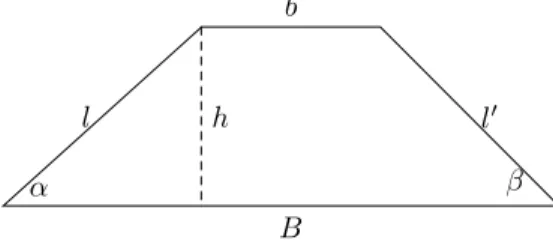
(3) For the acute trapezoid, i.e. the sum of the bottom angles is less than
π2. b
B
l
′l h
α β
Figure 5: acute trapezoid
Clearly, given the eigenvalues, we have the the following four identities:
l = h
sin α , l
′= h
sin β ,
B + b = 2A
h , l + l
′= P − (B + b).
Therefore, it suffices to determine α and β. The following lemma provides us an answer to deter- mining the bottom angles.
Lemma 4 (Lu and Rowlett [7]) Let p, q ∈ R satisfy
csc α + csc β = p,
1
α(π−α)