(2014年 3 月発行)
Beliefs of Effective Japanese Language Teachers: Results of a Questionnaire Study in
Indonesia
Reiko S ATO and Akiko K OBAYASHI
『総合政策論叢』第 27 号(2014 年 3 月)
島根県立大学 総合政策学会
Abstract
This study aims to discover the beliefs of non-native Japanese language teachers and to discuss the relationship between their beliefs and the following attributes: teaching experience, self-rated language ability, and motivation for teaching and learning Japanese. A questionnaire study was adapted and completed by 93 teachers in Indonesia.
Factor analysis shows that subject knowledge, supportive attitudes, and classroom teaching skills are perceived as beliefs that define effective language teachers. Furthermore, the relationship between these beliefs and attributes of the teachers was compared. The results showed that subject knowledge and classroom teaching skills were related to teaching experience and Japanese speaking and listening abilities. On the other hand, all three factors were related to motivation for teaching and learning Japanese.
1. Introduction
As of 2006, the Republic of Indonesia was ranked fourth highest in the world for the number of Japanese learners, where among the 272,719 Japanese learners 89.6% were in primary and secondary education (Japan Foundation, 2008). The latest data from 2009 (Japan Foundation, 2011)
Beliefs of Effective Japanese Language Teachers:
Results of a Questionnaire Study in Indonesia
Reiko S
ATOand Akiko K
OBAYASHI1. Introduction 2. Method
2. 1. The Questionnaire 2. 2. Data collection 3. Results
3. 1. Characteristics of respondents 3. 1. 1. Teachers’ biographical data 3. 1. 2. Self-rated Japanese language skills 3. 2. Teachers’ beliefs on effective language teachers 3. 3. Teachers’ beliefs and teaching experience
3. 4. Relationship between the beliefs and Japanese language ability 3. 5. Relationship between the beliefs and motivations
4. Discussion 5. Conclusion
shows that there were 716,353 Japanese learners, because of Japanese being taught as a second foreign language, among other languages such as Arabic, Chinese, French, and German from the first year of high school. This change brought about a significant increase in the number of Japanese language learners and teachers at the secondary-education level in Indonesia. Extended in-service teacher development training for non-native teachers which enhances their teaching skills and Japanese language ability were needed. However, the studies of non-native Japanese language teachers are still in the early stages (Yokoyama, 2005). More informed evidence-based research on non-native Japanese language teachers would benefit in helping to develop or improve teacher development program.
Teaching beliefs are one of the important factors which influence teachers’ teaching behavior, and the awareness of their teaching beliefs would help them become more effective teachers (Williams
& Burden, 1997). Previous studies have indicated that teachers’ beliefs develop dynamically through their teaching practices and are influenced by their circumstances. Teachers’ teaching beliefs are influenced by (a) biographical data such as age and gender (Yagi, 2003) and whether the teacher is a native or non-native speaker of the target language (Okazaki, 2001), (b) educational background and experience in instruction (Brown, 2009; Richardson, 1996), (c) knowledge of educational theory and current research trends (Bell, 2005), and (d) the country in which they teach (Kubota, 2006). These influences suggest that the teachers’ beliefs are dynamic and emergent, socially constructed, and contextually situated, experiential, and mediated (Williams & Burden, 1997).
In addition, when we focused on non-native language teachers, their self-acknowledgement about their language ability and current language-learning motivation may have also influenced their beliefs. A non-native teacher has “the perspective of both teacher and learner” (Yokoyama, 2007).
Abe and Yokoyama (1991) showed that non-native Japanese language teachers expect to learn Japanese more than educational theory or teaching methods in a teacher-training course regardless of their Japanese language proficiency. Therefore, it can be presumed that non-native teachers’
perception toward Japanese language learning is related to their beliefs about effective language teachers.
The current study seeks to explore non-native language teachers’ beliefs about effective language teachers, with focus on teachers’ attribute and self-acknowledgements, by asking the following questions:
(i) What are the beliefs of Indonesian teachers regarding an effective Japanese language teacher?
(ii) What is the relationship between teachers’ beliefs and their teaching experience as one of their attributes or self-acknowledgements (self-rating of language ability and their motivation to teach and learn the target language)?
2. Method
2. 1. The Questionnaire
To examine the beliefs of non-native teachers in Indonesia about effective Japanese language teachers, a questionnaire developed by Sato and Watanabe (2007) was used, which investigated
Beliefs of Effective Japanese Language Teachers: Results of a Questionnaire Study in Indonesia
the beliefs of effective language teachers as perceived by Japanese language learners from five countries in East Asia and Southeast Asia. This questionnaire was modified to match Japanese language education overseas and covered both characteristics of Japanese language teachers and teaching methods. A series of their studies found that the effective language teachers need to have a good understanding of Japanese culture and practical teaching skills, including teacher-student interaction skills, creating a positive classroom atmosphere, and responding to students (Watanabe, Sato, Kano & Nuibe, 2006; Sato & Watanabe, 2007).
The respondents completed a questionnaire, which consisted of two main parts. The first section (41 items) asked them to rank the extent to which outstanding Japanese language teachers should possess specific qualities on a four-point Likert scale [1 (not true) to 4 (very true)]. The second section dealt with personal information: gender, first language, teaching institution, the length of their teaching experience, major, self-rated Japanese language ability (speaking, writing, listening, and reading, which were rated on a four-point Likert scale), motivation for teaching (“How much do you like teaching Japanese?”), and motivation for improving their target language ability (“How eager are you to learn Japanese?”).
2. 2. Data collection
The participants in this study were non-native Japanese language teachers in Indonesia (including part-time teachers). Data were collected between October 2007 and January 2008. The questionnaire was prepared in Indonesian and distributed at high school teacher-development workshops that were organized by teachers’ associations in Jakarta and West Java area. These were the most economically developed regions in Indonesia, and many Japanese companies have expanded their business in these regions. The participants returned the questionnaires by mail. The questionnaire was also sent to eleven universities which had Japanese language courses via e-mail. Survey data were quantitatively analyzed using the statistical package Predictive Analytics Software (PASW) Statistics, version 17.0.
3. Results
3. 1. Characteristics of respondents
A total of 109 questionnaires were returned. Incomplete questionnaires were removed, and consequently 93 questionnaires were analyzed.
3. 1. 1. Teachers’ biographical data
71 of 93 were from high school teachers associations. 12 of these 71 teachers taught Japanese not only at the high schools but also at other institutions (junior high school (n=1), polytechnic (2), university (4), career college (3), others (4); multiple answers were allowed). Of the remaining teachers, 22 were from universities, and 5 taught at universities and other institutions (elementary school (1), high school (1), career college (3)).
Eighty percent of the teachers were female; however, there were more female high school teachers (90.0%) than in universities (45.5%). The average teaching experience they had was 10.5 years,
and university teachers had more teaching experience than high school teachers, 17.6 years and 8.3 years, respectively.
Ninety-six percent of the teachers’ majors were related to Japanese language: Japanese language, Japanese language education, and Japanese literature. The most frequent major was the “Japanese language” (55.9%), and only 19.4% of the teachers had majored in Japanese language education.
3. 1. 2. Self-rated Japanese language skills
Regarding the means (SDs) of the self-rated Japanese language skills on the four-point Likert scale, speaking was 2.62 (0.64), listening was 2.59 (0.61), writing was 2.72 (0.56), and reading was 2.78 (0.49). The relations among self-rated Japanese language skills (speaking, listening, writing, and reading) were analyzed using one-way ANOVA. The results showed marginally significant differences across language skills [F(3,368) = 2.21, p = .09]. The mean score of the four skills indicated that teachers rated their speaking and listening skills lower than their reading and writing skills.
3. 2. Teachers’ beliefs on effective language teachers
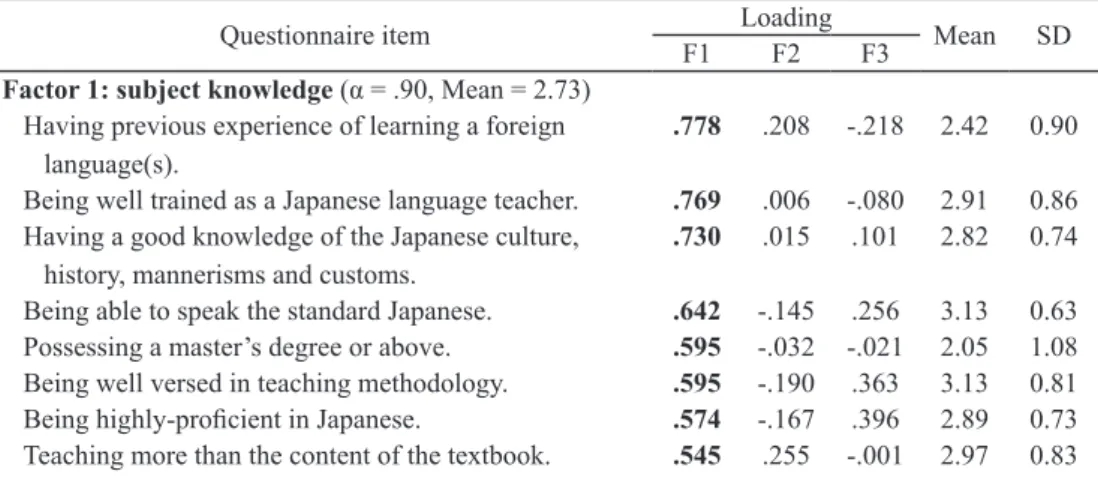
Exploratory factor analysis (maximum likelihood, promax rotation) was used to explore the underlying factor structure of the teachers’ beliefs. Items with loadings less than .40 were not included in the component interpretation and cross-loading items were eliminated. Three factors (31 items) of underlying beliefs on the characteristics of effective language teachers were identified.
Table 1 shows the factor loadings for the three factors.
The first factor (13 items) was labeled “Subject knowledge” and contained items that address the quality of professional teachers, including knowledge about the Japanese and language skills. The second factor (10 items) was labeled “Supportive attitude” because the items reflected teachers’
support to enhance students’ innate motivation. The third factor (8 items) was labeled “Classroom teaching skills” because it contained items addressing beliefs toward the classroom and the teaching style. Furthermore, factor correlation coefficients between the three factors were positive. In other words, teachers recognized that teachers’ subject knowledge, teaching skills, and supportive attitude should work together for effective teaching.
Table 1 Factor loadings for beliefs on effective language teachers
Questionnaire item F1 LoadingF2 F3 Mean SD
Factor 1: subject knowledge (α = .90, Mean = 2.73) Having previous experience of learning a foreign language(s).
.778 .208 -.218 2.42 0.90 Being well trained as a Japanese language teacher. .769 .006 -.080 2.91 0.86 Having a good knowledge of the Japanese culture,
history, mannerisms and customs.
.730 .015 .101 2.82 0.74 Being able to speak the standard Japanese. .642 -.145 .256 3.13 0.63 Possessing a master’s degree or above. .595 -.032 -.021 2.05 1.08 Being well versed in teaching methodology. .595 -.190 .363 3.13 0.81 Being highly-proficient in Japanese. .574 -.167 .396 2.89 0.73 Teaching more than the content of the textbook. .545 .255 -.001 2.97 0.83
Beliefs of Effective Japanese Language Teachers: Results of a Questionnaire Study in Indonesia
Having a good knowledge of world affairs. .543 .275 -.126 2.48 0.77
Having a sense of professionalism. .539 -.038 .083 2.76 0.84
Being able to analyze the Japanese language objective. .508 .103 .149 3.08 0.65 Having a good knowledge of classical Japanese
language.
.444 .135 .062 2.03 0.71
Being an experienced teacher. .437 .036 -.021 2.77 0.81
Factor 2: supportive attitude (α = .85, Mean = 3.36)
Praising and encouraging students. -.251 .727 .207 3.54 0.52
Being willing and able to answer students' question. -.067 .653 .288 3.56 0.50
Having a sense of humor. .208 .641 -.219 3.19 0.73
Being warm-hearted, considerate and kind. .077 .592 .163 3.45 0.58 Being willing to accept students' ideas and
suggestions.
.094 .572 -.019 3.49 0.50 Trying not to perplex or ridicule students when they
have made mistakes.
-.210 .544 .214 3.55 0.52 Being willing to talk with students about matters other
than the Japanese language.
.200 .502 -.194 3.05 0.73 Creating a warm and friendly atmosphere in the class. -.013 .490 .198 3.40 0.53
Being patient. .187 .434 .053 3.32 0.66
Accept students’ feelings. .262 .432 -.169 3.08 0.63
Factor 3: classroom teaching skills (α = .85, Mean = 3.34) Being able to make up tests according to students’
achievement and to analyze the results statistically.
.076 -.135 .713 3.26 0.59 Making the class interesting and fun. .072 .027 .667 3.51 0.54
Being diligent. -.179 .200 .664 3.55 0.52
Being able to explain clearly when students do not understand.
.139 -.050 .644 3.30 0.62 Teaching at an appropriate pace according to the
students' progress.
.169 .050 .561 3.35 0.60 Having a sound linguistic knowledge of Japanese. .253 .101 .443 3.12 0.69 Encouraging students to speak Japanese as often as
possible.
-.036 .367 .420 3.47 0.56 Being a qualified teacher of Japanese. -.046 .153 .401 3.16 0.71
Factor correlation F1 F2 F3 F2 0.44
F3 0.58 0.49 Note 1 = strongly disagree, 4 = strongly agree, α = Cronbach’s alpha
3. 3. Teachers’ beliefs and teaching experience
The correlation between the three factors of beliefs and the number of years participants have been teaching was examined. “Subject knowledge” (r = .31) and “classroom teaching skills”(r
= .22) had a weak correlation with teaching experience. In other words, the teachers with more experience tended to agree on the importance of “subject knowledge” and “classroom teaching skills”. However, “supportive attitude” had no significant correlation with teaching experience.
3. 4. Relationship between the beliefs and Japanese language ability
The relation between the three factors of beliefs and self-rated Japanese language abilities was
examined. The correlation coefficients are presented in Table 2. The correlation matrix presents several significant relationships among individual variables. “Subject knowledge” showed a weak correlation with speaking and listening skills. “Classroom teaching skills” also had a very weak correlation with speaking and listening skills. We interpreted these findings to mean that teachers’
awareness of their own abilities in oral communication skills, such as speaking and listening, may relate to their beliefs of effective language teachers. One possible interpretation was based on the
“subject knowledge” factor, which included a question about speaking skills. The teachers who were aware of their high oral language ability may have tended to agree that effective language teachers should be able to speak Japanese well. “supportive attitude” had no correlation with any of the four language skills. This finding suggests that the beliefs about “supportive attitude” that enhance students’ motivation, such as praising and encouraging students, was independent from the teachers’ Japanese language ability.
Table 2 Correlation between beliefs and Japanese language ability Self-rated Japanese language skills
Speaking Listening Writing Reading
Subject knowledge .34** .35** .12 .20
Supportive attitude .03 .16 -.07 .01
Classroom teaching skills .28** .28** .04 .12
**p<.01, *p<.05
3. 5. Relationship between the beliefs and motivations
The correlation between the beliefs and motivations for teaching and learning Japanese was examined, as outlined in Table 3. The motivation for teaching was addressed by asking whether the participants liked teaching Japanese, and the results showed a weak correlation with all three factors. The eagerness to learn Japanese had a weak correlation with classroom teaching skills.
These results suggest that motivations for teaching and improving their own language ability are related to perceptions of effective Japanese language teachers.
Table 3 Correlation between beliefs and motivations
Teaching Japanese Learning Japanese
Subject knowledge .25* .22*
Supportive attitude .22* .28**
Classroom teaching skills .30** .28**
**p<.01, *p<.05 4. Discussion
As previously stated, the answer to the first research question revealed several underlying factors that comprise teachers’ beliefs. The results suggested that there were several aspects to teachers’
beliefs: “subject knowledge”, “supportive attitude”, and “classroom teaching skills”. Sato and Watanabe (2007), using the same questionnaire, showed that effective language teachers (a) have practical teaching skills, (b) are able to create a positive classroom atmosphere, (c) respond to
Beliefs of Effective Japanese Language Teachers: Results of a Questionnaire Study in Indonesia
learners, and (d) understand the target culture. Practical teaching skills and creating a positive classroom atmosphere were integrated into “classroom teaching skills” in the current study;
responding to the learner was similar to “supportive attitude”; and understanding the target culture was considered “subject knowledge”. The number of factors in the current study was relatively small, but the way the factors were structured was relatively similar.
The second research question was, “What is the relationship between teachers’ beliefs and their teaching experience or self-acknowledgements? The results indicated that the length of teaching experience has a weak correlation with “subject knowledge” and “classroom teaching skills”, but not with “supportive attitude”. It can be presumed that the teachers with longer experience focused more on “subject knowledge” and “classroom teaching skills”.
An interesting result was obtained by analyzing the relation between the participants’ beliefs and their self-acknowledgements. Result on teachers’ self-rated Japanese language abilities, only speaking and listening abilities indicated a weak correlation with “subject knowledge” and
“classroom teaching skills”, but not with “supportive attitude”. Teachers who evaluated their speaking and listening abilities as high tended to emphasize more on subject knowledge and better teaching skills in effective language teachers. On the other hand, teachers’ beliefs to target language ability may not relate learners’ motivation with a “supportive attitude”.
One important finding was that teachers’ motivation for teaching and learning Japanese may relate to all three factors of beliefs, including “supportive attitude”. This indicates that teachers who had a higher motivation toward teaching seemed to have higher expectations for effective language teachers compared to less motivated teachers. Non-native language teachers were considered to be language learners even after becoming teachers, as their eagerness to learn Japanese showed a weak relation to all three factors. This result suggests that willingness to learn the target language is a part of being a more effective language teacher.
5. Conclusion
This study aims to discover the beliefs of non-native Japanese language teachers in Indonesia and to discuss the relationship between their beliefs and teaching experience, self-rated language ability, and motivation for teaching and learning Japanese. The results showed that there were three factors concerning beliefs about effective language teachers: subject knowledge, supportive attitudes, and classroom teaching skills. Furthermore, subject knowledge and classroom teaching skills had a weak relation to teaching experience and Japanese speaking and listening abilities. On the other hand, motivation for teaching and learning Japanese were related to the all three beliefs of effective language teachers. This result suggests that non-native teachers may take advantages of their learning experience and apply it to their teaching. It has been proposed that a course aiming for teachers to improve their language skills should be integrated into the teacher-development program for non-native language teachers (Yokoyama, 2007). For instance, Yokoyama (2007) reported that non-native Japanese language teachers’ beliefs about teaching were changed by experiencing a new teaching method as a learner. It is crucial to offer an environment in which non-native teachers maintain a motivation to learn and experience various teaching methods as a learner. In order to
support teacher development, it is necessary to enhance in-service training to maintain teachers’
motivation for teaching and also learning Japanese.
This study has some limitations. First, our results are based on self-reported perceptions of Japanese language teachers in Indonesia. Hence the generalizability of our findings may be limited to this group. Second, high school teachers in this study were participants in teacher development workshops. This may limit the reliability of our findings because of the possibility that the teachers could provide a more positive picture of effective teachers than other teachers. Third, the number of participants wasn’t enough to compare their attributes using more reliable statistical methods.
Therefore, additional studies are required to test and confirm the study’s findings among high school Japanese language teachers.
Acknowledgements
We would like to thank the Japan Foundation, Jakarta for the assistance in collecting the data for this study, and the teachers who participated in the study. This research was supported by JSPS
"Grant-in-Aid for Scientific Research (B) 18320084".
References
Abe, Y., & Yokoyama, N. (1991). Proposals for non-native teachers of the Japanese: Language for better teaching. Japan Foundation Japanese-Language Institute, Urawa Bulletin, 1, 53-74. (Japanese).
Bell, T.R. (2005). Behaviors and attitudes of effective foreign language teachers: Results of a questionnaire study. Foreign Language Annals, 38(2), 259-270.
Brown, A.V. (2009). Students' and teachers' perceptions of effective foreign language teaching: A comparison of ideals. The Modern Language Journal, 93, 46-60.
Japan Foundation (2008). Survey on Japanese-Language Education Abroad 2006. Bonjinsha. (Japanese).
Japan Foundation (2011). Survey on Japanese-Language Education Abroad 2009. Retrieved April 1, 2012, from http://www.jpf.go.jp/e/japanese/survey/result/index.html
Kubota, Y. (2006). Factor analysis of non-native Japanese teachers’ beliefs: Accuracy-oriented and expressiveness-oriented. Journal of Japanese Language Teaching, 130, 90-99. (Japanese).
Okazaki, T. (2001). Perspectives of native and non-native teachers on language education: A case study of teachers of Japanese in Japan and China. Journal of Japanese Language Teaching, 130, 110-119. (Japanese).
Richardson, V. (1996). The Role of attitudes and beliefs in learning to teach. In J. Sikula (Ed.), Handbook of Research on Teacher Education. New York: Macmillan, 102-119.
Sato, R., & Watanabe, T. (2007). Behavioral characteristics of outstanding Japanese language teachers toward university students in five counties of Asia: Differences in language learning experience. Journal of International Students’ Education, 12, 1-7. (Japanese).
Watanabe, T., Sato, R., Kano, F., & Nuibe, Y. (2006). Empirical research on the behavioral characteristics of outstanding Japanese language teachers: From the standpoint of JFL learners at the secondary and tertiary levels in New Zealand. The Bulletin of Japanese Curriculum Research and Development, 29(1), 59-68.
(Japanese).
Williams, M., & Burden, R.L. (1997). Psychology for Language Teachers: A Social Constructivist Approach.
Cambridge: Cambridge University Press.
Yagi, K. (2003). Occupational images held by Instructors of Japanese as a second language. The Japanese Journal of Language in Society, 5(2), 3-19. (Japanese).
Yokoyama, N. (2005). Research on second language teacher education: With a focus on in-service non-native language teachers. The Japan Foundation Japanese-Language Education Bulletin, 1, 1-19. (Japanese).
Beliefs of Effective Japanese Language Teachers: Results of a Questionnaire Study in Indonesia
Yokoyama, N. (2007). The Influence of target language learning on language learning and teaching beliefs for non-native language teachers: An empirical study on in-service education through listening instruction.
Journal of Japanese Language Teaching, 132, 98-107. (Japanese).
KEYWORDS: non-native language teachers, effective Japanese language teachers, self-rated Japanese language ability, motivation
(Reiko SATO, Akiko KOBAYASHI)