16
Published by Research Institute for Humanity and Nature Proceedings of the Online International Symposium on the Sanitation Value Chain 2020 (SVC2020)
https://doi.org/10.34416/svc.00031
Sanitation Value Chain Vol. 5 (1) pp.016–017, 2021
* Correspondence
[email protected]
Applying an Integrated Framework for
Improving Sanitation Uptake and Sustainability in Rural Karangasem, Bali
Ni Made Utami DWIPAYANTI
1*
1
School of Public Health, Udayana University, Indonesia
Keywords: integrated frameworks, sanitation, rural, determinants, uptake, sustainability
An effective sanitation system is vital for public health and the environment, as poor sanitation is a key contributor to a high burden of diarrhoea and hygiene- related diseases and environmental pollution. Yet 2.4 billion people in developing countries are without access to sanitation facilities. The challenges lie in the complex nature of sanitation issues from uptake to sustainability, which requires a multi-disciplinary solution. This paper applied an analytical tool “Integrated Framework for Sanitation Service” (IFSS) developed in this study to combine health promotion and engineering perspectives in order to examine a complete sanitation system from uptake to sustainability. Using an ecological public health promotion approach, this framework examines the determinants at all levels from the individual level to the structural level. While the engineering perspective of a complete sanitation system considers the needs for accelerating sanitation uptake and also for ensuring the sustainability of a sanitation system. The paper was based on a case study conducted in rural Karangasem, Bali that using a mix method approach by conducting a survey on 200 households and interviews with multilevel stakeholders. Using the IFSS framework, determinants of sanitation uptake and sustainability were identified and comprehensive strategies were developed.
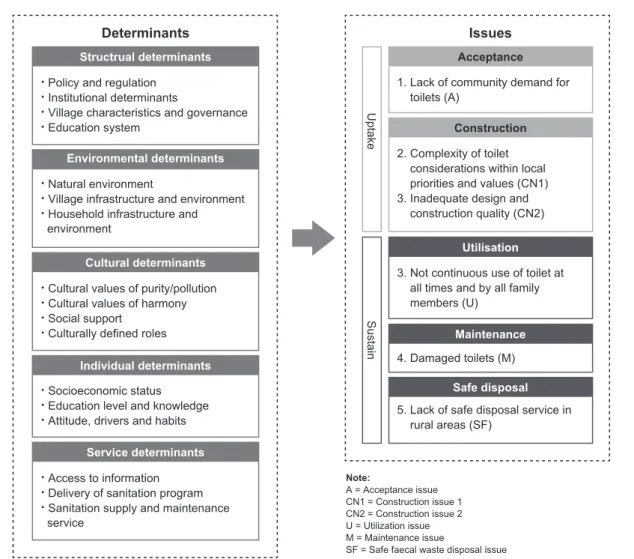
The analysis shows the main issues of sanitation uptake in study areas, which relate to lack of demand, complexity and inadequate construction quality as well as sustainability issues that relate to non-continuous use of the facility, damage to the facilities and lack of safe waste disposal practice (Figure 1). The analysis also illustrates the intertwined determinants across the five ecological categories and across the sanitation value chain (Figure 1).
Uptake of sanitation practice includes the stage of accepting the practice and constructing the facility. At the acceptance stage, the communities in study areas had little demand for a toilet. Lack of demand is a common issue highlighted in sanitation literature which has led sanitation interventions to focus on software aspects of people’s perceptions and needs (e.g., Cole et al. 2012). Those who are motivated to build toilets sometimes face the issue of complexity of toilet considerations that relate to local priorities and values. Local values and customs are frequently stronger in rural areas and create significant issues concerning sanitation practices which are highly embedded in the culture (Akpabio 2012). The construction of toilets in rural areas also has an issue of low quality in terms of proper design and strength to ensure adequate and long-term use and function. Further, sustaining the sanitary practice includes continuous use and maintenance of the facility, and ensures safe disposal or reuse of the waste. At the utilization stage, the built toilets are sometimes not being used throughout the year by all family members. This means that the practice of sanitation is not yet universal and sustained (Potter et al. 2011).
In regards to maintenance, a few toilets were found to be damaged due to clogging, natural disaster or cultural reasons. Moreover, currently no plan has been prepared for rural areas in regards to the promotion and provision of maintenance and safe disposal services.
Oral presentation
17
Proceedings of the Online International Symposium on the Sanitation Value Chain 2020 (SVC2020)
Sanitation Value Chain Vol. 5 (1) pp.016–017, 2021
These interrelated determinants also suggest that sanitation professionals should pay more attention to cultural values and the community structure in addition to the attention to the individual capacities in order to improve the program’s effectiveness. The recommended strategies include improving policies and guidelines to facilitate collaboration, working with cultural values and norms, and improving supply and maintenance services to meet local needs.
References
Akpabio, E. M. 2012. Water meanings, sanitation practices and hygiene behaviours in the cultural mirror: a perspective from Nigeria. Journal of Water Sanitation and Hygiene for Development 2(3): 168–181. https://doi.
org/10.2166/washdev.2012.073
Cole, B., Pinfold, J., Ho, G. and Anda, M. 2012. Investigating the dynamic interactions between supply and demand for rural sanitation, Malawi. Journal of Water Sanitation and Hygiene for Development 2(4): 266–278.
https://doi.org/10.2166/washdev.2012.014
Potter, A., Klutse, A., Snehalatha, M., Batchelor, C., Uandela, A., Naafs, A., Fonseca, C. and Moriarty, P. 2011.
Assessing Sanitation Service Levels. IRC International Water and Sanitation Centre, Hague.
Policy and regulation
Institutional determinants
Village characteristics and governance
Education system
Determinants Issues
Structrual determinants
1. Lack of community demand for toilets (A)
Acceptance
2. Complexity of toilet considerations within local priorities and values (CN1) 3. Inadequate design and construction quality (CN2)
Construction
3. Not continuous use of toilet at all times and by all family members (U)
Utilisation
4. Damaged toilets (M) Maintenance
5. Lack of safe disposal service in rural areas (SF)
Note:
A = Acceptance issue CN1 = Construction issue 1 CN2 = Construction issue 2 U = Utilization issue M = Maintenance issue
SF = Safe faecal waste disposal issue
Safe disposal
Natural environment
Village infrastructure and environment
Household infrastructure and environment
Environmental determinants
Cultural values of purity/pollution
Cultural values of harmony
Social support
Culturally defined roles Cultural determinants
Socioeconomic status
Education level and knowledge
Attitude, drivers and habits Individual determinants
Access to information
Delivery of sanitation program
Sanitation supply and maintenance service
Service determinants
UptakeSustain