
• 検索結果がありません。

KATOH New

N/A
N/A
Protected

Academic year: 2021

シェア "KATOH New"

Copied!
7
0
0

読み込み中.... (全文を見る)

全文

(1)

NTUT Education of Disabilities, 2006 Vol. 5

Implementation and Impact of Japanese New National Curriculum Standards on Education in Schools for the Blind

and Schools for the Deaf

KATOH Hiroshi

Research and Support Center on Higher Education for the Hearing and Visually Impaired Tsukuba University of Technology

4-12-7 Kasuga, Tsukuba-shi, Ibaraki-ken, 305-8521 Japan

Abstract: The Japanese Government reformed the national curriculum standards of K-12 and schools for children with impairments to help all children to be sound members of society living independently in the 21st century. As far as the upper-secondary level is concerned, a new curriculum had been adopted since the 2003 school year. We conducted a survey of the achievements of the new curriculum, and also an evaluation of the new system from teachers in schools for the blind and schools for the deaf. The survey was carried out from October to December of 2004. Survey forms were delivered to all upper-secondary level schools for the blind and for the deaf. Forty-five of the sixty schools for the blind and fifty-three of the sixty nine schools for the deaf answered. There are broad discrepancies in the adoption rate of elective subjects in various academic areas between schools.

Teachers certainly appreciated the new curriculum in that it helped students develop their individualities. At the same time however, they do not expect to see the new system yielding strong educational improvements, but are expecting improvement from the new university for the hearing and visually impaired, Tsukuba University of Technology.

Key Words: Reform of the National Curriculum Standards , Schools for the Blind, Schools for the Deaf, Teachers' Evaluation for the Education Reform

1. Introduction

The Curriculum Council of Japan received an inquiry from the Minister of Education in August 1996 about "reform of the national curriculum standards of kindergarten, elementary school, lower and upper secondary schools and schools for the visually disabled, the hearing impaired and the otherwise disabled". The Council comprehensively discussed this and reached the conclusion that the national curriculum standards should be reformed. Targets of the new curriculum are helping children's well- balanced development and how to educate them to be sound members of the nation and the society living independently in the 21st century. [1-5]

In conjunction with this reform, the Ministry of Education, Culture, Sports, Science and Technology (MEXT) carries out the education for the disabled from

"special education," which means providing education at special places depending on

(2)

disabled pupils and students. Thus, MEXT promotes that disabled children will be able to acquire the necessary knowledge and skills to achieve their independence and

participate in the society. [6]

Coincidentally, the new national university for the deaf and the blind, Tsukuba University of Technology was launched as a higher education institution exclusively for the hearing or visually impaired. Future contributions to education for the disabled are

expected from this new university.

2. Purpose of the Research

The new national curriculum has been carried out from the school year of 2003 in upper-secondary level schools for the disabled. This curriculum forced some new concepts, e.g., selected contents of subjects, correspondence to information society, cultivating the "zest for living" such as ability to learn and think independently in the 21st century. Schools all over the country were required to implement the concurrent operation of the old and this new curriculum system in the school. On the other hand, the slimming of subject contents invites the criticism that this will provoke the deterioration of students' scholastic abilities

In this transitional phase, as well as for the practical attainment of the new curriculum, we would like to know how teachers realize the concepts of the new curriculum and what they feel are the practical difficulties in implementation of the new system. Additionally, we will ask what expectations or requests they have for the new national university for the deaf and the blind, Tsukuba University of Technology, as a university their graduates will be expected to go on to.

2.1. Survey Procedure

The research was based on a survey. We sent a questionnaire to the principals of upper-secondary level schools for the deaf and for the blind across the country in October, 2004. Answers were collected by the middle of December.

The questionnaire consisted of questions related to, "attainment of new curriculum",

"evaluation of the reform of the national curriculum", and "expectations and requests for our new university."

3. Results and Discussion

Forty-five schools of the sixty schools for the blind and fifty-three schools of the sixty nine schools for the deaf answered. Percentages df collection are 75% for- schools for the blind and 76.8% for schools for the deaf. Respondents were principals, head

teachers, etc.

3.1. The Attainments of New Curriculum in Schools for the Deaf and Schools for the Blind

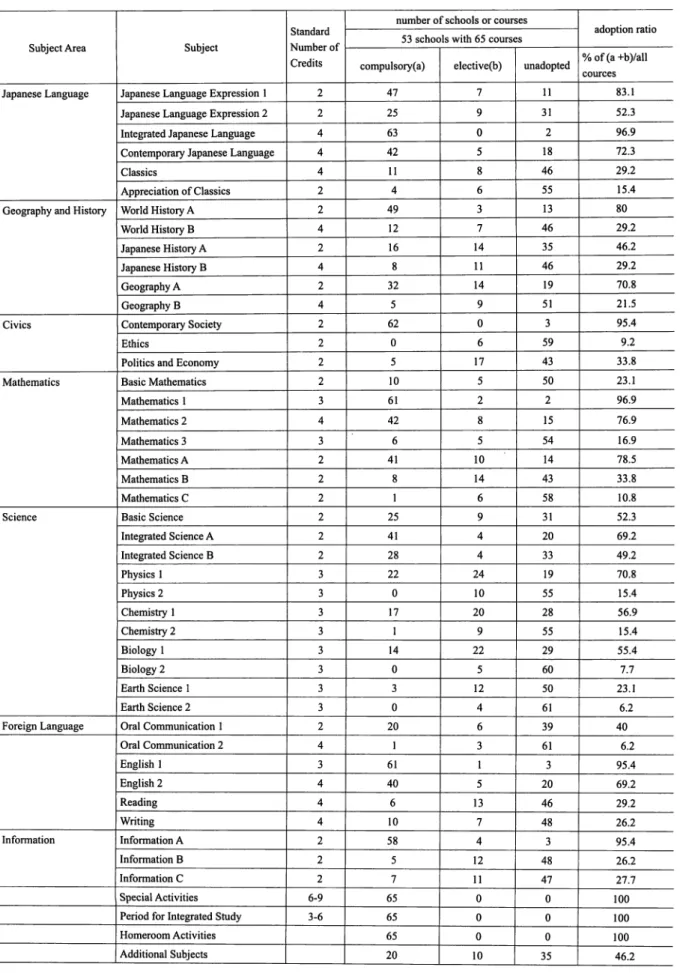
Under the new curriculum, the adoption ratio of each academic subject of schools for the deaf and for the blind is shown in Table 1 and Table 2 respectively. There is big difference in adoption in terms of subjects in the same area for both schools for the deaf and for the blind.

2

(3)

Implementation and Impact of Japanese New National Curriculum Standards on Education in Schools for the Blind and Schools for the Deaf

Table 1 Adoption Ratios of Subjects of Schools for the Deaf

Subject Area

Japanese Language

Geography and History

Civics

Mathematics

Science

Foreign Language

Information

Subject

Japanese Language Expression 1 Japanese Language Expression 2 Integrated Japanese Language Contemporary Japanese Language Classics

Appreciation of Classics World History A World History B Japanese History A Japanese History B Geography A Geography B Contemporary Society Ethics

Politics and Economy Basic Mathematics Mathematics 1 Mathematics 2 Mathematics 3 Mathematics A Mathematics B Mathematics C Basic Science Integrated Science A Integrated Science B Physics 1

Physics 2 Chemistry 1 Chemistry 2 Biology 1 Biology 2 Earth Science 1 Earth Science 2 Oral Communication 1 Oral Communication 2 English 1

English 2 Reading Writing Information A Information B Information C Special Activities Period for Integrated Study Homeroom Activities Additional Subjects

Standard Number of Credits

2 2 4 4 4 2 2 4 2 4 2 4 2 2 2 2 3 4 3 2 2 2 2 2 2 3 3 3 3 3 3 3 3 2 4 3 4 4 4 2 2 2 6-9 3-6

number of schools or courses 53 schools with 65 courses

compulsory(a)

47 25 63 42 11 4 49 12 16 8 32 5 62 0 5 10 61 42 6 41 8 1 25 41 28 22 0 17 1 14 0 3 0 20 1 61 40 6 10 58 5 7 65 65 65 20

elective(b)

7 9 0 5 8 6 3 7 14 11 14 9 0 6 17 5 2 8 5 10 14 6 9 4 4 24 10 20 9 22 5 12 4 6 3 1 5 13 7 4 12 11 0 0 0 10

unadopted

11 31 2 18 46 55 13 46 35 46 19 51 3 59 43 50 2 15 54 14 43 58 31 20 33 19 55 28 55 29 60 50 61 39 61 3 20 46 48 3 48 47 0 0 0 35

adoption ratio

%of(a+b)/all

cources

83.1 52.3 96.9 72.3 29.2 15.4 80 29.2 46.2 29.2 70.8 21.5 95.4 9.2 33.8 23.1 96.9 76.9 16.9 78.5 33.8 10.8 52.3 69.2 49.2 70.8 15.4 56.9 15.4 55.4 7.7 23.1 6.2 40

6.2

95.4

69.2

29.2

26.2

95.4

26.2

27.7

100

100

100

46.2

(4)

Subject Area

Japanese Language

Geography and History

Civics

Mathematics

Science

Foreign Language

Information

Subject

Japanese Language Expression 1 Japanese Language Expression 2 Integrated Japanese Language Contemporary Japanese Language Classics

Appreciation of Classics World History A World History B Japanese History A Japanese History B Geography A Geography B Contemporary Society Ethics

Politics and Economy Basic Mathematics Mathematics 1 Mathematics 2 Mathematics 3 Mathematics A Mathematics B Mathematics C Basic Science Integrated Science A Integrated Science B Physics 1

Physics 2 Chemistry 1 Chemistry 2 Biology 1 Biology 2 Earth Science 1 Earth Science 2 Oral Communication 1 Oral Communication 2 English 1

English 2 Reading Writing Information A Information B Information C Special Activities Period for Integrated Study Homeroom Activities Additional Subjects

Number of Credits

2 2 4 4 4 2 2 4 2 4 2 4 2 2 2 2 3 4 3 2 2 2 2 2 2 3 3 3 3 3 3 3 3 2 4 3 4 4 4 2 2 2 6-9 3-6

45 schools with 59 courses

compulsory(a)

27 8 53 34 21

0 30 27 20 12 25 3 52 4 10 11 52 29 3 35 7 0 18 42 32 3 0 20 0 38 4 0 0 44 7 52 34 11 4 51 2 1 57 57 57 8

elective(b)

11 14 2 8 8 6 4 4 12 11 10 8 1 6 7 3 2 13 1 9 8 3 0 2 0 17 7 22 8 16 17 11 5 7 6 3 9 9 8 3 6 5 0 0 0 14

unadopted

21 37 4 17 30 53 25 28 27 36 24 48 6 49 42 45 5 17 55 15 44 56 41 15 27 39 52 17 51 5 38 48 54 8 46 4 16 39 47 5 51 53 2 2 2 37

%of(a+b)/all

cources
64.4

37.3

93.2

71.2

49.2

10.2

57.6

52.5

54.2

39

59.3

18.6

89.8

16.9

28.8

23.7

91.5

71.2

6.8

74.6

25.4

5.1

30.5

74.6

54.2

33.9

11.9

71.2

13.6

91.5

35.6

18.6

8.5

86.4

22

93.2

72.9

33.9

20.3

91.5

13.6

10.2

96.6

96.6

96.6

37.3

(5)

Implementation and Impact of Japanese New National Curriculum Standards on Education in Schools for the Blind and Schools for the Deaf

Subsequently we describe some characteristics of difference in adoption of subjects between schools for the deaf and the blind. In Japanese subjects, adoption rate of

"Japanese Language Expression 1", "Integrated Japanese Language", and

"Contemporary Japanese Language" are high both in schools for the deaf and for the blind. In addition, schools for the deaf give more time for Japanese language education than schools for the blind.

In geography and history subjects, it is remarkable both with "World History",

"Japanese History" together in schools for the blind and for the deaf, adoption rate of an "A" subject is high. Generally, regular high schools tend to adopt a "B" subject in this subject area because of the advantage for university entrance examinations.

Adoption of "Contemporary Society" is most popular in area of subjects for civics, on the other side adopting "Ethics" and "Politics and Economy" is the minority.

In terms of mathematics area students in most schools for the blind and for the deaf learn "Mathematics 1", "Mathematics 2", and "Mathematics A". The adoption rate of "Mathematics B" was less than 40%. Study of "Mathematics B" is required for the examination for most national universities of science departments, therefore this situation narrows the range of choice for going to university.

There are many subjects in the science field. Adoption of "Basic Science",

"Integrated Science A", and "Integrated Science B" were high. In addition, adoption of "Biology" and "Chemistry" was less than "Physics" and "Earth Science." Difficulty in teacher placement is one the presumed causes of this situation.

In regards to the tendency of foreign language subjects, at the schools for the blind adoption of "English 1" and "Oral Communication 1" exceeds 85%. On the other hand, in deaf schools, "Oral Communication 1" drops to 40%.

"Information" is a newly introduced subject for adapting the IT times.

"Information A" was studied in most schools for the blind and for the deaf.

3.2. Teachers' Evaluation for New System

These are questions and response rates of each option.

Q.I. Do you think the academic achievement of students is being changed by the enforcement of the new national curriculum?

Choices for the teachers in schools for the deaf are as follows.

(1) Students' academic performance is improving. 6%

(2) There is no influence on students' academic performance. 43%

(3) Students' academic performance is deteriorating. 2%

(4) I do not know. 41%

(5) Otherwise 6%

(6) No Answer • 2%

Choices of the teachers in schools for the blind are as follows.

(1) Students' academic performance is improving. 11%

(2) There is no influence on students' academic performance. 35%

(3) Students' academic performance is deteriorating. 11%

(4) I do not know. 39%

(5) Otherwise 2%

(6) No Answer 2%

(6)

blind. But in their free responses, some teachers expressed their welcome to the expansion of discretionary powers by schools in the new system.

Q.2. Do you think that education for the disabled is influenced by the introduction of the new curriculum?

Choices for the teachers in schools for the deaf are as follows.

(1) Education is advancing with the new curriculum. 11%

(2) Education is retrogressing with the new curriculum. 41%

(3) Education does not change through the new curriculum. 4%

(4) I do not know. 34%

(5) Otherwise 8%

(6) No Answer • 2%

Choices of the teachers in schools for the blind are as follows.

(1) Education is advancing with the new curriculum. 14%

(2) Education is retrogressing with the new curriculum. 43%

(3) Education does not change through the new curriculum. 5%

(4) I do not know. 34%

(5) Otherwise " 2%

(6) No Answer 2%

As in the response for Question 1, teachers both in schools for the deaf and for the blind evaluate that the reforming of the national curriculum would not induce much effect on education for the deaf or the blind.

Q.3. What views or opinions do you have regarding the education of academic subjects, throughout the education system in schools for the deaf and for the blind, especially for the recently-introduced policy change for Special Needs Education (SEN)?

Teachers in schools for the blind or the deaf answered this question by certain evaluation about a new system. But therewith about eighty percent of teachers evaluated that the new curriculum could not improve the scholarship of students or give no effect by enforcement of new curriculum.

Whatever the case may be, teachers may have a recognition of the current situation as that education for the disabled could not change by curriculum reform or by concept change toward such as the philosophy of Special Needs Education (SEN).

Q.4. What expectations or requests do you have for the new national university for the deaf and the blind, Tsukuba University of Technology?

According to this question there were many demands for the expectation it of Tsukuba University of Technology enlarging "Departments for Liberal Arts or Literature" and the establishment of "A Teacher-Training Course."

For development of curriculum for Tsukuba University of Technology, we have to

review this result and base it on the actual situation in education for the blind and the

deaf. We would like to keep a dialogue open between us and teachers in schools for

(7)

Implementation and Impact of Japanese New National Curriculum Standards on Education in Schools for the Blind and Schools for the Deaf

the disabled. And we have to make sure that we do not have any more misunderstandings. And it will be immediately required to build a curriculum for bridging between university and secondary education for the disabled.

4. Conclusion

There are broad discrepancies in the adoption rate of subjects in academic areas between schools. Teachers certainly appreciated the new curriculum. However, they do not see the new system as yielding strong improvements in the academic achievement of disabled students. For the improvement of education for those with hearing and visual impairment, respondents expressed high expectations regarding the new university for the hearing and visually impaired, Tsukuba University of Technology.

References

[1] Ministry of Education, Culture, Sports, Science and Technology (MEXT), http://www.mext.go.jp/english/org/struct/013.htm "School Education, Reform of Compulsory Education"

[2] Ministry of Education, Culture, Sports, Science and Technology (MEXT), http://www.mext.go.jp/english/org/struct/010.htm "School Education, School System"

[3] Ministry of Education, Culture, Sports, Science and Technology (MEXT), http://www.mext.go.jp/english/org/struct/006.htm "Education Reform, Promotion of Education Reform in Order to Develop Human Resources"

[4] Ministry of Education, Culture, Sports, Science and Technology (MEXT), http://www.mext.go.jp/english/org/struct/014.htm "School Education, Improvement of Comprehensive Learning Ability"

[5] Ministry of Education, Culture, Sports, Science and Technology (MEXT), http://www.mext.go.jp/english/news/1998/07/980712.htm "Press Releases 1998/07, National Curriculum Standards Reform for Kindergarten, Elementary School, Lower and Upper Secondary School and Schools for the Visually Disabled, the Hearing Impaired and the Otherwise Disabled (Synopsis of the Report)

[6] Ministry of Education, Culture, Sports, Science and Technology (MEXT), "The

Development of Education in Japan, National Report of Japan, August 2004"

Table 1 Adoption Ratios of Subjects of Schools for the Deaf

参照

関連したドキュメント

8 Deng JuIong ; Fundamental method of Grey system, Huazhong University of Science and Technology Press, Wuhan of China , p.. 5 Deng Julong ; The Properties of Multivariable Grey

Keck and Kathryn Sikkink, Activists Beyond Borders: Advocacy Networks in International Politics (Ithaca, NY: Cornell University Press, 1998).. Thomas Risse,

Hong Kong University of Science and Technology 2 9月-12月. 2月-5月

This research was supported by Natural Science Foundation of the Higher Education Institutions of Jiangsu Province (10KJB110003) and Jiangsu Uni- versity of Science and

In Subsection 1.2 we prove the existence theorem under an assumption on the boundary data g that is reminiscent of the compatibility conditions in the theory of 1st

Mono-anabelian geometry I: Reconstruction of function fields via Belyi cuspidalization..

→ in bijection with Binary trees through the binary search tree insertion algorithm. Viviane Pons A lattice on decreasing trees: the

東ティモール National Directorate of External Commerce, Cabinet General Directorate of Commerce, Ministry of Tourism, Commerce and Industry. ブータン Ministry of