Review Article
Influence of exercise on the pain modulation system
Yukiko Shiro
1and Takako Matsubara
21Department of Physical Therapy, Faculty of Rehabilitation Sciences, Nagoya Gakuin University 2Department of Rehabilitation, Faculty of Health Sciences, Nihon Fukushi University
Abstract
Exercise therapy is recommended in the management of patients with chronic pain. However, there is little evidence supporting a relationship between changes in pain or physical disability and changes in physical per-formance by exercise therapy. Thus, exercise is thought to be involved it directly in the improvement of pain. Exercise has been shown to reduce the peripheral pain sensitivity in healthy subject. This effect, known as exercise– induced hypoalgesia (EIH), may be induced by the activation of central pain modulation systems. However, the effects of acute exercise in chronic pain conditions are heterogeneous and adverse. In patients with chronic pain, for example, exercise seems to decrease pain threshold. Notably, acute exercise followed by physical fatigue induces hyperalgesia. Therefore, regular exercise, rather than acute exercise, is recommended, in the management of patient with chronic pain.
Physical inactivity is a perpetuating factor which can cause pain to become chronic. We investigated the relationship between intensity of physical activity in daily life and the function of central pain inhibitory systems. Our results suggested that the function of central pain inhibitory systems may decrease with a low amount of physical activity in women ; therefore, maintaining physical activity may be more important for women than for men in preventing chronic pain.
The effects and mechanisms of pain inhibition through regular exercise have been suggested using the animal model of pain. According to one of these suggested mechanisms, regular exercise increases the release of met– enkephalin in the rostral ventromedial medulla (RVM) and uses opioid receptors centrally to mediate analgesia. We investigated the influences on central pain inhibitory systems by regular exercise in subjects with chronic pain. While regular exercise for 2weeks carried out three times a week improved the central pain modulation systems, it was ineffective if only done twice a week. However, an effect was seen if twice–weekly exercise continued for 3weeks. Therefore, we conclude that increasing physical activity in daily life by regular exercise may be important in prevention and management of chronic pain.
はじめに
廃用や不活動に伴う身体活動量の減少は疼痛 の持続・増悪因子のひとつとして周知されるよ うになった。一方,身体活動量の増大が様々な 疼 痛 関 連 症 状 を 改 善 さ せ る こ と が 示 さ れ , 2000年以降の各国の疼痛診療ガイドラインに おいて,運動療法は,急性痛に対する活動継続, 慢性痛に対する活動再開・促進のために強く推 奨されている。 従来,運動療法の効果としては,骨格筋の筋 力・筋持久力増強や柔軟性の向上による関節へ の負担軽減,バランス能力の向上,体重コント ロールなどが期待されてきた。しかし,慢性疼 痛患者において,筋力や筋持久力,柔軟性の改 善といった身体機能の向上は疼痛や疼痛関連機 能障害の改善に直接的には反映されないことが 報告されている1)。このことから,運動療法に よる疼痛緩和効果は身体機能の向上による二次 的効果としてだけでは説明できず,近年では運 動すること自体による疼痛緩和(exercise–induced hypoalgesia : EIH)効果についての報
告がされている。
運動による疼痛緩和と痛覚過敏
EIHについての報告は多く,特に健常者に おいては有酸素運動,等尺性収縮運動,レジス タンス運動など様々な運動によりEIHが生じ ることが報告されている2)。我々も健常者を対象に,運動強度40%heart rate reserve (HRR)
での15分間の自転車駆動により運動とは直接 関係のない上腕二頭筋の圧痛閾値が即時的に上 昇することを確認した(Fig.1)。しかし,その 効果は運動終了15分後までしか持続せず,臨 床には応用しにくい。また,このような一度き りの運動(acute exercise)は,中枢性感作や下 行性疼痛抑制機能低下をきたしているような線 維筋痛症,慢性疲労症候群,慢性腰痛などの患 者においては逆に痛覚過敏(hyperalgesia)を生 じることも指摘されている2)。例えば,慢性疲 労症候群患者に対する中等度強度の運動は,身 体的・心理的疲労感の増大とともに疼痛も増強 させ,その変化は運動終了48時間後も持続す ることが報告されている3)。このように慢性疼 痛患者ではEIHは生じ難く,特に疲労感を伴 うような運動は痛みを増悪させる危険性がある。 Keywords
Exercise ; Physical activity ; Pain modulation system ; Chronic pain
Received : 31October2017
運動療法による疼痛修飾機能への影響 城 由起子1/松原 貴子2
1名古屋学院大学 リハビリテーション学部 2日本福祉大学 健康科学部
こういった運動による痛覚過敏(exercise– induced hyperalgesia)のメカニズムのひとつと して,普段運動をしていない人が突然運動をす るとプロテインキナーゼを介してNMDA受容 体のNR–1サブユニットのリン酸化が促進さ れ痛みが生じるといわれている4)。一方,普段 から運動習慣のある人では運動をすることでオ ピオイドの分泌によりNR–1のリン酸化が抑 制される4)ことの他,脊髄や末梢神経での様々 な疼痛緩和メカニズムが示されており,疼痛緩 和にはacute exerciseではなく継続的な運動
(regular exercise)が推奨される。また,Meeus
らは運動することによる痛みの増悪を経験する ことで運動恐怖が増大し,活動量が低下,運動 耐容能も低下する結果,易疲労性が助長され exercise–induced hyperalgesiaを生じやすくな るという悪循環のモデルを示している5)。これ らを踏まえると,慢性疼痛患者に対する運動処 方においては,患者の体力や普段の身体活動量 を考慮し,低強度での運動から開始することと, 運動を継続することによる身体活動量の漸増を 図ることが重要であると考えられる。
身体活動量と疼痛修飾機能
身体活動量と痛みの関係については,普段の 運動量が少ない人ほど慢性疼痛になりやすく6), 痛みの慢性化の予防としても運動により身体活 動量を増大させることが推奨される7)。またア スリートは一般成人と比べて疼痛閾値や耐性値 が高い8)ことが知られており,痛みの感受性も 身体活動量によって影響される。 一方,近年,中枢性疼痛修飾機能の指標とし て,temporal summation (TS)や,痛みで痛みを抑制するdiffuse noxious inhibitory control
(DNIC)現 象 を 利 用 し た conditioned pain modulation (CPM)が用いられている9)。TS は中枢性感作を反映し,人工股関節置換術前の TSが増大している人ほど術後痛が強いこと10), CPMは下行性疼痛抑制系の機能指標とされ, 様々な慢性疼痛患者でCPMが減弱しているこ と11)などが報告されている。また,身体活動 量とTSやCPMとの関係も示されている。例 えば,健常高齢者では中~高強度の身体活動時 間が長い人ほどTSが減衰,つまり中枢性感作 が抑制されやすいことや,不活動の時間が短く 低強度の身体活動時間が長い人ほどCPMが増 大,つまり下行性疼痛抑制機能が高いことが報 告されている12)。 また,我々は健常成人を対象に7日間の身体 活動量とCPMの関係を調べた結果,全体では 明らかな関係性を認めなかったが,女性のみで みると中等度(3 METs相当)以上の身体活動 時間が短い人ほどCPMの減弱を認め,下行性 疼痛抑制機能が低下していると考えられた (Fig.2)13)。先行研究において,女性の線維筋 痛症患者では身体活動量と背外側前頭前野,後 帯状回,中脳中心灰白質を含む疼痛修飾に関連 Fig.1 Change of the pressure pain threshold
(PPT) on the biceps brachii due to acute exercise.
する脳領域の活動とに関係があるともいわれて おり14,15),これらのことから,女性の方が男性 に比べ疼痛修飾機能が身体活動量の影響を受け やすい可能性が示唆される。
Regular exercise
による
疼痛修飾機能の変化
前述してきたように,acute exerciseは効果 が短く痛みを増悪させる危険性さえあるため, regular exerciseを行うことで身体活動量を増 大させることが疼痛修飾機能の改善・向上につ ながると考えられる。Regular exerciseの効果 やそのメカニズムについては,疼痛モデル動物 を用いた研究が進められている。慢性疼痛モデ ルマウスを用いた報告では,事前に8週間の regular exerciseをさせておくことで痛覚過敏 や疼痛行動の発生を抑制する効果が示されてい る16)。さらに吻側延髄腹内側部でのリン酸化 したNR–1の発現が抑制された16)ことから, 普段から運動をしていることでオピオイド鎮痛 系を介した疼痛抑制効果が得られると考えられ る。他にも受傷前のregular exerciseにより痛 覚過敏の発生や疼痛行動を抑制し,慢性疼痛を 予防できるという報告は多数見受けられる17,18)。 また,疼痛発症後に運動を開始した場合であっ て も ,疼 痛 緩 和 効 果 は 得 ら れ て い る17,18)。 Kamiらは神経障害性疼痛モデルマウスを用い た実験により,14日間の強制的な走運動と自 発的な走運動を行わせた結果,自発運動であっ ても強制運動と遜色のない疼痛行動の改善効果 をもたらすとしており,そのメカニズムとして 外側腹側被蓋野でのドパミン産生量増加による 脳報酬系の活性化が関与するとしている19)。 また自発走運動を行わせた群では走行距離が長 いほど高い鎮痛効果を示したことから19),運 動強度よりも運動量が鎮痛効果に影響している 可能性が考えられる。しかし,これらの疼痛緩 和効果を得るために必要な運動期間については, 動物実験では1日から8週間と幅があり,明 確ではない16,17,18,19)。そこで我々は,慢性頚肩 痛有訴者を対象に,中枢性疼痛修飾機能を変化 Fig.2 Correlation between CPM response and MVPA.MVPA : moderate–to–vigorous physical activity, CPM : conditioned pain modulation (modification of reference 13)
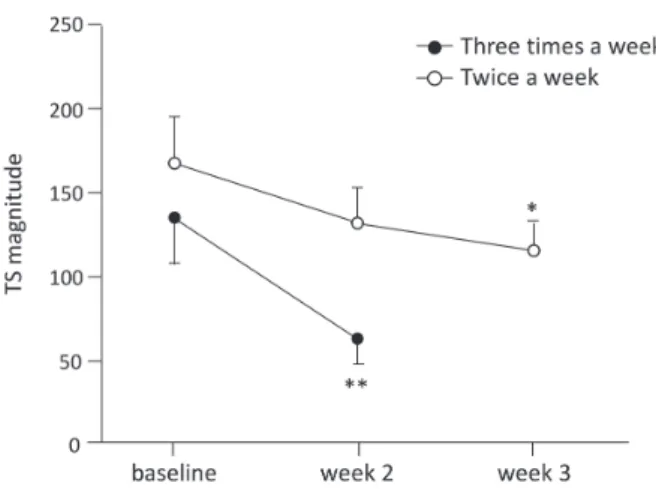
させるにはどの程度の運動頻度と期間が必要か について検証を進めている。運動方法は低負荷 (50%HRR)での自転車運動を20分間とし, 週3回を2週間(計6回)行う群と週2回を3 週間(計6回)行う群に振り分け,中枢性感作 の指標であるTSを有痛部である僧帽筋で測定 し,運動によるTSの変化を比較した。その結 果,週3回行う群では2週間の運動継続によ りTSの減衰を認めた。それに対し,週2回行 う群では2週間の時点では有意なTSの変化は 認められず,3週間の運動継続によりTSの減 衰を認めた(Fig.3)。このことから,臨床にお いては週3回程度の運動処方が有効であると考 えられる。また,患者の体力や環境要因などに より週3回の運動が困難である場合には,頻度 を下げて,その分期間を長く運動を継続させる ことで運動による疼痛緩和効果が期待できる。 しかし今回,自覚的な頚肩部の疼痛強度や身体 機能障害はどちらの群も運動期間終了の時点で は有意な改善を認めておらず,疼痛症状よりも 中枢性疼痛修飾機能の改善が先行して生じるの ではないかと推察される。
ま と め
Acute exerciseによるEIH効果は持続時間が
短く臨床には応用しにくい。特に,慢性疼痛患 者においては,疲労を伴うようなacute exercise により逆にhyperalgesiaを生じる危険性がある。 一方,普段の身体活動量は中枢性疼痛修飾機能 に影響を及ぼすことから,regular exerciseに より身体活動量を増大させることが,慢性疼痛 の予防や改善につながると考えられる。また, regular exerciseを指導する際は,運動強度は 高強度である必要はなく患者個々の体力や環境 に合わせたものとし,週2日から3日の頻度 で長期間継続することが疼痛緩和効果を得るた めに重要である。 謝 辞 実験にご協力いただいた前原外科整形外科リハビ リテーションクリニックの服部貴文氏,日本福祉 大学の小河翔氏に感謝いたします。 文 献
1) Steiger, F., Wirth, B., de Bruin, E.D., Mannion, A.F., Is a positive clinical outcome after exer-cise therapy for chronic non–specific low back pain contingent upon a corresponding improve -ment in the targeted aspect(s) of performance ? A systematic review, Eur. Spine J., 21 (2012) 575–598.
2) Naugle, K.M., Fillingim, R.B., Riley, J.L. 3rd., A meta–analytic review of the hypoalgesic effects of exercise, J. Pain, 13 (2012) 1139–1150. 3) Light, A.R., White, A.T., Hughen, R.W., Light, K.C., Moderate exercise increases expression for sensory, adrenergic, and immune genes in chronic fatigue syndrome patients but not in normal subjects, J. Pain, 10 (2009) 1099–1112.
Fig.3 Change of temporal summation (TS) due to regular exercise.
TS–magnitude: Pressure–induced pain was recorded with VAS (visual analogue scale) by 10times and summed it altogether.
4) Lima, L.V., Abner, T.S.S., Sluka, K.A., Does exercise increase or decrease pain ? Central mechanisms underlying these two phenomena, J. Physiol., 595 (2017) 4141–4150.
5) Meeus, M., Nijs, J., van Wilgen, P., Noten, S., Goubert, D., Huijnen, I., Moving on to move-ment in patients with chronic joint pain, PAIN CLINICAL UPDATES., MARCH (2016). 6) Landmark, T., Romundstad, P., Borchgrevink,
P.C., Kaasa, S., Dale, O., Associations between recreational exercise and chronic pain in the general population: evidence from the HUNT 3 study, Pain, 152 (2011) 2241–2247. 7) Harris, G.R., Susman, J.L., Managing
musculo skeletal complaints with rehabilitation therapy : summary of the Philadelphia Panel evidence–based clinical practice guidelines on musculo skeletal rehabilitation interventions, J. Fam. Pract., 51 (2002) 1042–1046.
8) Tesarz, J., Schuster, A.K., Hartmann, M., Gerhardt, A., Eich, W., Pain perception in athlete s compared to normally active controls: a systematic review with meta–analysis, Pain, 153 (2012) 1253–1262.
9) Kong, J.T., Schnyer, R.N., Johnson, K.A., Mackey, S., Understanding central mechanisms of acupuncture analgesia using dynamic quan-titative sensory testing : a review, Evid. Based Complement. Alternat. Med., 2013 (2013) 187182.
10) Izumi, M., Petersen, K.K., Laursen, M.B., Arendt–Nielsen, L., Graven–Nielsen, T., Facilitated temporal summation of pain cor -relates with clinical pain intensity after hip arthroplasty, Pain, 158 (2017) 323–332. 11) Gerhardt, A., Eich, W., Treede, R.D., Tesarz, J.,
Conditioned pain modulation in patients with nonspecific chronic back pain with chronic local pain, chronic widespread pain, and fibromyalgia, Pain, 158 (2017) 430–439. 12) Naugle, K.M., Ohlman, T., Naugle, K.E., Riley,
Z.A., Keith, N.R., Physical activity behavior predicts endogenous pain modulation in older adults, Pain, 158 (2017) 383–390.
13) Shiro, Y., Ikemoto, T., Terasawa, Y., Arai, Y.C., Hayashi, K., Ushida, T., Matsubara, T., Physical activity may be associated with conditioned pain modulation in women but not men among healthy individuals, Pain Res. Manag., (2017) (in press).
14) Ellingson, L.D., Shields, M.R., Stegner, A.J., Cook, D.B., Physical activity, sustained seden-tary behavior, and pain modulation in women with fibromyalgia, J. Pain, 13 (2012) 195–206. 15) McLoughlin, M.J., Stegner, A.J., Cook, D.B.,
The relationship between physical activity and brain responses to pain in fibromyalgia, J. Pain, 12 (2011) 640–651.
16) Sluka, K.A., O'Donnell, J.M., Danielson, J., Rasmussen, L.A., Regular physical activity prevents development of chronic pain and activation of central neurons, J. Appl. Physiol. (1985), 15 (2013) 725–733.
17) Kuphal, K.E., Fibuch, E.E., Taylor, B.K., Extended swimming exercise reduces inflam-matory and peripheral neuropathic pain in rodents, J. Pain, 8 (2007) 989–997.
18) Bobinski, F., Martins, D.F., Bratti, T., Mazzardo– Martins, L., Winkelmann–Duarte, E.C., Guglielmo L.G., Santos A.R., Neuroprotective and neuroregenerative effects of low–intensity aerobic exercise on sciatic nerve crush injury in mice, Neuroscience, 27 (2011) 337–348. 19) Kami, K., Taguchi, S., Tajima, F., Senba, E.,
Mechanisms and effects of forced and volun-tary exercises on exercise–induced hypoalgesia in neuropathic pain model mice, PAIN RES., 30 (2015) 216–229.
Address for correspondence: Yukiko Shiro
Department of Physical Therapy, Faculty of Rehabilitation Sciences, Nagoya Gakuin University
1350Kamishinano-cho, Seto-city, Aichi 480-1298, Japan