JAPANESE-ENGLISH CODE-SWITCHING SPEECH DATA CONSTRUCTION Sahoko Nakayama, Takatomo Kano, Quoc Truong Do, Sakriani Sakti, and Satoshi Nakamura
Augmented Human Communication Laboratory Graduate School of Information Science Nara Institute of Science and Technology, Japan
ABSTRACT
As the number of Japanese-English bilingual speakers con- tinues to increase, code-switching phenomena also happen more frequently. The units and locations of switches may vary widely from single word switches to whole phrases (be- yond the length of the loanword units). Therefore, speech recognition systems must be developed that can handle not only Japanese or English but also Japanese-English code-switching. Consequently, a large-scale code-switching speech database is required for model training. But collecting natural conversation dialogues of Japanese-English data is both time-consuming and expensive. This paper presents the construction of Japanese-English code-switching speech data by utilizing a Japanese and English text-to-speech system from a bilingual speaker. Various switching units are also in- vestigated including units of words and phrases. As a result, we successfully constructed over 280-k speech utterances of Japanese-English code-switching.
Index Terms— Data construction, code-switching, Japanese and English languages
1. INTRODUCTION
Code-switching, which is defined as an alternative linguistic variety between two languages in the same conversation, usu- ally within the same conversational turn or even in the same sentence of that turn [1], has been studied for several decades.
Most researchers agree that it plays a vital role in bilingualism and is more than a random phenomenon [2]. Several studies on code-switching speech recognition also exist. Since the units and locations of switches may vary widely from single word switches to whole phrases (beyond the length of stan- dard loanword units), simply utilizing multiple monolingual ASR systems is difficult. Furthermore, unexpected switch- ing between languages greatly complicates the recognition of such speech.
White et al.[3] investigated alternatives to model the acoustics for multilingual code-switching, and Imseng et al.
[4] proposed an approach to estimate the universal phoneme posterior probabilities for mixed language speech recogni- tion. Vu et al. focused on the speech recognition of Chinese
and English code-switching [5] and proposed approaches for phone merging in combination with discriminative training as well as the integration of language identification systems in decoding processes. Recently, Yilmaz et al. investigated the impact of bilingual deep neural networks in the contexts of Frisian and Dutch code-switching [6].
Despite extensive studies on code-switching speech recognition in bilingual communities, the Japanese-English case has received scant research up to now because the Japanese language shows almost complete dominance over the country’s entire population. Furthermore, a large number of its loanwords, most of which have been borrowed from English, are already commonly used [7, 8].
In recent years, the number of bilingual speakers has in- creased in Japan. According to a Ministry of Health, Labour and Welfare (MHLW) survey, the number of children who have a foreigner parent in Japan has increased from 13,686 in 1990 to 21,180 in 2016 [9]. The Japanese Ministry of Ed- ucation, Culture, Sports, Science, and Technology (MEXT) also reported that the number of school-age children (from elementary to high school) who have returned from living abroad increased from 5,900 in 1977 to 12,527 in 2015 [10]. Moreover, the number of Japanese students who study abroad has increased from 23,633 to 60,643 in the past ten years, as reported by the Japan Student Services Organiza- tion (JASSO) [11]. Under this background, the phenomenon of Japanese-English code-switching is also more frequent.
Code-switching often happens unconsciously; speakers may be unaware of it.
Nakamura [12] surveyed the code-switching of a Japanese child who came to the United States by recording 30-minute segments of conversation between the subject and his mother and found that mixed turns (both English and Japanese in a single turn) occurred 59 times. In other words, he started his utterances in Japanese and changed to English in the middle of a single turn. Fotos also analyzed four hours of conversa- tion of four bilingual children living in Japan with American parents or one American parent and observed 153 instances of code-switching [13].
The above reports reveal that some people actually use
code-switching in everyday life. Therefore, speech recog-
nition systems must be developed that can handle not only
Japanese or English language but also Japanese-English code- switching. Consequently, models must be trained with code- switching speech. In addition, a significant amount of data is necessary for training a deep neural network model. Unfortu- nately, no such large-scale Japanese-English code-switching speech database exists for model training. Unfortunately, col- lecting natural conversation dialogues of Japanese-English data is time-consuming and expensive. This paper describes our Japanese-English code-switching speech database that utilizes a Japanese and English text-to-speech (TTS) system from a bilingual speaker. The target of the code-switching speaker is a native Japanese speaker who can also speak English.
2. CODE-SWITCHING IN JAPANESE
Code-switching is classified into two primary categories:
inter-sentential and intra-sentential. Inter-sentential code- switching is when the language switch is done at the sentence boundaries. In intra-sentential code-switching, the shift is done in the middle of a sentence. Intra-sentential code- switching has different types of code-switching based on locations and lengths. Intra-sentential code-switching can occur from the length of just a single word unit to an entire phrase.
We differentiate between code-switching words and loan- words (borrowings), which are generally used by monolin- gual speakers in monolingual societies. For example, meritto is borrowed from the English word merit, but Japanese mono- linguals use it in their monolingual society. Thus, it is not counted as a switch. Below are examples of code-switching and loanword insertion that were reported in existing stud- ies. Regarding loanword and intra-sentential phrase insertion code-switching, here is a quotation from content that was ac- tually spoken in the lecture transcription at our institute:
• [Loanword insertion]:
tyukangengo wo tsukatta toki no meritto ni naniga aruka?
(What is the merit of using an interlingua?)
• [Intra-sentential word-level code-switching]:
Trust-shiteru hito ni dake kashiteageru no.
(I lend (it) only to a person I trust.) [12]
• [Intra-sentential phrase insertion code-switching]:
“He reckons the current account deficit” to yuu bunga aruto suruto “He” to yuuno ga ninsyoudaimeishi dearu.
(If there is a sentence “He determines the current ac- count deficit,” “he” is a personal pronoun.)
• [Inter-sentential code-switching]:
Aa, soo datte nee. On the honeymoon, they
bought this.
(Oh, year, you’re right. On their honeymoon, they bought this.) [12]
3. AVAILABLE DATA RESOURCES 3.1. Monolingual BTEC Text Data
The ATR Basic Travel Expression Corpus (BTEC) [14, 15]
covers basic conversations in travel domains, such as sight- seeing, restaurants, hotels, etc. Its sentences were collected by bilingual travel experts from Japanese/English sentence pairs in travel domain phrasebooks. The BTEC has been translated into French, German, Italian, Chinese, and Korean.
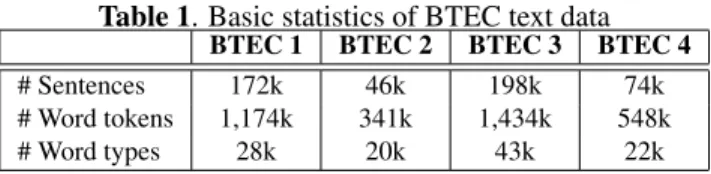
In this study, we used Japanese-English BTEC text data called BTEC 1, 2, and 3. Table1 lists their basic statistics.
Table 1. Basic statistics of BTEC text data BTEC 1 BTEC 2 BTEC 3 BTEC 4
# Sentences 172k 46k 198k 74k
# Word tokens 1,174k 341k 1,434k 548k
# Word types 28k 20k 43k 22k
3.2. Bilingual BTEC Speech Data
We also utilized the Bilingual BTEC speech data that were originally constructed to emphasize a speech translation study [16]. 1015 Japanese-English sentence pairs were selected from 16,000 BTEC sentences. The recording was done with three bilingual speakers in a quiet environment, and the WAV audio was recorded with a frequency of 16 KHz, 16 bits, and a single channel. After the recording, all the audio files were verified to ensure that no clipping was caused by a speaker who was talking too loudly. In this study, we only use the data from one bilingual speaker. A transcription sample is shown in Table 2.
Table 2. Sample of bilingual BTEC speech data Language Transcription
Japanese Kamera desu.
Suteki na hi ne?
English That’s a camera.
Beautiful day, isn’t it?
4. ENGLISH AND JAPANESE HMM-BASED SPEECH SYNTHESIS
Since large-size BTEC speech utterances for the correspond-
ing BTEC 1-4 text corpora are unavailable, we developed
monolingual Japanese and English TTS systems. To enable
code-switching speech from the same speaker, both TTS sys-
tems were generated based on a small set of bilingual BTEC
speech data described above and conducted using an open- source speech synthesis engine called a HMM-based Speech Synthesis System (HTS) [17].
A total of 960 training utterances were used for both the Japanese and English TTS systems. The only difference be- tween them was the data; the model architecture was iden- tical. The speech signals were sampled at 16 kHz and win- dowed using a 25-ms Hamming window and a 5-ms frame shift. The feature vector consisted of 40-dimensional Mel- Generalized cepstral coefficients mgc, a log f0 (lf0), and band aperiodicities (bap). We used the WORLD vocoder [18] to generate the speech.
5. CODE-SWITCHING DATA CONSTRUCTION
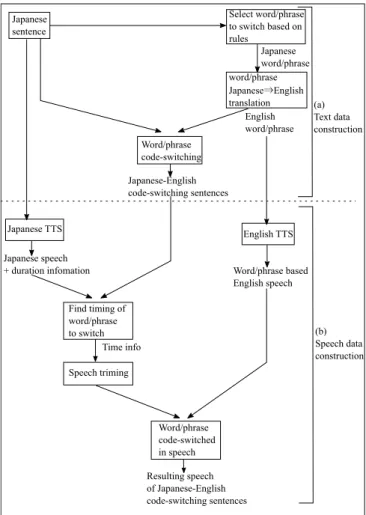
An overview of the data construction is illustrated in Fig. 1 and consists of two main processes: text and speech data con- struction. Both processes are described in more detail below.
Fig. 1. Overview of Japanese-English code-switching data construction
5.1. Text Data Construction
5.1.1. Intra-sentential word-level code-switching
We first selected words from the BTEC text data that are com- monly written with Japanese katakana characters and trans- lated them into English using Google translation API. Intra- sentential word-level code-switching sentences were created by inserting the translated English words into the original Japanese sentences.
Note that although Japanese katakana is often used to de- scribe loanwords, since we later used the speech pronounced by a native English speaker in an English TTS system to gen- erate utterances, they can be distinguished from loanwords.
Here, code-switching can be done by inserting a single word or a chunk of two-to-three words. Two or more words may also be inserted in different places within one sentence.
Below is an example of the resulting intra-sentential word- level code-switching sentences:
• Kanko basu no pamphlet wa ari masu ka?
(Do you have any brochures for the sightseeing bus?) 5.1.2. Intra-sentential phrase-level code-switching
In contrast with the word-level code-switching case, we se- lected phrases from the BTEC text data beyond the length of the loanword units. Here, to produce natural conversa- tions, we referred to the actual examples that were reported in existing studies [12], especially a switching pattern from Japanese-to-English phrases after Japanese particles appear.
We translated the Japanese phrases after Japanese par- ticles into English using the Google Translate API and re- inserted them into the original sentences. We used the fol- lowing Japanese particles:
ga, wo, ni, he(e), to, kara, yori, ba, temo, keredo, noni, node, kara, nari, nagara, tari, and tsutsu.
Below is an example of the resulting intra-sentential phrase- level code-switching sentences:
• gasu iri no tansan sui wo bring me with two ice.
(Bring me two bottles of carbonic minerals and some ice, please.)
5.2. Speech Data Construction 5.2.1. Synthesizing Speech
Given intra-sentential code-switching sentences, we generate
Japanese and English speech using our monolingual TTS
systems. Japanese speech utterances were synthesized from
Japanese sentences, and files with the duration information
of Japanese speech were simultaneously created. English speech utterances were also synthesized from translated En- glish words or phrases.
5.2.2. Trimming and Concatenation
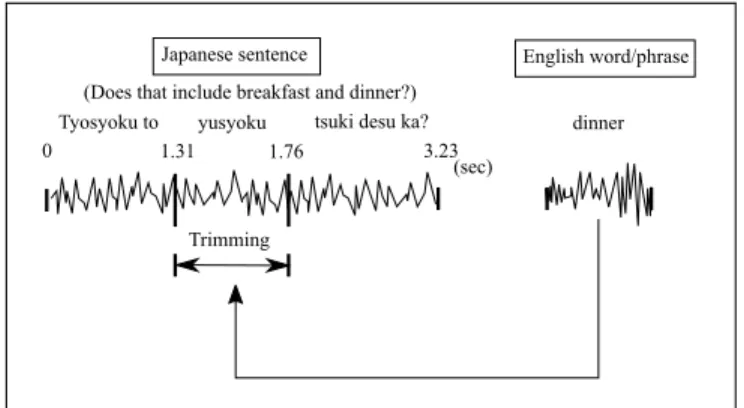
Based on the obtained time information, we trimmed the Japanese speech utterances at the switching position using the sox
1command. Next we concatenated them with the English speech part also using a sox command (Fig. 2). As a result, we created speech of Japanese-English code-switching sentences.
Fig. 2. Speech trimming and concatenation process
6. DATA ANALYSIS
After constructing the data, we investigated what percentage of English and Japanese are included in the code-switching by counting the number of words. A morpheme analyzed by MeCab
2is counted as one unit. We counted the number of morphemes in each language and the number of whole mor- phemes and calculated the ratio. Morphemes that are neither English nor Japanese words (such as numbers and symbols) were excluded from the results because they were less than 0.15%. The investigation results are shown in Table 3. In the monolingual Japanese corpus, the proportion of Japanese is 100%, and the proportion of English is 100% in the monolin- gual English corpus. But in the word insertion, the proportion of Japanese words is 88% and only 12% English words; in the phrase insertion, the proportion of Japanese words is 46% and 56% are English words.
7. CONCLUSION
In this paper, we described the construction of a Japanese- English code-switching corpus. Japanese-English code- switching speech data were generated by utilizing Japanese
1
Sox – http://sox.sourceforge.net/
2