Abstract
The aim of this report is to provide some preliminary results of a survey aimed to investigate the methods that Japanese junior high school students adopt to learn/
practice English pronunciation. This study - part of an ongoing project - was carried out at a public junior high school in Niigata Prefecture. The surveyees were asked to choose two main methods that they usually make use of for this purpose. The results showed that first year pupils tended to adopt a variety of methods whilst senior students polarized their attention on mimicking Japanese teachers’ pronunciations.
Another finding was that girls tend to show a little more interest in using audio CD than boys during their first two years; however, this difference is little when they reach the third grade.
Keywords
English pronunciation, Japanese junior high school, practicing method
1 INTRODUCTION
Back in the early times of English education in Japan, teaching and learning of pronunciation were secondary after grammar and translation and this reasoning lasted until several decades ago (Duke, 2009; Smith and Imamura, 2004). With the educational reforms of 90’s and on, a paradigm shift towards nurturing language skills in order to achieve global and international communication abilities in English language has raised a concern with learning English pronunciation in schools as early as fifth grade - as of 2016, and scheduled to start earlier yet from year 2020 - of elementary education, which consists of six years of mandatory education.
Since then, the educational outcomes have been examined from a variety of standpoints ranging from the changes in the textbooks (Sugimoto and Uchida, 2013) and pedagogy (Yuzawa, 2007) to acoustical analysis of the English sounds produced by Japanese students
A Brief Report Regarding Some Preliminary Data on How Japanese Junior High School Pupils
Practice English Pronunciation - A Case Study
Giido Izuta and Tomoko Nishikawa
(Izuta, 2013; 2014a; 2014b; 2015a; 2015b; 2015c; 2015d; 2016e; 2016).
This very short paper presents preliminary results of a project aimed to investigate the factors that influence the English pronunciation by Japanese individuals, in particular, the relationships between the learning methods adopted by students during the school education and the ability to pronounce the English sounds in a non-Japanese language speaking fashion which is enough to communicate in a global world where English is being used as a means of communication. Specifically, it gives the results of a questionnaire responded by students of a junior high school, which provides three years of mandatory education following the six years of elementary education, as they were asked to mark the two main methods of practicing English pronunciation from a set of possible methods listed on a piece of paper.
2 EXPERIMENTAL PROCEDURE
A public junior high school in Niigata Prefecture participated in this study. The respondents were 184 first graders (83 boys and 101 girls), 209 second graders (101 boys and 108 girls), and 220 third graders (105 boys and 115 girls). Thus the ages ranged from 12 to 15 years old. Also, the survey was performed during the first week of March in the year 2016. Note that for third graders, this period is just a week to the high school entrance examination, which is a battery of tests that students
have to undergo in order to conquer a place in their aspiring high school.
The questionnaire sheet consisted basically of the items shown in Table 1, from where kids were asked to mark their two main methods of practicing English pronunciation.
The data was processed on a Microsoft windows 8 computer equipped with Microsoft excel 2013. Basically, two types of charts were used to express the results: pie charts drawn to show the ratios of appearance of the items, and bar charts to visualize the conspicuous combinations of the items.
Table 1: Questionnaire items
3 RESULTS
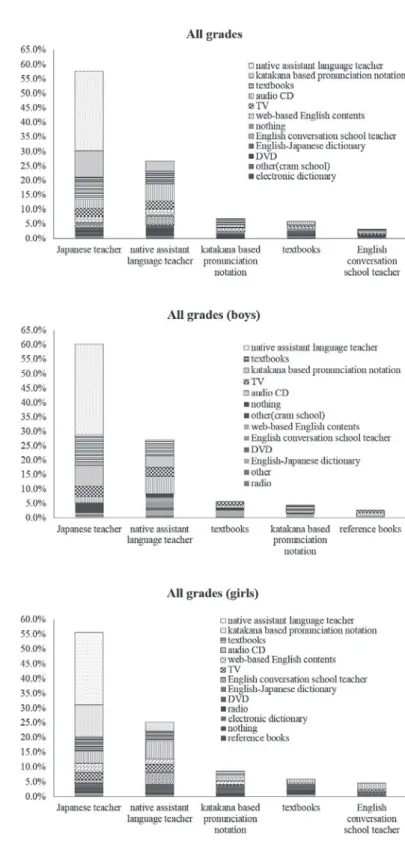
Fig.1 shows the results for all the students surveyed from first through third grades, 616 i n a l l w i t h t h r e e invalid answers. In fact, these pie charts give the percentages o f a p p e a r a n c e a s m e t h o d s o f practicing English pronunciation. The u p p e r m o s t c h a r t gives the results for all the interviewed kids independent of the gender whereas t h e c h a r t s i n t h e middle and at the bottom summarize the answers given by boys and girls respectively.
T a k i n g t h e s e i n t o a c c o u n t ,
‘Japanese teachers’
appeared in 26.3%
o f a l l a n s w e r s against the 24.4%
o f ‘n a t i v e A LT Fig. 1: First- throught third-year pupils
(assistant language t e a c h e r )’, w h i c h w a s f o l l o w e d b y 9.0% of ‘textbooks’, 8.9% of ‘katakana based pronunciation n o t a t i o n’, 7 . 8 % related to ‘audio CD’, 4.0% of ‘TV’, 3.5% of ‘nothing’, a n d s o o n . T h i s pattern is more or less seen in both boys and girls as t h e m i d d l e a n d lowermost graphs s h o w. N o t e t h a t the percentage of
‘n a t i v e a s s i s t a n t l a n g u a g e t e a c h e r (ALT)’ is higher for boys than girls.
The charts in Fig. 2 were built such that the leftmost item is
‘Japanese teacher’, a n d b a r c h a r t represents all the combinations with other parameters; the second element of the horizontal axis is
Fig. 2: Top five combinations for first- throught third-year pupils - percentage of combinations with elements to its right only.
taken to be ‘native assistant language teacher (ALT)’ and all its combinations with other elements excluding ‘Japanese t e a c h e r’, a n d s o o n . F o r t h e s a k e of clarity, only the top five tall bars are depicted here.
T h u s , i n o v e r a l l ,
‘Japanese teacher’
made up 57.6% of all combinations, a m o n g t h e m t h e pairing with ‘native ALT’ amounted to 27.4% leaving the c o m b i n a t i o n s o f
‘Japanese teacher’
with other methods be 30.2%. Yet the c o m b i n a t i o n s o f
‘native ALT’ with other methods, not including Japanese teacher, accounted for 26.6%, in which the combination with
‘audio CD’ (6.0%)
r a n k i n g h i g h e s t . Fig. 3: First-year pupils
T h e c o m b i n a t i o n o f ‘n a t i v e A LT’ with ‘audio CD’ gave 6.1% and with
‘textbooks’, 5.7%
whereas girls gave 6 . 8 % a n d 4 . 1 % , respectively.
In what follows, the answers of each grade is analyzed in order to get a more detailed figure of the situation.
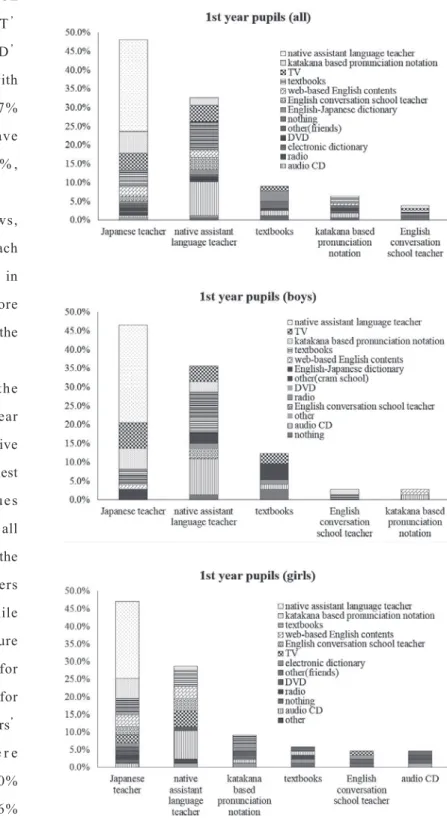
Fig. 3 yields the charts of first year pupils. Here, ‘native ALT’ had the highest percentage values of appearance in all cases. In fact, for the whole first graders it was 25.5% while for boys, the figure was 28.3%, and for girls, 23.2%. As for
‘Japanese teachers’
t h e v a l u e s w e r e 21.8% (all), 22.0%
(boys), and 21.6%
(girls) from top to bottom of Fig. 3,
Fig. 4: Top five combinations for first-year pupils - percentage of combinations with elements to its right only.
respectively.
Fig. 4 provides the details of the answers. Excluding the combinations of
‘Japanese teacher’
with ‘native ALT’
- 2 4 . 4 % f o r a l l , 2 6 . 0 % f o r b o y s , and 21.8% for girls - the percentage of the combinations o f ‘n a t i v e A LT’ with other methods i s h i g h e r t h a n
‘Japanese teacher’
with others. It is also clear that boys a n d g i r l s h a v e slightly different c o m b i n a t i o n p a t t e r n s . I n d e e d , b o y s h a v e h i g h p e r c e n t a g e s f o r c o m b i n a t i o n s o f
‘native ALT’ with
‘textbooks’ (11.0%) a n d w i t h ‘a u d i o CD’ (9.6%) whilst girls do for ‘audio C D’ ( 8 . 1 % ) a n d
‘TV’ (4.6%). Fig. 5: Second-year pupils
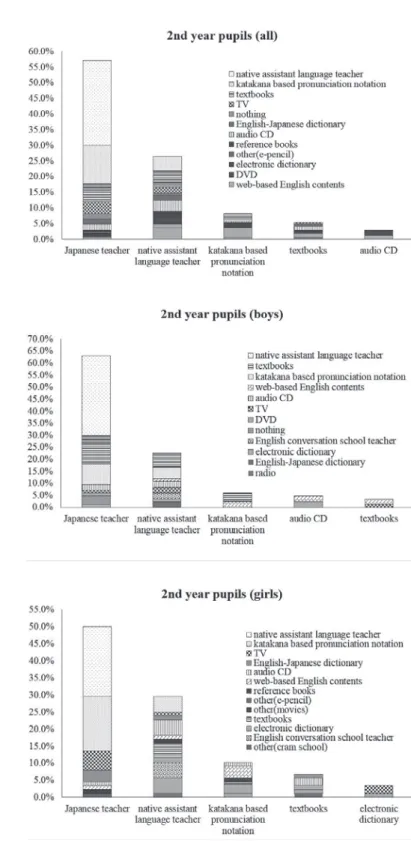
N o w, a s f a r a s the second grade is concerned, Fig. 5 gives the appearance r a t i o s o f t h e methods. In overall,
‘Japanese teacher’
topped with 25.7%, and it was followed b y ‘n a t i v e A LT’ with 24.2%. This pattern was also seen in boys, in which they summed up to 28.9% and 25.7%, r e s p e c t i v e l y. O n the contrary, girls chose ‘native ALT’
w h i c h a p p e a r e d in 22.8% of cases.
Also, the method appearing third and fourth in boys was
‘textbooks’ (11.2%) a n d ‘k a t a k a n a n o t a t i o n’ ( 8 . 6 % ) while for girls they w e r e ‘k a t a k a n a notation’ (14.4%) a n d ‘a u d i o C D’ (6.9%).
Fig. 6 shows that
Fig. 6: Top five combinations for second-year pupils - percentage of combinations with elements to its right only.
l e a v i n g o u t t h e c o m b i n a t i o n s o f
‘Japanese teacher’
with ‘native ALT’
(adding up to 27.0%
for all, 33.3% for b o y s a n d 2 0 . 5 % f o r g i r l s ) h a d higher percentage o f c o m b i n a t i o n s involving ‘Japanese teacher’ than that m e a s u r i n g t h e c o m b i n a t i o n s o f
‘native ALT’ with o t h e r m e t h o d s . As for girls, even t h o u g h t h e v a l u e was still smaller, the difference became relatively smaller when compared to what first graders showed. Thus these values suggest that the combinations e m b o d y i n g
‘Japanese teacher’
l i k e l y i n c r e a s e d as though a shift from ‘native ALT’
had taken place as Fig. 7: Third-year pupils
the academic year advanced.
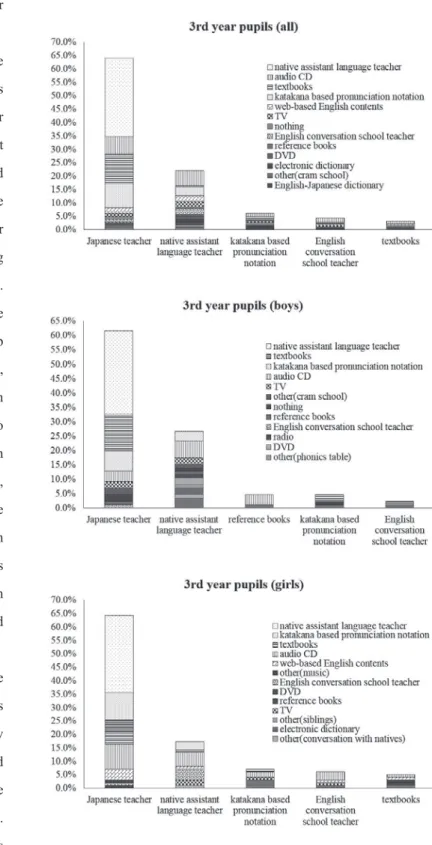
Fig. 7 presents the appearance ratios of the methods for third year pupils. It is straightforward t h a t ‘J a p a n e s e t e a c h e r’ w a s f a r t h e t o p m a r k i n g 30.2% in all cases.
In addition, ‘native A LT’ s u m m e d u p to 23.1%, 25.0%, a n d 2 1 . 4 % f r o m u p p e r m o s t t o l o w e r m o s t g r a p h in this order. Yet,
‘textbooks’ came third for boys with 8.9% whereas girls wrote ‘audio CD’ in third, which counted 11.2%.
Looking into the minutiae, Fig. 8 says that the tendency s e e n i n s e c o n d g r a d e r s b e c a m e e s t a b l i s h e d h e r e . T h e p e r c e n t a g e s o f c o m b i n a t i o n s
Fig. 8: Top five combinations for third-year pupils - percentage of combinations with elements to its right only.
embracing ‘Japanese teacher’ were 64.1% for the whole academic year; 61.2% for boys; and 64.3% for girls, in which the combinations with ‘native ALT’ summed up to 29.3% for the whole academic year, 29.1% for boys and 28.6% for girls. Moreover, the combinations of
‘native ALT’ with ‘audio CD’ filled up 5.5%, 5.8% and 5.1% from top to bottom, in Fig. 8.
4 DISCUSSION
Looking at the method that is most mentioned regardless of the grades and genders,
‘Japanese teacher’ was far at the top of list. However, this situation is not always true as can be verified in Fig. 3, 5 and 7. De facto, first year students alluded to ‘native ALT’ more frequently than ‘Japanese teacher’. The turnabout in the order of these methods took place in the second grade, and the percentage of ‘Japanese teacher’ exhibited further increase in third grade while ‘native ALT’ decreased. This suggests that pupils tend, as the time goes on, to rely basically on how teachers pronounce/speak English words in classrooms and spend less time checking out how the words are pronounced in English speaking countries.
Conceivably that happens because students have less and less time as the grade goes up to dedicate to voluntary learning.
As a matter of fact, this time sequence shift is also ascertainable from Fig. 2, 4, 6 and 8.
Note that there, the percentages of combinations of ‘Japanese teacher’ with other methods, excluding ‘native ALT’, increased from first to third grade whereas combinations of ‘native ALT’ with other methods decreased.
Now focusing on the combinations of ‘native ALT’ with other methods other than ‘Japanese teacher’, the graphs show that boys bear mainly on ‘textbooks’ and ‘katakana based pronunciation notation’ during the first two years of junior high school whereas girls made intensive use of ‘audio CD’. In third grade, both boys and girls combined highly with ‘audio CD’ in this context. This fact probably reflects the examination preparation driven studies for high school entrance, which includes an English listening test.
5 FINAL REMARKS
This report presents some basic results concerning the methods that junior high school students adopt to learn English pronunciation. Further investigation is needed to understand how these methods actually affect students’ ability to recognize English sounds that are not found in Japanese language. Also, more studies are necessary to probe the relationships
between this learning phase along with the methods and the ways the English sounds are produced in adulthood.
Acknowledgement
The authors would like to express their gratitude to the principal, teachers, staff members and pupils of junior high school for their cooperation in our project. Also, the authors would like to thank all their friends, colleagues and staff members of Yonezawa Women’s Junior College for their support and help.
REFERENCES
Duke, B. C. (2009). The History of Modern Japanese Education: Constructing the National School System, 1872-1890, Rutgers University Press.
Izuta, G. (2013). An assessment of the utterances of some English vowels spoken by Japanese Students – A survey at a junior college for women in Japan , Bulletin of Yonezawa Women's Junior College, Vol.49, p.63-82.
Izuta, G. (2014a). Does the production mechanism of the typical Japanese utterances affect the English Speech? Some insights from a phonetic analysis perspective, Reports of The Institute for Culture in Life of Yonezawa Women’s Junior College, Vol. 41, p.39- 57.
Izuta, G. (2014b). Towards understanding how young Japanese female college students pronounce the letters of English alphabet - Part I: general analysis of the formants F1 and F2, Bulletin of Yonezawa Women's Junior College, Vol.50, p.59-87.
Izuta, G. (2015a). Towards understanding how young Japanese female college students pronounce the letters of English alphabet - Part II: analysis of the pitch frequency modulation, Reports of The Institute for Culture in Life of Yonezawa Women’s Junior College, Vol. 42, p.17-74.
Izuta, G. (2015b). On How Young Japanese Female College Students Say the English Alphabet: A Comparison of the Fundamental Frequencies F0s with Native Speakers of English Language, Proceedings of The Asian Conference on Second Language Acquisition and Teacher Education, , SLATE 2015/8/2-4 Hiroshima, digital format, ISSN: 2189-2164, 6 pages.
Izuta, G. (2015c). A Study on How Young Japanese Female College Students Say the English
Alphabet: Comparison of the Fundamental Frequencies F0s across the Sub-Groups and Along Different Percentiles, Proceedings of The Asian Conference on Second Language Acquisition and Teacher Education, SLATE 2015/8/2-4 Hiroshima, digital format, ISSN: 2189-2164, 8 pages.
Izuta, G. (2015d). Formant Analysis of the English Alphabet Read by Japanese Female Students and Native Speakers, Proceeding: 1st International Conference on Teaching
& Learning (ICTL 2015), Langkawi, Malaysia 14-15 September 2015, ISBN 978- 967-13637-1-3, p.18-22
Izuta, G. (2015e). A Study of the English Sounds Made by Japanese Female Students Based on the Percentile Analysis, Proceeding: 1st International Conference on Teaching &
Learning (ICTL 2015), Langkawi, Malaysia 14-15 September 2015, ISBN 978-967- 13637-1-3, p.23-27.
Izuta, G. and Nishikawa, T. (2016). Some Insights into the Japanese Junior High School English Education from the Student Learning Awareness Perspective, Proceedings of 2016 International Conference on Education, Psychology, and Social Sciences.
Malaysia (ICEPS), p.206-217.
Smith R. C. and Imura M. (2004). Lessons from the past: traditions and reforms, chapter 2 of Makarova, V. and T. Rodgers (eds), English Language Teaching: The Case of Japan, Munich, p. 29-48.
Sugimoto J. and Uchida, Y. (2013). An analysis of Japanese junior high school textbooks, the full Proceedings of PTLC2015 as an ebook pdf, https://www.ucl.ac.uk/pals/study/cpd/
cpd-courses/ptlc/proceedings_2015, p.91-95
Yuzawa, N. (2007). Teaching English Pronunciation, The Economic Journal of TCUE, vol.50, p.95-107.