SPEECH CHAIN FOR SEMI-SUPERVISED LEARNING OF JAPANESE-ENGLISH CODE-SWITCHING ASR AND TTS
Sahoko Nakayama 1 , Andros Tjandra 1,2 , Sakriani Sakti 1,2 , Satoshi Nakamura 1,2
1 Nara Institute of Science and Technology, Japan
2 RIKEN, Center for Advanced Intelligence Project AIP, Japan
{nakayama.sahoko.nq1,andros.tjandra.ai6,ssakti,s-nakamura}@is.naist.jp
ABSTRACT
Code-switching (CS) speech, in which speakers alternate be- tween two or more languages in the same utterance, often occurs in multilingual communities. Such a phenomenon poses challenges for spoken language technologies: auto- matic speech recognition (ASR) and text-to-speech synthesis (TTS), since the systems need to be able to handle the input in a multilingual setting. We may find code-switching text or code-switching speech in social media, but parallel speech and the transcriptions of code-switching data, which are suit- able for training ASR and TTS, are generally unavailable. In this paper, we utilize a speech chain framework based on deep learning to enable ASR and TTS to learn code-switching in a semi-supervised fashion. We base our system on Japanese- English conversational speech. We first separately train the ASR and TTS systems with parallel speech-text of monolin- gual data (supervised learning) and perform a speech chain with only code-switching text or code-switching speech (un- supervised learning). Experimental results reveal that such closed-loop architecture allows ASR and TTS to learn from each other and improve the performance even without any parallel code-switching data.
Index Terms— Speech chain, semi-supervised learning, code-switching, ASR and TTS, Japanese and English lan- guages
1. INTRODUCTION
The number of Japanese-English bilingual speakers continues to increase. One reason is that the number of children in Japan with at least one non-Japanese parent has risen gradually over the past 25 years [1]. Also the number of school-age children who have lived abroad was reported that more than doubled in 2015 [2]. The number of international travelers or residents in Japan is steadily increasing for reasons of tourism, education, or health. These changes are affecting how people communi- cate with each other. The phenomenon of Japanese-English code-switching is becoming more and more frequent.
Code-switching (CS), which refers to bilingual (or multi- lingual) speakers who mix two or more languages in discourse (often with no change of interlocutor or topic), is a hallmark
of bilingual communities world-wide [3]. Nakamura [4] sur- veyed the code-switching of a Japanese child who lived in the United States and found that 179 switches occurred during total one hour conversation with his/her mother. Fotos inves- tigated four hours of conversations of four bilingual children in Japan with at least one American parent and observed 153 code-switchings [5]. Both reports reveal that people actually use Japanese-English CS in everyday life. Since people may not always communicate in monolingual settings, spoken lan- guage technologies, i.e., ASR and TTS, must be developed that can handle the input in a multilingual fashion, not only Japanese or English but also Japanese-English CS.
Unfortunately, despite extensive studies of CS in bilin- gual communities, scant research has addressed the Japanese- English case. Moreover, the common way of developing spo- ken language technologies for code-switching relies on a su- pervised manner that requires a significant amount of CS data to train the models. Although it might still be possible to find a sufficient amount of only CS text or CS speech in so- cial media, unfortunately, parallel speech and transcription of CS data are mostly unavailable that are suitable for training ASR and TTS. However, in contrast with human communica- tion, many people who speak in CS languages did not learn it by a supervised training mechanism with a parallel speech and textbook. Although many language courses are available, no CS class is offered. This means that they develop strate- gies for speaking in CS languages by merely growing up in bilingual/multilingual environments and listening and speak- ing with other bilingual speakers. CS often happens uncon- sciously. No fundamental reason exists why spoken language technologies have to learn CS in a supervised manner.
In this paper, we utilize a speech chain framework based on deep learning [6, 7] to enable ASR and TTS to learn CS in a semi-supervised fashion. We base our system on Japanese- English conversational speech. We first separately train ASR and TTS systems with the parallel speech-text of monolingual Japanese and English data (supervised learning) that might resemble what students of multiple languages learn in school.
After that, we perform a speech chain with only CS text or
CS speech (unsupervised learning) that imitates how humans
simultaneously listen and speak in a CS context in a multilin- gual environment.
2. RELATED WORKS
CS has been studied for several decades. Most researchers agree that it plays a vital role in bilingualism and is more than a random phenomenon [8]. White et al. [9] investigated alternatives to the acoustics for multilingual CS model, and Imseng et al. [10] proposed an approach that estimates the universal phoneme posterior probabilities for mixed language speech recognition. Vu et al. focused on speech recognition of Chinese and English CS [11]. They proposed approaches for phone merging in combination with discriminative train- ing as well as the integration of a language identification sys- tem into the decoding process. Ahmed et al. proposed the automatic recognition of English-Malay CS speech. Their framework first used parallel ASR in both languages and sub- sequently joined and rescored the resulting lattices to estimate the most probable word sequence of English-Malay CS [12].
Recently, Yilmaz et al. investigated the impact of bilingual hidden markov model - deep neural networks (HMM/DNN) in Frisian and Dutch CS contexts [13]. Toshinwal et al. at- tempted to construct multilingual speech recognition with a single end-to-end model [14]. Although the model provided an effective way for a multilingual setting, it was found that the model was still unable to code-switch between languages, indicating that the language model is dominating the acoustic model.
In synthesis system researches, Chu et al. [15] constructed Microsoft Mulan, a bilingual Mandarin-English TTS system.
Liang et al. also focused on Mandarin-English languages and proposed context-dependent HMM state sharing for their code-switched TTS system [16]. Sitaram et al. performed TTS experiments on code-mixed Hindi and English written in Romanized script and German and English written in their native scripts [17, 18]. SaiKrishna et al. investigated ap- proaches to build mixed-lingual speech synthesis systems of Hindi-English, Telugu-English, Marathi-English, and Tamil- English, based on separate recordings [19].
Despite extensive studies on CS spoken language tech- nologies in bilingual communities, the Japanese-English case has received scant research up to now. Until recently, no research work has addressed Japanese-English CS. Seki et al. developed the speech recognition of mixed language speech including the Japanese-English case with hybrid at- tention/CTC [20]. However, they created data that used different speakers for different languages, where the main challenge in the CS phenomenon in which the same speakers alternate between two or more languages within sentences is not addressed.
Most existing approaches, developed for bilingual CS, ei- ther mainly focused on supervised learning with CS data only for ASR or only for TTS. Furthermore, the study of Japanese-English CS is still very limited. In contrast,
our study constructs sequence-to-sequence models for both Japanese-English CS ASR and TTS that are jointly trained through a loop connection. The overall closed-loop speech chain framework enables ASR and TTS to teach each other and learn CS in a semi-supervised fashion without parallel CS data.
3. JAPANESE-ENGLISH CODE-SWITCHING CS phenomena can basically be classified into two primary categories: inter-sentential and intra-sentential. In inter- sentential CS, the language switch is done at the sentence boundaries. In intra-sentential CS, the shift is done in the middle of a sentence. However, the units and the locations of the switches in intra-sentential CS may vary widely from single word switches to whole phrases (beyond the length of standard loanword units). Below are examples of actual Japanese-English CS [4]:
• Intra-sentential code-switching:
– [Word-level code-switching]:
“Trust-shiteru hito ni dake kashite- ageru no.” (I only lend (it) to a person I trust.) – [Phrase-level code-switching]:
“Kondo no doyoubi no yuugata, ohima deshitara please come to our house for a Japanese dinner.” (If you are free this Satur- day evening, please come to our house for a Japanese-style dinner.)
• Inter-sentential code-switching:
– [Inter-sentential code-switching]:
“Aa, soo datte nee. On the honeymoon, they bought this.” (Oh, year, you’re right. On their honeymoon, they bought this.)
However, some CS cases remain problematic. For exam- ple, loanwords cannot be called intra-sentential word-level CS, and quotations may not be intra-sentential phrase-level CS. Although they might not theoretically be CS, we also handle such cases within a CS framework because we aim to recognize every word in Japanese-English conversations.
4. SPEECH CHAIN FOR SEMI-SUPERVISED LEARNING OF CODE-SWITCHING
We previously designed and constructed a machine speech
chain based on deep learning at our laboratory [6, 7], in-
spired by a human speech chain [21]. Humans learn how to
speak by constantly repeating their articulations and listen-
ing to the produced sounds. By simultaneously listening and
speaking, a speaker can monitor her volume, articulation, and
her speech’s general comprehensibility. Therefore, a closed-
loop speech chain mechanism with auditory feedback from
the speaker’s mouth to her ear is crucial.
ASR
TTS CS speech
CS speech CS speech
ASR
TTS CS speech
CS speech
( , )
ASR
TTS
CS speech
( , )ASR
( , )
TTS
( , )
Mono speech
Mono speech (a)
ASR
TTS CS speech
CS speech CS speech
ASR
TTS CS speech
CS speech ( , ) ASR
TTS
CS speech ( , )
ASR
( , )
TTS
( , ) Mono speech
Mono speech
(b)
ASR
TTS CS speech
CS speech CS speech
ASR
TTS CS speech
CS speech
( , )ASR
TTS
CS speech
( , )ASR
( , )
TTS
( , )
Mono speech
Mono speech
(c)
ASR
TTS CS speech
CS speech CS speech
ASR
TTS CS speech
CS speech
( , )
ASR
TTS
CS speech
( , )ASR
( , )
TTS
( , )
Mono speech
Mono speech
(d)
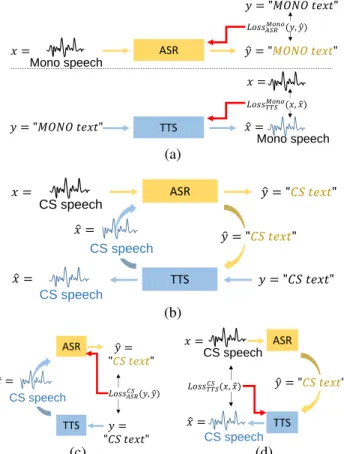
Fig. 1. Overview of proposed framework: (a) Train ASR and TTS separately with parallel speech-text monolingual data (supervised learning); (b) Train ASR and TTS simultaneously through speech chain with unparallel CS data (unsupervised learning); (c) Unrolled process from TTS to ASR given only CS text; (d) Unrolled process from ASR to TTS given only CS speech.
Over the past few decades, the development of ASR and TTS has enabled computers to either learn only how to listen through ASR or how to speak by a TTS. In contrast, a ma- chine speech chain provides additional capability that enables computers not only to speak and listen but also to speak while listening. Its framework consists of a sequence-to-sequence ASR [22, 23] and a sequence-to-sequence TTS [24] as well as a loop connection between them. The closed-loop architec- ture allows us to train our model on the concatenation of both labeled and unlabeled data. While ASR transcribes the un- labeled speech features, TTS reconstructs the original speech waveform based on the ASR text. In the opposite direction, ASR also attempts to reconstruct the original text transcrip- tion given the synthesized speech.
Our CS ASR and TTS systems were built upon a speech chain framework (Fig. 1) with the following learning process:
1. Train ASR and TTS separately with parallel speech- text monolingual data (supervised learning) We first separately train the ASR and TTS systems
with parallel speech-text of monolingual Japanese and English data (supervised learning) that might resem- ble humans who learn multiple languages at school (Fig. 1(a)). Given a speech and text pair of monolin- gual data (x M ono , y M ono ) with speech length S and text length T , ASR generates text probability vector ˆ
y M ono with teacher-forcing using directly ground- truth samples (y M ono ) as decoder input, and loss L M ono ASR (ˆ y M ono , y M ono ) is calculated between out- put text probability vector y ˆ M ono and reference text y M ono . On the other hand, TTS also generates best predicted speech x ˆ M ono by teacher-forcing using the reference (x M ono ), and loss L M ono T T S (ˆ x M ono , x M ono ) is calculated between predicted speech x ˆ M ono and ground-truth speech x M ono . The parameters are then updated with gradient descent optimization.
2. Train ASR-TTS simultaneously in a speech chain with unparallel CS data (unsupervised learning) After that, we then simultaneously train ASR and TTS through a speech chain with unparallel CS data (unsu- pervised learning) that imitate simultaneous human lis- tening and speaking CS in a multilingual environment (Fig. 1(b)).
To further clarify the learning process during unsuper- vised training, we unrolled the following architecture:
(a) Unrolled process from TTS to ASR given only CS text
Given CS text input y CS only, TTS generates speech waveform x ˆ CS , while ASR also attempts to reconstruct original text transcription y ˆ CS , given the synthesized speech. Fig. 1(c) illus- trates the mechanism. Here, we can also treat it as another autoencoder model, where the text- to-speech TTS serves as an encoder, and the speech-to-text ASR serves as a decoder. Then loss L CS ASR (ˆ y CS , y CS ) can be calculated between output text probability vector y ˆ CS and input text y CS to update the ASR parameters.
(b) Unrolled process from ASR to TTS given only CS speech
Given unlabeled CS speech features x CS , ASR
transcribes unlabeled input speech y ˆ CS , while
TTS attempts to reconstruct original speech
waveform x ˆ CS based on the output text from
ASR. Fig. 1(d) illustrates the mechanism. We can
also treat it as an autoencoder model, where the
speech-to-text ASR serves as an encoder, and the
text-to-speech TTS serves as a decoder. Then loss
L CS T T S (ˆ x CS , x CS ) can be calculated between re-
constructed speech waveform x ˆ CS and the input
of original speech waveform x CS to update the TTS parameters.
Here, we can weigh all of the loss into a single loss variable by the following formula:
L = α ∗ (L M ono ASR +L M ono T T S ) +β ∗ (L CS ASR +L CS T T S ) (1) θ ASR = Optim(θ ASR , ∇ θ
ASRL) (2) θ T T S = Optim(θ T T S , ∇ θ
T T SL), (3) where α and β are hyperparameters to scale the loss be- tween the supervised (parallel) and unsupervised (un- parallel) loss. This idea allows us to train new matters without forgetting the old ones. If α > 0, we can keep using some portions of the loss and the gradient pro- vided by the paired training set; if α = 0, we com- pletely learn new matters with only CS speech or only CS text.
5. EXPERIMENTS
5.1. Monolingual and Code-Switching Corpora
We utilized the monolingual Japanese and English ATR Ba- sic Travel Expression Corpus (BTEC) [25, 26], which covers basic conversations in the travel domain, such as sightseeing, restaurants, hotels, etc. The sentences were collected by bilin- gual travel experts from Japanese/English sentence pairs in travel domain phrasebooks. We randomly selected 50k sen- tences for training, 500 sentences for the development set, and 500 sentences for a test set from BTEC1-4.
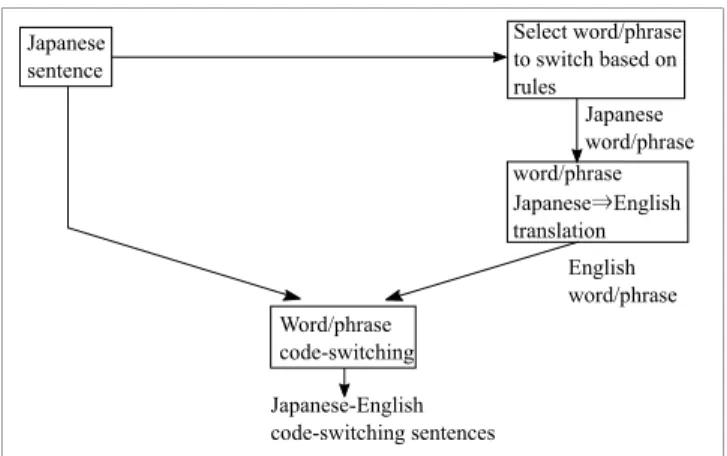
Since no large Japanese-English CS dataset exists yet, we constructed one from monolingual Japanese and En- glish BTEC sentences. Here, we created two types of intra- sentential code-switching: word-level and phrase-level CS.
An overview of the text data construction is illustrated in Fig. 2, and more details are also available [27].
Fig. 2. Japanese-English CS text data construction.
Since collecting the natural speech of Japanese-English CS data from bilingual speakers requires much time and money, we also utilized Google TTS 1 to generate speech from the text corpora for all the text data, including mono- lingual Japanese, monolingual English, and Japanese-English CS.
5.2. Features Extraction
All raw speech waveforms are represented at a 16-kHz sam- pling rate. For the speech features, we used a log magni- tude spectrogram extracted by short-time Fourier transform (STFT) from the Librosa library 2 . First, we applied wave- normalization (scaling raw wave signals into a range [-1, 1]) per utterance, followed by pre-emphasis (0.97), and extracted the spectrogram with an STFT, a 50-ms frame length, a 12.5- ms frame shift, and a 2048 point FFT. After we got the spec- trogram, we took the squared magnitude and used a Mel-scale filterbank with 40 filters to extract the Mel-scale spectrogram.
Next we got the Mel-spectrogram and the squared magnitude spectrogram features. In the end, we transformed all of the speech utterances into log-scale and normalized each feature into 0 mean and unit variances. Our final set included 40 dims log Mel-spectrogram features and 1025 dims log magnitude spectrograms.
For the English text, we converted all of the sentences into lowercase letters and removed all the punctuation marks [,:?.].
For the Japanese text, we applied a morphological analyzer Mecab 3 to extract the katakana characters and converted them into English letters using pykakasi 4 . We have 26 letters (a-z), one punctuation mark (-) for extending the sound of Japanese, and three special tags (<s>, </s>, <spc>) that denote the start and end of sentences and the spaces between words.
5.3. ASR and TTS Systems
Our ASR system is a standard encoder-decoder with an atten- tion mechanism [22]. On the encoder side, we used a log- Mel spectrogram as the input features. The input features were projected by a fully connected layer and a LeakyReLU (l = 1e − 2) [28] activation function and processed by three stacked BiLSTM layers with 256 hidden units for each di- rection (total 512 hidden units). We applied sequence sub- sampling [29, 23] to the last two top layers and reduced the length of the speech features by a factor of 4. On the decoder side, the input characters were projected with a 128 dims em- bedding layer and fed into one layer LSTM with 512 hidden units. Then we calculated the attention matrix with an MLP scorer [30], followed by a fully connected layer and a softmax function. Both the ASR and TTS models were implemented with the PyTorch library 5 .
1
https://pypi.python.org/pypi/gTTS
2
Librosa–https://librosa.github.io/librosa/0.5.0/index.html
3
MeCab is a morphological analyzer–https://github.com/taku910/mecab
4
Pykakasi–https://github.com/miurahr/pykakasi
5
https://github.com/pytorch/pytorch
The TTS system is based on a sequence-to-sequence TTS (Tacotron) [24]. Its hyperparameters are almost the same as with the original Tacotron, except we generally used LeakyReLU instead of ReLU. On the encoder sides, CBHG used K = 8 different filter banks instead of 16 to reduce our GPU memory consumption. For the decoder sides, we used two stacked LSTMs instead of a GRU with 256 hidden units.
Our TTS predicts four consecutive frames at one time step to reduce the number of time steps in the decoding process.
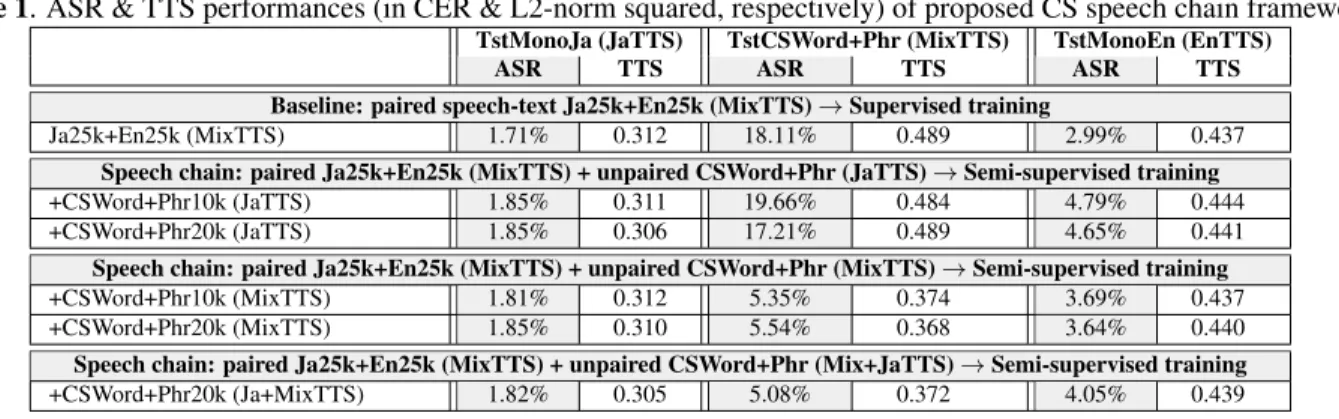
As described in Section 3, we first separately trained the ASR and TTS systems with parallel speech-text of monolin- gual Japanese and English data (supervised learning). After that, we performed a speech chain with only CS text or CS speech (unsupervised learning). For the α and β hyperparam- eters to scale the loss between the supervised (parallel) and unsupervised (unparallel) loss, we used the same α = 0.5, β = 1 for most of our experiments.
6. EXPERIMENTAL RESULTS
We conducted our evaluation on four types of test sets:
(1) TstMonoJa (JaTTS): a Monolingual Japanese text and corresponding speech created by a Japanese TTS; (2) TstCSWord+Phr (JaTTS): an intra-sentential word and phrase-level CS Japanese-English text and corresponding speech created by a Japanese TTS; (3) TstCSWord+Phr (MixTTS): an intra-sentential word and phrase-level CS Japanese-English text and corresponding speech created by a mixed Japanese-English TTS; (4) TstMonoEn (EnTTS):a Monolingual English text and corresponding speech created by an English TTS. Note that the combination of TstMonoJa (JaTTS) and TstMonoEn (EnTTS) can also be considered as inter-sentential code-switching test set. The ASR per- formance was evaluated by calculating the character error rate (CER), which is the edit distance between the reference data (ground-truth) and the system’s hypothesis transcription.
For the TTS evaluation, we calculated the difference in the L2-norm squared between the ground-truth and the predicted log-Mel spectrogram.
6.1. Baseline Systems
Figures 3 and 4 respectively show the performance of the baseline systems for ASR and TTS. The baseline systems were trained with supervised learning using a standard sequence-to-sequence ASR or a TTS framework without the speech chain framework. Eight types of baselines were evaluated: (1) MonoJa50k (JaTTS): an ASR or TTS system trained with 50k monolingual Japanese text and correspond- ing speech created by a Japanese TTS; (2) CSWord50k (JaTTS) and (3) CSPhr50k (JaTTS): ASR or TTS sys- tem trained with a 50k intra-sentential word or phrase-level CS Japanese-English text and corresponding speech created by a Japanese TTS; (4) CSWord50k (MixTTS) and (5) CSPhr50k (MixTTS): ASR or TTS system trained with a 50k intra-sentential word or phrase-level CS Japanese-
English text and corresponding speech created by the mixed of Japanese and English TTS; (6) Ja25k+En25k (JaTTS): an ASR or TTS system trained with a 25k monolingual Japanese text plus a 25k monolingual English text and correspond- ing speech created by a Japanese TTS (inter-sentential CS);
(7) Ja25k+En25k (MixTTS): using the same text data as Ja25k+En25k (JaTTS) but with corresponding speech cre- ated by a Japanese TTS and a English TTS (inter-sentential CS); (8) MonoEn50k (EnTTS): an ASR or TTS system trained with a 50k monolingual English text and correspond- ing speech created by an English TTS.
0%
50%
100%
150%
200%
250%
MonoJa 50k (JaTTS)
CSWord 50k (JaTTS)
CSPhr 50k (JaTTS)
CSWord 50k (MixTTS)
CSPhr 50k (MixTTS)
Ja25k+
En25k (JaTTS)
Ja25k+
En25k (MixTTS)
MonoEn 50k (EnTTS) TstMonoJa (JaTTS) TstCSWord+Phr (JaTTS) TstCSWord+Phr (MixTTS) TstMonoEn (EnTTS)
Fig. 3. Performances of ASR baseline in CER.
0.00 0.10 0.20 0.30 0.40 0.50 0.60 0.70
MonoJa 50k (JaTTS)
CSWord 50k (JaTTS)
CSPhr 50k (JaTTS)
CSWord 50k (MixTTS)
CSPhr 50k (MixTTS)
Ja25k+
En25k (JaTTS)
Ja25k+
En25k (MixTTS)
MonoEn 50k (EnTTS) TstMonoJa (JaTTS) TstCSWord+Phr (JaTTS) TstCSWord+Phr (MixTTS) TstMonoEn (EnTTS)