Firm Organizational Heterogeneity and Market Structure : Evidence from the Japanese
Pesticide Market
著者 TAKECHI Kazutaka, HIGASHIDA Keisaku
出版者 Institute of Comparative Economic Studies, Hosei University
journal or
publication title
Working Paper
volume 161
page range 1‑46
year 2011‑01‑14
URL http://hdl.handle.net/10114/7215
国際相互依存下のアジア各国国内制度の特殊性.普遍,性と市場構造シリーズNo.3
FirmOrganizationalHetCrogeneityandMarketStructure- EvidencejfromtheJapanesePesticideMarket-
KazutakaTakechi
KeisakuHigashida
Firm Organizational Heterogeneity and Market Structure – Evidence from the Japanese Pesticide Market –
∗Kazutaka Takechi†
Faculty of Economics, Hosei University
4342 Aihara-machi, Machida, Tokyo, 194-0298, Japan
Keisaku Higashida‡
School of Economics, Kwansei Gakuin University
1-155, Ichiban-cho, Uegahara, Nishinomiya, Hyogo, 662-8501, Japan
∗We are grateful to anonymous referees for useful comments and suggestions that significantly improved the paper. We would like to also thank Konosuke Odaka and other participants for helpful comments at the seminar held at Hitotsubashi University, Hosei University, Tsukuba University, and the 77th Annual Meetings of Southern Economic Association. The authors gratefully acknowledge financial support from Japan Society for the Promotion of Science under the Grant-in-Aid for Young Scientists (17730150 and 21730205). Any remaining errors are our own.
†e-mail: [email protected]
Title: Firm Organizational Heterogeneity and Market Structure: Evidence from the Japanese Pesticide Market
Abstract: This paper investigates empirically the effects of organizational forms of firms on their entry behavior and market structure. To shed light on this important issue, we focus on the Japanese pesticide market. First, we prove that this market for each pesticide category is competitive despite the existence of regulations. Second, we estimate the effect of firm heterogeneity on entry behavior using the method of simulated moments (MSM). Our empirical results reveal that firms having capital ties to special distribution networks tend to enter this market more readily than firms without such ties. Moreover, diversified and vertically nonintegrated firms are more likely to enter this market than stand- alone and vertically integrated firms. Our study demonstrates how organizational form significantly affects market structure.
Keywords: Firm organization, entry behavior, pesticide market.
JEL classification: L13, L22, N55
1 Introduction
The entry behavior of firms is one of the key factors that influence market structure and industrial competition. The easier it is for firms to enter, the more competitive will be the environment, which implies that market efficiency is achieved. Generally speaking, however, it is difficult to determine the factors that influence entry behavior, because each market has specific characteristics including historical customs and regulations.
Therefore, it is very important to elucidate what factors determine firms’ entry into markets.
The characteristics of markets and products, such as scale economies, market size, technology, regulations, and product differentiation, are possible factors. The seminal paper by Bresnahan and Reiss (1991) examined the relationship between market size and market structure in a strategic entry framework. Recently, using hamburger chain- store data, Toivanen and Waterson (2005) showed that because of expected market expansion, rival presence may induce entry. The effect of firm characteristics on entry has been analyzed by Berry (1992) and Ciliberto and Tamer (2009). Berry (1992) explained entry into airline routes by airport and airline characteristics, and Ciliberto and Tamer (2009) further examined the effect of the types of competitors and regulatory reforms without entry order assumptions. Product differentiation has also been found to be a key determinant of market structure: Mazzeo (2002) using data on motels along freeways, and Seim (2006) studying video rental market data in an incomplete information framework.
While these studies shed light on entry strategies, there is another set of factors that
are crucial for the determination of entry, and accordingly, market structure; namely, organizational forms. In particular, the following factors influence entry into a certain product market: whether or not the firm has a relationship (capital ties) with special distribution networks, being either stand alone or diversified, and whether or not the firm is vertically integrated. Past studies in the corporate finance and industrial organization literatures have examined the role of organizational forms. For example, managerial ability and resource allocation within firms depend on organizational form in terms of diversification. Empirical studies have found that diversified firms do not perform better or have lower productivity than stand-alone firms (Lang and Stulz (1994), Berger and Ofek (1995), and Maksimovic and Phillips (2002)). Another aspect of organizational form, which has been examined often in studies in the literature of industrial organi- zation, is the boundary of firms. For example, Baker and Hubbard (2003) focused on the relationship between the degree of integration and contractual environment based on incomplete contract theory.
However, these studies did not deal with strategic interactions and the firms’ entry decisions directly. If firms’ entry behavior depends significantly on their organizational forms, organizational forms matter not only for firms’ internal efficiency but also for social efficiency through market competition. This effect may be prominent in industries where organizational forms were determined by historical factors and have been stable.
In such cases, firm organization is considered to be an exogenous factor, which helps us identify the effect of organizational form on market structure. By analyzing such an industry, the purpose of this paper is to reveal whether firm characteristics, such as capital ties to special distribution networks (as well as diversification or vertical
integration), are entry enhancing.
The Japanese pesticide industry is the most suitable industry for analyzing this im- portant issue in the field of industrial economics. In particular, the final goods market for pesticide has three important features.1 First, when it comes to firms in the Japanese pesticide market, the three organizational forms that we focus on can be classified as follows: (1) firms that have a relationship with the head office of Japanese agricultural cooperatives (Zen-noh), which is a kind of giant retailer in the distribution network of agrochemicals, or firms that have no relationship with Zen-noh; (2) firms that produce only agrochemicals (stand alone), or firms that produce not only agrochemicals but also other chemical products or pharmaceuticals (diversified); and (3) firms that specialize in the production of final products (nonintegrated), or firms that not only produce final products but also develop new compounds (vertically integrated). These organizational forms are easily observable, and there are adequate data. Furthermore, these forms were determined by both firm characteristics and the situation of the industry before and immediately after World War II (WWII). Therefore, these forms can be treated as exogenous from the current market situation.
Second, each pesticide product has to pass inspection, and is registered under a strict registration system along with its compound, content, and type of product (powder, granule, liquid, and so on).2 Therefore, it is easy to define a market for each pesticide category. Moreover, under this registration system, licensed products and patent-expired
1With regard to agrochemical products, there have been many studies on the issue of pesticide use. The economic benefits of pesticide use are estimated using a food production function or damage abatement cost function. For example, see Lichtenberg and Zilberman (1986). While the pesticide price and regulations are examined by Freshwater and Short (2005), the market structure of pesticides markets has not been examined in the literature.
2
(generic) products are not distinguished. They have to go through the same certification process, which implies that, unlike medicines, the process cannot be simplified even for generic products. The registration system has the same effect on the entry of foreign agrochemicals producers into the domestic market, because they have to register their products in the same way as Japanese firms. Therefore, we can conceive that there is one market for each registered final product category.
Third, regarding entry into the agrochemicals market, the characteristics of mar- kets and products, which have been investigated in the literature, are not likely to be key factors. The production of agrochemicals can be divided into two processes: the development of compounds, and the production of final goods (agrochemicals). Scale economies work in the development of new compounds, because this process requires a large amount of expenditure and is time-consuming.3 On the other hand, the produc- tion of final goods, including mixing more than one kind of compound, does not need a large production facility, and only small quantities of each final product are produced because a great variety of production methods of mixing compounds exist. Therefore, scale economies do not seem to exist. Each firm that develops compounds supplies its own compounds to more than one final goods producer, and each final goods producer purchases compounds from more than one compound-developing firm. In addition, the production method may be licensed. Therefore, we cannot assume that patents and know-how are entry barriers in pesticides markets. Furthermore, because substitute
3The probability of a compound being marketed is one in 10,000. The R&D cost is almost $100 million for the development of one compound if the safety research cost is included. Furthermore, the development period is sometimes more than 10 years. Ollinger and Fernandez-Cornejo (1998) examined the effect of an increase in the sunk research costs on the number of firms in the industry.
products appear quickly, it is difficult for each final goods producer to differentiate its own product from rivals’ products for a long time. Thus, it is easier to identify the effects of firm heterogeneity, rather than product heterogeneity, on market structure.
To achieve our goal, we take two steps. In the first step, we examine whether or not the Japanese pesticide market is competitive. Following Bresnahan and Reiss (1991), we estimate the per-firm market sizes for monopoly, duopoly, and oligopoly markets for various numbers of entrants. It is shown that despite the existence of the strict registration system, the final product markets are competitive.
In the second step, the effect of firm heterogeneity on entry behavior is estimated using the framework of Berry (1992). Our findings indicate that firms that have capital relationships with special distribution networks tend to enter the markets more readily than firms that have no capital relationship with those distribution networks. A close manufacturer–retailer relationship may avoid double marginalization, which leads to high joint profitability and thus a good chance of entry. This result implies that the existence of special distribution networks is important for firms’ entry into markets, and accordingly, the competitiveness of markets. Diversified firms are also more likely to enter markets than stand-alone firms. This suggests that it is likely that diversified firms will generate enough benefit from scope economies. Furthermore, nonintegrated firms are more likely to enter the markets than integrated firms. A possible reason is that because nonintegrated firms specialize in the production of final products, they have more information on the needs of consumers, which are sometimes specific to types of crops and areas.
The rest of the paper is organized as follows. Section 2 provides historical back-
ground information on the industry, which explains the current organizational forms of manufacturers and the industry structure. Section 3 proposes our hypotheses. Section 4 outlines the data, and Section 5 describes the framework of the empirical analysis. In particular, we outline the method of simulated moments (MSM). Section 6 reports the empirical results, and the final section concludes.
2 Industry Background
After WWII, along with the increase in the production of agricultural products, the output of agrochemicals increased steadily in Japan. Dichloro-diphenyl-trichloroethane (DDT) was used in the production of rice from 1945 through 1953. From the mid 1950s, farmers also began to use agrochemicals for raising other kinds of crops and vegetables, and their use increased drastically in the 1960s. In the 1970s, because of the problem of residuals and the policy of reducing rice acreage under cultivation, the market for agrochemicals became stagnant. Increasing prices for agrochemicals, however, expanded the market scale until the early 1980s, and the scale of the final goods market in Japan in 1990 was 398.1 billion yen (2.75 billion US dollars). The market has been shrinking gradually since 2000, and the volume in 2005 was 337.8 billion yen (3.7 billion US dollars).4 In this section, we survey the four important characteristics of the Japanese agrochemical industry: the distribution routes, diversification, vertical nonintegration, and the registration system.
4See Noyaku Sangyo Hakusyo 2006, Yano Research Institute, for details of the agrochemicals market after 2000. One US dollar was equal to 144.81 yen on average in 1990 and 110.15 yen in 2005.
2.1 Distribution
In Japan, there are two main channels for the distribution of agrochemicals: the channel through Zen-noh, which is the nationwide organization of agricultural cooperatives; and the channel through the distribution networks of agrochemical companies. In the former case, agrochemicals purchased by Zen-noh are distributed through its lower branches.
There is a lower branch of Zen-noh in each prefecture, which also has a lower branch in each municipality. This three-tier structure is firm, and farmers are able to procure agrochemicals that they need through this channel if they want. In the latter case, farmers purchase agrochemicals at DIY stores. In the following, we call the former channel “Zen-noh related”, and the latter channel “non-Zen-noh related”.
In terms of industrial organization theory, we consider a situation in which there is one giant retailer (Zen-noh) and other relatively small retailers (DIY stores). Because at least some of the agrochemical companies distribute their products through both types of retailers, the existence of two types of retailers may give rise to a competitive environ- ment, in the sense that it is difficult to enforce entry deterrence effectively. Moreover, because several manufacturers have an ownership relationship with Zen-noh, they may have an entry advantage.
This established distribution system traces back to the origin of Zen-noh. In 1900, the Industry Cooperative Association Law was enacted, which was modeled on the Ger- man cooperatives. Under this law, cooperatives are allowed to undertake four kinds of projects: procurement, sales, financing, and providing agricultural facilities. As capital- ism spread in Japan, petty farmers were experiencing great difficulty because of higher
chasing cooperative of agriculture, which was called “Zen-ko-ren”, was established in 1923 to enable farmers to obtain agrochemicals more easily. By this time, the three-tier structure described above had been organized, and almost all farmers joined agricultural cooperatives.
Although this cooperative system was disbanded in the wartime economy during WWII, the new nationwide purchasing cooperative of agriculture, which was also called Zen-ko-ren, was established in 1948 soon after the Agricultural Cooperative Association Law was enacted. This was formerly the procurement section of the Japan Agricultural Cooperative. The purpose of Zen-ko-ren is the same as the former cooperative: (a) to enable small-scale farmers to obtain agrochemicals more easily, and (b) to make the distribution of agrochemicals efficient. In 1972, Zen-ko-ren merged with the nationwide sales section of the Japan Agricultural Cooperative, and the new organization was called Zen-noh. Hereafter, we use Zen-noh for both Zen-ko-ren and Zen-noh.
In cooperation with the financial sections of the agricultural cooperatives, the sys- tematization of transactions of agrochemicals through the three-tier structure had been completed by 1955. As indicated by the increase in the production of agricultural prod- ucts, the use of agrochemicals (pesticides, germicides, herbicides, etc.) increased rapidly in the early 1950s (20 metric tons in 1950, and 125 metric tons in 1955). Accordingly, the amount of expenditure per farmer also increased from 960 yen (2.67 US dollars) in 1950 to 3372 yen (9.37 US dollars) in 1955.5 In this era, almost all farmers operated at a small scale, and they were not well funded. Thus, Zen-noh played an important role in the procurement of agrochemicals, the establishment of the Zen-noh-related distribution
5One US dollar was equal to 360 yen in the 1950s.
channel, and the increased yield.
The ratio of agrochemicals transacted through Zen-noh to total consumption was 36 percent in 1955. The ratio was around 50 percent in the 1970s and 1980s, and it decreased continuously in the 1990s. As of 2005, however, the ratio was still 34 percent.
Moreover, contrary to European cooperatives, Japanese agricultural cooperatives handle multiple agricultural products. Therefore, Zen-noh is still a giant retailer.
Two more important points should be mentioned about the behavior of Zen-noh.
First, Zen-noh began to provide capital to a few agrochemical companies in the 1950s.
Currently, some final goods producers, known as “Zen-noh-related manufacturers”, have a close relationship with Zen-noh. For example, Zen-noh provides capital for pesticide companies, such as Kyoyu Agri, Kumiai Chemical Industry, and Hokko Chemical In- dustry. These relationships had been established by the early 1970s. This behavior is considered to have partly removed the inefficiency caused by double marginalization, and accordingly, the distribution of agrochemicals has become more efficient.
Second, Zen-noh and its lower branches issue the calendar for prevention and exter- mination every year, which helps determine the use of necessary agrochemicals. This implies that, with regard to the distribution through Zen-noh, a certain number of trans- actions is guaranteed.6 Because the agro-chemicals on the calendars reflect the needs and utility of consumers (farmers), the quality and characteristics of agro-chemicals capture the utility of farmers more properly as compared with when there are no such calendars.
It is likely that the behavior of Zen-noh has encouraged the establishment of a unique
6This situation is similar to the situation in which beverage or/and food companies acquire some of the shelves in giant supermarkets for their own products.
distribution system and has made the distribution of agrochemicals more efficient. Thus, Zen-noh-related manufacturers may have different entry patterns from non-Zen-noh- related firms.
2.2 Diversification and Vertical Nonintegration
As noted in the Introduction, when analyzing the agrochemical industry, it is important to distinguish between compounds and final goods. In terms of the effect of organiza- tional forms on the development of compounds and the production of final products, diversification and vertical nonintegration should be focused on. Similar to the case of the distribution system, historical factors before, during, and immediately after WWII influenced these organizational forms.
In the Meiji Era (1868–1912), pyrethrum was used as a pesticide. A mixture of lime and sulfur was also produced. After that, inorganic compounds, such as copper wet- table powder, were developed, and some agrochemicals were exported to foreign coun- tries. During WWII, however, because there was a continuous shortage of materials, the production of agrochemicals was strictly regulated. Therefore, in this period, although organic compounds were developed in foreign countries, such as Germany, Japan did not keep pace with the industry elsewhere in the world.
Immediately after WWII, the demand for agrochemicals increased under the policy of increasing agricultural outputs. Because Japanese companies had to acquire licenses to produce compounds that were patented by foreign firms, only large-scale chemical companies were able to acquire these licenses. Thus, those chemical companies produced compounds and exercised scale economies. On the other hand, other firms purchased
those compounds and specialized in the production of final goods.
This historical background influenced the structure of the Japanese agrochemical industry until the late 1950s. Although final goods producers did not develop compounds themselves, they were successful in developing effective final products and differentiating their own products from rivals’ products. Moreover, chemical companies did not have distribution channels and consumer networks in rural agricultural districts. On the other hand, final goods producers had such networks, and accordingly, they knew the farmers’ demand well. Therefore, final goods producers had an advantage over chemical companies on the sales of final goods. Thus, vertical separation of the agrochemical industry occurred.
A few pharmaceutical companies followed those chemical companies and began to produce compounds by the early 1960s, and domestic chemical companies began to de- velop compounds by themselves in the 1960s. In addition, some final goods producers embarked on the development of compounds, and some firms that had specialized in the production of compounds also embarked on the production of final goods. Consequently, three types of companies arose out of these changes: (a) diversified and vertically inte- grated, (b) nondiversified (stand alone) and vertically integrated, and (c) nondiversified (stand alone) and vertically nonintegrated.7 A “vertically integrated company” means a company that produces both compounds and final goods.
Ever since then, the diversification and vertical integration characteristics of those companies have not changed drastically, although some mergers and acquisitions have
7Theoretically, diversified and nonintegrated manufacturers can exist. In reality, however, there are no manufacturers that fall into this category.
taken place. Even now, there exist firms that specialize in the development of new compounds or the production of final products.
2.3 Regulation
Japanese regulations are also an important factor to consider when analyzing the agro- chemical industry. There were inferior pesticides everywhere in the late 1940s, which became a social problem. To solve this problem, the Agricultural Chemicals Regulation Law was enacted in 1948, under which each agrochemical had to be registered before it was distributed, and each product had to pass inspection on toxicity, effectiveness, potential damage, and residual substances. This law has been amended several times so far, and there was an important amendment in 1971. Because of this amendment, the necessary conditions for the registration and the safety criteria became stricter, because toxicity and the effect of agrochemicals on the environment had become big problems.
Even if two different final products include the same compound, they should be registered separately according to their types, effective ingredients, and so on.8 More than one firm often registers the same product. The possible reasons are that the firm that has the patent for the compound licenses more than one firm to use the compound at the same time, or that they produce the product after the patent has expired. At present, the risk assessment is conducted for each new compound, and so the certification process has become more complicated. For example, in 2005, 19 new compounds and 26 final products that use one or more new compound were newly registered. Because the total number of final products newly registered in 2005 was
8The main types of agrochemical are dustable powder, wettable powder, granule, emulsifiable concentrate, and sus- pension concentrate.
150, the proportion of newly registered products that include the new compounds is 17 percent. Under this registration system, licensed products and patent-expired (generic) products are not distinguished. Therefore, both types of products have to go through the same certification process, which implies that, unlike medicines, the process cannot be simplified even for generic products.
There is one more important point. The registration system has the same effect on the entry of foreign agrochemicals producers into the domestic markets. Because it is assumed that there is no regional difference in toxicity, the field trial data that are obtained in foreign countries can be used for the registration as long as the data are supplied by an institution certified by Good Laboratory Practice (GLP). On the other hand, because effectiveness and residual substances depend on the weather and soil conditions, data collected in Japan are required.9
2.4 Summary
In summary, the following points should be noted. ( i ) There are three important criteria regarding the organizational forms of agrochemical companies: whether or not a company has a close relationship with a large distribution network, Zen-noh; whether or not a company is diversified; and whether or not a company is vertically nonintegrated.
( ii ) Having observed the registration system, there exists one market for each registered final goods category. ( iii ) All of the basic organizational forms and regulations had
9GLP was adopted by the Organization for Economic Co-operation and Development (OECD) in 1981 as a measure to secure the credibility of the variety of safety inspection records on chemical substances. Under this system, each inspection facility has to go through a verification of conformity to the OECD–GLP criteria every three years. See the website of the National Institute of Technology and Evaluation for details (http://www.safe.nite.go.jp/kasinn/glp/glp.html).
been established by the early 1970s, and they have not changed drastically since then.
3 Hypotheses
In oligopolistic markets, the decision to enter is not solely an individual choice. Instead, it depends on other firms’ decisions to enter. Therefore, we adopt a strategic approach to entering markets, which was developed by Bresnahan and Reiss (1991) and Berry (1992).
We incorporate firm organizational forms into that framework. The basic structure of the entry model is a two-stage, complete information game, in which firms decide to enter a market in the first stage, and then they compete in a product market in the second stage.
With regard to the timing of entry, we mainly follow the assumption of Berry (1992):
higher-profit firms enter first. Without an assumption on entry order, there is a multiple equilibria problem. To tackle this problem, Ciliberto and Tamer (2009) utilize the set estimation technique, which does not require the assumption of entry order. The set estimator developed by, for example, Imbens and Manski (2004) and Chernozhukov et al. (2005), provides us with identified sets and a confidence interval of parameters using a subsampling procedure. Therefore, we also follow Ciliberto and Tamer (2009) for robustness checks of our assumption on entry order.
Because of the dynamic nature of the entry decision, several studies used a dynamic model to estimate entry behavior. Pakes and McGuire (1994) and Ericson and Pakes (1995) developed a framework for solving a Markov-perfect equilibrium of dynamic in- teraction, and more recently, Aguirregabiria and Mira (2007) and Bajari et al. (2007) developed a structural estimation framework. Their fully specified dynamic model is be-
yond the scope of this paper, mainly because of computational intractability involving a relatively large number of sample firms in our case. In addition, our focus is on the impact of organizational forms on entry, not, for example, that of investment on entry.
Organizational forms change infrequently in the Japanese pesticide industry. Because we want to examine the long-term relationship between stable firm characteristics and market structure, our two-stage entry model can be regarded as describing a stationary equilibrium.
The entry decision depends on profit. Firms decide to enter in the first stage if they can earn a positive profit in the second stage. This profit is assumed to depend on market characteristics and the firm’s organizational forms. These organizational forms, such as vertically integrated or nonintegrated firms, are assumed to be exogenous when firms decide to enter. After entry, the reduced form profit is expressed as:
πim =π(Xm, Yi, N, im), (1) where Xm and Yi are the exogenous market and firm characteristics, respectively, N is the endogenous number of entrants, and im denotes the unobservable factors. Hence, we focus on the entry stage decision by using the reduced form profit function, πim.
The market characteristics, Xm, affect the entry decision by changing the profit. For example, the basic theory of oligopoly tells us that the greater is the demand for the product, the greater is the profit earned by each firm, given the number of entrants and the other market and firm characteristics. Thus, a marginal increase in market scale increases the incentive of firms to enter the product’s market. In other words, if an increase in market scale does not lead to an increase in the number of entrants, there
may be barriers to entry.
The firms’ organizational forms, Yi, also affect the entry decision as determined by the profit function (1). If some organizational forms have an advantage by being able to increase net profits, firms having such forms tend to enter final goods markets. As explained in the previous section, in the Japanese pesticides market, an important giant retailer (Zen-noh) exists. Zen-noh has a specific relationship with several agrochemical companies (Zen-noh-related manufacturers), which means that Zen-noh is a major share- holder of those manufacturers. Because Zen-noh has a distribution network nationwide through a lower branch in each region, Zen-noh-related manufacturers are considered to have an advantage over other companies that do not have close relationships with Zen-noh (non-Zen-noh-related manufacturers).
Zen-noh-related manufacturers are considered to be integrated with distributors to a certain degree because of shareholdings. On the other hand, non-Zen-noh related firms are independent manufacturers. Because both manufacturers and distributors have market power, there will be a double marginalization problem (Tirole (1988)).
Zen-noh and Zen-noh-related manufacturers may maximize their integrated profits when prices are set. However, Zen-noh does not take into account the incremental profit for independent firms, i.e., non-Zen-noh firms, when determining retail prices. Total supply and total profits are then lower than those under integration. Thus, the chance of entry will be higher for Zen-noh-related manufacturers.
To illustrate, consider the relationship between a manufacturer and a retailer as in Tirole (1988). Let us compare the case where there is an independent manufacturer and a retailer with that where there is a Zen-noh-related manufacturer and Zen-noh.
The final goods demand is assumed to be D = 1 −P, where P is the retail price.
Then, the manufacturer’s profit function isπM = (Pw−C)Q, where Pw is the wholesale price, C is marginal cost, and Q is derived demand. The retailer’s profit function is π = (P −Pw)(1 −P). If a product is produced and distributed by an independent manufacturer and a retailer, by solving a successive monopoly problem, the profits are:
πM = (1−C)2/8 and π= (1−C)2/16. Suppose that there is fixed distribution cost, F, and the profit for the retailer will be negative when it supplies the pesticide produced by an independent manufacturer, (1−C)2/16−F <0. Then, there will be no entry.
However, if it is produced by a Zen-noh-related manufacturer and distributed by Zen- noh, the joint profit is maximized,πjoint= (1−C)2/4, and the profit is shared according to bargaining power related to stock holdings. If Zen-noh has enough bargaining power and can obtain a certain profit share,λ, positive profits for Zen-noh are realized (λ(1− C)2/4−F > 0) and entry occurs. Therefore, Zen-noh-related manufacturers have a high probability of entry.
Consequently, we have the following hypothesis.
Hypothesis 1: Firms closely related to Zen-noh are more likely to enter final goods markets as compared with firms that do not have close relationships with Zen-noh.
Cost differences may occur between stand-alone and diversified firms. Let Cs and Cd denote the supply costs of a stand-alone firm and a diversified firm, respectively.
Diversified firms may enjoy scope economies because they engage in producing not only pesticides but also general chemical products or pharmaceutical goods. Those experi- ences may improve the efficiency of supplying pesticides. If such scope economies exist,
supply costs for a diversified firm are lower than those for a stand-alone firm, Cd < Cs. Then, diversified firms tend to enter a final goods market. For example, in terms of R&D, this grouping is important. For chemical companies, some agrochemicals R&D processes overlap with those of other chemical products. Therefore, it is likely that di- versified firms can develop final goods (agrochemicals) more efficiently than stand-alone firms can.
On the other hand, if scope economies do not exist, stand-alone firms may be more efficient than diversified firms, because stand-alone firms specialize in the production of pesticides, and accordingly, they have better know-how. However, as noted in the previous section, this grouping was formed mainly for historical reasons. No stand-alone firm was originally diversified or decided to concentrate its resource management on the development and production of final goods (agrochemicals). Thus, scope economies are an important factor for the entry decision of pesticide companies.
Hypothesis 2: Diversified firms are more likely to enter final goods markets as com- pared with stand-alone firms.
Cost differences may also occur between vertically integrated and nonintegrated firms.
When a nonintegrated firm attempts to enter a final goods market, it has to have a licensed chemical compound, which is protected by patent. On the other hand, an integrated firm can enter the market on its own. It is also possible for a firm to choose to not enter by itself and to license the product to other firms. Suppose that the supply cost to a final goods market for an integrated firm (resp. a nonintegrated firm) is Cin (resp. Cn).Then, integrated firms will license their products if licensees are more
efficient (Cn< Cin), because they obtain larger profits by imposing licensing fees. It is possible that nonintegrated firms have more information on the needs of consumers than vertically integrated firms do, because they have been specializing in the production and the supply of final products. Thus, in such a case, nonintegrated firms are likely to enter.
In reality, integrated firms tend to concentrate their resource management on the development and production of compounds. On the other hand, as noted in the previ- ous section, because nonintegrated firms have communication with consumers in rural agricultural districts, they are highly capable of developing effective final products and differentiating their own products from rivals’ products. When developing and produc- ing a new final product, the way in which more than one compound is mixed and the type of final product is crucial for whether or not the demand for the new product in- creases rapidly. Nonintegrated firms are considered to have accumulated know-how of these factors by making use of their own communication with consumers.
Hypothesis 3: Vertically nonintegrated firms are more likely to enter final goods mar- kets as compared with integrated firms.
This framework can be applied to other types of firm organizational forms. The basic idea is whether a particular organizational form provides advantages to firms that have the characteristic. In this study, we focus on the organizational forms discussed above.
In theory, there are other factors that can affect entry behavior. For example, entry deterrence may take place. In reality, this factor is important in some other industries.
However, in addition to the existence of two types of retailers/distribution channels, there are many kinds of pesticides, and those pesticide markets can be considered to
be competitive.10 Thus, entry deterrence is less important in the agrochemical industry in Japan. This means that the organizational forms we focus on are more crucial than other factors in this industry, and accordingly, the effects of organizational forms on entry behavior can be determined.
4 Data
4.1 The Choice of Markets and Firms
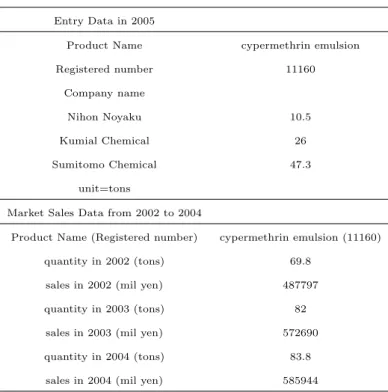
“Noyaku Yoran 2005” (Handbook of Agrichemicals) published by Japan Plant Protection Association reports data on pesticide market sales and market entrants. The data are classified according to pesticide product, such as marathon powder, marathon emulsion, and DEP emulsion. For example, in the cypermethrin emulsion market, Nihon Noyaku, Kumiai Chemical, and Sumitomo Chemical have entered. An example of the information that can be extracted from the data file is shown in Table 1. Thus, we can collect the data on which firms enter which pesticide product markets.
The number of registered pesticides in 2005 was 1424, and there were about 90 firms supplying pesticides. As mentioned in the industry background section, markets are defined for each pesticide category. For example, if some pesticides consist of the same chemical compounds but they are registered separately according to their types, pow- der and granule, their markets are treated as different markets. In fact, there is data variation over entrants among pesticide types. Different types of pesticides are some- times supplied by different manufacturers, even if they are made of the same chemical compounds.
10This point will be referred to in Sections 4 and 6.
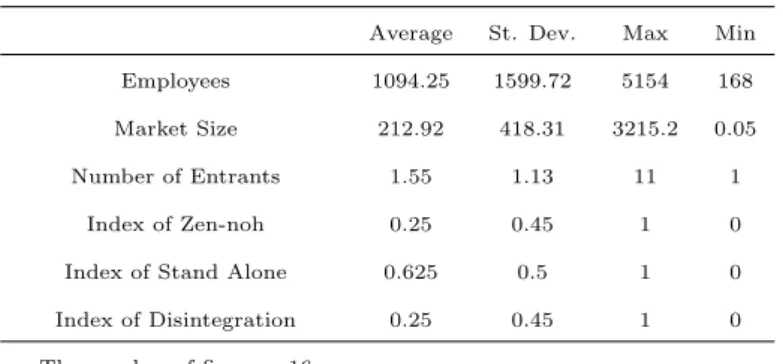
For each market, there are data on quantity and sales. We use average total sales of the previous three years, from 2002 to 2004, as a measure of market size, because the units of measurement of quantity differ depending on the type of pesticide (kilogram or liter) and we deal with any possible endogeneity problem by using 2005 sales to analyze the 2005 market structure. Table 2 reports summary statistics, and the reported average market size is for 2005. The average market size is about 212 million yen (1.82 million US dollars), the standard deviation is 418.31 million yen (3.59 million US dollars), the largest market is 3.22 billion yen (28 million US dollars), and the smallest market is 0.05 million yen (4 hundred US dollars).11 Therefore, there is a large variation in market size.12 To remove the effect of the types of final products, we adopt two product-type dummy variables: powder and granule.
Because several firms are small private firms, we cannot obtain information on all 90 firms’ characteristics, such as the number of employees. Therefore, we use the data on firms that enter more than 15 markets, providing us with 18 sample firms. Because those 18 firms are sufficiently large, we can collect firm characteristics data. There remain 361 markets. Because we study strategic interactions, we deal with markets that only these 18 firms enter. Excluding the markets where other than those 18 firms enter gives us 16 firms and 289 markets (a certain two firms always enter markets that include other tiny firms, so these two firms and 72 markets are excluded). In these 289 markets, we are able to examine the strategic interaction among these firms. The 16 firms involved are: Agro Kanesho, Bayer, Hokkai Sankyo, Hokko Chemical, Kumiai Chemical,
11One US dollar was equal to 116.5 yen on average from 2002 to 2004.
12For each market, there are data on the value of production and shipments. If a product is unsold and returned, a negative value is recorded. In this case, we assume that only positive-sales firms enter the market.
Kyoyu Agri, Mitsui Chemical, Nihon Noyaku, Nippon Soda, Nissan Chemical, Otsuka Chemical, Sankei Chemical, Sankyo Agro, SumikaTakeda Noyaku, Sumitomo Chemical, and Syngenta.
We use the number of employees as a measure of firm size. The data are taken from the Market Report on Agrochemical Industry (Yano Research Institute (2006)) and the companies’ websites.13 The average is about 1094, the smallest is 168 (Sankei Chemical), and the largest is 5154 (Sumitomo Chemical). While the data on diversified firms are not merely the number of employees in the agrochemical division, because of limited data availability, we use this to control for each firm’s observable characteristics.
With regard to the market structure, in our sample, the most frequent market struc- ture is a monopoly, and the second most frequent is a duopoly. The largest number of entrants into a particular market is 11. The average number of entrants is about 1.55, and the standard deviation is 1.13.
The method of choosing sample firms and markets is significant. There are two im- portant reasons why we define a market by registration. First, the markets for final goods are homogeneous goods markets, for which we can assume simple quantity com- petition in the output market. Therefore, our market segmentation is consistent with the theory of competition in product markets.
Second, these markets are considered to be independent of each other. As noted in the Introduction and Industry Background sections, each pesticide product must pass inspection and is registered under a strict registration system with its compound,
13This market report is written in Japanese and published every two years by Yano Research Institute. The English version of its homepage is http://www.yanoresearch.com/. We use the 2006 Market Report.
content, and type of product (powder, granule, liquid, and so on), which does not depend on whether it is generic or whether it is domestically produced. Because it is uncertain whether or not each pesticide will pass inspection, firms consider each pesticide independently when they make applications. Moreover, pesticides are different from each other in terms of targeted crops, spraying seasons, and targeted areas. Therefore, once pesticides pass the inspection, firms do not have incentives to supply those pesticides associated selectively with other markets’ conditions. Because development costs are sunk costs, the decision of a firm depends on the condition of each market: whether or not the pesticide is profitable.
However, the small firms tend to face capacity constraints, and they may not be able to enter more than one market at the same time. In such cases, factors other than organizational forms affect firms’ entry behavior. Thus, to make the independence of the pesticides markets certain, our selection of 16 firms, such that we exclude firms entering less than a certain number of markets, is appropriate for excluding firms that cannot enter a market simply because of capacity constraints. There may still remain some factors causing interdependence across markets. If a firm has an advantage over other firms for a particular pesticide, it tends to enter markets related closely to it. We control for such effects by considering a company-specific unobservable term in the estimations.
4.2 Organizational Forms
The data on organizational forms are obtained and used as follows. When Zen-noh owns shares of a manufacturer, we regard the manufacturer as a Zen-noh-related manufacturer, which has a close relationship with Zen-noh. Among the manufacturers, Kyoyu Agri,
Kumiai Chemical, Hokko Chemical, and Hokkai Sankyo are classified into this group.
We use the data on large shareholders in the securities reports. In the case of Hokkai Sankyo, we use the information on the website of the firm.
We sort the data on diversification from the securities reports of firms, if they exist.
Hokkai Sankyo’s stock is not listed on the stock exchange; therefore, we obtained the necessary data from its website. We assume that if more than 75 percent of sales are from pesticides, the firm is stand alone.
Finally, we use the 2006 Handbook on Agrochemicals and the 2006 Market Report on Agrochemical Industry for data on vertical integration.14 This information is used to determine whether each company produced both chemical compounds and final pes- ticides.
The basic characteristics of organizational forms were determined prior to the 1970s, and the age of firms may provide evidence on the exogeneity of the organizational form to market structure. The average year of establishment is approximately 1921, because several pharmaceutical or chemical oriented companies started business very early. Sev- eral companies were born by a merger of pesticide companies, and the newest one was born in 2003. However, because the basic firm characteristics that we focus on (for example, Zen-noh relationship) do not change because of mergers, the organizational forms are regarded as established long before 2005.15
14The Handbook on Agrochemicals is published by The Chemical Daily Co., Ltd., which is written in Japanese. The Chemical Daily (a newspaper on the chemical industry) has an English version on its website (http://www.japanchemicalweb.jp/). It also has the data on chemical products and companies (http://en.chem- edata.com/).
15Firm characteristics determined quite a while ago may still have an impact on firm performance. Klepper and Simons (2000) examined the effect of experience in the radio industry, which is a key determinant of success in the TV industry.
5 Empirical Specification
In this section, we describe our empirical framework. First, we use a simplified version of the ordered probit model of Bresnahan and Reiss (1991). In this framework, the profit function (1) is expressed as follows:
π=V ariableP rof it×M arketSize−EntryCosts. (2) Assuming that variable profit is constant, that the market size is expressed in terms of total sales, and that firms are symmetric, the profit function (2) is:
πm =βlnXm−µn+m,
where Xm, β, and µn are the market size measured by total sales in market m, a parameter, and an index capturing the effect when n firms enter, respectively. That is, the profit depends on characteristics of the market, the degree of competitiveness, and an error term. By assuming that m follows a normal distribution, the probability that N firms enter is given by:
P rob(N) = P rob(ΠN ≥0∩ΠN+1 <0)
= P rob(βlnX−µN +m >0∩βlnX−µN+1+m <0)
= P rob(−βlnX+µN < <−βlnX+µN+1)
= Φ(µN+1−βlnX)−Φ(µN −βlnX),
where Φ is a normal distribution function. This shows that the probability of N firms entering the market is obtained as follows: N firms enter the market if the profit of the
They found that such experience has a substantial effect on firm survival. By contrast, we investigate directly the effect
entrants is positive when there are in fact N entrants, but negative when there are N+1 entrants. We estimate the parameters by maximum likelihood. This type of model is an ordered probit model.
We can derive the minimum market size from the estimation results and consider the effect of competition changes. If there are N entrants, and if the estimates are ˆµand ˆβ, we have:
ˆ
µN = ˆβlnX ⇐⇒ exp{µˆN/β}ˆ =X.
Then, we can obtain the minimum market size for N entrants. Using this, we can calculate per-firm market size,sN =X/N, and the threshold ratio,sN+1/sN, to consider the changes in market size when the number of entrants changes. If this ratio is larger than 1, the per-firm market size for breakeven increases as the number of entrants increases. This means that as a result of severe competition, the market price falls because the supply of each firm increases. Therefore, using ordered probit estimation, we can examine the changes in market competition in the pesticide market.
One problem with the above approach is controlling for heterogeneity. It is able to control for market heterogeneity but not for firm heterogeneity. In the pesticide industry, there could be some unobservable heterogeneity that we cannot control for by using observable variables. Here, we use the approach of Berry (1992), where unobservable fixed costs are heterogeneous. Then, the profit function (1) is specified as follows:
πim =β1lnXm+β2Yi+δln(N + 1) +eim,
where eim is firm-specific unobservable heterogeneity. As Berry (1992) discussed, this form of profit function can be derived from the Cournot competition model with a
constant elasticity of demand and constant marginal costs. Even though we do not specify the mode of product market competition, because of the product characteristics and market definition, it is possible to assume that we are dealing with a homogeneous goods market, and therefore we can consider Cournot competition. Yi includes firm organizational characteristics. The following is the list of variables of organizational forms and the expected signs, which are in parentheses:
• Zen-noh related (Hypothesis 1): (+),
• Stand alone (Hypothesis 2): (−),
• Vertical nonintegration (Hypothesis 3): (+).
The above indices of organizational forms are used to test whether those organi- zational forms affect firms’ entry behavior. We consider the correlation between any two unobservable factors, Cov(eim, ejm) = ρ2. This correlation is the same as in Berry (1992), where the error term is ρuio +√
1−ρ2uim. uio is a firm-specific factor, and uim is a market-specific factor.
The decision to enter is based on the profit: only if the profit is positive does the firm enter. In this type of entry game, the number of entrants is not unique in equilibrium (Berry (1992)). We impose the same assumption as Berry (1992): sequential entry is assumed, and firms with higher profits enter the market. Because it is difficult to calculate the probability of entry equilibrium analytically, we examine entry behavior by simulation, and we estimate the parameters by matching the moments of the actual data and the simulated data (MSM).
The individual firm’s decision is described by the indicator function, I = I(π ≥
0), which takes the value one if entry occurs, and zero if entry does not occur. The equilibrium number of entrants N is determined by the condition that there are N positive profit firms when the number of entrants is N, and the (N + 1)th firm’s profit is not positive if there are N + 1 entrants:
N = maxN|XI(πim(N)≥0)≥N.
Each firm’s entry decision is described by Ikm = I(N ≥ q(k)), where q is the profit ranking function of firm k. The firm whose profit is the highest, that is, the highest ranking firm (q(k) = 1) to theNth highest ranking, (q(k) =N), will enter the market.
We derive the number of entrants by simulation, consider the prediction error from the data, and then estimate the parameters by using MSM. Given the exogenous variable, x, and the parameter, β, the prediction value of the number of entrants is E[N|x] = R N(x, e, β)p(e|x, β)de, where p(e|x, β) is a normal density function given x and β. The prediction error is therefore νio = N −E[N|x]. When the param- eter values take the true value, β = β∗, the mean of the prediction error is zero:
E[νio|x] =E[N −E[N(x, e, β)|x,]|x] = 0. We use this condition to estimate by method of moments.
The unbiased estimator of the prediction value is ˆN = (1/S)PNt, and the entry decision is ˆP = (1/S)PIkt, where S is the number of simulation draws. LetV = (N, I) and ˆV = ( ˆN ,Pˆ). Then, the prediction error is given by ˆνi = V −Vˆ, where ˆV is the prediction estimator of V. Therefore, E[ ˆνi|x, β∗] = 0 holds.
We use the sample moment, (1/M)Pνxˆ = 0, in the estimations. Consider the
moment condition:
G(β) = (1/M)X
m
(Vm−(1/S)X
m
Vˆs,m)Z,
whereZis an instrumental variable. Because the number of moment conditions is greater than the number of parameters, we minimize the quadratic form distance,G(β)0W G(β), to estimateβ, whereW is a positive definite matrix. For the moment conditions, we use the number of entrants in each market and the decision of firms that enter more than 35 markets. That is, N is the number of entrants, and Ik is the vector of eight firms’ entry choice. We use six instrumental variables, which are market and firm characteristics as in Berry (1992). These are the number of entrants divided by the total number of firms, the per-firm size of the market, the number of foreign firm entrants, the number of vertically nonintegrated firm entrants, and whether the pesticide type is powder. For historical reasons, the organizational characteristics of Japanese pesticide firms operating in 2005 have been determined by the 1970s. Therefore, because our firm characteristics can be considered to be exogenous when they decide to enter markets, we can use those characteristics as instruments. Furthermore, we also use market and other firms’
characteristics, not an individual firm’s own characteristics, as those that are exogenous to an individual firm’s decision. Similar firm and market characteristics are used in Berry (1992) for the same reason. Because there are nine variables—the number of entrants and the eight firms’ entry choices—there are 54 moment conditions.
Because the decision to enter is a discrete choice, whether to enter or not, the objective function is a step function. We cannot use the gradient-based method to minimize this function. Therefore, we use the importance sampling procedure by Ackerberg (2001).
This involves transforming the error term given δ >0 as follows:
(β1Xm+β2Yi+δln(N+1)+eim)/δ= (β1Xm+β2Yi+eim)/δ+ln(N+1) =im+ln(N+1).
That is, im = (β1Xm+β2Yi+eim)/δ. Then, if the profit is positive, πim/δ ≥ 0 ⇐⇒
(β1Xm +β2Yi +eim)/δ+ ln(N + 1) > 0 ⇐⇒ im + ln(N + 1) > 0, letting N = max{N|PI(im+ ln(N + 1)≥0)> N}, yields:
E[N] =
Z
N(x, e, β)p(e|x, β)de=
Z
N()p(|x, β)
g() g()d.
This is the predicted number of entrants. By simulation, we can derive the number of entrants as follows:
(1/S)X
s
N(es) = (1/S)X
s
N(s)(p(s|X)/g(s)).
This transforms the draw of eim fromp(·) to the draw of im fromg(·). Here, we choose p(·) when β = 0, δ = 1, and ρ= 0 as g(·). That is, drawing from g(·) means drawing from the standard normal distribution. This transformation makes the objective function smooth in the parameters; therefore, we can use gradient-based methods.
If there is no entry order assumption, the set estimator has to be adopted. Imbens and Manski (2004) and Chernozhukov, Hong, and Tamer (2005) developed a set estimator, and it has been applied to the static entry model by Ciliberto and Tamer (2009). The moment condition is the inequality:
H1(x, β)≤P r(I|x)≤H2(x, β),
where P r(I|x) is the entry probability, H1 is the probability that the model predicts a particular market structure as the unique equilibrium, andH2 contains the probabilities
of regions of multiple equilibria. The objective function turns out to be:
Q(β) = (1/M)X
m
[((P rM(Xm)−H1(Xm, β))−)2+ ((P rM(Xm)−H2(Xm, β))+)2], where P rM(Xm) is a consistent estimator of P r(I|x), (A)− = [a11(a1 ≤ 0), . . . , a2N1(a2N ≤ 0)], (A)+ = [a11(a1 ≥ 0), . . . , a2N1(a2N ≥ 0)], 1(·) is an indicator function, and ak is the k-th element of a 2N vector, A. P rM(Xm) is obtained by a simple frequency estimator, andH1 andH2 are derived by simulation. We discretize the data in four bins and use a subsampling procedure twice to obtain confidence intervals of the parameters as in Ciliberto and Tamer (2009).16 We employ this estimation to check whether the estimates of the organizational form parameters depend crucially on the entry order assumptions.
6 Results
This section reports the estimation results of entry behavior. First, we show the ordered probit estimation results. Then we report the results of MSM.
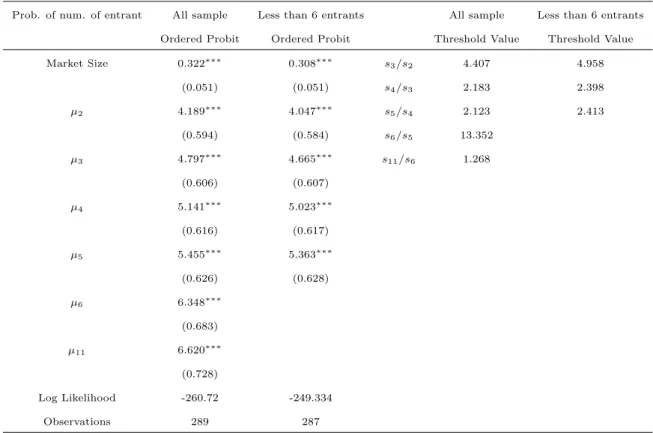
Column 2 in Table 3 reports the ordered probit results. The coefficient of market size is positive, implying that the number of entrants increases as the market becomes larger. This is an intuitive result. The estimated µN shows the effect of competition changes. We derive the threshold value ratio by calculating the minimum market size from µN. Column 5 in Table 3 reports the threshold values. All values are greater than 1. This suggests that an increase in the number of entrants promotes competition.
As the number of entrants increases, the effect of the increase in competition weakens
16Their Matlab codes are available at http://www.econometricsociety.org/ecta/Supmat/5368 data and programs.zip.
except froms5 tos6. This exceptional high value may be caused by the presence of only a few markets with a large number of entrants. The number of markets with more than five entrants is two out of 289 markets. The average market size is 212 million yen (1.82 million US dollars) for markets with less than or equal to five entrants, and 311 million yen (2.67 million US dollars) for markets with more than five entrants, which implies that the markets with larger firms are larger markets. Because of the small fraction of the overall market with more than five firms, we cannot estimate separate coefficients to examine the difference between these markets. Instead, we estimate the ordered probit model using the information on markets with five or fewer entrants. The results are reported in columns 3 and 6 in Table 3, and these are almost identical to the previous results.
The estimation results of the ordered probit model are quite intuitive, and this has an important implication for the Japanese pesticide market. It is not clear that the market functions properly in the pesticide market, because there are many regulations and because of the unique presence of the agricultural cooperatives. However, our estimation results suggest that a large market can accommodate a large number of entrants, and an increase in the number of entrants increases competition substantially. This is a basic finding in the regulated pesticide market.
Now, we report the results of MSM, which accounts for firm-specific heterogeneity.
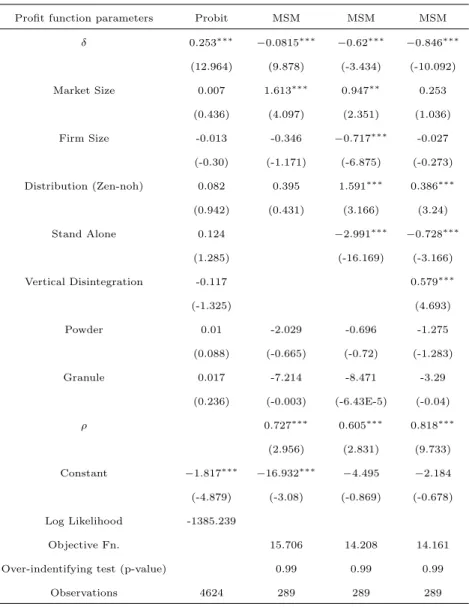
Before doing so, we report the estimation results where the entry decision is considered to be solely the firm’s individual decision, which is estimated by probit and is shown in column 2 in Table 4. These estimation results are affected by the endogeneity problem of the number of entrants. The most important point is that the coefficient of the number
of entrants is positive. This means that if there are more entrants, firms tend to enter.
However, this is caused by the endogeneity. Therefore, we need to consider the strategic version of the entry model.
Columns 3 to 5 in Table 4 report the MSM results. The results of the parsimonious specification, which includes only the Zen-noh characteristic of firm organizational form, are in column 3. The number of entrants has a negative effect. The more intensive the competition, the fewer the entries. The point estimate of the effect of market size is positive and statistically significant. The positive estimate suggests that a large market induces entry. We also find that there are significant correlations among unobservable factors between firms. This implies the importance of controlling for firm-specific unob- servable heterogeneity.
Our focus is on firm organizational forms. Column 3 reports that the products made by manufacturing firms whose shares are owned by the large retailer, Zen-noh, tend to enter markets. This is because the likelihood of entry is higher when the large retailers and manufacturers take into account their joint profits. While the statistical signifi- cance is low, this may be caused by an omitted variable problem. In the following, we incorporate other organizational form variables.
Column 4 shows the results not only for the distribution-related characteristic but also for the stand-alone characteristic. The estimates of the number of entrants and market size are similar to those in the previous specification. The effect of the distribution relation is positive and statistically significant. While in recent years it has been argued that the distribution share of Zen-noh has been decreasing, our estimates indicate a positive entry effect. Firms having a close tie to a large distribution channel can be
considered to have an advantage over other firms. This may also be because firms having a capital relationship with Zen-noh can acquire information about farmers, and so they are able to enter various markets.
Column 4 reports that the coefficient of stand alone is significantly negative: if firms are diversified, they tend to enter. This is because the diversified firms benefit from scope economies. They may have better technologies and know-how to produce and develop new pesticides because they have more experience in the markets of other kinds of products as compared with stand-alone firms.
One point should be noted. The estimate of firm size is negative and statistically significant. There is also a negative correlation between firm size and the number of markets entered (−0.183). This might be because of the differences in entry strategies between small and large firms. Large chemical firms can raise revenues by licensing instead of by entering markets directly. If licensee firms have low supply costs, it would be desirable to let licensees sell the products and capture the revenue by levying licensing fees. Thus, entry likelihood may be related negatively to firm size.
The last characteristic we examine is whether or not firms are vertically integrated.
Column 5 reports the results with all characteristics: distribution relation, stand alone, and vertical nonintegration. The signs of all coefficients are the same as the previous specification. The coefficient of nonintegration is positive and statistically significant.
This implies that there is a significant difference in final market advantage between integrated and nonintegrated firms. That is, the vertically nonintegrated firms have ad- vantages in entering final goods markets. It is likely that these nonintegrated firms have more information on the needs of consumers than vertically integrated firms do, because
they specialize in the production of final products. The needs of consumers sometimes change drastically, because pests often acquire resistance to pesticides. These needs could also be specific to areas. Nonintegrated firms are able to use more management resources to acquire such information. Some of them even focus on the supply to a specific area.
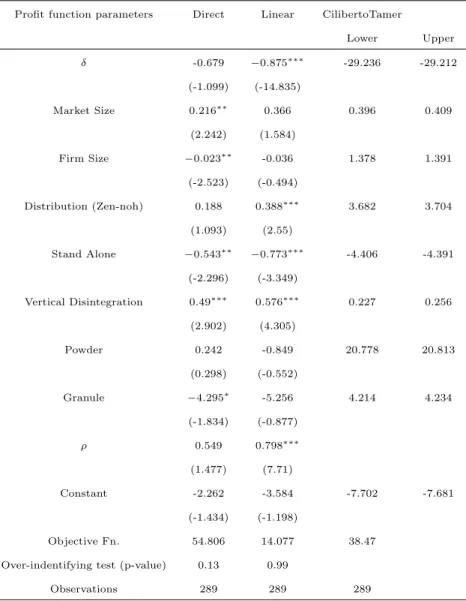
Table 5 reports robustness checks. First, we estimate the same model as in col- umn 5 in Table 4 without employing an importance sampling procedure: we use the Nelder–Mead simplex algorithm. The standard errors are obtained by 200 bootstrapped simulations. The results are similar to those from using importance sampling. Second, while our functional form is a conventional one, the specification of competition might affect our results. Thus, as a robustness check, we use the linear form of the number of competitors instead of the log of the number of competitors. Column 3 in Table 5 reports the estimation results. It turns out that our results are similar, which means that our functional form does not bias the results. Note that we employ overidentifying restrictions tests. The p-values for the chi square test of overidentifying restrictions are greater than 10 percent. For example, the chi square test statistic in column 2 in Table 5 is 54.8, and the tenth percentile of the chi square distribution is 56.4. Thus, we conclude that overidentification is not a problem here.
One issue regarding Berry’s (1992) framework is the assumption of entry order. While our assumption that firms with higher profits enter first is reasonable, this does not always occur necessarily. Thus, another robustness check uses the set estimator of Ciliberto and Tamer (2009). Because of the computational intractability of 16 firms’
strategic interactions, we group Zen-noh-related firms, pharmaceutical-related firms, and
chemical-related firms into separate categories. Each group is treated as an entity of strategic entry decisions. There are four firms that are not in these categories, so this gives us strategic interactions among seven firms. The results are reported in columns 4 and 5 in Table 5. The headings “Lower” and “Upper” correspond to the lower 2.5 and upper 2.5 percentiles, respectively. The Zen-noh relationship is found to be associated positively with entry. With respect to the effect of Zen-noh, our results are robust to entry order. Therefore, from our results in Table 5, our estimations are considered to be robust.
7 Conclusion
We analyzed the effects of the organizational forms of firms on their entry behavior and market structures. To shed light on this important issue, we focused on the Japanese pesticide markets.
First, we investigated whether or not the Japanese pesticide markets are competitive.
We found that these markets function properly despite the existence of many regulations.
This result also proves that the competitiveness of markets is able to survive certain types of regulations.
Second, we estimated the effect of firm heterogeneity on entry behavior using MSM.
Our empirical study revealed that distribution-related, diversified, and vertically non- integrated firms are more likely to enter the market as compared with distribution un- related, stand-alone, and vertically integrated firms. This suggests that distribution- related, diversified and vertically nonintegrated firms are able to find profitable oppor- tunities in the pesticide markets. These results imply that policies that affect firms’
organizational forms influence the structure of product markets. Moreover, some kinds of these policies encourage competition, whereas others may be anticompetitive. For example, policies that promote licensing contracts can make markets more competitive, because such policies strengthen the advantage of being vertically nonintegrated.
Only a few attempts have been made so far at estimating directly the effects of the characteristics of these organizational forms on entry behavior. In this respect, our results are clearly important. We not only demonstrated that organizational forms affect entry behavior significantly but also determined how they affect entry behavior.