Interfirm Relationship between Automobile Firms and Tire Firms in the U.S., 1900‑1940
著者 Kim Yongdo
出版者 法政大学イノベーション・マネジメント研究センタ
ー journal or
publication title
法政大学イノベーション・マネジメント研究センタ ー ワーキングペーパーシリーズ
volume 209
page range 1‑20
year 2019‑08‑01
URL http://hdl.handle.net/10114/00022370
WORKING PAPER SERIES
Yongdo Kim
Interfirm Relationship between Automobile Firms and Tire Firms in the U.S., 1900-1940
August 1, 2019
No. 209
The Research Institute for Innovation Management, HOSEI UNIVERSITY
Working Paper, The Research Institute for Innovation Management, August, 2019
Interfirm Relationship between Automobile Firms and Tire Firms in the U.S.,1900-1940
Yongdo Kim
Faculty of Business Administration, Hosei University, Japan
Summary
This study empirically examines the relationships among major U.S. automakers and tire firms before World War II. Accordingly, it discusses the primary historical records of Ford Motor Company (Ford Motors) and Goodyear Tire & Rubber Company (Goodyear). Analysis reveals that organizational principles underlie and influence transactions related to tire sales between large automakers and tire firms. Underlying long-term negotiated contracts, however, market principles were also hard at work. This paper provides important historical sources that can be used for international comparative analysis of other interfirm relationships, analysis that can contribute factor findings in the area of business history.
Keywords or phrases: Interfirm relationship, U.S. tire industry, automobile firm, market principle, organizational principle
Introduction
In this paper, I empirically examine how vertically integrated big firms conducted transactions of intermediary products during an era characterised by the growth of modern large corporations in the United States. In particular, I analyse the tire transactions that occurred between big tire firms and automobile firms during 1900–
1940.
According to Alfred Chandler Jr.,1 who has significantly contributed to business history research, successful big enterprises were vertically integrated in this era in the
1Chandler, 1977.
United States. However, at the time, even big assembly firms could not integrate the production of all the required parts and materials, and large proportions of intermediary products were produced by ‘specialized’ suppliers. Moreover, sometimes, major assemblers tended to rapidly increase the number of parts to be purchased from suppliers rather than performing in-house production. For example, big U.S. automobile companies stopped the in-house production of many parts and started buying them in the early 1920s (Kim, 2013; Murray and Schwartz, 2019).
Furthermore, an oligopolistic structure was established in many intermediary, as well as consumer product industries. Hence, it is highly likely that the volume of transactions regarding intermediary products among large oligopolistic firms expanded rapidly and the interfirm relationships among these firms became very important.
Nevertheless, very few historical studies, particularly, those on business history, have examined the interfirm relationships among oligopolistic customers and suppliers in the intermediary industries of the U.S.. Accordingly, I examine the interfirm relationships that existed between big U.S. automobile firms and tire firms during 1900–1940, when both industries were leading the United States’ manufacturing sectors, which were oligopolistic in nature. For example, Goodyear and Firestone occupied the 11th and 16th positions, respectively, in the list of domestic firms with the largest number of employees among all U.S. industrial companies in 1957.2 Although extensive research has been conducted on the history of the U.S. tire industry and tire firms, none of them focuses on interfirm relationships in tire transactions.
Tire products are categorized into two types: Original equipment (OE) and Renewal (RE) tires. The former type refers to tire products that are assembled in new cars, whereas the latter type refers to tires that are used to replace old ones. This paper discusses OE tire transactions alone as only these tires are transacted between tire and automobile firms.
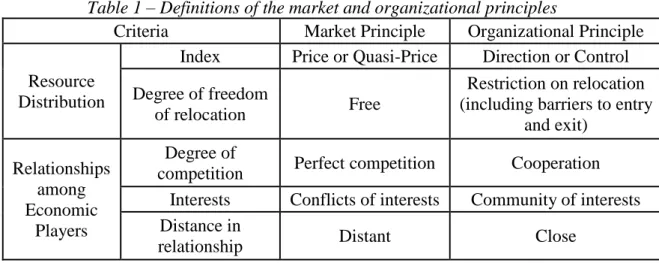
The objective of this paper is to clarify how the market and organizational principles worked in tandem to promote tire transactions among U.S. firms and intertwined each other in interfirm transaction of U.S. tires during 1900–1940. Now, I define the concepts of the market and organizational principles that are used in this paper. I first choose two criteria to differentiate between the two principles: the method of allocation of resources, and the relationships among economic players (Table 1).
2 Chandler, 1977, 114; Fortune 500 list, Fortune, June 1958.
Table 1 – Definitions of the market and organizational principles
Criteria Market Principle Organizational Principle Resource
Distribution
Index Price or Quasi-Price Direction or Control Degree of freedom
of relocation Free
Restriction on relocation (including barriers to entry
and exit) Relationships
among Economic
Players
Degree of
competition Perfect competition Cooperation Interests Conflicts of interests Community of interests Distance in
relationship Distant Close
Further, the first criterion, on resource allocation methods, is divided into two sub- criteria. One is the index to move resources, which is the price or quasi-price under the market principle, whereas it is direction or control under the organizational principle.
The other sub-criterion is the degree of freedom of relocation. Whereas resources move freely under the market principle, the movement of resources is restricted, including barriers to entry and exit, under the organizational principle.
The second criterion, regarding the relationships among economic players, is also divided into three sub-criteria: degree of competition, interests, and distance in relationship. Initially, the market principle works to ensure perfect competition among players, whereas the organizational principle represents the cooperation among players.
Regarding players’ interests, the market principle appears as conflicts of interests.
Contrastingly, the organizational principle refers to communities of interests. In addition, whereas the market principle works among players to make them distant to one another, the organizational principle functions among players to promote close relationships among them (Table 1).
It is highly probable that organizational principle works in interfirm relationships, which are part of organizations’ behaviours. For example, OE tire transactions between both oligopolistic customers and suppliers involved significant organizational transactions so that, in such cases, the organizational principle strongly affected the transaction. Furthermore, if the organizations such as big enterprises in the U.S.
strengthened their influence on the economy as emphasized by Chandler, the organizational aspect was probably strongly reflected in interfirm relationships including tire transactions.
On the other hand, since an interfirm relationship depends on many factors other than the firms themselves, no specific firm can control it completely. Consequently, many phenomena in interfirm relationships may not represent the organizational principle and, hence, they can be considered to represent the market principle. Therefore, it is highly likely that organizational and market principles were intertwined in interfirm relationships.
However, the specific ways in which market and organizational principles were intertwined in interfirm relationships probably varied across industries, periods, and countries. Hence, the accumulation of empirical analyses on the history of interfirm relationships from the perspective of business history is crucial. Nevertheless, to the best of my knowledge, no historical study has examined this perspective on intermediary industries in the United States.
In this paper, I use primary sources of information and data on Goodyear Tire and Rubber Co. obtained from Akron University, Ohio, and Benson Ford Research Center at Dearborn, Michigan, as well as secondary materials on the U.S. automobile and tire industries. The first half of this paper analyses the tire transactions that occurred between Ford and Firestone, whereas the second half focuses on the interfirm relationship between General Motors and US Rubber.
1. Beginning of long-term transactions between Ford Motors and Firestone Tire In 1900, Harvey Samuel Firestone established Firestone Tire in Akron city. Originally, Firestone Tire sold final tire products that manufactured the semi-finished tire and parts of tires to be purchased from BF Goodrich, which was the first mover in the rubber tire market.3 As Firestone was a late comer to the automobile tire market, until 1908, Firestone it delivered car tires to only a few automobile companies, such as Maxwell, White, and Peerless.4 Its market shares were relatively small.
However, on hearing a rumour that Henry Ford, the founder of Ford Motors, was planning to mass-produce four-cylinder cars at 500 dollars, Firestone visited the Highland Park plant, Dearborn, to see Henry Ford and obtain an order for tires from the latter.5 In this visit, Firestone succeeded in entering into a transaction contract with Ford
3 Blackford and Kerr, 1996, 34; Lief, 1951b, 78; Love and Giffels, 1999, 17.
4 Lief, 1951b, 26, 78, 85.
5 Lief, 1951a, 28, 86, 100.
and obtained orders for 10,000 OE tire units for Ford T-model cars in 1906 and delivered 2,000 tire units by June 1906. After the first transaction agreement was signed between Ford and Firestone in 1906, the interfirm relationship between the two companies was maintained for several decades and became stronger over the years, as discussed later in this paper.
2. Working of the organizational principle in the transaction between Ford Motors and Firestone Tire
Many phenomena that represent the organizational principle can be observed in the transaction of OE tires between Ford and Firestone from the late 1900s to the 1930s.
First, Ford and Firestone continued to transact between them in the form of long-term obligational contracts. This obligational contract relationship demonstrates the organizational principle. The details are as follows: Since 1906, the number of transactions between the firms tended to increase, although it occasionally declined in the short run. Even during economic depression, Firestone acquired an order of tires from Ford. For instance, during the recession in the early 1920s, to recover from their financial difficulties, Harvey Firestone invited Henry Ford to his mansion, named
‘Harbel Manor’, and negotiated tire transactions with the latter. In spring 1921, Harvey Firestone paid a visit to the headquarters of Ford in Detroit and succeeded in obtaining new orders from Ford.6 This transaction assisted Firestone’s recovery from a management crisis. Again, in 1930, Firestone sold 700,000 cases of tires to Ford regardless of the prevalence of economic depression. Furthermore, Firestone increased its sales to Ford more than twice in the late 1930s compared to those in the early 1930s.7
Table 2 – Goodyear's tire sales to Ford and General Motors
Period Tire Sales to
Ford Period Tire Sales to
General Motors 1916–1917 730,041 July 1, 1916–June 30,
1917 260,322
1917–1918 656,165 July 1, 1917–June 30,
1918 250,278
1918–1919 487,802 July 1, 1918–June 30,
1919 231,850
Aug. 1, 1919–Sept. 635,226 July 1, 1919–June 30, 385,102
6 Lief, 1951a, 187; Lief, 1951b, 159.
7 Blackford and Kerr, 1996, 59; Bobcock, 1966, 308.
20, 1920 1920
1920–1921 933,720 July 1, 1920–June
30, 1921 129,155
Source: Internal document, Goodyear Tire and Rubber Company Records, 1898-1933, Goodyear Archives, American History Research Center, University of Akron.
Meanwhile, the firms’ dependency on each other in tire transactions showed an increasing trend. In 1906, Ford purchased 65 percent of their total tire requirements. In 1912, the sales to Ford comprised more than 10 percent of Firestone’s total sales.8 According to the contract document on tire transaction between Ford and Firestone drafted in January 22, 1916, Ford was required to buy from Firestone at least 40 percent of the amount of tire purchases.9 Further, based on Table 2, from 1916 to 1921, Firestone’s sale of tires to Ford was three to seven times larger than its sale to General Motors, which was the second largest car maker during the period.
According to Table 3, in 1924, Ford exclusively purchased car tires alone from Firestone, which demonstrates that Firestone and Ford considered each other to be important transaction parties. Further, during the late 1930s, Ford purchased more than 20 percent of their requirement for tires from Firestone.10
Table 3 – Tire suppliers of U.S. automobile firms in 1924 Automobile
Firms
Suppliers of Tire=Tire Firms
Automobile Firms
Suppliers of Tire=Tire Firms
Anderson Firestone Lafayette Goodyear
Apperson Goodyear, Goodrich, Firestone
Lincoln Goodyear, Firestone, Goodrich, US Rubber Auburn Goodyear, Goodrich Locomobile Goodyear, Goodrich, Fisk Barley Goodyear, Firestone,
Goodrich
Marmon Goodrich, Firestone Buick Goodyear, Goodrich, Ajax,
Dunlop, US Rubber, Pennsylvania, Firestone
Maxwell Fisk
Cadillac Goodyear, Goodrich, US Rubber
McFarlan Goodyear and standard makes
Case Goodyear Moon Miller, Kelly
Charlmers Fisk Nash Goodyear, Firestone
Chandler Goodyear, Goodrich Oakland Goodyear, Firestone, Ajax
8 Lief, 1951a, 64.
9 Internal document, Ford Motors Archives, Benson Ford Research Center; Lief, 1951b, 145.
10 Bobcock, 1966, 308.
Chevrolet Goodyear, Goodrich Olds Goodyear, Ajax, Kelly, Goodrich, Firestone
Chrysler Fisk Overland Fisk
Cleveland Goodyear, Oldfield Willys- Knight
Fisk
Cole Firestone, Goodrich Packard Kelly, Miller, Firestone
Columbia Fisk, Firestone Paige Goodyear, Firestone
Cunningham Goodyear Peerless Goodyear, Firestone, US
Rubber
Davis Goodrich Pierce-
Arrow
Goodyear, Goodrich, US Rubber, Firestone
Dodge Goodyear, US Rubber, Ajax
R & V Knight
Goodrich, Firestone Dorris Goodyear, Goodrich Raugh &
Lang
Goodyear, Goodrich, Fisk
Dort Miller REO US Rubber
Duesenberg Goodyear, Goodrich, Firestone
Rickenbacke r
Kelly, Seiberling
Durant Fisk Roamer Goodyear, Goodrich,
Firestone
Elgin Goodrich Rollin Firestone
Essex Kelly Rolls-Royce Goodyear, Dunlop,
Goodrich
Flint Fisk Sayers-
Scoville
Goodyear, Goodrich
Ford Goodyear, Firestone,
Goodrich, Miller, Mason
Stanley Goodyear, Goodrich
Franklin Goodyear Star Fisk
Gardner Goodyear Stearns Goodyear, Firestone,
Goodrich
Gray Goodrich Sterling
Knight
Goodrich, Firestone, Miller
Hanson Goodyear Stevens-
Duryea
Tires furnished as specified
Haynes Goodyear, Seiberling Studebaker Goodyear, Firestone, US Rubber, Goodrich
Hudson Kelly Stutz Goodrich
Hupp Goodyear Velie Miller
H.C.S Goodrich Westcott Firestone
Jewett Oldfield, Miller Wills-St.
Claire
US Rubber, Firestone Jordan Goodyear, Firestone Willys-
Overland
Tires furnished as specified
Kissel Goodyear, Firestone - -
Source: Internal document, Goodyear Tire and Rubber Company Records, 1898–1933, Goodyear Archives, American History Research Center in University of Akron.
Second, the construction of a factory for a specific customer represents the working of the organizational principle. Specifically, when its dependency on Ford in terms of tire transactions increased and it started considering Ford an important customer, Firestone constructed a tire factory to ensure exclusive production to Ford. The new factory started its operations in 1917 and its products were exclusively delivered to Ford for the Ford T-Model. In this manner, the organizational principle was reflected in Firestone’s capital investment behaviour in its interfirm relationships with Ford.
Third, the cooperation between Firestone and Ford in tire production represents the organizational principle. In 1936, the ‘rubber strike’ started in Akron as a protest against a plan created by Goodyear to reduce wages and increase the pace of production. The strike created problems in Firestone’s delivery of tires to Ford, and Ford and Firestone cooperated with each other to overcome these issues. For instance, at the time of Ford’s preparations to start in-house tire production, Firestone dispatched its tire production engineers to Ford to support the latter’s tire production. Consequently, in approximately two years, Ford’s in-house tire factory could manufacture half the firm’s requirement of tires and implement several innovations to significantly reduce manufacturing costs.11 Similarly, Ford dispatched some engineers from its crude rubble plantation to assist Firestone in learning rubber fabric technologies. In addition, when Ford’s production of truck tires was stopped in the spring of 1941 due to the strike, Firestone increased its supply of tires to support Ford’s requirements.12 In this manner, whenever difficulties occurred in tire production, both the firms cooperated with each other to overcome these problems, which reflect the application of the organizational principle.
Fourth, personal relationships and networks played an important role in the transactions between the two firms, which reflects the organizational principle, as well.
For instance, William S. Knudsen who had formerly worked at Ford and had a close relationship with the top management of Firestone moved to the Division of Chevrolet of General Motors as the division manager. Consequently, although Firestone had previously established weak relationship with General Motors, it could increase its tire sales to Ford as a result of the aforementioned relocation of personnel.13 This personnel moving illustrates the organizational principle, as well.
11 Sorensen, 1956, 198-200; Schwartz, 2000, 75.
12 Interview with E. F. Wait in 1954, 29.
13 Lief, 1951b, 261.
3. Working of the market principle in transactions between Ford Motors and Firestone Tires
There are many examples for the working of the market principle in transactions between Ford and Firestone. To begin with, Ford’s role as an important customer brought down the price of Firestone’s tires, which demonstrated the effect of the market principle. While negotiating on the first transaction between Ford and Firestone, Firestone emphasized product quality since he was confident about his own products.
Contrarily, Henry Ford was interested in only the delivery price of tire14 because, prior to the negotiation, he had already checked the high quality of the tires manufactured by Firestone through several tests. After negotiation, the price of Firestone’s tire for the Ford N-Model car was set at 55 dollars per set, which was 15 dollars lower than the price of the clincher tire that was popular and patented at the time.15 Since then, Firestone has repeatedly attempted to reduce the production cost of tires delivered to Ford.16 Consequently, in the 1910s, Firestone sold its tire to Ford at a much lower price than the tire price at which Goodyear and Goodrich supplied to Ford.17 Despite continuing its good relationship with Ford, Ford requested Firestone to deliver tires at extremely reduced rates. Under the pressure exerted by customers on suppliers to reduce the transaction price, since the price affected resource allocation in Firestone, the severe request made by Ford represents the market principle
Moreover, although Ford heavily depended on Firestone to meet their tire requirements, it mainly practiced the multi-sourcing policy in OE tire purchases during the pre-war period. During the 1900s and 1910s, Ford bought OE tires for its T-Model cars from Goodyear and Goodrich, as well as Firestone.18 The contract document signed by Ford and Goodrich in November 1914 specified that Ford should buy from Goodrich at least half of its monthly purchasing number of tires during the contract period.19 According to Table 3, in 1924, Ford purchased tires from not only Firestone but also
14 Lief, 1951a, 28.
15 Lief, 1951b, 87.
16 Nelson, 1988, 23.
17 Internal document, Ford Motor Archives, Benson Ford Research Center.
18 Allen, 1949, 315; Litchfield, 1954, 100.
19 Internal document, Ford Motor Archives, Benson Ford Research Center.
Goodyear, Goodrich, Miller, and Mason. Further, Table 4 reveals that Ford purchased a substantial number of tires from Goodyear in 1926. Despite high dependency on Firestone in purchasing tires, Ford used the competition among big tire firms by the multi-sourcing policy of tires, on the other hand. This competition represents the market principle.
Table 4 – Purchase of tires by automobile firms from Goodyear and various other tire makers in 1926
Automobile firms
Suppliers of tires and Goodyear’s share in the total numbers of tires purchased by each automobile firm
Automobile firms
Suppliers of tires and Goodyear’s share in the total numbers of tire purchased by each automobile firm Auburn 60 percent (Goodrich 20
percent, Firestone 20 percent)
Lincoln 40 percent
Buick 30–60 percent Moon 0 percent (Miller and
Firestone 100 percent)
Cadillac 60 percent Nash 50 percent
Case 100 percent Marmon 0 percent (Goodrich,
Firestone, and Seiberling had considerable shares) Chandler 50 percent (Goodrich 50
percent) Oakland Low percent
Chevrolet 50 percent Olds Low percent (Pennsylvania
and Kelly had substantial shares)
Chrysler 0 percent (Fisk 100 percent) Packard 0 percent (US Rubber, Seiberling, Firestone, Kelly, Miller)
Cleveland Most of the exported cars purchased tires from Goodyear
Paige Jewett 40 percent of total purchase by Paige(residuals are made by Firestone and Miller) Dodge Approximately 40 percent Peerless 40 percent (Goodrich and
Firestone) Durant 0 percent (Fisk 100 percent) Pierce-Arrow 40 percent Elgar 0 percent (Firestone 100
percent) REO 0 percent (US Rubber,
Firestone, Kelly) Ford High proportion. U.S. west
coast automobile factory 100 percent
Rickenbacker 100 percent in tire for the eight-cylinder car that occupied half of the car maker’s total sales
Franklin 100 percent Stearns 0 percent (Miller 100
percent)
Gardner 100 percent Studebaker 0 percent (Firestone, US Rubber, Goodrich)
Hudson & 75 percent (US Rubber 25 Stutz 0 percent (Lee and Goodrich
Essex percent) 100 percent)
Hupp 100 percent Velie 0 percent (Miller 100
percent) Jordan 0 percent (Lee 100 percent) Wills-St.
Claire
0 percent (Firestone had a substantial share)
Hupp Approximately 75 percent (Firestone 25 percent)
Willys- Overland
0 percent (Fisk 100 percent) Source: Sales Promotion Department of Goodyear, 1926, Sales Promotion Material.
4. Intertwining of the market and organizational principles in tire transactions In the long-term transactions between Ford and Firestone, the market and organizational principles intertwined in several ways. First, the long-term transactions between the two firms were based on the intense competition among automobile companies and that among oligopolistic tire companies. In other words, market competition was intertwined with organizational transaction. Second, the beginning of in-house tire production by Ford illustrates the intermingling of the organizational and market principles. The firm started in-house tire production in the River Rouge Factory in 1938. Within a short period, the productivity of tire production increased to high levels, although Ford sold its tire business to Soviet Union in 1943.20 The beginning of in-house production demonstrates the organizational principle since it is an organizational action.
Simultaneously, it represents the market principle, as well, since one of the reasons why Ford started the in-house production of tires was its interest conflict with suppliers and the interest conflict between suppliers and customers illustrates the market principle.
Moreover, by starting in-house production, Ford suddenly changed from being a customer to a competing tire firm,21 thereby promoting fierce competition in OE tire market. This case expresses the market principle. In addition, although it started the in- house production of tires, Ford continued to purchase tires from other tire firms.
Consequently, the in-house tire division had to compete against other tire firms. This phenomenon was very similar to the multi-sourcing policy since the competition among tire suppliers was beneficial to customers, which further revealed the market principle.
Consequently, the in-house production of tires by Ford can be considered to express the intertwining of market and organizational principles.
20 Interview with E. F. Wait in 1954, 28-29, 37; French, 1989, 180; French, 1991, 59.
21 Gaffey, 1940, 169; Interview with E. F. Wait in 1954, 27.
In the third example of the intermingling of the two principles, the multi-sourcing policy of tire production adopted by Ford, which represents the market principle, coexisted with Firestone’s construction of a factory to deliver tires exclusively to Ford, which represents the organizational principle. Finally, although automobile companies used the competition among tire companies by adopting the multi-sourcing policy while purchasing tires, there were only a small number of suppliers who delivered tires to automobile firms.
5. Formation of a close relationship between General Motors and US Rubber:
Manifestation of the Organizational Principle
General Motors, which had a decentralized purchasing system comprising several divisions, had weak relationships with specific tire firms, unlike Ford and Chrysler.22 Nonetheless, since the early 1930s, General Motors had been performing long-term continuous tire transactions with US Rubber.
Until the 1920s, General Motors and US Rubber did not have a strong relationship in terms of tire transactions. In the 1910s, Goodyear was the main supplier of tires to General Motors23 and, as illustrated in Table 4, different divisions in General Motors had different suppliers. In addition, According to Table 3, US Rubber could not sell OE tires to the main divisions of General Motors, such as Chevrolet and Oakland.
According to a former salesman of US Rubber, in 1930, US Rubber contracted with Ford for the sale of 700,000 sets of tires and, for several years, US Rubber supplied about 20 percent of the total number of tires required by Ford. The firm’s relationship with General Motors deteriorated in the late 1920s.24
Nevertheless, in the early 1930s, US Rubber started its long-term transaction with General Motors. In March 1931, the two companies formally declared their long-term transaction contract. The first delivery of tires occurred in May 1932 and, in the same year, US Rubber supplied half the number of tires purchased by General Motors. In 1933, US Rubber sold tires to 100 percent of luxury cars in the Cadillac Lasalle
22 Bobcock, 1966, 303.
23 Blackford and Kerr, 1996, 93, 95; French, 1989, 180; French, 1991, 27; Jones, 1983, 33.
24 Bobcock, 1966, 305, 308.
Division.25 This transaction and the close interfirm relationship continued until 1942 and, following World War II, the two firms restarted their long-term transaction.
The long-term and close relationships maintained by the two companies in their transactions represent the organizational principle, although I could observe other organizational aspects, as well, in this relationship. First, with respect to price, General Motors set a “preliminary billing price” in its transaction with US Rubber and maintained this price a secret from other tire companies. The price was fixed after considering the estimated cost reduction by US Rubber and adding ‘proper profit’ to the estimated production cost; the price was regularly revised.26 I infer that, in the transaction, the two companies practiced organizational price setting.
Second, in 1931, US Rubber purchased a considerable number of the stocks of Gillette Safety Tire, which transacted OE tires with General Motors and was established in 1916 in Wisconsin. Further, in 1940, US Rubber bought all the stocks of Gillette Safety. Consequently, US Rubber increased the number of tires that were transacted with General Motors. By assuming the ownership of and performing mergers with other tire companies, US Rubber intentionally expanded the volume of its tire transaction with General Motors, which illustrates the organizational principle, as well.
Third, the establishment of personal relations promoted the close relationships between the companies. An example is discussed as follows: Du Pont purchased 20 percent of US Rubber’s stocks in 1928, based on its capital relations, he sent Francis David Jr., a top management personnel of General Motors, to US Rubber as the new chief executive officer. After this relocation, David Jr. managed to expand the tire orders from several divisions of General Motors by using the personal network that had been formed by him while working at General Motors.27 Fourth, General Motors maintained close relationships with Firestone in not only tire transactions but also the procurement of rubbers. Hence, the two companies shared multifaceted organizational relationships. Specifically, General Motors used US Rubber’s purchasing department as its own ‘purchasing agent’ to procure crude rubber. Initially, General Motors requested US Rubber to buy some crude rubber on behalf of the former. Accordingly, US Rubber delivered the rubber to General Motors, following which General Motors distributed
25 Bobcock, 1966, 307.
26 Bobcock, 1966, 306-307.
27 Bobcock, 303, 306-307, 309; French, 1991, 59.
crude rubber back to US Rubber for tire production to satisfy the former’s demand.
Moreover, the skilful management of inventory and procurement of crude rubber by US Rubber resulted in an increase in the volume of transactions between the two firms.28
6. Market principle in the interfirm relationship between General Motors and US Rubber
The market principle was observed to work in the transaction between General Motors and US Rubber. First, General Motors practiced the multi-sourcing policy in its purchase of tires. Table 2 clarifies that each division of General Motors practiced the same policy. Under the firm’s decentralized purchasing system, the purchasing department of each division carefully adjusted the numbers of tires purchased from each tire firm to utilize the competition among the tire firms.29 Even after General Motors had established long-term continuous transaction relations with US Rubber, it purchased tires from many other tire companies. This policy aimed at promoting competition among tire firms represents the market principle.
Second, General Motors applied pressure on US Rubber to provide price cuts and low profit margins, which represents the working of the market principle in this case.
Regardless of their long-term relationship, the price level requested by General Motors was extremely severe.30 Further, in 1933, a new provision on the delivery price of tires was added to the contract between General Motors and US Rubber. The provision required the delivery price of US Rubber tires to be below the price level at which the other big tire firms.31 This provision severely limited US Rubber’s profit. This is particularly relevant since, in the 1930s, the OE tire business of most big tire firms had low profit rates.32 This phenomenon demonstrates the market principle.
Third, the conflict between General Motors and US Rubber and change in bargaining power between them in terms of tire transactions represent the market principle. Since the interest of a customer varies from that of a supplier in terms of product price, quality,
28 Bobcock, 1966, 306; French, 1989, 183.
29 Bobcock, 1966, 307.
30 Nelson, 1988, 112; Rodengen, 1997, 91.
31 Bobcock, 1966, 308; French, 1991, 59; Katz, 1977, 379.
32 Allen, 1943, 353; French, 1991, 53; Gaffey, 1940, 133.
and delivery time, there occurred conflicts of interests between the two firms, which represent the market principle. Moreover, in the transaction, the bargaining process helped resolve the conflicts of interests and secure the interest of each party. This demonstrates the market principle.
In this bargaining process of the tire transaction, there occurred a change in the relative power of the two firms, that is, the bargaining power of General Motors tended to increase compared to that of US Rubber. The first reason for this strengthening of General Motor’s bargaining power is that the concentration ratio of the U.S. automobile industry was larger than that of the U.S. tire industry at the time.33 The second reason is the size difference that existed between big automobile companies and big tire companies. Since General Motors had a higher bargaining power, US Rubber had to accept the former’s request for low tire delivery prices and many unfavourable transaction conditions.34 This represents the working of the market principle.
Furthermore, the U.S. car market was mature and saturated in the late 1920s, and the Great Depression in the early 1930s had a significant negative effect on the demand for cars. Consequently, car production fluctuated sharply. General Motors was affected, and the company’s tire order volume and its transaction volume with US Rubber underwent violent fluctuations; however, the firms maintained their long-term transaction relationship. Since this violent fluctuation in transaction was significantly affected by market conditions, this phenomenon can be interpreted as representing the market principle.
I observe that the amount of transaction between General Motors and big tire companies sharply fluctuated in the late 1910s and the 1920s. For instance, according to Table 5, General Motors rapidly decreased its purchase of tires from Goodyear from late 1918 to 1921. Further, the ratio of tire sales to Goodyear’s production for General Motors declined sharply (Table 5), which illustrates that predicting the quantity of transaction with General Motors was difficult during the recession period in early 1920.
In general, the demand for OE tires fluctuated more sharply than the total tire demand prior to World War II. For instance, according to Figure 1, the OE tire demand of Goodyear varied more significantly than the total demand for tires in the 1930s.
33 Bobcock, 1966, 213; French, 1991, 30, 53.
34 French, 1991, 28.
Table 5 – Sales to General Motors and production for General Motors in Goodyear Unit: Set, percent Sales to General
Motors(A)
Production for General Motors(B)
(B)÷(A)×100 July 1, 1916–June 30,
1917
275,567 260,322 94.5
July 1, 1917–June 30, 1918
292,952 250,278 85.4
July 1, 1918–June 30, 1919
256,538 231,850 90.4
July 1, 1919–June 30, 1920
390,521 385,102 98.6
July 1, 1920–June 30, 1921
211,455 129,155 61.1
July 1, 1921–Dec. 31, 1921
116,439 60,727 52.2
Jan. 1, 1922–Dec. 31.
1922
444,367 250,576 56.4
Jan. 1, 1923–Dec. 31.
1923
763,921 286,926 37.6
Source: Goodyear Tire and Rubber Company Records, 1898–1933.
Figure 1 – Change rates of the sales of all tires and OE tires for Goodyear; OE, original equipment
Unit: Percent
Source: Goodyear Tire and Rubber Company Records, 1898–1933.
-80.0 -60.0 -40.0 -20.0 0.0 20.0 40.0 60.0 80.0 100.0 120.0
1930 1931 1932 1933 1934 1935 1936 1937 1938 1939
Change rate of all tires Change rate of OE tires
Since the tire industry is highly capital intensive, it is very important that tire companies maintain the operation rate of tire production to meet sharp fluctuations in demand. Consequently, tire makers sell their tires at low prices and with low profit rates to acquire stable orders. These phenomena clearly demonstrate the sensitivity of price and profit rate to demand and supply in the market and, thereby, represent the working of the market principle.
7. Intertwining of market and organizational principles in the interfirm relationship between General Motors and US Rubber
In tire transactions between General Motors and US Rubber, the market and organizational principles are intertwined in different ways. At the time of establishing a transaction relationship, interfirm cooperation is essential since conflicts of interests occur between the participating firms and each insists on furthering its own interest.
Second, General Motors exerted pressure on US rubber to reduce the price of tire supply, while the former considered setting the price to ensure the ‘proper’ production cost and
‘proper’ margins of US Rubber. Third, General Motors combined its long-term transaction relationship with the multi-sourcing policy in its purchase of tires to utilize the competition among tire firms. Moreover, while adopting this multi-sourcing policy, General Motors carefully adjusted the purchasing shares of tire firms. Finally, although it had close relationship with US Rubber in terms of tire transactions, General Motors sought competing bids that were open to many other tire companies to purchase more than half of its requirement for tires. In these bids, tire firms suggested low prices to General Motors.35
Conclusions
Before World War II, the organizational principle strongly affected the tire transactions between big automakers and big tire manufacturers in the U.S. tire industry in the way of long-term contracts. Further, in transactions between big automobile firms and tire firms, personnel relationships and networks, including the relocation of personnel both in firms and between firms, were important aspects illustrating the organizational principle.
35 Sobel, 1953, 13.
On the other hand, the transactions on a negotiation basis were significantly affected by market forces and market principles. First, even in long-term transactions, there were conflicts of interests between automobile companies and tire companies. In tire transactions between big automobile firms and big tire firms, the bargaining power of the former was stronger. These conflicts of interests and changes in bargaining power represent the working of the market principle. Second, customers exerted pressure on tire firms to reduce the cost of tires, which resulted in a low margin rate of tire production and even unprofitability. Furthermore, OE tires underwent wide fluctuations in demand so that, to maintain high operation rates, tire firms tended to competitively offer price cuts. Since the bargaining power of them tended to be weaker than that of automobile firms in interfirm transactions, the former often yielded to the pressure exerted by the latter in reducing prices. These phenomena illustrate the working of the market principle. Third, the competition among tire firms created by the customer’s adoption of the multi-sourcing policy in their purchase of tires interacted with the low price and low profitability.
Meanwhile, the transactions between Ford and Firestone and those between General Motors and US Rubber revealed the intertwining of the organizational and market principles. Long-term transactions of tires were maintained based on the intense competition among not only automobile companies but also oligopolistic tire companies.
In other words, these transactions represented a combination of market competition and organizational transaction. Second, although long-term relationships existed between customers and suppliers in many cases, conflicts of interests and variations in bargaining power occurred in the OE tire transactions. Third, when big automobile companies practiced the multi-sourcing policy in their tire purchases, they intentionally adjusted the purchasing proportions of automobile companies to prevent extensive changes in the suppliers’ market shares. Fourth, pressure to enable price cutting was combined with price setting to ensure proper production cost and the proper margins of suppliers. Finally, the beginning of in-house tire production by Ford illustrates the intermingling of the organizational and market principles.
This paper will provide the important clues to international comparative analysis on interfirm relationship, which can contribute to accumulation of studies in the area of business history.
Acknowledgment
This work was supported by the Research Institute for Innovation Management at Hosei University.
References
Allen, H., 1943. The House of Good Year: A Story of Rubber and of Modern Business.
The Corday and Gross Company, Cleveland, OH.
Allen, H., 1949. The House of Good Year: Fifty Years Men and Industry. The Corday and Gross Company, Cleveland, OH.
Bobcock, G. D., 1966. History of the United States Rubber Company. Indiana University Press, Bloomington, IN.
Chandler, A. Jr.,1977. The Visible Hand: The Managerial revolution in American Business. Harvard University Press, Cambridge, MA.
Ford Motors Archives, Benson Ford Research Center, Dearborn, Michigan.
“Fortune 500 list”, Fortune, June 1958.
French, M. J.,1989. Manufacturing and marketing: Vertical Integration in the U.S. Tire Manufacturing Industry,1890-1980s. Business and Economic History Second Series, 18, 178-187.
French, M. J., The U.S. Tire Industry: A History. Twayne Publishers, Boston, MA.
Gaffey, J. D., 1940. The Productivity of Labor in the Rubber Tire Manufacturing Industry. Columbia University Press, New York, NY.
Goodyear Tire and Rubber Company Records, 1898-1933, Goodyear Archives, American History Research Center in University of Akron.
Interview with Wait, E. F.1954. Owen W. Bombard Interviews series, 1951-1961, Benson Ford Research Center.
Jones, G.,1984. The Growth and Performance of British Multinational Firms before 1939:The Case of Dunlop. Economic History Review, 37(1), 35-53.
Katz, H.,1977. The Decline of Competition in the Automobile Industry, 1920-1940.
New York Times Co., New York,NY.
Kim, Y.,2015. The Dynamics of Inter-firm Relationships: Markets and Organization in Japan. Edward Elgar Publishing Ltd., Cheltenham.
Lichfield, P.W., 1954. Industrial Voyage: My Life As an Industrial Lieutenant.
Doubleday and Co. Inc., New York, NY.
Lief, A., 1951a. The Firestone Story: A History of the Firestone Tire and Rubber Company. McGraw-Hill Book Company, Inc., Cambridge, MA.
Lief,A., 1951b.Harvey Firestone Free Man of Enterprise. McGraw-Hill Book Company, Inc., New York, NY.
Love, S., Giffels, D., 1999. Wheels of Fortune: The Story of Rubber in Akron. The University of Akron Press, Akron, OH.
Murray, J., Schwartz, M., 2019. Wrecked: How the American Automobile Industry Destroyed Its Capacity to Compete. Russel Sage Foundation, NY.
Nelson, D., 1988. American Rubber Workers and Organized Labor 1900-1941.
Princeton University Press, Princeton, NJ.
Rodengen, J. L., 1997. The Legend of Goodyear, The First 100 years. Write Stuff Syndicate, Inc., Fort Lauderdale, FL.
Sales Promotion Department of Goodyear,1926. Sales Promotion Material.
Schwarz, M., 2000. Markets, Networks, and the Rise of Chrysler in Old Detroit, 1920- 1940.Enterprise and Society, 1(1), 63-99.
Sobel, I., 1954. Collective Bargaining and Decentralization in the Rubber-Tire Industry.
Journal of Political Economy, 62(1),12-25.
Sorensen, C., 1956. My Forty Years with Ford.W. W. Norton and Co., New York,NY.
本ワーキングペーパーの掲載内容については、著編者が責任を負うものとします。
〒102-8160 東京都千代田区富士見2-17-1 TEL: 03(3264)9420 FAX: 03(3264)4690 URL: http://riim.ws.hosei.ac.jp
E-mail: [email protected]
(非売品) (非売品) (非売品) (非売品)
The Research Institute for Innovation Management, HOSEI UNIVERSITY