
英語科授業における教師の誤りへの対処行動の類型と効果
75
0
0
全文
(2) 英語科授業における教師の誤りへの対処行動の類型と効果 The Types and Effects of the Teacher’s Error Treatments in EFL classes (課題番号. 08680252). 平成8~10度科学研究費補助金(基盤研究C2)研究成果報告書 The Report of a Research Project Supported by Grant-in-Aid for Scientific Research (C), The Ministry of Education, Science, Sports and Culture, Japan (1996-1998, No.08680252). 平成11年3月. 研究代表者. 萬谷隆一. Ryuichi Yorozuya (北海道教育大学函館校. 教育学部助教授). Hokkaido University of Education, Hakodate.
(3)
(4) 研究組織 研究代表者. 萬谷隆一. (北海道教育大学教育学部函館校助教授). 研究経費 平成 8年度 平成 9年度 平成10年度 計. 700千円 1300千円 600千円 2600千円. 研究論文 1)Ryuichi Yorozuya, How Do Inexperienced English Teachers Treat Students' Oral Errors?『北海道教育大学紀要』(第1部C)第48巻、第2号、121-129 頁、1998年。. 研究発表 1)萬 谷 隆 一、教師はいかに誤りを直しているか - 教育実習生の誤り処理 行動の実態分析 -, 第22回全国英語教育学会仙台研究大会(平成8年8月 1日) 出版物 1)萬谷隆一「英語の誤り: 教師はどう対処すべきか」、北海道教育大学教科 教育学研究図書編集委員会編『子どもの学びとつまづき - 「わからない」 「できない」からの教科教育 - 』東京書籍、84-96 頁、1997 年。.
(5) Table of Contents. 1. Introduction. 1. 2. The Study (1) Purpose (2) Subjects and Methods. 2 2. 3. Results and Discussion (1) Error Frequency (2) Error Distribution (3) Rate of Errors Ignored (4) Distribution of Error Treatment Types Observed (5) Use of Error Treatments in Communicative and Mechanical Practice (6) Effectiveness of Error Treatment Types: Uptake Success Rate. 3 7 8 11 14 19. 4.Conclusion. 23. Notes. 25. References. 26. Appendix 1 List of 41 Lessons Analyzed Appendix 2 Descriptions of Error Treatment Types Appendix 3 Scripts of Sample Lessons. 29 31 33.
(6) Abstract In an attempt to provide descriptive data on novice teachers’ error treatment behaviors, 41 junior high school English lessons taught by student teachers were transcribed and analyzed. The findings were as follows; (1) the average frequency of error occurrence was extremely low, which turned out to be due to the overuse of grammatical explanations and repetitive drills, (2) the most frequent errors observed were errors in grammar, vocabulary, and pronunciation, (3) only a small portion of the errors committed was ignored, (4) treatment types for mechanical English practice which directly provided correct answers were used more than self-corrective treatments, (5) for communication practice non-interruptive types of error treatment were more used than interruptive types, but only a limited number of the subjects used the former types. (6) Some of “Answer Provision” types and some of “Self-correction” types showed better short-term effects, successfully eliciting corrected responses from students.. 1.. Introduction. The present study attempts to provide basic descriptive data on student teachers’ error treatments. The final, yet far distant, goal of error treatment research is to empirically prove the cognitive and affective effects of different kinds of error treatment on acquisition. However, as Ellis(1994:585) points out, before we can set out on the ambitious undertaking of empirical verification, it is first necessary to investigate what error treatment options are used by teachers, how often they are used, and what factors influence their use in practice. Such descriptive work on error treatments will help us find meaningful questions to tackle, helping us aim towards more informed and principled uses of error treatments in the classroom. Many studies provide descriptive data on English-speaking teachers’ treatment of oral errors in the second language classroom context (e.g. Allwright 1975, Chaudron 1977, Fanselow 1977, Nystrom 1983, Chaudron 1986). However, descriptive studies on non-native teachers’ oral error treatment in the foreign language classroom context in Japan are very limited in number. For example, Yoneyama’s (1982) pioneering work investigates student. 1.
(7) teacher’s corrective behaviors. Kubota(1991) explores seven experienced high school teachers’ patterns of verbal behaviors toward students’ errors. The present study intends to replicate and complement the findings of these two studies. 2.. The Study. (1) Purpose The purpose of this study is to investigate how novice teachers (student teachers) treat students’ oral errors in class. More specifically this study tries to answer the five questions as follows: (a) How often are errors committed in classes? How are they distributed according to linguistic and other areas? (b) How often are errors ignored by student teachers? Which linguistic areas are ignored the most? (c) What types of Error Treatment are used? What is the most prevalent types of Error Treatment? (d) Can student teachers differentiate use of error treatments depending on practice types? (e) What error treatment types are effective in terms of short-term effects? More specifically, what types have higher uptake success rates? Along with a research interest to gain some insights into the nature of effective error treatments, this study is also motivated by the present writer’s need to gain some implications for teacher training, in particular, in terms of the weaknesses of student teachers in error correction. (2) Subjects and Methods The subjects of this study were 41 student teachers who taught at junior high schools as part of their requirements of the student teaching program. They were all native speakers of Japanese. Of the 41, 19 were juniors and 22 were seniors at the university. There were 14 male student teachers and 27 female ones. The student teachers taught for 5 or 6 weeks at junior high schools in and around Hakodate. None of them were aware of the purpose of this study. 41 classes were videotaped over a five-year period from 1991 to 1996 (see Appendix 1. For sample lessons, see Appendix 3). All of the classes were the. 2.
(8) final classes for evaluation as required by the student teaching program. The classes usually lasted for 50 minutes, and all of them were transcribed. The students’ errors were located and classified. Errors are defined as any of the students’ utterances that deviate from standard English, or wrong answers that do not meet the teacher’s expectations about the task or question. Only speech errors were analyzed. Errors in answers to questions that require students to give grammatical explanations in Japanese were excluded in the analysis. When judgment of the correctness of a particular utterance was difficult, a native speaker was consulted. The student teachers’ error treatment moves were then coded by two other teachers of English. The coding was done according to a category system adapted from Yoneyama (1982)(see Appendix 2 for the categories, their definitions and examples). 3. Results and Discussion (1) Error Frequency Table 1 and Figure 1 show the frequencies of errors observed in class. The total number of errors observed in the forty one classes was 156. The average error frequency for the first year classes was 4.18 per class, for the second year classes 3.54, for the third year classes 3.00. The overall frequency for all the classes was 3.80. The general trend was that the error frequency decreased as the grade year increased. This is presumably because beginning level classes generally included more oral practice than more advanced classes. Table 1 Average Numbers of Errors Observed in Class Grade 1 2 3 Total Number of Teachers 22 13 6 41 Total Number of Errors 92 46 18 156 Average Occurrence of Errors 4.18 3.54 3.00 3.80. Average No. of Errors. Figure 1 Average Occurrence of Errors 6 5 4 3 2 1 0. 4.18. 1. 3.54. 3. 2. 3. Grade. 3.
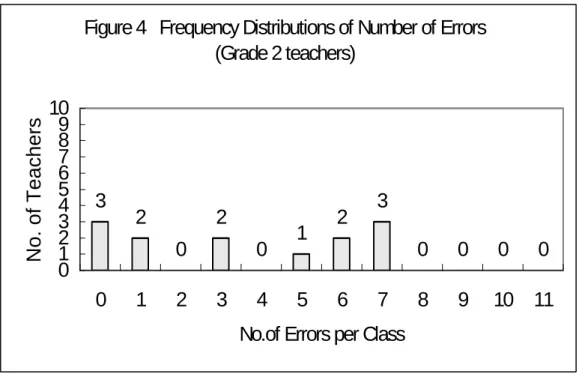
(9) Figure 2 shows the overall frequency distribution of errors observed in classes of each grade. Figures 3, 4, 5 show the frequency distribution of each grade. The right hand bars represent classes with high frequencies of errors, whereas the left hand bars those with low frequencies. For instance, referring to Figure 2, there were two classes where 9 errors were observed and three classes where no error was observed.. Figure 2 Frequency Distribution of Number of Errors (All Grades Combined). No. of Teachers. 10 8 6 4 2 0 0. 1. 2. 3. 4 5 6 7 8 No. of Errors per Class. 9. 10. 11. No. of Teachers. Figure 3 Frequency Distributions of Number of Errors (Grade 1 teachers) 11 10 9 8 7 6 5 4 3 2 1 0. 9 5 3. 2 0. 0. 0. 1. 2. 3. 4. 5. 1. 1. 6. 7. No.of Errors per Class. 4. 0 8. 1 9. 0. 0. 10. 11.
(10) No. of Teachers. Figure 4 Frequency Distributions of Number of Errors (Grade 2 teachers) 10 9 8 7 6 5 4 3 2 1 0. 3. 2. 2 0. 0. 1. 2. 1. 0 3. 4. 5. 2. 6. 3. 7. 0. 0. 0. 0. 8. 9. 10 11. No.of Errors per Class. Frequency. Figure 5 Frequency Distributions of Number of Errors (Grade 3 teachers) 10 9 8 7 6 5 4 3 2 1 0. 0. 0. 1. 1. 0. 2. 1. 3. 0. 4. 1. 5. 0. 0. 0. 6. 7. 8. No.of Errors per Class. 5. 1. 9. 0. 0. 10 11.
(11) Referring back to Table 1 and Figure 1, one important fact that should be pointed out is that the total frequency of error occurrence was extremely low. On the average, only 3.8 oral errors on the average were committed during the fifty-minute classes. This low error frequency found in the present study might seem to be a desirable feature of successful classes, where students do not make frequent errors. However, on a close examination of the class protocols, it was revealed that classes with low frequencies of errors were not necessarily effective or successful. In many classes error frequencies were low because there were not many opportunities provided for the students to try out what they learned. In other words, most of the class time of such classes was spent not so much on students’ oral production in communicative practices, but rather for grammatical explanations and repetitive drills where the possibility of making errors was low. The notion that error-free classes are better classes need to be seriously reconsidered. It might be considered that experienced teachers allow few errors to occur in class, but, in fact, this is not necessarily the case. For example, Kubota(1991) reports that 95 errors were observed in seven English classes taught by experienced high school teachers, which means that on the average, 13.6 errors were committed per class. This figure is far greater than that of the present study(3.8 errors per class). Although the exact reason for the difference can only be conjectured, the most probable reason would be that Kubota’s subject teachers provided ample opportunities for challenging the student’s current knowledge of English, whereas the student teachers of this study did not. This problem of error frequency in a class can also be viewed in relation to the degree of “communicativeness” of the class. An examination of the 41 classes revealed that classes with abundant communicative interactions tended to have more errors than classes with great amounts of grammar explanations or repetitive drills. For example, of the first grade classes, the class with the highest error frequency showed 9 errors(see Figure 3 above). This class was taught by a female student who used English most interactively with students promoting communicative exchanges during the class. She was a fluent speaker of English who had studied in Canada for 8 months(See Lesson Transcription 1 in Appendix 3). On the other hand, the class with the lowest error frequency(2 errors) was taught by a male student who used Japanese most of the class time and extensively used repetitive drills(see Figure 3). There were, of course, some exceptions, but in general, as far as the student. 6.
(12) teachers’ classes which were analyzed in this study are concerned, it can be said that the more communicative interactions there are in the class, the more errors are committed. It even looks as if the degree of “communicative health” of a class could be measured by the number of errors committed in the class. (2) Error Distribution Table 2 and Figure 6 show the distribution of the errors observed. Along with linguistic areas, three more categories have been added. “Different task” refer to the student’s errors arising from his or her misunderstandings regarding the nature of the task he or she was supposed to do. The category of translation errors was included since there were cases where it was difficult to determine the linguistic causes of translation errors. Content errors refer to those errors caused by the student’s factual misunderstandings.. Table 2. Distribution of Errors Types Grammar. Voca-bu Pronun- Trans- Different Dis-cou Content lary ciation lation Task rse. Total. N. of Errors. 69. 35. 17. 13. 10. 7. 5. 156. %. 44%. 22%. 11%. 8%. 6%. 4%. 3%. 100%. Figure 6. 80. 69. 70 No. of Errors. Distribution of Error Types. 60 50 35. 40 30. 17. 20. 13. 10. 7. 10. 5. t on te n C. rs e D. re n D. iff e. is co u. k tT. as. la tio n an s Tr. Pr o. nu n. ci at io n. ul ar y ca b Vo. G ra m m ar. 0. The most frequent errors were those of grammar (44%), which suggests that most of the classroom drills and activities were concerned with grammar. The second were vocabulary errors(22%), and the third were pronunciation 7.
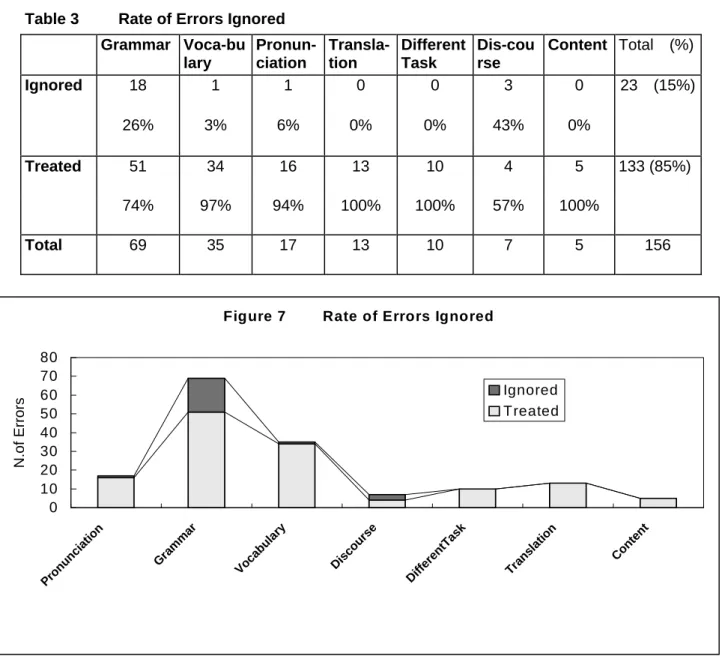
(13) errors(11%). This order of frequency roughly corresponds with Chaudron(1988) and Kubota’s(1991) studies which show a similarity in the prevalence of grammar, pronunciation, and vocabulary errors, although different orders of the three were obtained in each study. (3) Rate of Errors Ignored The percentages of errors ignored for respective error areas are shown in Table 3 and Figure 7 below. Discourse errors were ignored the most (43%), followed by grammar errors(26%), and pronunciation errors(6%).. Table 3. Rate of Errors Ignored Grammar Voca-bu Pronun- Transla- Different Dis-cou Content Total (%) lary ciation tion Task rse 18 1 1 0 0 3 0 23 (15%). Ignored. Treated. Total. 26%. 3%. 6%. 0%. 0%. 43%. 0%. 51. 34. 16. 13. 10. 4. 5. 74%. 97%. 94%. 100%. 100%. 57%. 100%. 69. 35. 17. 13. 10. 7. 5. t en on t C. Tr. an sl a. tio n. sk D iff er en tT a. ur se D is co. Vo. ca b. ul a. m ar G ra m. ci at io. ry. Ignored Treated. un Pr on. 156. Rate of Errors Ignored. 80 70 60 50 40 30 20 10 0 n. N.of Errors. Figure 7. 133 (85%). As can be found from the last column on the right side of Table 3, of the 156 errors observed, the percentage of errors ignored was 15%, and that of those. 8.
(14) treated was 85%. Thus, the majority of the errors received some kind of corrective feedback. A similar result was obtained by Yoneyama(1982) who reported that 9.5% of the errors committed in the classroom are ignored by student teachers. This tendency for the teacher to correct most errors committed in the classroom in some way or other sharply contrasts with error correction in natural communication outside the classroom(Chun, et al. 1982). The clear difference between classroom and natural settings should remind us that an overuse of overt error correction can greatly interfere with natural exchanges of messages. Two kinds of error ignorance were discernible from the class protocol. One was "recognition failures", and the other was "positive ignorance". Recognition failures occur mainly for two reasons. One is the teacher's inattentiveness. This is particularly the case with inexperienced student teachers. They often tend to fail to recognize errors committed by students as they are busy making complex decisions during a class. The other reason for recognition failures is more serious. That is, the teacher does not notice errors because he or she has an inaccurate knowledge of English. The following example shows a student teacher's recognition failure due to an inaccurate knowledge of grammar. Teacher: OK, would you play the dialogue,S1 and S2? S1: Do you like tomato? S2: No, I don't. S1: (Turning to other students) Does S2 like tomato? Sall: No, he doesn't. T: Good. OK. Thank you. As this pair of students demonstrated the dialogue, S1 made errors in pluralization (tomato). However, the teacher did not notice them. Also, the teacher did not notice the same kind of errors when two other pairs demonstrated the dialogue using "banana" and "ogrange" instead of "tomato". It was clear that this student teacher did not know that "tomato" had to be pluralized in this case, since she herself produced the same kind of errors elsewhere during the class. Thus the student teacher's lack of the knowledge of grammar made her blind to the errors. Cases of error recognition failures remind us of the importance of having an accurate knowledge of grammar as a language teacher.. 9.
(15) Positive ignorance is one option of error treatment in which a teacher deliberately ignores student errors, giving allowance to a student who is correctly producing other target items of a greater importance, or a teacher trying not to break the flow of communicative interactions. The dialogue below shows an example of positive ignorance of errors. Here, a nominated student is giving a quiz he made based upon pictures of several persons, one of whom is a thieve who stole a headmark(a nameplate attached to the head of a train). The other students are supposed to answer who the thieve is listening to the description the student gives of the thief’s appearance. S1:. T:. (Drawing a picture of a headmark on the blackboard) He steal a headmark in the bag. He is the man who has long hair. He has a bag which is bigger than mine. That color is black. Thank you so much.(はい、ありがとう). Several errors are committed here. The most noticeable one is “steal” in the first sentence. This verb(“steal”) must be in the past tense(“stole”). However, the student teacher did not correct the error. Without fussing about the error, she simply went on to confirm the answer of the quiz. She later reported that she intentionally ignored the error in the past verb form because the student was able to correctly produce a relativized sentence which was the target item of the lesson. The above type of positive ignorance is motivated by the teacher’s wish to have the student concentrate on one item at a time rather than distracting the student’s attention by pointing out errors randomly. There is one more important reason for the teacher’s use of positive ignorance. That is when the teacher has the students engage in communicative practice where more emphasis is placed on the exchange of information than the accuracy of linguistic forms. The teachers tend to raise the student’s motivation to express themselves in a relaxed atmosphere by giving feedback to what they say, not to how they say it. The conversation below shows this type of positive ignorance motivated by the teacher’s communicative consideration. (S1 and S2 present their dialogue they created) S1: If she want to eat curry and rice, she has to prepare glass of water. S2: Why? S1: Because it is very spicy….. 10.
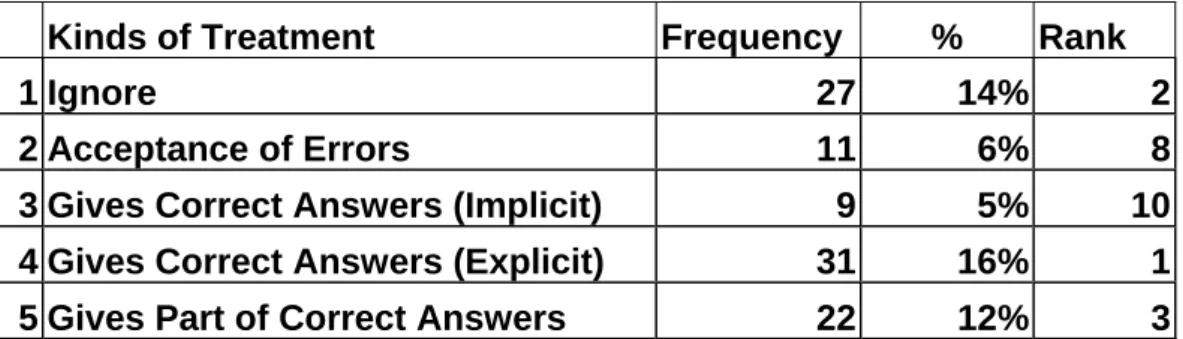
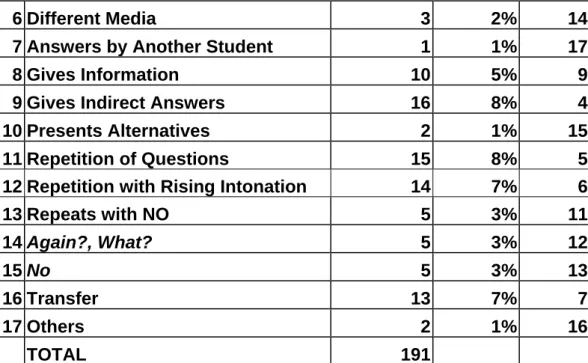
(16) T:. Thank you very much(「はい,どうもありがとうございます。」). The student teacher ignored the errors in the dialogue(e.g. If she want… prepare (a) glass of water…) . It may be difficult to find out the reason for her ignorance of the errors here. However, in the next scene of her lesson, she wrote the above dialogue on the blackboard and pointed out the errors explicitly to the class. Thus, although she did notice the errors at the time of their occurrence, she intentionally ignored them for the sake of lively communication. Positive ignorance is a principled use of error ignorance in the sense that it helps to facilitate the students’ fluent communication. However, recognition failure is clearly undesirable, especially in the case of recognition failures due to the teacher’s incorrect knowledge of grammar. Two negative consequences are foreseeable. First , a continuous ignorance of particular errors can lead to the fossilization of those errors. Vigil and Oller’s theory of rule fossilization states that lack of feedback, whether affective or cognitive, will result in the permanent incorporation of incorrect rules into the second language learner’s grammar(Vigil and Oller 1976). Second, if the teacher does not recognize errors committed, there is no way for the teacher to keep mental notes of the errors in order that he or she can devise ways to eradicate those errors later. It is necessary for teacher trainers to make sure that student teachers have accurate knowledge of English grammar and also pay closer attention to errors during class hours. (4)Distribution of Error Treatment Types Observed Table 4 and Figure 8 show the frequencies of each treatment type and their rank. The top three treatment types with high frequencies were “Gives Correct Answers”(16%), “Ignore”(14%)1), “Gives Part of Correct Answer”(12%). Table. 4. Frequency of Error Treatments. Kinds of Treatment. Frequency. %. Rank. 1 Ignore. 27. 14%. 2. 2 Acceptance of Errors. 11. 6%. 8. 3 Gives Correct Answers (Implicit). 9. 5%. 10. 4 Gives Correct Answers (Explicit). 31. 16%. 1. 5 Gives Part of Correct Answers. 22. 12%. 3. 11.
(17) 6 Different Media. 3. 2%. 14. 7 Answers by Another Student. 1. 1%. 17. 8 Gives Information. 10. 5%. 9. 9 Gives Indirect Answers. 16. 8%. 4. 2. 1%. 15. 11 Repetition of Questions. 15. 8%. 5. 12 Repetition with Rising Intonation. 14. 7%. 6. 13 Repeats with NO. 5. 3%. 11. 14 Again?, What?. 5. 3%. 12. 15 No. 5. 3%. 13. 13. 7%. 7. 17 Others. 2. 1%. 16. TOTAL. 191. 10 Presents Alternatives. 16 Transfer. Figure 8 Frequency of Error Treatment Type 31. 1 Gives Correct Answers (Explicit) 27. 2 Ignore 22. 3 Gives Part of Correct Answers 16. 4 Gives Indirect Answers. 15. 5 Repetition of Questions. 14. 6 Repetition with Rising Intonation. 13. Frequency. 7 Transfer 11. 8 Acceptance of Errors. 10. 9 Gives Information 9. 10 Gives Correct Answers (Implicit) 11 Repeats with NO. 5. 12 Again?, What?. 5. 13 No. 5 3. 14 Different Media 15 Presents Alternatives. 2. 16 Others. 2 1. 17 Answers by Another Student 0. 5. 10. 12. 15 20 25 Error Treatment Types. 30. 35.
(18) Except for “Ignore” type, the first and the third types(“Gives Correct Answers” and “Gives Part of Correct Answer”) are similar in that they involve some kind of provision of a correct answer by the teacher. These types provide correct answers, whether in a whole sentence or in a sentence fragment. The feedback information of this type is always explicit. The student is clearly informed that he or she is wrong and usually he or she is required to reproduce the correct sentence. The result of this study concurs with those of previous studies(Yoneyama 1982, Kubota 1991, Fanselow 1977) which showed that the teacher’s most prevalent error treatment type was a direct provision of correct answers. It is difficult to give an evaluative judgement on the prevalence of direct provision error treatment types since the appropriate use of these treatment types depend upon the kind of practice where the treatment takes place. Thus it is necessary to evaluate the frequency of these treatment types in relation to the practice types, which we will deal with in section 5. Next we will analyze what treatment types were used to correct each kind of errors. Table 5 lists top two most frequent treatment types for each area of errors. Table. 5. Top Two Treatments Used to Correct Each Type of Error Most Frequent Treatment. Pronunciation Gives Correct Answers (Explicit). Fre que ncy 6. Grammar. Ignore. 22. Vocabulary. Gives Correct Answers (Explicit) Ignore. 11. Discourse. Different Task Repetition of Questions. 3. 4. %. 2nd Most Fre Frequent que Treatment ncy 30% Gives Part of 5 Correct Answers 25% Gives Correct 13 Answers (Explicit) 23% Acceptance of 7 Errors 43% Gives Part of 1 Correct Answers Gives 1 Information Gives Indirect 1 Answers Transfer 1 40% Gives Indirect 2 Answers. 13. %. Total Freque ncy 20 25%. 15%. 87. 15%. 47. 14%. 7. 14% 14% 14% 20%. 10.
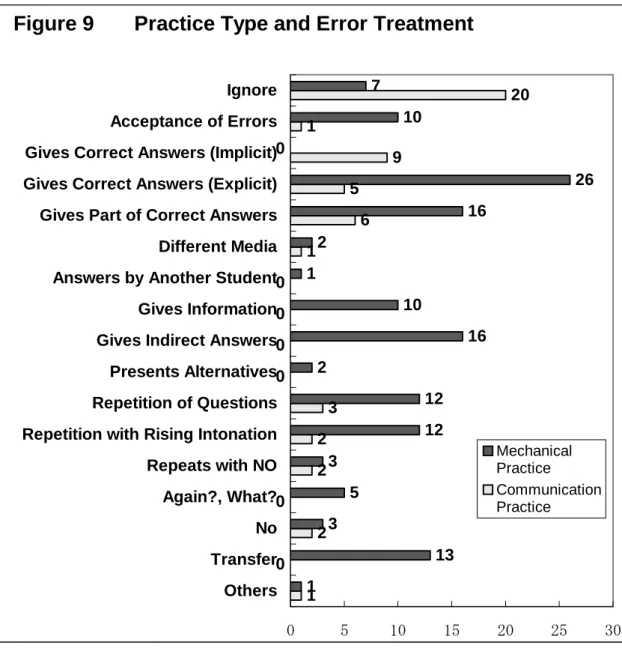
(19) Translation Content. Acceptance of Errors Transfer. 4 3. 27% Gives Indirect Answers 60% Repetition of Questions Repeats with NO. 3 20%. 15. 1 20%. 5. 1 20%. We will limit our discussion to the top three frequent types of errors in order to secure reliability of judgement. Again we can detect a tendency to provide correct answers when correcting errors. This is particularly the case with pronunciation errors. We can see that for pronunciation errors, “Gives Correct Answers(Explicit)” is the most frequent treatment and “Gives Part of Correct Answers” is the second. This is understandable considering the nature of pronunciation errors that are corrected more easily by directly providing correct models than giving hints or correcting indirectly. The same tendencies toward direct provision of correct errors can be seen with grammar and vocabulary errors. (5) Use of Error Treatments in Communicative and Mechanical Practice Are student teachers versatile enough to differentiate use of various error treatment options according to the kind of practice they use, in particular, mechanical practice and communicative practice? Mechanical practice here is defined as any kind of practice where there is only one correct answer expected, whereas communicative practice is defined as any kind of practice where new information is exchanged, making the answer partly or wholly unpredictable by the teacher. Each type of error treatment was tallied for the two categories of mechanical and communicative practice. The result of the tally is reported in Table 6 and Figure 9. Table 6. Differential Use of Error Treatments in Communicative and Mechanical Practice. Treatment. Communication. %. Practice. Mechanical. %. Total. Practice. 1. Ignore. 20. 74%. 7. 26%. 27. 2. Acceptance of Errors. 1. 9%. 10. 91%. 11. 3. Gives Correct Answers (Implicit). 9. 100%. 0. 0%. 9. 4. Gives Correct Answers (Explicit). 5. 16%. 26. 84%. 31. 14.
(20) 5. Gives Part of Correct Answers. 6. 27%. 16. 73%. 22. 6. Different Media. 1. 33%. 2. 67%. 3. 7. Answers by Another Student. 0. 0%. 1. 100%. 1. 8. Gives Information. 0. 0%. 10. 100%. 10. 9. Gives Indirect Answers. 0. 0%. 16. 100%. 16. 10 Presents Alternatives. 0. 0%. 2. 100%. 2. 11 Repetition of Questions. 3. 20%. 12. 80%. 15. 12 Repetition with Rising Intonation. 2. 14%. 12. 86%. 14. 13 Repeats with NO. 2. 40%. 3. 60%. 5. 14 Again?, What?. 0. 0%. 5. 100%. 5. 15 No. 2. 40%. 3. 60%. 5. 16 Transfer. 0. 0%. 13. 100%. 13. 17 Others. 1. 50%. 1. 50%. 2. 52. 27%. 139. Total. 15. 73% 191.
(21) Figure 9. Practice Type and Error Treatment 7. Ignore Acceptance of Errors. 20 10. 1. Gives Correct Answers (Implicit)0. 9. Gives Correct Answers (Explicit). 26. 5. Gives Part of Correct Answers. 16. 6. Different Media. 1 1. Answers by Another Student0. 2. 10. Gives Information0. 16. Gives Indirect Answers0 2. Presents Alternatives0 Repetition of Questions. 12. 3. Repetition with Rising Intonation. 2. Repeats with NO. 2. 12 Mechanical Practice Communication Practice. 3 5. Again?, What?0 No. 2. 3 13. Transfer0 1 1. Others 0. 5. 10. 15. 20. 25. 30. Let us first look at what error treatments are used to correct errors in mechanical practices. Many studies have shown that teachers extensively use “direct provisions”, that is, to directly provide correct answers to the student, either partly or wholly (Yoneyama 1982, Kubota 1991, Fanselow 1977, etc.). The dialogue below is an example of this type observed in this study; Student1: He play the piano. Teacher : plays. Student1: He plays the piano.. To counteract this tendency, researchers recommend the use of “self-corrective treatments”, i.e. error treatments that allow the learner to search for the answer autonomously (e.g. Holley & King 1994, Fanselow 1977, van Lier 16.
(22) 1988). An example of self-corrective treatment is shown below. This is called “Repetition with Rising Intonation” where the teacher repeats a part of the student’s utterance indicating which part is wrong using a rising intonation; Student1: He play soccer. Teacher :. He play...?. Student1: He plays soccer.. How much did the student teachers of the present study use each of the two kinds of error treatments in mechanical practices? It is possible to classify some of the treatments listed in Table 6 into the two kinds, although we must keep in mind that the classification is a matter of degree rather than a black and white decision. Treatments that can be regarded as direct provision type are No. 4, 5, 6 and 8. The frequencies are 26, 16, 2 and 10, respectively, which total 54(39.4% of the total number of treatments(137)). Treatments that can be regarded as self-corrective are No.9, 11, 12, 13, 14 and 15, The frequency of each are 16, 12, 11, 3, 5 and 3, respectively, which amount to 50(36.5%).. Figure 10. Rate of Explicit Answer Provision and SelfCorrection Eliciation. Answer Provision (3,4,5,8). 54 39.4%. Self-correction Elicitation (9,11,12,13,14,15). 50 36.5%. 33. Other Treatments. 24.1%. 0. 10. 20. 30. 40. 50. The direct provision types were slightly more common than the self-corrective types. Although it is difficult to evaluate this balance of the two kinds of error treatments, more use of self-corrective types should be considered, since, if direct provisions are overused, two kinds of undesirable effects are expected. First, learners will be deprived of hypothesis-testing opportunities in which they try to modify inaccurate interlanguage rules in an attempt to find a correct answer themselves. The ultimate goal, as Chaudron. 17. 60.
(23) points out, is to have the learner internalize accurate grammar so that they can monitor the grammaticality of their own utterance autonomously2). Secondly, self-correction is emotionally less threatening compared with the teacher’s correction as Ellis states3). We could even say whenever the learner is corrected he or she is facing the danger of losing his or her self-respect. Therefore, as a number of researchers recommend (Holley & King 1994, Fanselow 1977, van Lier 1988), the use of treatments to promote self-correction by such as giving hints along with an increased wait time should be considered more, while investigating their effects further. From a teacher training perspective, teachers should be trained to use self-corrective treatment types, since such types would be difficult to use unless teachers are specifically trained in the use of them and sensitized to the importance of such error treatment options. Next, we shall look at the frequencies of error treatments used for communicative practice. An interesting question here is whether the student teachers were able to use more “non-interruptive treatments” than “interruptive treatments”. The former are those in which the teacher responds to the learner’s message content with an intention to maintain the flow of communication. For example, the teacher in the dialogue below uses a non-interruptive treatment. (a pair-work activity where one student introduces his friend to the class in English) S1: I am going to introduce M. He likes baseball. He favorite class is special activity. T : O.K. His favorite class is special activity. So he likes special activity.. The latter treatments draw the learner’s attention to the surface form of a message, thus breaking the flow of communication. The treatments classifiable as non-interruptive are No.1 and 3 on the Table 4. The former simply let errors pass untreated while the latter is a kind of error treatment that attempts to respond to the message while implicitly providing a correct form. To give an example of the latter type observed in this study, when a student said “A-kun like nurse”, the teacher responded “Oh, A-kun likes nurses.” The percentages of their frequencies are 37% and 17%, which, if combined, occupies 54% of all the treatments used for communication practice. Most of the other treatments can be classified as interruptive. 18.
(24) treatments(No. 4, 5, 6, 7, 8, 9, 10, 11, 12, 13, 15, and 16). Their frequencies total 42%. Thus non-interruptive treatments were more common than interruptive ones, which suggests that, in general, the student teachers were able to use more appropriate treatment types for communication practices. Finally, concerning the non-interruptive treatments, although the percentage of non-interruptive treatments seems to be great enough, a close analysis shows that these treatments are in fact only used by a limited number of the subjects. Of the 41 student teachers, only 11 used treatment No.1, only 4 used treatment No. 3. Considering that some instances of No. 1 were “recognition failures” as discussed above, meaning they were not intentional uses of the treatment option, we could say that not many of the student teachers were able to make conscious use of non-interruptive error treatments during communicative practices. Particularly, the small number of users of treatment No.3 is disappointing. This treatment option is one of the most appropriate for communication practice since it is one of the few error treatments that balances fluency and accuracy. The principal reason for the small number of No. 3 users would be that this treatment puts a greater demand on the teacher’s communication ability than the other options, and requires a relaxed attitude towards oral communication. This is born out by the fact that, of the 4 student teachers who used this option, 3 studied in Canada for 8 months(See Lesson Transcription 1 in Appendix 3 for a lesson taught by one of the three students). Further efforts are necessary to train student teachers in using this non-interruptive error treatment so that they can promote communication in the classrooms as well as maintaining accuracy. (6) Effectiveness of Error Treatment Types: Uptake Success Rate Now, let us look at how effective each treatment type. Although the exact degree of the effectiveness of each type must await a more rigorous experimental study, we can find some clues by analyzing the success rate of the learner’s response immediately following the teacher’s error treatments. Chaudron(1986) analyzed the success rate, or “uptake rate” of French immersion teachers’ correction. Also Kubota(1991) has shown the effectiveness of some treatment types with uptake rates. Uptake can be considered as an intermediate stage of second language acquisition between input and intake.. 19.
(25) Input. →. →. Error. ……… →. Uptake. Intake ↑ Treatment Input is what is fed into the eyes and ears of the learner. However, receiving input does not guarantee that the input is “learned”. Conversely, intake does mean the internalization of what comes in as input. When the learner shows an uptake immediately after error treatment, it does show that he or she is on the progress toward the intake state although we can not definitely determine how far he or she has progressed. Also, uptake success rates depend upon the illocutionary force of the error treatments, as well as the effectiveness of the treatments. For example, Gives Correct Answers (Explicit) indicates to the student the teacher's clear intention that the student's answer was wrong, whereas Gives Correct Answers (Implicit) does not clearly do so. With these limitations in mind, we will analyze our data. The overall results of the analysis are reported in Table 7. The total uptake success frequency was 83, which means that 44.5% of error treatment successfully elicited correct responses from students. This percentage is roughly the same with the percentage (39%) obtained in Chaudron’s study(Chaudron 1986) on French immersion teachers.. Table 7 Uptake Success Rate of Error Treatment Types (overall) Treatment. Success Frequency. Failure. Total. %. Frequency. %. 0.0. 27. 100.0. 27. 27.3. 8. 72.7. 11. 0.0. 9. 100.0. 9. 1. Ignore. 2. Acceptance of Errors. 3. Gives Correct Answers (Implicit). 4. Gives Correct Answers (Explicit). 16. 51.6. 15. 48.4. 31. 5. Gives Part of Correct Answers. 18. 81.8. 4. 18.2. 22. 6. Different Media. 3. 100.0. 0.0. 3. 7. Answers by Another Student. 1. 100.0. 0.0. 1. 8. Gives Information. 10. 100.0. 0.0. 10. 9. Gives Indirect Answers. 15. 93.8. 6.3. 16. 3. 20. 1.
(26) 10 Presents Alternatives. 2. 100.0. 0.0. 2. 11 Repetition of Questions. 12. 80.0. 3. 20.0. 15. 12 Repetition with Rising Intonation. 13. 92.9. 1. 7.1. 14. 13 Repeats with NO. 2. 40.0. 3. 60.0. 5. 14 Again?, What?. 5. 100.0. 0.0. 5. 15 No. 4. 80.0. 1. 20.0. 5. 16 Transfer. 4. 30.8. 9. 69.2. 13. 0.0. 2. 100.0. 2. 17 Others Total. 83 (44.5%). 108 (56.5%). 191. For the sake of the reliability of the analysis we limit our discussion to the treatments that have enough total frequency observed. Somewhat arbitrarily, let us take top 10 most frequent error treatment types, or the ones with a higher frequency than 9. Table 8 is a summary table based upon Table 7 and shows the ranks of the top 10 error treatment types. A graphical representation of Table 8 is shown in Figure 11.. Table 8. Uptake Success Rate (Top 10 among Frequent Types). Rank Treatment Type. Success Rate (%). Success Frequency. Total Frequency. 1. Ignore. 0. 0. 27. 2. Gives Correct Answers (Implicit). 0. 0. 9. 3. Acceptance of Errors. 27.3. 3. 11. 4. Transfer. 30.8. 4. 13. 5. Gives Correct Answers (Explicit). 51.6. 16. 31. 6. Repetition of Questions. 80. 12. 15. 7. Gives Part of Correct Answers. 81.8. 18. 22. 8. Repetition with Rising Intonation. 92.9. 13. 14. 9. Gives Indirect Answers. 93.8. 15. 16. 10. Gives Information. 100. 10. 10. 21.
(27) Figure 11. Uptake Success Rate(Top 10 among Frequent Types). Treatment Type. Gives Information. 100. Gives Indirect Answers. 93.8. Repetition with Rising Intonation. 92.9. Gives Part of Correct Answers. 81.8. Repetition of Questions. 80. Gives Correct Answers (Explicit). 51.6. Transfer. 30.8. Acceptance of Errors. 27.3. Gives Correct Answers (Implicit). 0. Ignore. 0 0. 20. 40. 60. 80. Success Rate (%). There are roughly two groups of effective error treatments. One is that of “Answer Provision Types”, which include: Gives Information 100% Gives Part of Correct Answers 81.8% Gives Correct Answers(Explicit) 51.6%. The reason for the effectiveness of Gives Information lies in the fact that with this type the teacher first explains what is wrong and why it is wrong and subsequently gives the correct answer(see Appendix 2). Unlike other treatment types, this type provides the information as to the cause and location of errors and the correct model. The other two treatment types also showed high uptake success rates. The reason for the difference between Gives Part of Correct Answers(81.8%) and Gives Correct Answers(Explicit) (51.6%) is that the former gives a more focused information as to the location of errors by showing the correct model of the very item that the learner made an error of. The other group of treatments that showed high success rates was that of. 22. 100.
(28) “Self-correction”, which includes: Gives Indirect Answers 93.8% Repetition with Rising Intonation 92.9% Repetition of Questions 80%. With Gives Indirect Answers, the teacher gives “hints” and has the student grope for the correct answer. Repetition with Rising Intonation indicates where the student made an error and urges him or her to find the correct answer(For samples of this type see Lesson Transcription 2 and 3, Appendix 3). Lastly, Repetition of Questions has the student reshape the answer according to the original question. These self-correction types seem promising as candidates of effective error treatment techniques. Particularly, regarding Repetition with Rising Intonation, Kubota(1991) reports that this type is an effective correction technique. Although the result of the present study needs a more rigorous empirical verification, we may well reconsider a more use of self-corrective error treatments in the classroom to facilitate the student’s second language acquisition. There were two error treatment types that showed no uptake success(Table 8). They were Gives Correct Answers(Implicit) and Ignore. The former has been discussed in the previous section as an recommendable treatment type for communicative practice. The latter was also discussed previously as an important error treatment option during communicative practice provided that the teacher ignores errors intentionally(positive ignorance). Although we recommended these treatment types for communicative practice, their low uptake success rates imply that they may not be very effective as far as its short-term effect is concerned. As was pointed out earlier, the value of these types is that they do not interrupt the flow of communication, whereby motivating the student to talk. Although their short-term effect seems less promising, it is still possible that these types of error treatment might leave, though vague, an image of correct model, which in the long run might help the student to learn a second language. This again needs to be verified empirically. 4. Conclusion This study reported descriptive data on novice teachers’ error treatment behaviors in order to gain some insights into the effective ways of error. 23.
(29) treatments in the classroom. 41 junior high school English lessons taught by student teachers were transcribed and analyzed. The findings were as follows; (1) the average frequency of error occurrence was extremely low, which turned out to be due to the overuse of grammatical explanations and repetitive drills, (2) the most frequent errors observed were errors in grammar, vocabulary, and pronunciation, (3) only a small portion of the errors committed was ignored, (4) treatment types for mechanical English practice which directly provided correct answers were used more than self-corrective treatments, (5) for communication practice non-interruptive types of error treatment were more used than interruptive types, but only a limited number of the subjects used the former types. (6) Some of “Answer Provision” types and some of “Self-correction” types showed better short-term effects, successfully eliciting corrected responses from students. With the recent emphasis on communication, error correction might be considered unnecessary in the classroom. However, on the contrary, error correction has an important role in foreign language learning. As has been pointed out by Shachter(1991), unlike children learning a first language, older learners learning a foreign language can benefit from receiving negative feedback from the teacher. It is an important part of the language teacher’s responsibility to provide appropriate feedback for the learner’s interlanguage development. Thus more research is needed to investigate into effective error treatment. This study is exploratory in nature and thus has posed more questions than solved ones. Several further research questions remain to be investigated. (1)What is the relationship between error frequency and the effectiveness of classroom instruction on acquisition? (2)What is the relationship between error frequency and the amount of communicative interactions in the classroom? (3)Are self-corrections more effective for acquisition than corrections by the teacher? (4)What are the cognitive and affective effects of non-interruptive and interruptive treatments on the learner during communication practices? (5)How do experienced teachers differentiate the use of error treatment options according to the kind of practice, and how do they compare with novice teachers. (6)What is the difference between native and non-native teachers’ error. 24.
(30) treatment? (7)What are the most effective corrective treatments for different linguistic areas(e.g. pronunciation, grammar, and lexical errors)? (8)To what extent are “uptake” rates related to long-term effects of error treatment types? Note 1)There is a discrepancy between this percent(14% 27cases) and the percentage(15% 23 cases) shown in Table 3. The former figure was calculated with the number of treatments observed whereas the latter with the number of “errors” observed. One error is not necessarily treated by a single treatment move. Sometimes the teacher uses more than one treatment move. Therefore, the former percentage was obtained with 27 errors and the latter with 23 treatment types. 2) C. Chaudron, Second Language Classrooms, Cambridge University Press, p.150. 3) R. Ellis, The Study of Second Language Acquisition, Oxford University Press, 1994, p.586. 4) Originally, this treatment type was used in Chaudron(1977) where he calls “Repetition with No Change(with Emphasis and Reduction). Kubota’s (1991) study analyzed teachers’ corrective treatments and showed that this error treatment type had a higher uptake success rate than repeating the whole sentence or giving an expanded model of the sentence (p.17).. 25.
(31) References Allwright, D.1975.Problems in the study of the language teacher’s treatment of learner error' in Burt and Dulay (eds.) 1975. Allwright, D. and K.Bailey.1991.Focus on the Language Classroom: An Introduction to Classroom Research for Language Teachers. CUP. Brown, H.,C.Yorio, and R.Crymes eds. 1977.On TESOL '77.TESOL. Brock, C., G. Crookes, R.Day, and M. Long.1986.Differential effects of corrective feedback in native speaker-nonnative speaker conversation. In Day, ed. 1986, pp. 229-236. Burt, M.K. and H.Dulay.eds. 1975.On TESOL '75:New Directions in Second Language Learning, Teaching and Bilingual Education.TESOL. Burt, M.K. and Kiparsky, C.1972.The Gooficon: A Repair Manual for English, Newbury House. Cathcart,R. and J.Olsen.1976.Teachers' and students' preferences for correction of classroom errors. in Fanselow and Crymes(eds)1976.. Chaudron, C.1977.A descriptive model of discourse in the corrective treatment of learners' errors. Language Learning. 27. 29-46. Chaudron, C.1986.Teachers' priorities in correcting learning errors in French immersion classes. in Day.ed.1986. Chaudron, C.1988.Second Language Classrooms.CUP. Chenoweth, A., R. Day, A.Chun, and S.Luppescu.1983.Attitudes and preferences of nonnative speakers to corrective feedback. Studies in Second Language Acquisition 6:79-87. Corder, S.P.1967.The significance of learners’ errors, International Review of Applied Linguistics, 5. 161-170. Chun, A., R.Day, N.Chenoweth, & S. Luppescu.1982.Errors interaction, and correction: a study of native-nonnative conversation.TESOL Quarterly, 16.4. 537-547. Courchene,R.1980.The error analysis hypothesis, the contrastive analysis hypothesis, and the correction or error in the second language classroom.TESL Talk 11/2:3-13 and 11/3:1-29. Day, R.ed.1986.Talking to Learn:Conversation in Second Language Acquisition. Newbury House. Day,R.Chenoweth,. A.. Chun,and. S.. Luppescu.1984.Corrective. feedbakc. in. native-nonnative discourse. Language Learning 34:19-45. DeKeyser, R.M.1993.The Effect of Error Correction on L2 Grammar Knowledge and. 26.
(32) Oral Proficiency.Modern Language Journal 77/4:501-14. Edmondson,.1985.Discourse worlds in the classroom and in foreign. language.. Studies in Second Language Acquisition 7:159-68.. Ellis, R. 1994. The Study of Second Language Acquisition. Oxford University Press. Fanselow, J.1977.The treatment of error in oral work. Foreign Language Annals. 10. 583-93. Fanselow, J. and R.Crymes(eds)1976.On TESOL '76. TESOL.. Holley,F. & J.K.King.1974.Imitation and correction in foreign language learning. In J.H. Schumann & N. Stenson.eds.New Frontiers in Second Language Learning. Newbury House. 1-89. Kasper, G.1985.Repair in foreign language teaching. Studies in Second Language Acquisition 7:200-15.. Kubota, M.1991.Corrective feedback by experienced Japanese EFL teachers. The IRLT Bulletin, 5, 1-25. The Institute for Research in Language Teaching. Kubota, M.1994. The role of negative feedback on the acquisition of English dative altenation by Japanese College Students of EFL.The IRLT Bulletin, 8, 1-36. The Institute for Research in Language Teaching. Long, M.H.1977.Teacher feedback on learner error: mapping cognitions. in Brown et al.eds.1977. Lucas,E.1975.Teachers' reacting moves following errors made by pupils in post-primary English as a second language classes in Israel. MA thesis, School of Education, Tel Aviv University. Cited in Chaudron 1988, p.137. Moskowitz, G.1967.The classroom interaction of outstanding foreign language teachers. Foreign Language Annals.9.135-143, 146-157. Nasu, T.1980.A Consideration on Students’ preferences for correction of classroom conversation error. 中国地区英語教育学会紀要. No.11.67-70.. Nystrom, N.1983.Teacher-student interaction in bilingual classrooms: four approaches to error feedback. In H. Seliger & M. H. Long. eds.Classroom Oriented Research in Second Language Acquisition. Newbury House, pp. 169-188. Ramirez, A. and N.Stromquist.1979.ESL methodology and students language learning in bilingual elementary schools.TESOL Quarterly 13: 145-58. Salica, C.1981.Testing a model of corrective discourse. Unpublished MA in Tesl thesis. UCLA,Cited in Chaudron 1988.. Schachter, J.1991.Corrective feedback in historical perspective. Second Language Research. 7. 89-102.. 27.
(33) Schumann, J.H. and N. Stenson.eds.1974.New Frontiers in Second Language Learning. Newbury House. Seliger, H. and M. Long(eds.).1983.Classroom-oriented Research in Second Language Acquisition. Newbury House.. van Lier, L.1988. The Classroom and the Language Learner. Longman. Vigil, N.A. and J.W.Oller.1976.Rule fossilization: A tentative model. Language Learning, 26, 2, pp.281-295. Yoneyama.A.1982.The treatment of learners’ errors by novice EFL teachers. Bulletin of the College of Education, Human and Social Sciences. 23. 85-94. University of Niigata. 萬谷隆一.1981.「英語教授における誤り訂正について」.『英語教育と言語研究』 No.1,釧路英語教育学会, pp.73-84. 萬谷隆一.1995.「誤りへの対処:何を、どのように直すか」『英語教育』12月号、 大修館書店,pp.20-22. 萬谷隆一.1997.「生徒の誤りにどう対処する?-そのチェックポイント」『現代 英語教育』研究社、3月号、pp.26-29. Yorozuya, R.1998."How Do Inexperienced English Teachers Treat Students' Oral Errors?" 『北海道教育大学紀要』(第1部C)Vol.48, No.2、pp.121-129.. 28.
(34) Appendix. 1. List of 41 lessons analysed No Grad Year Teach Target Item e er. Textbook. 1. 1 1991 TM. What time is it?. New Horizon 1, L9-1. 2. 1 1991 MS. Does he ...?. New Horizon 1, L8-2. 3. 1 1991 NM. Does he ...?. New Horizon 1, L8-2. 4. 1 1992 OY. 3rd Person Singular. New Horizon 1, L8-1. 5. 1 1992 SS. 3rd Person Singular. New Horizon 1, L8-1. 6. 1 1992 YK. Present tense. New Horizon 1, L9-2. 7. 1 1993 YR. Can(Question, Negative). New Horizon 1,L7. 8. 1 1993 MN. Does he...? He doesn't.... Sunshine 1, Program 8. 9. 1 1993 TM. Reading. Sunshine 1, Program 7. 10. 1 1993 MY. Where do you - ?. New Horizon 1, L8-3. 11. 1 1994 ITY. Can you -?. New Horizon1, L7-2. 12. 1 1994 ST. 3rd Person Singular. New Horizon1, L8-1. 13. 1 1994 TS. I can.... New Horizon1, L7-1. 14. 1 1994 NT. Can you ...?. New Horizon1 L7-3. 15. 1 1994 YM. 3rd Person Singular. New Horizon1 L8-1. 16. 1 1994 SA. 3rd Person Singular. New Horizon1 L8-1. 17. 1 1995 TO. Where...?. New Horizon 1, L6-3. 18. 1 1995 WT. 3rd Person Singular. New Horizon 1, L8-1. 19. 1 1995 NY. How many ...?. New Horizon 1, L6-1. 20. 1 1995 YY. 3rd Person Singular. New Horizon 1, L8-1. 21. 1 1995 NT. 3rd Person Singular. New Horizon 1, L8-2. 22. 1 1995 SN. 3rd Person Singular. New Horizon 1, L8-1. 23. 2 1991 AK. have to. New Horizon 2, L6-1. 24. 2 1991 SK. Question(have to). New Horizon 2, L6-3. 25. 2 1991 MK. when(conjunction). New Horizon 2, L6-1. 26. 2 1993 SM. Have to,why-because. New Horizon 2, L6-1. 27. 2 1993 DD. Will. New Horizon 2, L5-3. 28. 2 1994 TH. Have to. New Horizon2 L6-1. 29. 2 1994 IWY. Tell me -. New Horizon2, L7-2. 29.
(35) 30. 2 1994 OT. Call A B. New Horizon2, L6-2. 31. 2 1994 ITYM. Call A B. New Horizon2, L6-2. 32. 2 1994 YK. something to eat. New Horizon2, L7-1. 33. 2 1995 ME. have to. New Horizon 2, L6-1. 34. 2 1995 KA. have to. New Horizon 2, L6-1. 35. 3 1991 AS. S+V+O+to-infinitive. New Horizon 3, L7-1. 36. 3 1991 TS. Reading. New Horizon Read 2. 37. 3 1992 KN. who, which(relative pron.). New Horizon 3, L6-2. 38. 3 1992 SE. when(conjunction). New Horizon 2, L6-1. 39. 3 1993 SH. It - to -. New Horizon 3, L4-4. 40. 3 1994 AM. -ing(post modifier). New Horizon3, L6-1. 41. 3 1995 AS. -ed(post modifier). New Horizon 3, L6-2. 30. 3,. Let's.
(36) Appendix 2 Descriptions of Error Treatment Types. Type 1 Ignore. 2 Acceptance of Errors. 3 Giving Correct Answers (Implicit). 4 Giving Correct Answers (Explicit) 5 Giving Part of Correct Answers 6 Different Media. 7 Answers by Another Student 8 Giving Information. 9 Giving Indirect Answers. 10 Presents Alternatives. Description. Example. The teacher(T) either ignores the student’s (S) erroneous responses on purpose or just lets them go without notice. T may or may not know the occurrence of an error. T accepts S's response with the accompaniment of accepting behavior, verbal or non-verbal. T may go on to correct the error.. S:I asked Miss Kimura to shake hand with Tanaka. T:はい、Thank you very much.. T:What's the meaning of this "translate"? S:「通訳する」 T: O.K.通訳する。又は翻訳す る。 Without breaking the flow of S:A-kun likes nurse. communication T responds to S's T:Oh, A-kun likes nurses. utterance at the meaning level. However, T implicitly provides a correct form. T gives the correct answer explicitly. T S:It's book. T:It's a book. provides the whole sentence. T gives the correct answer explicitly. T S:I watch TV at six thirteen. provides part of the correct sentence. T:Thirty. T tries to correct S's utterance by using S:その若い男の人は...T:(板書 non-verbal media such as pointing to a を指して)これこれ。先にここを written word on the board or a picture. 訳して。 Another S jumps in to correct Ss' error T:(訳させるつもりで)「いつ before T corrects it. も」 S1:also. S2:えっ、always だよ。 T gives an explanation on a particular (3単現の疑問文の練習で) point of a language item which he judges T:like は、元の形に戻っている to be a stumbling block. T subsequently ね。いい?もう一回。Does Nobita gives the correct answer. like dogs? T gives hints to have Ss try to find the S:Yes, I... T:彼女はできます answer themselves. T does not provide かって聞いているんだから。は the correct answer. い、みんなで。 S:Yes, she can. T gives alternatives to lead an S to a S:It's eleven fifty. correct answer. T:Fifty ですか。fifteenです か。 S:Fifteen.. 31.
(37) T repeats the same question to give S T:Does Ken get up at seven another chance to figure out the answer. thirty? S:Yes. T:Does Ken get up at seven thirty? S:No. Repetition with Rising Without providing the correct model T S:No, she doesn't. Intonation repeats S's wrong response partly or T:No,she...(rising wholly, with rising intonation to let S intonation). know about the fact, location, and nature Please say again. of the error. S:No, she isn't. Repeats with NO T denies S's answer repeating the S's S:Does Nobita likes dogs? response. T:likes じゃないね。 Again?, T asks S to repeat his or her answer. S:Where do you buy egg? T:ん? S:あっ、eggs. No T simply denies S's answer. S:I can..play skate. T:No. I can skate. Transfer T abandons the interaction with S and T:Draw. A君。この意味は? S: transfer the task to another S. 引く T:そういう意味もあるけ ど、ここの本文ではどういう意味 だったっけ。 分かんないか な。じゃBさん。 Others All the other unclassifiable treatments.. 11 Repetition of Questions 12. 13 14 15 16. 17. 32.
(38) Appendix 3 Scripts of Sample Lessons The following transcriptions are some of the lessons analyzed in this study. The first and second lessons are first-grade lessons which aim to teach Third Person Singular (Present Tense). The third is a second-grade lesson focusing on "have to" and "has to." The fourth is a third-grade lesson which focuses on the use of noun phrases with post-modified by "~ing." (※indicates a repetition by students.. T means Teacher and S means Students.. Parenthesized numbers on the right side indicate Error Treatment Types adopted. None of the names that appear in the script are real ones.). Lesson Transcription 1 (Grade T:O. K.. 1,. New Horizon 1, 8-1, Third Person Singular Present). Everybody, look at me. O. K. Good morning,everyone.. S:Good morning,Ms. Sasaki. How are you? T:Ⅰ’m really. good. How about you?. S:I’m fine,too. T:O. K. Great. Today‥. Today‥is my last class. Last class. 最後の授業。えーん、かなしい。 S:(笑) T:悲しくないの?. Today‥‥. This is a family picture of my host. family. My host family. This is my host family. Can you see this?. Can you see this?. Yes or no?Yes?. S:Yes, T:O. K. This is my host father,Roland. Roland. He is very tall, Tall. He is 6 feet and 2 inches tall. Ⅰt is about one-hundred- and-ninety centimeter. S:おお。 T:さあ、one hundred and ninety centimeter は、なんぼでしょう。 Raise your hand. S:はい、はい、はい。 T:誰にしようかな。じゃ、島本さん。 S:はい。190 センチ。. 33.
(39) T:そう。190 センチなんですよ。 S:写真だとあんまりおっきくないよ。 T:これ、座ってるんだもの。で、His shoe size,shoe size is thirty three centimeters. S:えっ。すげ-。 T:さあ。いくらでしょう。小橋君。 S:33 センチ。 T:そう。33 センチもあるの。 S:えー、でっけ-。Shaquille O’Neal みたいだ。 T:うん。Shaquille のような足なの。And he plays football, Football. Do you know foot ball?Football? S:(何人か)Yes, T:なんか、アメリカン・フットボールってよく言われるんだけど。 Football is very popular sport in America.. Very popular.. He often cooks break fast for his. family. 日本人の男の人はあんまりやんないよね。おとうさん、cook する? S:する。しない。 T:しないよね. else. ‥‥. He often cooks breakfast for his family. And‥what. He likes very very sweet cake. 何かね、食べると砂糖. がじゃりってなるようなケーキが好きなの。He sweet. cake. And. what else‥‥. Joyce,she likes the. Disney. The Alladin,and this. is always. This is my. movies.. Like‥. likes cooking.. home.. host. mother,Joyce.. 今日持ってきました. is the Beauty and the. T:She likes cooking. She She. likes very very. And she. Beast. is always. home.. Always.. S:いつも T:そう。いつも。Always cook. hom.いつも家にいます。But,she. cannot. often.. S:えっ。なんで。 T:Because,なぜなら,She Look. at the. picture.. has six. One child.. children,she. has six. children,. two children,three children,. four children,five children,six children,さあ、Roland と Joyce,私は、Roland は何のスポーツが好きといったでしょう。 S:はい、はい、はい。 T:誰にあてよっかな。(右側のほうを指して)こっちのほう誰も挙げて ないよ。じゃ、西川さん。 S:はい。Football. T:そう。He. likes…plays. football. (板書)He plays football.. S:(一人の生徒)先生、たしかね、plays の y のとこ、-ys じゃなくて -ies じゃない. ‥‥. 34.
(40) S:違うよ。かわんないの。 T:そう. これは、-ys でいいの。あと、私は、彼は家族のためによく何をすると言った でしょう。 S:はい、はい、はい。 T:He often. cooks breakfast. for his family.といったよね。今の聞いたら分かるよ. ね。三澤君。 S:Cook. T:cook なんて言った?. 家族めために何を cook するって言った?. S:はい、はい、はい。 T:はい。平原君。 S:breakfast T:そう。breakfast っていったよね。breakfast ってわかるよね。みんなでさんはい。 S:(めいめいに)朝御飯。朝食。 T:まあ、ばらばらだったけどいいや。(板書)He cooks. breakfast. for. his family. And,Joyce. Joyce はどんな映画が好き?She,‥景澤さん S:Disney の映画。 T:そう。Disney movie. 私がなんて言ったかわかった?英語でなんてい った?辻君。 S:Disney T:そう。彼女は Disney movie が好きって英語でなんていった? S:She likes Disney movie. T:そう。 (板書)She. likes. the. Disney. ( 4). movies.. S:the つくの。 T:そう。そして、子供が何人いるといったでしょう。はるかさん。 S:六人 T:そう、六人。なんて英語でいったでしょう。佐古君。 S:Six children. T:そう。Six. children. She. . has‥. (板書)She. has six. haves じゃなくて has. children,一人の子供だと one. .. S:child T:そう。one. child なんだけど、two. children,five. children,three. children,six children. になります。. Mr. . Children じゃないよ。(板書)one child, six さあ、みんなでそれじゃ、Repeat after me. Okay? one. child. S:(※) T:six. children,four. children. S:(※) T:one child S:(※). 35. children.
(41) T:Six. children. S:(※) T:O. K. And‥. Okay,this is my host sister,Carol. She is ten years old. Ten years old.. And she is in the fourth grade.. Fourth grade. She likes books. She is very quiet girl. Quiet girl. 氏家君みたいな人じゃないってことだね。 S:(ある生徒が)わかった。頭がいいってこと? S:(他の生徒が)違う、違う。おとなしいってことじゃない。 T:そう。おとなしいってこと。さあ、Carol は何が好き?はい。(とい ってあてる) S:本 T:英語でなんて言った?はい。(といってあてる) S:BOOK T:そう。book,文では‥. はい加藤君。 S:She likes books. T:That’s right. (板書)She likes books. And this is her sister.. Her name is Sarah. Sarah.. S:Sailormoon,,, T:そう。Sarah. She is eight years old. She is in the second grade. Second grade. She likes cartoons. Cartoons. Cartoons. 覚えてる?. Cartoons. Cartoons. Cartoons. こういうの(といって. ディズニーのアニメのビデオを指す)Cartoon,cartoon. S:車?ああ、アニメだ。 T:そう。アニメとか‥‥. S:マンガだ。 T:そう。マンガ。She and. she. likes cartoons. She likes 一”Tom&Jerry,”. likes“Alladin,” too. She likes. (板書)She. likes cartoons.. the. Alladin,too.. Okay‥‥Next.. This is Benjamin. Benjamin. He is five years old. Five. And he likes ”おかあさんと一緒’’ and S:なんで?. “Dragon Ball”.. 日本にいるの?. T:言うの忘れてたけど、米軍基地のホストファミリーなの。米軍基地に 住んでるから、日本のテレビも見れるし、むこうのテレビも見れる S:おお。 T:He likes the Dragon Ball. But he. cannot understand. English,I. mean,Japanese. He cannot understand Japanese. 日本語わかんな いの。But he likes…おかあさんと一緒’’ and. “Dragon Ball. ”. S:訳してないの? T:日本語のまま。でもほらドラゴンボールとかって、「や一っ」とか 「は一っ」とかっていうのばっかりだからたぶん分かるんじゃない?. 36.
(42) 「おかあさんと一緒」は?. S:じゃ. T:う一ん。 「おかあさんと一緒」はね,,,きっと♪ぞうさんのあくび♪ とかやってるからわかるんじゃないかな。 (板書)He likes the Dragon Ball. Okay‥‥. This is Bethany.. Bethany.. S:べったに-? T:No.. (15). Bethany.. Bethany.. She is very cute.. ( 4). She is four years old,. and she likes Sesame Street. She likes Sesame Street. Sesame Street みんな知ってる? S:知ってる。知らない。 T:教科書にも載ってるの知ってた? S:知ってる。知らない。 T:Please open your textbooks.. Page seventy six.. Seventy. six.. You can see Ernie and Big Bird,Today,Ⅰ brought. these. これ. 私のなんだけど。This is mine. This is Bert. And. this is Ernie.. She likes Ernie and Big Bird. (板書)She likes Ernie and Big Bird. But I like Bert.. How about you?. Which do you like?Do you like Ernie. or do. you. S:I like Big. Bird.. T:Oh, you like. Big. S:I like Big. like Bert or do you like Big Bird? Bird.. How about. you,Sachiko?. Bird,too.. T:Oh,okay. How about. you?. S:I like Big Bird,too. T:She. likes. Big bird,too.. (板書)I like But. I like. Bert.. Bert.. I like Bert. Big. Bird. is pretty. Pretty.. S:(何人かの生徒が)えー。 T:Yeah!Okay,here Old,I. mean,one. But he. is another one. This is Mark. He is one years year old. One. year old.. He. is a baby.. likes dogs and cats.. S:犬とか猫だ。 T:Yes. Dogs and cats. And he dogs name. has a dog. He has a dog. で、The. is 一 Inu.. (坂書)He. likes dogs. and cats.. S:先生、「いぬ」ってどう言うふうに呼んでるの?なんかアクセントと かおかしいの?. 37.
(43) T:[inu]ってよんでるよ。そしてさ、ここに注目。なんかさ違うよね I like Bert. She likes Ernie. and Big. Bird. 何が違うでしょう。. S:はい。はい。 T:なんか違うとこあるよね。違うとこをあげてください。はい、渚狩さ ん。 S:like のところに、-s がっいてるのと、ついてないのがある。 T:他の意見の人どうぞ。はい、辻君。 S:複数形になってる。 T:どこが?や、ただ違うところはどこ? S:最初の文は、彼女はっていう文だけど、下の文は、私はっていう文だ T:そうだね。Ⅰ. と she が違うね。そして、猪狩さんが言ってくれたみた. いに like の形も違うよね。 S:先生、Bert とかっていうのはいいの? T:え?. Bert. っていうのは、人の名前だからそのままなんだよ。これが. さあ、そして、I と she が違うと何だか知らないけどここの. Bert.. 形(動詞を指して)も違ってるよね。 S:三人称だからじゃないの。 T:そう。そして、こっちをみると、今まで、play とか cook,like だった ものが、なんか s がついてるよね。こういうふうになって(といって すべての-s にアンダーーラインをひく)。 そして、ここは(といって、has を指す)なぜか、例えば I have two sisters. でも、She has six children,というふうに、なりま す。他の単語だとただ、うしろに s がついただけだったのが、これは 特別な単語で、have が has になってるの。(板書)has (have) というように、前に、he とか she とか、後ここには出てきてないんだ けど it とかがきたときに、動詞のあとに-s がつきます。 (板書) でも、has は例外で、単語自体の形. he she →. s!. が変わってしまいます。. it ということで、Everybody,write these sentences. down. 書いて。. S:え、全部? T:好きなのどれでもいいよ。ひとつ。 S:(ノートに記入) T:(机間巡視をしながら)Ⅰ’ll give you one minute. One. minute.. Okay?Thirty second,Twenty,Ten,nine,eight,seven,six, five,four,three,two,one,zero. S:(生徒も、声をあわせて、countdown する). 38.
(44) T:終わってない?. まだ。Finished?Finished?Yes. or No?Finished?. S:Yes. T:Okay. あとさ、この He likes の-s と cats and dogs の一 s は、同じもの でしょうか。違うものでしょうか。同じものだと思う人、Raise. your. hand. 違うものだと思う人、Raise your hand. S:(ほとんど違うものだと思うほうに手をあげたが、二人だけ同じ方に 挙手) T:じゃ、新岡君。cats と likes 同じだと思う? S:あ、それだったの。あ、じゃあ違う。 T:ね。じゃ、誰かその違いを説明できる人。上島君。 S:えーと、likes のほうは、一人称、二人称、三人称のやつで、 T:一人称、二人称? S:三人称だよ。 T:みんな、三人称ってわかるかな。 S:わかる。わかんない。 S:はい。一人称っていうのは、例えば、僕から見たら僕が一人称で、二 人称が先生で、三人称っていうのはその外のいろんなものは、全部三 人称。 S:はい。はい。この場合の三人称っていうのは、Ⅰ. と you を抜かした、. he とか she とかそういうのをすべて三人株っていう。 T:そうだね。例えば、私って誰がいなくても私って一人で存在できるよ ね。あなたっていったら、最低二人いないと、あなたっていえないよ ね。彼、彼女っていったときにも、私とあなただけじゃ、存在できな T:いよね。最低、三人必要だよね。それが、多分、一、二、三に、関係 するんだと思うんだけど、三人称っていうのは、he とか、she とか、 it とか、そういうののことをさします。だから、likes の-S はそうい うのの、S デス。じゃ、cats の s は?. 加藤君。. S:いっぺんに犬とか猫とか言っても、いろんな種類がいるから、だから S が つく。 T:そう思う人。みんな、加藤君の言ったの分かった? S:複数形でしょ。 T:そう。それで、加藤君は何で複数形になるのかを説明したよね。犬と か猫は、いろんな種類の犬や猫がいるから cats,dogs になってるんだ よね。Okay ですか。O. K. では、実際みんなで、今出てきた likes, plays,has を使って、自己紹介じゃなくて他己紹介をしてみましょう (板書)likes,plays,has 隣の人のことについてでもいいし、友達のことでもいいし。 例えば‥. (騒がしくなったので)Everybody,listen to me, じゃ、私が例文を作ってみます。じゃ、古山。 Do you like poems?Do you like poems?. 39.
(45) S:Yes,I do. T:(板書) likes→Furuyama likes poems. S:意味わかんない人のために教えてあげよう。poem というのは、詩です よ。 T:And he plays‥‥soccer. Do you play soccer? S:Yes,I do. T:(板書)He plays soccer. ほかに、play 使って、何かできるよね。 play the ‥. なんとかで‥.. S:(何人か)楽器。guitar とか。 T:そう。楽器をひくっていう文もできるよね。で、has は、have と同じ いみだから、例えば He has computers. とか I have two sisters. だから、Tamaki has two sisters. とかいうふうにできます。 Furuyama,do you have any brothers or sisters? S:I have one brother. T:Okay. He has. one brother. (板書)というふうに、たって歩いてもい. いから誰かにきいて。いいよ。すきなひとに質問をしてください。 S:(めいめいに英語で質問しながら、英作文をする) T:(机間巡視しながら、アドバイスをしていく) Okay. Class. Sit down. O. k. さあ、ぜひ発表したいっていう人。 はい、景澤さん。 S:高屋さんのことなんだけど、She likes yakitoris. T:O. K. 日本食ば"yakitori“でいいと思う。日本食は。焼き鳥。O. K. And. ( 5). she plays‥,. S:あ、聞いてない。 T:ほんと。じゃ、ぜひ発表したい人、ほかに。あ、項川君。面白いと思 うよ。どうぞ。 S:佐古君のことで、Sako T:Oh, Sako. likes. likes nurse.. nurses. Nurse. ってわかる?. S:わかる。看護婦。 T:こっちは?. plays のほうは?きいた?. S:聞いた。He plays baseball. T:Oh, he plays baseball. Has のほうは?. He has‥.. S:He has a girlfriend. T:Uh oh,he has a girlfriend. How many girlfriends?One girlfriend or two girlfriends or three‥ S:Many. T:O. k. Sako has many. girlfriends. O. K. 他の人。だれか他の人。新岡. 君。 S:三澤君のことだけど、He likes baseball.. 40. ( 3).
(46) He. favorite. class is special activity. (3). T:O. K. His favorite class is special activity. So he likes. special activity. じゃ、はい。 (といって指名). S:はい。Hirahara likes banana. (3). T:Hirahara likes bananas. S:He plays soccer. T:He plays soccer. S:He has a pen. T:He has a pen. Just one? S:Many. T:Many pens. Okay. はい (having another S to answer.) S:こちらのひとは、She don't,あ,She doesn't like poems. で、 She doesn't like Kawaguchi. T:好きなものだよ。likes を使って。. (9). S:で、plays のほうは、She play‥あ,She plays the piano. T:O. K. はい、川口君。 S:辻君のことだけど、He likes special lunch set. T:O. K. He likes special lunch? Set?. ( 1). とにかく食べることしか頭にないのね。 はい、じゃ、佐古君。 S:Horikawa likes tennis. He plays tennis. He has nice tennis rackets. T:Great. How about Yoshida Keigo kun? S:え、うそ。 T:何か作ったでしょ。 S:すごいつまんないよ。 T:いいよ。 S:ものづごいつまんないよ。 T:いいよ。Good. どうぞ。Please. S:Nyui likes baseball. Nyui plays baseball. あとは時間なくてできなかった。 T:O. K. もっと発表したい人。辻君。 S:南部君のことで, He likes. bat and. glove.. バットとグローブがすきで。 T:He. likes bat and glove. で、. S:He plays baseball.. (1). He have one sister.. T:O. K. How about‥‥. (1). もっと発表したい人。もう発表したくないの? S:先生、先生に質問していいの? T:O. K.. Ask questions.. 41.
図



+7


関連したドキュメント
The notion of free product with amalgamation of groupoids in [16] strongly influenced Ronnie Brown to introduce in [5] the fundamental groupoid on a set of base points, and so to give
We consider the problem of finding the shortest path connecting two given points of the Euclidian plane which has given initial and final tangent angles and initial and
I give a proof of the theorem over any separably closed field F using ℓ-adic perverse sheaves.. My proof is different from the one of Mirkovi´c
В данной работе приводится алгоритм решения обратной динамической задачи сейсмики в частотной области для горизонтально-слоистой среды
Keywords: continuous time random walk, Brownian motion, collision time, skew Young tableaux, tandem queue.. AMS 2000 Subject Classification: Primary:
This paper presents an investigation into the mechanics of this specific problem and develops an analytical approach that accounts for the effects of geometrical and material data on
While conducting an experiment regarding fetal move- ments as a result of Pulsed Wave Doppler (PWD) ultrasound, [8] we encountered the severe artifacts in the acquired image2.
Wro ´nski’s construction replaced by phase semantic completion. ASubL3, Crakow 06/11/06
